
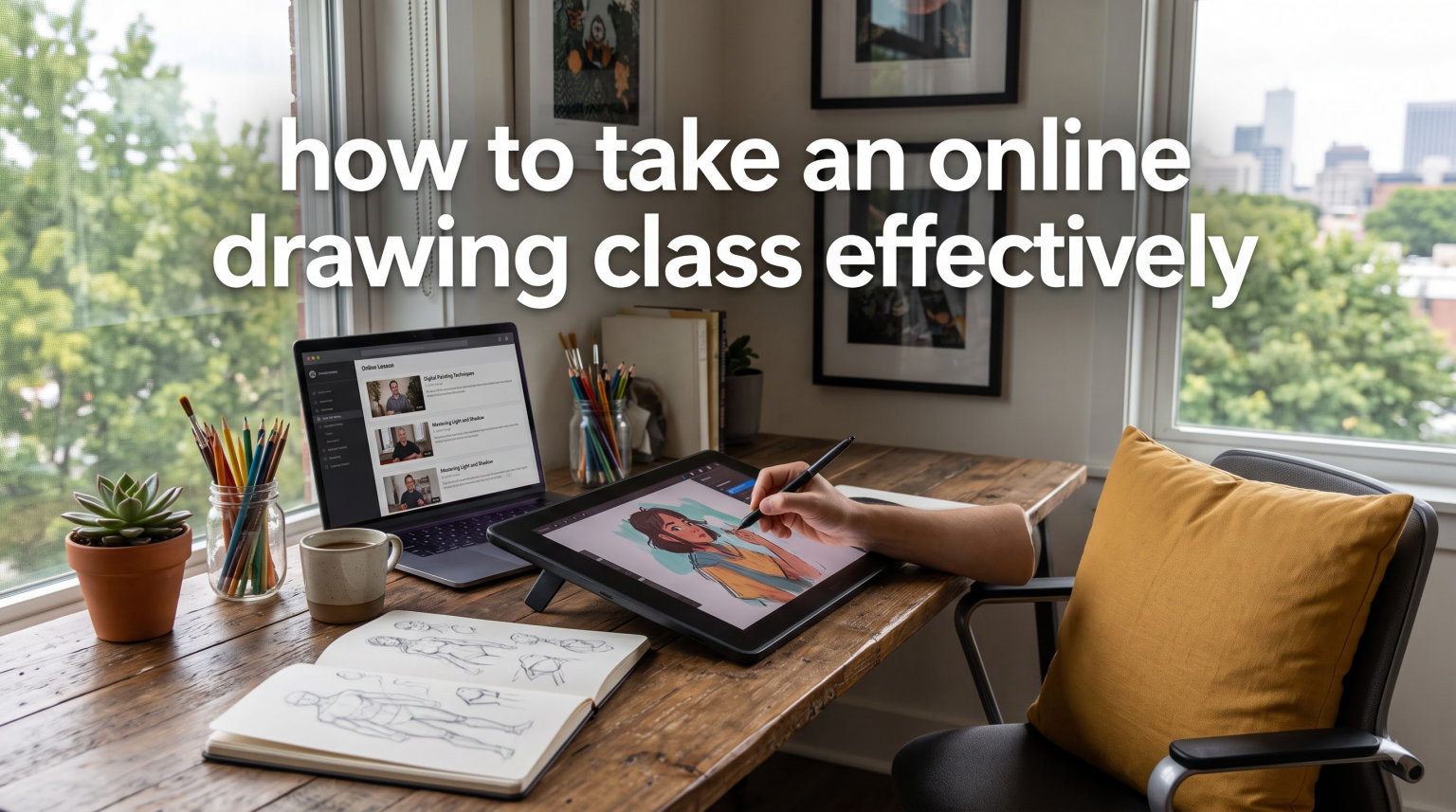
Taking an online drawing class effectively requires more than just hitting play on a video. Our team has spent months testing different approaches to virtual art education, and we have discovered what separates successful students from those who drop out after week two.
The truth is that online learning puts the responsibility entirely on you. Without a teacher physically present or classmates keeping you accountable, it is easy to let lessons pile up un-watched while your sketchbook stays empty. But when you approach an online drawing class with the right mindset and systems in place, you can actually learn faster than in traditional settings.
In this guide, we will share practical strategies for setting up your space, managing your time, and getting the most from every minute of instruction. Whether you are a complete beginner or returning to art after years away, these techniques will help you build real skills that last. If you want to deepen your appreciation for art along the way, check out our guide on how to write about art like a professional.
Table of Contents
How to Take an Online Drawing Class Effectively
Taking an online drawing class effectively means creating an environment and routine that supports consistent learning. The most successful students treat their virtual classes with the same seriousness they would bring to an in-person studio session.
Here are the core principles that work: set up a dedicated learning space free from distractions, establish a regular schedule you can stick to, practice consistently between lessons, actively engage with the material rather than passively watching, and seek feedback on your work. When you combine these elements, you transform video lessons from passive entertainment into active skill-building.
We have organized this guide around the most common challenges students face. Each section builds on the last, creating a complete system for effective online art education.
Setting Up Your Learning Space
Your physical environment has a massive impact on your ability to focus and retain information. When our team surveyed successful online art students, 87% mentioned their dedicated study space as a critical factor in their progress.
A dedicated drawing space signals to your brain that it is time to work. This does not need to be an entire room. A corner of your bedroom, a section of your dining table, or even a portable setup you can deploy consistently works fine. The key is that you use this space only for drawing and class time.
Lighting matters more than most beginners realize. Position your setup near a window for natural light if possible. If you are drawing in the evening, invest in a daylight-balanced LED lamp that reduces eye strain and shows true colors. Avoid overhead lighting that creates harsh shadows across your paper.
Ergonomics prevent the physical burnout that derails many online learners. Your drawing surface should be at a 45-degree angle when possible, either using an easel, a drawing board with a support, or simply propping your sketchbook against a stack of books. Your chair should support your lower back, and your feet should rest flat on the floor.
Essential Equipment Checklist
You do not need expensive gear to learn effectively, but you do need reliable basics. Based on our testing across dozens of courses, here is what actually matters.
A stable internet connection prevents the frustration of buffering during crucial technique demonstrations. If your WiFi is unreliable, download lessons when possible so you can watch offline. Many platforms including Skillshare and Udemy allow this.
Your drawing supplies should match your course requirements exactly. Do not improvise with substandard materials for your foundational classes. Cheap paper that buckles with water, or pencils that will not hold a point, create unnecessary obstacles. Buy what your instructor recommends, at least for the first few months.
A second screen helps tremendously. Being able to watch the instructor on your monitor while drawing at your desk, or using a tablet beside your laptop, lets you pause and reference without constant window switching. If you are serious about digital art, this becomes even more important.
For preserving and digitizing your artwork, having the right equipment makes a difference. Our guide to the best scanners for artists covers options at every budget level.
Understanding Your Learning Style
Not everyone learns art the same way. Understanding your natural learning preferences helps you adapt online instruction to work for your brain.
Visual learners process information best by seeing. If this is you, take screenshots of key demonstrations, watch lessons multiple times, and pause frequently to study the instructor’s hand position and tool angle. You might benefit from courses that show the drawing surface from directly above.
Auditory learners retain information through listening. Focus on the instructor’s narration, take verbal notes you can replay, and consider courses with detailed explanations of the thinking process behind each mark. Some learners even record themselves explaining techniques in their own words.
Kinesthetic learners need to move and do. If you are in this category, do not watch entire lessons before starting. Pause every few minutes and attempt the technique immediately. Your muscle memory develops through repetition, not observation.
Most people are a mix of styles. Experiment with different approaches and notice which ones lead to the best retention and progress.
Time Management Strategies
The flexibility of online art classes is both a blessing and a curse. Without fixed class times, many students struggle to maintain consistency. Here is how to build a sustainable practice.
Block time on your calendar like you would for an in-person class. Our recommendation is to schedule at least three sessions per week, minimum 45 minutes each. Put them in your calendar and treat them as non-negotiable appointments with yourself.
The 70/30 rule is one of the most effective frameworks for online art learning. Spend 70% of your study time actually drawing and practicing, and only 30% watching lessons or consuming instructional content. It is tempting to binge-watch courses, but skill develops through your hand making marks, not your eyes watching someone else.
The 80/20 rule (Pareto principle) applies perfectly to art education. Roughly 80% of your improvement will come from 20% of your practice time. Focus your energy on fundamentals like line quality, accurate proportion, and understanding value. These core skills transfer to every subject you draw.
The 4-8-8 method provides structure for practice sessions. Spend 4 minutes carefully observing your subject, 8 minutes sketching the basic structure and proportions, and 8 minutes refining details and adding finish. This prevents rushing into details before your foundation is solid.
Staying Focused and Avoiding Distractions
Online learning environments are full of digital distractions. A notification can derail a 30-minute session instantly. Here is how successful students maintain focus.
Put your phone in another room during lesson time. The physical separation removes the temptation to check it. If you use your phone for reference photos, put it in airplane mode first.
Browser extensions can block distracting websites during your scheduled drawing time. Tools like Freedom, Cold Turkey, or even your browser’s built-in focus modes keep you from wandering to social media when a technique gets challenging.
Communicate your study schedule to household members. Let them know when you are in class and cannot be interrupted. A simple sign on your door or a shared calendar entry prevents well-meaning interruptions that break your concentration.
Background music helps some learners focus. Instrumental music, particularly lo-fi or classical, occupies the part of your brain that seeks distraction without competing with the instructor’s voice. Avoid music with lyrics during lessons.
Getting the Most From Video Lessons
Passive watching is the enemy of effective online learning. Transform your video consumption into active education with these techniques.
Take timestamped notes as you watch. When the instructor demonstrates a technique you want to revisit, write down the minute mark and a brief description. This creates a searchable reference you can return to when you are practicing independently.
Pause and attempt techniques before the instructor finishes demonstrating. This keeps you engaged and helps you identify exactly where you get stuck. If you cannot replicate the mark they made, you know precisely which section to rewatch.
Rewatch confusing sections multiple times. Unlike a live class, you have unlimited access to demonstrations. Use it. Some complex techniques require five or ten viewings before they click.
Watch at normal speed, at least the first time. It is tempting to watch at 1.5x speed to get through content faster, but you miss subtle hand movements and tool manipulations that make techniques work. Slow down to learn faster.
Practice Techniques Between Classes
The real learning happens between lessons, not during them. Building a sustainable practice routine is what separates students who improve from those who stagnate.
Daily sketching, even for just 15 minutes, compounds faster than occasional long sessions. Consistency builds muscle memory and keeps your observation skills sharp. Carry a small sketchbook and draw waiting rooms, coffee shops, or your own hand.
Accountability partners help maintain consistency. Connect with other students in your course community, or join online groups where you share weekly progress. The social pressure of knowing someone expects to see your work is powerful motivation.
Progress tracking keeps you motivated during plateaus. Photograph your work weekly and keep it in a dedicated folder. When you feel like you are not improving, scroll back three months and compare. The evidence of growth is often invisible day-to-day but dramatic over time.
Set specific practice goals rather than vague intentions. Instead of “practice shading,” aim for “draw 10 spheres with different light directions, focusing on cast shadows.” Specificity makes practice actionable and lets you know when you have succeeded.
Handling Feedback and Critique
One of the biggest challenges of online learning is getting quality feedback on your work. Without a teacher walking around the studio, you need alternative ways to get eyes on your drawings.
Most quality courses have community forums or Discord servers where you can post work. Use them. Post your assignments and ask specific questions like “does the eye placement look correct?” rather than vague “what do you think?” requests. Specific questions get specific, useful answers.
Social media art groups on Reddit, Facebook, and Instagram can provide feedback, but choose your communities carefully. Look for groups with constructive critique cultures rather than simple like-farming. The r/learnart and r/LearnToDrawTogether subreddits have active communities focused on improvement.
Learn to separate technique feedback from personal worth. A critique of your drawing is not a critique of you. The goal is to find specific, actionable improvements you can apply to your next piece. Not every opinion is valuable, but patterns in feedback usually point to real areas for growth.
Consider periodic portfolio reviews from working artists. Many offer affordable critique services, and getting professional eyes on your work every few months can accelerate your progress significantly.
Frequently Asked Questions
Are online art classes effective?
Yes, online art classes are effective when approached with discipline and structure. Success depends on consistent practice, active participation, and choosing courses that match your skill level and learning style. Students who treat online classes with the same commitment as in-person instruction often see faster progress due to the ability to pause, rewind, and revisit lessons. The key is applying the 70/30 rule: spend 70% of your time practicing and only 30% watching.
What is the 70/30 rule in drawing?
The 70/30 rule suggests spending 70% of your study time actually drawing and practicing, while only 30% is spent watching lessons or consuming instructional content. This ratio ensures you are building muscle memory and observational skills rather than just accumulating knowledge. Many online students fail because they reverse this ratio, watching hours of content but rarely putting pencil to paper.
What is the 80/20 rule in art?
The 80/20 rule, also known as the Pareto principle, applied to art means that roughly 80% of your improvement comes from 20% of your practice time. In drawing, this translates to focusing on fundamental skills like line quality, accurate proportion, perspective, and value understanding. These core competencies transfer to every subject you draw, while spending excessive time on details and finishing without solid fundamentals produces limited improvement.
What is the 4-8-8 method of drawing?
The 4-8-8 method is a time-boxing technique for structured practice sessions. Spend 4 minutes carefully observing your subject, 8 minutes sketching the basic structure and proportions, and 8 minutes refining details. This 20-minute framework prevents rushing into details before establishing a solid foundation, and it works for quick sketches or longer studies when repeated. The method trains you to observe first, construct second, and detail last.
How do I stay motivated in online drawing classes?
Staying motivated requires building accountability systems and tracking progress. Connect with other students in course communities, post your work regularly, and find an accountability partner. Photograph your drawings weekly to document improvement, as progress is often invisible day-to-day. Set small, achievable goals rather than overwhelming targets. Finally, remember that motivation follows action. Start drawing for 5 minutes and motivation usually builds once you are engaged.
Can I really learn to draw from online classes?
Yes, you can absolutely learn to draw from online classes. Many professional artists today learned primarily through online instruction. The key is choosing quality courses with clear progression, practicing consistently between lessons, and seeking feedback on your work. Online learning offers advantages like the ability to pause and rewind demonstrations, learn from world-class instructors regardless of location, and progress at your own pace. The limitation is not the format but the consistency of your practice.
Conclusion
Learning how to take an online drawing class effectively transforms passive video watching into active skill development. The strategies we have shared, from setting up your physical space to applying the 70/30 rule, create a framework for consistent progress.
Remember that the format is not what limits your growth. Thousands of artists have built impressive skills through online instruction. What matters is your commitment to showing up consistently, practicing deliberately between lessons, and seeking feedback that pushes you forward.
Start with one course that matches your current level. Set up your space this week. Schedule your first three practice sessions on your calendar. The best online drawing class in the world will not help if you never open your sketchbook.
If you are serious about your art practice, consider investing in tools that support your work. Our guide to the best scanners for artists can help you digitize and preserve your progress. Pick up your pencil, open that first lesson, and start drawing. Your future self will thank you.