
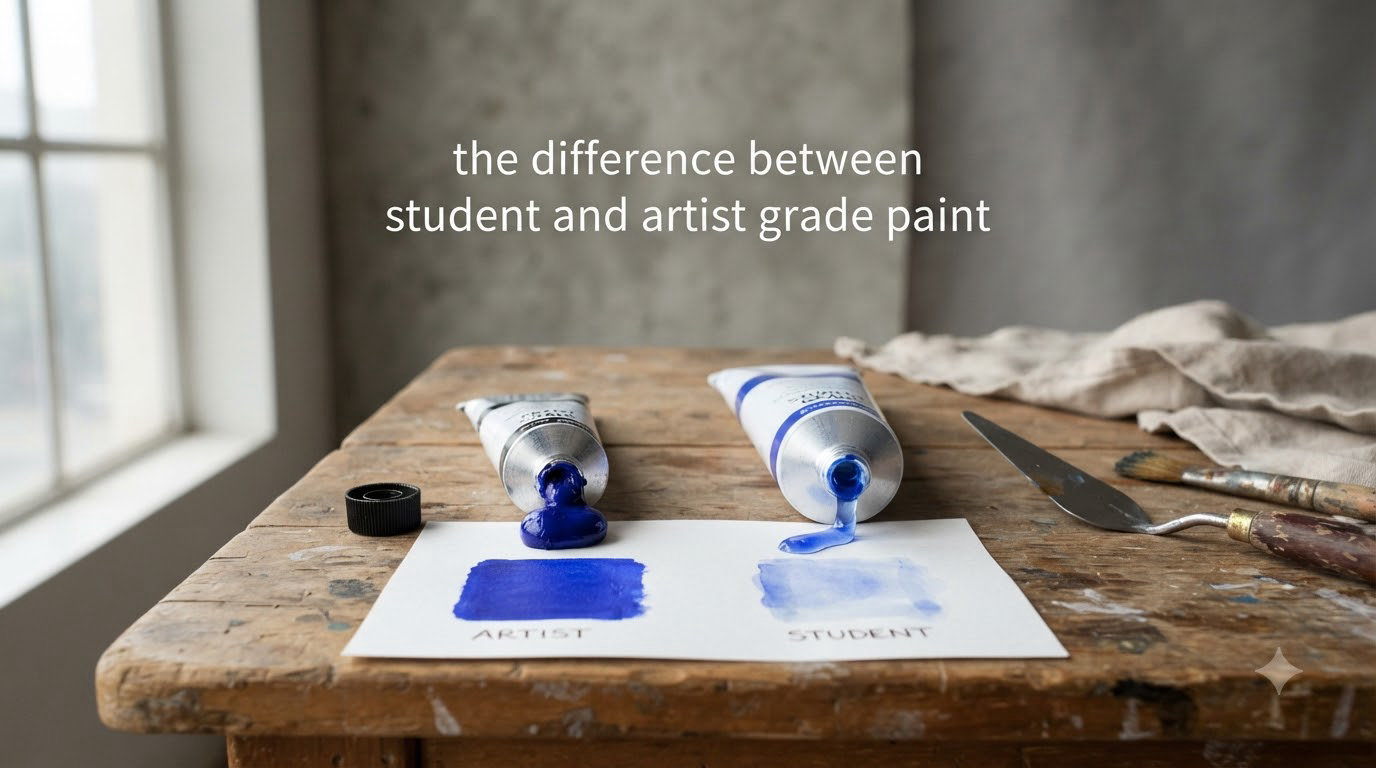
Artist grade paint contains a higher concentration of pure pigment with less filler material, while student grade paint uses more extenders and fewer expensive pigments to keep costs affordable. This fundamental difference affects everything from how vibrantly colors mix to how long your artwork will last without fading. Understanding this distinction helps you make smarter purchasing decisions whether you are just starting out or working toward professional results.
In my years testing different paint brands and talking with working artists, I have seen the same confusion play out repeatedly: artists spending money on the wrong grade, or conversely, holding back their progress with inferior materials. This guide breaks down exactly what separates these two paint grades so you can invest your art budget wisely.
Table of Contents
What Defines Paint Grades?
Paint grade classification comes down to one primary factor: the ratio of pigment to binder and filler. Manufacturers assign grades based on the quality and quantity of pigments used, which directly impacts performance characteristics.
Pigment Concentration Explained
Pigments are the colored particles that give paint its hue. They are also the most expensive ingredient in any paint formulation. Artist grade paints typically contain between 30% and 100% pure pigment by weight, depending on the specific color and brand. Student grade paints often contain as little as 10% to 30% pigment, with the remaining volume made up of cheaper extenders and fillers.
This difference explains why a single tube of cadmium red artist grade paint costs more than an entire set of student grade colors. Those expensive cadmium pigments are simply not present in the same concentration. Many experienced artists describe the distinction simply: student grade is minimum pigment in maximum medium, while artist grade reverses that formula entirely.
The Role of Binders and Fillers
Binder is the substance that holds pigment particles together and adheres them to your painting surface. In acrylic paints, this is acrylic polymer. In watercolors, it is gum arabic. In oil paints, it is typically linseed, safflower, or walnut oil. Fillers are inexpensive materials added to stretch the paint volume and reduce production costs.
Common fillers include calcium carbonate, talc, and barium sulfate. These materials add bulk but contribute little to color quality or longevity. When you use student grade paint, a portion of your brush strokes and mixing effort goes into working with these extenders rather than pure color. Artist grade paints minimize fillers, giving you more pigment power per stroke.
Key Differences Between Student and Artist Grade Paint
The pigment concentration difference creates a cascade of performance variations that affect every aspect of your painting experience.
Pigment Load Comparison
Artist grade paints deliver significantly more color impact per tube. When you mix artist grade paints, you achieve richer, more saturated hues with less effort. The higher pigment load means you use less paint to cover the same area, which paradoxically can make artist grade paints more economical over time for serious work.
Student grade paints require more paint from the tube to achieve the same color intensity. This means you consume more paint during mixing and layering. Artists frequently report that student grade tubes empty quickly because you need to apply more layers to reach desired opacity.
Forum discussions reveal a common frustration: many artists who started with student grade paints noticed dramatic improvements when switching to artist quality. One artist on Reddit described their experience as switching from “muddy confusion to crystal clear color mixing.”
Coverage and Opacity
Coverage refers to how well a paint hides what is underneath it. Higher pigment concentration in artist grade paints means better coverage with fewer strokes. A single pass of artist grade titanium white can obscure dark underlayers, while student grade may require three or four layers to achieve the same result.
Opacity varies by color within both grades. Transparent colors let light pass through them, creating luminous glazes. Opaque colors block completely. Artist grade paints offer a wider range of both opacity levels within each color line, giving artists more technical flexibility for techniques like glazing and scumbling.
The practical implication is that artist grade paints are more versatile for advanced techniques. Student grade paints work adequately for basic coverage but may struggle with sophisticated layering approaches.
Color Range and Availability
Major paint manufacturers like Winsor & Newton, Golden, and Liquitex typically offer their full pigment range only in artist grade lines. Student grade lines often include fewer total colors, and critically, they frequently omit expensive genuine pigments in favor of cheaper alternatives.
For example, genuine ultramarine blue and manganese blue are expensive pigments often missing from student lines. Instead, you might find less expensive synthetic blues that do not mix as cleanly or lack the same luminosity. This limitation affects both the colors you can achieve directly and the range of mixed colors available to you.
Artist grade lines also tend to include specialty colors like iridescent, fluorescent, and interference paints that are rarely available in student quality. If your work requires specific colors or effects, you may find student grade lines disappointingly limited.
Understanding Hue and Imitation Pigments
The term “hue” appears frequently on paint labels, especially student grade products. Understanding what this means helps you evaluate paint quality at a glance.
What “Hue” Means on Labels
When a paint label says “Hue,” it means the color is an imitation of the named pigment rather than the genuine article. For example, “Cadmium Red Hue” contains no actual cadmium pigment. Instead, it uses less expensive pigments to approximate the color of genuine cadmium red.
Manufacturers create hues because some traditional pigments are toxic (cadmium and lead pigments), environmentally restricted, or prohibitively expensive. A hue version allows students and artists to work with colors inspired by these pigments safely and affordably.
The quality of hues varies dramatically. Some modern hues match their genuine counterparts remarkably well. Others fall short in mixing behavior, lightfastness, or color intensity. Artist grade paints typically use genuine pigments, while student grade may rely more heavily on hues to keep costs down.
When Hue Matters
For beginners learning color mixing, hues perform adequately as learning tools. You can practice color theory concepts without investing in expensive genuine pigments. However, as your skills advance, you may notice that hues do not behave quite like the real thing in mixing scenarios.
Some specific situations where genuine pigments make a meaningful difference include portrait skin tones, landscape greens, and any work where color accuracy matters critically. Professional artists often insist on genuine pigments for these challenging color families.
That said, many artist grade colors are also hues. Expensive pigments like terre verte and yellow ochre have hue versions even in professional lines because the genuine pigments are scarce. The key difference is that artist grade hues use higher-quality base pigments and more precise formulation, resulting in better performance than student grade imitations.
Color Shift and Tinting Strength
Two characteristics that separate paint grades most noticeably in practice are color shift and tinting strength.
Wet to Dry Color Shift
Almost all paints change color when they dry. Pigments settle differently as binder absorbed into the painting surface changes the light refraction. The degree of this shift varies significantly between grades.
Student grade paints often exhibit more dramatic color shifts because the higher filler content interacts differently with the painting surface. That bright blue you mixed might dry noticeably grayer or duller than expected, requiring adjustments as you work.
Artist grade paints generally maintain more consistency between wet and dry states. While some shift still occurs, it tends to be less extreme and more predictable. This consistency makes planning and executing color-sensitive work much more manageable.
For watercolor artists especially, color shift affects how you judge your work mid-process. Many watercolorists insist on artist grade precisely because the wet-to-dry predictability allows proper evaluation while painting.
Tinting and Mixing Behavior
Tinting strength describes how effectively a color changes other colors when mixed together. Higher pigment concentration gives artist grade paints greater tinting power. A small amount of artist grade phthalocyanine blue will shift a large amount of yellow toward green more dramatically than the same amount of student grade paint.
This matters for two reasons. First, you achieve more vibrant mixed colors with artist grade paints. Second, you develop better color intuition because the results are more predictable. Student grade paints can produce muddy results more easily because the higher filler content dilutes the color interaction during mixing.
Artists frequently report that color mixing becomes more intuitive and enjoyable with artist grade paints. The feedback is cleaner, and you spend less time compensating for weak pigment performance.
Series Pricing Explained
If you have browsed artist grade paint selections, you have noticed that colors are organized into series with different price points. Understanding this system helps you budget strategically.
How Paint Series Work
Manufacturers assign each color a series number based on the cost of its pigments. Series 1 contains the least expensive pigments, while Series 6 or 7 contains the most expensive ones. Genuine cadmiums, cobalts, and other scarce pigments typically occupy the highest series numbers.
When purchasing artist grade paints, you pay significantly more for Series 5-7 colors regardless of brand. A single tube of Series 7 cadmium red might cost five times as much as a Series 1 color from the same manufacturer. This pricing reflects the actual pigment costs rather than any quality difference.
Student grade paints typically do not use the series system because they rely more heavily on inexpensive synthetic pigments regardless of what they are imitating.
Budget Implications
The series system allows strategic purchasing. You can build a functional artist grade palette by investing in Series 1-3 colors (which cover many basic needs adequately) while reserving your budget for higher-series colors only where you need specific expensive pigments.
Some artists recommend this approach for beginners investing in artist grade: start with basic colors across all series, then upgrade specific colors as you identify your needs through experience. This prevents overspending on expensive pigments you may not use frequently.
The student grade alternative offers lower upfront costs but does not scale as effectively for serious work. Many artists find they eventually replace their student grade purchases with artist grade equivalents, effectively spending more overall than if they had started with artist quality.
Lightfastness and Archival Quality
Lightfastness describes how resistant a paint is to fading when exposed to light over time. This characteristic significantly impacts whether your artwork will remain vibrant for decades or begin fading within years.
What is Lightfastness?
Manufacturers test lightfastness by exposing paint samples to controlled UV light and measuring color change over time. Results are typically rated on a scale from I (excellent, will last 100+ years) to III or IV (will fade noticeably within decades).
Professional and artist grade paints normally include lightfastness ratings on their labels. Student grade paints sometimes omit these ratings or include only minimum-quality pigments that may not meet archival standards.
ASTM D4236 is the standard in the United States for chronic health hazards in art materials. Lightfastness testing is separate but equally important for longevity. Look for the lightfastness rating symbol on paint tubes to assess archival potential.
Student vs Artist Longevity
Artist grade paints generally offer better lightfastness because they use higher-quality pigments that have been tested and rated. Many student grade pigments, particularly in hue versions, may only achieve “fair” lightfastness ratings.
This matters enormously if you create artwork for sale, gifts, or personal keepsakes. A painting created with fugitive student grade pigments might look beautiful initially but fade significantly within a decade, especially in bright lighting conditions.
For practice work and studies where longevity is unimportant, student grade lightfastness limitations are irrelevant. However, any work you want to preserve or display should ideally use pigments rated I or II for archival quality.
Which Paint Grade Should You Buy?
The right answer depends on your situation, goals, and budget. Here is practical guidance for different scenarios.
For Absolute Beginners
If you are completely new to painting, student grade supplies offer a reasonable starting point. The lower investment allows you to explore whether painting appeals to you without committing significant money to supplies you might abandon. Focus your limited budget on a few primary colors rather than an extensive set.
However, consider investing in at least one artist grade color even as a beginner: titanium white. This workhorse color appears in almost every painting, and the quality difference in your whites noticeably affects your results. Better whites make everything else look better by comparison.
Many experienced artists recommend buying the best white you can afford from the start. Student grade titanium white contains less pigment and more filler, resulting in weaker coverage and a less brilliant finish.
For Advancing Artists
As your skills develop and you begin caring more about color mixing and technique, transitioning to artist grade becomes worthwhile. Your color intuition develops better when pigments behave predictably and vibrantly.
Consider upgrading your most-used colors first. If you paint lots of landscapes, your greens and blues matter most. If you paint portraits, skin tone capability drives your palette decisions. Identify which colors you use constantly and invest in artist grade versions of those.
Forum discussions reveal a common pattern: artists who made the switch rarely return to student grade for their primary work. The improvement in color mixing and overall painting experience typically outweighs the cost increase for serious practitioners.
For Professional Artists
Professional work demands artist grade materials for several reasons. Client expectations require archival quality that will last. The technical demands of professional work require predictable pigment performance. Your reputation depends on finished pieces looking exactly as intended years later.
Professionals often maintain extensive palettes with many high-series pigments. They also tend to buy in larger quantities (37ml, 50ml, or fullpan sizes) to reduce per-unit costs. Establishing relationships with art supply retailers can provide access to professional discounts.
Frequently Asked Questions
What is the difference between artist grade and student grade paint?
Artist grade paint contains a higher concentration of pure pigment with less filler material, while student grade paint uses more extenders and fewer expensive pigments to keep costs lower. This results in better color vibrancy, coverage, lightfastness, and color mixing predictability in artist grade paints.
What is the difference between student and artist watercolor paint?
The difference is the same as with other paint types: artist grade watercolor contains more pigment concentration and less gum arabic filler than student grade. This means richer colors, better transparency control, less color shift when drying, and superior lightfastness for archival work.
What is student grade acrylic paint?
Student grade acrylic paint is an affordable acrylic paint formulation with lower pigment concentration and more acrylic polymer filler than artist grade alternatives. It is designed for beginners and practice work, offering adequate coverage for basic techniques but limited suitability for advanced or archival work.
Is Van Gogh oil paint artist grade?
Van Gogh oil paints are generally considered student to artist grade quality. They offer good pigment load and lightfastness ratings at a mid-range price point, making them a popular choice for serious students and emerging artists transitioning from beginner supplies.
What is the 70/30 rule in art?
The 70/30 rule is a budgeting guideline suggesting artists invest roughly 70% of their art supply budget on quality pigments and paints, with only 30% going toward brushes and other tools. The reasoning is that paint quality affects every aspect of the finished artwork more directly than brush quality.
Conclusion
The difference between student and artist grade paint comes down to pigment concentration, filler content, and resulting performance characteristics. Artist grade paints deliver more vibrant colors, better coverage, less color shift, stronger tinting power, and superior lightfastness. Student grade paints offer affordability and adequate performance for learning and practice work.
For beginners, starting with student grade supplies makes financial sense while you develop your interest. As your skills grow, transitioning to artist grade colors gradually will noticeably improve your work and color mixing intuition. Professional artists need artist grade materials to meet client expectations and archival standards. Whatever your level, investing thoughtfully in your paints pays dividends in the quality of your finished artwork.