
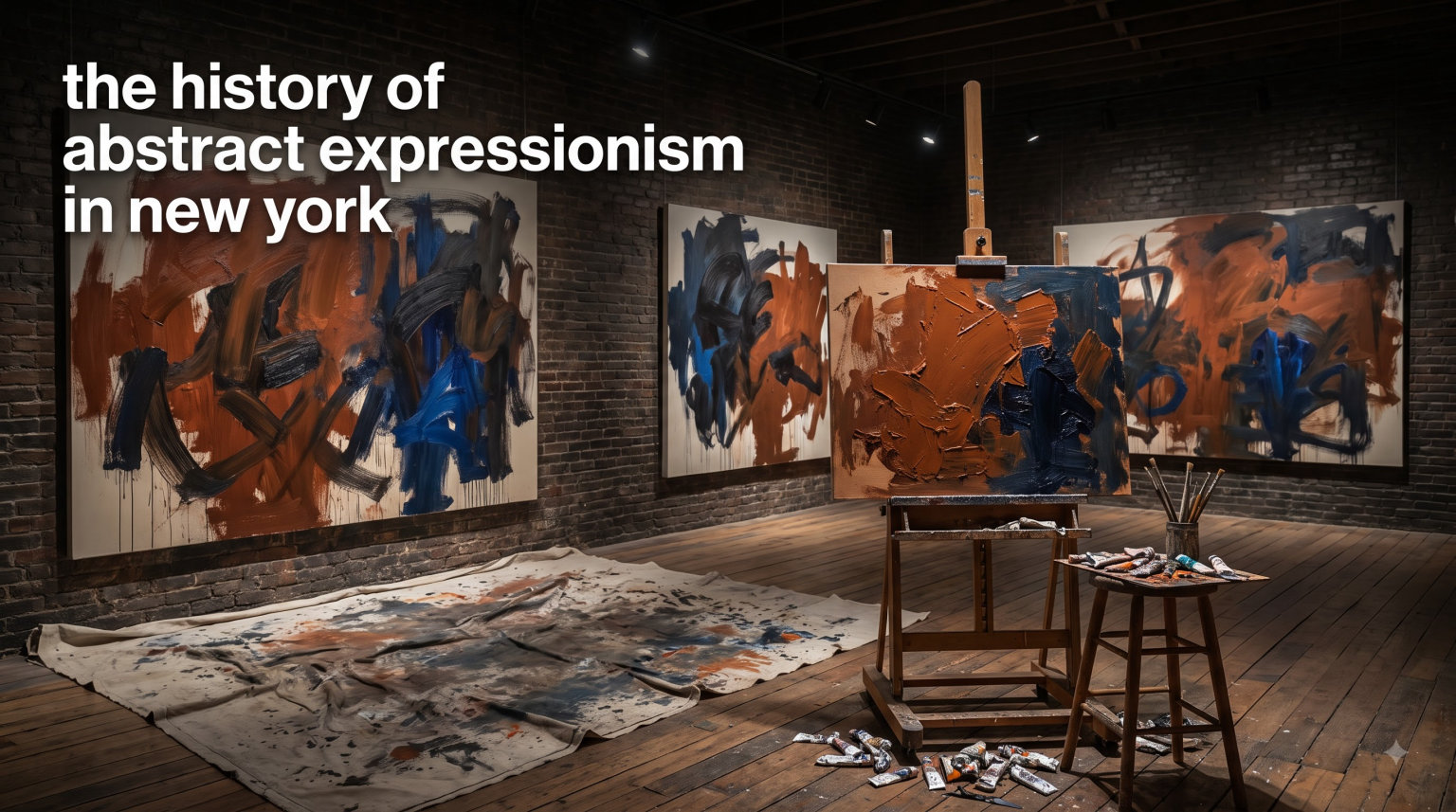
I remember standing before my first Jackson Pollock at the Museum of Modern Art and feeling completely lost. The canvas was enormous, covered in what looked like random drips and splatters, and I could not understand why it mattered. But that was before I learned about the history of Abstract Expressionism in New York and how this movement changed everything we think about art.
Abstract Expressionism was not just a style. It was a revolution that shifted the entire art world from Paris to New York City in the years following World War II. For centuries, European artists had set the standards for what fine art should be. Then, almost overnight, American painters took the lead. They rejected traditional representation and instead poured their raw emotions onto canvas through bold gestures, massive scales, and unprecedented techniques. Modern art movements like Abstract Expressionism showed us that art could be about process and feeling rather than recognizable subjects.
In this guide, I will walk you through exactly how this happened. You will learn why New York became the new art capital, who the key players were, and what made their work so groundbreaking. By the end, you will understand why those seemingly simple drips and color fields represented one of the most significant shifts in art history.
Table of Contents
The History of Abstract Expressionism in New York: From Paris to the Big Apple
The history of Abstract Expressionism in New York begins with a dramatic shift in the global art landscape. Before the 1940s, Paris had been the undisputed center of the art world for over two centuries. French artists set the trends, and American painters largely followed their lead. Everything changed with World War II.
As Nazi Germany occupied France, many European artists fled to the United States. Surrealists like Andre Breton, Max Ernst, and Yves Tanguy found refuge in New York City. They brought with them revolutionary ideas about the subconscious, automatism, and psychological expression. These European emigres would profoundly influence a generation of American artists who were hungry for something new.
Meanwhile, the United States government had been investing in American art through the Works Progress Administration during the Great Depression. The WPA provided employment for struggling artists and created an infrastructure for art education and production that had not existed before. Young painters like Jackson Pollock, Willem de Kooning, and Mark Rothko received crucial support during these years.
By the time the war ended, New York was positioned to replace Paris. The European avant-garde was in disarray, and American artists had spent years developing their own voice. What emerged was something entirely new: a movement that combined European modernist techniques with distinctly American energy and scale. The New York School, as it became known, would dominate the art world for the next two decades.
What Is Abstract Expressionism?
Abstract Expressionism was a post-World War II art movement characterized by large-scale, non-representational paintings that emphasized spontaneous, emotional expression. The term itself was coined in 1946 by critic Robert Coates, writing for The New Yorker, to describe the work of Hans Hofmann. It stuck because it captured the dual nature of the movement: abstract forms combined with expressive intent.
Several key characteristics define Abstract Expressionist work. First is the emphasis on spontaneity and improvisation. Artists wanted to capture the moment of creation, channeling their subconscious directly onto the canvas. Second is the monumental scale. These were not intimate paintings meant for private contemplation. They were massive works that enveloped the viewer, creating an immersive experience. Third is the focus on process over product. The act of painting itself became the subject, with brushstrokes, drips, and gestures documenting the artist’s physical and emotional journey.
The movement rejected traditional representational art entirely. No more portraits, landscapes, or still lifes. Instead, artists sought to express universal human emotions through pure form, color, and gesture. This was art as direct communication between the artist’s inner world and the viewer’s psyche.
Surrealist Influences and Automatism
The Surrealist refugees who fled to New York brought with them a concept that would prove transformative: automatism. This technique involved creating art without conscious thought, allowing the hand to move freely across the canvas while the mind remained in a kind of waking dream state. The Surrealists believed this process tapped into the subconscious mind, revealing truths that rational thinking concealed.
Andre Breton, the Surrealist manifesto author, defined automatism as “pure psychic automatism by which one proposes to express, either verbally, in writing, or by any other manner, the real functioning of thought.” American artists adapted this concept, but they stripped away Surrealism’s dream imagery and symbolic content. What remained was the emphasis on spontaneous gesture and subconscious expression.
Another significant influence was Carl Jung’s theory of the collective unconscious. Many Abstract Expressionists were fascinated by Jung’s idea that all humans share a deep reservoir of universal symbols and archetypes. Artists like Pollock and Rothko incorporated mythological and primitive imagery into their early work, seeking to access these primal, universal aspects of human experience.
Two Streams of Abstract Expressionism: Action Painting vs Color Field
The movement was never monolithic. Art historians generally divide Abstract Expressionism into two major streams: Action Painting and Color Field painting. Each represented a different approach to the problem of non-representational art.
Action Painting, championed by critic Harold Rosenberg, emphasized the physical act of painting itself. The canvas became an arena in which to act, and every brushstroke, drip, and gesture recorded the artist’s presence and movement. Jackson Pollock’s drip technique is the most famous example, but Willem de Kooning’s aggressive brushwork and Franz Kline’s bold black strokes also exemplify this approach. The finished painting was less important than the process that created it.
Color Field painting, associated with critic Clement Greenberg, took a different approach. Artists like Mark Rothko, Barnett Newman, and Clyfford Still created vast fields of color intended to produce a contemplative, almost spiritual response in viewers. Rothko famously said he wanted viewers to experience his paintings as “a sudden sense of shock or recognition.” These works referenced the concept of the sublime, evoking emotions too vast for words through carefully modulated color relationships.
While these two approaches seem different, they shared fundamental goals. Both rejected recognizable subject matter. Both emphasized emotional and psychological content over formal considerations. And both asserted the artist’s freedom to create without following any rules or conventions.
The Key Artists Who Defined Abstract Expressionism
Jackson Pollock: The Face of Action Painting
No artist embodies Abstract Expressionism more completely than Jackson Pollock. Born in Wyoming in 1912, Pollock moved to New York in 1930 and studied under regionalist painter Thomas Hart Benton before discovering European modernism and Surrealist automatism. By the late 1940s, he had developed his signature drip technique.
Pollock placed his canvases on the floor and walked around them, dripping and pouring paint from sticks, brushes, and directly from the can. This method, which he called “action painting,” eliminated the traditional gap between artist and canvas. The artist’s entire body became involved in the creative act, and the resulting webs of paint recorded every movement.
His work caused immediate controversy. Critics either hailed him as a genius or dismissed him as a fraud. Life magazine famously asked in 1949, “Is he the greatest living painter in the United States?” The photograph of Pollock standing before one of his drip paintings made him an instant celebrity, and his work became synonymous with the entire movement.
Willem de Kooning: Between Figuration and Abstraction
Willem de Kooning arrived in the United States as a stowaway from the Netherlands in 1926. He spent decades working odd jobs while painting at night, sharing a studio with Arshile Gorky and absorbing influences from Picasso, Miro, and the Surrealists. Unlike Pollock, de Kooning never fully abandoned figuration.
His famous “Women” series, begun in the early 1950s, featured aggressive, semi-abstract female figures that scandalized the art world. Critics argued that these paintings betrayed the movement’s principles by returning to recognizable subject matter. De Kooning defended his choice, arguing that he was not painting women but “the idea of woman.”
His brushwork was ferocious, with thick layers of paint slashed and scraped across the canvas. Where Pollock’s drips seemed spontaneous and ethereal, de Kooning’s marks were muscular and confrontational. He remained a central figure in the New York art scene until his death in 1997.
Mark Rothko: Master of Color Field
Mark Rothko’s mature work consists of soft-edged rectangles of color floating on vast canvases. Born Marcus Rothkowitz in Russia in 1903, he immigrated to the United States as a child and began painting representational scenes before gradually moving toward abstraction. By 1949, he had developed the style that would define his career.
Rothko believed his paintings were portals to spiritual experience. He wanted viewers to stand close to his large canvases so that the colors would envelop their peripheral vision and trigger emotional responses. “I’m not an abstractionist,” he once said. “I’m not interested in the relationship of color or form or anything else. I’m interested only in expressing basic human emotions: tragedy, ecstasy, doom, and so on.”
His use of the sublime, borrowed from philosopher Edmund Burke, aimed to overwhelm viewers with emotion. The paintings seem simple but require extended contemplation. Colors shift and pulse as you look at them, creating a meditative, almost religious experience. Rothko committed suicide in 1970, but his work continues to command some of the highest prices in the art market.
Lee Krasner: The Overlooked Pioneer
Lee Krasner was a major figure in her own right, though she has often been overshadowed by her husband, Jackson Pollock. Born in Brooklyn in 1908, she studied at Cooper Union and the National Academy of Design before finding her way to the avant-garde scene. She was one of the few women to achieve recognition in the male-dominated New York School.
Krasner worked in both gestural and color field modes, sometimes combining elements of both. Her “Little Images” series from the late 1940s featured intricate, repetitive marks that resembled hieroglyphics. After Pollock’s death in 1956, she returned to painting with renewed energy, creating some of her most powerful work.
She was a fierce advocate for Abstract Expressionism and helped organize exhibitions that promoted the movement. Yet art historians and collectors largely ignored her during her lifetime. Recognition of her contributions has grown significantly since her death in 1984, with major retrospectives establishing her place in the canon.
Barnett Newman: The Zip Painter
Barnett Newman developed one of the most distinctive styles in Abstract Expressionism. His mature paintings feature vast fields of pure color interrupted by vertical lines he called “zips.” These zips divide the canvas into distinct zones while maintaining a unified whole. Newman saw his work as modern equivalents to religious art, creating a sense of the sublime through simplicity.
Newman was also an important writer and theorist. His essay “The Sublime is Now,” published in 1948, argued that modern art could achieve the same spiritual power as Gothic cathedrals or ancient monuments. He believed that by stripping away all narrative and representation, abstract art could confront viewers with the infinite directly.
Clyfford Still: Isolation and Vision
Clyfford Still pursued a unique path within Abstract Expressionism. Born in North Dakota in 1904, he spent years teaching in California before moving to New York in 1950. His work featured jagged forms of bold color that seemed to tear across the canvas. Still was notoriously reclusive and withdrew from the New York art scene in 1961, moving to Maryland and refusing to allow his work to travel.
He believed that most galleries and collectors misunderstood his work. His paintings were meant to be confrontational, even aggressive. He wanted viewers to feel uncomfortable, to recognize the dark aspects of human existence alongside moments of transcendence. The Clyfford Still Museum in Denver now houses nearly 95 percent of his total output.
New York’s Artistic Infrastructure: The Social Scene Behind the Movement
Abstract Expressionism did not emerge in a vacuum. New York provided the perfect environment for this revolution, with institutions, galleries, and social spaces that supported experimental art. Galleries in New York that showed Abstract Expressionist works played a crucial role in promoting these artists when traditional venues rejected them.
The Museum of Modern Art, under director Alfred H. Barr Jr., was instrumental in legitimizing the movement. MoMA acquired works by Pollock, Rothko, and others, giving them institutional credibility. The museum’s exhibitions introduced European modernism to American audiences while simultaneously promoting American innovation.
The Cedar Tavern in Greenwich Village became the unofficial headquarters of the Abstract Expressionist community. Artists gathered there nightly to argue about art, politics, and philosophy. Heavy drinking was common, and legendary fights sometimes broke out. But the tavern also fostered creative exchange. Ideas developed over beers would appear in paintings months later.
Betty Parsons Gallery, opened in 1946, gave many Abstract Expressionists their first solo shows. Parsons believed in the work deeply and supported artists financially during lean periods. Other important galleries included Samuel Kootz, Charles Egan, and Stable Gallery. These venues created a market for work that most collectors initially dismissed as incomprehensible.
Critics like Clement Greenberg and Harold Rosenberg wrote passionate defenses of the movement in Partisan Review and other publications. Their essays shaped how the public understood Abstract Expressionism, creating critical frameworks that still influence art history today.
Underrepresented Voices: Women and Artists of Color
The traditional narrative of Abstract Expressionism focuses on white male artists, but the movement was more diverse than commonly acknowledged. Women artists faced significant barriers in the sexist art world of the 1940s and 1950s, yet several made major contributions. Lee Krasner was joined by Elaine de Kooning, Grace Hartigan, Joan Mitchell, and Helen Frankenthaler, among others.
Elaine de Kooning, married to Willem, maintained a distinct practice while writing art criticism to support the couple. Her portraits of President John F. Kennedy brought her national recognition. Helen Frankenthaler pioneered the “soak-stain” technique, pouring thinned paint directly onto unprimed canvas. This method influenced an entire generation of Color Field painters.
African American artists also participated in the movement, though they received little recognition at the time. Norman Lewis developed an abstract style influenced by jazz music and African art. His work combined gestural energy with social consciousness. Other Black artists including Ed Clark, Alma Thomas, and Beauford Delaney created important work within the Abstract Expressionist framework.
The marginalization of these artists had lasting consequences. Their work was excluded from major exhibitions and collections, and their prices lagged far behind their white male counterparts. Today, museums and scholars are working to recover these overlooked contributions and present a more complete picture of the movement.
The Legacy of Abstract Expressionism
By the mid-1950s, Abstract Expressionism had achieved dominant status in the art world. Museums collected it, galleries sold it, and art schools taught it. But dominance brought criticism. Younger artists began to rebel against what they saw as the movement’s excesses. Pop Art, Minimalism, and Conceptual Art all emerged partly in opposition to Abstract Expressionist principles.
Yet the movement’s influence proved impossible to escape. Every subsequent American art movement has had to engage with Abstract Expressionism, whether building on its ideas or rejecting them. Pop Art borrowed its scale and ambition. Minimalism extended its interest in pure form. Even artists who returned to figuration, like Philip Pearlstein or Alex Katz, worked in the shadow of the New York School.
Internationally, Abstract Expressionism established American art as a force to be reckoned with. European artists had to respond to New York, reversing centuries of influence. The movement also played a role in Cold War cultural politics, with the CIA secretly promoting Abstract Expressionism as evidence of American freedom and creativity.
Today, the major works command astronomical prices at auction. Rothko’s “Orange, Red, Yellow” sold for $86.9 million in 2012. Pollock’s “Number 17A” reportedly sold for $200 million in a private sale in 2015. These prices reflect not just market speculation but genuine recognition of the movement’s historical importance.
Frequently Asked Questions
What is Abstract Expressionism?
Abstract Expressionism was a post-World War II art movement that emerged in New York in the 1940s. It is characterized by large-scale, non-representational paintings that emphasize spontaneous, emotional expression through gestural brushwork or vast color fields. The movement shifted the art world’s center from Paris to New York and included artists like Jackson Pollock, Mark Rothko, and Willem de Kooning.
Who started Abstract Expressionism?
Abstract Expressionism was not started by a single person but emerged from a group of artists working in New York during the 1940s. Key figures include Jackson Pollock, Willem de Kooning, Mark Rothko, Barnett Newman, and Clyfford Still. The term was coined in 1946 by critic Robert Coates to describe the work of Hans Hofmann. European emigre artists, particularly the Surrealists who fled to New York during World War II, significantly influenced the movement’s development.
Why did Abstract Expressionism develop in New York?
Abstract Expressionism developed in New York due to several factors: the emigration of European artists during World War II, particularly Surrealists who brought ideas about automatism and the subconscious; the Works Progress Administration programs that supported American artists during the Depression; the exposure of American artists to European modernism; and New York’s emergence as the new art capital after Paris lost its dominance during the war.
What is the difference between action painting and color field painting?
Action painting emphasizes the physical act of painting itself, with visible brushstrokes, drips, and gestures recording the artist’s movements. Jackson Pollock and Willem de Kooning are the most famous action painters. Color field painting features large areas of flat, solid color intended to produce contemplative or spiritual responses. Mark Rothko, Barnett Newman, and Clyfford Still are key color field artists. While action painting focuses on process and energy, color field painting emphasizes mood and meditation.
What is the legacy of Abstract Expressionism?
Abstract Expressionism shifted the center of the art world from Europe to America, establishing New York as the new art capital. It influenced every subsequent art movement, including Pop Art, Minimalism, and Conceptual Art. The movement established the value of individual expression and artistic freedom, and its major works now command some of the highest prices in the art market. u003ca href=u0022https://www.thebrucehighqualityfoundation.com/what-is-contemporary-art/u0022u003eAbstract Expressionism’s influence on contemporary artu003c/au003e remains significant even today.
Conclusion
The history of Abstract Expressionism in New York represents one of the most significant shifts in art history. What began as a small group of experimental painters working in downtown lofts transformed into a movement that would reshape global culture. These artists proved that American art could lead rather than follow, that abstraction could convey profound emotion, and that the act of creation mattered as much as the finished product.
Walking through a museum today, you can see the legacy everywhere. Contemporary artists still grapple with questions that Pollock, Rothko, and de Kooning posed decades ago. How do we express the inexpressible? What is the relationship between the artist and the work? Can pure form communicate universal human experience?
If you ever find yourself standing before a massive canvas of drips or color fields feeling confused, remember that you are participating in a dialogue that began in 1940s New York. The history of Abstract Expressionism is not just about paintings. It is about the moment when American artists stopped looking to Europe for permission and started creating something entirely their own.