
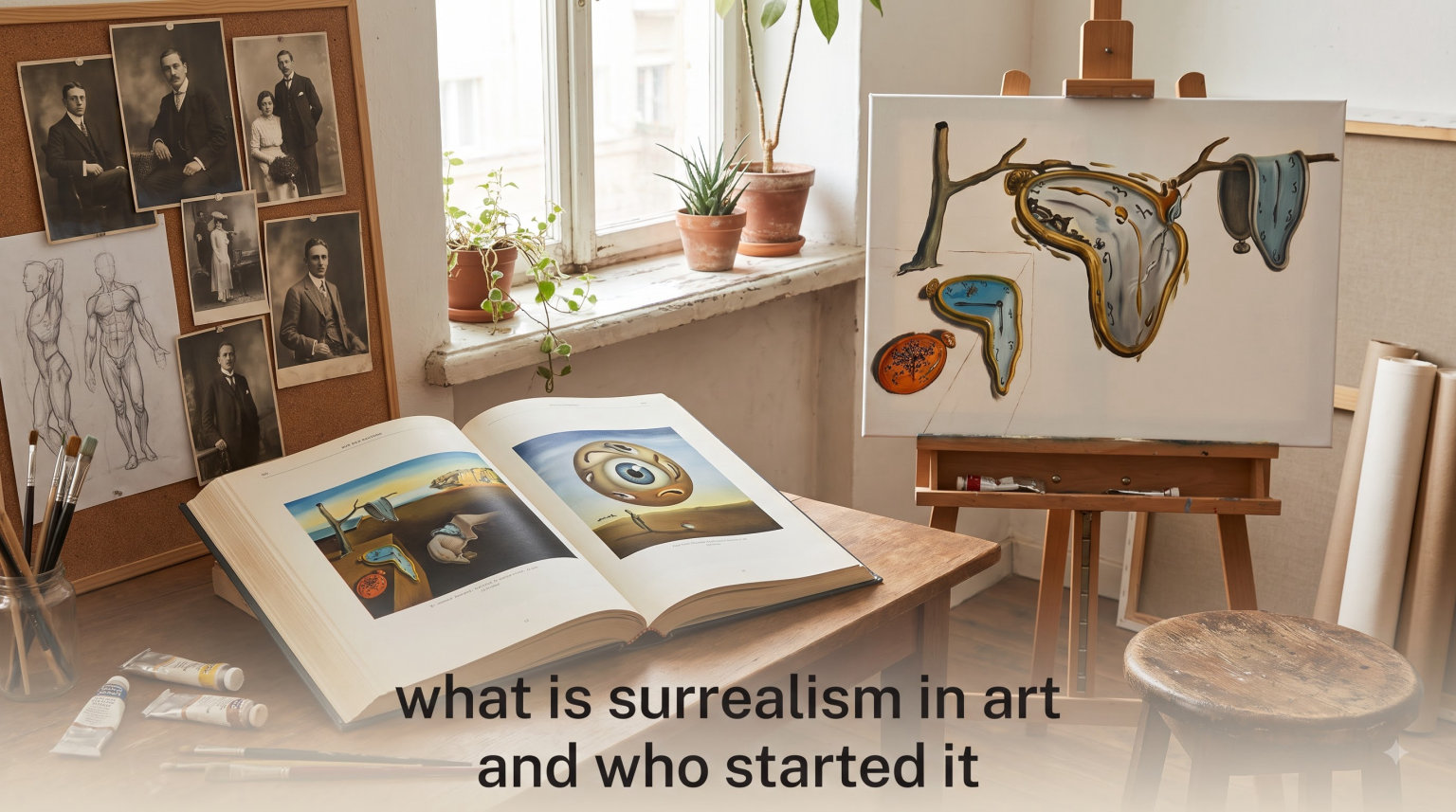
Surrealism was a 20th-century avant-garde art and literature movement that sought to release the creative potential of the unconscious mind through dreamlike, irrational imagery. Founded by French poet Andre Breton in Paris in 1924 with the publication of his Surrealist Manifesto, the movement represented a revolutionary break from rational art traditions, drawing inspiration from Sigmund Freud’s theories on dreams and the unconscious mind. Surrealism would go on to profoundly influence modern art, film, photography, and popular culture.
The movement emerged from the ashes of World War I and grew directly from the earlier Dada movement, which had rejected rationalism and traditional artistic conventions. Where Dada embraced chaos and nihilism, Surrealism channeled this energy toward exploring the deeper realms of the human psyche, seeking to unlock the imagination through what Breton called “psychic automatism”—a method of accessing the unconscious mind through spontaneous creation.
The Origins of Surrealism: From Dada to the 1924 Manifesto
From Dada to Surrealism
Surrealism did not emerge in a vacuum. It grew principally out of the earlier Dada movement, which originated during World War I in Zurich around 1916. Dadaists like Tristan Tzara, Hugo Ball, and Jean Arp reacted to the absurdity and destruction of the war by rejecting conventional aesthetics, logic, and reason itself. They created art that intentionally defied interpretation—collages, readymades, and performances that challenged what art could be.
When the war ended, many Dadaists sought a more constructive approach to their anti-rational philosophy. In Paris, poet Andre Breton began organizing these scattered avant-garde energies into something more structured. Between 1920 and 1924, Breton worked with former Dadaists including Louis Aragon, Paul Eluard, and Philippe Soupault, developing theories about the relationship between the unconscious mind and creative expression.
The connection to Dada was essential: both movements rejected the rationalist traditions that had led to the devastation of World War I. But where Dada stopped at destruction, Surrealism pushed forward into exploration—using the irrational not as an end in itself, but as a doorway to the deeper self.
Andre Breton and the 1924 Manifesto
Andre Breton (1896-1966), a French poet and writer, is universally recognized as the founder of Surrealism. On October 4, 1924, he published Manifesto of Surrealism (also known as First Surrealist Manifesto), which formally established the movement’s principles, goals, and methods.
In the manifesto, Breton defined Surrealism as “psychic automatism in its pure state, by which one proposes to express—verbally, by means of the written word, or in any other manner—the actual functioning of thought. Dictated by thought, in the absence of any control exercised by reason, exempt from any aesthetic or moral concern.”
Breton established the Surrealist movement in Paris, drawing together writers, poets, and artists who shared his interest in accessing the unconscious through automatic creation. The movement quickly spread beyond France to become an international phenomenon, with groups forming in Belgium, the United States, Spain, and beyond.
While the term “Surrealism” was first used by Guillaume Apollinaire in 1917, it was Breton’s manifesto that gave the movement its conceptual foundation and organizational structure. Breton would go on to publish a second manifesto in 1929 and remained the movement’s primary theorist throughout its peak years of the 1930s and 1940s.
Freud and the Unconscious Mind
No influence on Surrealism was more profound than the work of Austrian neurologist Sigmund Freud (1856-1939), particularly his theories on dreams, the unconscious, and the interpretation of dreams. Freud’s groundbreaking work The Interpretation of Dreams (1900) proposed that dreams were windows into the unconscious mind—a realm where repressed desires, fears, and memories lived, free from the rational constraints of waking life.
Surrealists embraced Freud’s concept that the unconscious mind held creative potential that rational thought suppressed. They believed that by accessing this deeper realm through dreams, automatic writing, and similar techniques, artists could unlock imagery and ideas that bypassed conventional thinking.
The concept of “psychic automatism” became central to Surrealist practice—allowing the conscious mind to step aside and let the unconscious direct creation. This could manifest in automatic writing (writing without conscious direction), automatic drawing, or creating works inspired directly by dream imagery rather than deliberate composition.
Freud’s discussions of the “uncanny”—experiences that feel simultaneously familiar and strange—also resonated with Surrealists, who often created works that challenged viewers to question their perceptions of reality. The Surrealists’ interest extended beyond Freud to other psychoanalytic thinkers, including Carl Jung’s ideas about archetypes and the collective unconscious.
Key Characteristics of Surrealism
Dreamlike Imagery and the Irrational
The most recognizable characteristic of Surrealist art is its dreamlike quality—scenes that feel like fragments from dreams or the subconscious mind rather than waking reality. These works often feature impossible objects, scale distortions, and combinations of elements that defy logical explanation. A melting clock hangs from a branch; a face appears in an ordinary household object; a figure transforms into something else before your eyes.
This irrational imagery was deliberate. Surrealists sought to bypass the rational mind by presenting scenes that could not be easily processed or categorized. This “defamiliarization” forces viewers to engage with art on a deeper, more emotional level, moving beyond surface aesthetics to tap into the subconscious resonances that dreams and fantasy evoke.
The irrational also served a philosophical purpose: Surrealists wanted to demonstrate that rational thought was not the only—or even the best—path to truth. By embracing the illogical, they challenged the Enlightenment assumptions that had dominated Western thought since the 18th century.
Figurative vs Abstract Approaches
Surrealism encompassed two broad artistic approaches that might seem contradictory but shared the same philosophical foundation:
Figurative (or representational) Surrealism maintained recognizable imagery—human figures, familiar objects, realistic landscapes—but placed them in impossible contexts or combinations. Artists like Salvador Dali and Rene Magritte mastered the technique of rendering everyday objects with hyper-realistic precision while presenting them in contexts that made no logical sense. The jarring contrast between realistic execution and irrational content created a powerful unsettling effect.
Abstract or biomorphic Surrealism moved away from recognizable forms toward abstract shapes that suggested organic, cellular, or otherwise ambiguous shapes. Artists like Joan Miro and Max Ernst created works filled with floating forms, amoeba-like shapes, and mysterious configurations that seemed to emerge from some deep biological or cosmic source. This approach drew on潜意识 imagery even more directly, bypassing the layer of recognizable “symbols” to reach pure form.
The Power of Juxtaposition
Central to Surrealist practice was the technique of juxtaposition—placing seemingly unrelated objects or elements side by side in ways that created new meanings. A giant eye rests on a beach; a man slices through a woman’s body to reveal another face inside; a suit jacket contains an entire landscape.
This technique, which the Surrealists called “irrational combinations,” was inspired by Freud’s theory of “condensation” and “displacement” in dream work—where connections form through unexpected associations rather than logical links. For Surrealists, juxtaposition was a tool for accessing the unconscious and revealing truths that rational thought could not perceive.
The Surrealist game of “exquisite corpse” (cadavre exquis) demonstrated this principle in collaborative form: participants would add to a composition without knowing what previous players had contributed, creating absurd and unexpected combinations that no single mind would have conceived.
Surrealist Techniques
Automatism and Automatic Drawing
Automatism—the technique from which Surrealism took its name—remains the movement’s most characteristic method. “Psychic automatism” referred to the process of creating without conscious control, allowing the unconscious mind to direct the work. In practice, this manifested as automatic writing, automatic drawing, and similar spontaneous creation methods.
Automatic writing involved writing continuously without conscious direction, allowing thoughts and images to flow onto the page without editing or rational intervention. This technique was adapted from spiritualist practices that Surrealists adapted for artistic purposes. The resulting texts often read like fragments of dreams or free association, revealing imagery and connections that waking thought would suppress.
Automatic drawing extended this principle to visual art. Artists would draw without planning or correcting, following impulses rather than conscious decisions. This could result in abstract, rapidly executed lines and shapes (as in works by Joan Miro from his “automatic” period) or in more controlled compositions that still maintained a sense of spontaneity and freedom.
Collage, Frottage, and Found Objects
Surrealists developed numerous techniques for creating imagery that bypassed conscious planning:
Collage involved combining disparate images cut from different sources—magazines, newspapers, books—into new compositions. This technique, inherited from Dadaists like Hannah Höch and Raoul Hausmann, allowed Surrealists to create unexpected visual poems where unrelated images created new meanings through their juxtaposition.
Frottage (French for “rubbing”) was developed by Max Ernst. The technique involved placing paper over textured surfaces and rubbing with graphite or other materials to create patterns and images. Ernst used this to create his series Histoire naturelle (Natural History), finding forms in the random textures that suggested leaves, cells, feathers, and other organic shapes.
Decalcomania involved pressing paint between surfaces and then pulling them apart, creating billowing, organic textures. Both Ernst and Wolfgang Paalen developed this technique independently in the 1930s.
Found objects (readymades, though Surrealists preferred the term “found objects”) involved presenting ordinary objects in contexts that transformed their meaning. Man Ray’s “Assemblage” series exemplified this approach, combining everyday items in ways that revealed their hidden poetic potential.
Photography and Film Techniques
Surrealist photographers and filmmakers developed experimental techniques that extended the movement’s principles into new media:
Rayographs (also called Camerawork photograms) were created by Man Ray without a camera, placing objects directly on photosensitive paper and exposing it to light. The resulting images had an otherworldly quality, with shapes emerging from pure light and shadow in ways that seemed to bypass conscious intention.
Double exposure and solarization created images that combined multiple exposures or partially reversed tones, creating dreamlike effects that challenged straightforward perception. Man Ray’s solarization technique—accidentally exposing a print during development and then deliberately replicating the effect—became one of his signature methods.
In cinema, Surrealist filmmakers created films that applied the movement’s principles of dreamlike imagery, irrationality, and automatic creation. Luis Buñuel’s Un Chien Andalou (1929), co-directed with Salvador Dali, became the defining Surrealist film—a nine-minute journey through sequences of disturbing, seemingly disconnected imagery that challenged conventional narrative logic. Other important Surrealist films included Buñuel’s L’Age d’Or (1930) and Jean Cocteau’s Blood of a Poet (1930).
Famous Surrealist Artists
Salvador Dali
Salvador Dali (1904-1989) is perhaps the most universally recognized Surrealist artist, known for his technical precision, vivid imagination, and theatrical personal style. Born in Figueres, Spain, Dali moved to Paris in 1929 and quickly became associated with the Surrealist movement, becoming one of its most famous exponents.
Dali’s approach combined hyper-realistic painting technique with fantastical imagery drawn from dreams and the unconscious. His most famous work, The Persistence of Memory (1931), features the iconic “melting clocks” set against a desolate landscape—a perfect example of Surrealist defamiliarization, where familiar objects (clocks) are rendered in impossible states that challenge our perception of reality and time.
Dali’s “paranoiac-critical method” involved inducing a state of self-induced paranoia to access creative imagery that seemed to reveal hidden meanings. This approach, which Dali described as “irrational knowledge that burns,” allowed him to create works that seemed to contain multiple layers of meaning while remaining fundamentally mysterious.
René Magritte
René Magritte (1898-1967) was a Belgian painter whose deceptively simple images challenged viewers’ assumptions about perception and representation. Magritte’s style was characterized by precise, almost clinical rendering of ordinary objects placed in puzzling contexts—faces replaced with clouds, pipes painted as if they were paintings of pipes.
His work The Treachery of Images (1929), which features a painting of a pipe below the text “This is not a pipe,” became one of the most discussed works in modern art. Magritte questioned the relationship between objects, their representations, and language itself—a philosophical investigation that placed him at the heart of Surrealist concerns with reality and illusion.
Unlike Dali’s more theatrical approach, Magritte’s images often have a quiet, contemplative quality. Yet they are equally unsettling—their power deriving from the uncanny suggestion that the familiar world conceals deeper, perhaps sinister meanings.
Joan Miro and Max Ernst
Joan Miro (1893-1983), a Spanish painter, developed one of the most distinctive abstract styles within Surrealism. His works from the late 1920s onward featured floating biomorphic forms—shapes that suggested organic life (cells, amoebas, tentacles) while refusing to resolve into specific objects. Miro described his approach as “automatic painting,” seeking to bypass conscious control and access deeper levels of the psyche.
Max Ernst (1891-1976), a German-born artist, was one of the pioneers of Surrealist technique. A key figure in both Dada and Surrealism, Ernst developed frottage and decalcomania as methods for generating imagery without conscious intention. His collage novels, particularly La Femme 100 Têtes (1929), created complex narratives from incongruous images.
Together, Miro and Ernst represented the biomorphic or abstract wing of Surrealism, demonstrating that the movement encompassed more than Dali’s figurative precision. Their work showed how pure form, color, and texture could access the unconscious as effectively as recognizable imagery.
Women Surrealists
While male Surrealists dominated historical accounts, women artists made essential contributions to the movement—contributions that are increasingly recognized as vital to Surrealism’s development and legacy.
Leonora Carrington (1917-2011), a British-Mexican artist, created works filled with hybrid creatures, alchemical symbolism, and mystical imagery. Her paintings combined Surrealist techniques with personal mythology, creating worlds where humans transformed into animals and where everyday objects contained magical powers.
Dorothea Tanning (1910-2012), an American artist, produced paintings that combined Surrealist imagery with psychological complexity. Her work Birthday (1942) became an iconic image of the movement, depicting a seemingly innocent room that conceals deeper strangeness.
Remedios Varo (1908-1963), a Spanish-born artist who worked in Mexico, created works that combined Surrealist imagery with scientific curiosity and spiritual exploration. Her paintings often depicted women engaged in mysterious scientific or alchemical experiments.
Meret Oppenheim (1913-1985), a Swiss-German artist, created one of Surrealism’s most famous objects: Object (1936), a fur-covered teacup, spoon, and plate. This work exemplified Surrealism’s ability to transform ordinary objects into something both familiar and utterly strange.
Surrealism’s Legacy
Influence on Modern Art
Surrealism’s influence extended far beyond its peak years (roughly 1924-1945). The movement’s emphasis on automatic creation, the unconscious, and dreamlike imagery influenced numerous later movements, including Abstract Expressionism, Pop Art, and contemporary practice.
Abstract Expressionists like Jackson Pollock and Willem de Kooning adopted Surrealist techniques of spontaneous, automatic creation. Pop artists like Andy Warhol and Roy Lichtenstein drew on Surrealism’s interest in mass culture and its techniques of juxtaposition and transformation. The movement’s exploration of the unconscious influenced later developments in art therapy and creative process research.
Contemporary artists continue to draw on Surrealist techniques and concerns. Artists like Kyle Dunn, whose work combines surrealist imagery with contemporary urban culture, demonstrate the ongoing relevance of the movement’s approaches. The use of dreamlike imagery, irrational combinations, and the exploration of the unconscious remain vital tools for contemporary artists addressing questions of identity, reality, and perception.
For more on how art movements connect, see our guide to modern art movements and how Surrealism fits into art history.
Film, Photography, and Popular Culture
Surrealism’s influence on film has been particularly profound. The movement’s dreamlike visual language, irrational narrative structures, and disregard for conventional logic created a template for cinematic experiments that continues to influence filmmakers today. Directors from David Lynch to Terry Gilliam, from Terry Richardson to Alejandro Jodorowsky, have drawn on Surrealist techniques and imagery.
In photography, Surrealist techniques like photograms, solarization, and double exposure remain influential. Fashion photographers and advertising creatives regularly employ Surrealist strategies of juxtaposition and defamiliarization to create memorable images.
Surrealist imagery has permeated popular culture in ways that often go unrecognized. From album covers to music videos, from fashion to social media aesthetics, the dreamlike, irrational visual language that Surrealists developed has become a shared vocabulary for contemporary culture. This influence reflects both the movement’s visual power and its success in making the strange feel accessible.
The movement’s impact on contemporary art continues through artists exploring subconscious imagery, on filmmakers creating dreamlike narratives, and on photographers experimenting with techniques that bypass conscious control. Surrealism’s legacy demonstrates how an avant-garde movement can become so embedded in cultural consciousness that its innovations become invisible—simply part of how we see and create.
Frequently Asked Questions
Who started Surrealism in art?
Andre Breton, a French poet and writer, officially founded the Surrealist movement in Paris in 1924 with the publication of his Surrealist Manifesto. While the term was first used by Guillaume Apollinaire in 1917, Breton established the movement’s principles and methods, gathering around him a group of artists and writers who shared his interest in exploring the unconscious through automatic creation.
What are 5 facts about Surrealism?
1) Surrealism began in Paris in 1924 with Andre Breton’s manifesto. 2) It was inspired by Sigmund Freud’s theories about dreams and the unconscious mind. 3) Surrealism grew from the Dada movement, which rejected rationalism after World War I. 4) The movement included both figurative artists (like Dali and Magritte) and abstract biomorphic artists (like Miro). 5) Surrealist techniques include automatism, collage, and dream-inspired imagery.
Did Van Gogh do Surrealism?
No, Vincent van Gogh did not create Surrealist art. He worked in the late 19th century (1853-1890), primarily in the Post-Impressionist style. Surrealism as a movement did not begin until the 20th century, officially launching in 1924—decades after van Gogh’s death. His expressive, emotional painting style influenced many later artists, including some Surrealists, but he was not part of the movement.
Who established Surrealism?
Andre Breton, a French poet and intellectual, established Surrealism as an organized movement with his 1924 publication “The Surrealist Manifesto.” He defined the movement’s goal as “psychic automatism”—freeing the creative potential of the unconscious mind. Breton’s writings and his role as the movement’s primary theorist established him as Surrealism’s founder.
Conclusion
Surrealism remains one of the most influential and recognizable art movements in history. Born from the chaos of World War I, shaped by Freud’s theories on the unconscious, and driven by a passion for freeing human creativity from rational constraints, the movement created some of modern art’s most enduring images and ideas. From Dali’s melting clocks to Magritte’s mysterious pipes, from automatic drawing to found objects, Surrealism demonstrated that art could access depths of human experience that reason could not reach. Its legacy continues to influence artists, filmmakers, photographers, and creators across every medium—proving that the unconscious mind’s creative power remains as vital today as it was when Andre Breton published his manifesto in 1924.
{
“@context”: “https://schema.org”,
“@type”: “Article”,
“headline”: “What Is Surrealism in Art and Who Started It?”,
“description”: “Discover what surrealism in art is and who started it. Learn about Andre Breton, the 1924 Surrealist Manifesto, key characteristics, famous artists, and techniques.”,
“author”: {
“@type”: “Organization”,
“name”: “Bruce High Quality Foundation”
},
“datePublished”: “2026-05-15”,
“dateModified”: “2026-05-15”,
“mainEntity”: {
“@type”: “Question”,
“name”: “Who started Surrealism in art?”,
“acceptedAnswer”: {
“@type”: “Answer”,
“text”: “Andre Breton, a French poet and writer, officially founded the Surrealist movement in Paris in 1924 with the publication of his Surrealist Manifesto.”
}
}
}