
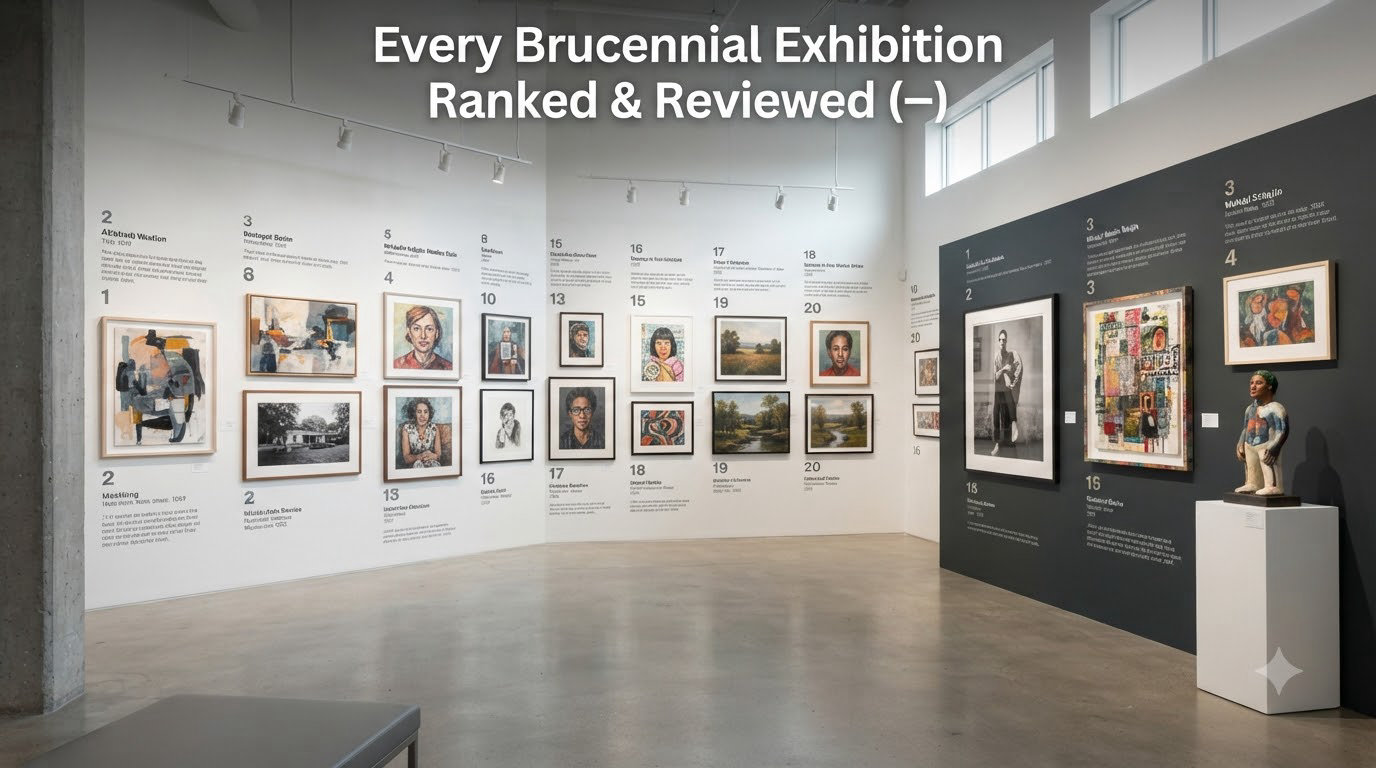
I still remember the first time I stumbled into a Brucennial exhibition. The walls were packed floor-to-ceiling with art in a way that felt more like a passionate artist’s studio than a museum. That chaotic energy, that sense that anything could happen, defined what made the Brucennial exhibition ranked among the most important alternative art movements of the 2000s.
The Brucennial wasn’t just another art show. It was a statement, a rebellion, and a love letter to emerging artists who traditional institutions ignored. Between 2008 and 2014, the Bruce High Quality Foundation created four legendary exhibitions that challenged everything we thought we knew about art world gatekeeping.
In this guide, I’ve reviewed every Brucennial exhibition to give you the definitive ranking. Whether you’re researching the Bruce High Quality Foundation history or simply curious about what made these shows legendary, this is the most complete retrospective you’ll find anywhere.
Table of Contents
The Brucennial Phenomenon: An Alternative to Everything
To understand the Brucennial, you first need to understand the Bruce High Quality Foundation. This Brooklyn-based art collective operated under a beautifully simple mission statement: to foster “an alternative to everything.” They weren’t interested in playing by the art world’s rules. They wanted to burn the rulebook and invite everyone to the party.
The collective emerged from shared frustration with MFA programs and gallery systems that seemed designed to exclude rather than embrace. Founding members met while students at Cooper Union and the Whitney Independent Study Program, where they bonded over late-night conversations about what art could be if power structures disappeared. Their answer was BHQF, a semi-anonymous collective that used myth, humor, and institutional critique as their primary tools.
The name itself carries meaning. “Bruce High Quality” is a fictional character, a mythological figure representing the pure, uncorrupted amateur spirit. According to BHQF lore, Bruce died on September 11, 2001, while saving cats from a burning building. Whether you believe that story matters less than understanding what it represents: the romantic idea of art as heroic, selfless, and slightly absurd.
The Brucennial emerged as their answer to the Whitney Biennial, that prestigious, invitation-only exhibition that defines American contemporary art for many collectors and institutions. While the Whitney Biennial represented exclusivity and careful curation, the Brucennial promised inclusion and chaos. Anyone could submit. Everyone was welcome. The result was pure creative anarchy.
Beyond the exhibitions themselves, BHQF launched B.H.Q.F.U., the Bruce High Quality Foundation University. This free, unaccredited art school operated on the principle that art education should be accessible to everyone, not just those who could afford expensive MFA programs. Classes were taught by working artists, critics, and curators who volunteered their time. Students paid nothing. The university embodied the same philosophy as the Brucennial: “Professional Challenges. Amateur Solutions.”
The TEACH 4 AMERIKA tour took this philosophy on the road. BHQF members traveled across the country in a repurposed school bus, visiting art schools and posing uncomfortable questions about the cost and value of arts education. They weren’t just talking about change. They were demonstrating it in real time.
2008: The Inaugural Brucennial
The first Brucennial opened in 2008, and honestly, it was gloriously rough around the edges. Held in a space that felt more like a collective studio than a gallery, this inaugural exhibition set the template for everything that followed. Walls were covered salon-style, works crowded together without the breathing room of white cube aesthetics.
What the 2008 Brucennial lacked in polish, it made up for in pure enthusiasm. This was the moment when BHQF proved their concept could work. Artists submitted work without jurors, without gatekeepers, without the anxiety of waiting for acceptance letters. If you made art, you could be in the Brucennial. That radical simplicity attracted hundreds of participants.
The venue itself became part of the story. Located in Brooklyn, the exhibition space felt deliberately anti-institutional. Exposed brick, industrial lighting, and a sense that the building had a history before art moved in. Visitors weren’t entering a pristine museum environment. They were stepping into a world where artists actually lived and worked.
Looking back, the 2008 Brucennial was foundational but unpolished. It proved the concept of a democratic, inclusive art exhibition could draw crowds and generate excitement. It established the visual language of salon-style hanging that would define later exhibitions. Most importantly, it announced that BHQF wasn’t just talking about alternatives. They were building them.
The exhibition ran for several weeks, drawing art students, collectors, curious locals, and the simply confused. Reviews were enthusiastic if occasionally puzzled. Critics recognized something important was happening, even if they couldn’t quite categorize it. That resistance to categorization would become a Brucennial trademark.
2010: The Miseducation Brucennial
If 2008 was the experiment, 2010 was the proof of concept. The Brucennial: Miseducation took everything that worked in the first exhibition and amplified it. This edition coincided with the 2010 Whitney Biennial, a deliberate scheduling choice that made the contrast impossible to ignore. While the Whitney showed carefully selected artists in pristine galleries, the Brucennial packed work into the Vito Schnabel gallery in a celebration of creative excess.
The Miseducation subtitle referenced the idea that traditional arts education might be miseducating students about their worth and possibilities. The exhibition positioned itself as a “visual art performance biennial,” incorporating live elements alongside static artwork. Performances happened throughout the run, turning the gallery into a space where art was made, not just displayed.
Vito Schnabel’s gallery provided a fascinating venue. Unlike the raw spaces of 2008, this was a legitimate gallery in a legitimate art district. BHQF was entering the system they critiqued, using established infrastructure to deliver anti-establishment content. The tension between venue and message created an energy that pervaded the entire exhibition.
Artist participation grew significantly from 2008. The open submission process attracted hundreds of creators, many of whom had never shown in a gallery before. Walking through the space felt like exploring a treasure hunt. Hidden gems appeared between works of wildly varying quality. That inconsistency was the point. The Brucennial wasn’t promising a curated experience. It was promising democracy, with all the messiness democracy entails.
The 2010 exhibition also marked the first time the Brucennial received serious critical attention. Major art publications covered the show, often comparing it directly to the Whitney Biennial. Those comparisons generally favored the Brucennial’s energy and accessibility over the Whitney’s careful institutional approach. For emerging artists, this was validation that alternative paths existed.
I remember walking through the Miseducation exhibition and feeling like I’d discovered a secret. The crowd was younger, more diverse, and visibly more excited than typical gallery audiences. People were actually talking about the art, arguing about what worked and what didn’t, sharing discoveries with strangers. That social energy was the true artwork, a living demonstration of relational aesthetics in action.
2012: Harderer Betterer Fasterer Strongerer
The 2012 Brucennial hit its stride with Harderer Betterer Fasterer Strongerer, a title that announced ambitions even as it poked fun at them. This edition featured nearly 400 artists, making it the largest Brucennial to date. The New York Times covered it extensively, calling it a “populist, inclusive survey” that put the Whitney Biennial’s exclusivity to shame.
What made 2012 special was the refinement of the Brucennial formula. After two editions, BHQF understood exactly what they were creating. The salon-style hanging reached its peak, with works covering every available surface in a dizzying array of styles, mediums, and quality levels. Walking through felt like speed-dating with hundreds of artists simultaneously.
The exhibition occupied a massive space that allowed for real scale. Previous Brucennials had felt intimate, almost cramped. The 2012 edition felt like a genuine biennial, sprawling across rooms and corridors with surprises around every corner. Yet it maintained the chaotic energy that defined the series. Nothing felt corporate or sanitized.
Critical reception was overwhelmingly positive. The NY Times review captured what made the show special: “The Brucennial 2012 is a populist, inclusive survey, featuring the work of nearly 400 artists.” That populism wasn’t just a gimmick. It was a genuine philosophical position about who deserved to have their art seen.
The 2012 exhibition also benefited from timing. Occupy Wall Street had recently mobilized conversations about inequality and access. The Brucennial’s anti-elitist message resonated with cultural currents questioning traditional gatekeepers. Art didn’t need permission to exist, and artists didn’t need validation from institutions to be legitimate.
One of my favorite memories from this exhibition was watching visitors discover artists they’d never heard of. Because there were no wall labels announcing famous names, people judged work on its own merits. A painting by an unknown art student hung next to pieces by established artists, and both received equal attention. That radical equality was the Brucennial’s greatest achievement.
2014: The Final Brucennial
Everything ends, and the Brucennial chose to end on a high note. The 2014 Final Brucennial took over a massive space in Manhattan’s Meatpacking District, drawing over 2,000 people to the opening night alone. Beer flowed freely. Bacon was served. Performance art punctuated the evening. It was less an exhibition opening than a celebration of everything BHQF had built.
This edition featured more than 600 artists, making it the largest Brucennial ever. The sheer volume of work was almost overwhelming. Visitors spent hours navigating the space, discovering new work around every corner. The exhibition ran for weeks, drawing steady crowds of art students, collectors, and curious locals who’d heard about this legendary alternative art phenomenon.
The Meatpacking District location was significant. This was prime Manhattan real estate, a neighborhood synonymous with luxury and fashion. BHQF had come a long way from their scrappy Brooklyn beginnings. Yet the exhibition maintained its anti-establishment spirit. The contrast between the upscale neighborhood and the chaotic, democratic art show created a tension that energized the entire experience.
What made the 2014 Brucennial special was its retrospective quality. Everyone knew this was the final edition. That knowledge gave the exhibition a valedictory feeling, a sense of looking back while celebrating the present. Artists who’d participated in previous Brucennials returned. Regular attendees made pilgrimages. It felt like a family reunion for everyone who believed in BHQF’s mission.
The opening night set the tone. With over 2,000 attendees packed into the space, the energy was electric. Performance artists worked the crowd. Musicians played in corners. The beer and bacon weren’t just refreshments. They were symbols of the Brucennial’s populist approach. Fine art can coexist with casual fun. Actually, they’re better together.
When the Final Brucennial closed, it marked the end of an era. From 2008 to 2014, BHQF had created something genuinely unique: a recurring art exhibition that challenged every assumption about how art should be shown, sold, and experienced. The Brucennial proved that inclusion could be a curatorial strategy. It demonstrated that art’s value wasn’t determined by gatekeepers. Most importantly, it built a community that outlasted any single exhibition.
Brucennial Exhibition Ranked: The Definitive Guide
After reviewing all four Brucennial exhibitions in depth, here’s my definitive ranking from fourth place to first. Each exhibition brought something valuable to the table, but some achieved more complete realizations of the Brucennial vision than others.
#4: 2008 Inaugural Brucennial
The first Brucennial earns last place not because it failed, but because it was understandably a work in progress. The exhibition established the template but hadn’t yet refined it. The rough edges that felt charming in retrospect were simply rough at the time. Still, without this foundational experiment, none of the later exhibitions would have existed. It deserves recognition as the proof of concept that launched everything.
#3: 2014 The Final Brucennial
The 2014 edition ranks third because while it was the largest and most spectacular, it occasionally felt like a greatest hits compilation rather than a bold new statement. The retrospective quality, while emotionally resonant, meant the exhibition was looking backward as much as forward. That’s not a criticism exactly. A goodbye can be beautiful without breaking new ground. The 600+ artists and massive crowds proved the Brucennial concept had won, which made this finale feel like both a celebration and a conclusion.
#2: 2010 The Miseducation Brucennial
The 2010 Brucennial ranks second for achieving the difficult balance of growth without compromise. Moving to the Vito Schnabel gallery gave the exhibition legitimacy without sacrificing its outsider energy. The performance elements added new dimensions to the format. Most importantly, this edition proved the Brucennial wasn’t a one-time stunt. It was a sustainable model for democratic art presentation. The timing alongside the Whitney Biennial made the comparison explicit, and the Brucennial held its own against the establishment heavyweight.
#1: 2012 Harderer Betterer Fasterer Strongerer
The 2012 Brucennial stands as the peak achievement, the moment when everything aligned perfectly. With nearly 400 artists, massive space, critical acclaim from major publications, and an energy that captured the cultural moment, this exhibition represented the Brucennial ideal fully realized. The NY Times coverage validated what participants already knew: something important was happening here. The scale was ambitious without being overwhelming. The quality was varied but exciting. The crowds were engaged and enthusiastic. If you could only visit one Brucennial, this was the one to see.
Frequently Asked Questions
What is the Brucennial?
The Brucennial was an art exhibition series organized by the Bruce High Quality Foundation between 2008 and 2014. It served as a democratic, inclusive alternative to the Whitney Biennial, featuring hundreds of emerging and established artists in non-traditional venues across New York City. Anyone could submit work, and the exhibitions were known for their salon-style presentation and populist approach.
When did the Brucennial exhibitions happen?
The Brucennial exhibitions occurred in four editions: 2008 (the inaugural exhibition), 2010 (The Miseducation), 2012 (Harderer Betterer Fasterer Strongerer), and 2014 (The Final Brucennial). Each exhibition built upon the previous one, growing in scale and cultural impact until the series concluded in 2014.
What was the Bruce High Quality Foundation?
The Bruce High Quality Foundation (BHQF) was a Brooklyn-based art collective founded to foster an alternative to everything. The semi-anonymous collective used myth, humor, and institutional critique to challenge traditional art world hierarchies. They also operated B.H.Q.F.U., a free unaccredited art school, and organized the TEACH 4 AMERIKA tour questioning arts education costs.
How many artists participated in Brucennial 2012?
The 2012 Brucennial featured nearly 400 artists, making it one of the largest editions in the series. The exhibition used a salon-style hanging approach where works covered walls floor-to-ceiling, creating an immersive experience that showcased the diversity of contemporary art being made outside traditional gallery systems.
What was the last Brucennial exhibition?
The 2014 Final Brucennial was the last exhibition in the series, held in Manhattan’s Meatpacking District. It featured over 600 artists and drew more than 2,000 people to the opening night. The exhibition served as both a celebration of everything BHQF had built and a farewell to the Brucennial format.
Conclusion: The Brucennial Legacy
Looking back at the Brucennial exhibitions today in 2026, what’s striking is how thoroughly they proved their point. The Bruce High Quality Foundation set out to create “an alternative to everything,” and across four exhibitions from 2008 to 2014, they demonstrated that alternative art ecosystems weren’t just possible. They were necessary.
The Brucennial challenged the assumption that quality art requires gatekeepers. It showed that inclusion could be a curatorial strategy, not a compromise. Most importantly, it built a community of artists and art lovers who found space to create, connect, and celebrate outside traditional structures.
While the Brucennial exhibition series has ended, its influence persists. The democratic, populist approach to art presentation has inspired countless alternative spaces and exhibitions. The question BHQF posed remains relevant today: who gets to decide what art matters, and what possibilities open when we let everyone participate in that decision?
The Brucennial wasn’t perfect. Some shows were stronger than others, and the quality of work varied wildly. But perfection was never the goal. The goal was proving that art belongs to everyone who makes it and everyone who experiences it. On that measure, the Brucennial succeeded completely.