
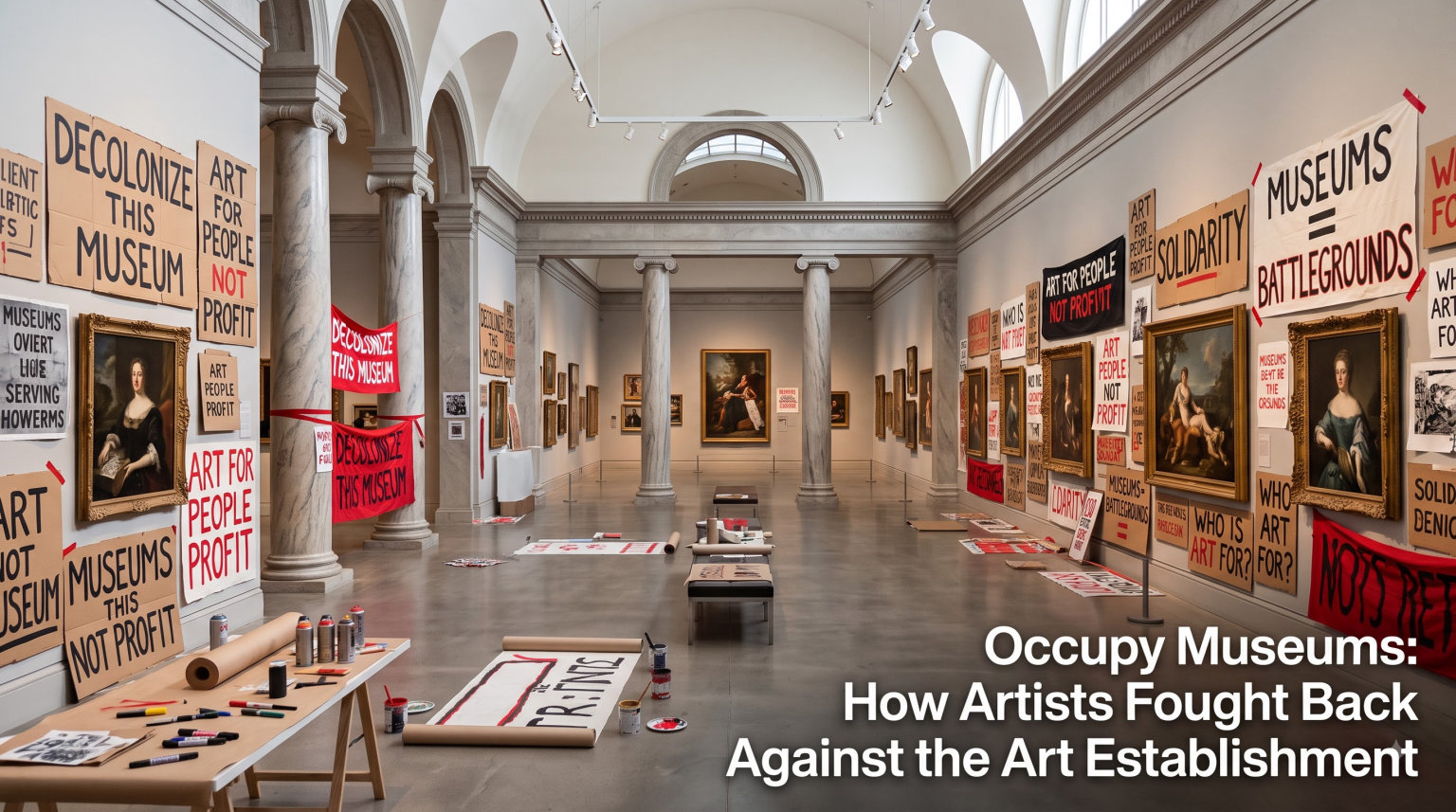
Occupy Museums emerged in September 2011 as a fierce response to the growing economic inequality that had infiltrated every corner of American life, including the art world. Born from the grassroots energy of Occupy Wall Street, this activist collective set out to expose how museums had transformed from public cultural institutions into playgrounds for the wealthy elite. The movement asked a provocative question that still resonates 2026: Who do museums really serve when their boards are stacked with billionaires and their funding depends on corporations with questionable ethics?
The art establishment had long positioned itself as a progressive space for free expression and cultural dialogue. Yet beneath the surface of prestigious institutions like MoMA, the Whitney, and the Guggenheim lay a web of corporate sponsorships, billionaire trustee influence, and economic exclusion that Occupy Museums sought to dismantle. Through protests, teach-ins, and direct action, these artists and activists fought to reclaim cultural spaces for the public they were meant to serve.
What started as a small group of artists gathering at Zuccotti Park evolved into a sustained campaign of institutional critique that would influence art activism for years to come. The movement connected the dots between student debt, labor exploitation, corporate control, and museum governance in ways that had never been done before. Their story is one of courage, creativity, and the ongoing struggle to make art accessible to everyone, not just the one percent.
Table of Contents
Historical Context: Art Activism Before Occupy
To understand Occupy Museums, one must first look back to the Art Workers Coalition, a group that shook the New York art world in 1969. Formed in response to the Metropolitan Museum of Art’s exclusionary practices, the AWC demanded free admission, better representation of women and minority artists, and artist representation on museum boards. They represented an earlier generation’s attempt to democratize institutions that had become increasingly elitist.
The Art Workers Coalition succeeded in pushing some reforms. They helped establish free admission days and brought attention to institutional racism and sexism in museum programming. However, by the 1980s, much of the radical energy had been absorbed into the very institutions it sought to change. Museums learned to market themselves as edgy while maintaining corporate structures that served wealthy trustees.
The tradition of institutional critique continued through artists like Hans Haacke and Michael Asher, who used their work to expose the political and economic underpinnings of museums. But by 2011, economic inequality had reached levels not seen since the Great Depression, and a new generation of artists recognized that critique from within was no longer enough. The stage was set for a more confrontational approach that would bring activism out of the galleries and into the streets.
How Occupy Museums Was Born
On September 17, 2011, hundreds of protesters descended on Zuccotti Park in Lower Manhattan, beginning what would become the Occupy Wall Street movement. Among them were artists who quickly recognized that the economic inequality being protested in the financial district was deeply connected to the culture sector just blocks away. Artist Noah Fischer emerged as a key organizer, helping to launch Occupy Museums in the movement’s first month.
The group’s initial manifesto cut directly to the heart of their critique. Museums, they argued, had become temples of cultural elitism that pandered to rich trustees while excluding the general public. The one percent, they noted, controlled not just the economy but also the cultural narrative, using museums to launder their reputations and cultural capital. This message resonated with artists who had spent years struggling with debt, precarious employment, and exclusion from the very institutions that showcased art.
Using the horizontal organizing structure pioneered by Occupy Wall Street, Occupy Museums operated through general assemblies where decisions were made by consensus. The people’s mic, a call-and-response technique developed to circumvent amplification restrictions at protests, became a hallmark of their gatherings. This structure reflected their values: no single leader, transparent decision-making, and inclusion of all voices regardless of art world status.
Early participants included established artists, art students, unemployed graduates, and museum workers. Many were anonymous, fearing career repercussions in an industry where gatekeepers controlled opportunities. Others, like Coco Fusco, lent their names and reputations to lend credibility and draw media attention. The diversity of participants reflected the movement’s commitment to crossing boundaries that typically separated famous artists from struggling ones.
Major Actions and Museum Protests
Occupy Museums wasted no time taking their message directly to the institutions they critiqued. Their first major target was the Museum of Modern Art, where they protested the museum’s reliance on corporate sponsors and billionaire trustees with ties to controversial industries. Protesters carried signs highlighting trustee connections to exploitative labor practices, environmental destruction, and financial speculation that had caused the 2008 economic collapse.
The MoMA actions drew significant media attention and sparked debate within the art community. Some critics dismissed the protesters as naive or misguided, arguing that museums needed wealthy donors to survive. Others saw the protests as a long-overdue conversation about whose interests cultural institutions truly served. The movement’s response was clear: accepting money from the one percent came at the cost of artistic integrity and public trust.
The Whitney Museum and the 2012 Biennial
When the Whitney Museum held its prestigious Biennial exhibition in 2012, Occupy Museums saw both an opportunity and a contradiction. The Biennial claimed to represent the most vital contemporary American art, yet its $18 admission price and corporate sponsorship structure excluded many of the artists and audiences it purported to celebrate. Protesters staged demonstrations outside the museum, distributing flyers that connected the dots between trustee wealth, corporate control, and artistic gatekeeping.
The Whitney actions were particularly significant because they highlighted how even supposedly cutting-edge institutions reinforced economic hierarchies. Protesters noted that many artists featured in the Biennial were drowning in student debt from MFA programs, while the museum’s board included individuals who profited from the student loan industry. This contradiction between the art world’s progressive rhetoric and its conservative economics became a central theme of Occupy Museums’ messaging.
Guggenheim and Labor Solidarity
The Guggenheim Museum became another focal point for Occupy Museums actions, particularly around issues of labor exploitation. The museum’s construction of a new branch in Abu Dhabi raised serious concerns about the treatment of migrant workers building the facility. Occupy Museums joined forces with Gulf Labor, an activist group dedicated to protecting workers’ rights in Gulf State cultural projects, to protest at the Guggenheim’s New York headquarters.
These protests connected local art world issues to global labor struggles in ways that resonated far beyond the museum sector. By highlighting how American museums were complicit in labor exploitation abroad, Occupy Museums demonstrated that institutional critique needed to extend beyond national borders. The solidarity with Gulf Labor also showed that the movement was part of an international network of cultural activists fighting similar battles worldwide.
The Lincoln Center Die-In
One of Occupy Museums’ most visually striking actions was a die-in at Lincoln Center during a gala event. Protesters dressed in formal attire collapsed to the ground in silent protest, symbolizing the death of cultural accessibility under current economic arrangements. The action disrupted an exclusive event where tickets cost thousands of dollars, forcing wealthy patrons to confront the inequality that made such evenings possible.
The die-in tactic, borrowed from AIDS activism and other social movements, demonstrated Occupy Museums’ willingness to use confrontational methods when necessary. It also showed their understanding that protests needed to be visually compelling to attract media coverage in an attention economy. The images of protesters lying motionless on the marble floors of Lincoln Center circulated widely on social media, amplifying their message far beyond the physical event.
Counter-Commencement Ceremony
In a particularly creative action, Occupy Museums staged a counter-commencement ceremony for art school graduates burdened by debt. While traditional commencement ceremonies celebrated academic achievement, this alternative gathering acknowledged the economic reality facing graduates: degrees that cost hundreds of thousands of dollars were leading to careers that paid poverty wages. The ceremony offered a space for graduates to voice their anger and connect with others facing similar struggles.
This action highlighted the specific crisis facing art students, who often took on massive debt for degrees that the art establishment required but the market would not support. By framing student debt as an art world issue, Occupy Museums expanded the conversation about economic inequality to include education and professional development. The counter-commencement also served as a recruitment tool, bringing newly graduated artists into the movement’s orbit.
Debtfair: Art, Activism, and the Student Debt Crisis
By 2017, Occupy Museums had evolved its tactics to focus more specifically on the student debt crisis affecting artists. Their flagship project was Debtfair, an exhibition and campaign that transformed the abstract statistics of educational debt into visceral, personal stories. The project asked a simple but devastating question: How can artists create when they are drowning in debt?
Debtfair gained significant visibility when it was included in the 2017 Whitney Biennial, marking a moment when the institution that had once been a protest target became a platform for activist art. The exhibition featured artists alongside their debt burdens, displaying the financial reality behind the creative output. This unflinching presentation of economic struggle challenged the art world’s tendency to romanticize poverty while ignoring its structural causes.
The Debtfair project was accompanied by advocacy for the American Arts Revival Act, legislation introduced by Representative Nydia Velazquez that would have provided student debt relief for artists. While the bill did not pass, it represented an attempt to translate street protests into policy change. The legislation would have recognized artists as workers deserving of the same protections and support given to other professionals.
Noah Fischer and other organizers saw Debtfair as a way to connect individual economic struggles to collective political action. By displaying debt as part of the artistic presentation, they made visible what institutions preferred to hide: the financial exploitation of creative workers. The project also served as a networking tool, connecting indebted artists with debt relief resources and organizing opportunities.
Key Figures and Organizers
Noah Fischer emerged as the most visible organizer of Occupy Museums, though he consistently emphasized the movement’s horizontal structure over individual leadership. An artist himself, Fischer brought both credibility and practical organizing skills to the group. His background in theater and performance art informed the movement’s attention to visual impact and media strategy.
Fischer’s role involved coordinating actions, speaking to press, and articulating the movement’s political analysis. He connected Occupy Museums to broader economic justice movements, ensuring that art activism was seen as part of a larger struggle rather than a niche concern. His writings and interviews from this period remain some of the most thorough documentation of the movement’s thinking.
Coco Fusco brought a different set of credentials to the movement. An established artist and scholar with a long history of politically engaged work, Fusco lent intellectual weight and art world legitimacy to Occupy Museums. Her participation demonstrated that the movement was not just disgruntled outsiders but included respected figures who had succeeded within the system yet still recognized its fundamental flaws.
Beyond these prominent figures, hundreds of anonymous participants kept the movement alive through countless general assemblies, planning meetings, and direct actions. Many were recent art school graduates working service jobs to pay off student loans. Others were museum employees who saw the inner workings of institutional inequality firsthand. This diversity of experience enriched the movement’s analysis and ensured that its critiques were grounded in real-world knowledge.
Solidarity and Related Movements
Occupy Museums never operated in isolation. Within the Occupy Wall Street ecosystem, they worked closely with the Arts & Labor working group, which focused on labor issues affecting cultural workers. This partnership connected art world concerns to broader labor struggles, highlighting how museum guards, art handlers, and other workers faced exploitation alongside the artists whose work they handled.
International solidarity played a crucial role in the movement’s development. Gulf Labor Coalition, fighting for workers’ rights in Abu Dhabi’s Saadiyat Island cultural district, became a close ally. When Occupy Museums protested at the Guggenheim, they were explicitly connecting local actions to global labor struggles. This international perspective distinguished Occupy Museums from earlier art activism that focused primarily on domestic concerns.
In the United Kingdom, Liberate Tate was waging a similar battle against corporate sponsorship of museums, particularly targeting BP’s support of the Tate galleries. Occupy Museums and Liberate Tate shared tactics, strategies, and moral support across the Atlantic. These connections demonstrated that the problems facing American museums were part of a global pattern of cultural privatization and corporate capture.
Closer to home, Occupy Museums influenced and was influenced by Decolonize This Place, a movement focused on indigenous rights, black liberation, and Palestinian solidarity within cultural institutions. The overlap between these groups showed how economic inequality intersected with racial and colonial injustice in the museum sector. Together, they pushed the conversation beyond class analysis to include broader questions of representation and historical accountability.
Legacy and Lasting Impact
Assessing the legacy of Occupy Museums requires looking beyond immediate policy victories to broader cultural shifts. While museums still rely on wealthy donors and corporate sponsors, the conversation around these relationships has changed fundamentally. Institutions are now more likely to face public scrutiny over trustee backgrounds and sponsorship sources, thanks in part to the groundwork laid by Occupy Museums.
The movement succeeded in politicizing museum spaces in ways that persist 2026. Where once such institutions were treated as neutral zones above politics, they are now regularly sites of protest and contestation. The tactics developed by Occupy Museums, from die-ins to guerrilla ceremonies, have been adopted by subsequent activist groups targeting cultural institutions.
Student debt remains a crisis for artists, and the art world’s complicity in that crisis is now widely acknowledged. While the American Arts Revival Act did not pass, the conversation about artist debt relief continues. Organizations like the Student Debt Collective have picked up where Occupy Museums left off, applying pressure for loan forgiveness and free education.
Not all assessments of the movement are positive. Some critics argue that Occupy Museums, like Occupy Wall Street more broadly, lacked clear objectives and measurable outcomes. They point out that museum boards remain dominated by the wealthy and that economic inequality in the art world has, if anything, worsened since 2011. These critiques deserve consideration and highlight the limitations of protest movements without sustained institutional power.
However, even skeptics acknowledge that Occupy Museums changed the conversation. The term art washing, now commonly used to describe how corporations use cultural sponsorship to clean up their reputations, gained currency through the movement’s activism. Questions about representation, accessibility, and economic justice that Occupy Museums raised are now standard in art world discourse, even if solutions remain elusive.
Frequently Asked Questions
What is Occupy Museums?
Occupy Museums was an activist collective formed in September 2011 as an offshoot of Occupy Wall Street. The group was dedicated to exposing economic inequality, corporate influence, and elitism in art institutions through protests, teach-ins, and direct action at museums including MoMA, the Whitney, and the Guggenheim.
What did the Occupy movement want?
The Occupy movement, including Occupy Museums, sought to address extreme economic inequality and the disproportionate influence of wealthy elites on society. Specifically, Occupy Museums demanded that cultural institutions serve the public rather than wealthy trustees and corporate sponsors. They advocated for free museum admission, transparency in funding sources, fair labor practices, and relief from the student debt burdening artists.
What museums did Occupy target?
Occupy Museums targeted major New York institutions including the Museum of Modern Art (MoMA), the Whitney Museum, the Guggenheim Museum, and Lincoln Center. Each target was chosen for specific reasons: MoMA for its billionaire trustees and corporate sponsors, the Whitney for high admission prices during the Biennial, and the Guggenheim for labor exploitation in its Abu Dhabi construction project.
What is activist art called?
Activist art is often called political art, socially engaged art, or interventionist art. When focused specifically on museums and cultural institutions, it falls under the category of institutional critique. Occupy Museums represented a form of direct action art activism that combined artistic practice with protest tactics to challenge the economic and political structures of the art world.
Is Occupy Museums still active?
Occupy Museums as a formal collective has not been active since approximately 2017, following the conclusion of the Debtfair project at the Whitney Biennial. However, its legacy continues through subsequent movements like Decolonize This Place and various museum worker organizing efforts. Many former participants remain active in art activism, labor organizing, and cultural policy advocacy, though not under the Occupy Museums name.
Conclusion: The Ongoing Fight for Art Accessibility
Occupy Museums represented a moment when artists stopped asking for permission to critique the institutions that shaped their careers and started demanding fundamental change. Through creative protests, horizontal organizing, and unflinching honesty about economic realities, they exposed the contradictions at the heart of the art establishment. Their work demonstrated that cultural institutions are not neutral spaces but active participants in economic systems that create winners and losers.
The movement’s legacy lives on in the continued politicization of museum spaces, the ongoing struggle against student debt, and the networks of solidarity it helped build between artists, workers, and activists. While many of the specific structures Occupy Museums challenged remain in place, the conversation around them has been permanently altered. Questions about accessibility, representation, and economic justice that were once marginal are now central to discussions about the future of art institutions.
As economic inequality continues to widen and cultural institutions face new pressures, the lessons of Occupy Museums remain relevant. The fight for art that serves everyone, not just the wealthy, did not end with the close of the Debtfair exhibition. It continues every time artists organize, every time workers demand fair treatment, and every time the public asserts its right to cultural participation. Occupy Museums showed us that another art world is possible, and the work of building it continues 2026.