
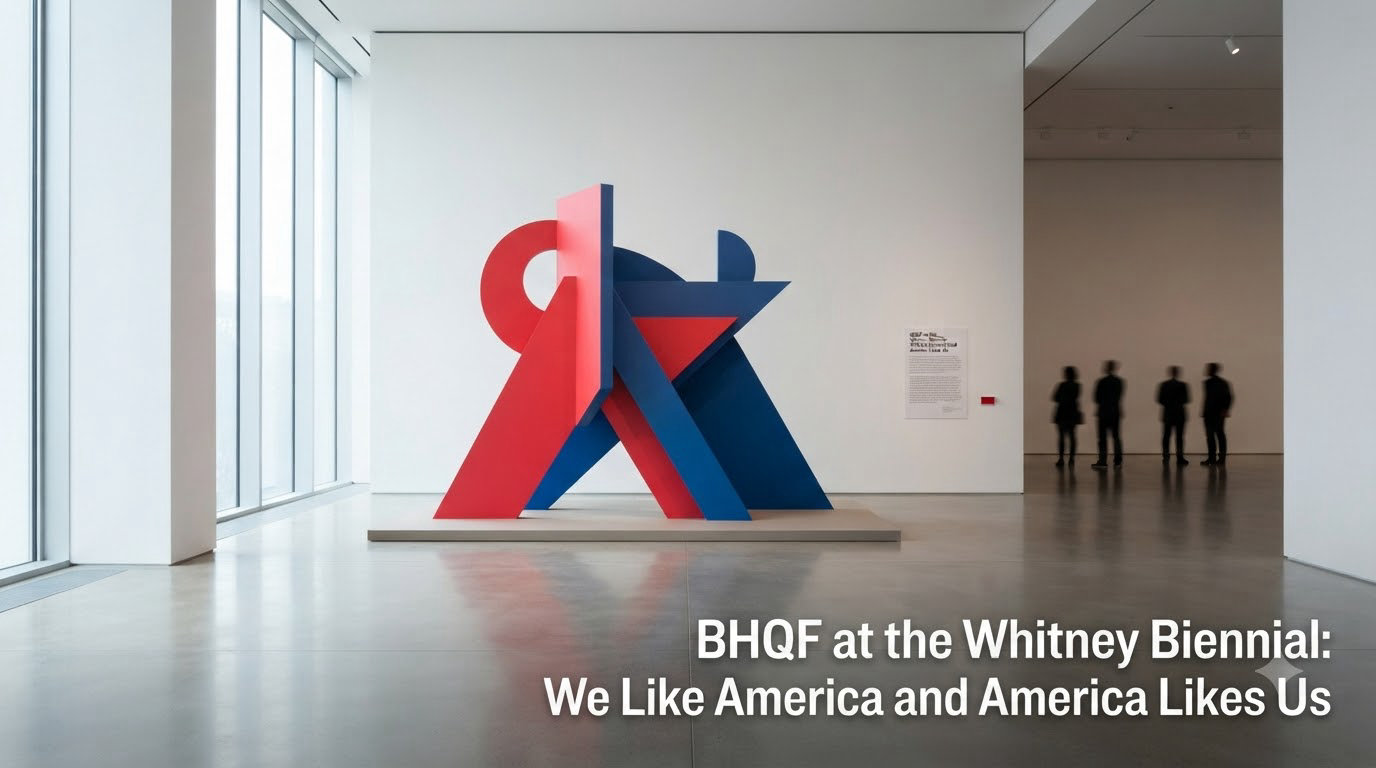
We Like America and America Likes Us stands as one of the Bruce High Quality Foundation’s most provocative meditations on American identity. This 2010 installation transformed a vintage Cadillac Miller-Meteor ambulance into a rolling commentary on national myths, collective memory, and the way pop culture mediates our understanding of ourselves. I first encountered documentation of this work while researching BHQF’s early museum interventions, and it immediately struck me as a perfect distillation of their anarchic yet deeply thoughtful approach to institutional critique.
The work appeared at the 2010 Whitney Biennial, the 75th edition of what remains the longest-running survey of American art. Curated by Francesco Bonami and Gary Carrion-Murayari, this iteration of the Biennial occupied the Marcel Breuer building on Manhattan’s Upper East Side. BHQF claimed a prominent spot on the fourth floor, where their white hearse became an unexpected gathering point for visitors navigating the exhibition’s sprawling layout. What makes this installation particularly compelling is how it hijacks the language of Americana—the open road, the vintage automobile, Hollywood spectacle—and reframes it as a melancholic state of the nation address.
The title itself functions as a sly provocation, directly referencing Joseph Beuys’s legendary 1974 performance I Like America and America Likes Me. By tweaking Beuys’s singular first-person declaration into a collective “we,” BHQF immediately signals their interest in shared experience over individual genius. This is art made by a collective about collective consciousness, and it wears its populist sympathies on its sleeve while maintaining a sophisticated critical edge.
Table of Contents
What is We Like America and America Likes Us?
At its core, BHQF We Like America and America Likes Us consists of a Cadillac Miller-Meteor ambulance, the same model immortalized as the Ghostbusters Ecto-1 vehicle. These dual-purpose vehicles were manufactured from 1959 to 1981, serving as both ambulances and hearses depending on configuration. The Miller-Meteor combined Cadillac’s commercial chassis with custom coachwork, creating a distinctive silhouette that immediately reads as both emergency response vehicle and funeral transport—a liminal machine perfectly suited to BHQF’s meditation on American life and death.
The technical specifications of these vehicles reveal why they became icons. Built on Cadillac’s 390 cubic inch V8 platform, the Miller-Meteor measured over 21 feet in length and weighed approximately 5,000 pounds. The coachwork featured the distinctive pointed tail fins and extensive chrome trim that defined American automotive excess of the era. When configured as an ambulance, the rear compartment accommodated a stretcher and medical equipment. As a hearse, it carried caskets through a separate rear loading system. BHQF’s choice of this specific vehicle model carries layers of meaning—the same car that rushed patients to emergency rooms also carried the deceased to their final rest.
The installation’s physical presence in the gallery was striking. The white Cadillac sat in the center of the space, positioned so visitors could approach from multiple angles. But the real action happened on the windshield, where BHQF projected a continuous video montage. This wasn’t simply decorative footage—the projection transformed the car’s front window into a screen, turning the vehicle into a drive-in theater of American cultural memory. The clips were pulled from YouTube, Hollywood movies, and news media, creating a found-footage narrative that viewers watched through the glass.
The audio component completed the experience. A voiceover narration delivered what critics described as a “heart-broken monologue” about America, weaving together end-of-a-relationship platitudes with observations about national decline. This wasn’t dry political commentary—it was personal, emotional, almost uncomfortably intimate. One critic noted it sounded like “someone reads a letter to an ex-lover they can’t quite quit,” and that characterization captures the ambivalence perfectly. America appears here as a difficult family member, a dysfunctional relationship you keep returning to despite knowing better.
The Joseph Beuys Reference: I Like America and America Likes Me
To fully understand this work, we need to examine the shadow it deliberately steps into. In May 1974, German artist Joseph Beuys arrived at New York’s JFK airport, wrapped himself in felt, and was transported by ambulance to the Rene Block Gallery in SoHo. For three days, he shared a room with a wild coyote, never touching the ground of the country he claimed to be healing. This performance, titled I Like America and America Likes Me, became one of the most documented works in performance art history.
Beuys chose the coyote specifically for its symbolic weight in American mythology—simultaneously trickster spirit, endangered native species, and Western frontier icon. The felt blanket referenced both warmth and isolation. The ambulance represented the medicalized, institutional approach to healing. Every element was charged with shamanic intention. Beuys saw himself conducting a “social sculpture,” using ritualized confrontation to address what he perceived as America’s spiritual wound. The performance ended when he was loaded back into the ambulance, returned to the airport, and flown out without ever having touched American soil.
BHQF’s transformation of this material is characteristically irreverent yet respectful. Where Beuys used a real coyote and genuine shamanic ritual, BHQF substitutes the mediated experience of pop culture. Where Beuys focused on individual spiritual healing, BHQF emphasizes collective cultural memory. The felt blanket becomes a projected video; the living animal becomes Hollywood footage; the shaman becomes a heartbroken narrator scrolling through YouTube clips.
This substitution is not a diminishment but a translation. BHQF recognizes that in 2010, American experience was increasingly mediated through screens. We don’t encounter the frontier directly anymore—we encounter it through John Ford films, car commercials, and viral videos. The Whitney Biennial installation suggests that this mediation isn’t necessarily a loss. Pop culture becomes the vocabulary through which we process national identity, grief, and hope. The Ghostbusters connection isn’t random—it’s precisely the kind of shared reference point that allows Americans to communicate across regional, political, and demographic divides.
The 2010 Whitney Biennial Context
The 75th Whitney Biennial opened in February 2010, marking three-quarters of a century since the museum began its ambitious survey format. Curators Francesco Bonami and Gary Carrion-Murayari assembled a roster of 55 artists that reflected both established names and emerging voices. The exhibition occupied the entire Marcel Breuer building, with each floor presenting a distinct curatorial mood. The fourth floor, where BHQF’s hearse was stationed, became a kind of waypoint—visitors naturally gravitated toward the vehicle as both spectacle and resting point.
The political context of 2010 cannot be ignored. Barack Obama had been president for just over a year, following the 2008 financial crisis that shook American confidence to its core. The Tea Party movement was gaining momentum. The country felt simultaneously hopeful and anxious, united in crisis yet fractured in response. BHQF’s installation captured this specific moment—the sense of an abusive relationship with one’s own country, the desire to leave tempered by the inability to actually go anywhere.
The Biennial has always functioned as a state of the union for American art, and BHQF’s contribution leaned hard into that diagnostic role. By positioning their work as a “portable museum,” they also made a subtle institutional critique. The Whitney had mounted 75 of these surveys—what had changed? What remained the same? The Cadillac Miller-Meteor, a vehicle designed to transport people in moments of medical emergency or death, became a metaphor for the museum itself: an institution moving through time, carrying American culture through its various crises and transformations.
Critical Reception and Interpretation
Contemporary reviews of We Like America and America Likes Us reveal a work that divided critics while consistently engaging them. Frieze Magazine characterized it as a “state of the nation lament,” reading the voiceover as an elegy for American promise. The critic noted how the piece used “end-of-a-relationship platitudes” to describe national experience—America as ex-lover, the difficult partner you keep returning to despite the accumulated hurt. This framing proved particularly resonant in the Obama era, when questions of American exceptionalism and decline dominated cultural discourse.
The Brooklyn Rail offered a more formally oriented analysis, focusing on what they termed “pop culture mediation.” Their reviewer described the video montage as “tawdry yet tragic,” a car crash of imagery that viewers couldn’t look away from despite—or because of—its emotional manipulation. The Rail’s critic compared the work to Otabenga Jones’s 2006 Biennial installation, noting that both used found cultural materials to construct alternate histories of American experience. Where Jones focused on Black collectivity, BHQF aimed for broader national commentary, but both shared an understanding that American identity is constructed as much from media fragments as from lived experience.
The Guardian’s review emphasized the pointed nature of BHQF’s critique, calling it “altogether more pointed—at least in theory—than many Biennial contributions.” Their critic noted the tension between the work’s ambitious conceptual framework and its actual emotional impact, suggesting that the “cheap emotions” and “arch references” sometimes undermined the serious intent. This ambivalence—between genuine feeling and ironic distance—is characteristic of BHQF’s practice, and it clearly challenged some viewers’ expectations for how political art should behave.
Visitor reactions from 2010, recorded in art forums and personal blogs, paint a picture of an installation that genuinely affected its audience. Multiple accounts describe the space around the hearse as “quiet, a little sad, introspective.” The heart-broken monologue resonated with viewers who recognized their own complicated feelings about America in the narrator’s words. Some found the work “perversely compelling,” drawn to watch the video loop even as they questioned its methods. Others dismissed it as entertainment masquerading as critique, too seductive for its own good. This range of response suggests the piece succeeded in its primary goal: making viewers feel something complicated about their national identity.
Cultural Significance and Legacy
BHQF’s installation fits within their larger “portable museum” concept, a recurring motif in their practice that treats vehicles and mobile structures as institutions unto themselves. By creating museums that can travel—whether by hearse, bus, or boat—they challenge the fixed, monumental nature of traditional art institutions. The Cadillac Miller-Meteor becomes a museum of American pop culture, a traveling exhibition that visits the Whitney rather than the other way around. This inversion of institutional roles is classic BHQF: cheeky, thoughtful, and fundamentally democratic in its impulse.
The specific video content—YouTube clips and Hollywood movie footage—deserves particular attention. While exact details of every clip used remain difficult to verify, accounts suggest the montage included car crash scenes, news footage of national events, excerpts from classic American cinema, and viral video moments. This selection strategy treats all moving images as equally valid sources for constructing national narrative. A YouTube clip of a cat video carries the same weight as a scene from a John Ford western; both reveal something about what Americans choose to watch, share, and remember.
The work’s legacy extends through BHQF’s subsequent practice and broader conversations about art and national identity. The themes of collective memory and dysfunctional national relationships have only become more relevant in the years since 2010. The installation anticipated our current moment of hyper-mediated political discourse, where TikTok videos and news clips circulate as the primary vocabulary for processing national experience. BHQF understood early that Americans increasingly encounter their own culture through screens, and they built an artwork that made that mediation literal and unavoidable.
Frequently Asked Questions
What is the Whitney Biennial and why is it important?
The Whitney Biennial is the longest-running survey of American art, first established in 1932. Held every two years at the Whitney Museum of American Art, it showcases contemporary work from living American artists and has historically served as a bellwether for emerging trends in the art world. The exhibition is important because it offers a snapshot of American artistic production at a specific moment, often introducing emerging artists to wider audiences while also providing institutional recognition to established figures.
Who was the German artist known for his performance I Like America and America Likes Me?
Joseph Beuys was the German artist who created the 1974 performance I Like America and America Likes Me. A major figure in post-war contemporary art, Beuys was known for his expanded concept of art that incorporated social sculpture, shamanistic ritual, and political activism. His 1974 performance involved sharing a room with a wild coyote for three days at the Rene Block Gallery in New York, wrapped in felt and never touching American soil.
What elements were used in the performance work entitled I Like America and America Likes Me?
Joseph Beuys’s 1974 performance used several key elements: a wild coyote as the central living component, felt blankets that wrapped Beuys and served symbolic purposes, an ambulance that transported him to and from the gallery without touching ground, a large pile of straw, copies of the Wall Street Journal, a walking stick, gloves, and a triangular felt-covered space that served as the performance area. The work lasted for three days and became one of the most documented performances in art history.
What is the longest-running survey of American art?
The Whitney Biennial is the longest-running survey of American art. First held in 1932 as the Whitney Annual, it became a biennial exhibition in 1973. The 2010 edition, where BHQF exhibited We Like America and America Likes Us, was the 75th iteration of this important institutional survey. The Biennial has been held at the Whitney Museum of American Art and serves as a crucial platform for contemporary American artists.
What kind of car did BHQF use in the 2010 Whitney Biennial?
BHQF used a Cadillac Miller-Meteor ambulance in their 2010 Whitney Biennial installation. This is the same model famously used as the Ecto-1 vehicle in the Ghostbusters films. The Miller-Meteor was a dual-purpose vehicle manufactured between 1959 and 1981 that could be configured as either an ambulance or hearse. BHQF’s choice of this specific vehicle connected American pop culture iconography with themes of emergency, death, and cultural memory.
Conclusion: A Lasting Meditation on American Identity
BHQF We Like America and America Likes Us remains a significant marker in the collective’s practice and in the history of the Whitney Biennial. By combining the iconic Cadillac Miller-Meteor with projected video and heart-broken narration, they created a work that manages to be simultaneously entertaining and deeply unsettling. The installation asks us to consider how we know what we know about America—through direct experience or through the screens that mediate it? Through individual reflection or through shared cultural reference points?
The answer, of course, is both. And it’s this both-ness that BHQF captures so effectively. We are the nation that produces Ghostbusters and heartbreak in equal measure. We consume pop culture and we produce it. We critique our institutions even as we depend on them. The hearse sits in the gallery, projecting fragments of our collective memory onto its windshield, and we stand watching—quiet, a little sad, unable to look away.