
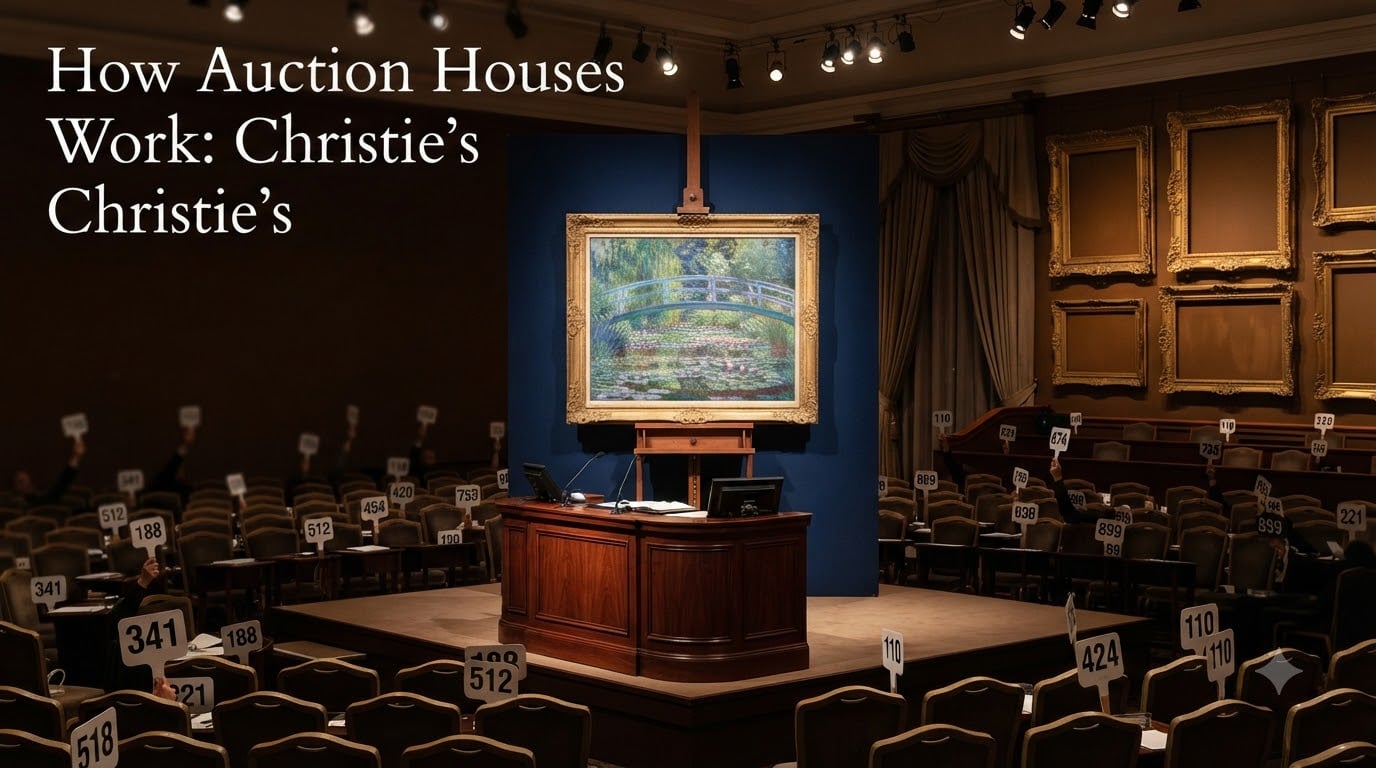
Auction houses are businesses that bring sellers and buyers together through competitive bidding, and Christie’s is the world’s oldest and most famous example. I spent the last few months studying how these institutions operate, talking with specialists, and reviewing the mechanics behind multi-million dollar sales.
If you’ve ever wondered how auction houses work, you’re not alone. From the moment a painting arrives at Christie’s London saleroom on King Street to the gavel falling on a new buyer, the process involves valuation, cataloguing, marketing, and a layer of fees most first-timers never see coming. In this guide, I’ll walk you through every step, using Christie’s as the main case study.
Whether you’re a collector considering your first bid, an estate manager evaluating how to sell a piece, or just curious about the art market, this breakdown covers the full picture. We’ll explore the auction process, bidding methods, fees, and how Christie’s compares to its main rival, Sotheby’s.
Table of Contents
What Is an Auction House and How Does It Work?
An auction house is a business that facilitates the sale of high-value goods through competitive bidding, acting as an intermediary between sellers and buyers. The company handles valuation, marketing, the bidding event itself, payment collection, and delivery. Christie’s, Sotheby’s, Phillips, and Bonhams sit at the top of this industry, with smaller regional houses handling more modest consignments.
Auction houses operate in what’s called the secondary market, where art and collectibles change hands after their initial purchase. This is different from the primary market, where you buy directly from an artist or gallery. In the primary market, the artist (or their gallery) sets the price. In the secondary market, the price is determined by what bidders are willing to pay on a given day.
This distinction matters because secondary market prices can swing wildly based on taste, fashion, and the size of the bidding pool. A Warhol might fetch $80 million at Christie’s one season and struggle to hit $20 million a few years later. If you’re curious about how the gallery side compares to street art sales, our piece on street art vs gallery art market differences covers the primary market angle.
Three sides make an auction happen: the seller (called the consignor), the buyer, and the auctioneer who runs the sale. The auction house itself sits in the middle, taking a cut from both sides through commissions and fees. This structure has barely changed since James Christie held his first sale in 1766.
A Brief History of Christie’s Auction House
Christie’s was founded in 1766 by James Christie in London, making it the oldest major auction house still operating today. Christie ran his first sale in Pall Mall on December 5, 1766, and the business has remained in continuous operation ever since. In its early decades, Christie’s handled a wide range of goods including books, fine art, and even estate property from prominent British families.
By the 19th century, Christie’s had cemented its reputation as the auction house of choice for major estates, including paintings from the British Royal Collection. The firm auctioned pieces from kings, queens, and aristocrats, building a level of trust that competitors found hard to match.
The 20th century brought international expansion and record-breaking sales. Christie’s opened salerooms in New York in 1977, Geneva in 1975, and Hong Kong in 1986. The November 2017 sale of Leonardo da Vinci’s Salvator Mundi for $450.3 million remains the most expensive painting ever sold at auction, a record that still stands in 2026.
In 2026, Christie’s continues to lead the global art market alongside Sotheby’s. The firm sold Beeple’s Everydays: The First 5000 Days NFT for $69.3 million in March 2021, marking the third-highest sale ever for a work by a living artist. Christie’s has also embraced online-only sales, sustainability commitments through the Science Based Targets initiative, and a focus on expanding access for new collectors. For a look at who shapes today’s top auction results, see our roundup of influential contemporary artists with auction records.
The Auction Process: Step by Step
The auction process at Christie’s follows a predictable path from consignment to final payment. Here’s how it works, in order.
Step 1: Initial Contact and Valuation. A seller contacts Christie’s through a department specialist (for example, the Post-War and Contemporary Art team). The specialist reviews photographs, provenance documents, and any condition reports. If the piece looks promising, the specialist schedules an in-person examination at the seller’s home, studio, or storage facility.
Step 2: Consignment Agreement. Once both parties agree on a sale, they sign a consignment agreement. This contract sets out the reserve price (the minimum price the seller will accept), the estimated sale range, and the seller’s commission. The reserve protects the consignor from selling below their threshold. If bidding doesn’t hit the reserve, the lot goes unsold.
Step 3: Cataloguing and Estimate. Christie’s specialists prepare a catalogue entry for the lot, including full provenance, condition notes, exhibition history, and literature references. The catalogue is published online and in print, with the estimate range shown in the local currency. Estimates guide bidders on what specialists consider fair market value.
Step 4: Pre-Sale Exhibition and Marketing. Lots are displayed at the pre-sale exhibition, usually held for 7 to 14 days before the auction. Christie’s produces marketing materials, runs advertising, and contacts registered clients who have shown interest in similar works. Private viewings are available for serious buyers.
Step 5: Condition Reports. Buyers can request detailed condition reports from the department, describing any damage, restoration, or wear. Reading the condition report is critical, especially for works on paper, sculpture, and older paintings. This is your main chance to verify the lot before bidding.
Step 6: The Auction. Bids are placed live in the saleroom, by phone, online, or as absentee bids written into the system in advance. The auctioneer opens each lot at the low estimate and bids rise in set increments (for example, $5,000 increments under $100,000 and $50,000 increments over $1 million). When bidding stops, the gavel falls, and the highest bidder wins, subject to the reserve being met.
Step 7: Post-Sale Payment and Delivery. The winning bidder pays the hammer price plus the buyer’s premium (explained below). Christie’s handles payment, helps arrange shipping, and assists with customs paperwork for cross-border purchases. Unsold lots can be re-negotiated privately between the consignor and interested buyers.
How Bidding Works at Christie’s and Sotheby’s
Bidding at a major auction house is more accessible than most people think, but each method works differently. Christie’s and Sotheby’s offer four main options.
Live Bidding in the Saleroom. This is the classic auction experience. You register in advance, show ID and financial proof (a bank reference or proof of funds), and receive a paddle with your bidder number. When your lot comes up, raise your paddle to bid. You’ll see the auctioneer, hear the rapid-fire call, and feel the room’s energy.
Online Bidding. Christie’s Live and Sotheby’s live online platforms let you bid from anywhere in the world with a real-time video feed. You’ll see the auctioneer, hear their calls, and place bids with one click. Online bidding has grown massively since 2020 and now accounts for a significant share of total sales volume.
Phone Bidding. For high-value lots, Christie’s assigns a specialist to call you during the sale. You watch the live feed, and the specialist places bids on your behalf as instructed. Phone bidding is popular for works above $500,000 where buyers want real-time guidance.
Absentee Bidding. You submit a maximum bid in writing before the auction. Christie’s system bids on your behalf up to your ceiling, raising in the standard increments against other bidders. This works well if you can’t attend in person but know exactly what you want to spend.
Buyer’s Premium and Seller Fees Explained
Fees are where most first-time bidders get surprised, and where auction houses make most of their money. Understanding the structure protects you from overpaying and helps you budget accurately.
The buyer’s premium is a percentage added to the hammer price (the winning bid). At Christie’s, the premium is 26% of the hammer price up to $1 million, 20% on the portion from $1 million to $6 million, and 14.5% on the portion above $6 million. There’s also an additional fee for items sold through Christie’s online-only platforms, often around 3%. These rates are published on every lot page and updated periodically.
So if you win a lot at a $500,000 hammer price, your buyer’s premium is $130,000 (26% of $500,000), and your total bill is $630,000 before any taxes, shipping, or import duties. For a $10 million lot, the calculation is tiered and the effective premium rate drops significantly.
Sellers pay a separate commission, often called the seller’s commission or vendor’s commission. This rate is negotiated privately and typically ranges from 0% to 10% of the hammer price, depending on the consignor’s relationship, the value of the consignment, and the costs of marketing and insurance the auction house is covering. Top consignors bringing multi-million dollar works often negotiate lower rates, while first-time sellers or smaller estates may pay closer to the higher end.
In addition to the buyer’s premium, buyers should budget for sales tax (in the US), VAT (in the UK and EU), shipping, insurance, and any customs duties for international purchases. These add-ons can reach 10% to 25% of the hammer price for cross-border transactions. I always recommend buyers get a full estimate of total cost before bidding, not just the hammer.
Christie’s vs Sotheby’s: Key Differences
Christie’s and Sotheby’s are the two biggest names in fine art auctions, and collectors often ask which one is better. The honest answer is that both are excellent, with subtle differences in focus and culture.
Christie’s was founded in 1766 in London and is owned by Groupe Artémis, the holding company of French billionaire François Pinault. Sotheby’s was founded in 1744, two decades earlier, and is owned by Patrick Drahi’s BidFair USA. Christie’s is privately held, while Sotheby’s is publicly traded, which influences how each firm approaches growth and acquisitions.
Both houses handle similar categories: Impressionist and Modern art, Post-War and Contemporary art, Old Masters, jewelry, watches, wine, and design. Christie’s has historically held a slight edge in Post-War and Contemporary evening sales, while Sotheby’s often leads in Old Masters and certain collectibles categories like books and musical instruments. The gap shifts depending on the season.
Fee structures are nearly identical for buyers, with both houses using similar tiered buyer’s premium schedules. Seller commission rates are private but generally comparable for consignors at similar value levels. The deciding factor for most sellers comes down to relationships with specific specialists and which department has the strongest track record in their category.
For first-time buyers, either house works well. Registration processes, condition reports, and post-sale services are similar. My advice is to focus on the specific department handling the artwork you want, because the specialist’s knowledge and network have a bigger impact on your experience than the brand on the building.
Private Sales and Alternative Services
Not every transaction happens in the auction room. Both Christie’s and Sotheby’s run private sales divisions that broker deals outside the public auction calendar. Private sales work for collectors who want discretion, sellers who prefer a guaranteed price over a public auction, or situations where the artwork isn’t suited to the auction format.
Private sale commissions are typically higher than auction commissions, often in the single-digit to low-double-digit percentage range, but you get certainty and confidentiality in return. Christie’s calls this service Private Sales, while Sotheby’s uses the name Private Sales and Sotheby’s Preferred, both reaching similar buyer pools.
Beyond sales, major auction houses offer additional services that have become significant parts of their business. These include art advisory for collectors building long-term holdings, art financing (lending against existing collections), storage and shipping logistics, and estate planning for clients transferring works to heirs or foundations. Christie’s and Sotheby’s also run educational programs, museum partnerships, and online research databases like Christie’s Provenance Research and Sotheby’s Mei Moses Fine Art Database.
Frequently Asked Questions
What percentage does Christie’s auction house take?
Christie’s charges buyers a premium of 26% on the first $1 million of the hammer price, 20% on the portion between $1 million and $6 million, and 14.5% above $6 million. Sellers negotiate a private rate, typically ranging from 0% to 10% depending on consignment value.
How much does it cost to sell at Sotheby’s?
Sotheby’s seller commission is negotiated per consignment and depends on the value of the work, marketing costs, and the consignor’s history with the house. Most sellers pay between 0% and 10% of the hammer price, plus any agreed costs for catalogue production, insurance, and marketing.
How does Christie’s auction work?
Christie’s auction process runs through seven stages: initial contact and valuation, consignment agreement, cataloguing and estimate, pre-sale exhibition, condition reports, the live or online auction itself, and post-sale payment and delivery. Bidders can participate live in the saleroom, online, by phone, or via absentee bids.
Which auction house is better, Christie’s or Sotheby’s?
Both Christie’s and Sotheby’s are top-tier houses with comparable fee structures, similar departments, and global reach. Christie’s is privately owned by Groupe Artémis while Sotheby’s is publicly traded. The best fit often comes down to the specific specialist handling your category rather than the brand itself.
Can first-time buyers participate in art auctions?
Yes, first-time buyers can register with Christie’s or Sotheby’s by providing photo ID, address proof, and financial references such as a bank letter or proof of funds. Many first-timers start with online bidding or lower-value lots to learn the process before moving to higher-value sales.
Final Thoughts on How Auction Houses Work in 2026
Understanding how auction houses work, with Christie’s as the clearest example, comes down to grasping the flow from valuation to gavel to delivery. The art market runs on trust, specialist expertise, and transparent fee structures, and the biggest names have spent centuries building those foundations.
If you’re buying, register early, review the condition report carefully, and budget for the buyer’s premium plus taxes and shipping. If you’re selling, build a relationship with a specialist in your category and negotiate consignment terms before signing. Either way, the auction process in 2026 is more accessible than ever, with online bidding opening the doors to global participation.
Christie’s, Sotheby’s, and Phillips will continue running the world’s most important sales, but the mechanics underneath remain surprisingly approachable once you know what to look for. If you have questions about a specific lot or category, reach out to a specialist directly. They’re the ones who make the whole system work.