
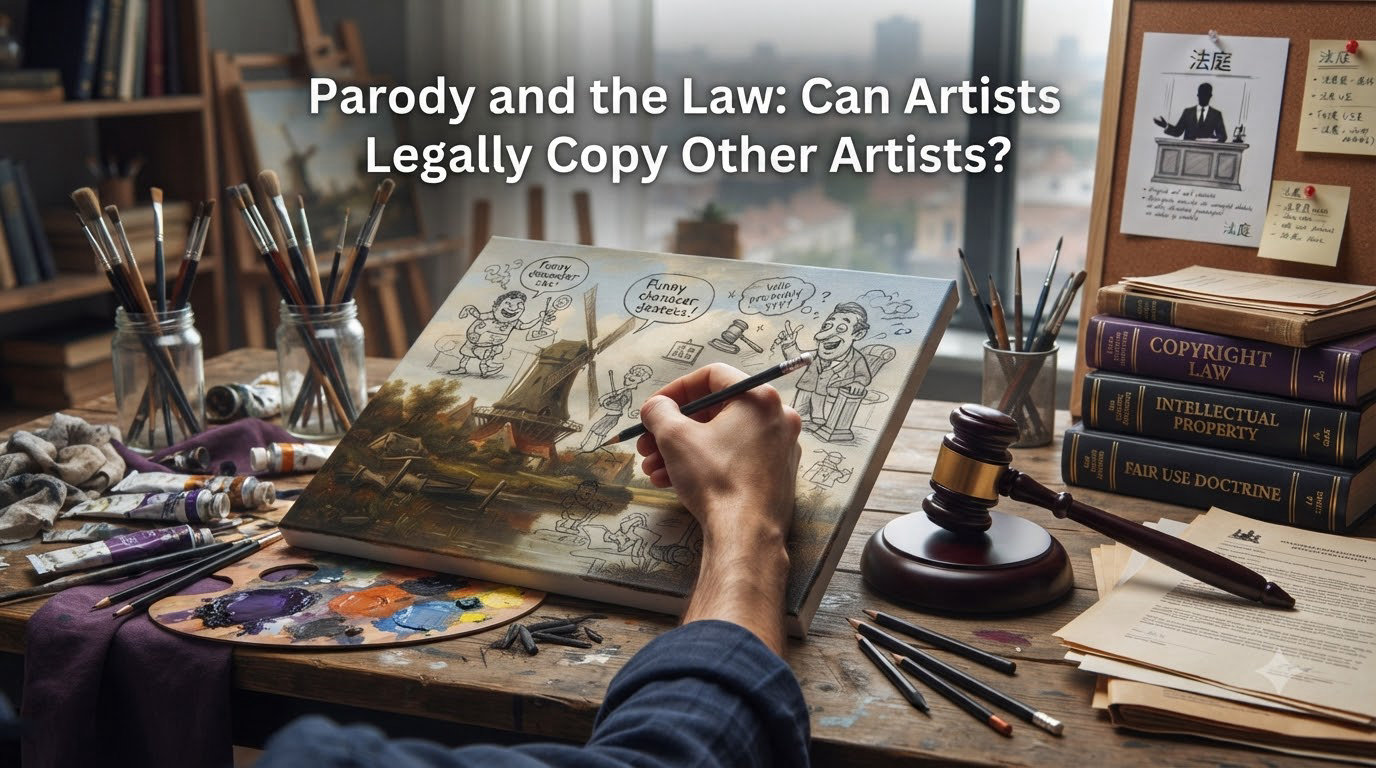
Every artist has faced the question at some point: Can I legally reference, borrow from, or transform someone else’s work in my own art? The short answer is yes, but only under specific conditions that fall under what courts call the fair use doctrine. Understanding parody and the law can mean the difference between creating transformative art that comments on culture and facing a copyright infringement lawsuit.
Our team has analyzed court cases, legal texts, and practical artist experiences to bring you this comprehensive guide. We will explain what makes a parody legally protected, how courts decide these cases, and what practical steps you can take to protect yourself while creating the art you want to make.
Important: This article provides general information about copyright law. It does not constitute legal advice. For specific questions about your work, consult a qualified attorney.
Table of Contents
What Is Parody and How Is It Different?
Parody is a work that imitates an original creative piece in an exaggerated, comedic way to criticize or comment on the original work itself. The key distinction is that parody must target the original work or its creator directly. It is not simply copying with a twist; it is transformative commentary that relies on recognition of the original to make its point.
Many artists confuse parody with other forms of creative borrowing. Understanding these distinctions matters because copyright law treats each category differently. A parody may be protected fair use, while a satire that merely uses a work to comment on something else may not receive the same protection.
| Form | Definition | Legal Protection |
|---|---|---|
| Parody | Imitates to comment on the original work | Strong fair use protection |
| Satire | Uses work to comment on society or other topics | Weaker fair use protection |
| Homage | Tribute showing respect to original artist | No automatic protection |
| Plagiarism | Copying without credit or transformation | Copyright infringement |
The Supreme Court clarified this distinction in the landmark Campbell v Acuff-Rose case. Justice Souter wrote that parody must actually comment on the original work, not merely use it as a vehicle to comment on something else. A Weird Al Yankovic song parody that mocks the original artist qualifies for stronger protection than a political cartoon that merely uses a copyrighted character to make an unrelated point about politics.
The Legal Foundation: Fair Use Doctrine
Parody is not automatically exempt from copyright law. Instead, it operates within a legal framework called the fair use doctrine, codified in Section 107 of the Copyright Act of 1976. This doctrine acknowledges that certain uses of copyrighted material, even without permission, serve public interests like free speech, education, and cultural commentary.
Fair use is what lawyers call an affirmative defense. This means that if you are sued for copyright infringement, you can raise fair use as a defense in court. It does not prevent you from being sued in the first place. Understanding this distinction is critical because fair use is determined on a case-by-case basis, and no bright-line rule exists that automatically makes any use fair.
The First Amendment plays a role here too. Courts recognize that parody represents a form of protected speech. Without some breathing room for artists to comment on the culture around them, copyright holders could effectively silence criticism of their work. This tension between protecting creators’ rights and allowing transformative commentary creates the legal space where parody exists.
The Four Factors Courts Use to Decide
When a parody case reaches court, judges analyze four specific factors established by Congress in Section 107. No single factor is determinative, and courts weigh them together based on the specific circumstances of each case. Understanding these factors helps artists evaluate their own work before potential legal issues arise.
1. Purpose and Character of the Use
The first factor examines whether the new work transforms the original by adding new meaning, expression, or message. Courts ask whether the new work merely supersedes the original or instead adds something new with a different purpose or character. The more transformative the new work, the less significant the other factors become.
Commercial use weighs against fair use, but it is not disqualifying. The 2 Live Crew case established that commercial parodies can still be fair use if sufficiently transformative. Courts look at whether the parody targets the original work for criticism or commentary, which strengthens the fair use argument regardless of commercial intent.
2. Nature of the Copyrighted Work
The second factor considers what type of work was copied. Using material from a highly creative, fictional work weighs against fair use because creators have stronger rights to control derivative uses of their most imaginative content. Copying from factual works or published works weighs more favorably.
However, this factor rarely decides parody cases alone. Because parody must necessarily conjure up the original work to make its point, courts recognize that parodists have limited choice in what to copy. You cannot parody Star Wars without referencing Star Wars, so the creative nature of the original becomes less significant in the analysis.
3. Amount and Substantiality of the Portion Used
The third factor asks how much of the original work was taken, both quantitatively and qualitatively. Copying the heart of the work, even a small portion, weighs against fair use. However, parody sometimes requires taking recognizable elements to make the commentary effective.
Courts have developed what they call the conjure up test for parodies. A parody can take enough of the original to conjure up the work in the audience’s mind, but no more than necessary. A visual artist might need to reproduce a character’s distinctive features to make the parody recognizable, but copying entire scenes or compositions when only one element is needed could weigh against fair use.
4. Effect Upon the Potential Market
The fourth factor examines whether the parody substitutes for the original work in the market or harms potential derivative markets. If consumers would buy the parody instead of the original, this weighs against fair use. However, parodies rarely serve the same market function as the works they critique.
Courts distinguish between market substitution and market harm caused by criticism. If a parody is so effective that it hurts the original’s reputation, that does not count as market harm for fair use purposes. Copyright holders cannot use the fair use doctrine to insulate their work from negative commentary, even commentary that might reduce its commercial value.
Famous Cases That Shaped Parody Law
Court decisions have established the boundaries of parody protection over decades. Understanding these cases helps artists see how the four factors apply in real-world situations. Each case below illustrates important principles that still guide fair use decisions in 2026.
Campbell v Acuff-Rose Music (1994)
The Supreme Court’s decision in Campbell v Acuff-Rose Music, Inc. remains the definitive case on parody and fair use. 2 Live Crew recorded a rap version of Roy Orbison’s Oh, Pretty Woman, transforming the romantic ballad into a bawdy commentary on the original. The music publisher sued for copyright infringement.
The Supreme Court ruled that 2 Live Crew’s version was fair use. Justice Souter emphasized that parody falls within fair use because it must necessarily mimic the original to create its commentary. The commercial nature of the rap song did not defeat the fair use claim because the work was sufficiently transformative. This case established that parody can be profitable and still protected.
South Park and Brownmark Films (2011)
Comedy Partners, the company behind South Park, created a parody of a viral YouTube video showing a toddler dancing to What What (In the Butt) by Samwell. The original video’s producer sued, claiming copyright infringement. The case reached the Seventh Circuit Court of Appeals.
The court ruled in favor of South Park, finding that their parody was clearly transformative. The South Park version used the song to mock viral video culture and the original music video itself, not merely to entertain using someone else’s work. This case reinforced that parody must target the original work directly to receive strong fair use protection.
Dr Seuss Enterprises v ComicMix (2019)
A more recent case involved a Dr Seuss and Star Trek mashup book titled Oh, the Places You’ll Boldly Go! The creators argued that combining Seuss’s style with Star Trek elements constituted parody. Dr Seuss Enterprises sued, and the case worked its way through the courts for years.
The Ninth Circuit ultimately ruled against the mashup creators. The court found that the book was not primarily commenting on Dr Seuss’s work but rather using Seuss’s distinctive style to tell an unrelated Star Trek story. This case illustrates the critical distinction between parody (commenting on the original) and merely borrowing a style for a different purpose. The creators had to pay damages and stop distribution.
Leibovitz v Paramount Pictures (1998)
Fashion photographer Annie Leibovitz sued Paramount over a Naked Gun movie poster that parodied her famous pregnant Demi Moore Vanity Fair cover. The poster featured Leslie Nielsen’s face superimposed on a pregnant body, mimicking Leibovitz’s lighting and composition.
The Second Circuit ruled that the poster was fair use as parody. The court found that the poster commented on the seriousness of Leibovitz’s original image by creating a ridiculous counter-image. By taking only what was necessary to conjure up the original photograph and transforming it for comedic effect, the poster qualified as protected parody.
Practical Guidance for Visual Artists
Understanding legal theory helps, but artists need practical guidance for their own work. The following framework can help you evaluate whether your parody has strong fair use protection before you publish, sell, or display it.
Ask yourself these questions:
Does your work comment on or criticize the original, or does it just use the original to comment on something else?
Are you taking only what is necessary to make your point, or are you copying more than needed?
Will consumers buy your work instead of the original, or does it serve a completely different purpose?
Can you document your transformative intent through sketches, artist statements, or commentary?
Weird Al Yankovic famously asks permission for his parodies even though he likely does not legally need it. This illustrates an important point: courtesy and legality are different things. Asking permission can avoid legal headaches even when you have a strong fair use claim. However, permission is not required for legitimate parody, and copyright holders cannot legally stop you from creating critical commentary.
If you plan to sell your parody commercially, document your transformative intent carefully. Keep sketches, write an artist statement explaining your commentary, and save any research that shows your work targets the original specifically. This documentation can help if questions arise later. When in doubt, consult an intellectual property attorney who can evaluate your specific situation.
FAQs: Common Questions About Parody Law
Is parody exempt from copyright law?
Parody is not automatically exempt from copyright law. Instead, parody is protected under the fair use doctrine, which provides a defense against copyright infringement claims. Courts evaluate whether a parody qualifies as fair use on a case-by-case basis using four statutory factors. Parody receives strong protection when it comments on or criticizes the original work rather than merely using it for unrelated purposes.
What is the difference between copying and parody?
Copying reproduces an original work without transformation or commentary, while parody imitates an original work to criticize or comment on it. The key distinction is purpose: parody requires that the new work target the original for commentary, humor, or criticism. A copy merely duplicates; a parody transforms. Courts look for whether the new work adds new meaning, expression, or message that comments on the original.
Do you need a license for a parody?
No, you do not need a license to create a parody that qualifies as fair use. If your work meets the legal requirements for parody by commenting on or criticizing the original work, permission from the copyright holder is not required. However, some artists choose to seek permission as a courtesy or to avoid legal disputes. Seeking a license can simplify matters but is not legally necessary for legitimate parody.
Can a parody be sued for copyright?
Yes, a parody can be sued for copyright infringement. Fair use is a defense raised in response to a lawsuit, not a shield that prevents lawsuits from being filed. Copyright holders can sue parody creators, and courts must then determine whether the parody qualifies as fair use. Most parody lawsuits are decided based on the four fair use factors, but being sued requires responding legally even if you ultimately win.
Do you need copyright permission to make a parody?
No, you do not need copyright permission to make a parody that qualifies as fair use. The fair use doctrine specifically allows unauthorized use of copyrighted material for purposes including criticism, comment, and parody. However, if your work does not meet the legal definition of parody by commenting on the original, or if it takes more than necessary from the original, it may not qualify as fair use and could constitute infringement.
Are parody logos legal?
Parody logos can be legal under fair use if they comment on or criticize the original brand or logo. However, trademark law adds additional complications beyond copyright. Parody logos must avoid consumer confusion about the source of goods or services. A logo that mocks a brand’s practices may be protected, while one that merely trades on a brand’s recognition to sell unrelated products may face trademark challenges. Each case depends on specific facts.
What is the parody exception in copyright law?
There is no specific parody exception in copyright law. Instead, parody falls within the broader fair use doctrine in Section 107 of the Copyright Act. Courts have interpreted fair use to protect parody because it serves public interests in free speech and cultural commentary. To qualify, the parody must comment on or criticize the original work, not merely use it for unrelated purposes. The four fair use factors determine whether any particular parody is protected.
Conclusion: Know Your Rights, Understand Your Risks
Parody and the law creates a complex but navigable space for artists who want to comment on the culture around them. The key is understanding that parody must target the original work itself for criticism or commentary, not merely use the original as a vehicle for unrelated messages. By keeping the four fair use factors in mind and documenting your transformative intent, you can create parody art with greater confidence in 2026.
Remember that fair use is a defense, not a guarantee against lawsuits. Each case is evaluated individually, and outcomes depend on specific facts. If you have questions about a particular work, consulting an intellectual property attorney is the best way to understand your specific situation. The freedom to parody is worth protecting, both for artists and for the culture we all share.
Disclaimer: This article provides general information about copyright law and parody. It does not constitute legal advice. For specific legal questions about your work, consult a qualified attorney in your jurisdiction.