
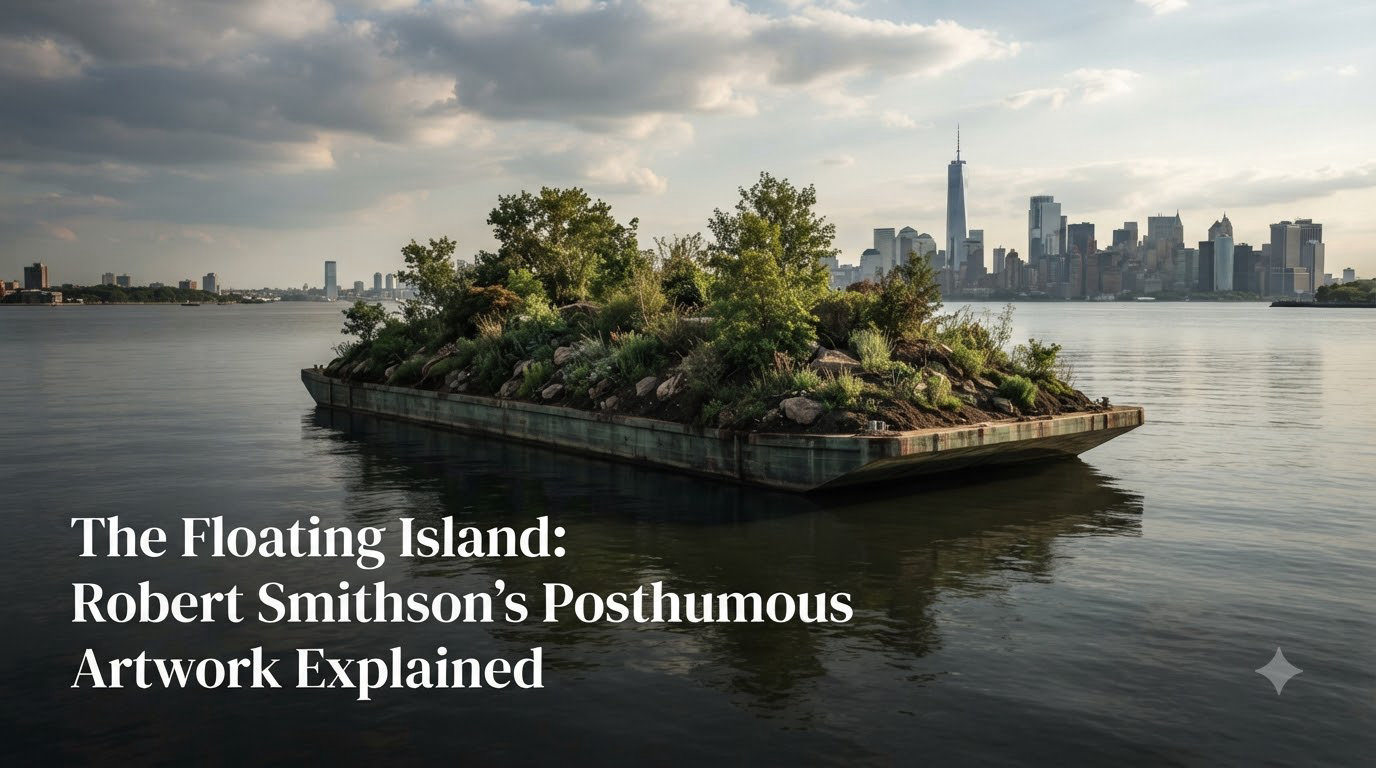
Imagine a floating fragment of Central Park drifting through the steel and glass canyons of Manhattan. Robert Smithson envisioned exactly this improbable image in 1970 when he drew The Floating Island to Travel Around Manhattan Island, a conceptual earthwork that remained trapped on paper for 35 years. The Robert Smithson Floating Island finally broke free in September 2005, becoming one of the most fascinating posthumous artwork realizations in contemporary art history.
Smithson died in a plane crash in 1973 at just 35 years old, leaving behind a collection of drawings and writings that would take decades to fully understand. His floating island concept lived on as a promise unfulfilled until a coalition of artists, curators, and the Minetta Brook organization brought it to life. Today, this land art piece stands as a testament to how conceptual art can transcend an artist’s lifetime to find new meaning in a changed world.
In this guide, we explore the complete story behind The Floating Island. From Smithson’s earthworks philosophy to the tugboat-pulled barge that finally circled Manhattan in 2005, every detail reveals how art can reimagine our relationship with urban landscapes and the natural world.
Table of Contents
Who Was Robert Smithson?
Robert Smithson emerged as one of the most provocative voices in American art during the late 1960s and early 1970s. Born in Passaic, New Jersey in 1938, he began his career as a painter before shifting his focus toward sculpture, photography, and eventually the large-scale land interventions that would define his legacy. His brief but intense career produced some of the most significant works in the earthworks movement before his untimely death.
The artist’s life ended tragically on July 20, 1973, when the small plane he chartered to document one of his Texas earthworks crashed near Amarillo. Smithson was just 35 years old, leaving behind a wife and fellow artist Nancy Holt, along with a body of work that would influence generations of land artists, environmental artists, and conceptual practitioners. His estate and Holt’s dedicated stewardship preserved his unrealized projects for future generations.
Smithson’s artistic philosophy centered on concepts that remain challenging today. He wrote extensively about entropy, the tendency of systems toward disorder and decay, viewing it not as something to fight but as a natural process to embrace in art. His ideas about site and nonsite, the dialectic between raw outdoor locations and their gallery representations, fundamentally reshaped how we think about where art can exist.
His most famous realized work, Spiral Jetty (1970), exemplifies these principles perfectly. The 1,500-foot coil of black basalt rocks and earth extends into Utah’s Great Salt Lake, changing appearance as water levels rise and fall, algae colonize its surface, and entropy slowly reclaims the materials. This acceptance of natural processes over permanence distinguished Smithson from traditional sculptors who sought to freeze their work in time.
The Floating Island to Travel Around Manhattan Island: The Original Concept
In 1970, the same year Smithson created Spiral Jetty, he produced a series of drawings for an even more ambitious project. The Floating Island to Travel Around Manhattan Island depicted a 30-by-90-foot barge loaded with earth, rocks, native trees, and shrubs being pulled by a tugboat around the perimeter of Manhattan. The drawing showed a portable Central Park fragment floating past the island’s industrial waterfront, creating a surreal collision between wilderness and urban infrastructure.
The concept carried deep art historical and cultural resonance. Smithson admired Frederick Law Olmsted, the landscape architect who designed Central Park in the mid-19th century. Olmsted had envisioned the park as a carefully constructed wilderness where city dwellers could experience nature without leaving Manhattan. Smithson’s floating island literalized this vision, detaching a piece of Olmsted’s pastoral creation and setting it adrift through the city’s working harbor.
The drawing captured Smithson’s characteristic wit and conceptual rigor. It proposed a mobile earthwork that would be truly site-specific yet constantly changing location, contradicting the very idea of fixed sites that dominated site-specific art discourse. The tugboat would pull this artificial ecosystem past piers, sewage treatment plants, and power stations, creating what Smithson might have called a nonsite relationship between the pastoral ideal and industrial reality.
Native vegetation played a crucial role in the concept. Smithson specified that the barge should carry actual earth from Central Park, along with indigenous trees and shrubs native to the New York region. This was not decorative landscaping but a functioning miniature ecosystem complete with soil biota, root systems, and the potential for continued growth and change. The floating island would literally be alive.
The water route itself mattered as much as the island’s cargo. Traveling up the Hudson River, around the Harlem River, down the East River, and through the Upper and Lower New York Bay, the barge would trace Manhattan’s liquid boundary. This circumnavigation suggested a kind of ritual journey, transforming the island into a processional object that revealed the city’s maritime context usually hidden by its dense urban fabric.
Land Art and the Earthworks Movement
Land art, also known as earth art or earthworks, emerged in the late 1960s as artists sought alternatives to the gallery system and commodification of art objects. Practitioners like Smithson, Michael Heizer, Walter De Maria, and Nancy Holt moved their work into deserts, lakes, and remote landscapes where it could not be bought, sold, or easily transported. The movement rejected the white cube gallery in favor of raw outdoor sites where natural processes became collaborators in the creative act.
Smithson positioned himself as both a participant in and theorist of this movement. His 1968 essay “A Sedimentation of the Mind: Earth Projects” articulated the philosophical underpinnings of land art, arguing that artists should work with geological time and natural forces rather than against them. The earthwork became a way to think about time, entropy, and humanity’s relationship to the planet in an era of growing environmental awareness.
The Spiral Jetty connection illuminates Smithson’s thinking about The Floating Island. Both projects began in 1970 and shared an interest in water, landscape transformation, and unconventional viewing experiences. Where Spiral Jetty engaged with the ancient salt lake and its primordial bacteria, The Floating Island confronted the industrial waterfront of America’s largest city. Each work responded to its specific environment while exploring broader themes about nature and culture.
Conceptual art principles permeated Smithson’s earthworks. The idea behind a work often mattered more than its physical realization, a radical position in an art world still obsessed with objects. Drawings, maps, and photographs became legitimate artistic outputs, documenting projects that might never be built or that existed only temporarily. This conceptual emphasis made posthumous realizations like The Floating Island possible, the idea retained its power independent of the artist’s physical presence.
Site-specific art emerged as a related but distinct category. While all land art is site-specific, not all site-specific art is land art. Smithson explored this distinction through his dialectic of site and nonsite, where materials removed from a location (the site) became transformed through their gallery presentation (the nonsite). The Floating Island complicated this relationship by being both mobile and site-specific, present yet constantly departing.
Why Smithson Never Realized The Floating Island
Robert Smithson’s death in 1973 prevented any attempt to realize The Floating Island during his lifetime. The drawing remained one of many unrealized projects in his archive, a promise waiting for circumstances that would allow its activation. Had he lived, Smithson might have pursued permits, funding, and partnerships to make the floating journey happen, though the challenges would have been significant even for a living artist of his stature.
Permitting and logistical obstacles would have tested Smithson’s patience and resources. Navigating the Hudson River, East River, and Harlem River required Coast Guard approvals, harbor clearances, and coordination with the busy commercial shipping lanes serving the Port of New York and New Jersey. The 1970s waterfront was still heavily industrial, with less public access and fewer precedents for art projects of this scale in active harbor waters.
Financial constraints also limited what Smithson could accomplish. His major realized works like Spiral Jetty relied on specific commissions or patron support. The Floating Island required a barge, tugboat rental, soil, plant materials, insurance, and crew for what might be weeks of navigation. Without institutional backing or a committed patron, the project remained economically unfeasible for an artist who often struggled to fund even simpler interventions.
The conceptual nature of the work may have suited Smithson’s philosophical interests perfectly. As a drawing and idea, The Floating Island existed in a state of potential, free from the compromises and entropy that physical realization inevitably brings. Smithson appreciated how concepts could remain pure while materials decayed, and perhaps he recognized that some ideas gain power precisely through their nonexistence.
The Posthumous Realization: September 2005
Thirty-five years after Smithson first drew The Floating Island, the Whitney Museum of American Art prepared a major retrospective of his work scheduled to open in 2005. Museum curators saw an opportunity to realize one of Smithson’s most compelling unrealized projects as a companion to the exhibition. They partnered with Minetta Brook, a New York-based nonprofit organization dedicated to supporting innovative art projects, to make the floating earthwork a reality.
Minetta Brook, named after a buried stream that once flowed through Manhattan, brought expertise in realizing complex environmental art projects. The organization coordinated with the Whitney, Smithson’s estate, horticultural consultants, maritime contractors, and city agencies to plan every aspect of the journey. Their work transformed Smithson’s 1970 drawing into detailed engineering specifications, horticultural plans, and navigation charts.
The realization followed Smithson’s specifications closely. A 30-by-90-foot barge received tons of soil harvested from Central Park, along with native trees and shrubs selected for their ability to thrive in the challenging conditions of a floating environment. The living cargo included oak, maple, and pine saplings, along with understory vegetation that created a recognizable fragment of Olmsted’s designed wilderness. This was not a decorative garden but a functioning ecosystem.
Between September 17 and September 25, 2005, a tugboat pulled the floating island on a circumnavigation of Manhattan. The journey traced the route Smithson had envisioned, moving up the Hudson River, around the Spuyten Duyvil at the island’s northern tip, down the Harlem River, along the East River, and back through the Upper and Lower New York Bay. The barge passed landmarks including the George Washington Bridge, the United Nations, the Brooklyn Bridge, and the Statue of Liberty.
Public response exceeded expectations. Thousands of spectators gathered along waterfront parks, piers, and bridges to glimpse the unlikely sight of a floating forest moving through the industrial harbor. The contrast between the pastoral barge and the surrounding urban infrastructure created exactly the dialectical tension Smithson had imagined. Viewers experienced their city anew, suddenly aware of Manhattan’s identity as an island defined by water on all sides.
Documentary photographs and video captured the journey, creating a new layer of Smithson’s artistic archive. These records showed the floating island passing oil tanks, power plants, and sewage facilities, making visible the working waterfront that supports modern urban life. The images extended Smithson’s own photographic practice, which consistently sought to reveal the industrial and geological realities underlying contemporary experience.
Frequently Asked Questions
What is The Floating Island by Robert Smithson?
The Floating Island to Travel Around Manhattan Island is a conceptual land art project created by Robert Smithson in 1970. It envisioned a 30-by-90-foot barge loaded with earth, native trees, and shrubs from Central Park being towed by a tugboat around the perimeter of Manhattan Island. The artwork was realized posthumously in September 2005, thirty-five years after Smithson’s death.
What type of art was Robert Smithson creating?
Robert Smithson was a pioneer of land art, also known as earthworks or earth art. He created large-scale interventions in natural landscapes that engaged with geological processes, entropy, and the relationship between sites and their representations. His work bridged sculpture, conceptual art, and environmental art movements.
What art movement is Robert Smithson’s Spiral Jetty an example of?
Spiral Jetty (1970) is a foundational example of the land art or earthworks movement. This 1,500-foot coil of black basalt rocks extends into Utah’s Great Salt Lake, demonstrating Smithson’s interest in site-specific art, entropy, and the interaction between human-made forms and natural geological processes.
How did Robert Smithson think artists could impact the natural world?
Smithson believed artists should work with natural processes rather than against them. He embraced entropy and decay as creative forces, viewing art as a way to engage with geological time and environmental change. His earthworks were designed to evolve, erode, and transform through natural forces.
How was Robert Smithson’s Floating Island realized after his death?
The Floating Island was realized in September 2005 through a collaboration between the Whitney Museum of American Art and Minetta Brook, a nonprofit arts organization. They constructed a barge with Central Park soil and native vegetation, then towed it around Manhattan for nine days as part of a Smithson retrospective exhibition.
The Legacy of The Floating Island
The Floating Island represents something rare in art history, a posthumous artwork that maintained its conceptual integrity while gaining new meaning through temporal distance. The 2005 realization demonstrated how land art ideas can survive their creators, finding relevance in changed environmental and cultural contexts. What began as a 1970 drawing about Central Park and Manhattan’s waterfront became, in 2005, a meditation on memory, legacy, and the persistence of artistic vision.
The project inspired ongoing engagement with Smithson’s unrealized works. The Holt-Smithson Foundation, established by Nancy Holt before her death in 2014, continues to steward Smithson’s estate and support new research and realizations of his projects. The Island Project specifically extends Smithson’s floating island concept into new territories and interpretations, keeping the dialogue between art and environment alive.
Robert Smithson Floating Island stands today as a landmark in conceptual art history. It proves that the most powerful art ideas can transcend their moment of conception, waiting patiently for the world to catch up. Whether floating on a barge or existing as a drawing in a museum archive, the work continues to challenge how we think about nature, cities, and the boundaries between them in 2026.