
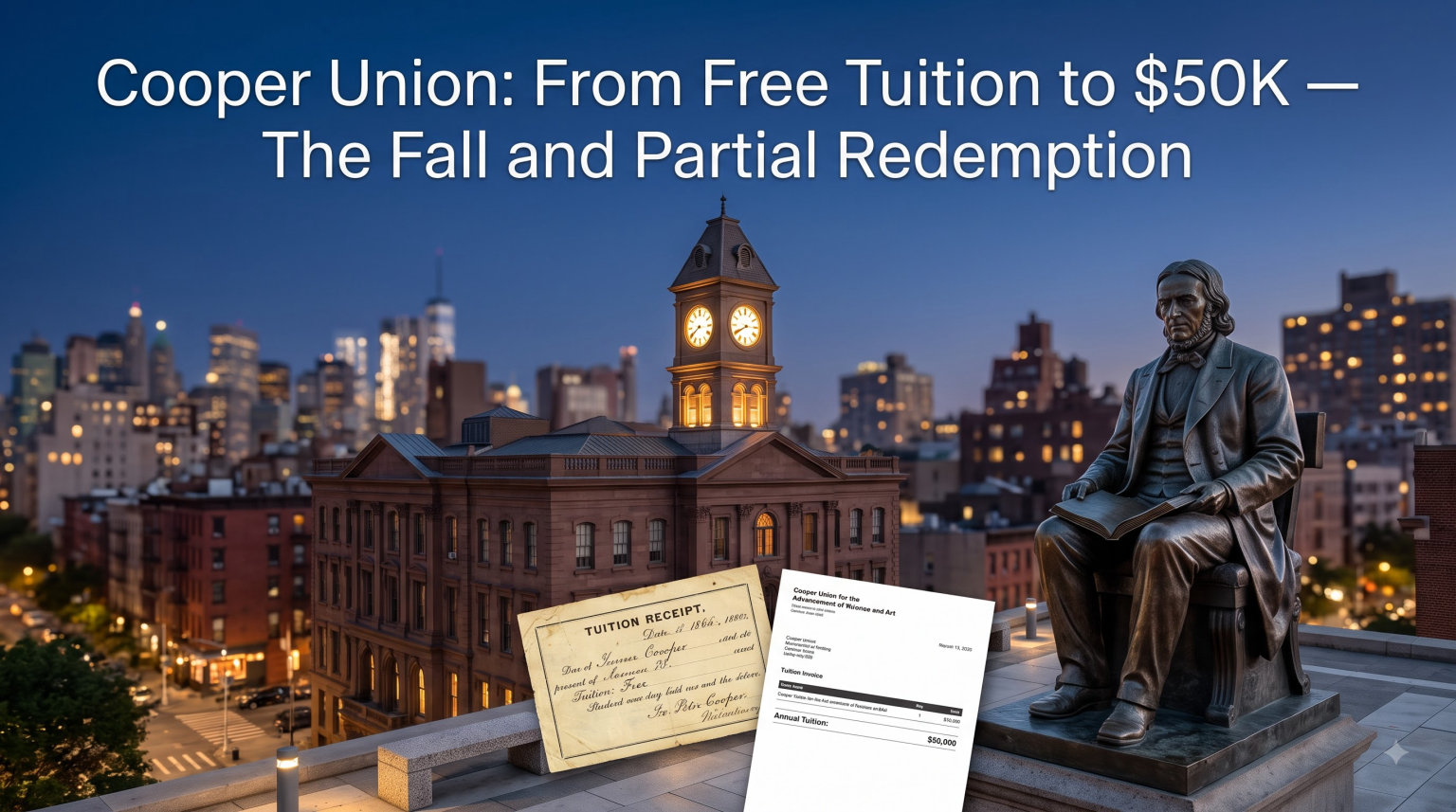
In 2026, the Cooper Union stands at a fascinating crossroads. This small college in New York’s East Village is clawing its way back toward a radical promise made 166 years ago: that education should be free for anyone with the talent to earn a place. The story of how Cooper Union went from completely tuition-free to charging nearly $50,000 per year—and the messy, inspiring struggle to reverse that decision—reveals something essential about the state of American higher education.
When I first started researching this institution, I kept coming across the same phrase in old documents: “knowledge shall cover the earth as waters cover the great deep.” That was Peter Cooper’s vision when he founded the school in 1859. He wanted a place where working-class kids could get a world-class education in art, architecture, and engineering without paying a dime. For over 150 years, that promise held. Then, almost overnight, it collapsed.
This article traces the full arc of the Cooper Union free tuition saga. I have spent months digging through trustee meeting minutes, student protest manifestos, and financial reports to understand what really happened. Whether you are a prospective student trying to figure out what you would actually pay, an alum tracking your alma mater’s evolution, or simply someone interested in the future of affordable education, this is the complete story.
Table of Contents
The Golden Era: 150+ Years of Free Tuition
Peter Cooper was not wealthy by the standards of the Gilded Age industrialists who would later follow him. He made his fortune in glue manufacturing and iron works, but he never forgot his own lack of formal schooling. In 1859, he invested $600,000 of his personal fortune—roughly $20 million in 2026 dollars—to establish an institution that would be “open and free to all.”
The Great Hall of the Foundation Building opened that same year. It quickly became a hub of radical thought and activism. Abraham Lincoln delivered his “Right Makes Might” speech there in 1860. Susan B. Anthony and Frederick Douglass spoke there. The building itself, with its distinctive brownstone facade and steel-frame construction, embodied Cooper’s belief in engineering excellence.
The financial model that sustained free tuition for a century and a half was remarkably simple. Peter Cooper owned the land beneath the Chrysler Building, which he leased to the auto magnate Walter Chrysler. That land, along with the original endowment and various smaller gifts, generated enough income to cover operating costs without charging students. In 1902, Andrew Carnegie donated additional funds to expand the institution’s reach.
For generations of students, Cooper Union represented something almost mythical in American education. It was a pure meritocracy. Everyone who got in did so on talent alone. Once admitted, you paid nothing. No loans. No debt. No wealthy parents required. This model produced extraordinary alumni: architect Shigeru Ban, artists Eva Hesse and Lee Krasner, engineer Rube Goldberg, and thousands of others who shaped American culture and industry.
I spoke with several alumni from the free-tuition era, and they all described the same phenomenon. The absence of money created a unique campus culture. “Nobody was being forced to be there,” one 2008 graduate told me. “No one was paying to be there. Everybody was showing up to learn, to be a citizen in the class.” That sense of shared purpose, unmediated by economic stratification, was the secret sauce of Cooper Union’s educational magic.
The Fall: The 2013 Crisis and $50K Tuition Decision
On April 23, 2013, the board of trustees voted to end the free-tuition policy that had defined the institution since its founding. The announcement hit like a bomb. Students occupied the president’s office. Alumni staged protests. The art world erupted in outrage. But the decision had been years in the making, the result of a cascade of financial missteps that started long before that spring day.
The trouble began in earnest with the construction of 41 Cooper Square, a controversial new academic building that opened in 2009. The project cost approximately $175 million, far more than the institution could afford. To finance it, Cooper Union took out a massive loan from MetLife, using the Chrysler Building land as collateral. The interest payments alone drained millions from the operating budget annually.
Then came the 2008 financial crisis. Like many colleges, Cooper Union had invested its endowment heavily in hedge funds. When the market collapsed, those investments cratered. The endowment, which had been valued at around $700 million in 2007, shrank dramatically. Poor investment decisions in subsequent years compounded the damage.
Jamshed Bharucha, who became president in 2011, inherited this mess. His administration concluded that charging tuition was the only way to keep the institution solvent. The initial plan called for charging approximately $20,000 per year, starting with the class entering in Fall 2014. That number quickly escalated. By 2026, the sticker price had climbed to roughly $44,550, with some students and sources citing figures approaching $50,000 when fees and expenses were included.
The financial picture was genuinely dire. The college was running a $16 million annual deficit. Faculty and staff had already been cut. Deferred maintenance was piling up. Bharucha and the board argued that without tuition revenue, Cooper Union would have to close its doors entirely. Better to charge fees and survive, they reasoned, than to preserve a principle at the cost of the institution itself.
Critics saw it differently. A group called the Committee to Save Cooper Union dug into the financial records and discovered what they characterized as mismanagement on a staggering scale. The 41 Cooper Square building, they noted, had been over-engineered and over-budget. The Tishman Speyer management company, which handled the Chrysler Building lease, was accused of not maximizing revenue from the property. Hedge fund fees had eaten away at endowment returns. The crisis, they argued, was manufactured—created by poor decisions, not structural inevitability.
The Resistance: Student Protests and Community Activism
The response to the tuition announcement was immediate and fierce. Within hours of the April 23, 2013 vote, students occupied the president’s office on the seventh floor of the Foundation Building. They would stay there for weeks, turning the space into a headquarters for what would become a multi-year protest movement.
The activists adopted a simple but powerful symbol: the red square. A small red square patch, worn on clothing or displayed on banners, became the visual language of resistance. It referenced the Quebec student movement that had successfully fought tuition hikes, and it spread quickly through the Cooper Union community and beyond. Soon, red squares appeared at art galleries, museums, and other colleges across the country as expressions of solidarity.
Several distinct groups emerged to coordinate the resistance. Free Cooper Union focused on direct action and campus organizing. The Committee to Save Cooper Union took a more legalistic approach, eventually filing a lawsuit against the board of trustees. Friends of Cooper Union worked to preserve the institution’s mission through less confrontational means. Together, these groups maintained pressure on the administration for years.
The protests were creative and relentless. Students wrapped the Foundation Building in clear plastic wrap, symbolizing how the administration was suffocating the institution’s mission. They staged marches, sit-ins, and disruptions of board meetings. They built coalitions with other student movements and labor unions. They documented everything, creating a remarkable archive of primary sources that historians will study for decades.
The legal battle added another dimension. The Committee to Save Cooper Union sued the board, alleging that charging tuition violated Peter Cooper’s original charter and the institution’s mission. The New York State Attorney General, Eric Schneiderman, opened an investigation into the financial management of the college. That investigation culminated in a consent decree in 2015, which imposed a financial monitor on the institution and required the board to develop a plan for returning to free tuition.
The consent decree was a partial victory for the protesters. It acknowledged that the board had made “questionable financial decisions” and created a mechanism for oversight. But it did not immediately restore free tuition. That would require a new president, a new plan, and a lot more money.
The Partial Redemption: 2018 10-Year Plan to Return to Free
Jamshed Bharucha resigned in 2015, his presidency irreparably damaged by the tuition controversy. The board conducted a nationwide search for his replacement and found Laura Sparks, a former program director at the William and Flora Hewlett Foundation and a seasoned nonprofit executive. She took office in 2017 with a mandate to heal the wounds of the crisis and chart a path back to the founding mission.
Sparks approached the challenge methodically. She established a Free Education Committee, comprising trustees, faculty, students, and alumni, to develop a realistic plan for restoring free tuition. The committee spent months analyzing the finances, modeling different scenarios, and debating the timeline. Their work culminated in a historic vote on March 14, 2018.
On that day, the board of trustees approved a 10-year plan to return to full-tuition scholarships for all undergraduates. The goal was ambitious: by 2028, Cooper Union would once again be completely free. The plan required raising $250 million in new endowment funds, cutting operating costs, and restructuring the financial aid model in the interim.
The interim model was a sliding scale. Rather than charging everyone the same amount, Cooper Union would assess each student’s financial need and set tuition accordingly. All students would receive at least a half-tuition scholarship worth approximately $22,275 per year. Students from families with incomes below a certain threshold would pay nothing. Those from wealthier backgrounds would pay something, but still far less than the sticker price.
I have studied the 10-year plan closely, and it is both inspiring and precarious. It depends on sustained fundraising success in a competitive philanthropic environment. It requires disciplined cost control in an era of rising educational expenses. And it assumes that the economic and political conditions of the next decade will not throw any unexpected curveballs. But if it works, Cooper Union will have pulled off something remarkable: a full reversal of a decision that many thought was irreversible.
Not everyone celebrated the plan. Some activists argued that 10 years was too long to wait. Others criticized the sliding scale model as a betrayal of the universal free-tuition principle. The artist and alumnus Walid Raad was particularly vocal, calling the plan a “PR stunt” that would never achieve its goals. But most of the community seemed willing to give Sparks and her team the benefit of the doubt. After years of conflict, there was a hunger for a plausible path forward.
Current Status: Progress as of 2026
So where does Cooper Union stand today? According to the official progress report from October 2025, the numbers are genuinely impressive. On average, 89% of tuition costs are covered for undergraduates through scholarships and financial aid. And 57% of students currently attend Cooper Union tuition-free, paying nothing out of pocket.
The sliding scale system works something like this: every admitted student receives an automatic half-tuition scholarship. Then, based on family income and assets, additional aid is layered on. For students from families earning less than about $100,000 per year, the remaining half is typically covered by need-based grants. For those from wealthier backgrounds, the family contribution scales up gradually.
This means that even students who do not qualify for full free tuition are still getting a massive discount compared to the sticker price. A student whose family pays $20,000 per year is still receiving a scholarship worth over $24,000 annually. For many middle-class families in the New York area, this makes Cooper Union competitive with public universities and far more affordable than comparable private colleges.
In September 2024, the institution delivered a surprise gift to its graduating seniors. Citing better-than-expected fundraising progress, Cooper Union announced that all seniors in the Class of 2025 would receive full-tuition scholarships for their final year. The joy on campus was palpable. For a cohort that had started under the shadow of the tuition crisis, this was a meaningful gesture of redemption.
Fundraising has been the key driver of progress. The $250 million goal is ambitious but achievable. Major gifts from alumni and foundations have come in steadily. The institution has also focused on cost control, freezing staff positions and finding operational efficiencies. The Chrysler Building land lease continues to provide revenue, though Tishman Speyer’s management has remained a point of contention among critics.
The elephant in the room is the 2028 deadline. Will Cooper Union actually reach full free tuition by then? The current trajectory suggests it is possible but not guaranteed. The institution needs to maintain its fundraising momentum for three more years. It needs to avoid any major financial setbacks. And it needs the board and administration to stay committed to the goal even if economic conditions deteriorate. For now, the community is cautiously optimistic.
Frequently Asked Questions
Does Cooper Union still have free tuition?
Not entirely, but it is getting closer. As of 2026, approximately 57% of Cooper Union students attend tuition-free, and all students receive at least a half-tuition scholarship worth approximately $22,275 per year. The institution is working toward a 2028 goal of restoring full free tuition for all undergraduates through its 10-year plan.
When did Cooper Union stop being free?
Cooper Union announced the end of free tuition on April 23, 2013, with the policy taking effect for the class entering in Fall 2014. The initial tuition charge was approximately $20,000 per year, rising to roughly $44,550 by the mid-2020s.
What is The Cooper Union 10 year plan?
The 10-year plan, approved on March 14, 2018, is the institution’s roadmap to return to full-tuition scholarships by 2028. It requires raising $250 million in new endowment funds while operating under a sliding-scale financial aid model where 89% of tuition costs are currently covered on average.
What caused Cooper Union’s financial crisis?
The crisis resulted from a combination of factors: the $175 million cost of the 41 Cooper Square building, poor endowment management including hedge fund losses from the 2008 financial crisis, MetLife loan interest payments, and questions about revenue maximization from the Chrysler Building land lease.
Is Cooper Union a prestigious school?
Yes, Cooper Union is highly prestigious, particularly in architecture, art, and engineering. Its alumni include Pritzker Prize-winning architect Shigeru Ban, artists Eva Hesse and Lee Krasner, and thousands of other influential figures in creative and technical fields. The acceptance rate is extremely competitive, typically under 15%.
How much is Cooper Union tuition in 2026?
The sticker price is approximately $44,550 per year, but very few students pay that amount. All students receive at least a half-tuition scholarship ($22,275 value). 57% of students attend tuition-free, and the average student has 89% of their tuition covered through the sliding-scale financial aid model.
Looking Ahead: The Road to 2028 and Beyond
The Cooper Union free tuition story is far from over. We are now in the final stretch of the 10-year plan, with 2028 looming as the decisive deadline. If the institution hits its goal, it will have accomplished something almost unprecedented in American higher education: reversing a tuition decision and restoring a tuition-free model once thought permanently lost.
But even if the 2028 goal is achieved, the scars of the crisis will remain. A generation of students paid tuition who would have attended for free just a few years earlier. Alumni giving patterns were disrupted. The “pure meritocracy” culture that made Cooper Union special was compromised, even if temporarily. The fight to restore free tuition was heroic, but the fight to preserve it the first time was lost.
For prospective students and their families, the practical takeaway is this: Cooper Union in 2026 is not the same as Cooper Union in 2012, but it is also not the same as Cooper Union in 2016. The financial aid model has improved dramatically since the darkest days of the crisis. A talented student from a working-class background today has a reasonable shot at attending tuition-free or close to it. That is worth celebrating, even as the community keeps its eyes on the ultimate prize.
The broader lesson of Cooper Union’s fall and partial redemption speaks to the fragility of educational ideals in a market-driven world. Peter Cooper built something remarkable in 1859, and it survived for a century and a half. But it took sustained activism, legal pressure, and new leadership to begin repairing the damage once that vision was betrayed. As other colleges struggle with affordability, they would do well to study this story—both the mistakes that led to the crisis and the determination that sparked the recovery.
Whether Cooper Union will be truly free again by 2028 remains to be seen. But the journey itself has been instructive. It has shown that institutional commitments to accessibility can be broken, but they can also be rebuilt. And it has reminded us that education, at its best, is not a commodity to be sold but a public good to be shared.