
The Bruce High Quality Foundation members are an anonymous group of five to eight rotating artists, most of whom are Cooper Union graduates based in Brooklyn, New York. Founded in 2004, this Bruce High Quality Foundation uses humor, performance, and satire to critique the commercial art world.
If you’ve searched for their names and come up empty, that’s by design. The collective intentionally hides individual identities to make a philosophical point: art should stand on its own, free from the cult of personality that drives art market prices.
In this guide, I’ll walk you through who the collective is, why anonymity matters to their work, and what we actually know about the people behind the masks. I’ll also cover their influential art school, the Whitney Biennial appearance, and how they fit into the broader landscape of 21st-century anonymous art collectives.
Table of Contents
What Is the Bruce High Quality Foundation?
The Bruce High Quality Foundation is a Brooklyn-based art collective that has been operating under a shared pseudonym since 2004. The “Bruce High Quality” name comes from a fictional artist persona invented by the group, a deceased bohemian figure whose legacy they claim to steward.
Officially, the collective treats itself as a nonprofit organization, not a group of individual artists. Members come and go, but the identity of “Bruce High Quality” stays constant. According to Wikipedia, the membership rotates between five and eight people at any given time.
The group’s work spans performance art, sculpture, video, public interventions, and curated exhibitions. Their signature style mixes art historical references with biting humor, often lampooning the very institutions that exhibit them.
Why Does the Collective Stay Anonymous?
Anonymity is the core artistic statement. By refusing to credit individual members, the collective rejects what Wikipedia describes as “the star-making machinery of the art market.” When you can’t attach a famous name to a painting, the work has to speak for itself.
This philosophy connects them to a long lineage of anonymous or pseudonymous artists. Marcel Duchamp created the alter ego Rrose Sélavy in the 1920s. Banksy has hidden behind a pseudonym for decades. More recently, the collective Walid Raad’s Atlas Group used fictional historians to obscure real authorship.
For the Bruce High Quality Foundation, anonymity isn’t about hiding. It’s about challenging the assumption that artistic value flows from individual genius. Their argument: if the art market collapsed tomorrow, would we still need to know who painted what?
Who Are the Members of the Bruce High Quality Foundation?
The Bruce High Quality Foundation members are a deliberately undisclosed group of five to eight rotating artists. Press and academic sources have identified several names associated with the collective over the years, though the group itself has never confirmed an official roster.
Names that have appeared in connection with the collective include Vito Schnabel (son of painter Julian Schnabel), fellow Cooper Union alumni, and a rotating cast of collaborators who participate in individual projects. The Wikipedia entry on the collective lists the core membership as Cooper Union graduates who met during or shortly after their studies.
Because membership rotates, the lineup changes between exhibitions. Some artists participate in one project and step away from the next. This fluid structure makes the collective less like a band with fixed members and more like a recurring workshop where artists drop in and out.
The group has consistently refused to publish an official member list. Press inquiries about individual identities are typically met with statements about the collective’s commitment to anonymity and its philosophical opposition to personality-driven art markets.
What We Know About the Founding Members
The earliest documented members came out of Cooper Union’s art program in the early 2000s. They reportedly bonded over shared frustrations with the New York art world’s commercialism and a desire to make work that prioritized ideas over marketability.
Artforum notes that the group formalized in 2003, when a cohort of Cooper Union alumni organized to “maintain and promote the artistic legacy of Bruce High Quality,” a fictional artist whose biography the collective invented. The 2004 public emergence followed shortly after.
The founding cohort has remained largely intact in spirit, even as individual members have cycled through. This continuity gives the collective a stable artistic voice while still allowing fresh perspectives.
Associated Individuals and Collaborators
Over the years, several names have surfaced in connection with the collective. Vito Schnabel is among the most frequently cited, though he has never publicly confirmed or denied membership in a definitive statement.
Other Cooper Union alumni have been linked to specific projects, particularly the 2010 Whitney Biennial and the founding of BHQFU in 2009. The collective often collaborates with curators, musicians, and performers who participate in individual pieces without becoming long-term “members.”
This loose collaboration model means that anyone researching “Bruce High Quality Foundation members” will find more questions than answers. The collective has turned that ambiguity into a feature, not a bug.
The Cooper Union Connection
Cooper Union, the tuition-free college in New York’s East Village, has produced a remarkable number of influential artists. The Bruce High Quality Foundation draws most or all of its members from Cooper Union alumni, which gives the group a shared educational foundation.
The Cooper Union connection matters because it explains the collective’s intellectual orientation. Cooper Union’s art program emphasizes conceptual rigor, craft, and critical engagement with art history. Those values show up clearly in the collective’s work, from art historical references in their videos to the institutional critique embedded in their exhibitions.
Being Cooper Union graduates also shaped the collective’s later decision to found BHQFU, the free art school launched in 2009. Several members had experienced the value of free, intensive arts education firsthand and wanted to extend that opportunity to others.
Notable Projects and Artworks
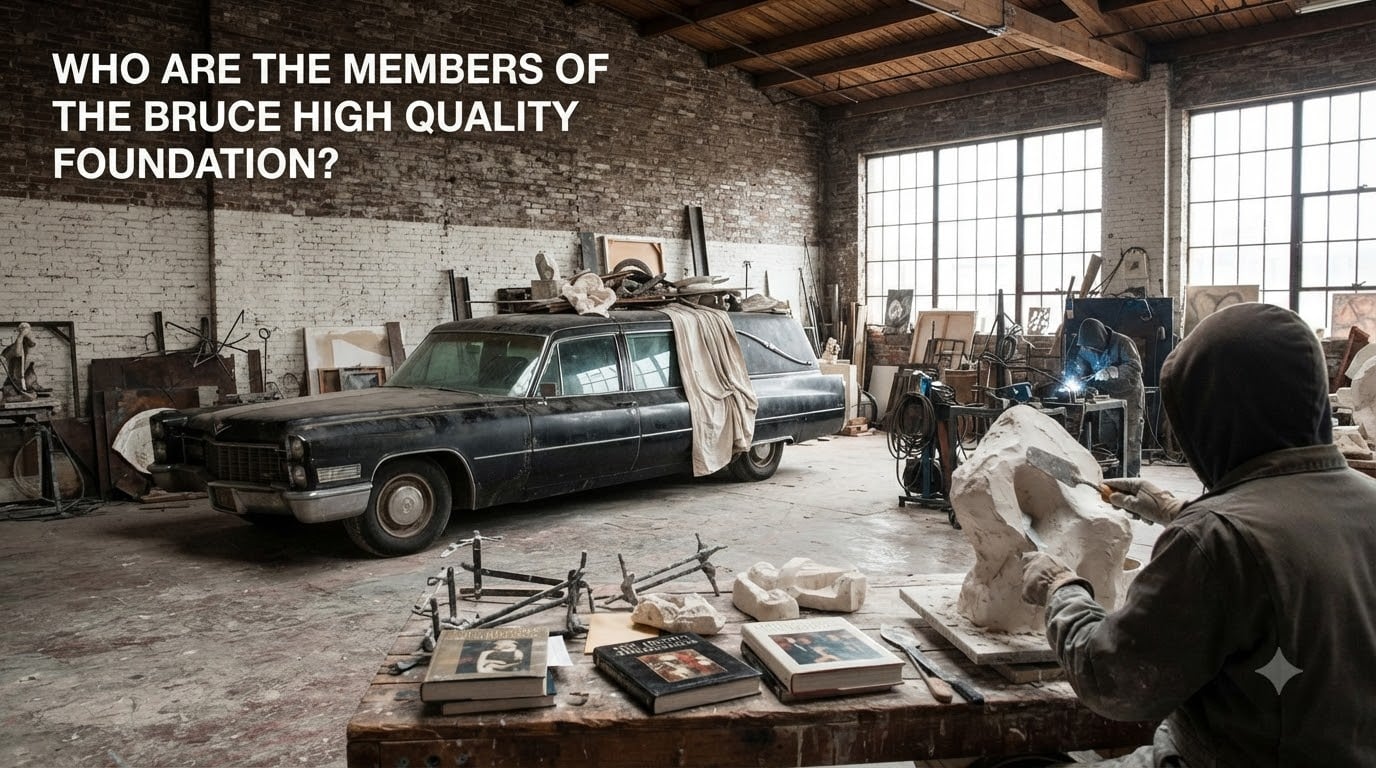
The collective’s project list reads like a guided tour through the contradictions of contemporary art. One of their most discussed pieces was the 2010 Whitney Biennial contribution, where they parked a 1971 Cadillac Miller-Meteor hearse outside the museum as a “portable museum” responding to Joseph Beuys’s “I Like America and America Likes Me.”
That piece alone captured the group’s style: deadpan humor, historical literacy, and a refusal to play by the museum’s usual rules. The Cadillac referenced both Beuys’s 1974 performance with a coyote and the American mythology of the open road.
Other notable projects include guided “art world bus tours” that satirized Chelsea gallery hopping, viral video works parodying art criticism, and public interventions that blurred the line between activism and performance. Their video works often featured members in costume, delivering scripted monologues loaded with art historical references.
In 2026, the collective’s auction market continues to validate their approach. A notable sculpture sold at Sotheby’s for $425,000, a striking figure for any anonymous group, regardless of their gallery pedigree.
The Bruce High Quality Foundation University (BHQFU)
In 2009, the collective launched BHQFU, the Bruce High Quality Foundation University, an unaccredited, tuition-free art school in New York. According to Creative Time, the school was founded as a collaborative project offering alternative art education.
BHQFU operates on a peer-recommendation admission model. Prospective students don’t submit portfolios; they’re nominated by existing community members. This admission structure mirrors the collective’s own opaque membership process.
The curriculum, as described in press coverage, focuses on “education in metaphor manipulation,” a phrase that captures the school’s emphasis on critical thinking, humor, and conceptual play. Classes are held in donated spaces, and instructors are working artists who volunteer their time.
BHQFU has since expanded beyond its original Tribeca launchpad. The school has hosted lectures, workshops, and exhibitions across New York, building a community of artists who share the collective’s skepticism toward traditional art world gatekeeping.
Reception and Legacy in the Art World
The collective has earned both critical praise and market success. The New York Times described their work as “subversive performance art, humorous videos and conceptual sculptures all infused with Ph.D. quantities of art history references.” Julia Chaplin, also writing in the Times, called them “the darlings of the art world.”
In 2010, ArtReview’s Power 100 list, an annual ranking of the contemporary art world’s most influential figures, placed the Bruce High Quality Foundation at a remarkable position for an anonymous collective. That ranking reflected both their institutional reach and their ability to shape conversations about art and value.
The Whitney Museum’s inclusion of the collective in the 2010 Biennial marked another milestone. Few anonymous groups have been given that level of institutional validation. Their biennial appearance placed them alongside some of the most celebrated artists working at the time.
Their legacy continues to shape conversations about authorship, anonymity, and the economics of contemporary art. Younger collectives have cited the Bruce High Quality Foundation as a model for collaborative, identity-flexible practice.
Frequently Asked Questions
Who founded the Bruce High Quality Foundation?
The Bruce High Quality Foundation was founded in 2003 and publicly emerged in 2004 by a group of Cooper Union alumni who wanted to maintain and promote the fictional legacy of an artist named Bruce High Quality.
How many members does the Bruce High Quality Foundation have?
The collective is made up of five to eight rotating and anonymous members at any given time, with membership fluctuating as artists join specific projects and step away from others.
Why does the Bruce High Quality Foundation stay anonymous?
The collective maintains anonymity to protest what it describes as ‘the star-making machinery of the art market,’ arguing that art should be evaluated on its own merits rather than on the fame of its individual creator.
What is BHQFU?
BHQFU is the Bruce High Quality Foundation University, an unaccredited, tuition-free collaborative art school launched in 2009 by the collective. It uses a peer-recommendation admission model and focuses on conceptual practice.
Is the Bruce High Quality Foundation still active?
Yes. The collective continues to produce work, exhibit internationally, and run BHQFU. Their auction market remains strong, and they continue to participate in major institutional exhibitions.
Final Thoughts on the Bruce High Quality Foundation
The Bruce High Quality Foundation members remain deliberately unknown, and that mystery is the point. By keeping their five to eight rotating identities private, the collective has built one of the most philosophically coherent arguments against personality-driven art markets in contemporary practice.
If you’re researching Bruce High Quality Foundation members for academic, curatorial, or personal interest, the most useful takeaway is this: the group treats its anonymity as a working artistic medium, not a publicity stunt. Their Cooper Union roots, their free art school BHQFU, and their institutional appearances at the Whitney Biennial all reinforce the same message.
For broader context on how this anonymous collective fits into the wider landscape, our guide to the most influential art collectives of the 21st century offers a useful comparison. The Bruce High Quality Foundation stands out as one of the few collectives that has used anonymity to scale institutional influence rather than retreat from it.