
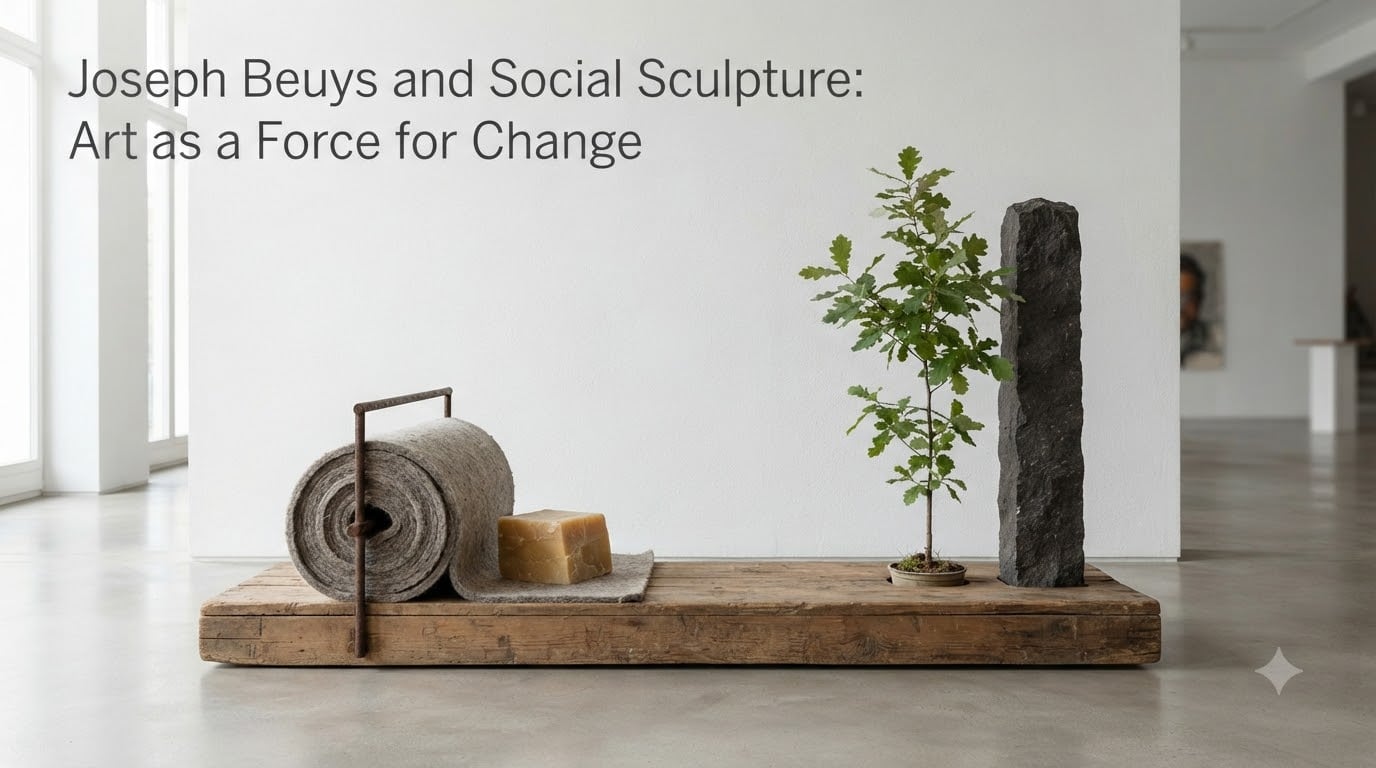
When I first encountered the phrase “social sculpture” years ago, I assumed it meant sculpture placed in public spaces. I was wrong, and the reality turned out to be far more ambitious. Joseph Beuys Social Sculpture is the idea that society itself is a work of art, and every human being is a sculptor shaping it through thoughts, words, and actions. In 2026, more than four decades after his death, Beuys’s expanded concept of art remains one of the most influential ideas in contemporary culture.
In this guide, I want to walk you through what social sculpture actually means, where it came from, and why it still matters. We will look at Beuys’s biography, his most famous projects, the philosophy behind his slogan “everyone is an artist,” and how you can apply these ideas today. Whether you are an art student, an activist, or simply curious, this is the practical deep dive I wish I had when I started learning about Beuys.
You may also recognize his name from our guide on performance art, where Beuys appears as one of the movement’s defining voices.
Table of Contents
What Is Social Sculpture: Joseph Beuys’s Expanded Concept of Art
Social sculpture is Joseph Beuys’s theory that everything is art and every aspect of life can be approached creatively, meaning everyone has the potential to be an artist who shapes society. Rather than limiting art to paintings hanging in galleries, Beuys proposed that art is a process, a way of thinking and acting that transforms individuals and the social structures around them. In his words, the formation of human beings and their environment was itself an artistic activity.
This idea flips the traditional relationship between artist and viewer. Instead of a small group of trained specialists creating objects for passive audiences, Beuys argued that each person contributes to a constantly evolving social artwork. He called this the “extended concept of art,” and it sits at the heart of his philosophy.
The core principles of social sculpture include:
- Creativity as a human right. Every person has creative capacity, regardless of training.
- Interdisciplinary practice. Beuys blended sculpture, performance, drawing, lecture, and political organizing without distinction.
- Participatory transformation. Art must engage the public and aim to change society, not just decorate it.
- Democracy of expression. Free dialogue and direct action are themselves creative acts.
- Holistic thinking. Drawing on anthroposophy and Rudolf Steiner, Beuys connected art to science, ecology, and economics.
Beuys first articulated this framework publicly in the late 1960s and refined it throughout the 1970s. He used the German term “Soziale Plastik” and saw it as a counterweight to what he viewed as a fractured, materialistic postwar culture. For him, art was not separate from life. Art was life, lived consciously.
Joseph Beuys Biography: The Artist Behind the Movement
Joseph Beuys was born on May 12, 1921, in Krefeld, Germany. His life story is inseparable from his art, and his wartime experience in particular shaped everything that came after. Understanding his biography is the fastest way to understand why social sculpture felt so urgent to him.
Beuys grew up in Kleve, near the Dutch border, where his father ran a business and his mother worked as a saleswoman. As a child he drew constantly and joined the local Hitler Youth, a fact that has been widely documented and which he later described as a youthful mistake. He showed early talent in natural science and eventually studied sculpture and drawing at the Kunstakademie Düsseldorf.
Wartime Experience and a Second Beginning
Beuys served as a Luftwaffe radio operator during World War II. In 1944 his plane was shot down over the Crimea, and he was severely wounded. The famous story, repeated by Beuys himself, claims that nomadic Tatars saved him by wrapping him in felt and fat. Whether or not every detail is historically accurate, Beuys used this myth as the foundation of his personal narrative.
Felt and animal fat became signature materials in his art. They symbolized for him warmth, protection, and the recovery of life after trauma. He also kept bees, a recurring motif in his work, because he saw them as models of warm, collective activity. Each of these choices traces back to his vision of a society rebuilt on care rather than destruction.
After the war, Beuys returned to the Düsseldorf Academy and became a student of Ewald Mataré, a sculptor known for his quiet animal carvings. Beuys graduated in 1951 and spent years building a teaching practice. In 1961 he was appointed professor of monumental sculpture, a position he would later lose because of his political activism.
Teacher, Mythmaker, Public Figure
By the 1960s, Beuys had transformed from a quiet sculptor into a magnetic public figure. He lectured constantly, drew on blackboards in front of audiences, and staged actions in galleries and on the street. Students adored him, critics often dismissed him, and a global audience watched as he pushed the boundaries of what an artist could be.
Our team has visited exhibitions of his work at the Walker Art Center and seen first-hand how audiences still respond to that presence, decades later. Few postwar artists have left such a deep mark on how we think about the role of art.
The Philosophy of Everyone Is an Artist
Joseph Beuys’s most famous statement is “Everyone is an artist.” It is also the most misunderstood. He did not mean that everyone can paint well or sculpt beautifully. He meant that everyone is capable of creative activity, and that this creative capacity is what shapes our social world. In his view, refusing to recognize this creative potential was itself a form of cultural damage.
Beuys developed this idea through several overlapping intellectual traditions. Anthroposophy, the spiritual philosophy founded by Rudolf Steiner, gave him a framework for thinking about human development as an ongoing artistic process. German Romantic ideas about the Gesamtkunstwerk, or total work of art, influenced his belief that society could be reshaped as a unified creative act. And his reading of the philosopher Novalis and the poet Schiller helped him link individual transformation with social renewal.
Creativity as a Biological and Social Force
One of Beuys’s most striking arguments was that human beings are not merely rational or economic creatures, but fundamentally creative ones. He often said that creativity is not reserved for a small elite. It is a basic human capacity that can be trained, suppressed, or liberated. To him, the future of society depended on whether people could reclaim this capacity.
This is why Beuys devoted so much energy to education. In 1973 he co-founded the Free International University (FIU) in Düsseldorf as an alternative learning space where art, science, and politics could be discussed on equal terms. The FIU held lectures, workshops, and conferences for years, and it became a laboratory for his ideas in practice.
The Extended Concept of Art
Closely tied to “everyone is an artist” is Beuys’s “extended concept of art,” or “erweiterter Kunstbegriff.” This is the formal name he gave to social sculpture. Under this framework, anything that shapes thought, language, or human action counts as art. A conversation, a protest, a curriculum, even economic policy can be approached creatively.
This expansion is not just theoretical. It is a political claim. If only a few specialists get to define what art is, then only those specialists get to shape the cultural imagination. Beuys wanted that power distributed more widely, and he believed art was the vehicle for doing so.
You can see echoes of this philosophy in our list of the 50 most important performance art pieces in history, where Beuys’s actions appear alongside work by his contemporaries.
Key Works: 7000 Oaks, I Like America, and Beyond
Theory matters, but Beuys’s work is best understood through specific projects. Three pieces in particular show what social sculpture looked like when he put it into practice, and each one gives a different angle on his philosophy.
7000 Oaks: Reforestation as Sculpture
The most ambitious social sculpture Beuys ever realized was 7000 Oaks, launched at documenta 7 in Kassel in 1982. Working with the city and residents, Beuys and his team began planting 7,000 oak trees across Kassel, each accompanied by a basalt stele placed beside it. The project aimed to transform the urban environment while making a direct political statement: cities should integrate nature rather than erase it.
The project was deliberately unfinished. Beuys died in 1986, and his son Wenzel continued planting until all 7,000 oaks were in the ground. Today the trees have grown into a living monument to Beuys’s belief that city planning, ecology, and art are a single practice. Every visitor to Kassel who walks the streets sees social sculpture in action.
I Like America and America Likes Me
In 1974, Beuys flew to New York for one of his most famous performances, I Like America and America Likes Me. He did not leave the René Block Gallery for the duration of the piece. Instead, he shared the space with a live coyote, wrapped in felt, holding a shepherd’s crook, and gradually earning the animal’s trust over three days.
The piece was a meditation on America, on the violence of colonization, and on the possibility of reconciliation between human beings and wild nature. It also demonstrated social sculpture’s interdisciplinary reach: a single action combined sculpture, drawing, performance, and political commentary without privileging any one medium.
The Free International University and the Organization for Direct Democracy
Alongside his gallery work, Beuys co-founded the Free International University for Creativity and Interdisciplinary Research in 1973. The FIU organized lectures, films, and public discussions that brought artists, scientists, and activists into the same room.
In 1971 Beuys also helped establish the Organization for Direct Democracy through Referendum, a political group that advocated for citizen-initiated plebiscites. Both projects treated political and educational work as art. For Beuys, founding an organization was as much a creative act as carving a sculpture.
Political Activism and the German Green Party
Beuys’s commitment to political action was not symbolic. He used his visibility to push for concrete change, especially around ecology, education, and direct democracy. In 1980 he joined the founding members of the German Green Party and remained active until his death.
His political work grew directly out of social sculpture. If society is a sculpture we all shape, then voting, organizing, and public dialogue are the chisels. Beuys saw no contradiction between his role as an artist and his role as a political actor. Both were part of the same practice.
Düsseldorf and the Battle over Teaching
Beuys’s political stance cost him his professorship at the Düsseldorf Academy in 1972. The state government dismissed him after he occupied the office of the rector and refused to limit admissions to oversubscribed classes. The fight became a public cause, with students and artists rallying in his support.
For Beuys, education itself was a form of social sculpture. Limiting access to knowledge was, in his view, a way of suppressing creative capacity. His dismissal made that point more clearly than any lecture could.
Green Politics and Ecological Vision
Beuys was an early and consistent voice for ecological thinking. Long before climate change became a mainstream issue, he argued that humans had to rethink their relationship with nature, soil, and the urban environment. The 7000 Oaks project is the clearest expression of this commitment, but it runs through nearly everything he did.
Social Sculpture’s Impact on Contemporary Art and Society
Beuys died in January 1986, but social sculpture did not end with him. His ideas have shaped everything from community-based art to ecological design to the contemporary teaching of art history. When art programs today speak of “social practice” or “socially engaged art,” they are working in a tradition Beuys helped create.
Contemporary artists who continue this lineage include Pedro Reyes, whose ongoing project San Quoted collects recipes for world peace from members of the public, and Theaster Gates, who turns abandoned buildings into community cultural hubs. Both projects share Beuys’s instinct for treating social acts as art and for engaging ordinary people as creative collaborators.
The influence extends beyond galleries. Community land trusts, participatory urban planning, civic technology, and design justice movements all echo Beuys’s claim that shaping our environment is a creative and therefore political act. Each time a city hosts a participatory budgeting process or a neighborhood organizes a public mural project, the spirit of social sculpture is at work.
Applying Social Sculpture Principles Today
You do not have to plant 7,000 oaks to live inside Beuys’s idea. Social sculpture is a practice, not a credential, and you can begin engaging with it in your own community. I have suggested some starting points to teams and educators I have worked with, and they tend to land well.
Three Ways to Begin
First, treat everyday conversation as creative work. How you speak with neighbors, colleagues, and strangers shapes the social fabric. Listening carefully, asking better questions, and refusing to flatten disagreement are all forms of social sculpture.
Second, find a local environmental project. Join a tree-planting day, a community garden, or a stream cleanup. These activities physically reshape the environment while building relationships. They also model the integrated, long-term thinking that Beuys practiced.
Third, host a small public gathering. A reading group, a film screening, a potluck, or a skill-share can function as a miniature Free International University. Beuys did not need a giant institution to start a conversation. Neither do you.
Social Sculpture in the Digital Age
What does social sculpture look like online? Open-source software, collaborative wikis, civic forums, and platform cooperatives extend Beuys’s logic into digital life. Each is a collective artwork, shaped by many hands, governed democratically, and aimed at shared benefit. The challenge is the same one Beuys faced: avoiding capture by private interests and keeping the work in the hands of those who build it.
This is also where critiques enter. Social sculpture assumes a level of agency and free time that not everyone enjoys. We will look at those critiques next.
Critiques and Limitations of Social Sculpture
Social sculpture is inspiring, but it has limits worth naming. First, not everyone has equal capacity to act as a “sculptor” of society. Structural inequalities of class, race, gender, and disability shape who can participate in creative public life. Beuys himself has been criticized for romanticizing individual agency without always addressing these constraints.
Second, the concept can blur the line between art and activism in ways that leave both disciplines underfunded. When art is everything, it can be hard to fund artists as artists. When activism is art, the political stakes can be aestheticized away. This is a tension that contemporary social practice artists continue to negotiate.
Third, social sculpture’s utopian ambition can lead to disappointment. Beuys’s Germany in the 1980s did not transform the way he hoped. Climate change has worsened, democracy is under strain, and the art world still concentrates power in a few wealthy cities. Acknowledging these realities makes the practice more honest, not less useful.
Frequently Asked Questions
Why is Joseph Beuys so important?
Joseph Beuys is important because he expanded the definition of art to include social, political, and educational activity. Through his concept of social sculpture, he argued that every human being can contribute creatively to shaping society, and he backed that claim with public projects like 7000 Oaks, the Free International University, and the founding of the German Green Party.
What was Joseph Beuys’s most famous statement about art?
Beuys’s most famous statement is u0022Everyone is an artist.u0022 He did not mean that everyone can paint or sculpt well. He meant that creativity is a basic human capacity and that recognizing it is essential to building a freer, more democratic, and more ecological society. The slogan became a rallying cry for artists, educators, and activists around the world.
How can art be used to promote social change?
Art can promote social change by making invisible structures visible, by giving voice to communities excluded from public debate, and by modeling alternative ways of organizing life. Beuys showed this through participatory projects, public lectures, political organizing, and long-term environmental work such as the 7000 Oaks reforestation of Kassel.
What was Joseph Beuys’s philosophy?
Beuys’s philosophy centered on social sculpture, the idea that society itself is an artwork shaped by the creative activity of all its members. Influenced by Rudolf Steiner’s anthroposophy and German Romantic thought, he believed that recognizing the creative potential of every person was the foundation of a just, ecological, and democratic culture.
What is social sculpture in art?
Social sculpture is the practice of treating society as a work in progress, shaped collectively through creative acts such as teaching, organizing, conversing, and building. Coined by Joseph Beuys, it asks us to recognize art in everyday human activity and to take responsibility for the world we are constantly making together.
Conclusion: Carrying Social Sculpture Forward in 2026
Joseph Beuys Social Sculpture remains one of the most generous and ambitious ideas in modern art. It tells us that creativity is not a private luxury but a shared practice, and that the world we live in is being sculpted every day by what we say, build, and ignore. Beuys believed, and I think he was right, that this recognition can change how we treat one another and the planet.
If you take one idea from this guide, let it be this: you are already participating in a social sculpture. The question is whether you do so consciously, with care, and in conversation with others. Plant a tree, host a conversation, organize your block, and teach someone a skill you have. Each of these is a small sculpture. Together, they are the world.