
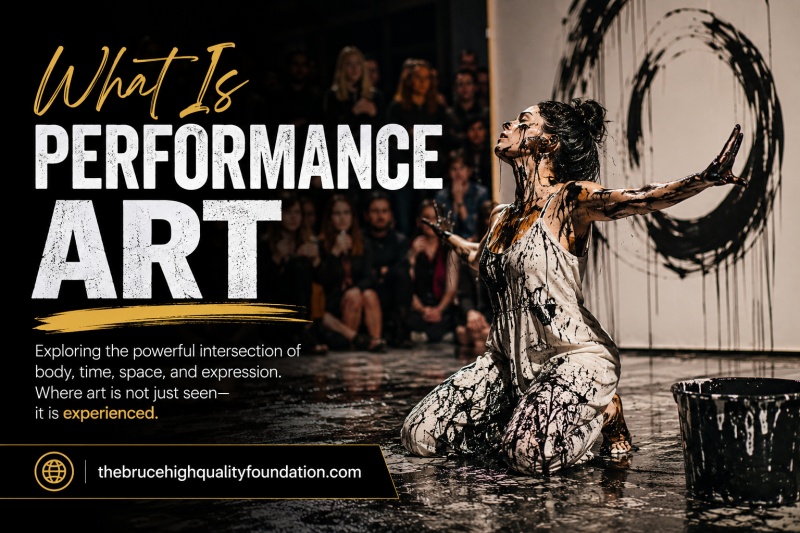
You are standing in a white gallery space. A person enters, moves slowly to the center, and stands completely still. Minutes pass. An hour passes. Nothing else happens. Is this art? You check your phone, wondering if you missed something. Other visitors seem transfixed. Welcome to the world of performance art, where the rules you learned about paintings and sculptures do not apply.
What is performance art? If you have ever felt confused, skeptical, or even annoyed by a performance you witnessed, you are not alone. I have spent years attending exhibitions, and I still remember my first performance art encounter. I did not know what to feel, how long to stay, or whether I was “getting it.” That uncertainty is actually part of the point.
This guide is for anyone who has asked why someone would sit in a chair for 736 hours, why an artist would let strangers use their body as an object, or whether performance art is just elaborate attention-seeking. By the end, you will understand the four pillars that define this art form, know how to interpret what you are seeing, and have practical tips for attending your first live performance.
Table of Contents
What Is Performance Art? A Definition for Beginners
Performance art is a live, time-based art form where the artist uses their body, actions, and presence as the medium to explore ideas, emotions, or social issues. Unlike traditional art forms that produce objects you can buy, sell, or hang on a wall, performance art exists only in the moment of its happening. It is ephemeral, meaning it disappears as soon as it ends.
Think of it this way. A painter uses paint and canvas. A sculptor uses stone or metal. A performance artist uses their own body, movement, voice, and relationship to space and audience. The artwork is the action itself, not any object left behind.
What makes performance art distinct from simply “doing something in front of people” is intention and context. The artist creates within a framework where the body, site, audience, and time become charged with meaning. A person lying on the floor in a subway is just resting. The same person lying on the floor in a gallery for six hours might be making a statement about vulnerability, labor, or stillness in a frantic world.
The Four Pillars of Performance Art
Every academic and practitioner I have encountered points to the same foundational elements. The Irish Museum of Modern Art describes these as the four pillars that support everything performance art does: body, site, audience, and time. Understanding these four elements is your key to unlocking any performance you encounter.
Body: The Artist as Medium
The body is everything in performance art. It is not just the tool the artist uses. It is the material, the canvas, the subject, and the object all at once. When Marina Abramovic stands in a gallery doorway for hours, her physical exhaustion becomes part of the work. When Chris Burden had himself shot in the arm, the real blood and real pain were non-negotiable components.
This embodied practice distinguishes performance art from theater. Actors pretend. They simulate emotions and actions. Performance artists typically do not pretend. If they appear fragile, they are actually fragile in that moment. If they endure discomfort, they are actually enduring it. This corporeal reality creates an intensity that representation cannot match.
The body in performance art is also political. Artists use their physical presence to address identity, gender, race, disability, and power. By putting their actual bodies on the line, they demand that viewers confront these issues as real, immediate, and unfiltered.
Site: Space as Meaning
Where a performance happens matters as much as what happens. Site-specific performance art responds to and transforms its location. A gallery, a street corner, a private home, or a natural landscape each brings its own history, politics, and energy to the work.
Joseph Beuys performed in galleries, but he also performed in classrooms, forests, and political conventions. Each space changed what the performance meant. When you attend a performance, ask yourself why this artist chose this specific place. What does the white cube of a gallery signify versus a public park? How does the architecture frame your perception?
Site also includes what artists call the “liminal space,” the threshold between art and life. Performance art often intentionally blurs these boundaries. It might begin in a gallery and spill into the street, or start as a lecture and transform into something unscripted. This fluidity keeps both artist and audience alert.
Audience: The Relational Dimension
In performance art, you are not a passive consumer. You are a participant, whether you like it or not. Your presence, your gaze, your reactions, even your decision to leave all become part of the artwork. This relational quality is unique to performance art and deeply unsettling for some viewers.
Marina Abramovic demonstrated this brilliantly in Rhythm 0 (1974). She stood passively for six hours while audience members could use 72 objects on her body, including a gun and a bullet. Initially gentle, the crowd grew increasingly aggressive. By the end, someone held the loaded gun to her head. When the performance ended and she became “herself” again, the audience fled. They could not face her as a person after treating her as an object.
This reveals the profound power of audience in performance art. You are not watching a finished product. You are completing the circuit. Your reactions, ethical choices, and presence are the final ingredients. This is why attending live performance feels so different from watching documentation later.
Time: The Durational Element
Performance art unfolds in real time. This sounds obvious, but it changes everything. A painting exists all at once. You can glance at it or stare for hours. Performance art forces you into its temporal rhythm. You cannot speed it up, skip ahead, or pause.
Durational works, where artists commit to extended periods of action or inaction, test the limits of attention and endurance. Tehching Hsieh punched a time clock every hour for an entire year. Marina Abramovic and Ulay sat back-to-back with their hair tied together for 17 hours. These extreme commitments make time itself visible and felt.
Time also relates to ephemerality. The performance happens, then it is gone. Documentation exists, photographs and videos remain, but these are traces, not the work itself. This resistance to commodification, to being bought and owned, is politically significant. It insists that some experiences cannot be captured, packaged, or sold.
A Brief History of Performance Art
Understanding where performance art came from helps you recognize its concerns and revolutionary spirit. This art form did not emerge from nowhere. It developed as a direct challenge to art world conventions and social norms.
From Futurist Manifestos to the 1960s Revolution
The seeds were planted in the early 20th century. Futurist artists in Italy staged provocative evening events where they read manifestos, played noise music, and provoked audiences to riot. Dada cabarets in Zurich during World War I used performance to mock bourgeois culture and the logic that had led to global destruction. These were not yet “performance art” as we know it, but they established that live action could be art.
The 1960s marked the true emergence. As conceptual art questioned whether art needed to be a physical object, performance art offered the ultimate dematerialization. The body could be the artwork. The event could be the artwork. Nothing needed to be produced, sold, or collected. This was radical in an art market driven by objects and ownership.
Happenings, pioneered by Allan Kaprow, blurred art and life. Fluxus artists like Yoko Ono created simple instruction-based works that anyone could perform. These movements emphasized process over product, experience over object.
The Golden Age: 1970s to Present
The 1970s saw performance art mature into a recognized medium. Feminist artists used the form to reclaim female bodies from art historical objectification. Adrian Piper, Ana Mendieta, and Carolee Schneemann created powerful works exploring identity, violence, and presence. This was also when the term “performance art” entered common usage, distinguishing these practices from theater and dance.
By the 1980s and 1990s, performance art had become institutionalized. Museums created performance departments. Documenta and the Venice Biennale included live works. Some critics worried this mainstream acceptance diluted the form’s radical potential. Others saw it as validation that performance had become central to contemporary art.
Today, performance art is everywhere. From Tino Sehgal’s museum interventions to hip-hop theater to social practice art engaging communities, the live, embodied, time-based artwork has become a dominant mode. 2026 finds performance art in biennials, galleries, public spaces, and even online streaming platforms.
Performance Art vs. Performing Arts: Understanding the Difference
This distinction confuses almost everyone at first. Performance art and performing arts sound identical, but they differ fundamentally in intent, process, and outcome.
Performing arts include theater, dance, opera, and music. These disciplines have established techniques, training systems, and traditions. A dancer studies for years to execute precise movements. An actor rehearses lines to convincingly portray a character. The goal is usually representation, entertainment, or the communication of a predetermined narrative.
Performance art typically rejects these conventions. The artist might have no training in theater or dance. There is often no script, no rehearsal in the traditional sense, and no goal of entertainment. The artist is not playing a character. They are presenting themselves, their body, their identity as the material.
The difference also lies in liveness. Theater performances aim to be identical each night. Performance art often changes based on the specific audience, space, and moment. It is less repeatable, more contingent, more risky.
Consider this comparison. In a Broadway show, the actor playing Hamlet pretends to be a Danish prince. In a performance art piece, the artist is simply themselves, in this space, with you, now. There is no fictional layer to penetrate. The meaning emerges from the real encounter between artist and viewer.
How to Understand and Interpret Performance Art
Now we address the question that brings most people to this guide. You are at a performance. Something is happening. You have no idea what it means or if it is good. What do you do?
5 Tips for First-Time Viewers
- First, trust your physical reactions. Performance art is designed to affect you physically before you understand it intellectually. Notice your discomfort, boredom, excitement, or confusion. These reactions are data. They tell you something about what the artist is doing.
- Second, resist the urge to decode immediately. Not every performance has a hidden message to unlock. Some works resist interpretation. The experience itself might be the entire point. Sit with uncertainty. That discomfort is often productive.
- Third, consider the context. Who is this artist? What is their background? What is happening in the world right now that might relate to this work? Context does not explain everything, but it helps.
- Fourth, pay attention to duration. How does your perception shift over time? Performance art often works slowly. The first five minutes might feel pointless. After thirty minutes, you might notice things you missed initially. Duration is information.
- Fifth, talk to other viewers afterward. Performance art benefits from collective interpretation. Other people saw things you missed. Your perspective enriches theirs. The conversation continues the work.
What to Look For During a Performance
Watch the artist’s relationship to their body. Are they comfortable or pushing physical limits? Is the body presented as strong, vulnerable, sexual, mechanical? Body language in performance art is intentional.
Observe how the artist uses the space. Do they stay in one place or move through the environment? How do they relate to architecture, objects, or boundaries? Spatial choices carry meaning.
Notice your own role. Are you watching from a distance or pulled into proximity? Can you touch the artist or are you strictly separated? These relational setups shape the work’s impact.
Finally, document how time feels. Does it drag or fly? Performance artists manipulate temporal experience deliberately. Your sense of time being stretched or compressed is part of what they are creating.
5 Iconic Performance Art Works Everyone Should Know
These works represent different approaches and eras. They are frequently referenced because they effectively demonstrate what performance art can do.
1. Marina Abramovic, Rhythm 0 (1974)
We have already discussed this work, but it deserves repeated mention. Abramovic stood passive for six hours with 72 objects available for audience use. The progression from flowers to scissors to a loaded gun revealed uncomfortable truths about human behavior when social constraints are removed. It is a masterclass in audience activation.
2. Chris Burden, Shoot (1971)
Burden had an assistant shoot him in the left arm with a .22 rifle from 15 feet away. The bullet grazed him. The entire performance lasted seconds, but the documentation and controversy lasted decades. Burden explored risk, trust, and the limits of art. It raised eternal questions about when art becomes self-harm.
3. Joseph Beuys, I Like America and America Likes Me (1974)
Beuys flew to New York, was transported by ambulance to a gallery wrapped in felt, and spent three days in a room with a wild coyote. He never touched American soil during the visit. The work addressed healing, Native American history, and cultural communication through symbolic materials and genuine encounter.
4. Tehching Hsieh, One Year Performance 1980-1981 (Time Clock Piece)
For one entire year, Hsieh punched a time clock every hour on the hour and photographed himself. He missed 133 punches out of 8,760 possible. The obsessive documentation of time, labor, and existence created a powerful meditation on duration and the industrial age.
5. Yoko Ono, Cut Piece (1964)
Ono sat on stage while audience members were invited to cut pieces of her clothing with scissors. The work explored gender, vulnerability, and the violence embedded in looking. It anticipated feminist performance art and remains chilling in its simplicity.
Frequently Asked Questions
What is performance art all about?
Performance art is about live, embodied artistic expression where the artist’s body becomes the medium. It explores ideas through real actions in real time, creating experiences that cannot be reproduced or owned. The art exists only in the moment of its happening, emphasizing presence, ephemerality, and the direct encounter between artist and audience.
What are the 5 elements of performance art?
The five core elements of performance art are: 1) Body – the artist’s physical presence as medium, 2) Time – the durational, real-time nature of the work, 3) Space/Site – the specific location and its meaning, 4) Audience – the viewers as active participants who complete the work, and 5) Action – the live, unmediated activities that constitute the artwork. These elements work together to create the unique experience of performance art.
Is performance art real art?
Yes, performance art is recognized as a legitimate and significant art form by museums, galleries, art historians, and collectors worldwide. Major institutions like MoMA, Tate Modern, and the Centre Pompidou have dedicated performance art programs. The form has been practiced since the early 20th century and has profoundly influenced contemporary art. What makes it ‘real art’ is its intentional use of artistic strategies to explore ideas, emotions, and social issues.
What is the difference between performance art and performing arts?
Performance art differs from performing arts (theater, dance, opera) in several key ways. Performance art typically lacks scripts, rehearsals, or fictional narratives. The artist is themselves, not a character. The work is often non-repeatable and changes based on audience and context. While performing arts aim for polished entertainment, performance art prioritizes raw presence, conceptual exploration, and the real encounter between artist and viewer.
How can I attend performance art events?
You can attend performance art at contemporary art museums, galleries, performance festivals, and university art departments. Check the events calendars of institutions like MoMA PS1, the Whitney Museum, local contemporary art centers, or international festivals like the Venice Biennale. Many cities have experimental performance venues. Tickets are often affordable or free. Arrive with an open mind, stay for the full duration if possible, and consider discussing the experience with other attendees afterward.
Conclusion: Why Performance Art Matters Today
Performance art matters because it insists on the value of live experience in an increasingly mediated world. Every day, we consume images, videos, and content through screens. Performance art demands that we show up, be present, and encounter another body in real space and real time.
The four pillars we explored, body, site, audience, and time, create a framework for experiences that cannot be downloaded, streamed, or owned. This resistance to commodification is political. It suggests that some things, presence, risk, endurance, encounter, cannot be bought or sold.
For beginners, the invitation is simple. Go see something live. Let yourself be confused. Let yourself be bored. Let yourself be moved without knowing exactly why. The meaning might not arrive during the performance. It might come hours later, in conversation, or years later, when you remember a moment of genuine human presence in a room full of strangers.
That is what performance art is. Not an object to decode, but an experience to have. Now you have the tools to enter that experience with curiosity instead of anxiety. The rest is up to you and whoever is brave enough to stand in that room and offer their body to your gaze.