
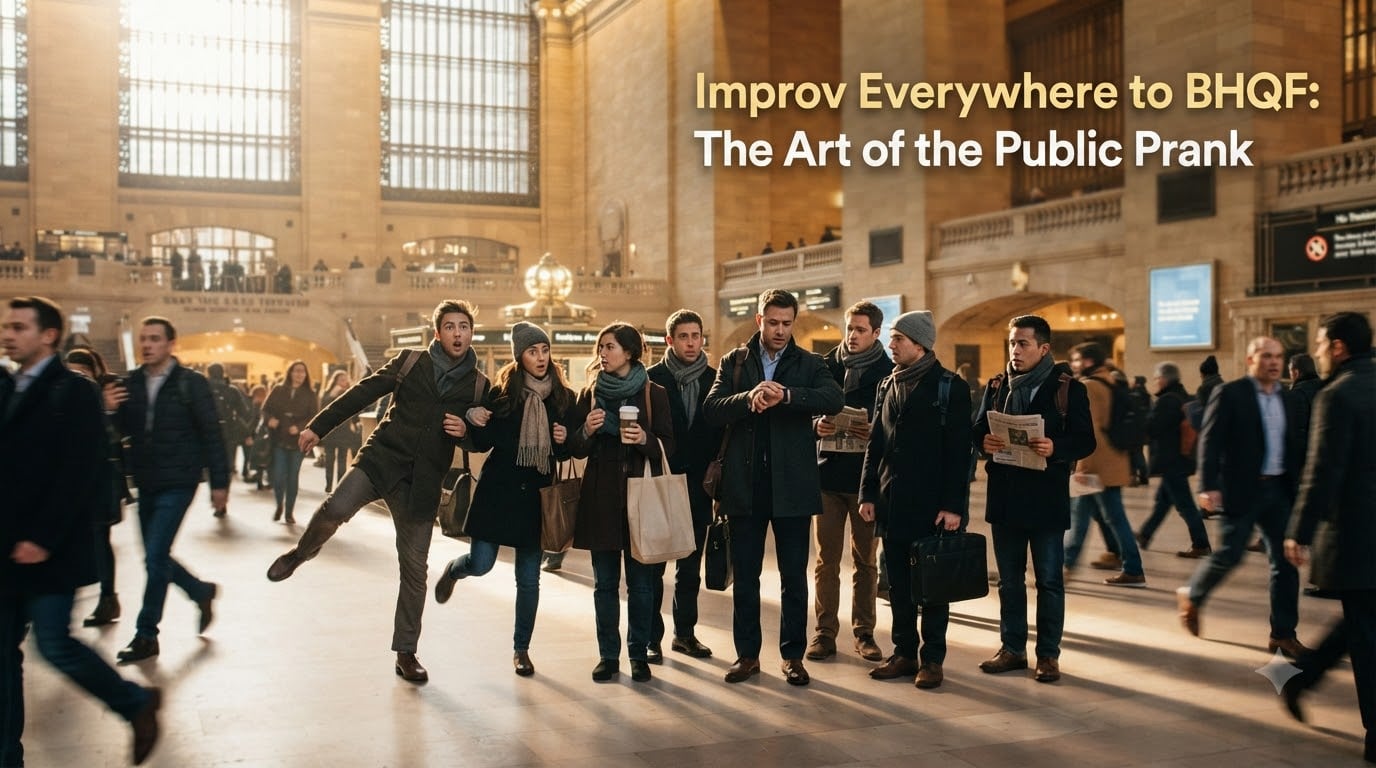
Picture this: a packed Grand Central Terminal in New York City, hundreds of commuters rushing to catch trains, and then, without warning, 207 people stop walking. They freeze in place like statues, holding the exact poses of a chaotic moment in time. Some hold coffee cups mid-sip. Others are frozen mid-stride, mid-laugh, mid-conversation. For five full minutes, the terminal becomes a living sculpture. Then, all at once, they unfreeze, applaud, and walk away as if nothing happened.
That was Frozen Grand Central, staged by Improv Everywhere in January 2007, and it remains one of the defining moments in the short history of public prank art. The video spread across the early internet like wildfire and helped turn a small New York comedy collective into a worldwide cultural reference point.
I have spent years following public prank art movements, and I keep coming back to two names: Improv Everywhere and BHQF, the Bruce High Quality Foundation. They emerged from different corners of the New York art world, used different tactics, and stayed loyal to different philosophies. Together, they defined what we now call public prank art. This guide explains how each collective started, what their missions were about, and why their work still shapes how we think about art in public spaces in 2026.
Table of Contents
What Is Improv Everywhere?
Improv Everywhere is a comedic performance art group based in New York City, formed in 2001 by Charlie Todd. The collective organizes surprise public events called “missions” in which a group of volunteer agents performs a synchronized but seemingly spontaneous act, while bystanders remain unaware that anything has been staged. The group has since completed more than 200 missions, and their videos have racked up over 470 million views on YouTube.
The core idea is simple. A handful of people meet online, get briefed on a scenario, and then carry it out in a crowded public place. Everyone around them thinks it is real. That tension between the staged and the spontaneous is the entire artistic medium.
Charlie Todd has described Improv Everywhere as a “performance art group,” and the label is deliberate. Each mission is a small, repeatable theatrical event designed to provoke joy, confusion, or wonder in strangers who never agreed to participate. Improv Everywhere publishes a written mission report after every event and encourages agents to keep costumes and identities secret, so the surprise stays intact for the unsuspecting public.
Definition Box: Mission
A “mission” is the term Improv Everywhere uses for one of their public pranks. Each mission has a name, a scenario, a written mission report, and usually a video. Missions range from small-scale gags (someone receiving a free MP3 player on the subway) to citywide spectacles (Frozen Grand Central).
Charlie Todd and the Origin Story
Charlie Todd grew up in Virginia and moved to New York City in the late 1990s to work in comedy. He was writing for a sketch comedy show when, in August 2001, he staged the very first Improv Everywhere mission: a staged proposal on a Manhattan sidewalk. His friends posed as paparazzi and onlookers. A stranger actually thought a TV crew was filming.
That single prank revealed something to Todd. People wanted to believe something interesting was happening. Given a small prompt and a group of strangers performing confidently, ordinary public spaces could turn into a stage. Todd launched improveverywhere.com shortly after, and the audience for mission reports started to grow.
By 2006, the group had a YouTube channel. That decision turned out to be transformative. Mission videos like “Best Gig Ever” (2006) and the MP3 Experiments went viral, drawing national press coverage. In 2013, a documentary titled We Cause Scenes followed Todd and his agents around for a year. Charlie Todd appeared on Reddit AMAs, gave a TED talk, and continued to publish weekly mission reports. Twenty-five years after the founding, Improv Everywhere is still active, still recruiting agents, and still staging missions in cities around the world.
Famous Improv Everywhere Missions
The most famous missions share a common pattern. They take a familiar public setting (subway car, coffee shop, food court) and disrupt it with a coordinated, joyful, and entirely harmless act. Here are the missions that defined Improv Everywhere.
Frozen Grand Central (January 2007)
207 agents froze in place inside Grand Central Terminal for five minutes during the evening rush. Bystanders gasped, took photos, and tried to talk to the frozen agents. The video became one of the earliest viral sensations of the YouTube era and is still used today as a textbook example of large-scale public performance.
No Pants Subway Ride (Annual, since 2002)
Every January, agents in cities around the world remove their pants on the subway and behave as if nothing is wrong. The mission started with seven agents in New York and has grown to involve thousands of participants in dozens of cities. It is now an annual tradition.
MP3 Experiments
Agents download a custom MP3 file with recorded instructions and play it simultaneously in a public space. The group follows the audio cues in unison while bystanders look on. Recent MP3 Experiments have drawn more than 3,000 participants to public parks in New York.
Food Court Musical (2009)
Agents in a shopping mall food court suddenly broke into a choreographed song-and-dance number, complete with a narrator. The video holds up as one of the group’s most ambitious productions.
Ghosts of Pasha (2010)
Agents dressed as a mysterious woman from another era boarded a New York subway car and pretended to be a haunting figure. The video has been viewed tens of millions of times and remains a fan favorite.
Star Wars: Look Up More (2011)
On the day Star Wars: The Complete Saga was released on Blu-ray, agents dressed as Jedi roamed New York’s East Village, encouraging passersby to “look up more” and engage with the city instead of staring at their phones.
The Mission Philosophy: Chaos and Joy
Improv Everywhere’s tagline is “We Cause Scenes.” That phrase captures the entire artistic philosophy. Todd has said in interviews that he is interested in giving strangers “permission to have fun.” Public spaces, especially in a city like New York, can feel cold and transactional. A mission inserts a small dose of absurdity into the routine of commuting, shopping, or eating.
Todd has explicitly drawn a line between Improv Everywhere and mean-spirited pranks. The rules are baked into the mission format:
- No one gets hurt.
- No one is humiliated.
- The agents do not take money or property.
- The goal is to make bystanders smile, not to make them feel foolish.
This ethical framework is what separates public prank art from prank channels on YouTube. Improv Everywhere’s pranks are gifts to strangers, not gotchas. In a 2013 CNET interview, Todd called the work “high art,” and he meant it without irony.
The phrase “chaos and joy” shows up in nearly every mission report. It is a useful summary: each mission is a small, controlled disruption that produces delight. There is no political message, no product placement, no monetization of the prank itself.
What Is BHQF (Bruce High Quality Foundation)?
The Bruce High Quality Foundation (BHQF) is an anonymous arts collective based in Brooklyn, New York City, founded in 2004 by a group of graduates from the Cooper Union art school. The collective uses prankster tactics, parody, and public interventions to critique the commercial art world and propose alternative models for how artists live and work.
BHQF takes its name from a fictional artist named “Bruce High Quality,” supposedly a Victorian-era painter who never actually existed. The fictional Bruce became a kind of mascot, and the collective’s members adopted anonymity as a core principle. Their identities as individual artists are deliberately obscured.
The collective gained international recognition in 2009 when they secretly installed a 15-foot-tall sculpture of a UFO on the Manhattan waterfront and later organized a free, unlicensed art school called the Bruce High Quality Foundation University in a former car dealership in Brooklyn.
The Anonymous Collective Model
Where Improv Everywhere recruits openly through a website and welcomes anyone to join a mission, BHQF operates in the opposite direction. Members of BHQF do not give interviews under their real names. They speak as “the Foundation,” and they sign letters and press releases as a group.
The anonymity is not gimmicky. It is part of the artistic statement. The contemporary art world runs on personal branding. Artists are expected to have a recognizable style, a signature look, and a market-friendly biography. BHQF refuses all of that. There is no single Bruce to point to. The work belongs to a collective, and the collective answers to no individual ego.
The Bruce High Quality Foundation University was their most ambitious project. It offered free classes, studio space, and exhibition opportunities to artists who could not afford a traditional MFA program. There were no grades, no tuition, and no credentials. It was an art school that pointedly refused to look like an art school.
The collective has also staged interventions in major museums. In one famous prank, BHQF members appeared at a Sotheby’s auction wearing white t-shirts printed with dollar bills, posing as bidders. In another, they installed a fake classical sculpture in an Italian piazza to see if the public would treat it as real art.
Improv Everywhere vs BHQF: Two Approaches to Public Art
On the surface, the two collectives look similar. Both are New York-based. Both use humor and surprise. Both reject the idea that art belongs only in galleries and museums. But their goals are quite different.
Improv Everywhere aims to create moments of joy for ordinary people going about their day. The art happens in the reaction of the bystander. The bystander is the audience. The prank is a gift.
BHQF aims to critique the art world itself. The art happens in the conversations that follow. The art world is the audience. The prank is a question.
Here is a simple comparison:
- Improv Everywhere: Comedic, joyful, accessible, open recruitment, named founder, viral videos.
- BHQF: Satirical, critical, conceptual, anonymous membership, art-world insider targets, gallery shows.
Both collectives changed how we think about who gets to make art and where art can happen. Improv Everywhere taught a generation of internet users that strangers in a public space could be the audience for a one-minute performance. BHQF taught the same generation that art institutions could be gently, cleverly mocked.
Flash Mobs, Culture Jamming, and the Public Prank Tradition
Public prank art did not begin with Improv Everywhere, and the genre has many ancestors.
The flash mob emerged in 2003, when hundreds of people in a New York City Macy’s suddenly gathered to buy a love rug. The form spread fast. By 2004, flash mobs were happening in cities around the world, often organized through early social platforms like Meetup and text messages. Flash mobs differ from Improv Everywhere missions in one important way: the public is sometimes invited to join, while IE missions keep the public in the dark by design.
Culture jamming is a related idea. The term was popularized in the 1980s by the band Negativland and refers to the practice of subverting advertising, branding, and corporate messaging. Improv Everywhere and BHQF both engage in culture jamming, but with different targets. Improv Everywhere jams the everyday routine of city life. BHQF jams the everyday routine of the art world.
Other public prank art movements worth knowing about:
- Yes Men (founded 1997) impersonate corporate spokespeople to publicly embarrass multinational companies.
- The Lampoonists and Pranks! magazines in the late 1990s and early 2000s published DIY prank guides that influenced many of today’s pranksters.
- Free Art Mondays and similar projects give away small artworks to strangers in public, blending Improv Everywhere’s approach with BHQF’s art-world critique.
All of these movements share a simple belief: public space is a canvas, and a city belongs to everyone who moves through it.
Ethics of Public Pranking
It is fair to ask whether surprising strangers in public is ethical. On Reddit and in comment sections, the question comes up often. Some viewers feel uncomfortable watching someone else be the unwitting star of a video. Participants sometimes report feeling awkward after the fact. Critics have asked where the line is between a public prank and a public manipulation.
Improv Everywhere has published a clear code of conduct for its agents, and most of its critics eventually run into one or more of these rules:
- Agents cannot use a mission to pick up dates, sell products, or promote a personal brand.
- Agents cannot involve vulnerable people (children, the visibly distressed, the obviously intoxicated).
- Agents are not allowed to trespass, vandalize, or create safety hazards.
- Agents must accept that any bystander can walk away, refuse to engage, or ask what is happening.
BHQF raises a different ethical question. When a collective is anonymous, who is accountable for the work? BHQF has answered that the work speaks for itself. The point of the collective is that no single artist needs to claim credit or accept blame. The prank belongs to the situation, not to a personality.
Both approaches have something to teach. Public prank art is not a license to abuse the public. It is, at its best, an invitation to remember that public spaces can still surprise us.
How to Get Involved in Public Prank Art
If this guide has made you want to stage your own mission, here are a few ways to start. None of them require permission from a gallery, an MFA, or a producer.
- Join an Improv Everywhere mission. Sign up on the official site and watch for mission announcements in your city. New agents are welcome, and you do not need any acting experience.
- Start an MP3 Experiment. The format is repeatable in any city. All you need is a synchronized audio track and a meeting point.
- Organize a small public prank of your own. Pick a low-stakes scenario, brief a few friends, and let it play out. Keep the goal positive: confusion plus delight, not humiliation.
- Support artists working in the tradition. Watch BHQF exhibitions, share Improv Everywhere mission reports, and engage with the culture around this work.
- Document and publish what you do. A mission report with a short video and a paragraph of context is itself a contribution to the genre.
Public prank art works because people share it. The next mission you see online might inspire the next one you stage.
Frequently Asked Questions
What is Improv Everywhere?
Improv Everywhere is a comedic performance art collective founded in New York City in 2001 by Charlie Todd. The group organizes surprise public ‘missions’ in which volunteer agents perform coordinated, spontaneous-looking acts while bystanders remain unaware that anything has been staged. The collective has completed more than 200 missions and has over 470 million YouTube views.
Who founded Improv Everywhere?
Charlie Todd founded Improv Everywhere in August 2001. He grew up in Virginia and moved to New York City to work in comedy, and the very first mission was a staged sidewalk proposal that fooled passersby into thinking a TV crew was filming.
What are some famous Improv Everywhere missions?
The most famous missions include Frozen Grand Central (2007, where 207 agents froze in place for five minutes), the No Pants Subway Ride (an annual tradition since 2002 held in cities worldwide), the MP3 Experiments, Food Court Musical (2009), and Ghosts of Pasha (2010).
Is Improv Everywhere considered art?
Yes, Improv Everywhere is widely treated as a form of performance art. Founder Charlie Todd has described the work as ‘high art,’ and the group has been covered by major outlets including the New York Times, TED, and CNET. The art lives in the reaction of unsuspecting bystanders and the brief moments of shared wonder the missions produce.
What is BHQF (Bruce High Quality Foundation)?
The Bruce High Quality Foundation is an anonymous arts collective based in Brooklyn, New York, founded in 2004 by graduates of the Cooper Union art school. The collective uses prankster tactics, parody, and public interventions to critique the commercial art world and propose alternative models for art education and exhibition.
What is the connection between Improv Everywhere and BHQF?
Both collectives emerged from the New York art and comedy scene in the early 2000s and both use surprise and humor in public spaces. They differ in goals: Improv Everywhere creates moments of joy for ordinary bystanders, while BHQF critiques the art world itself. They are usually discussed together as the two most influential groups in the public prank art movement.
The Living Legacy of Public Prank Art
Twenty-five years after Charlie Todd froze the first mission, public prank art has become a permanent part of how we think about art, city life, and online culture. Improv Everywhere proved that a few dozen strangers with a clear idea could turn a Tuesday morning commute into a memory. BHQF proved that the art world could be gently, persistently questioned by people who refused to play by its rules.
The next generation of pranksters is already at work. They organize synchronized dance routines in train stations, leave small sculptures on park benches, and stage flash performances in shopping malls. Some call it comedy, some call it activism, and some call it culture jamming. The truth is simpler than any of those labels. It is people deciding, for one brief moment, that the public space they share belongs to them.
If you want to read more about art collectives, performance art, and the cultural movements that shaped the New York art scene in 2026, our [Learn] section has more guides worth your time. And if you stage something of your own, send us a mission report. We would love to read it.