
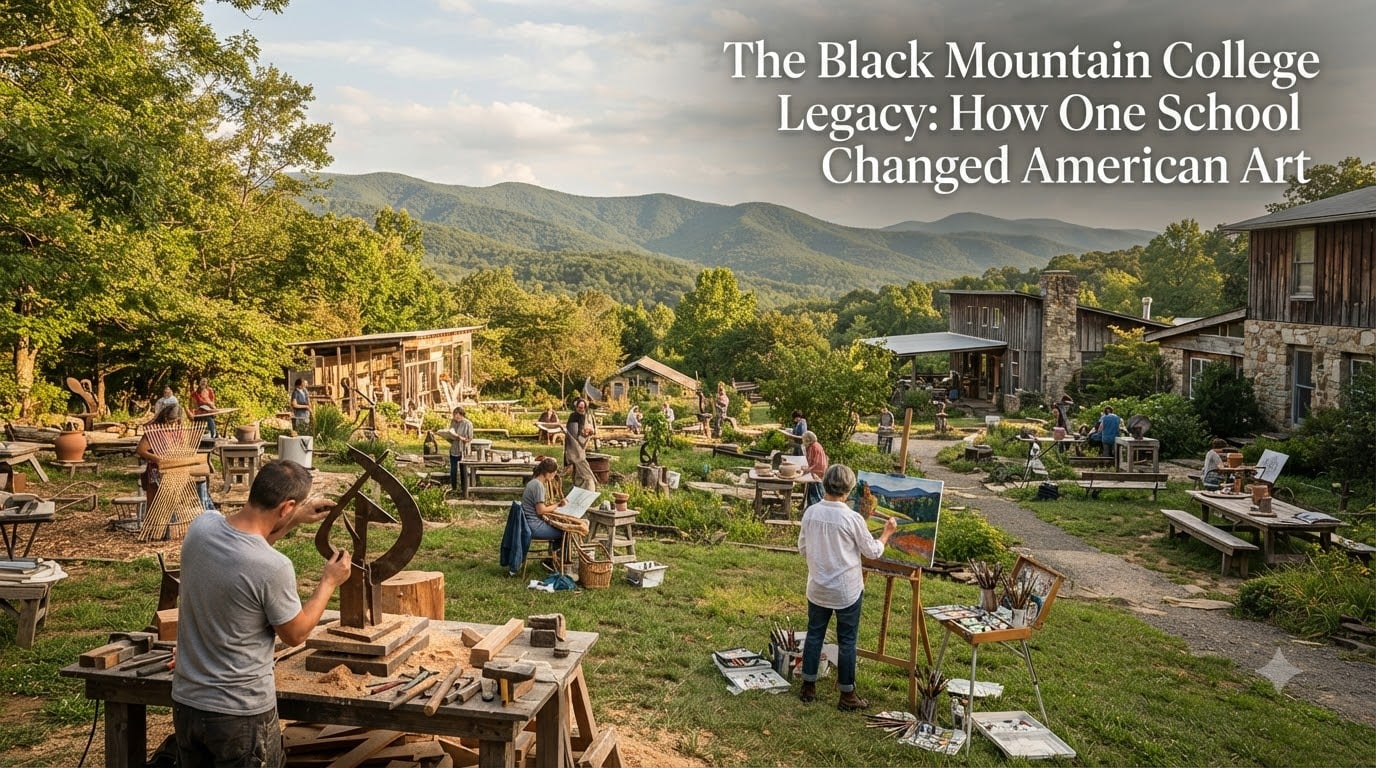
Black Mountain College closed its doors in 1957, but its influence on American art has never stopped echoing through galleries, studios, and art schools worldwide. This experimental liberal arts college in rural North Carolina operated for just 24 years, yet it produced an extraordinary concentration of artists who reshaped modern art. Our team has spent weeks researching BMC’s history to understand why this small school continues to captivate artists, educators, and historians more than six decades after its final graduation ceremony.
The Black Mountain College influence on American art runs deeper than most people realize. It was not simply a finishing school for talented teenagers. It was a living laboratory where Bauhaus refugees taught alongside American mavericks, where students built their own dormitories and grew their own food, and where the boundary between artist and teacher dissolved entirely. The results were revolutionary and continue to shape how we think about creative education today.
Table of Contents
Founding and Historical Context (1933)
Black Mountain College opened its doors in 1933 in the heart of the Blue Ridge Mountains near Asheville, North Carolina. The timing was deliberate. Founded during the Great Depression, it emerged from a crisis in American higher education that left many students and educators searching for alternatives to traditional academia.
The college was the brainchild of John Andrew Rice, a young educator who had studied under the philosopher John Dewey at Columbia University. Rice brought Dewey’s progressive education philosophy to rural North Carolina, creating an institution that placed experience and doing at the center of learning. Rather than memorizing facts in lecture halls, BMC students learned by making, building, and creating together.
Rice assembled a founding faculty that shared his belief in education through creative work. The early curriculum combined liberal arts with manual labor, physical fitness, and communal living. Every student participated in farm work, kitchen duty, and building maintenance. This was not punishment or charity work. It was pedagogy. Rice believed that the act of making things with your hands developed the same capacities as academic study.
The geographical isolation of BMC turned out to be a feature rather than a bug. Located far from the established art world in New York and Chicago, the college had to develop its own aesthetic vocabulary. Students and faculty spent long winters creating together, free from the pressures of commercial galleries and critical opinion. This isolation fostered a remarkable intensity of creative work that defined BMC’s character.
The Bauhaus Connection and Josef Albers
Nothing shaped Black Mountain College’s artistic identity more profoundly than its connection to the Bauhaus, the German art school that Nazi authorities closed in 1933. When the Bauhaus evacuated Berlin, many of its faculty scattered across Europe and eventually to America. Several found their way to the Blue Ridge Mountains.
Josef Albers arrived at BMC in 1933 as one of the first art teachers, and his influence cannot be overstated. Albers had studied at the Bauhaus under Walter Gropius and Wassily Kandinsky before becoming a faculty member himself. He brought with him the Bauhaus methodology: rigorous formal analysis, color theory based on perception rather than theory, and a belief that art could be taught through structured exercises.
At BMC, Albers taught not just technique but ways of seeing. His famous color interaction exercises asked students to explore how colors change depending on their surroundings. A red square looks different against blue than against yellow. These perceptual discoveries, Albers insisted, mattered more than any stylistic prescription. The goal was not to produce artists who painted in a particular way but to develop visual intelligence that students could apply to any creative endeavor.
Anni Albers, Josef’s wife, also joined the faculty and transformed BMC’s textile program into something unprecedented. Trained at the Bauhaus in weaving, Anni Albers elevated textile work from craft to fine art. She experimented with unconventional materials, explored the structural possibilities of woven fabric, and produced work that hung in galleries alongside painting and sculpture. Her presence at BMC demonstrated that the boundaries between art forms were artificial.
The Bauhaus refugees brought with them a commitment to integrating art with daily life. At the Bauhaus, students had designed furniture, typography, theater sets, and household objects. This practical orientation fit perfectly with BMC’s emphasis on making and doing. The result was an institution where fine art and applied art cross-pollinated freely.
A Revolutionary Pedagogical Approach
The educational philosophy at Black Mountain College defied easy categorization. It was progressive in the John Dewey sense: learning through experience, solving real problems, developing capacities through practical engagement. But it was also something new, shaped by the particular circumstances of its founders, faculty, and students.
Democratic governance was central to BMC’s identity. The college was owned and run by its faculty, not by an administration or board of trustees. Major decisions were made by faculty vote, and students participated in governance through student government. This created a genuine community of learners where everyone had a stake in the institution’s success and direction.
The arts stood at the center of the liberal arts curriculum in a way that no other American college attempted at the time. While traditional universities treated art as an elective or a cultural refinement, BMC considered artistic practice essential to human development. Every student engaged with visual art, music, theater, or dance, regardless of their major or career ambitions. The arts were not peripheral. They were the point.
Interdisciplinary collaboration happened naturally at BMC because the institutional barriers that separate departments did not exist. Dance students worked with musicians. Painters collaborated with poets. Theater productions drew on visual artists for set design and composers for original scores. This cross-pollination produced work that drew on multiple traditions simultaneously, creating something genuinely new.
The Summer Art Institutes, beginning in 1947, brought these principles to a wider audience. Each summer, BMC invited artists from across the country for intensive workshops and collaborations. The institutes attracted people who could not attend the regular academic program, spreading BMC’s influence beyond its mountain campus. The Summer Art Institute model became an important precedent for summer arts programs nationwide.
Notable Faculty and Their Contributions
The faculty at Black Mountain College read like a roster of American avant-garde art in the mid-twentieth century. Painters, composers, dancers, poets, and theorists gathered in the Blue Ridge Mountains to teach and create together. Their contributions to their respective fields extended far beyond BMC, but the college provided a unique environment for their development.
John Cage joined the faculty in 1952 and taught music composition until the college closed. His time at BMC was among his most productive. It was here that he developed his famous silent piece, 4’33”, premiered his works for prepared piano, and began the experiments with chance operations that would define his mature style. Cage’s presence attracted students interested in experimental music and sound art, creating a musical community that rivaled any in the country.
Merce Cunningham taught dance at BMC and revolutionized American modern dance. His choreography emphasized pure movement divorced from narrative or emotional content, a radical departure from the storytelling ballets that dominated the field. Cunningham’s collaborations with John Cage produced works where dance and music existed in “separate time structures,” linked only by the shared duration of the performance. This approach influenced generations of choreographers.
Franz Kline and Willem de Kooning, both central figures in Abstract Expressionism, taught at BMC during the 1940s and 1950s. Their black and white paintings, sweeping brushstrokes, and monumental scale defined a new American painting. Kline’s bold strokes and de Kooning’s layered surfaces attracted students who wanted to learn about the movement then reshaping the art world. Abstract Expressionists who taught at BMC helped spread the style beyond New York to a wider American audience.
Robert Rauschenberg, who would become one of the most influential American artists of the twentieth century, taught at BMC in the early 1950s before graduating from the program himself. His anti-disciplinary approach, combining painting, sculpture, photography, and found objects, reflected the BMC ethos of crossing boundaries between media. The “Combines” he created in the mid-1950s challenged viewers to reconsider what art could be.
Influential Student Artists
While the faculty at Black Mountain College read like a who’s who of American avant-garde art, the student body was equally remarkable. Young artists arrived in the mountains seeking something different from the academic training available elsewhere. Many left as transformed artists, carrying BMC’s progressive ethos into their subsequent careers.
Robert Rauschenberg attended BMC from 1948 to 1952, studying with Josef Albers in the foundation program. Albers’ rigorous exercises in color and form provided a counterweight to Rauschenberg’s already eclectic interests. After leaving BMC, Rauschenberg created the Combines, works that blurred the line between painting and sculpture by incorporating found objects and collaged materials. His influence extends through Pop Art, Minimalism, and contemporary installation art.
Ruth Asawa studied at BMC from 1937 to 1939, learning metalworking and weaving from Anni Albers and others. After leaving BMC, Asawa developed her signature wire sculptures, intricate basket-like forms that demonstrated how everyday materials could achieve sculptural elegance. Her public commissions, including the fountain at San Francisco’s Union Square, brought her work to a wide audience. Asawa credited BMC with teaching her to “think through her hands” and to value process over finished appearance.
Cy Twombly arrived at BMC in 1947 and studied with Ben Shahn and others before leaving to pursue a career that would make him one of the most distinctive painters of the late twentieth century. His scribbled, markings, and looped lines created a personal language that bridged Abstract Expressionism and later movements. The raw, immediate quality of his work reflected BMC’s emphasis on authentic expression over technical finish.
Many other students went on to significant careers in dance, theater, music, and visual arts. The concentrations of talent at BMC created an environment where students learned as much from each other as from their teachers. The peer community of ambitious young artists pushed everyone to take their work seriously and to pursue ambitious goals.
Closure and Lasting Legacy (1957)
Black Mountain College closed in 1957, a victim of financial struggles, philosophical divisions, and the difficult circumstances of its final years. The college had always operated on thin margins, dependent on tuition, donations, and the willingness of faculty to accept modest salaries. By the mid-1950s, these pressures had become unsustainable.
The conflicts that led to BMC’s closure were both financial and ideological. Some faculty wanted to expand the college and attract more students, while others defended the intimate scale that had made BMC distinctive. The death of John Rice, who had led the institution through most of its history, created a leadership vacuum that the faculty could not fill. Without Rice’s vision and energy, the college drifted toward dissolution.
The political climate of the McCarthy era created additional pressures. BMC’s progressive politics, its association with left-wing artists and educators, and its Quaker-influenced pacifism made it a target during the anti-communist hysteria. FBI investigations of faculty and students created an atmosphere of uncertainty and fear. Some supporters became reluctant to be associated with an institution that might attract government scrutiny.
The question “why did Black Mountain College close?” does not have a single answer. Financial factors, leadership succession, ideological conflicts, and external political pressures all contributed. What is clear is that the college’s closure marked the end of a remarkable experiment in progressive education. No subsequent institution has replicated its particular combination of democratic governance, arts-central curriculum, and geographic isolation.
The lasting legacy of Black Mountain College appears not in any single work of art but in the transformed practices of American art education. The integration of making and thinking, the boundary-crossing between disciplines, the emphasis on visual perception over stylistic prescription: these BMC innovations have become standard elements of art school curricula nationwide. When contemporary artists move fluidly between painting, sculpture, video, and performance, they are working in a tradition that BMC helped establish.
The influence extends beyond technical practices to institutional forms. BMC’s model of faculty governance, its Summer Art Institutes, its emphasis on community and collaboration: all have been adapted and adopted by later institutions. The artist-run spaces and collectives that emerged in the 1960s and 1970s owe a debt to BMC’s example of artists creating their own institutions.
Frequently Asked Questions
Why did Black Mountain College close down?
Black Mountain College closed in 1957 due to a combination of factors: chronic financial difficulties, leadership succession problems after founder John Rice’s death, philosophical divisions among faculty about the college’s direction, and external political pressures during the McCarthy era including FBI investigations of faculty and students.
Which famous artists attended Black Mountain College?
Many influential artists attended or taught at Black Mountain College. Faculty included Josef and Anni Albers, John Cage, Merce Cunningham, Franz Kline, and Willem de Kooning. Notable student alumni include Robert Rauschenberg, Ruth Asawa, and Cy Twombly. The college’s artistic community attracted figures who went on to shape Abstract Expressionism, Pop Art, and contemporary dance.
Why are we still talking about Black Mountain College?
Black Mountain College remains relevant because it revolutionized art education and produced an extraordinary concentration of influential artists. Its progressive pedagogy, integration of arts into liberal arts curriculum, and democratic governance became models for later institutions. The college demonstrated that isolated, intensive artistic communities could produce transformative work, an idea that continues to influence artist retreats, summer programs, and art schools today.
What was the Black Mountain art Colony?
The Black Mountain art Colony was another name for Black Mountain College, which functioned as both an educational institution and an artistic community. Located near Asheville, North Carolina in the Blue Ridge Mountains, the colony brought together artists, musicians, dancers, and poets for collaborative creative work. The isolated mountain location allowed for intensive artistic development away from commercial pressures of major art centers.
The Enduring Black Mountain College Influence on American Art
When we consider the Black Mountain College influence on American art, we face a remarkable paradox. An institution that operated for only 24 years, that never enrolled more than a few dozen students at any one time, that closed in financial failure and internal conflict, nonetheless reshaped American culture in ways that continue to unfold.
The artists who passed through BMC did not simply learn techniques or absorb theories. They absorbed a philosophy of creative life that emphasized questioning, experimentation, and boundary-crossing. When Robert Rauschenberg combined painting with found objects, when Merce Cunningham choreographed movement without narrative, when John Cage composed music from silence and chance, they were enacting BMC’s core belief that art should emerge from genuine inquiry rather than received formulas.
This is why Black Mountain College still matters. It demonstrated that artistic education could develop not just technical skills but creative capacities for independent thinking. It showed that communities of artists could create their own institutions and govern themselves democratically. It proved that isolation from commercial pressures could foster rather than hinder artistic development. These lessons have been absorbed into the DNA of American art education, often without attribution but always with gratitude.
The BMC model continues to inspire contemporary artist retreats, summer programs, and experimental schools. When artists gather in isolated communities to work intensively together, they are walking paths that John Rice, Josef Albers, and their colleagues blazed in the 1930s. The dream of an institution where art and life, making and thinking, individual development and community support reinforce each other: that dream was realized imperfectly but genuinely at Black Mountain College, and it remains alive wherever artists gather to learn together.