
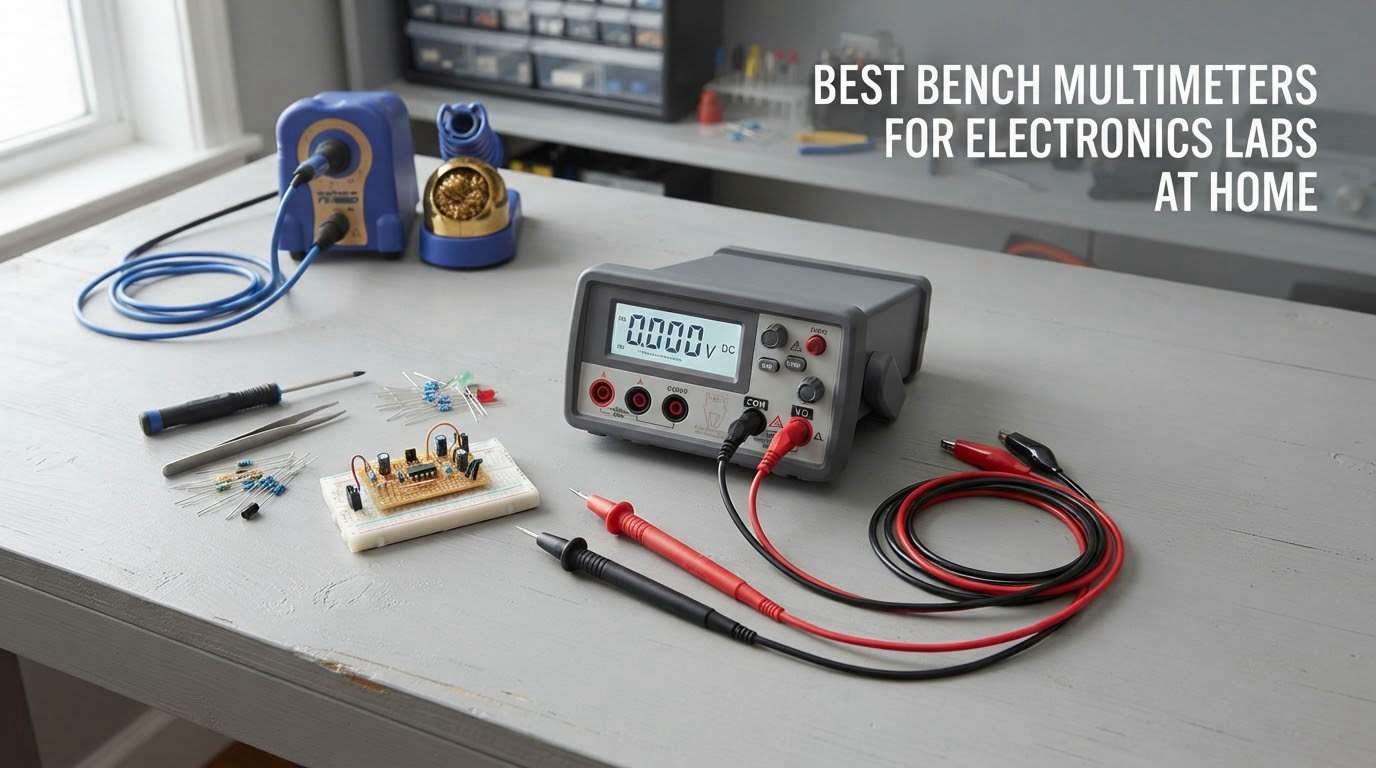
The best bench multimeters for electronics labs at home are the desktop meters that stay powered on all day, show you extra decimal places on a 3.3 V rail, and can log to your computer while your hands stay on the board. A handheld is still the right tool for AC mains checks and go-bag work. A bench meter is the right tool for everything that happens at a fixed spot on your bench.
I spend most weekends at a bench with a scope, a solder station and a pile of parts to characterize, and the difference a bench meter makes is not subtle. Nothing sleeps. Nothing gets knocked off the table. The reading is already there when I look up from the solder joint, and when I am watching a rail ripple while probing a regulator, two numbers are on screen at once.
What this roundup covers is ten desktop DMMs, from a 30,000-count rechargeable model that travels well to a 6.5 digit Siglent with 2,200,000 counts. I weighed them on the things that actually decide whether a bench meter earns its space: display counts, basic DC accuracy, True RMS on AC, whether it logs to a PC, how the screen reads from a seated angle, and how quickly the number updates when you touch a probe to a node. I also flag the units that are slow to settle and the ones whose published specs disagree with each other.
If you are still building a first electronics bench, start with the general-purpose meters in our multimeter guide for electronics hobbyists, then add a bench DMM once you need a second always-on instrument.
Table of Contents
Top 3 Picks: Best Bench Multimeters for Electronics Labs at Home (October 2026)
Our three picks cover the realistic range of home-lab work. The Siglent SDM3045X is the one we keep on the bench, the Siglent SDM3055 is the step up for precision and statistics, and the OWON XDM2041 is the value answer for anyone who does not need 5.5 digits.

Siglent SDM3045X
- Dual display with True RMS
- 0.01% basic DC accuracy
- USB host device and LAN
- 150 readings per second

Siglent SDM3055
- 5.5 digit resolution
- trend charts and limit testing
- 4-wire resistance
- stays powered on

Best Bench Multimeters at a Glance in 2026
Here is the full lineup in one place, with the specs that separate a bench DMM from a handheld.
| Product | Specifications | Action |
|---|---|---|
| Siglent SDM3045X |
|
Check Latest Price |
| Siglent SDM3055 |
|
Check Latest Price |
| OWON XDM2041 |
|
Check Latest Price |
 OWON XDM1041 OWON XDM1041 |
|
Check Latest Price |
 OWON XDM1241 OWON XDM1241 |
|
Check Latest Price |
 Crenova 8045 Mini Crenova 8045 Mini |
|
Check Latest Price |
 Rigol DM3058E Rigol DM3058E |
|
Check Latest Price |
 labloot LB1041 labloot LB1041 |
|
Check Latest Price |
 Rigol DM858 Rigol DM858 |
|
Check Latest Price |
 Siglent SDM3065X Siglent SDM3065X |
|
Check Latest Price |
1. Siglent SDM3045X – The Bench Meter I Keep Powered On
- 0.01% basic DC accuracy
- Dual display with True RMS AC
- Built-in cold junction compensation
- USB host USB device and LAN
- Up to 150 readings per second with statistics and graphs
- 4.5 digit resolution limits precision on low ranges compared with 5.5 and 6.5 digit meters
- Listing describes the meter as battery powered even though a power cord is included
This is the meter that stays on my bench every evening. It is a 4.5 digit desktop unit with a dual display, True RMS AC, and 0.01% basic DC accuracy, which is tight enough to see a 20 mV difference on a 5 V rail without squinting at the last digit.
The dual display is the feature I use most. One line holds the primary measurement and the second line carries frequency, or a second current reading, or a min/max trace. When I bring up a buck converter I can watch the input current on the bottom line while the output voltage holds steady on top, without switching ranges and losing the reading.
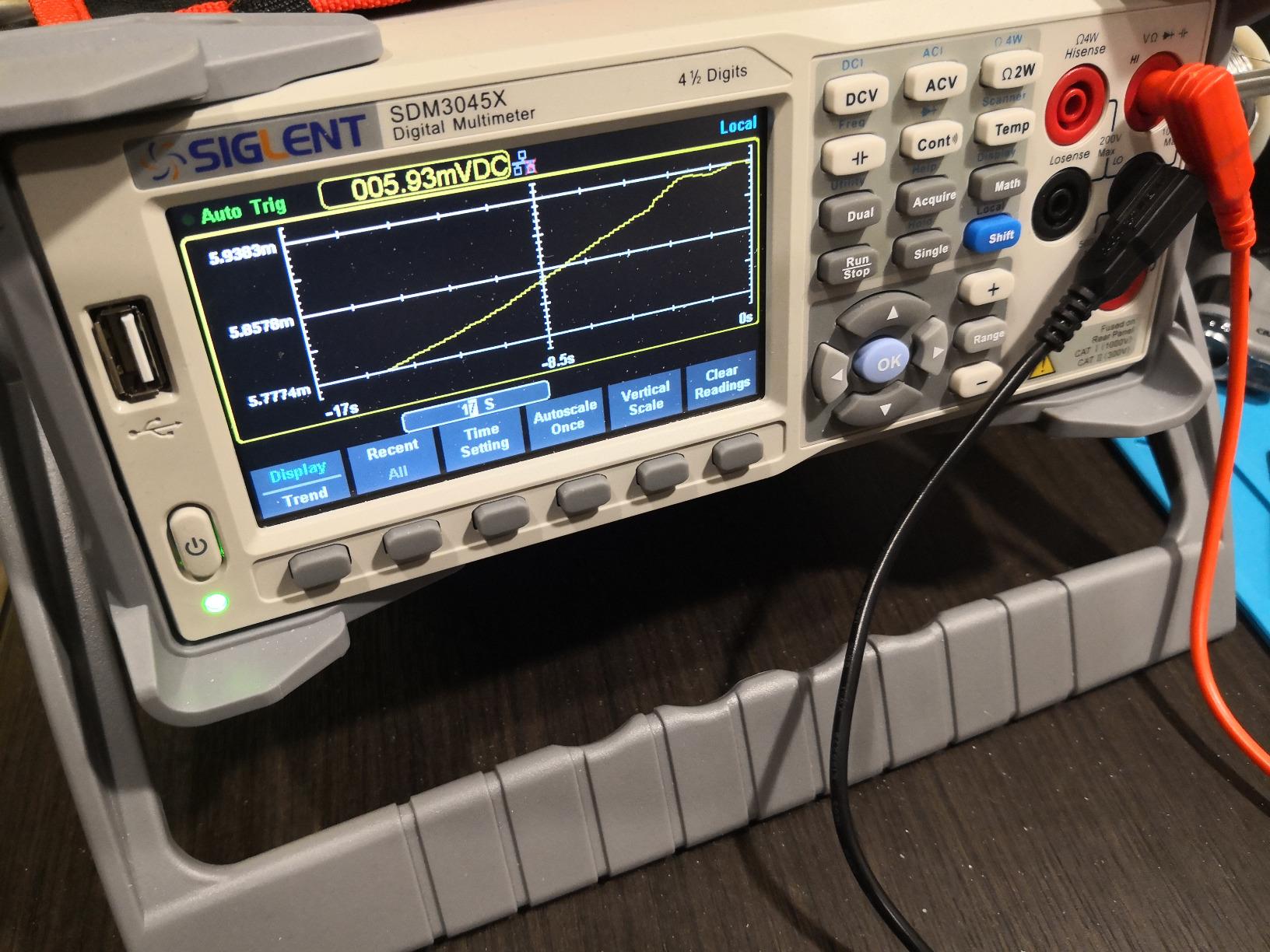
Connectivity is unusually generous for a meter at this level. It carries a USB host port, a USB device port and LAN, so it can log straight to a machine on the bench network, save screenshots to a USB stick, or be driven by a script. Throughput is quoted at up to 150 readings per second with statistics and graph modes on top.
Temperature is handled properly, with cold junction compensation built into the meter for thermocouple work. That matters more than it sounds, because an uncompensated junction can throw several degrees into your reading and send you chasing a fault that is not in the circuit.
Does 4.5 digit resolution cause problems on a home bench?
Only when you are measuring genuinely small signals. At 24,000 counts you get four full digits plus a leading one, so a 5 V reading resolves to about 0.1 mV and a 400 mV reading resolves much finer. If your work is 3.3 V logic, 5 V rails and millivolt-scale sensor outputs, that is plenty.
Where it stops being enough is precision resistor and reference measurement, where you want the extra resolution to average away noise. If that is your work, look at the Siglent SDM3055 or the 6.5 digit model further down.
What should you check before buying it?
Check the power input setting on the unit itself, because the listing is ambiguous about how it is powered. Owners report that the meter is described as battery powered while the box contents list a power cord, so confirm what you actually receive before you plan your bench layout around a wall outlet.
Second, decide early whether you will use 4-wire resistance. It is supported, which is good news for anyone measuring low ohms, but the resolution ceiling still applies. Buy this one for accuracy and connectivity, not for resolution.
2. Siglent SDM3055 – Best Step Up to 5.5 Digit Precision
- Large bright color display with big digits
- Trend charts statistics and limit testing
- 4-wire resistance works with inexpensive Kelvin probes
- Stays powered on instead of auto-sleeping
- Up to 150 readings per second
- Low-range readings can take around 15 seconds to fully settle
- Carry handle is cheap and detaches too easily
- Settings reset when power is switched off
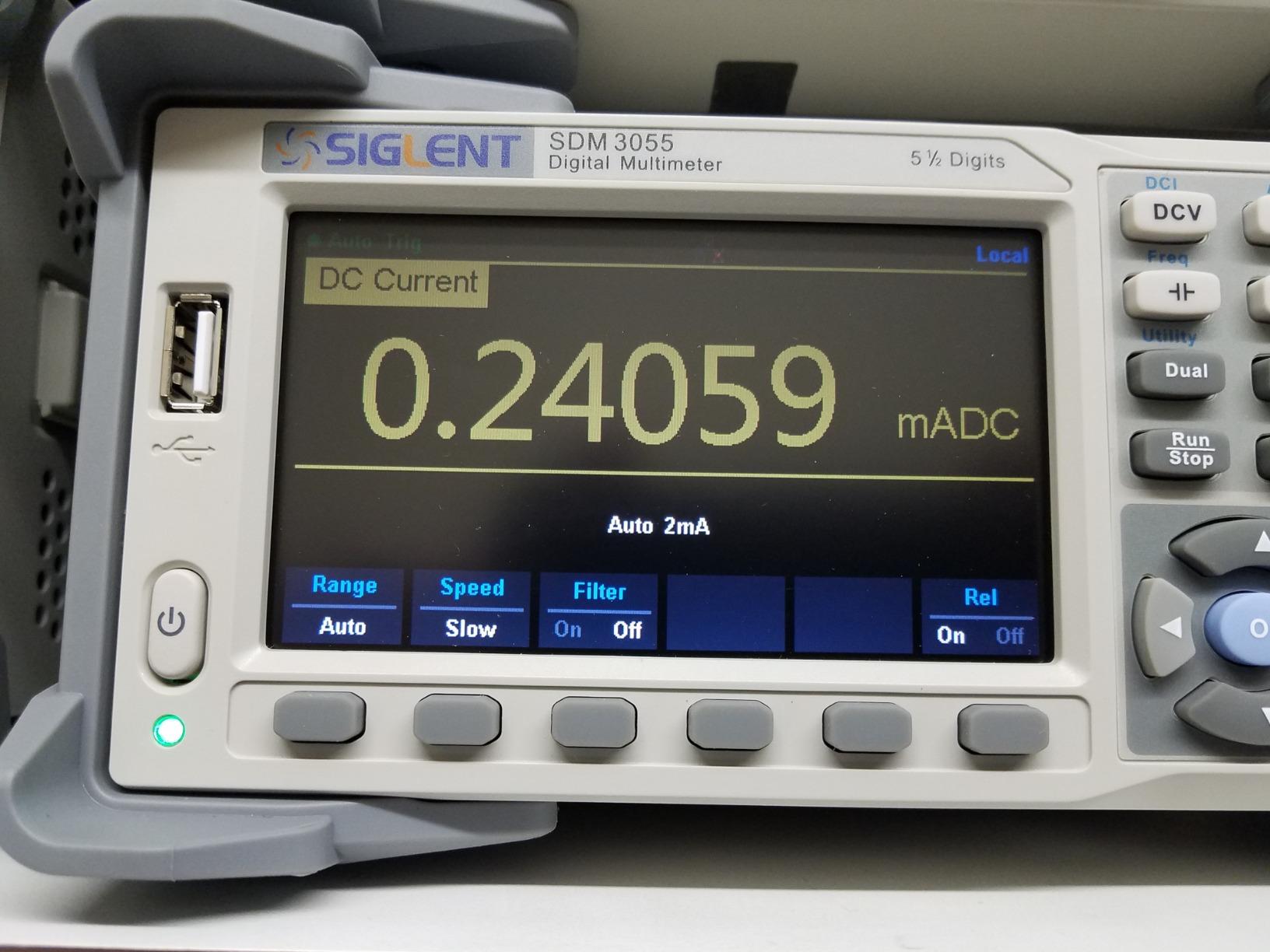
This is the meter most people mean when they say a bench DMM. It moves from 4.5 digit to 5.5 digit resolution, which is where you start to see real precision work: reference voltages, resistor networks, current shunt drops and battery profiling.
The display is the first thing you notice. It is a large, bright color screen with digits sized for a seated viewing distance, and it does not dim out while you solder. The trend charting, running statistics and limit tests turn it into a bench instrument rather than a bench calculator, and the limit alarm in particular is useful when you want to be told when a rail drifts out of tolerance while you work on something else.
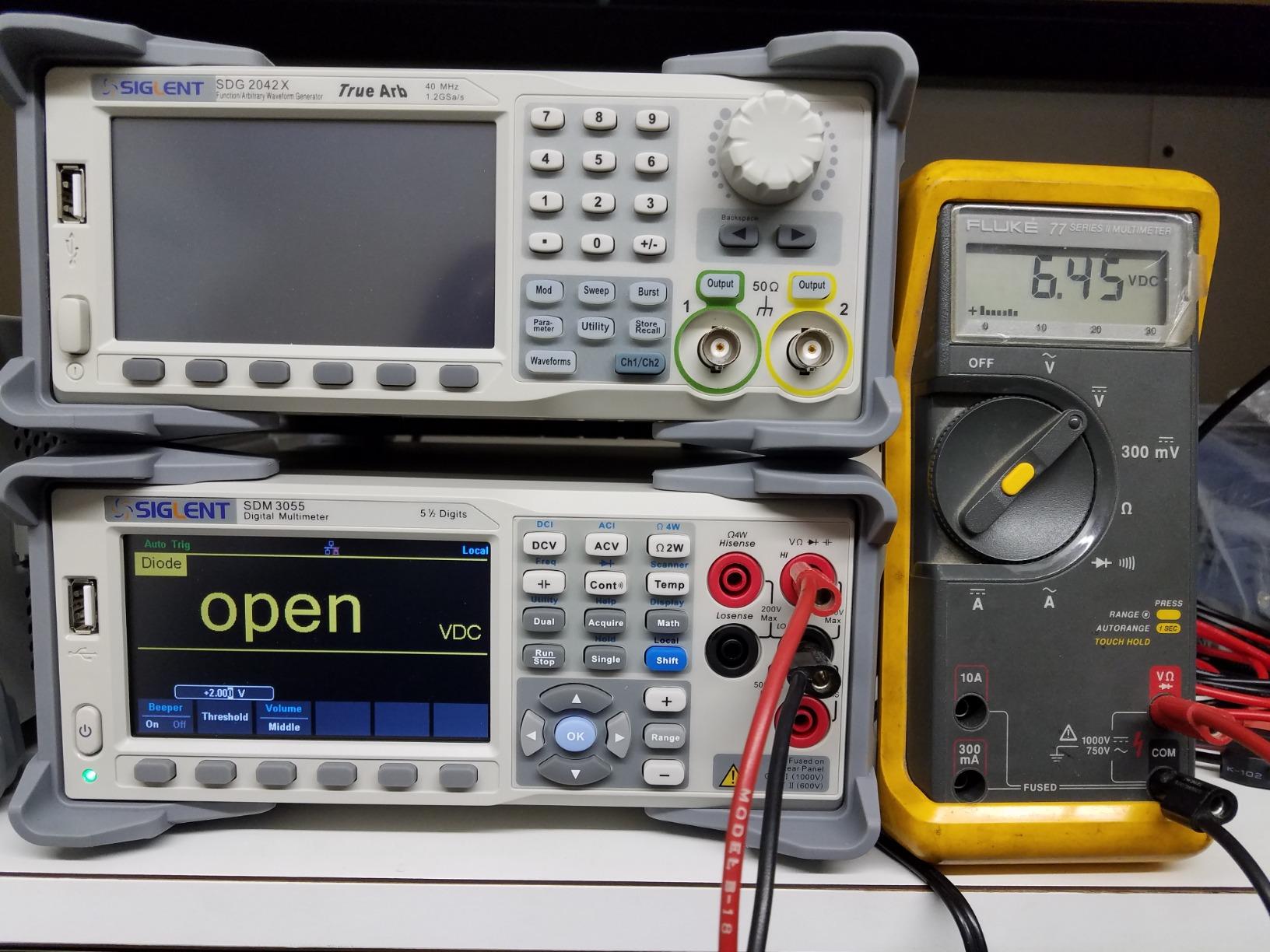
Four-wire resistance works here, and owners confirm it performs with inexpensive Kelvin probes rather than needing a premium accessory. It runs on mains power with a breathing power LED that signals standby, so it never sleeps in the middle of a measurement. That single design choice removes an entire category of bench frustration.
The math functions go beyond the usual, including dB and dBm conversions, which is a nice touch if you are doing anything with audio.
Is the slow low-range settling a real problem?
It can be, and it is the most common complaint. On the lowest ranges, readings can take up to roughly 15 seconds to fully stabilize. If you are chasing a drift, that wait is genuinely annoying, so plan on leaving the probe on the node while it settles instead of expecting an instant answer.
Two smaller things to know: the carry handle is cheap and detaches too easily for real transport, and the meter resets its settings when power is switched off. If you rely on a particular configuration, save your setup before you power cycle.
What about the power input and the test voltages?
Check the power input configuration before plugging it in, because the unit ships factory set for 220 V. It is a thirty-second check and it avoids the single most expensive mistake you can make with a bench instrument.
Also note the test source values. Continuity uses about 6.4 V and the low-ohm resistance measurement applies about 1 V, which is more than some sensitive components enjoy. Fine for rails and resistors, worth keeping in mind near low-voltage analog front ends.
3. OWON XDM2041 – Best Value Pick with 55000 Counts
- Readings match calibrated reference equipment
- Excellent readability even at an angle
- SCPI control syntax is quick to learn
- Single current port covers every range
- Retains range and speed settings between functions
- Out-of-box reading speed is slow until high-speed mode is selected manually
- Included probes have thick insulation and blunt tips
- 4-wire milli-ohm function is reported as inaccurate with no zero control
This is the value pick, and it is not a compromise in the way budget meters usually are. It shows 55,000 counts with True RMS AC, which puts it in the same numeric class as much more expensive desktop meters, and owners report readings that line up with calibrated reference equipment and a calibrated scope.
Two practical details make it nicer than its price suggests. The single current port covers every current range, so you are not swapping leads between the mA terminal and the high-current terminal fifty times an hour. And it retains your range and speed settings when you switch functions, which is exactly the behavior experienced users want from a bench instrument.
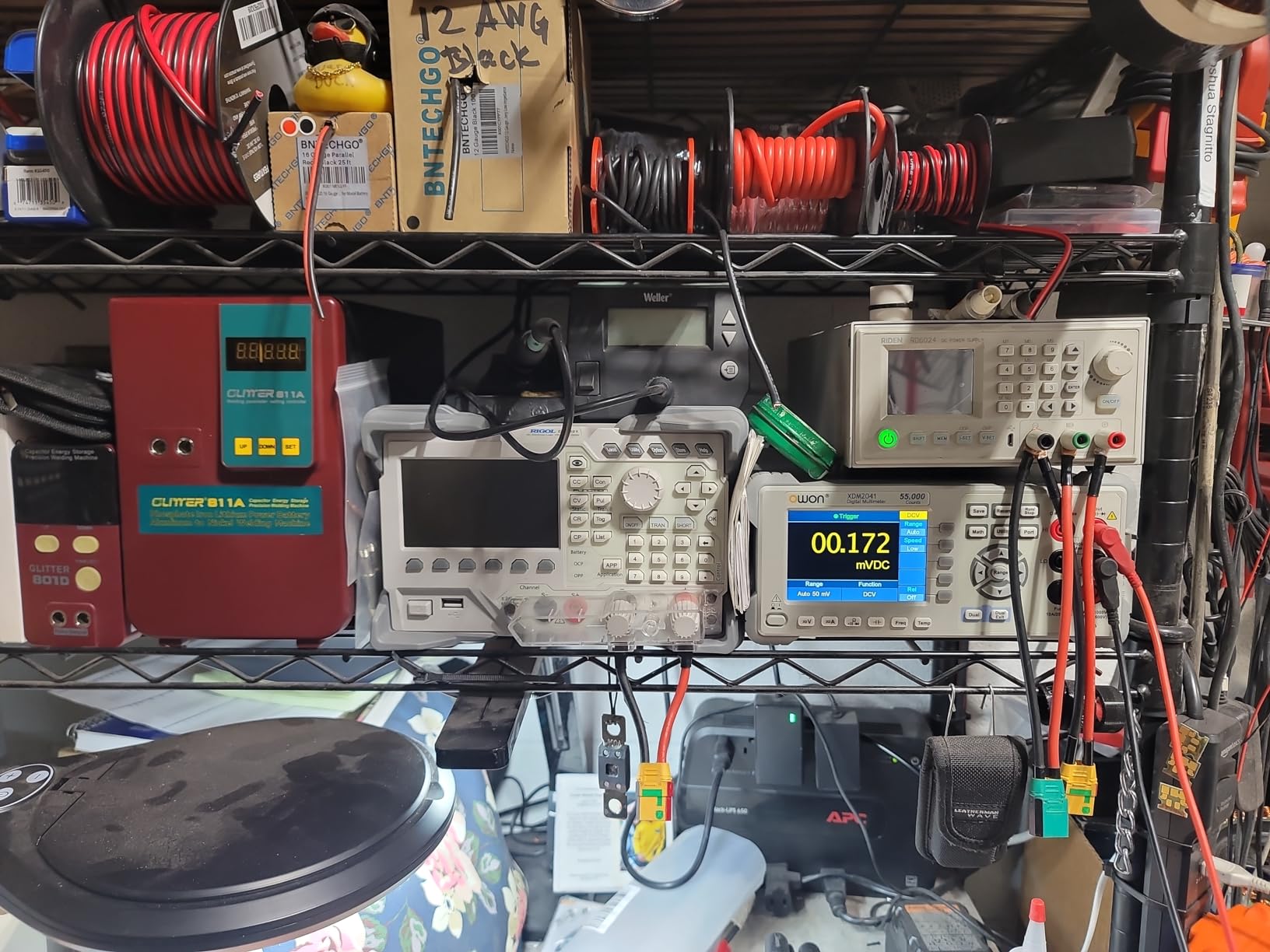
On the connectivity side it records up to 1000 points to internal memory with intervals set anywhere from 15 ms to 9999 s, and it exposes that data through the device interface as a table. That is enough to capture a rail settling after a load step without leaving the bench.
The chassis is also heavier than you would expect, which is a benefit here. Owners specifically praise the weight for keeping the meter planted on the bench rather than creeping across the surface.
Why does the reading speed need changing?
Out of the box it is set to a slow mode, and reviewers consistently flag this. The fix takes about ten seconds: choose high-speed mode and you get up to 65 readings per second on the dual line display. If you do not do that, the meter will feel sluggish and you may write it off unfairly.
Once it is in the right mode, the update rate is good enough for watching a supply rail respond while you tap a potentiometer. Just remember the setting is a choice you make, not a default you get.
What should I replace before using it?
Replace the test leads. The supplied probes have thick insulation and blunt tips that are poor for anything smaller than a through-hole part, and on a meter with this much capability you will regret probing a SOIC with them. Sharpener fine-tip leads cost very little and change the experience completely.
One more caution: the 4-wire milli-ohm function is reported as inaccurate and has no zero control, so do not trust it for contact resistance work. For ordinary 2-wire resistance it performs well.
4. OWON XDM1041 – The Compact Option for a Crowded Bench
OWON XDM1041 USB/RS232 Digital Multimeter 55000 Counts High Accuracy Universal Desktop Multimeters Meter with 3.7Inch LCD Screen
- Compact desktop footprint suited to small bench spaces
- Clear large-format LCD for bench reading
- Wide function coverage for a desktop meter
- SCPI and dual-line display support for PC-driven measurement
- Brand field on the listing reads LILLIPUT rather than OWON so support provenance is less clear
- Overall rating trails the other OWON desktop models in this roundup
Where most desktop meters are wide boxes that eat a shelf, this one is a compact desktop unit with a 3.7 inch high-resolution LCD and 55,000 counts. It measures AC and DC current and voltage, resistance, capacitance, and it includes diode, continuity and temperature functions.
The display is the reason to consider it. Two-line support means you can watch a voltage and a frequency at the same time, and the screen is clear enough to read from a seated position without leaning in.
It runs up to 65 readings per second and speaks SCPI over USB and RS-232, so scripted measurements are possible. The listing positions it for instrument labs, factories, radio work and home use.
Is it worth choosing over the larger OWON models?
If bench depth is the constraint, yes. The smaller footprint at 7.87 x 3.31 x 2.05 inches and a 2.01 pound weight make it easy to place behind a monitor or beside a keyboard, where a full-size chassis would not fit. You keep the 55,000 count display and the same SCPI access.
If you have room, the larger OWON units are the better buy. They carry the same count figure but add a proper backlit screen, a wider temperature range and a more consistent owner rating.
What is the concern with this listing?
The brand field on the listing reads LILLIPUT rather than OWON, which makes manufacturer and support provenance less clear. That is a real practical issue if you ever need a firmware file, a manual or a replacement fuse, so check what support actually reaches you before committing.
Its 4.3 average is also the lowest of the OWON units in this roundup, with a larger share of middling reviews than its siblings. It delivers the advertised functions, but it is viewed more as an entry-level desktop meter than as a standout one.
5. OWON XDM1241 – Most Versatile with USB Recording Built In
OWON XDM1241 Digital Multimeter,3.5in Desktop Multimeters, 55000 Counts LCD True RMS Temperature Tester Meter
- Simple approachable operation for beginners
- True RMS measurement on a compact desktop chassis
- USB PC software records readings to internal memory
- Replaceable line fuse with spare fuses included
- Diode continuity and temperature functions broaden bench coverage
- Lowest average rating of the OWON desktop units here
- High-temperature range is limited to 1000 degrees C
- Not the pick for milliohm or high-accuracy current work
This is the easy one. It does 55,000 counts with True RMS AC, it has a 3.5 inch display, and the USB software on your computer can record readings to internal memory manually or on a timer. If you have never used a desktop DMM, the interface will not be the thing that stops you.
The logging is the quietly valuable part. Being able to record a sequence of readings and pull them into a table means you can watch a supply rail or a charging curve without sitting and writing numbers down, and for LiPo and battery charger work that alone justifies the machine.
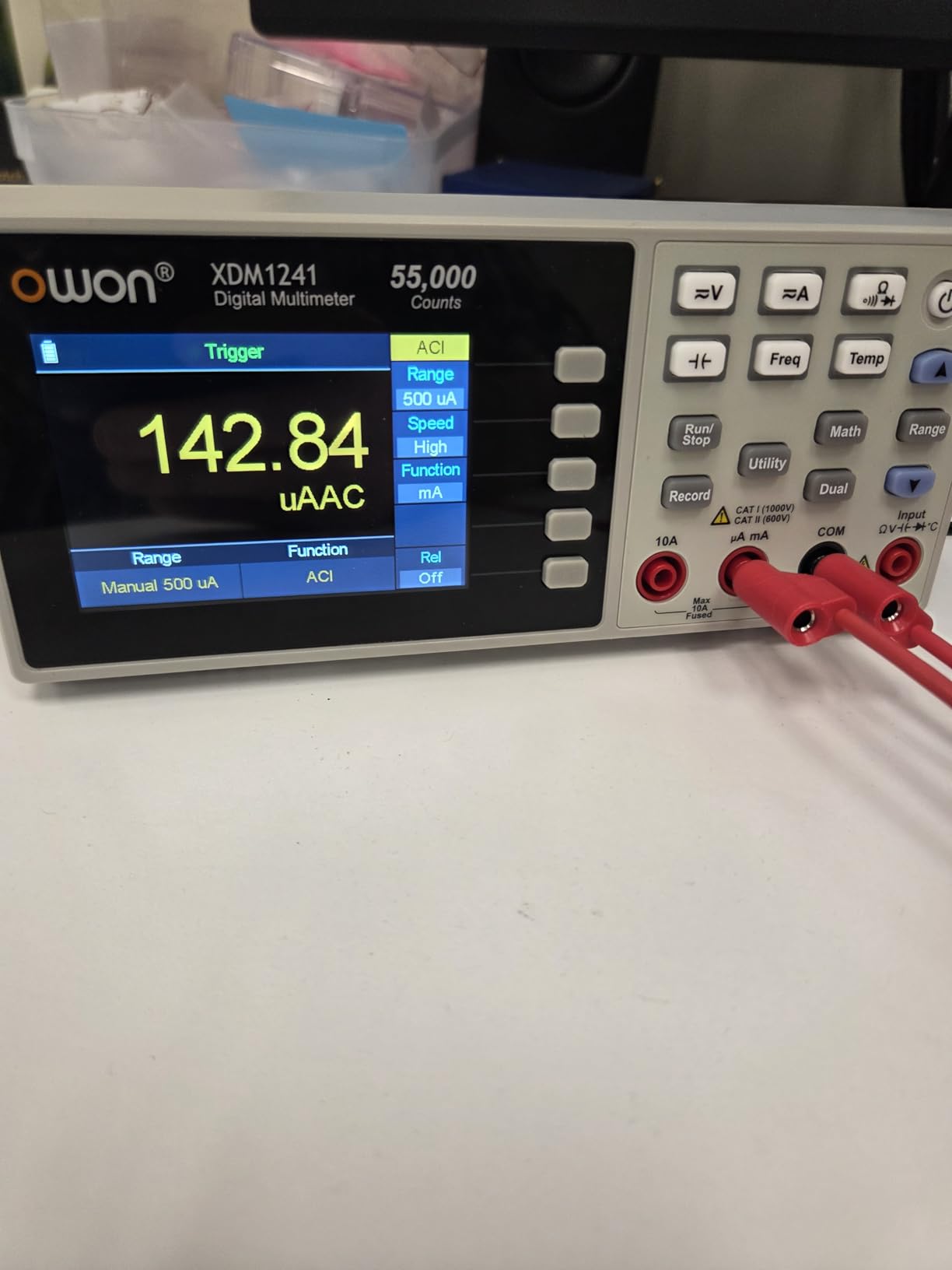
It is also built with a replaceable line fuse, spare fuses are included, and the anti-burn design is a genuine benefit on a meter that will live near a bench supply. High quality ABS construction suits a home lab that gets handled.
Like its OWON siblings it supports SCPI over USB, so it can be scripted alongside the rest of your bench.
Where does it fall short compared with the other OWON models?
It carries the lowest average rating of the three OWON desktop units in this roundup at 4.2, with about 10% of reviews at one star. That points to some dissatisfaction with accuracy or consistency rather than with the feature list, which is fully populated.
The temperature function is capped at 1000 degrees C, so it is not a choice for high-temperature work or thermocouple characterization of hot systems. And it is not the meter to reach for when you need milliohm measurement or high-accuracy current work.
Is it a sensible first bench DMM?
Yes, if your work is 3.3 V and 5 V digital, breadboard prototyping, continuity checks, diode tests and basic rail bring-up. Those are the tasks most home labs start with, and this meter covers all of them with room to spare.
It is also a reasonable second instrument, since a second meter is mostly about having an always-on screen showing a rail while you use a handheld on the circuit. Just do not expect laboratory-grade accuracy from it, and read the accuracy figures from the manual before you trust it for anything critical.
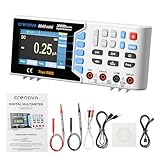
6. Crenova 8045 Mini – Best for Battery Powered Bench Work
Crenova 30000 Counts True RMS Digital Multimeter, Desktop Bench Multimeter
- Highest average rating of any bench meter in this roundup
- Battery powered so it works lying down standing or handheld
- Large bright backlit display with 11 measurement functions
- USB data logging removes the need to time readings
- Firmware is upgradeable and a 2 year warranty is available
- Accuracy was found wanting by at least one buyer against a Fluke 87
- No published programming documentation so PC control requires reverse engineering
- Software does not work on Linux
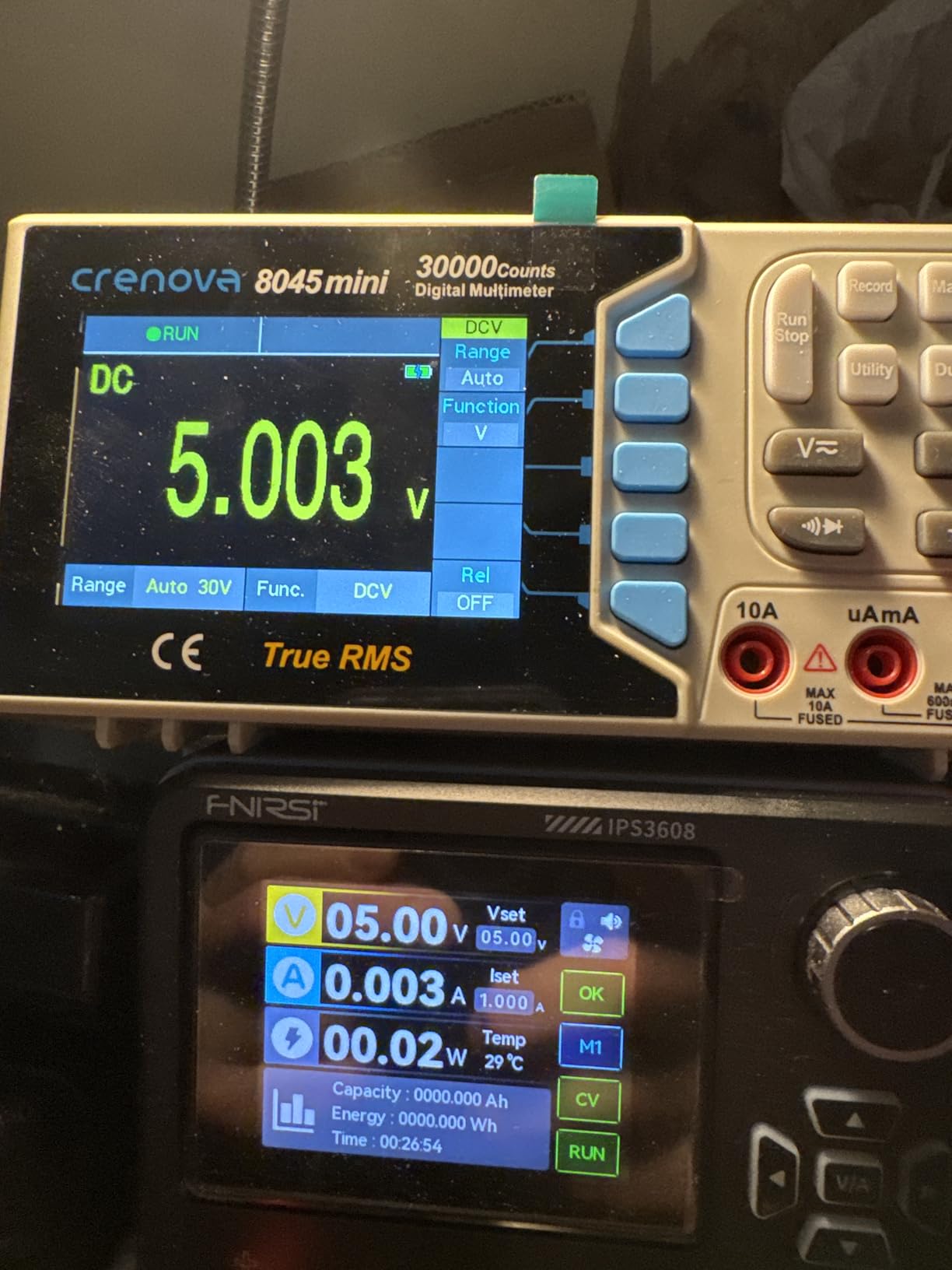
This one is different from everything else on the list, and that difference is the reason to like it. It runs on a 5000 mAh rechargeable battery for up to 10 hours of continuous use, so it works as a desktop meter, a stand-up meter or a handheld meter. Battery meters have traditionally meant mediocre accuracy, and this one carries a 4.7 average across its reviews.
The 30,000 count display on a 3.5 inch LCD with adjustable backlight is bright enough to read at an angle, and the math functions include Max, Min, Average, dBW and dBmW and relative, which is a more complete set than most meters at this level provide. There are 11 measurement functions covering AC and DC voltage and current, resistance, capacitance, temperature, frequency, duty cycle, continuity and diode.
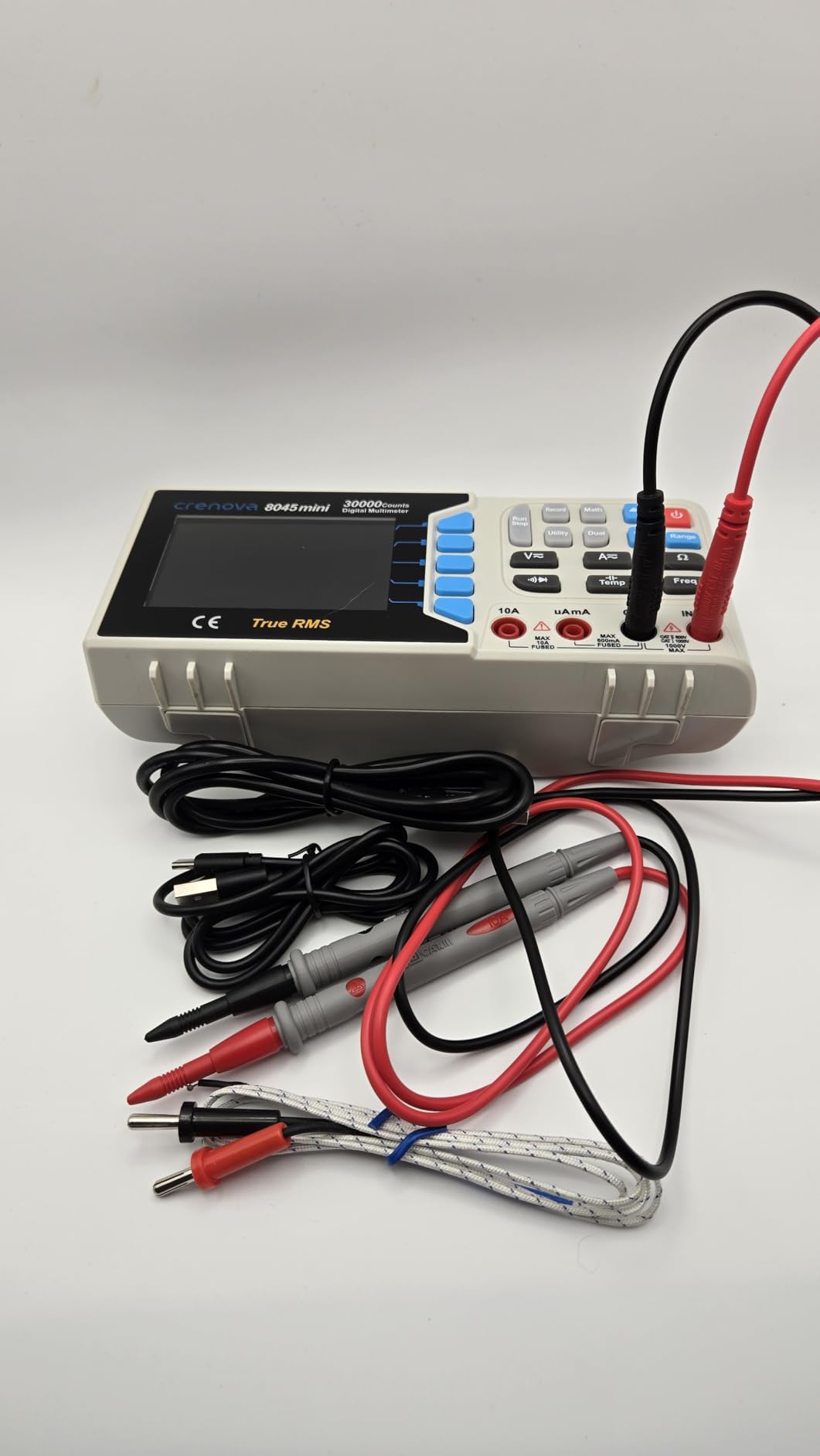
It also has USB for remote control, firmware updates and data logging or printing, and it is rated CAT I 1000 V and CAT II 600 V with two premium fuses. The kit includes probe leads, a K-type thermocouple, USB cables, a software disc and a manual, so there is nothing to buy separately to get started.
One hardware note worth knowing: the charge port reads about 8 ohms to ground in ohms mode, which matters if you ever probe a grounded circuit from the USB side.
Is the accuracy good enough to trust?
For most home-lab work, yes, and the review profile backs that up with 76% five-star ratings and no one-star reviews. But at least one buyer compared it against a Fluke 87 and found accuracy wanting, so treat it as a capable general instrument rather than a reference standard.
If your work involves small signals where the last two digits matter, this is not the meter. It is the meter for when you want True RMS, a readable display, logging and portability without thinking about it.
What are the limits of the PC side?
There is no published programming documentation, so PC control means reverse engineering the command set rather than reading a manual. The bundled software is also Windows-only, which will stop you cold if your bench machine runs Linux.
USB logging itself works, and firmware is upgradeable, which is a meaningful amount of flexibility. Just do not plan on writing a scripted test sequence against it without first spending an evening on the protocol.
7. Rigol DM3058E – Best for High Accuracy DC Measurement
Rigol DM3058E 5.5 Digit Bench Digital Multimeter, 123,000 Counts, True-RMS
- 0.015% basic DC voltage accuracy captures small signal changes
- Dual display lets two parameters be watched simultaneously
- Three year warranty on the main unit
- USB LAN and RS-232 with SCPI for automated test systems
- Published item dimensions of 0.01 x 0.01 inches are clearly not real measurements
- Lower 4.4 average and 11 percent three-star share indicate more mixed owner experiences
- Higher price than the 55000-count alternatives in this roundup
This is the accuracy-first pick. The published basic DC voltage accuracy is 0.015% of reading, which is the tightest figure among the 5.5 digit options here and the reason to buy this one over a similarly specced alternative. On a sensitive rail or a reference measurement, that is the difference between seeing a change and guessing at it.
It measures DC and AC voltage and current, resistance, capacitance, frequency, period, continuity, diode and temperature. The dual display lets you watch two parameters at once, which is the single most useful feature for supply debugging.
Connectivity is complete: USB, LAN and RS-232 remote control with SCPI command compatibility, which makes it straightforward to slot into an automated test sequence or a logging rig.
Is the mixed owner feedback a warning sign?
It is worth reading. At 31 reviews the base is small, and the 4.4 average comes with about 11% three-star and 5% one-star shares, more mixed than the Siglent models here. That points to some inconsistency in individual units rather than a fundamental design problem.
The published item dimensions of 0.01 x 0.01 inches are obviously not real measurements, and the listing states both 50,000 counts and 123,000 counts depending on where you read. Confirm the real display counts and physical size with the manufacturer before you plan a shelf for it.
What does the warranty mean for a home lab?
Three years on the main unit and one year on accessories is a real advantage over the typical electronics-tool warranty, and for something that stays powered on continuously it is worth something. A bench meter that survives five years of daily use will outlast two handhelds.
At 2.93 kg it is the heaviest meter in this roundup. That is stable on a bench, but it is a two-hand lift if you want to move it to another work surface, so pick a permanent home for it.
8. labloot LB1041 – Best for On-Meter Trend Logging
Labloot LB1041 Bench Digital Multimeter 55000 Counts DC/AC Voltmeter Ammeter HZ Temp Diode Continuity Tester Desktop Multimeters
- Sharp 480x320 backlit TFT screen at a low price point
- 0.05% DC voltage accuracy with True RMS AC
- Up to 1000 point manual and auto recording with PC export
- Trend analysis in chart mode plus SCPI support
- Replaceable line fuse with anti-burn design and spare fuses supplied
- 8 percent two-star and 5 percent one-star reviews indicate a meaningful share of dissatisfied owners
- Brand and manufacturer fields disagree so support provenance is unclear
- Only 28 reviews the thinnest review base in the group
The reason to look at this one is the screen. A 3.5 inch 480×320 backlit TFT at this level of price is unusual, and it makes the dual line display easy to read from a distance or at an angle, which is the whole point of a bench meter sitting in front of you.
It runs 55,000 counts with DC voltage accuracy up to 0.05% and True RMS on AC voltage and current. Data recording is manual or automatic, up to 1000 points in internal storage, and it exports to a computer, with a chart mode for trend analysis built into the meter itself.
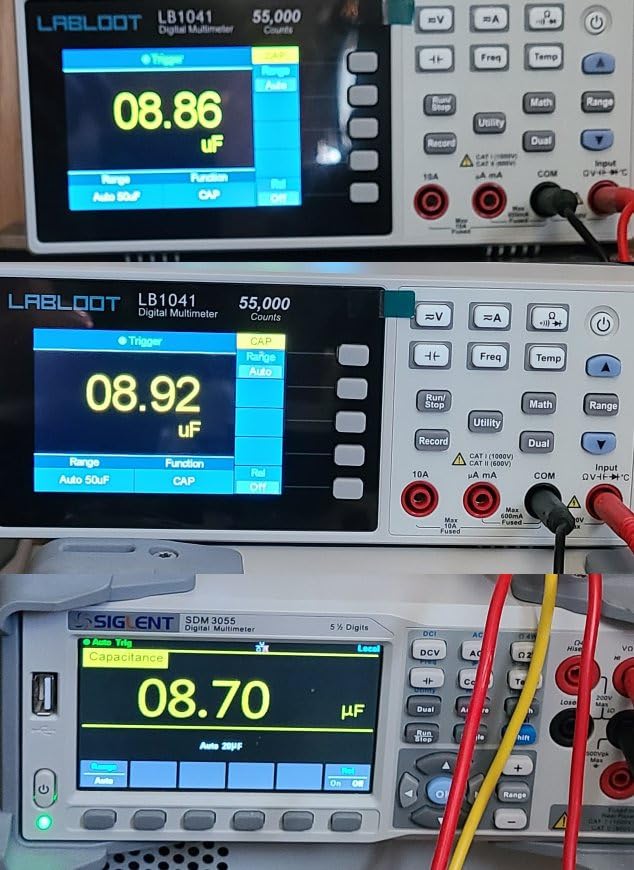
SCPI is supported, the replaceable line fuse has an anti-burn design, and spare fuses are supplied, which is more thoughtful than most. It covers diode, continuity, temperature, AC and DC current, voltage, resistance and capacitance, so nothing from a normal home-lab session is missing.
Manufactured by OWON and sold under a different brand name, so the internals are familiar even if the badge on the front is not.
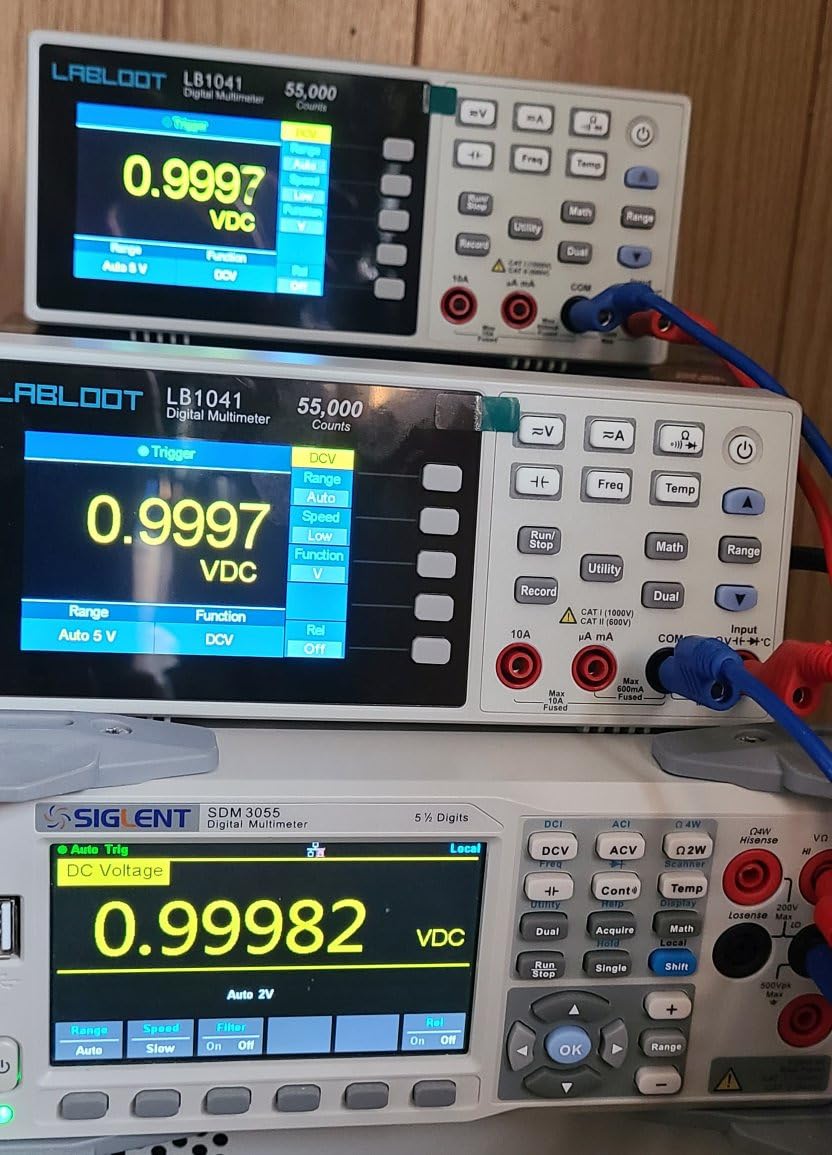
How does 0.05% accuracy compare with the Siglent and Rigol units?
It is roughly five times looser than the 0.01% figure on the Siglent SDM3045X and about three times looser than 0.015% on the Rigol DM3058E. In practice, at 5 V the difference between 0.01% and 0.05% is 0.5 mV, which is irrelevant for rail bring-up and meaningful on a precision reference.
So the question is not whether it is accurate, but whether your work sits in the first 20 mV of a signal. If it does, buy the Siglent or the Rigol. If it does not, this meter holds its own for everyday bench work.
What should concern you before buying?
About 13% of reviews sit at two stars or below, which points to some spotty build or accuracy consistency rather than a dead feature set. With only 28 reviews the sample is small, so treat the average as provisional rather than settled.
Also note that the brand and manufacturer fields disagree, so support provenance is unclear. Confirm with the seller that a manual and a replacement fuse are obtainable before you commit, and keep an eye on the review page for your unit specifically.
9. Rigol DM858 – Best for Touchscreen Bench Workflows
- 7 inch touchscreen and modern compact design
- 125 readings per second with 500000 point logging memory
- Built-in storage for data and setup
- Weighs 1.23 kg so it is easier to move around a bench
- Three graphical display types with 11 measurement functions
- Thinnest review base in the group with 18 reviews
- Best seller rank of 1752691 signals limited demand history
- Very low sales volume compared with the Siglent and OWON units here
This is the odd one out in form factor rather than in specification. It has a 7 inch touchscreen and a compact bench profile, which means you set ranges and functions by tapping rather than by turning a knob, and you can read several traces of information at once from a normal sitting position.
Under the display it is a serious 5.5 digit meter. Maximum reading rate is 125 readings per second, logging memory holds 500,000 points, and there are 11 measurement functions, 5 math operations and 3 graphical display types. Data and setup storage is built in, so recorded runs survive a power cycle.
At 1.23 kg it weighs less than half of the Rigol DM3058E, which makes it the easier instrument to move between benches, and it is Type-C powered rather than relying on a bulky barrel connector.
Is a touchscreen actually better on a bench?
It depends on your hands. If you are wearing solder flux on your fingers, gloves, or probing while holding a component, touch controls are worse than a physical knob. A tap that misses means a mis-measurement with a load connected.
Where it wins is graph-heavy work. Trend display, limit views and multi-parameter layouts are far easier to build on a 7 inch screen, and the three graphical display types make the DM858 a genuinely different tool rather than a spec-sheet upgrade.
What is the main risk with it?
The evidence base is thin. At 18 reviews it has the smallest review base in this roundup, with 8% two-star and 6% one-star shares, and its best seller rank of 1,752,691 in Tools and Home Improvement signals limited sales history. Very low sales volume is not a defect, but it does mean you are buying a less proven listing.
Long-term firmware support and accessory availability are the two things to confirm with the seller before you commit, especially if you plan to script it.
10. Siglent SDM3065X – Best for 6.5 Digit Precision
Siglent Technologies SDM3065X 6 ½ Digit Digital Multimeter, DMM
- Real 6.5 digit resolution and 2200000 counts with excellent stability
- Large display with big digits readable from across the room
- 4-wire resistance and diode test work well with diode test going to 4V
- Verified accurate against calibrated references and Fluke meters
- Ethernet remote control works with third-party controller software
- SCPI documentation is poorly written and contains errors with no Local command
- The MEAS VOLT command stops the local display updating and takes about 2 seconds per reading
- 4-wire Kelvin probes are not included
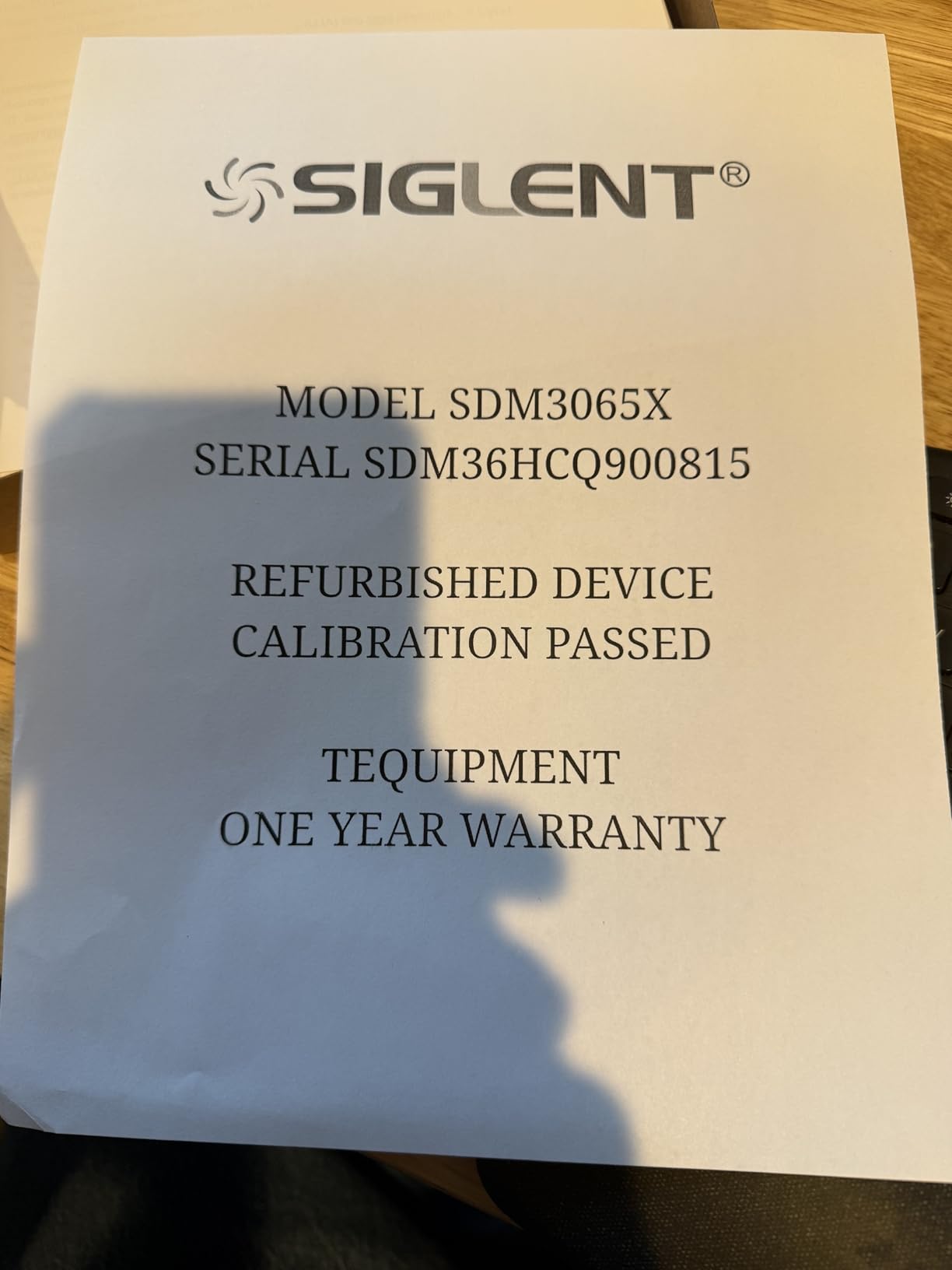
- One owner reports receiving a refurbished unit sold as new
This is the top of the list in resolution, and the resolution is real. At 6.5 digits and 2,200,000 counts it is the only meter here that lets you resolve microvolt-level changes on a signal, which is what you need for reference measurements, precise resistor networks, thermoelectric offset work and long drift studies.
The display is a 4.3 inch TFT LCD at 480×272 with digits large enough to read from across a room, so you can glance up from a microscope or a scope and still see the number. Measurement range runs from 200 mV up to 1000 V DC and 200 microamps to 10 A, with True RMS AC voltage to 750 V and True RMS AC current to 10 A.
Owners verify accuracy against a calibrated reference and against Fluke meters, and 4-wire resistance and diode test are both reported as working well, with the diode test going to 4 V. USB device, USB host and LAN come as standard, with an optional USB-GPIB adapter, and EasyDMM control and logging software is included.
Small details that improve daily use: adjustable buzzer volume and adjustable settings on the meter itself, so you are not forced through software for a preference change.
Do you actually need 6.5 digits at home?
Almost certainly not for digital work. 3.3 V rails, I2C buses, sensor outputs and USB signals are all comfortably served by 5.5 digit hardware, and a 5.5 digit meter will show you plenty of detail on them.
You need 6.5 digits when the signal itself is small and you are measuring it against something else. A 12-bit DAC reference, a current shunt drop in the millivolts, a thermopile, or a drift measurement taken over hours are the cases where the extra resolution pays for itself. If none of those describe your work, the SDM3055 is the smarter purchase.
What are the practical gripes?
SCPI is the big one. The documentation is poorly written and contains errors, there is no Local command, and the measurement command stops the front-panel display updating while taking about two seconds per reading. If you plan to script it, budget time for third-party controller software and the Ethernet connection rather than the bundled path.
Also: auto mode is slow to register readings, the power-on sequence is slow, Kelvin probes are not included, and there is no protective case. One owner received a refurbished unit sold as new, so check the condition on arrival and keep the packaging until you have verified it.
Bench DMM vs Handheld DMM: When a Second Meter Pays Off
A bench DMM is worth adding when your work is tied to one desk. A handheld is worth keeping when your work moves. Most home labs end up wanting both, and the honest answer is that the second instrument is the bench meter, not another handheld.
Here is where the difference actually shows up in daily use. The bench meter wins on power, display size, resolution and connectivity. The handheld wins on safety rating, physical protection and the ability to follow a circuit trace around a wall or into a fuse box.
Reviewers on electronics forums make this point repeatedly. People who came from automotive diagnostics prefer the professional-grade handhelds for their quality, then complain that the screens are too small or dim for a bench work area and that the meters get knocked over constantly. Auto power-off is another recurring complaint, because it means re-zeroing a second instrument every time you pick it up.
Autoranging is a genuine preference split. Experienced users often dislike it, because it is slow and the small mV or mA prefix indicators are easy to miss when you glance at the display. On a meter with manual ranging and range hold, you set the range once and read the unit confidently. Every meter here autoranges, so check whether you can lock the range.
There is also a straight over-buying argument worth making. A veteran engineer on a well-known electronics forum pushed back hard on spending far more than needed, saying that buying a premium meter when your work requires three decimal places is like buying a pocket knife when all you need is a small pair of scissors. That advice holds. A 55,000-count meter covers most home-lab measurement, and several picks here do it without the 5.5 digit price.
How to Choose a Bench Multimeter: Digits, Accuracy and Connectivity
Five specifications decide nearly everything else. Display counts set how much detail you can see, basic DC accuracy sets whether you can trust it, True RMS decides whether AC readings mean anything, connectivity decides whether the meter can log, and ergonomics decide whether you will fight the instrument every day.
What digit counts actually mean
A digit count is simply how many discrete steps the display can show. A 4.5 digit meter, the classic handheld class, resolves to 3,999 on its main range. A 5.5 digit meter steps up to 120,000 counts, and a 6.5 digit meter reaches 1,200,000 counts or more. The half digit is the leading digit that can only show one or two values, which is why 4.5 digit meters are described as 24,000 counts.
For a home lab, 55,000 counts is a sweet spot. It gives you four meaningful digits on a low-voltage range, which is where real measurements live. The 30,000-count Crenova is enough for general work, the 4.5 digit Siglent SDM3045X covers 24,000 counts, and the 6.5 digit Siglent SDM3065X is for precision reference work rather than everyday bench tasks.
How to read an accuracy figure
Accuracy is quoted as a percentage of reading, often plus a fixed number of digits. 0.05% on a 5 V reading is 2.5 mV, and 0.01% on the same reading is 0.5 mV. Both are excellent for hobby work. The difference only matters when the signal you care about is measured in millivolts.
Match the tier to the task. Rail bring-up and breadboard debugging need nothing special. Battery and LiPo charging curves benefit from 0.02% or better. Precision resistor networks, reference voltages and drift work need 0.015% or tighter, and that is where the Rigol DM3058E and the Siglent SDM3065X earn their cost. Checking every datasheet for the actual percentage of reading plus digits is worth the ten minutes it takes.
Why True RMS matters and when it does not
An average-responding meter assumes a sine wave and misreads everything else. True RMS responds to the actual shape of the waveform, so it gives a correct reading on switch-mode supply output, variable-frequency drives, dimmed LED lighting and any distorted AC. For a home lab full of DC-DC converters, True RMS is close to mandatory. Picks with it here include the Siglent SDM3045X, Siglent SDM3055, OWON XDM2041, OWON XDM1241, Crenova 8045 Mini, labloot LB1041 and Siglent SDM3065X.
Connectivity is the feature most buyers underrate
USB or LAN output turns a meter from a display into a data source. Owners on hobby forums ask repeatedly for a bench meter with USB out to a PC, and the answer here is broad: the Siglent SDM3045X and SDM3055 carry USB host, USB device and LAN, the Rigol DM3058E adds RS-232, the OWON XDM2041 and XDM1241 and the labloot LB1041 log up to 1000 points to internal memory, the Crenova 8045 Mini logs and takes firmware updates over USB, and the Siglent SDM3065X ships with EasyDMM software.
Check the documentation quality as well as the port. Several meters here support SCPI, but the quality of the command documentation varies widely, and a poor manual turns a logging feature into an evening of guesswork.
Ergonomics and safety on a permanent bench
A meter that lives on your desk needs to stay on, stay readable and stay put. Look for a large screen with an adjustable backlight, a chassis that is not top-heavy, and no aggressive auto power-off. The Crenova 8045 Mini solves this differently by running on a rechargeable battery for up to 10 hours, so it can lie flat, stand up or be carried. Heavier chassis such as the Rigol DM3058E and the OWON XDM2041 stay planted under a nudge.
Reading latency deserves its own check. A slow refresh rate and a laggy continuity buzzer are the most common complaints about budget bench meters, and the OWON XDM1041 and labloot LB1041 both ship with settings you will want to change on day one. Ask yourself whether you are working fast enough to notice a delayed beep.
Finally, CAT ratings. A home bench working on low-voltage DC is CAT II territory, and the Crenova 8045 Mini is rated CAT I 1000 V and CAT II 600 V. No bench meter in this roundup replaces proper training for mains work. If you are probing household wiring, use a handheld meter with the appropriate CAT rating and insulated probes, and work de-energized wherever possible.
Frequently Asked Questions
What is the best benchtop multimeter?
For a home electronics lab, the Siglent SDM3045X is the best all-round benchtop multimeter: 0.01% basic DC accuracy, dual display, True RMS AC, and USB host, USB device and LAN connectivity. If you need 5.5 digit resolution, step up to the Siglent SDM3055, and if 6.5 digit precision is your work, the Siglent SDM3065X offers 2,200,000 counts.
What is a good multimeter for electronics work?
A good electronics multimeter needs auto-ranging, True RMS on AC, continuity with a fast beep, diode test, and enough resolution to show a few decimal places on low-voltage DC signals. 55,000 counts is the practical sweet spot for a home lab, and adding USB connectivity lets you log readings to a computer instead of writing them down by hand.
Is a benchtop multimeter better than a handheld?
A benchtop multimeter is better for permanent desk work because it stays powered on, has a large always-on display, shows two measurements at once, and usually offers USB or LAN logging. A handheld is better for tracing circuits away from the bench, for AC mains work where a CAT rating matters, and for anything where the meter might be dropped. Many home labs own both.
Why is the Fluke 87V so popular?
The Fluke 87V is popular because it is a rugged, accurate handheld with a bright backlit display, True RMS AC, a wide feature set and a strong reputation for build quality and support. It is the reference most hobbyists compare against. Its limits are a small screen, an auto power-off timer, and a single-handed form factor that does not sit on a bench, which is why many owners add a desktop meter alongside it.
Which multimeter brand is considered the best for high quality?
For bench instruments, Siglent, Rigol, Keysight, Keithley, B and K Precision and Fluke Calibration are the names most often associated with high-quality measurement. For handhelds, Fluke, Keysight and B and K Precision lead. OWON and Crenova build capable lower-priced desktop meters, and buyers mostly find their accuracy holds up well for home-lab work once you read the spec sheet rather than the marketing.
Final Verdict on the Best Bench Multimeters for Electronics Labs at Home
The best bench multimeters for electronics labs at home come down to what sits permanently on your desk. The Siglent SDM3045X is our pick: 0.01% DC accuracy, dual display, True RMS, and real connectivity at a price that leaves room in a hobby budget. Add the Siglent SDM3055 when 5.5 digit resolution and trend charting matter, and keep a handheld for mains and moving around the house.
Whatever you choose, check the power input, replace cheap probes, and set the reading speed on day one. Those three minutes decide whether the meter becomes a tool you rely on or one that sits in a drawer.