
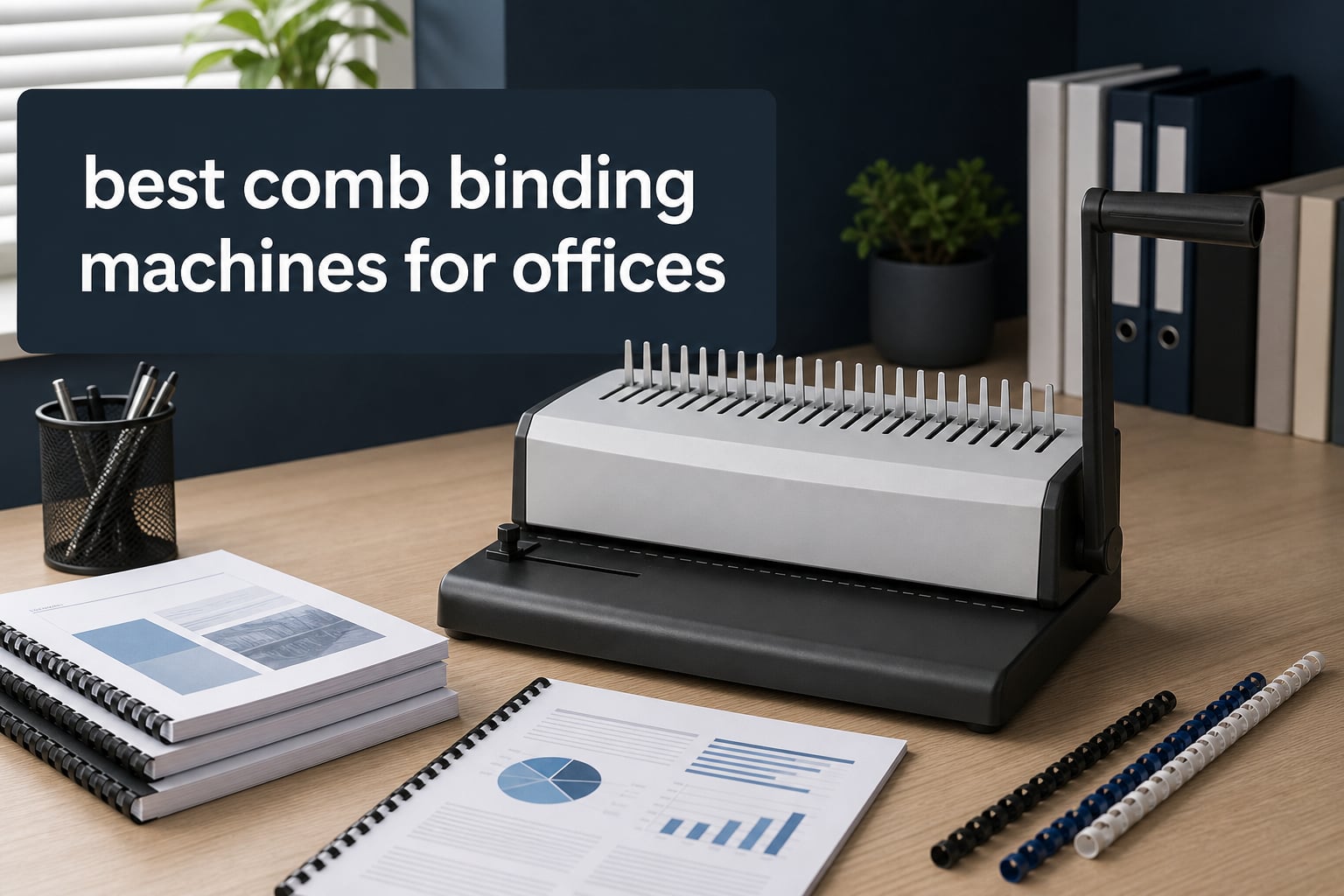
Comb binding machines for offices make recurring reports, training packets, proposals, and policy manuals look finished while keeping every page editable. The practical advantage is simple: a plastic comb can be reopened when a page changes, and the finished document lays flat for reading and copying.
Our eight selections separate light office work from demanding document production by focusing on the figures that change a workday: punch capacity per lift, total binding capacity, paper-size support, alignment controls, construction, and operation type. A machine advertised to bind hundreds of sheets still has a much smaller per-punch limit, so that distinction matters more than a headline number.
For most teams, I would begin with the Fellowes Pulsar+ when dependable guided manual work is the priority, choose the Fellowes Quasar+ for the largest manual punch and bind ratings here, or choose the Quasar 500 Electric when repeated punching makes lever work a poor fit. The models below are all comb binders, so none is a substitute for a wire or coil system if your documents need a different finish.
A comb binding machine punches holes along one document edge, opens a plastic comb spine, places the punched pages on that spine, then closes it. That workflow gives offices a professional-looking report that can lie flat and be edited later, which is why it remains a sensible choice for materials that change after printing.
Table of Contents
These are the top 3 comb binding machines for offices in 2026
The Fellowes Pulsar+ is our editor’s choice for teams that want a 20-sheet manual punch, 300-sheet binding capacity, and a vertical loading path with a documented edge guide. The Fellowes Quasar+ takes the best-value position because it raises the supplied manual capacity figures to 25 sheets punched and 500 sheets bound.
The OFFNOVA RC12 is the budget pick for a smaller office that needs Letter, A4, and A5 guides plus supplied comb spines. Its real-world workflow remains deliberately modest: its specifications say to punch 10 to 12 sheets of 80 g paper at a time.
These eight comb binding machines compare by office workload
Use this overview as a short list, then read the numbered reviews before deciding. Punch figures describe one lift of paper, while bind figures describe the largest document the comb-opening mechanism is rated to hold with the stated spine size.
| Product | Specifications | Action |
|---|---|---|
 Fellowes Pulsar+ Fellowes Pulsar+ |
|
View Details |
 Fellowes Star+ Fellowes Star+ |
|
View Details |
 OFFNOVA RC12 OFFNOVA RC12 |
|
View Details |
 RAYSON SD1202 RAYSON SD1202 |
|
View Details |
 Fellowes Quasar+ Fellowes Quasar+ |
|
View Details |
 MAKEASY Comb Binder MAKEASY Comb Binder |
|
View Details |
 Amazon Basics 3870 Amazon Basics 3870 |
|
View Details |
 Fellowes Quasar 500 Electric Fellowes Quasar 500 Electric |
|
View Details |
The Fellowes Pulsar+ is the best balanced choice for guided office binding
- 20-sheet manual punch
- 300-sheet binding
- Edge guide
- Comb storage
- Manual operation
- Plastic construction
The Pulsar+ is the model I would put in a general office where several people need consistent results without a long setup routine. It punches up to 20 sheets at one time and binds up to 300 sheets with a standard 1.5-inch plastic comb, a useful middle ground for training packs and recurring reports.
Its vertical document loading path and enhanced accuracy edge guide are meaningful details. Alignment mistakes waste covers and paper, and the vertical feed gives the user one clear reference point before using the manual punch.
The integrated tray stores combs and includes a document measurement tool, which reduces the common guesswork around spine size. Its 15.4-pound weight also suggests a stationary desk or supply-room role rather than a machine someone moves between rooms.
The rating is 4.8 from 569 reviews in the supplied data, with 89 percent five-star ratings. That feedback profile and the classroom-focused feature set make it a credible choice when office staff need a familiar, repeatable comb-binding process.
The Pulsar+ suits offices that bind medium-thickness reports regularly
Choose this model when your normal stack is well below its 20-sheet punch limit but your completed documents can reach several hundred sheets. A 300-sheet rating gives room for substantial manuals without moving to a larger manual unit.
It also fits teams producing documents that must lie flat, such as procedures, meeting books, and presentation handouts. Comb spines can be reopened when an approved page needs replacing.
The Pulsar+ needs a manual-workflow owner for busy periods
Every punch is manual, so a high-volume department should break paper into controlled lifts rather than rush a thick stack. The listed product information does not identify disengageable dies, so confirm that capability separately if you often create custom hole patterns.
Use ordinary office paper within the stated punch limit and test a small batch before committing specialty covers. This keeps the edge guide and margin position consistent from the first set to the last.
The Fellowes Star+ is the compact option for light office packets
- 15-sheet punch
- 150-sheet binding
- Edge guide
- Comb storage
- Lower document capacity
- Manual operation
The Star+ is the sensible downsized Fellowes option when the office makes smaller packets rather than thick manuals. It manually punches up to 15 sheets and binds up to 150 sheets using a standard three-quarter-inch plastic comb.
At 9.7 pounds and with listed dimensions of 3.13 by 9.81 by 17.69 inches, it asks for less permanent counter space than the Pulsar+. The compact format makes sense for an administrator’s office, a shared workroom, or a department that binds only when a packet is due.
Fellowes includes the same types of practical aids that help new operators: an enhanced accuracy edge guide, vertical document loader, built-in comb storage, and an integrated measurement device. Those features answer a forum concern directly, because choosing a comb by document thickness becomes easier when the machine offers a measuring reference.
The supplied rating is 4.7 from about 1.8k reviews, with 82 percent five-star ratings. That is a deep base of feedback for a light-duty comb binder, though the 150-sheet document limit is the number to respect.
The Star+ works best for short proposals and routine handouts
A team binding committee packs, project briefings, classroom-style materials, or modest proposals can work comfortably inside its 15-sheet punch and 150-sheet bind ratings. It is designed for light-duty punching, not an all-day production station.
Its vertical loader is especially helpful for staff who have not used office binding equipment before. Load, square the paper against the guide, punch a conservative lift, and repeat.
The Star+ becomes restrictive when reports grow beyond 150 sheets
Do not select it because its punch capacity looks close to a larger machine’s figure while ignoring the binding ceiling. A thicker report needs a larger compatible comb and a machine rated for that finished thickness.
If your office routinely prints long policy manuals, move to the Pulsar+, Quasar+, or Quasar 500 Electric instead. The Star+ is better viewed as a compact light-work machine than a capacity upgrade.
The OFFNOVA RC12 is the starter choice with multi-size paper guides
- 100 comb spines included
- Letter A4 A5 guides
- Adjustable edge guide
- Cast iron base
- Smaller punch lifts
- Capacity data differs by field
The OFFNOVA RC12 is aimed at a small office that wants to begin plastic comb binding with useful supplies already included. The data lists 100 three-eighth-inch comb spines, a comb protector, and an oil-absorbing paper, alongside guides for Letter, A4, and A5 paper.
Its operating guidance says it punches 10 to 12 sheets of 80 g paper per lift and binds up to 450 sheets. That difference is normal in this category: a binder may hold a thick completed document, but punching that document must happen in many smaller batches.
I like the practical focus on an adjustable edge guide, positioning knob, curved handle, and a cast-iron base. The listed record has conflicting weight references, so use the listed 9.09-pound product specification for planning rather than relying on a separate feature statement.
It carries a 4.6 rating from 996 reviews, with 80 percent five-star ratings in the supplied review summary. That makes it a plausible entry-level selection for offices that value paper-size flexibility and do not need large punch lifts.
The RC12 answers offices that use Letter, A4, and A5 documents
Paper-size marks and an adjustable edge guide give this machine a clear role in teams working across standard regional formats. Accurate positioning is more useful than raw punch speed when documents must look uniform to clients or staff.
The included 100 comb spines let a new user practice the opening and closing motion before ordering more supplies. Match the comb spine to the actual punched stack rather than forcing a thick document into a small comb.
The RC12 requires patience for large stacks and heavy covers
For standard 80 g paper, keep each lift within the stated 10-to-12-sheet capacity. Heavy covers need a separate test because their thickness does not behave like ordinary copy paper.
The data identifies an adjustable margin but does not provide a precise range, so users who require a fixed legal-document margin should verify that specification before buying. This is a capable starter binder, not a published high-speed production machine.
The RAYSON SD1202 is the metal-built choice for modest daily binding
- Metal construction
- 3-6 mm edge guide
- Horizontal loading
- 22 mm comb support
- 10-sheet punch
- 200-sheet bind limit
The RAYSON SD1202 focuses on a straightforward manual workflow with metal construction and a 19-hole pattern for Letter-size work. It punches up to 10 sheets of 20-pound, 80 g paper and binds up to 200 sheets of 18-pound, 70 g paper with a 22 mm, seven-eighth-inch comb ring.
Those paper-weight details are unusually useful because they make its stated capacity less abstract. Paper binding claims only mean something when the paper basis weight is clear; heavier stock raises the physical thickness of the finished document and lowers the sensible number of sheets per lift.
The side margin adjustment and 3 mm to 6 mm enhanced accuracy edge guide give users a defined alignment range. It loads horizontally, which some staff will prefer because the paper rests on the base while they square it before punching.
The rating is 4.6 from 349 reviews, with 79 percent five-star ratings in the supplied distribution. Its 10.43-pound weight and metal material make it the office-workhorse-style alternative for a team that does not need the 300- or 500-sheet tiers.
The SD1202 fits Letter-size documents with a known paper specification
This model has a clear fit when an office mostly handles Letter sheets, reports around 200 sheets or fewer, and standard-weight interior pages. The stated 3 mm to 6 mm guide range also gives a concrete place to start when setting the margin.
Users making planners, client reports, business proposals, craft patterns, or booklets are named in the feature data. For office work, that translates well to packets where a sturdy manual machine matters more than an electric punch.
The SD1202 needs smaller punch batches than heavier-duty office machines
A 10-sheet capacity calls for a steady, repetitive process rather than a one-lift approach. Divide a 100-sheet report into ten controlled punch batches, then inspect the first holes before continuing.
The listed 19-hole Letter maximum also means it is not the strongest fit where A4 or A5 support is a recurring requirement. Select a model with those listed paper-size marks if format changes are part of your workflow.
The Fellowes Quasar+ is the strongest manual choice for thick documents
Fellowes Binding Machine Quasar+ Comb Binding (5227201), 5.1″ x 18.1″ x 15.4″
- 25-sheet punch
- 500-sheet binding
- Edge guide
- Measurement tool
- Manual operation
- Fewer supplied reviews
The Fellowes Quasar+ has the largest published manual capacities in this group: it punches up to 25 sheets at a time and binds up to 500 sheets with a two-inch comb. For a busy office that still prefers a lever rather than an electric punch, those are serious document-production figures.
Its vertical loading design and enhanced accuracy edge guide center documents before punching. The comb storage tray and integrated document measurement device are not flashy features, but they reduce pauses when staff need to choose a spine and prepare the next report.
The listed 25-hole count should be treated as part of this product’s specified system, rather than assumed to match every other office binder. Hole pattern and comb compatibility need to be checked as a pair when you buy replacement supplies.
The Quasar+ has a 4.6 rating from 240 reviews, with 82 percent five-star ratings in the supplied distribution. It is a strong manual answer for policy handbooks, extensive training manuals, and thick annual-report-style documents that need editable pages.
The Quasar+ is built for offices that need 500-sheet binding capacity
This is the manual pick for large finished documents, especially when a two-inch plastic comb is appropriate for the page count. Capacity does not mean you should punch 500 sheets together; it means the opened comb mechanism is rated to close that size of document.
Its 25-sheet punch capacity can also cut the number of cycles compared with 10- or 12-sheet machines. That reduction matters when a staff member is assembling a long report from standard office paper.
The Quasar+ still asks staff to perform manual punching
The leverage and capacity are substantial, but the punch operation remains manual. A department binding many thick documents back to back may prefer the Quasar 500 Electric simply to remove repeated lever pulls.
The supplied data does not list disengageable dies, so avoid assuming it will create every custom hole pattern. If that feature is mandatory for tabs or irregular formats, confirm it before standardizing supplies.
The MAKEASY comb binder is a practical metal option for mixed paper sizes
- Metal construction
- 100 combs included
- Letter A4 A5 marks
- Adjustable guide
- Manual effort on batches
- 10-12-sheet punch
The MAKEASY model combines a heavy-duty metal build with marks for Letter, A4, and A5 paper, which is helpful for a small office with mixed templates. It binds up to 400 sheets with two-inch comb spines and has a stated standard-paper punch capacity of 10 to 12 sheets.
The supplied technical details go further than most entries on cover material: they specify two sheets of 230 g cover or textured paper, or one five-to-12-mil PVC cover. That is a useful planning detail for presentations, because covers should be punched separately from the ordinary paper stack.
Its edge guide adjusts from 3 mm to 5 mm, while non-slip feet and a low-force handle support a steady manual process. It also includes 100 comb spines, giving an office a starting supply for document binding.
The listing shows a 4.4 rating from about 4.8k reviews and a 71 percent five-star rate. That volume of feedback is notable, but the lower rating versus the Fellowes leaders means I would use the published capacity limits carefully instead of treating it as a no-compromise production tool.
The MAKEASY fits mixed-format offices that need cover guidance
Letter, A4, and A5 marks provide a practical selection rule for offices serving different regions or producing small-format manuals alongside standard reports. The stated cover limits also make it easier to stage a polished front and back cover separately.
Use its 400-sheet binding rating with an appropriate two-inch comb spine, then check that pages turn freely. Comb binding is editable, so correcting an overfilled spine is simpler than reprinting a whole report.
The MAKEASY needs deliberate pacing during large manual batches
The product data explicitly notes that manual punching can require effort for large batches. Keep ordinary 20-pound printing paper at 10 to 12 sheets per lift and reduce the lift for heavier stock.
Do not mix PVC covers, textured covers, and office paper in one punch cycle. The specifications distinguish their capacities, and separate punching protects hole alignment and the blade.
The Amazon Basics 3870 is the simple all-in-one choice for basic office work
- 12-sheet punch
- 350-sheet binding
- Carbon steel blade
- Fixed paper slider
- Combs not included
- Manual punching
The Amazon Basics 3870 keeps the requirements clear: it punches up to 12 sheets at a time and binds up to 350 pages. Its all-in-one layout covers the two essential tasks, while the carbon-steel hole-punch blade and fixed paper slider are intended to support repeatable hole placement.
It is compatible with A5, Letter, and A4 paper sizes, with the product data calling out 15, 19, and 21 holes respectively. That format coverage is valuable for a general office, provided you buy comb spines that match the selected paper-size pattern.
The published material mix is 90 percent steel and 10 percent plastic, and the listed weight is 7.63 pounds. That points to a machine that is manageable on a work surface but should still be kept level so the fixed slider can do its job.
It holds a 4.4 rating from about 1.4k reviews, with 72 percent five-star ratings in the supplied summary. The important limitation is plain: plastic comb spines are not included, so budget the correct spine supply into the first project.
The Amazon Basics 3870 suits offices that need several paper formats
The named A5, Letter, and A4 patterns make this a practical pick for a team that cannot standardize every document to one size. A fixed paper slider can prevent hole offset when users set it correctly for the selected format.
It also makes sense for basic document binding where 350 pages is enough and a 12-sheet manual punch does not slow the schedule. Follow the size marks, make a test punch, then run the remaining pages in equal lifts.
The Amazon Basics 3870 needs separate comb-spine planning
Unlike models that arrive with starter spines, this unit does not include plastic combs. Select the spine size after measuring the full stack, including covers, and match its hole pattern to the paper format.
A fixed slider helps repeatability but does not remove the need to square paper before every punch. Thick or curled stock can still shift, so reduce the lift and check the first result.
The Fellowes Quasar 500 Electric is the best answer for frequent punching
- Electric touch punch
- 500-sheet binding
- Measurement tool
- 2-year warranty
- 25.8-pound body
- Bulkier storage
The Fellowes Quasar 500 Electric is the clear productivity upgrade when staff repeatedly punch standard paper and manual lever work is the bottleneck. A button-operated electric punch handles up to 20 sheets, while the comb-binding mechanism supports up to 500 sheets with a two-inch plastic comb.
Electric operation changes only the punching step, not the need for good setup. Users still need to select the correct comb, align the stack with the precision edge guide, and inspect the first punched set before working through a large document.
The machine weighs 25.8 pounds and measures 16.88 by 16.88 by 5.13 inches, so it is a dedicated workstation machine rather than a portable tool. It includes a comb storage tray, integrated document measurement tool, starter kit, and a two-year warranty.
The supplied rating is 4.3 from 141 reviews, with 76 percent five-star ratings. Its rating is lower than the Pulsar+ score, but its electric touch punch and 500-sheet capacity are the relevant differentiators for an office with a repeatable high-volume workflow.
The Quasar 500 Electric fits departments that punch many standard-paper lifts
Choose this model when the repeated physical act of manual punching is the issue, not merely the maximum document thickness. Its 20-sheet electric punch can make a scheduled batch of training manuals or office reports less tiring for the operator.
The 500-sheet binding capacity with a two-inch comb gives the department a large finished-document ceiling. The built-in measurement tool can help users select a spine before they start opening combs.
The Quasar 500 Electric requires a permanent workspace
At 25.8 pounds, this is not the right unit for a team that stores its binder in a cabinet after every use. Give it a stable surface with room for the document stack, combs, and an outgoing tray.
Its listed drawbacks include a bulkier classroom-storage profile, and that applies to offices too. The electric punch earns its space when the number of punch cycles is high enough to matter.
The right office binder matches punch work, document thickness, and paper format
Start with the finished document, not the machine. Count the interior pages, add both covers and any tabs, decide whether pages must lie flat or rotate fully, then choose the comb spine and machine capacity that support that stack.
Punch capacity is the number of sheets one punch cycle can handle
Punch capacity per lift is the number that controls your labor. A 10-sheet machine can still bind a 400-sheet report, but the operator must punch that report in about 40 controlled sets before placing them on the comb.
For standard 20-pound or 80 g copy paper, use the manufacturer’s listed capacity as an upper limit, not a target to exceed. Reduce the number of sheets for heavier paper, textured stock, laminated material, or covers.
Binding capacity is the finished document thickness the comb can hold
Binding capacity refers to the number of sheets that can sit on the appropriate opened comb spine. The Quasar+ and Quasar 500 Electric are rated to 500 sheets with a two-inch comb; the Star+ is rated to 150 sheets with a three-quarter-inch comb.
Measure the actual stack rather than guessing from page count alone. Paper weight, cover thickness, and inserted divider sheets all affect spine size, and an overfilled comb makes pages hard to turn.
Manual operation works for occasional batches while electric punching reduces repetitive effort
Manual machines are appropriate for light and moderate document production because the operator controls every punch. The Pulsar+, Star+, OFFNOVA, RAYSON, Quasar+, MAKEASY, and Amazon Basics models all need that lever-driven rhythm.
Electric punching is a better fit for a department that processes many standard-paper lifts in one session. The Quasar 500 Electric still needs an operator to align paper and complete comb opening and closing, but its touch punch removes the repeated lever pull.
Comb binding is better for editable flat documents while wire and coil solve different problems
Choose comb binding for reports and training documents that must lie flat and may need a page replaced. The plastic spine can be reopened, which is a practical advantage when a policy, price sheet, or approved form changes after binding.
Choose coil binding when full 360-degree page rotation is more important than an editable comb. Choose wire binding when a more formal metal finish matters, understanding that editing is less convenient than reopening a plastic comb.
Alignment controls prevent the wasted-paper problem that frustrates office teams
An edge guide, paper slider, or vertical-loading path gives the paper a repeatable reference before punching. Fellowes calls out enhanced accuracy guides on the Pulsar+, Star+, and Quasar+, while the RAYSON and MAKEASY list adjustable guide ranges.
Before a large run, punch two sheets of the actual paper and hold them against the cover. If the margin is too shallow, too deep, or uneven, correct the guide before any full packet is punched.
Disengageable dies matter only when your documents need custom hole patterns
Disengageable dies are individual punching elements that can be turned off to avoid holes where tabs, unusual sizes, or special layouts require them. None of the supplied product records confirms this feature, so do not infer it from an adjustable edge guide or a high sheet capacity.
For ordinary Letter, A4, or A5 reports, a defined hole pattern and sound alignment are usually more important. Teams using custom tabs should confirm both die control and compatible comb spines before buying any machine.
In-house binding is worthwhile when a repeatable document workflow justifies the setup time
A binding machine is a worthwhile investment when your team regularly produces reports, manuals, proposals, or handbooks that need a consistent finished appearance and occasional edits. The useful comparison is not a machine’s sticker figure; it is the time saved, the frequency of binding, the control over revisions, and the supplies used per document.
For a simple internal check, track one month of outsourced or improvised finishing work, including staff time spent waiting for it. Then test an in-house batch: print, punch conservative lifts, bind, and note the time and supplies consumed for one representative document.
Maintenance starts with clean punches and conservative paper lifts
Paper dust and tiny punch scraps can interfere with a clean workflow, so empty the waste area according to the product instructions and keep the base clear. Do not force a handle when paper is above the documented punch capacity.
Use the supplied oil-absorbing paper only where the manufacturer directs it, as noted for the OFFNOVA package. Keep replacement combs sorted by size and pattern so a rushed user does not bind an A4 document with a mismatched spine.
A reliable binding process uses one test set before the full document run
First, stack the final contents in order and include the actual covers. Second, measure the stack, select the compatible comb spine, and set the paper guide for the format and margin you need.
Third, punch a small test lift and inspect every hole. Fourth, complete the remaining pages in equal batches, open the comb, load the punched sheets, close the comb, and turn through the document to check for snags.
These common questions answer the main comb-binding decisions
What is the best comb binding machine?
The Fellowes Pulsar+ is the best all-around choice here for an office that wants a 20-sheet manual punch, 300-sheet binding capacity, vertical document loading, and an accuracy edge guide. Choose the Fellowes Quasar+ for the largest listed manual capacity, or the Quasar 500 Electric for frequent button-operated punching.
Is a binding machine a worthwhile investment?
A binding machine is worthwhile for offices that regularly create reports, training manuals, proposals, or handbooks and want documents that lie flat and can be edited. Compare recurring volume, staff time, revision needs, supplies, and the machine’s punch workflow rather than selecting solely by the initial purchase figure.
How much does a comb binding machine cost?
Comb binding machines vary by manual or electric operation, per-lift punch capacity, finished-document capacity, construction, and included supplies. Instead of using a single cost figure, choose the smallest capacity that supports your normal document stack, paper formats, and expected number of punch cycles.
Which is better: a wire binding machine or a comb binding machine?
A comb binding machine is better when you need an editable document that lays flat because the plastic comb can be reopened. Wire binding is better when a formal metal finish is the priority, while coil binding is the better choice when pages need to rotate 360 degrees.
The best comb binding machines for offices depend on the work your team repeats
For most offices in 2026, I would choose the Fellowes Pulsar+ for guided all-around manual work, the Fellowes Quasar+ for the largest stated manual punch and binding capacity, or the Quasar 500 Electric when frequent punching justifies a dedicated workstation. The Star+, OFFNOVA, RAYSON, MAKEASY, and Amazon Basics choices each make more sense when their specific capacity, paper-format, construction, or starter-supply strengths match your actual documents.
Measure one typical report with its final covers, choose the right comb spine and hole pattern, then make a two-sheet test punch before committing to a full run. That small check is the fastest route to clean, editable documents from comb binding machines for offices.