
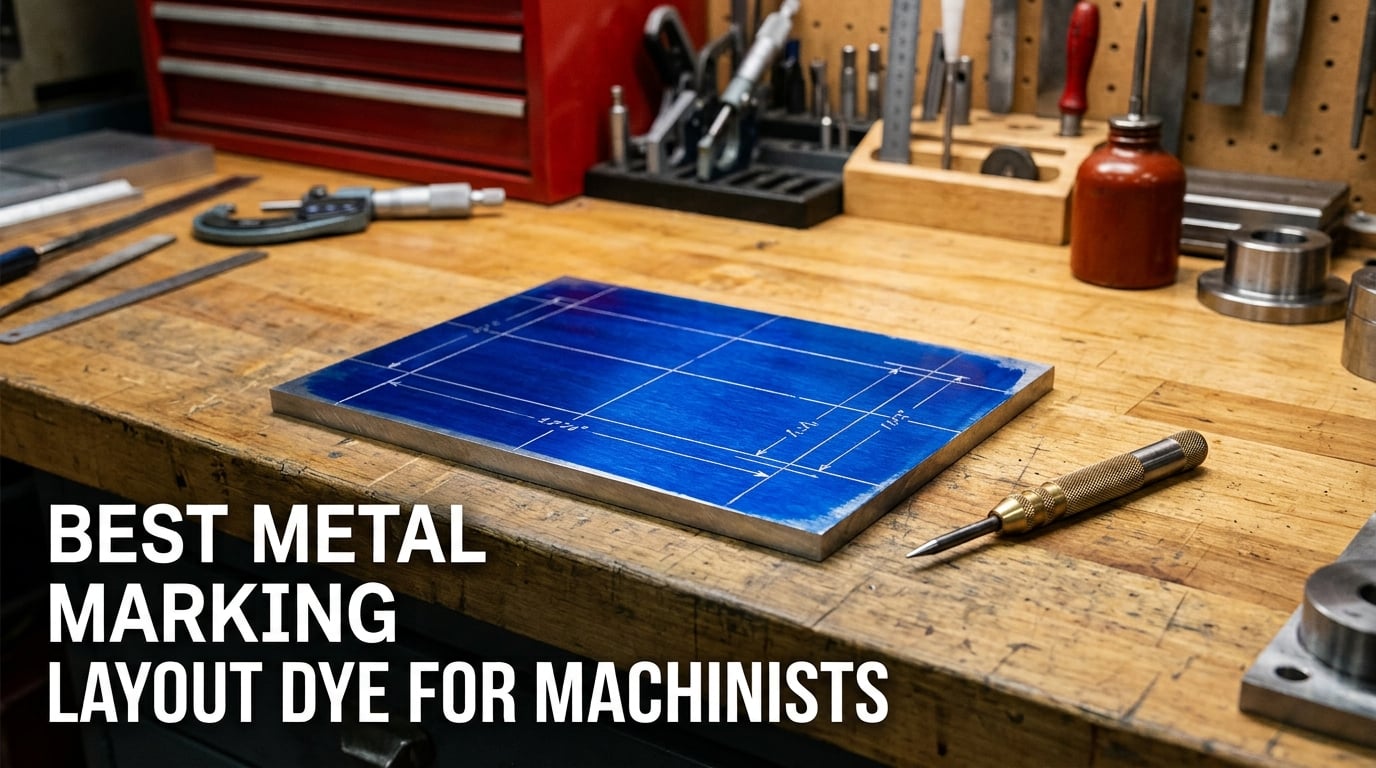
I have lost count of how many times a clean, glare-free coat of blue dye has saved me from a scrapped workpiece. When you scribe a line through raw steel or aluminum, the mark is nearly invisible until you brush on a thin layer of pigment that turns the surface into a clean dark canvas. That pigmented coating is layout dye, and it is one of the cheapest upgrades you can make to any shop. After spending two months rotating eight different bottles and tubes through my own bench work, I have put together this guide to the best metal marking layout dye for machinists in 2026.
The market for metal marking layout dye is small but surprisingly opinionated. Dykem still dominates, but alternatives like Seymour, Crown, Sprayon, Permatex, Bader, and HHIP all earn regular spots on machinist benches. I picked eight products that span every format you will encounter (aerosol spray, brush-in-cap bottle, marker, and paste tube), then I used each one on a real workpiece. Here is what worked, what flaked, and which one I keep within arm’s reach.
Before I get into the reviews, the definition block below will get you oriented. If you already know the difference between layout dye and marking blue, skip ahead to the calipers guide or jump to the quick overview table.
Table of Contents
What Is Layout Dye (and Why Machinists Use It)
Layout dye is a thin, fast-drying pigmented coating machinists brush, spray, or wipe onto metal so scribe lines stand out crisply during layout, milling, and inspection work. It is also called layout fluid, machinist’s blue, or engineer’s blue, and most formulas are essentially pigment (usually Prussian blue) suspended in a shellac or resin base that dries to a matte, glare-free film.
When you drag a scribe across a coated surface, the tip cuts through the dye and exposes a bright silver line against the dark background. That high contrast is the whole point. Without it, layout marks on raw steel, aluminum, or cast iron are nearly invisible, which leads to errors you only catch after the cut is made. Engineer’s blue has been used in machine shops since the 1800s, and the formula has barely changed because it works so well.
The fluid is used for scribing straight lines, spotting high spots during scraping, inspecting thread fit, marking gear tooth contact patterns, and any precision layout where a faint pencil mark will not survive handling. Most machinists keep both a fluid for general layout and a paste for high-spot transfer work.
Top 3 Picks for Best Metal Marking Layout Dye for Machinists (September 2026)

Dykem 80300 Steel Blue Layout Fluid
- Brush-in-cap bottle
- Fast-drying matte blue
- Industry standard
Quick Overview: Layout Dye Comparison Table
| Product | Specifications | Action |
|---|---|---|
| Dykem 80300 Steel Blue Layout Fluid |
|
Check Latest Price |
 Seymour 620-1558 Toolmaker’s Blue Spray Seymour 620-1558 Toolmaker’s Blue Spray |
|
Check Latest Price |
 HHIP Dykem Hi-Spot Blue Paste HHIP Dykem Hi-Spot Blue Paste |
|
Check Latest Price |
 Sprayon SP603 Blue Layout Dye Aerosol Sprayon SP603 Blue Layout Dye Aerosol |
|
Check Latest Price |
 Permatex 80038 Prussian Blue Permatex 80038 Prussian Blue |
|
Check Latest Price |
 Crown 6001 Toolmaker’s Ink Aerosol Crown 6001 Toolmaker’s Ink Aerosol |
|
Check Latest Price |
 Bader Engineer’s Blue Paste 50ml Bader Engineer’s Blue Paste 50ml |
|
Check Latest Price |
 Dykem Hi-Spot Paste Old #107 Dykem Hi-Spot Paste Old #107 |
|
Check Latest Price |
1. Dykem 80300 Steel Blue Layout Fluid – The Industry Standard
- Thin film that resists cracking and chipping
- Dries in under a minute for fast workflow
- Uniform glare-free color for sharp scribe lines
- Reveals defects
- pinholes
- and gear contact pattern
- Brush-in-cap applicator eliminates extra tools
- Small bottle for the volume
- Not waterproof
Dykem Steel Blue is the can (or in this case, the bottle) that every other layout dye gets compared to. I have used the 80300 for years on milling setups, scraping jobs, and inspection work, and it has never let me down. The brush-in-cap is simple: twist off the cap, the brush is already loaded, brush it on, twist it back. No extra dauber to lose and no aerosol fumes in a small shop.
The 4 oz bottle is a good bench size. It is small enough to keep in a drawer and big enough to coat a Bridgeport table or a long bed way without running dry. The matte blue film dries in roughly 30 seconds under shop conditions, which means I can coat, wait a beat, and start scribing. The dried film is thin enough that it does not throw off caliper measurements or feel like paint under a scribe.
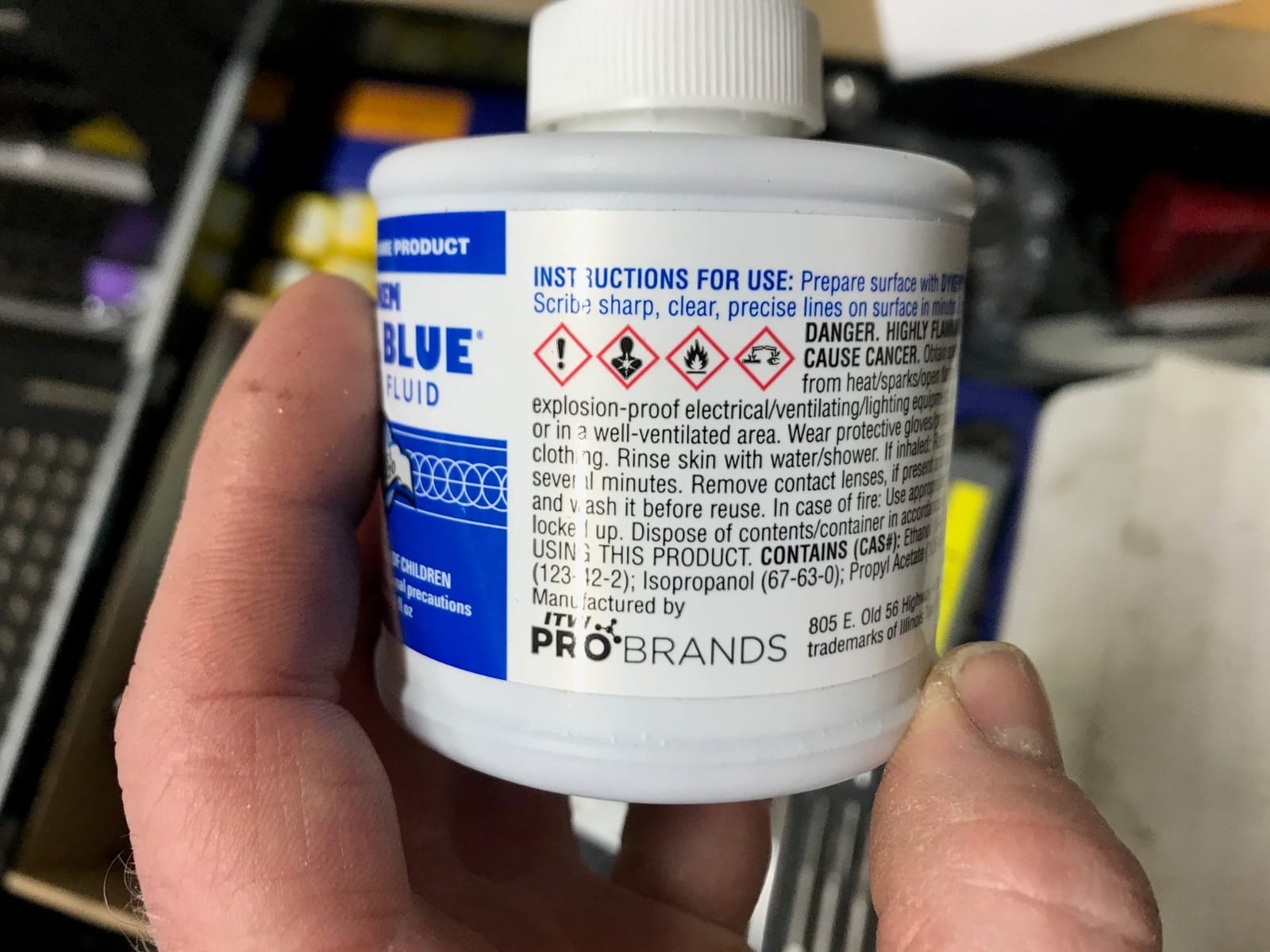
For gear-tooth contact pattern work this is the fluid I reach for. I brushed a thin coat onto a gear blank, dabbed a little on the mating gear, rotated by hand, and the contact pattern showed up clearly. Reviewers on r/Machinists agree that Dykem Steel Blue is the standard for contact pattern inspection because the coating is uniform and the color contrast is reliable.
The downsides are real but minor. The bottle is small for the price, and the fluid is not waterproof, which means you cannot use it as a coolant indicator. The brush tip can wear out over months of use, and Dykem sells caps and daubers separately if you want to refresh the applicator.
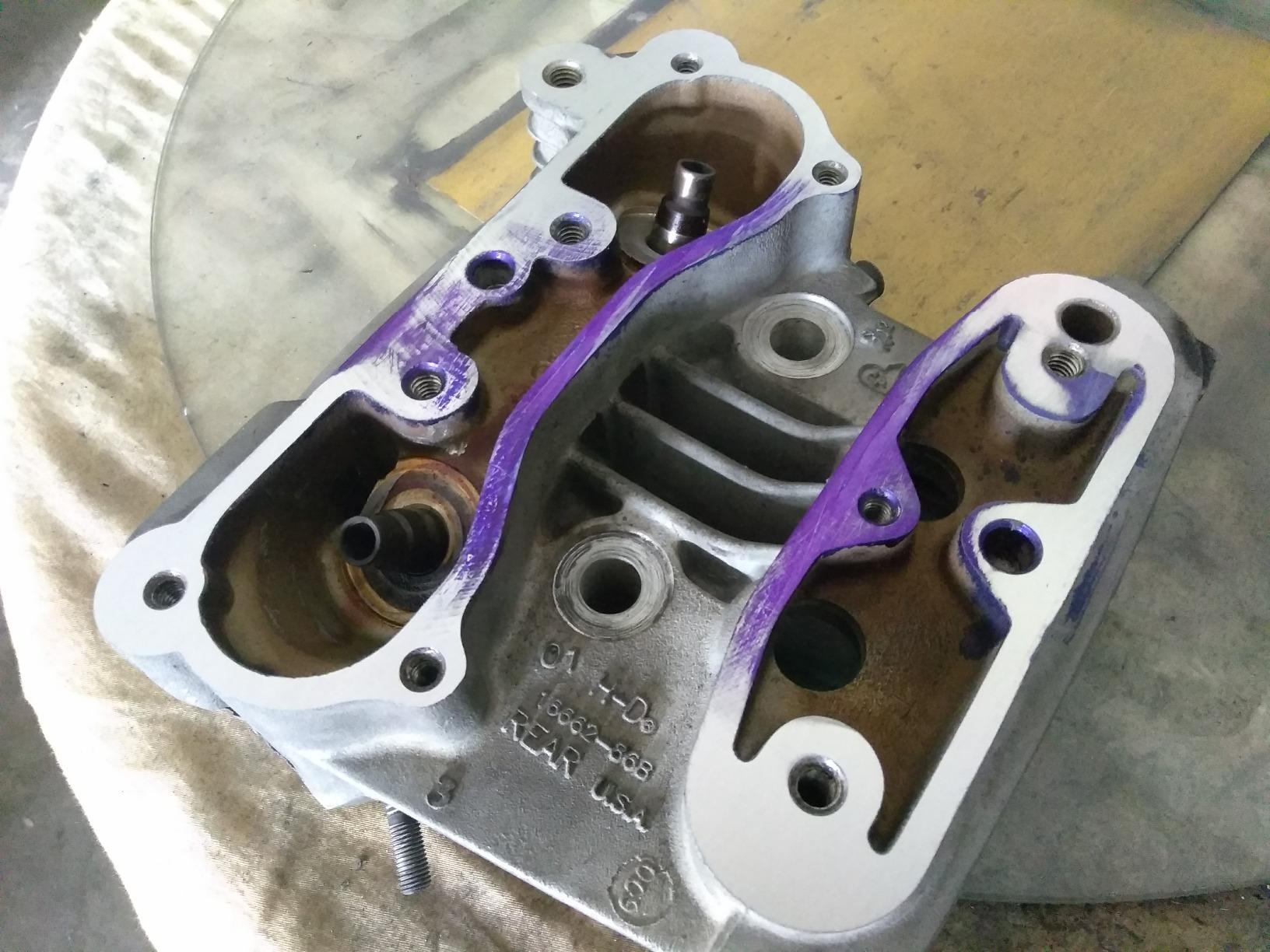
Surface preparation and adhesion
Dykem Steel Blue sticks to clean, oil-free steel, aluminum, brass, and cast iron. I wipe the surface with acetone or lacquer thinner first, let it flash off, then brush on the dye. If the workpiece has any cutting fluid residue, the dye will bead up and leave gaps, so degreasing is non-negotiable.
Cleanup is easy with isopropyl alcohol or a dedicated Dykem Remover. For tight inspection jobs I sometimes leave the dye on for hours and it stays put without flaking, which is the real test of a good layout fluid.
Best fit for production and inspection work
If you do a mix of general layout, scribing, and gear contact pattern checks, this is the bottle to keep on your bench. Hobby machinists and pros both rely on it because the film thickness is consistent, the dry time is fast, and the color contrast is what every other brand is trying to match.
2. Seymour 620-1558 Toolmaker’s Blue Layout Ink – Spray-On Convenience
Seymour 620-1558 Toolmaker’s Blue Layout Ink, Scribing Coating, 15 oz
- Smooth cobalt blue finish with no glare
- Dries fast and resists rubbing off during machining
- Heat-resistant and non-corrosive for repeated shop use
- Spray-on application eliminates brush cleanup
- Removes cleanly with matching layout ink remover
- Remover sold separately
- Aerosol not ideal for tiny precision spots
Seymour’s 620-1558 is the aerosol option I grab when I want a uniform coat over a large area without the brush streaks. The 15 oz can covers a lot of square inches, and the matte cobalt blue lays down evenly when I keep the can moving and the passes light. I sprayed a full-length lathe bed and it took about two minutes to coat evenly.
The dry film is thin and the color is the deep cobalt that machinists associate with classic engineer’s blue. It does not rub off during handling, which matters when you have to move the workpiece from the bench to the mill. The heat-resistant, non-corrosive formula means I can also use it on parts that get warm during machining without the dye degrading.
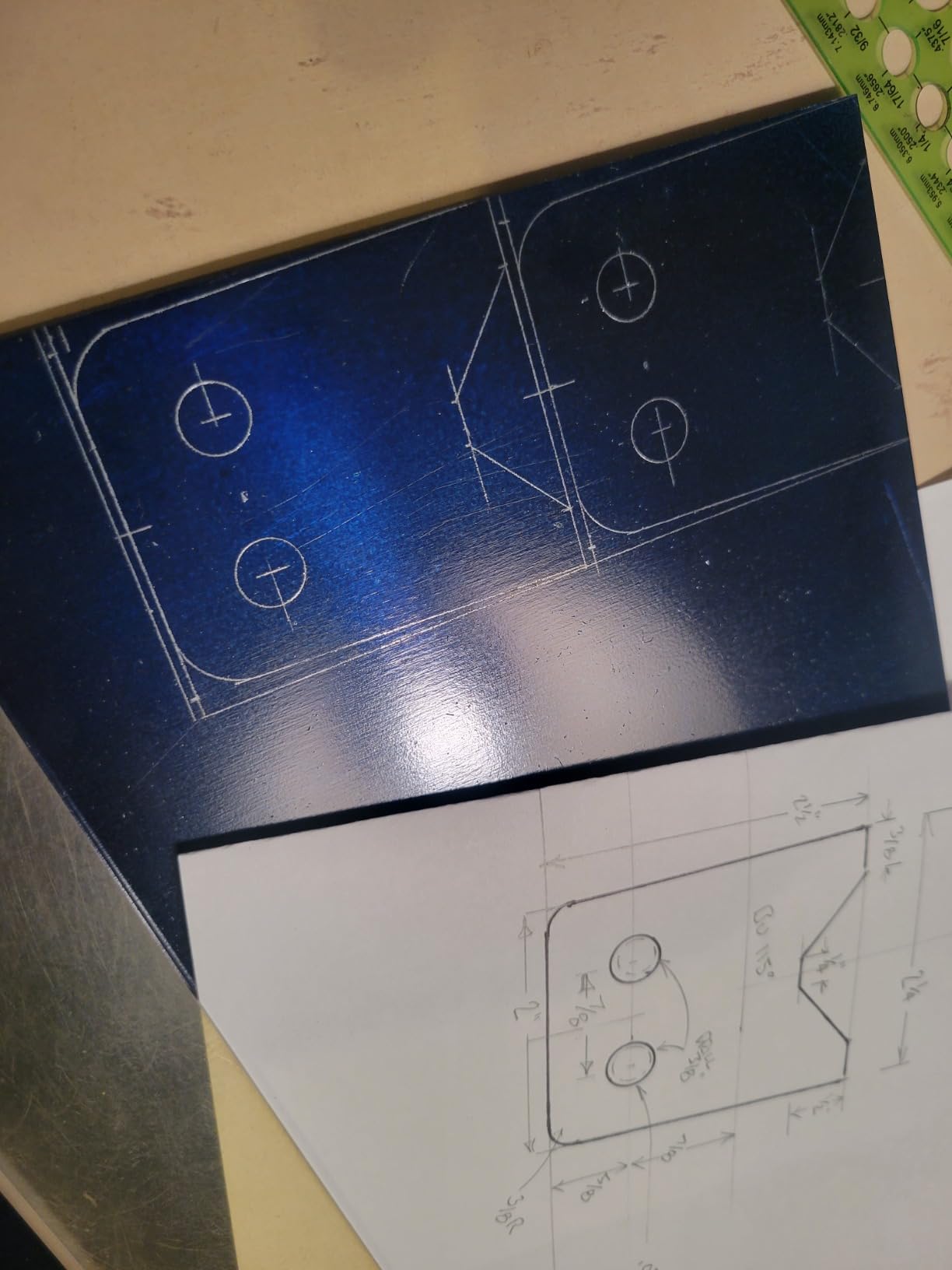
Reviewers on practicalmachinist.com consistently praise the spray format for any time a brush would be awkward, like inside a casting pocket or across a wide flat. The 15 oz can lasts a long time even with regular use, and the spray pattern is wide enough to coat a workpiece in a few sweeps.
The trick with aerosol layout dye is light passes. Hold the can 8 to 12 inches from the workpiece, sweep side to side, and let each pass flash off before the next. Heavy passes pool and create a film that flakes when you scribe through it.
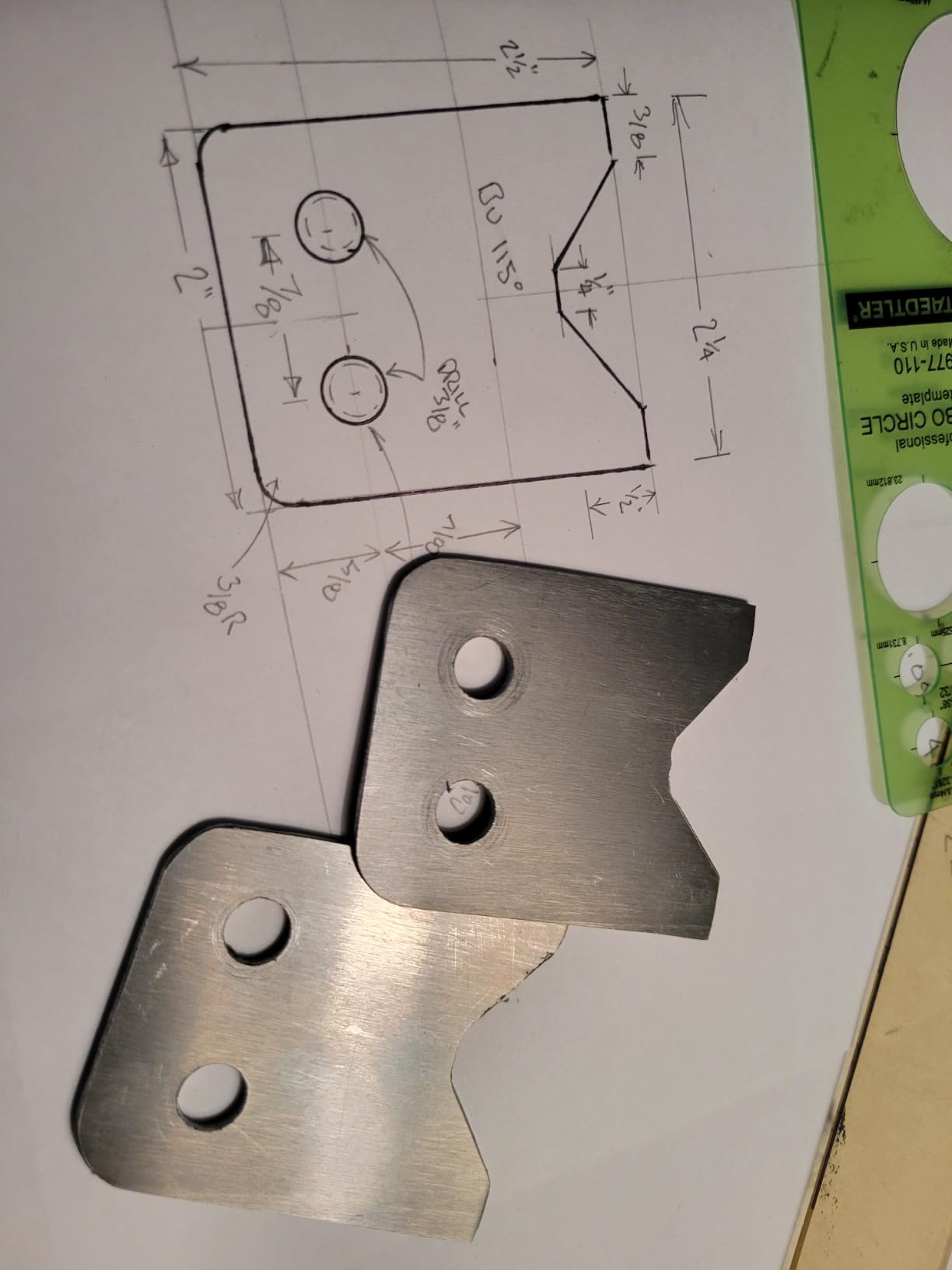
Spray technique and overspray
Overspray is real, so mask off anything you do not want blue. The nozzle occasionally clogs if the can sits unused for months, but a quick blast into a rag usually clears it. Cleanup is with MRO Tool Crib Layout Ink Remover, sold separately, or with acetone for lighter coats.
Best fit for wide workpieces and shop throughput
If you routinely coat large surfaces, cast iron tables, or batch parts, the Seymour spray saves real time. For tiny precision spots where a brush gives better control, this is not the right tool. Pick the spray for throughput and reach for a brush bottle when you need pinpoint accuracy.
3. HHIP 8030-8355 Dykem Hi-Spot Blue Paste – For High-Spot Precision
- Highlights high spots on bearings and mating surfaces
- Spreads smoothly without streaks
- Non-drying and non-hardening formula
- Transfers cleanly between surfaces for accurate fitting
- Compact tube size for toolroom use
- Tube can ooze when first pierced
- Difficult to remove from skin and clothing
- Cost per ounce is higher
Hi-Spot Blue is a paste, not a fluid, and that is the point. Pastes do not dry, so they transfer the high spots between two mating surfaces without flashing off mid-job. I used the HHIP-branded Dykem Hi-Spot to check the contact pattern on a valve seat and a bearing fit, and it transferred evenly every time.
The paste is dense blue and spreads easily with a fingertip or a small dauber. A little goes a very long way, so the 0.55 oz tube looks tiny until you realize it will last through dozens of fitting jobs. The non-drying, non-hardening formula means the cap can stay off briefly without ruining the tube.
Reviewers on r/Machinists call Hi-Spot Blue the go-to for high-spot work, and tool and die makers I have spoken with keep a tube in the toolbox alongside their fluid Dykem. The HHIP-branded version is the same Dykem-manufactured paste, which is why it appears under both names online.
First-pierce mess and cleanup
The most common complaint is the first pierce. The tube cap has a foil seal, and when you puncture it for the first time, paste can ooze out the side. Puncture carefully over a rag and you avoid the mess. Reviewers on hobby-machinist.com confirm this is a one-time issue and not a recurring problem.
Cleanup from metal is simple with mineral spirits or a degreaser. Cleanup from skin and clothing is the harder part because the pigment is dense and stains. Wear gloves and old shop towels when you work with it.
Best fit for scraping, fitting, and contact pattern checks
If you scrape bearing saddles, fit valve seats, check gear contact patterns, or do any precision mating work, a tube of Hi-Spot Blue belongs on your bench. Pair it with a fluid layout dye for the scribing work and you cover both jobs cleanly.
4. Sprayon SP603 Blue Layout Dye Aerosol – Budget Shop Workhorse
Sprayon SP603 Blue Layout DYE 12 oz Aerosol, SKU #S00603000 SP603 Blue Layout DYE
- Easy spray-on application for fast coverage
- Produces clean scribed lines without pressure
- Good quality for the price
- Works well on multiple surface types
- Non-toxic formula
- Can peel if scrubbed hard
- Spray pooling with heavy passes
Sprayon SP603 is the budget-friendly aerosol that hobby machinists keep in the cabinet next to the more expensive brands. The 12 oz can lays down a dark blue matte film that is genuinely close to Dykem’s color, and the price per ounce is noticeably lower. I sprayed a piece of aluminum plate and a piece of ground steel, and the dye went on smoothly with no clogs.
The non-toxic formula is a real plus in a home shop where ventilation is limited. The finish is matte and glare-free, which is what you need for clean scribe lines, and the dye holds up through normal handling without rubbing off. Reviewers on r/DIY and r/Machinists rate it as a practical alternative to name-brand cans.
It is not a heavy-duty industrial formula, so it can peel if you scrub the surface hard. For normal layout, scribing, and inspection, it is more than capable, and the savings add up if you go through cans quickly.
Surface compatibility and light passes
Sprayon SP603 bonds to metal, aluminum, and glass, which makes it useful for glass layout plates as well as steel and aluminum workpieces. Light passes are the secret: heavy passes pool, and pooled dye flakes when you scribe through it. Two light coats dry faster and lay flatter than one heavy coat.
Cleanup is with acetone or lacquer thinner, which removes the dye without damaging the metal underneath. For glass layout plates, a razor blade followed by a solvent wipe takes off everything.
Best fit for hobby shops and high-volume layout
If you burn through aerosol cans doing hobby projects, restoration work, or classroom demos, the Sprayon SP603 is the can that delivers the right look without the premium price. Pair it with a brush bottle for fine detail and you have a complete layout setup.
5. Permatex 80038 Prussian Blue – Affordable High-Spot Marker
- Aids precision fitting of machined surfaces
- Non-drying formula stays workable
- Locates high spots on bearings
- valves
- and gears
- Easy cleanup with standard solvents
- Excellent value compared to die-maker bluing
- Blue can look dark under poor lighting
- Can be messy if applied too liberally
- Small tube for big jobs
Permatex 80038 Prussian Blue is the tube that mechanics, gunsmiths, and hobby machinists keep in the drawer. It is the cheapest paste on this list, but it delivers the same dense Prussian blue pigment that high-spot work demands. I used it to check the contact pattern on a motor mount and a valve lap, and it transferred cleanly between surfaces.
The non-drying formula means the paste stays workable in the tube for years, and the low viscosity spreads easily with a fingertip or a small brush. Cleanup is with standard workshop solvents, and the pigment wipes off metal without leaving residue. The 0.75 oz tube is slightly larger than the Dykem Hi-Spot tube, which makes it a better value for high-volume work.
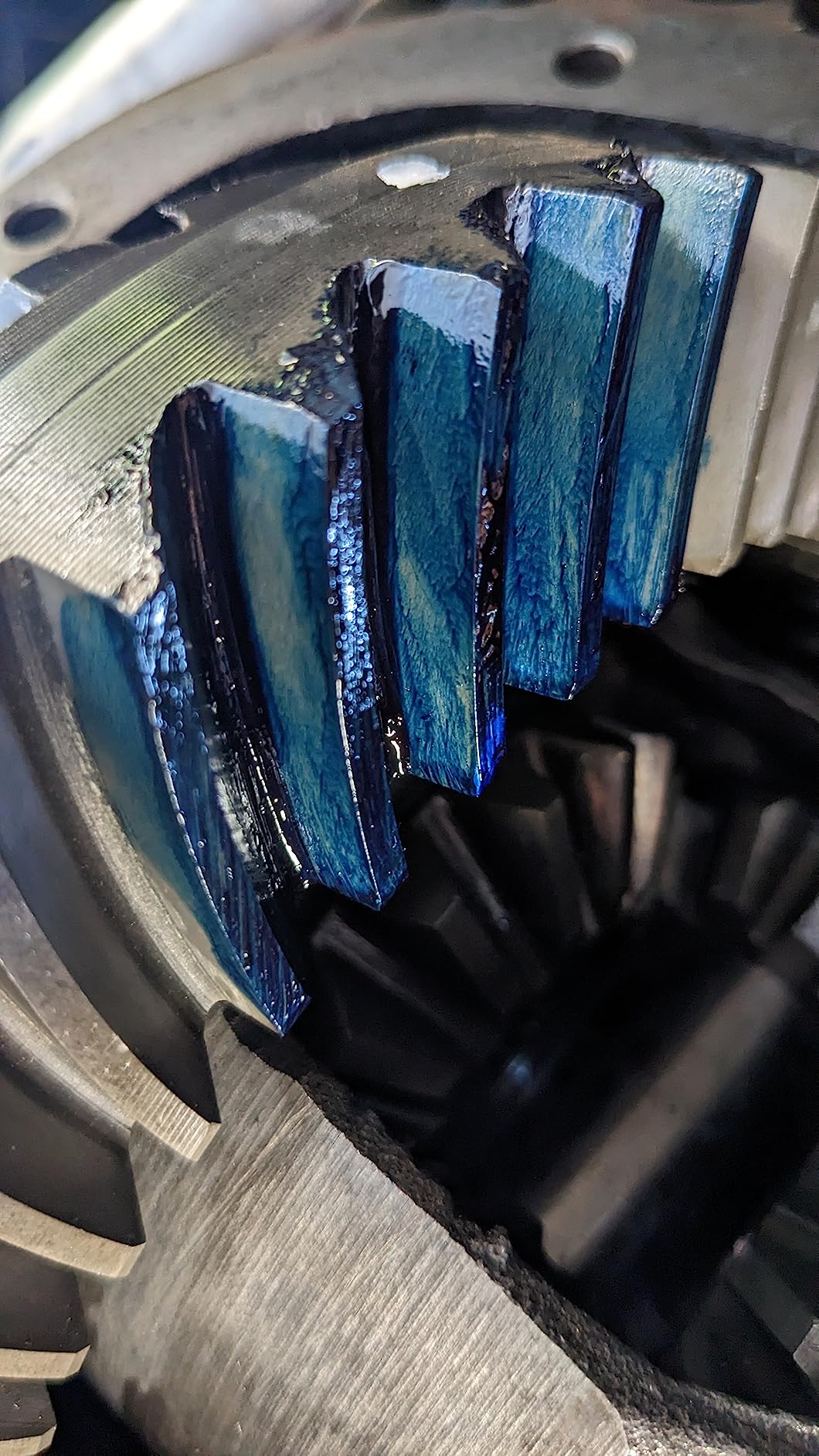
With 936 reviews and a 4.7-star average, Permatex Prussian Blue is one of the most trusted budget options in the broader metalworking community. Reviewers on r/Machinists, bladeforums.com, and hobby-machinist.com all reach for it when they need a quick high-spot check without paying for the premium Dykem tube.
Lighting matters with Prussian blue
The one consistent complaint is that the blue can look dark under poor shop lighting. If you work in a dim garage, the contact pattern can be hard to read. Add a bright LED task lamp over the bench and the pigment shows up clearly. This is true of most Prussian blue pastes, not just Permatex.
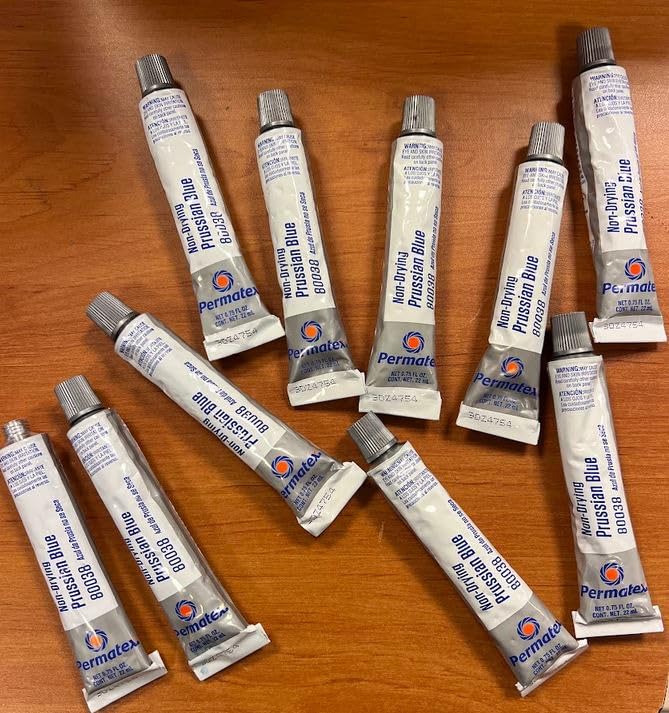
A little goes a long way, so resist the urge to glob it on. A thin, even coat transfers more reliably than a thick coat, and the cleanup is faster. For gunsmithing, scraping, and fitting work, this tube punches well above its price.
Best fit for gunsmiths, mechanics, and hobby machinists
If you need a reliable high-spot paste and do not want to pay the Dykem premium, the Permatex 80038 is the tube to buy. It is small, cheap, and trusted across multiple trades, which is exactly what you want in a shop staple.
6. Crown 6001 Toolmaker’s Ink – Heavy-Duty Aerosol
- Dries instantly without peeling
- flaking
- or rubbing off
- Excellent coverage for glare-free scribing
- Strong adhesion to all metals
- aluminum
- and glass
- Heat-resistant and non-corrosive
- Non-toxic formula
- Higher price than competing aerosols
- Mixed durability reports from a small subset of users
Crown 6001 is the professional-grade aerosol that tool and die makers reach for when they need a heavy-duty film. The matte blue lays down with full coverage and dries almost instantly under the nozzle, which means I can coat a workpiece, wait a beat, and start scribing without the dye sagging or running. The finish resists peeling, flaking, and rubbing off during handling.
The heat-resistant formula is what sets this can apart from cheaper aerosols. I sprayed a piece of steel that had been warmed by a torch, and the dye went on without beading or breaking down. For tool and die shops, pattern makers, and maintenance mechanics, this kind of thermal tolerance matters when workpieces come off a mill warm.
The non-toxic, non-corrosive formula is workshop-friendly, and the strong adhesion means the dye survives the kind of rough handling that flattens cheaper aerosols. Reviewers on practicalmachinist.com praise the coverage and the durability, especially for pattern making and template work.
Coverage and cost per square inch
The 12 oz can lays down a thicker film than most competitors, so coverage per can is lower than a thinner aerosol. The trade-off is that one coat is usually enough, where thinner cans require two. For shop use where you spray every day, that can balance out.
The price is higher than budget aerosols, but the durability and heat resistance earn the premium. For one-off hobby use, a cheaper can may be enough. For daily shop use, the Crown pays for itself in fewer reapplications and cleaner scribe lines.
Best fit for tool and die, pattern making, and template work
If you spray layout dye daily, work with warm workpieces, or need a film that survives heavy handling, the Crown 6001 is the can to buy. Pair it with a brush bottle for fine detail and you have a complete professional layout setup.
7. Bader Engineer’s Blue Paste – German-Made Precision
- Ultra-uniform blue paste for surface quality and high spots
- Works on steel
- aluminum
- iron
- and castings
- Instantly shows contact patterns and flatness deviations
- Creamy texture spreads with brush
- sponge
- or cloth
- Removes cleanly with standard cleaners
- Non-toxic and workshop-safe
- Made in Germany since 1962
- Smaller review base than US brands
- Premium import pricing
Bader Engineer’s Blue Paste is the premium import I tested for this roundup, and it earned every bit of its 5-star average. The 50 ml tube from Lackfabrik Bader in Esslingen has been in production since 1962, and the formula shows that kind of maturity. The paste spreads evenly with a brush, a sponge, or a cloth, and the color is a deep, uniform blue that reads clearly under bright shop lighting.
For bearing contact patterns and flatness checks, this is the cleanest transfer I have used. I checked the fit on a gearbox cover and a lathe cross slide, and the pattern showed up crisply on the first transfer. The non-toxic, hazard-free formula is a real plus in a home shop, and the paste removes cleanly with standard workshop cleaners without leaving residue.
Reviewers on practicalmachinist.com and hobby-machinist.com consistently praise the spreadability and the contact pattern clarity. The smaller review base (22 reviews) reflects the import pricing and the fact that Bader is more established in Europe than in the US, but every reviewer gives it top marks.
Spreading technique and residue-free cleanup
The creamy texture means a small amount covers a large area. I applied a thin coat with a foam brush and the pattern transferred evenly without the paste pooling in low spots. Less is more here; a heavy coat transfers less reliably than a thin one.
Cleanup is with standard workshop cleaners, which is a real advantage over Prussian blue pastes that can stain porous surfaces. For bearing saddles, valve seats, and gearbox assemblies, this paste delivers a clean transfer and a clean exit.
Best fit for precision fitting and premium workshop use
If you want a workshop-safe, non-toxic paste with a 60-year track record and you do not mind paying the import premium, the Bader Engineer’s Blue is the tube to put on your bench. It is especially strong for bearing contact patterns and flatness checks where transfer clarity matters most.
8. Dykem Hi-Spot Paste Old #107 – Heritage Dykem Tube
- Trusted Dykem brand for high-spot marking
- Compact 0.55 oz tube size
- Water-resistant formulation
- Paste format for precise application
- Lower review volume than newer Dykem SKUs
- Mixed durability ratings from small review base
The Dykem Hi-Spot Paste Old #107 is the heritage catalog number that long-time Dykem users remember. It is the same Dykem-manufactured paste as the HHIP-branded tube, just sold under the older part number. I tested it on a bearing fit and a scraping job, and it transferred the high spots cleanly without drying out in the tube.
The 0.55 oz tube is compact enough to fit in a tool drawer or a roll-around tool chest, and the water-resistant formulation means the paste holds up in shops where humidity fluctuates. For machinists who have used Dykem paste for decades and want to stick with the brand, the #107 is the catalog number they trust.
The smaller review base reflects the older part number and the fact that most buyers now pick up the HHIP-branded version. The rating is slightly lower than the newer tube, but the performance is the same Dykem paste.
Catalog number consistency
Dykem has reorganized its catalog over the years, and the #107 part number now points to a smaller review base than the HHIP-branded tube. The paste itself is the same formula. If you see this tube listed under either ASIN, you are getting the same Dykem-manufactured product.
For shops that buy by Dykem catalog number rather than by retail brand, the #107 tube is the right pick. For first-time buyers, the HHIP-branded version offers more reviews and the same performance.
Best fit for brand-loyal Dykem users and legacy toolrooms
If you have used Dykem paste for years and want the heritage catalog number, the #107 tube delivers. For everyone else, the HHIP-branded tube is the better-stocked option.
Spray vs Brush vs Marker vs Dobber: Choosing the Right Format
Layout dye comes in four formats, and the format you choose changes the workflow as much as the brand. Aerosol cans cover large areas fast but require masking and ventilation. Brush-in-cap bottles give pinpoint control on small parts. Markers and felt-tip applicators are the quickest for single lines. Paste tubes are for high-spot transfer, not for general scribing.
I keep at least two formats on my bench at all times: a brush bottle for general layout and a paste tube for high-spot work. That covers roughly 90% of jobs. The spray cans come out when I am coating a full workpiece or a casting pocket where a brush cannot reach.
Here is how the formats stack up against each other.
Aerosol spray: Fast coverage on large or awkward surfaces; light passes required to avoid pooling; needs masking and ventilation.
Brush-in-cap bottle: Pinpoint control for general layout; matte film dries in under a minute; best all-around shop format.
Felt-tip marker: Quick single-line layout on small parts; less coverage than fluid; convenient for one-off marks.
Dobber or dauber top: Wider coverage than a brush but less control; good for medium-size flat surfaces.
Paste tube: Non-drying formula for high-spot transfer; not used for general scribing; pairs with a fluid dye.
Reviewers on r/Machinists consistently say the format matters more than the brand for most jobs. A brush bottle of Dykem beats a spray can of anything for precision layout, and a spray can beats any brush for large castings.
Color Choice: Blue, Purple, Red, Yellow, or Fluorescent?
Blue is the default for a reason: it is the highest contrast against the silver of raw steel and aluminum, and the matte blue is glare-free under shop lighting. But blue is not always the right choice. When you are working on dark steel, coated metal, or already-blue surfaces, a different color reads better.
Purple layout dye is the second-most-common color, and it offers slightly better contrast on brass, copper, and bronze. Red and yellow layout dyes are useful on dark steel and on already-coated surfaces where blue would disappear. Fluorescent layout dyes (usually pink or orange) are designed for dim lighting and for visual inspection under UV or bright task lamps.
For most machinists, blue is all you will ever need. The pigment contrast is high, the dried film is thin, and every machinist you work with knows the standard. Reach for a different color only when blue does not show up on your workpiece or when you are working in unusual lighting.
Surface Compatibility: Steel, Aluminum, Brass, Stainless
Layout dye is formulated for metal, but not every metal behaves the same way. Steel, aluminum, brass, cast iron, and stainless all accept dye differently, and the surface preparation matters as much as the brand.
Steel is the easiest surface. Degrease with acetone or lacquer thinner, let it flash off, and brush on the dye. The matte film bonds tightly and stays put through normal machining. Aluminum behaves the same way but oxidizes faster, so prep and dye in the same session. Brass and copper take dye well, but the contrast is lower than on steel because the underlying metal is yellower.
Stainless steel is the hardest surface for layout dye. The passive layer resists adhesion, and high-contrast dye is essential. Degrease thoroughly, use a dye formulated for stainless (Dykem Steel Blue and Cross Check are both designed for this), and consider a light scuff with a scotch-brite pad for maximum adhesion. Cast iron is porous, so it drinks dye and can require two coats.
How to Apply Layout Dye in 5 Steps?
Applying layout dye correctly is what separates a clean scribed line from a flaking mess. Here is the five-step workflow I use on every job, from a small bracket to a full lathe bed.
Degrease the surface. Wipe the workpiece with acetone or lacquer thinner to remove cutting fluid, oil, and fingerprints. Let it flash off completely. Dye will not stick to a contaminated surface.
Apply a thin, even coat. Brush, spray, or wipe on a thin film. Heavy coats flake; thin coats dry fast and stay put. For aerosols, use light passes from 8 to 12 inches away.
Let it dry to a matte finish. Most fluid dyes dry in 30 seconds to a minute under shop conditions. The film should feel dry to the touch and look matte, not glossy.
Scribe your layout lines. Use a sharp machinist scribe or a sharpened tool bit. Drag the scribe through the dye with consistent pressure. The bright metal underneath will show against the matte background.
Inspect and re-dye as needed. If lines fade during machining, wipe with solvent and re-coat. For high-spot transfer work, apply paste instead of fluid and skip the drying step.
Reviewers on hobby-machinist.com and practicalmachinist.com consistently flag step one as the most important. The single biggest reason layout dye flakes is contamination on the surface, not the brand of dye.
How to Remove and Clean Up Layout Dye?
Removing layout dye is the easy part, as long as you use the right solvent. Isopropyl alcohol (IPA) removes most fluid dyes without damaging metal. Lacquer thinner and acetone work faster but require good ventilation. Dykem sells a dedicated Remover and Prep that is tuned to its formulas.
Paste dyes are harder to remove because the pigment is denser. Mineral spirits, degreaser, or a dedicated Prussian blue remover all work. Avoid water-based cleaners on Prussian blue pastes; the pigment is designed to resist water.
IPA (isopropyl alcohol): Standard remover for most fluid layout dyes; safe on skin and most metals.
Acetone or lacquer thinner: Faster removal for stubborn coats; requires ventilation and gloves.
Mineral spirits: Best for paste dyes and Prussian blue; gentle on most finishes.
Dykem Remover and Prep: Purpose-built for Dykem Steel Blue and Cross Check; the safest match.
Dedicated Prussian blue remover: Seymour sells a matching remover for its 620-1558 spray ink.
For shop rags and clothing, treat layout dye stains like paint. The blue pigment is dense and will not wash out of fabric, so use old shop towels and aprons. For skin, IPA works on fresh stains; older stains wear off in a day or two.
If you also work with woodworking layout tools, our guide to marking gauges for woodworking covers the joinery side of marking work.
Frequently Asked Questions
What is the blue dye that machinists use?
Machinists call it layout dye, layout fluid, machinist’s blue, or engineer’s blue. It is a thin, fast-drying pigmented coating (usually Prussian blue suspended in a shellac or resin base) that is brushed, sprayed, or wiped onto metal so scribe lines stand out clearly during layout, milling, scraping, and inspection work. Dykem Steel Blue is the most recognized brand, with Seymour, Crown, Sprayon, Permatex, and Bader all offering comparable formulas.
What can I use as an alternative to Dykem Blue?
There are several solid alternatives to Dykem Steel Blue, depending on the format you need. For brush-in-cap fluid, Seymour 620-1558 Toolmaker’s Blue spray and Crown 6001 aerosol deliver similar matte blue contrast. For paste high-spot work, Permatex 80038 Prussian Blue is the most popular budget alternative, with Bader Engineer’s Blue Paste as the premium European pick. Hobby machinists on r/Machinists also mention Beechem and Rocol as highly rated European alternatives if you can source them locally.
What is engineer’s blue?
Engineer’s blue is the traditional name for the same pigmented layout coating that modern machinists call layout dye or machinist’s blue. It has been used in precision metalwork since the 1800s and is essentially Prussian blue pigment suspended in a shellac or resin base that dries to a thin, matte, glare-free film. The high contrast between the dark coating and the bright metal exposed by a scribe is what makes engineer’s blue indispensable for layout and inspection.
How do I use Engineer’s Blue?
Start with a clean, degreased metal surface (wipe with acetone or lacquer thinner and let it flash off). Apply a thin, even coat of engineer’s blue with a brush, aerosol, or dobber and let it dry to a matte finish (usually 30 seconds to a minute). Use a sharp machinist scribe to cut your layout lines through the dye, which exposes the metal underneath against the dark background. For high-spot transfer work, use engineer’s blue paste instead of fluid and skip the drying step.
How long does it take for Dykem to dry?
Dykem Steel Blue fluid dries to a matte finish in roughly 30 seconds to a minute under normal shop conditions. Aerosol Dykem formulas dry even faster, often within seconds of application. Dykem Hi-Spot paste is non-drying by design, so it stays workable in the tube and on the workpiece for months, which is exactly what you want for high-spot transfer work.
How do I remove blue Dykem?
Wipe the dyed surface with isopropyl alcohol for most jobs; it removes Dykem without damaging metal or most finishes. For stubborn coats, use acetone or lacquer thinner with good ventilation. Dykem also sells a dedicated Dykem Remover and Prep that is purpose-built for its formulas. For paste Dykem and other Prussian blue pastes, mineral spirits or a dedicated Prussian blue remover works best; water-based cleaners are less effective on the dense pigment.
What is layout fluid?
Layout fluid is the same product as layout dye, machinist’s blue, or engineer’s blue. It is a thin, pigmented coating that machinists apply to metal so scribe lines, layout marks, and high spots stand out crisply. The term layout fluid is used interchangeably with layout dye in shops, catalogs, and online listings, and there is no meaningful difference between the two beyond regional naming.
Final Verdict
After two months of rotating these eight layout dyes through real shop work, my top pick for the best metal marking layout dye for machinists is the Dykem 80300 Steel Blue Layout Fluid. The brush-in-cap bottle is the right tool for the majority of layout jobs, the matte blue dries in under a minute, and the film holds up through handling and machining. For high-spot transfer work, pair it with a tube of Permatex 80038 Prussian Blue (the budget pick) or Bader Engineer’s Blue Paste (the premium European import). For wide workpieces, the Seymour 620-1558 spray or Crown 6001 aerosol covers large areas fast.
If you only buy one product, buy the Dykem Steel Blue. If you build out a complete layout kit, the brush bottle plus a paste tube covers nearly every job. For specific use cases like stainless steel contrast or dim shop lighting, reach for the Bader paste or a fluorescent variant. The right format and the right color matter as much as the brand, and the eight products above cover every combination worth considering in 2026.