
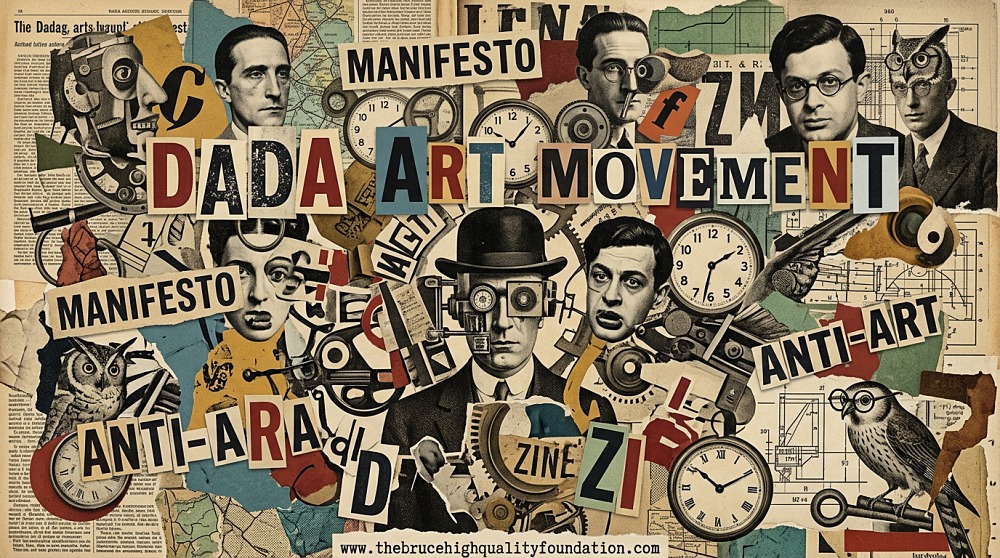
Dada was an international art movement that emerged in 1916 as a nihilistic reaction to the horrors of World War I, characterized by its deliberate rejection of logic, reason, and traditional aesthetic values. The Dada Art Movement sought to dismantle bourgeois cultural norms through absurdity, chance operations, and what participants called “anti-art.” This revolutionary approach would fundamentally reshape how we define art itself, influencing every major avant-garde movement that followed.
Our team has spent years studying the chaotic brilliance of Dada across museum exhibitions and archival research. The movement’s story involves visionary artists who gathered in war-torn European cities to challenge everything society held sacred about creativity and culture.
In this comprehensive guide, you’ll discover the origins of Dada at the Cabaret Voltaire in Zurich. We’ll explore the key figures like Marcel Duchamp and Hannah Höch who pushed artistic boundaries. You’ll learn about the techniques they pioneered from readymades to photomontage. By the end, you’ll understand why this movement born over a century ago still resonates in internet memes and contemporary art today.
Table of Contents
The Birth of Dada in Wartime Chaos
The Dada Art Movement erupted from the ashes of World War I, a catastrophic conflict that shattered European civilization and killed approximately 17 million people. By 1916, the war had devolved into mechanized slaughter in trench systems across France and Belgium. The senseless destruction convinced a group of young artists that traditional values, including artistic conventions, had become meaningless.
Zurich, Switzerland served as the unlikely birthplace for this artistic revolution. As a neutral country surrounded by warring nations, Switzerland became a haven for refugees, pacifists, and draft dodgers seeking escape from military service. The city attracted intellectuals and artists from across Europe who brought with them diverse languages, ideas, and a shared disgust for nationalism.
In February 1916, German poet Hugo Ball and his partner Emmy Hennings opened the Cabaret Voltaire at Spiegelgasse 1 in Zurich’s old town. This tiny nightclub became the incubator for Dada, hosting nightly performances that blended poetry, music, dance, and visual art in deliberately provocative ways. The cabaret’s name paid homage to the French philosopher Voltaire, embodying the spirit of questioning authority.
The original Dada circle included Romanian poet Tristan Tzara, German-French artist Hans Arp, and Swiss artist Sophie Taeuber-Arp. These founders represented the international character that would define Dada throughout its existence. They rejected nationalism completely, embracing instead a borderless approach to creativity that mirrored their stateless status as wartime exiles.
The performances at Cabaret Voltaire were deliberately shocking and chaotic. Hugo Ball recited sound poetry wearing a bizarre cardboard costume that made him look like a “magic bishop.” Musicians played atonal compositions. Artists displayed abstract collages. The audience, often packed into the small space, participated through shouting, jeering, or spontaneous contributions. Every event aimed to destroy the boundary between artist and spectator.
Why Is It Called Dada? The Story Behind the Name
The name “Dada” emerged in April 1916 during a now-legendary gathering at the Cabaret Voltaire. According to the most widely accepted story, Tristan Tzara randomly stabbed a French-German dictionary with a knife. The blade landed on “dada,” a French word meaning “hobby horse” or a child’s word for father. The absurdity and randomness of this selection perfectly captured the movement’s spirit.
However, multiple origin stories exist, and Tzara himself offered contradictory explanations over the years. Some sources suggest the word came from Romanian, where “da-da” means “yes-yes,” implying affirmation without meaning. Others note its resemblance to baby talk across multiple languages, suggesting regression to pre-rational communication. This ambiguity around the name’s meaning actually reinforced Dada’s anti-logic philosophy.
The word carried different connotations across the languages spoken by Dada’s international participants. In German, “Dada” sounds like a meaningless repetition that mocks the seriousness of other art movements. French speakers heard “hobby horse,” suggesting child’s play. English speakers might detect hints of “dad” or even “dodo,” the extinct bird representing something obsolete and foolish.
The name’s inherent meaninglessness became a central tenet of the movement. Dada artists embraced the idea that art need not communicate anything coherent. By choosing a nonsense word, they declared independence from the obligation to make sense. This rejection of rationality stood as their response to a world that had just demonstrated how dangerously irrational civilization could become.
The Rebels Who Defined Dada
The Dada Art Movement brought together some of the most innovative and controversial artists of the twentieth century. Each figure contributed unique techniques and perspectives while sharing a commitment to dismantling artistic conventions. Understanding these key players helps explain how Dada spread across continents and evolved into distinct regional variations.
Marcel Duchamp: The Master of Readymades
French-American artist Marcel Duchamp stands as perhaps the most influential figure in Dada’s development. Though he never formally joined any Dada group, his conceptual approach to art provided the movement with its most powerful weapon: the readymade. Duchamp’s decision to present ordinary manufactured objects as art challenged every assumption about creativity, skill, and aesthetic value.
His 1917 submission of “Fountain,” a porcelain urinal signed “R. Mutt,” to the Society of Independent Artists exhibition remains Dada’s most famous provocation. The work was rejected, but Duchamp had proven his point: an artist’s choice could transform any object into art. This radical democratization of art-making influenced Conceptual Art throughout the twentieth century.
Duchamp spent much of the war years in New York, where he collaborated with Francis Picabia and Man Ray. His work there helped establish New York as a parallel center of Dada activity independent from European developments. He would continue experimenting with optical effects, glass paintings, and chess throughout his long career, never abandoning his commitment to intellectual provocation over traditional craftsmanship.
Tristan Tzara: The Manifesto Writer
Romanian-born poet Tristan Tzara served as Dada’s most vocal propagandist during its Zurich phase. He wrote and performed manifestos that declared war on logic, coherence, and bourgeois culture. His 1918 “Dada Manifesto” announced that “Dada means nothing” and encouraged readers to “creep into the core of the labyrinths” of absurdity.
Tzara’s poetry employed cut-up techniques, randomly assembling words and phrases clipped from newspapers to create works that defied interpretation. This method of chance composition became fundamental to Dada practice. His aggressive promotion through manifestos, performances, and publications helped spread Dada from Zurich to Paris and beyond.
Later in his career, Tzara transitioned into Surrealism, though he maintained his commitment to poetic innovation. His work represents the political and literary dimensions of Dada, showing how the movement influenced writing as much as visual art. The cut-up technique he pioneered would influence later writers including William S. Burroughs and the punk movement.
Hugo Ball: The Sound Poet
German writer Hugo Ball founded the Cabaret Voltaire and wrote the first Dada manifesto in 1916. His most significant contribution to Dada came through sound poetry, performances that abandoned semantic meaning entirely in favor of pure phonetic expression. Wearing elaborate costumes designed with Hans Arp, Ball would recite verses of invented words that emphasized rhythm and texture over sense.
His poem “Karawane” exemplifies this approach, consisting entirely of nonsensical syllables arranged for sonic effect. Ball viewed this return to pre-rational vocalization as a spiritual escape from the corruption of language that had enabled wartime propaganda and nationalism. Sound poetry represented a complete break with literary tradition, establishing precedent for later performance art and experimental music.
Ball eventually left Dada to pursue religious and philosophical interests, but his brief involvement had established essential practices. The concept of performance as art, the rejection of linguistic coherence, and the use of costume and ritual all trace back to his innovations at the Cabaret Voltaire.
Hannah Höch: The Photomontage Pioneer
German artist Hannah Höch created some of Dada’s most visually striking works through photomontage, cutting and reassembling photographs from mass media publications. Her 1919 piece “Cut with the Kitchen Knife Through the Last Weimar Beer-Belly Cultural Epoch in Germany” stands among the movement’s masterpieces, combining political satire with avant-garde technique.
Höch’s work addressed themes of gender and the “New Woman” emerging in Weimar Germany. She was the only woman officially invited to participate in the First International Dada Fair in Berlin in 1920, though she faced marginalization from male colleagues. Her pioneering use of photomontage influenced advertising, graphic design, and later feminist art.
After Dada, Höch continued developing her unique visual language through the 1920s and beyond, adapting her methods while maintaining her commitment to political commentary through fragmented imagery. Her long career demonstrates how Dada techniques could evolve beyond the movement’s brief official existence.
Man Ray: The American Innovator
American artist Man Ray connected Dada with American culture while developing new photographic techniques. His “rayographs,” created by placing objects directly onto photosensitive paper and exposing them to light, eliminated the camera entirely from photography. This elimination of traditional tools embodied Dada’s anti-technique philosophy.
Working primarily in New York and later Paris, Man Ray photographed many Dada and Surrealist figures, creating portraits that became iconic images of the avant-garde. His technical experiments with solarization and multiple exposures expanded photography’s possibilities. He also created Dada objects and assemblages that demonstrated the movement’s visual vocabulary could transcend national boundaries.
Man Ray’s work shows how Dada concepts influenced the development of modern photography. His elimination of the camera from image-making prefigures digital manipulation and cameraless photography techniques used by contemporary artists today.
Francis Picabia: The Enfant Terrible
French painter and writer Francis Picabia brought wit and irreverence to Dada through his provocative publications and mechanical paintings. His magazine “391,” published in Barcelona, New York, and Zurich, spread Dada ideas across the Atlantic while mocking everything serious. Picabia’s “mechanomorphic” drawings portrayed human figures as machines, satirizing industrial civilization.
Picabia’s 1920 “Portrait of Cézanne” consisted of a stuffed monkey with a label, mocking the reverence for established masters. Such gestures demonstrated Dada’s willingness to offend even the art world itself. His constant shifts in style and medium embodied the Dada rejection of consistency and artistic identity.
Kurt Schwitters: The Merz Master
German artist Kurt Schwitters developed “Merz,” his own variant of Dada, centered on collage using found materials and refuse. His “Merz Pictures” transformed trash into intricate compositions that elevated everyday detritus to high art. Unlike political Berlin Dada, Schwitters focused on formal innovation and aesthetic transformation of found objects.
Schwitters’s most ambitious project, the “Merzbau,” was an architectural environment constructed within his home in Hanover that grew over decades. This total artwork incorporated collage into three-dimensional space, blurring boundaries between sculpture, architecture, and installation. The Merzbau would influence later environmental art and installation practices.
Dada Around the World: Regional Centers
The Dada Art Movement was never a unified organization with membership or headquarters. Instead, it consisted of loosely connected groups in different cities, each developing distinct characteristics based on local conditions and participants. Understanding these regional variations reveals how a single set of ideas could adapt to different cultural contexts while maintaining core principles.
Zurich: The Birthplace
Zurich Dada remained closest to the movement’s original spirit of anarchic performance and absurdity. The Cabaret Voltaire continued hosting events through 1916, though conflicts between Tzara and other founders led to splintering. Zurich Dada emphasized internationalism, with participants from Germany, Romania, France, and Switzerland collaborating regardless of their nations’ wartime hostilities.
The neutral Swiss environment allowed for artistic experimentation impossible in combatant countries. Zurich Dada focused on performance, sound poetry, and abstract visual art rather than overt political commentary. This emphasis on formal innovation and absurdity influenced later developments in theater, music, and visual poetry.
New York: Independent Experimentation
New York Dada developed independently from European centers, led by Marcel Duchamp and Francis Picabia with support from Man Ray and collector Walter Arensberg. The American context lacked the immediate trauma of trench warfare, producing a more philosophical and less nihilistic variant of Dada. New York artists focused on intellectual provocation through readymades and mechanomorphic imagery rather than political outrage.
The 1917 Society of Independent Artists exhibition, where Duchamp submitted “Fountain” under a pseudonym, represented New York Dada’s most significant event. The city’s commercial culture also influenced Dada’s engagement with advertising, consumer goods, and mass media. This American version would prove particularly influential on later Pop Art movements.
Berlin: Political Photomontage
Berlin Dada emerged after the war ended and Germany descended into revolutionary chaos. Artists like Raoul Hausmann, Hannah Höch, John Heartfield, and George Grosz applied Dada techniques to aggressive political satire targeting the Weimar government, militarism, and capitalism. Berlin Dada embraced Communist politics and used photomontage as a weapon in ideological struggle.
The First International Dada Fair in 1920 showcased Berlin’s distinctive approach, with works mounted on walls alongside slogans and revolutionary banners. John Heartfield’s photomontages attacking Hitler and the Nazi Party continued this political tradition well into the 1930s. Berlin Dada demonstrated how anti-art techniques could serve explicitly political purposes.
Cologne: Provocative Installations
The Cologne Dada group centered on Max Ernst and Johannes Baargeld organized a notorious exhibition in a public restroom in 1920. Visitors entered through a beer hall and passed a young girl in a Communion dress reciting obscene poetry. Inside, Ernst displayed works including a sculpture with a hatchet provided for viewers to attack it.
This emphasis on audience participation and environmental installation anticipated later performance and happening movements. The Cologne group’s deliberate offensiveness pushed Dada’s anti-bourgeois stance to extremes, drawing police attention and public outrage that pleased the artists enormously.
Paris: The Bridge to Surrealism
Paris became the final major Dada center when Tristan Tzara relocated there in 1920. His arrival provoked conflict with established French writers, culminating in a spectacular confrontation between Tzara and writer André Breton at a 1922 performance. This rivalry eventually led to Dada’s dissolution as Breton broke away to found Surrealism.
Paris Dada’s significance lies in this transition. Many Dada practices, including automatic writing, dream imagery, and Freudian theory, evolved into Surrealist doctrine. The Paris period shows how Dada’s destruction of artistic conventions created space for new movements to emerge.
What Is Anti-Art? Key Concepts and Techniques
Understanding the Dada Art Movement requires grasping its central paradox: creating art that opposes art itself. This “anti-art” stance rejected the entire framework of Western aesthetics including beauty, skill, originality, and meaning. The techniques Dada developed served this destructive purpose while inadvertently opening new creative possibilities.
The Readymade: Art Without Creation
Marcel Duchamp’s readymades represent Dada’s most radical concept. By selecting ordinary manufactured objects, signing them, and declaring them art, Duchamp eliminated traditional artistic labor entirely. A bicycle wheel, a bottle rack, or a urinal could become art through the artist’s choice alone.
The readymade questioned fundamental assumptions about creativity, craftsmanship, and artistic genius. If any object could be art, what distinguished art from non-art? This challenge influenced Conceptual Art movements of the 1960s and continues to shape discussions about art’s definition today.
Photomontage: Fragmented Reality
Photomontage techniques developed by Berlin Dada artists involved cutting photographs from newspapers and magazines, then reassembling them into new compositions. This method used the mass media’s own imagery against itself, creating satirical works that commented on politics and society.
The jagged edges and discontinuous spaces of photomontage rejected traditional artistic unity. By combining images from incompatible sources, artists created visual experiences that mirrored modernity’s fragmented nature. The technique influenced advertising, graphic design, and later digital collage practices.
Chance Operations: Surrendering Control
Dada artists frequently employed chance to determine creative decisions. Tzara’s poem creation method involved drawing words from a hat. Hans Arp allowed pieces of paper to fall randomly before fixing them into compositions. Such techniques eliminated the artist’s conscious intention, producing works that no individual could have deliberately designed.
Chance operations embodied Dada’s rejection of rationality and artistic personality. If art resulted from random processes, it could not express an artist’s emotions or ideas. This concept would profoundly influence later artists including John Cage and the Fluxus movement.
Sound Poetry: Beyond Language
Sound poetry abandoned semantic meaning in favor of pure sonic exploration. Hugo Ball’s invented words emphasized rhythm, tone, and texture rather than signification. This approach treated language as raw material rather than communication medium.
Sound poetry connected Dada to pre-rational vocal traditions and anticipated experimental music. The technique recognized that language itself had become corrupted through wartime propaganda and commercial advertising. Only by breaking language could artists reclaim its power.
Assemblage: The Art of Accumulation
Assemblage techniques combined found objects into three-dimensional constructions. Kurt Schwitters’s Merz works elevated refuse to aesthetic status through careful arrangement. These works rejected sculpture’s traditional dependence on carving or modeling, instead gathering existing materials into new relationships.
Absurdity and Humor as Weapons
Dada employed humor and absurdity as tools for cultural critique. By presenting ridiculous situations with straight faces, artists mocked the seriousness of bourgeois culture. This irreverent attitude proved contagious, spreading through artistic circles and eventually mainstream culture.
Iconic Artworks That Shook the Art World
Certain works from the Dada Art Movement became symbols of the entire avant-garde tradition. These pieces challenged viewers so radically that they continue generating controversy and discussion over a century later. Understanding these key artworks helps explain why Dada proved so influential despite its brief formal existence.
Fountain (1917) by Marcel Duchamp
Duchamp’s porcelain urinal signed “R. Mutt 1917” remains the most famous Dada artwork and perhaps the most influential piece of twentieth-century art. Submitted to an exhibition that claimed to accept all submissions, it was rejected by the committee, proving Duchamp’s point about institutional hypocrisy. The work argued that artistic choice matters more than technical skill.
The urinal’s evocation of bodily functions violated every rule of aesthetic decorum. By selecting a mass-produced object from everyday life, Duchamp collapsed the distinction between high art and ordinary reality. Multiple replicas created later now reside in major museums, demonstrating how thoroughly Duchamp’s provocation succeeded.
LHOOQ (1919) by Marcel Duchamp
Duchamp’s defacement of the Mona Lisa postcard with a drawn mustache and goatee, titled with letters that sound like French slang for “hot ass,” attacked art’s most sacred icon. This gesture demonstrated Dada’s willingness to desecrate revered masterpieces. The work questions why certain images achieve canonical status while others remain ignored.
Cut with the Kitchen Knife (1919) by Hannah Höch
Höch’s massive photomontage combines images from newspapers and magazines into a chaotic vision of Weimar Germany. The title references domestic labor, connecting women’s work with artistic production. Political figures, athletes, and machinery float across the composition in disorienting profusion.
The work addresses gender roles, political chaos, and technological modernity simultaneously. Its scale and complexity demonstrate photomontage’s potential for ambitious artistic statements. Höch included images of herself and other women artists in the composition, asserting female presence within avant-garde circles.
The Hat Makes the Man (1920) by Max Ernst
Ernst’s collage of hat advertisements reassembled into absurd configurations mocks bourgeois propriety and fashion culture. The subtitle, “célestes et terrestres, inachevés, antipériodiques et sadistes,” adds surrealist wordplay to the visual joke. Ernst’s work shows how advertising imagery could be repurposed for avant-garde ends.
Merz Pictures by Kurt Schwitters
Schwitters’s series of abstract collages using paper scraps, fabric, wood, and found materials created intimate compositions that transformed trash into beauty. Unlike Berlin Dada’s political photomontage, Merz focused on formal relationships and aesthetic harmony. These works suggest that art could emerge from any materials, regardless of traditional quality.
The Enduring Impact of Dada on Modern Culture
The Dada Art Movement officially lasted only from 1916 to 1924, yet its influence continues shaping contemporary art and culture. By destroying artistic conventions, Dada created space for entirely new approaches to creativity. The movement’s legacy appears in surprising places beyond museum walls.
The Path to Surrealism
When André Breton broke with Tzara in Paris during the early 1920s, he took many Dada techniques into Surrealism. Automatic writing, dream imagery, and chance operations migrated directly from Dada practice. The transition shows how Dada’s destructive phase prepared ground for constructive new movements.
Surrealism preserved Dada’s interest in the irrational while adding psychological and political frameworks. This evolution demonstrates how avant-garde movements build upon their predecessors even while declaring independence. The relationship between Dada and Surrealism remains a model for understanding artistic succession.
Conceptual Art’s Foundation
Contemporary Conceptual Art traces its lineage directly to Duchamp’s readymades. When artists present instructions, documents, or ideas as artworks, they extend Duchamp’s argument that artistic intention matters more than object quality. The entire conceptual tradition depends on Dada’s initial challenge to art’s definition.
Joseph Kosuth, Sol LeWitt, and other conceptual artists of the 1960s explicitly acknowledged Duchamp’s influence. Their work made Dada’s early twentieth-century provocations central to mainstream art discourse. This acceptance represents Dada’s ultimate victory over the institutions it attacked.
Pop Art and Consumer Culture
Pop Art’s embrace of advertising, mass media, and consumer goods extends New York Dada’s engagement with commercial culture. Andy Warhol’s soup cans and Roy Lichtenstein’s comic panels echo Picabia’s mechanical paintings and Duchamp’s readymades. The attitude of ironic detachment toward consumerism originates in Dada’s anti-bourgeois stance.
Performance and Happenings
The Fluxus movement and 1960s Happenings directly revived Dada performance practices. John Cage’s experimental music, Yoko Ono’s instruction pieces, and Nam June Paik’s video art all descend from Cabaret Voltaire events. This lineage connects contemporary performance art to Dada’s original provocations.
Internet Culture and Memes
Perhaps Dada’s most unexpected legacy appears in internet memes and digital culture. The absurdity, appropriation, and remixing techniques central to meme culture mirror Dada photomontage and readymade strategies. Randomness and nonsense as forms of cultural communication descend directly from sound poetry and chance operations.
Political internet memes function as modern equivalents of Berlin Dada’s satirical photomontage. The appropriation of existing images for new purposes reproduces Dada collage techniques digitally. This contemporary relevance demonstrates how Dada’s insights into media and culture anticipated digital communication by nearly a century.
Frequently Asked Questions About Dada
Who is the father of Dadaism?
There is no single ‘father’ of Dadaism. The movement emerged collectively in 1916 at the Cabaret Voltaire in Zurich through the collaboration of Hugo Ball, Tristan Tzara, Hans Arp, and others. While Hugo Ball founded the Cabaret Voltaire and wrote early manifestos, Tristan Tzara became the movement’s most vocal propagandist. Marcel Duchamp, though never formally joining any Dada group, contributed the most influential concept: the readymade. The movement’s collaborative nature resists attribution to any individual founder.
What are the characteristics of Dadaism?
Dadaism is characterized by anti-art attitudes, absurdity and irrationality, use of chance operations, appropriation of found objects (readymades), photomontage and collage techniques, sound poetry, rejection of traditional aesthetics, political and cultural critique, humor and satire, and internationalism. Dada artists deliberately rejected logic, reason, and aesthetic standards in response to the senseless destruction of World War I. The movement embraced nonsense as a legitimate artistic strategy.
What best describes the Dada movement?
The Dada Art Movement was an international avant-garde movement (1916-1924) that emerged as a nihilistic reaction to World War I. It rejected logic, reason, and traditional artistic values through absurdity, chance, and anti-art gestures. Dada sought to dismantle bourgeois cultural norms and challenge the very definition of art. The movement spread from Zurich to New York, Berlin, Paris, and Cologne, with each center developing distinct characteristics while sharing core principles of irreverence and experimentation.
Why is Dada art called Dada?
The name ‘Dada’ originated in April 1916 when Tristan Tzara randomly selected it from a French-German dictionary by stabbing pages with a knife. The blade landed on ‘dada,’ a French word meaning ‘hobby horse.’ Multiple origin theories exist: in Romanian ‘da-da’ means ‘yes-yes,’ while in German it resembles baby talk. The word’s inherent meaninglessness perfectly embodied the movement’s rejection of logic and coherent meaning.
What is the criticism of Dada?
Critics argue that Dada’s rejection of meaning and skill produces works without artistic value. Some view Dada as mere pranksterism or juvenile provocation rather than serious art. The movement’s embrace of nonsense can appear as an excuse for lack of technique. However, defenders argue that Dada’s challenges to artistic conventions opened necessary space for conceptual and experimental approaches. The criticism itself reflects the traditional values Dada sought to dismantle.
What was the only rule of the Dada movement?
Dada had no official rules, which was itself the point. The movement rejected all systems, manifestos, and dogmas. However, Tristan Tzara’s 1918 ‘Dada Manifesto’ ironically declared principles including ‘Dada means nothing’ and encouraged chaos over order. The only consistent ‘rule’ was the rejection of rules themselves. This anti-dogmatic stance allowed Dada to remain fluid and adaptable across different contexts and participants.
How did Dada influence later art movements?
Dada directly influenced Surrealism through techniques like automatic writing and chance operations. Conceptual Art descends from Duchamp’s readymades, which established that artistic ideas matter more than craft. Pop Art’s engagement with consumer culture extends New York Dada strategies. Fluxus and performance art revive Dada’s live events and sound poetry. Contemporary internet memes employ Dada techniques of appropriation, absurdity, and remixing. The movement’s influence permeates virtually every avant-garde development since 1916.
Who were some important artists in the Dada movement?
Key Dada artists include: Marcel Duchamp (readymades, Fountain), Tristan Tzara (manifestos, sound poetry), Hugo Ball (Cabaret Voltaire founder), Hans Arp (abstract collage), Hannah Höch (photomontage), Man Ray (photography, rayographs), Francis Picabia (mechanomorphic drawings), Kurt Schwitters (Merz assemblage), Raoul Hausmann (Berlin photomontage), and Max Ernst (Cologne Dada, collage). Female artists like Höch and Sophie Taeuber-Arp made essential contributions despite facing marginalization.
Why Dada Still Matters Today
The Dada Art Movement exploded into existence over a century ago, yet its questions about art, meaning, and culture remain urgently relevant. In an age of information overload, algorithmic content, and viral absurdity, Dada’s insights into media and communication feel prophetic. The movement understood that in a world saturated with images, only provocation and surprise could break through the noise.
Our exploration of Dada has traced its birth in wartime Zurich through its spread across global centers. We’ve met the visionary artists who sacrificed conventional success for artistic freedom. We’ve examined the techniques they pioneered and the masterpieces they created. Most importantly, we’ve seen how their revolutionary ideas influenced everything from Surrealism to internet memes.
What Dada offers contemporary culture is permission to break rules. The movement demonstrated that artistic value need not depend on technical skill, coherent meaning, or institutional approval. This liberating insight has empowered generations of artists to experiment without fear. The Dada Art Movement’s ultimate legacy is the freedom it bequeathed to all who create.
Whether you encounter Dada through a museum exhibition, an art history course, or a surreal internet meme, remember that you are experiencing the aftershocks of a revolution. Those original anti-art rebels gathered in a Zurich nightclub to scream nonsense at a world gone mad. Their screams still echo through our cultural landscape in 2026, inviting us all to question, provoke, and create without limits.