
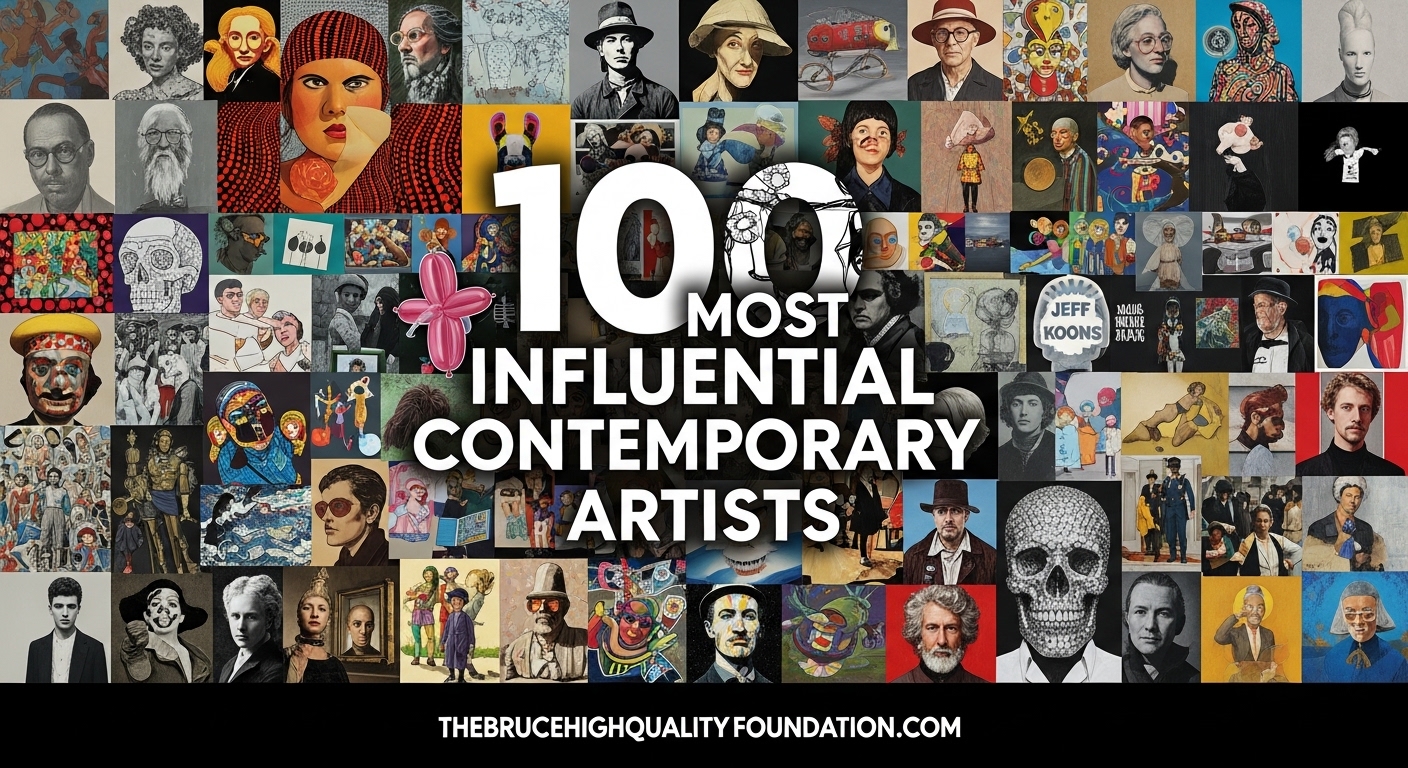
Contemporary art has transformed how we see the world around us. From gallery walls to digital screens, today’s most influential artists challenge conventions, spark conversations, and reshape culture. This guide presents the 100 most influential contemporary artists working today, selected for their impact on the art world and beyond.
Our team spent months researching museum exhibitions, auction records, critical reviews, and cultural reach to compile this list. We focused on artists who have shaped discourse, influenced peers, and captured public imagination across the globe.
These artists represent painting, sculpture, photography, video art, digital art, performance, and installation. They come from 35 countries across six continents. Their ages range from emerging talents in their 30s to established masters in their 90s.
Table of Contents
- How We Selected These 100 Artists
- Artists 1-25: The Established Masters
- 1. Gerhard Richter – German Painter (b. 1932)
- 2. Yayoi Kusama – Japanese Multimedia Artist (b. 1929)
- 3. Cindy Sherman – American Photographer (b. 1954)
- 4. Jeff Koons – American Sculptor (b. 1955)
- 5. Ai Weiwei – Chinese Conceptual Artist (b. 1957)
- 6. Marina Abramović – Serbian Performance Artist (b. 1946)
- 7. Anish Kapoor – British-Indian Sculptor (b. 1954)
- 8. Julie Mehretu – Ethiopian-American Painter (b. 1970)
- 9. Kara Walker – American Installation Artist (b. 1969)
- 10. Damien Hirst – British Artist (b. 1965)
- 11. Kerry James Marshall – American Painter (b. 1955)
- 12. William Kentridge – South African Artist (b. 1955)
- 13. Jenny Holzer – American Conceptual Artist (b. 1950)
- 14. Rirkrit Tiravanija – Thai Conceptual Artist (b. 1961)
- 15. Bruce Nauman – American Conceptual Artist (b. 1941)
- 16. Wangechi Mutu – Kenyan-American Collage Artist (b. 1972)
- 17. Olafur Eliasson – Danish-Icelandic Installation Artist (b. 1967)
- 18. Elizabeth Peyton – American Painter (b. 1965)
- 19. Peter Doig – British Painter (b. 1959)
- 20. Sarah Lucas – British Artist (b. 1962)
- 21. Thomas Schütte – German Sculptor (b. 1954)
- 22. Rashid Johnson – American Artist (b. 1977)
- 23. Katharina Grosse – German Installation Artist (b. 1961)
- 24. Doug Aitken – American Video and Installation Artist (b. 1968)
- 25. Theaster Gates – American Social Practice Artist (b. 1973)
- Artists 26-50: The Contemporary Icons
- 26. Kehinde Wiley – American Painter (b. 1977)
- 27. Amy Sherald – American Painter (b. 1973)
- 28. Banksy – British Street Artist (b. 1974)
- 29. Takashi Murakami – Japanese Artist (b. 1962)
- 30. KAWS – American Artist (b. 1974)
- 31. David Hockney – British Painter (b. 1937)
- 32. Jasper Johns – American Painter (b. 1930)
- 33. Frank Stella – American Painter (b. 1936)
- 34. Richard Serra – American Sculptor (b. 1938)
- 35. Anselm Kiefer – German Painter and Sculptor (b. 1945)
- 36. Shirin Neshat – Iranian-American Video Artist (b. 1957)
- 37. Paul Pfeiffer – American Video Artist (b. 1966)
- 38. Lorna Simpson – American Photographer (b. 1960)
- 39. Glenn Ligon – American Conceptual Artist (b. 1960)
- 40. Hank Willis Thomas – American Conceptual Artist (b. 1976)
- 41. JR – French Street Artist (b. 1983)
- 42. El Anatsui – Ghanaian Sculptor (b. 1944)
- 43. Ebony G. Patterson – Jamaican Artist (b. 1981)
- 44. Yinka Shonibare – British-Nigerian Artist (b. 1962)
- 45. Njideka Akunyili Crosby – Nigerian-American Painter (b. 1983)
- 46. Lynette Yiadom-Boakye – British Painter (b. 1977)
- 47. Toyin Ojih Odutola – Nigerian-American Artist (b. 1985)
- 48. Jordan Casteel – American Painter (b. 1989)
- 49. Noah Davis – American Painter (1983-2015)
- 50. Henry Taylor – American Painter (b. 1958)
- Artists 51-75: Rising Voices and New Perspectives
- 51. Amoako Boafo – Ghanaian Painter (b. 1984)
- 52. Firelei Báez – Dominican-American Painter (b. 1981)
- 53. Tschabalala Self – American Artist (b. 1990)
- 54. Derek Fordjour – American Artist (b. 1974)
- 55. Cassi Namoda – Mozambican Painter (b. 1988)
- 56. Christina Quarles – American Painter (b. 1985)
- 57. Louis Fratino – American Painter (b. 1993)
- 58. Doron Langberg – Israeli Painter (b. 1985)
- 59. Salman Toor – Pakistani-American Painter (b. 1983)
- 60. Jenna Gribbon – American Painter (b. 1978)
- 61. Lucy Bull – American Painter (b. 1990)
- 62. Sasha Gordon – American Painter (b. 1998)
- 63. Flora Yukhnovich – British Painter (b. 1990)
- 64. Jadé Fadojutimi – British Painter (b. 1993)
- 65. Reggie Burrows Hodges – American Painter (b. 1965)
- 66. Kyle Dunn – American Artist (b. 1990)
- 67. Anthony Cudahy – American Painter (b. 1989)
- 68. Danielle McKinney – American Painter (b. 1981)
- 69. Mimi Lauter – American Artist (b. 1982)
- 70. Vaughn Spann – American Painter (b. 1992)
- 71. Otis Kwame Kye Quaicoe – Ghanaian Painter (b. 1988)
- 72. Kwasi Darko – Ghanaian Artist (b. 1990)
- 73. Wangari Mathenge – Kenyan-American Painter (b. 1973)
- 74. Ibrahim Mahama – Ghanaian Installation Artist (b. 1987)
- 75. Adriana Oliver – Spanish Painter (b. 1990)
- Artists 76-100: Digital Pioneers and New Media Artists
- 76. Beeple (Mike Winkelmann) – American Digital Artist (b. 1981)
- 77. Refik Anadol – Turkish-American Digital Artist (b. 1985)
- 78. teamLab – Japanese Digital Art Collective (est. 2001)
- 79. Trevor Paglen – American Artist and Geographer (b. 1974)
- 80. Hito Steyerl – German Video Artist (b. 1966)
- 81. Ian Cheng – American Digital Artist (b. 1984)
- 82. Jakob Kudsk Steensen – Danish Digital Artist (b. 1987)
- 83. Lawrence Lek – British-Malaysian Digital Artist (b. 1982)
- 84. Cao Fei – Chinese Multimedia Artist (b. 1978)
- 85. Camille Henrot – French Multimedia Artist (b. 1978)
- 86. Jon Rafman – Canadian Digital Artist (b. 1981)
- 87. Omer Fast – Israeli Video Artist (b. 1972)
- 88. Christian Marclay – American-Swiss Video Artist (b. 1955)
- 89. Carsten Höller – German Installation Artist (b. 1961)
- 90. Ragnar Kjartansson – Icelandic Performance and Video Artist (b. 1976)
- 91. Tino Sehgal – British-German Installation Artist (b. 1976)
- 92. Pierre Huyghe – French Conceptual Artist (b. 1962)
- 93. Thomas Demand – German Photographer (b. 1964)
- 94. Wolfgang Tillmans – German Photographer (b. 1968)
- 95. Andreas Gursky – German Photographer (b. 1955)
- 96. Hiroshi Sugimoto – Japanese Photographer (b. 1948)
- 97. Catherine Opie – American Photographer (b. 1961)
- 98. Deana Lawson – American Photographer (b. 1979)
- 99. Zanele Muholi – South African Visual Activist (b. 1972)
- 100. Tyler Mitchell – American Photographer and Filmmaker (b. 1995)
- Geographic and Demographic Breakdown
- Contemporary Art Trends and Movements in 2026
- FAQs
- Conclusion: The Future of Contemporary Art
How We Selected These 100 Artists
Our selection process examined multiple factors that define influence in today’s art world. We looked at museum presence, including solo exhibitions at major institutions like MoMA, Tate Modern, and the Venice Biennale. Market impact played a role, though we weighted cultural significance over commercial success.
Critical acclaim from art historians, curators, and critics informed our choices. We also considered each artist’s reach beyond traditional art spaces – their presence in popular culture, social media engagement, and ability to spark public dialogue about important issues.
Diversity mattered in our selection. We aimed for balanced gender representation, geographic diversity across continents, and inclusion of various artistic mediums. We selected both established masters who have shaped decades of art history and emerging voices defining the future.
Transparency about our limitations is important. Any list of 100 artists necessarily excludes hundreds of worthy candidates. Influence is subjective and constantly shifting. We present this as a snapshot of the contemporary art landscape in 2026, not a definitive ranking.
Artists 1-25: The Established Masters
These artists have defined contemporary art for decades. Their work appears in major museum collections worldwide, and their influence extends across generations of younger artists.
1. Gerhard Richter – German Painter (b. 1932)
Richter stands as the most influential painter alive today. His photorealist canvases, abstract works, and stained glass windows have redefined what painting can be in the modern era.
His auction record reached $46.3 million for “Abstraktes Bild” in 2015. The artist’s ability to shift between photorealism and pure abstraction while maintaining conceptual depth has influenced thousands of contemporary painters.
Major works include “October 18, 1977,” his series about the Baader-Meinhof Group, and the Cologne Cathedral window. Richter’s photo paintings explore how photography shapes memory and perception.
2. Yayoi Kusama – Japanese Multimedia Artist (b. 1929)
Kusama’s infinity mirror rooms have become the most Instagrammed artworks of our time. Her polka dot patterns and pumpkin sculptures have made her a global phenomenon.
Her “Infinity Net” paintings from the 1960s influenced Minimalism before that movement had a name. After decades of relative obscurity, her 2012 retrospective at the Whitney Museum launched her into mainstream consciousness.
Her immersive installations draw millions of visitors worldwide. Kusama’s work addresses infinity, obsession, and mental health with unparalleled visual power.
3. Cindy Sherman – American Photographer (b. 1954)
Sherman transformed photography into a tool for examining identity, gender, and representation. Her “Untitled Film Stills” series redefined self-portraiture as conceptual art.
Working entirely as her own subject, Sherman uses makeup, costumes, and prosthetics to become countless characters. Her photographs challenge how women are portrayed in media and art history.
Her work has influenced an entire generation of artists exploring identity through photography. Recent series have addressed aging and the grotesque with unflinching honesty.
4. Jeff Koons – American Sculptor (b. 1955)
Koons has made kitsch into high art with his balloon animal sculptures and porcelain puppies. His work sells for tens of millions at auction, making him one of the most commercially successful living artists.
His “Balloon Dog” series and “Rabbit” sculpture have become contemporary art icons. Critics debate whether he celebrates or critiques consumer culture, but his influence is undeniable.
His giant floral “Puppy” sculpture sits outside the Guggenheim Museum Bilbao. Koons’ factory-like production model has influenced how many contemporary artists work at scale.
5. Ai Weiwei – Chinese Conceptual Artist (b. 1957)
Ai Weiwei combines art and activism with unmatched courage. His work addresses human rights, freedom of expression, and the refugee crisis with powerful visual impact.
His “Sunflower Seeds” installation at Tate Modern’s Turbine Hall featured 100 million porcelain seeds hand-painted by Chinese artisans. This work examined mass production and individual identity.
His documentary films and installations have brought global attention to political prisoners. Despite Chinese government surveillance and imprisonment, he continues creating from exile in Europe.
6. Marina Abramović – Serbian Performance Artist (b. 1946)
Abramović is the undisputed queen of performance art. Her 2010 MoMA retrospective “The Artist Is Present” brought performance art to mainstream audiences.
Her early works with partner Ulay pushed physical and psychological limits. She sat motionless for 736 hours at MoMA, staring into visitors’ eyes in a meditation on presence and connection.
Her “Method” workshops teach artists and non-artists alike about endurance and consciousness. Abramović has legitimized performance art as a major contemporary medium.
7. Anish Kapoor – British-Indian Sculptor (b. 1954)
Kapoor’s monumental sculptures manipulate space, form, and perception. His “Cloud Gate” in Chicago, known as “The Bean,” has become one of the most photographed artworks in the world.
His use of Vantablack, the blackest substance known, sparked controversy about artistic ownership of materials. His pigment works create voids that seem to absorb all light.
Recent works include the twisting ArcelorMittal Orbit tower for the London Olympics. Kapoor’s sculptures transform public spaces and challenge how we perceive reality.
8. Julie Mehretu – Ethiopian-American Painter (b. 1970)
Mehretu creates massive, layered abstractions that map history, migration, and urban experience. Her 2021 retrospective at the Whitney Museum cemented her status as a major voice in painting.
Her canvases combine architectural plans, calligraphy, and gestural marks into complex visual systems. She received the prestigious MacArthur “Genius Grant” in 2005.
Recent works address climate change and political upheaval through abstract visual language. Her paintings sell for millions and hang in major collections worldwide.
9. Kara Walker – American Installation Artist (b. 1969)
Walker’s silhouette installations confront America’s history of slavery and racial violence. Her work at the Domino Sugar Factory in Brooklyn drew over 130,000 visitors.
She transforms cut black paper into haunting narratives that expose uncomfortable truths. Her recent monumental sculpture “Fons Americanus” at Tate Modern’s Turbine Hall addresses colonialism and the transatlantic slave trade.
Her work sparks necessary conversations about race and representation. Walker’s influence extends across contemporary art, theater, and public discourse.
10. Damien Hirst – British Artist (b. 1965)
Hirst became the enfant terrible of the Young British Artists in the 1990s. His shark in formaldehyde, “The Physical Impossibility of Death in the Mind of Someone Living,” shocked the art world.
His spot paintings and spin paintings questioned authenticity and artistic labor. The 2008 auction “Beautiful Inside My Head Forever” sold his work directly to the public for over $200 million.
Recent projects include his NFT series “The Currency” and elaborate cabinet sculptures. Love him or hate him, Hirst defined contemporary art’s relationship with commerce and spectacle.
11. Kerry James Marshall – American Painter (b. 1955)
Marshall centers Black figures in his lush, figurative paintings. His work addresses the historical absence of Black subjects in Western art history.
His retrospective “Mastry” traveled from MCA Chicago to the Met Breuer and Museum of Contemporary Art Los Angeles. His painting “Past Times” sold for $21.1 million in 2018, setting a record for a living Black American artist.
His mastery of painting techniques rivals Old Masters while addressing contemporary Black American life. Marshall has influenced a generation of figurative painters addressing representation.
12. William Kentridge – South African Artist (b. 1955)
Kentridge creates animated films from charcoal drawings, exploring apartheid and post-apartheid South Africa. His process of drawing, erasing, and redrawing embodies history’s traces.
His work spans drawing, film, theater, and opera design. His productions of “The Nose” and “Lulu” at the Metropolitan Opera brought his visual language to new audiences.
His animations feel intimate despite addressing epic historical themes. Kentridge has shown how drawing can address complex political narratives.
13. Jenny Holzer – American Conceptual Artist (b. 1950)
Holzer projects text onto buildings, monuments, and LED signs. Her “Truisms” series – short statements like “Abuse of power comes as no surprise” – have become part of popular consciousness.
She was the first living American woman to represent the United States at the Venice Biennale in 1990. Her recent work addresses government documents and classified information.
Her art turns language into visual experience in public spaces. Holzer has influenced how artists use text and how we encounter art outside museums.
14. Rirkrit Tiravanija – Thai Conceptual Artist (b. 1961)
Tiravanija pioneered “relational aesthetics” by turning galleries into social spaces. His installations often feature cooking and sharing meals with visitors.
He won the Hugo Boss Prize from the Guggenheim in 2004. His work questions what art is by making social interaction the artwork itself.
His installations create temporary communities in gallery spaces. Tiravanija influenced a generation of artists exploring art as social practice.
15. Bruce Nauman – American Conceptual Artist (b. 1941)
Nauman has spent over five decades exploring the possibilities of conceptual art. His neon signs, video works, and installations address the body, language, and existence.
His retrospective at MoMA in 2018 traveled to multiple continents. His early video works in the 1960s established precedents for video art as a serious medium.
His neon sign “The True Artist Helps the World by Revealing Mystic Truths” questions artistic purpose. Nauman’s influence spans sculpture, video, performance, and installation.
16. Wangechi Mutu – Kenyan-American Collage Artist (b. 1972)
Mutu creates hybrid figures that merge human, animal, and machine elements. Her collages and sculptures address colonialism, femininity, and African identity.
She created bronze caryatids for the Met Museum’s facade, the first commissions for that space. Her work transforms magazine cutouts into powerful mythological beings.
Recent works include bronze sculptures and large-scale collages. Mutu’s visual language has influenced how artists address race, gender, and power.
17. Olafur Eliasson – Danish-Icelandic Installation Artist (b. 1967)
Eliasson creates immersive environments that manipulate light, water, and temperature. His “The Weather Project” at Tate Modern drew over two million visitors.
His studio employs over 100 people working across art, architecture, and design. He founded Little Sun, a social business providing solar lights to off-grid communities.
His work makes viewers conscious of their own perception. Eliasson has expanded what installation art can accomplish in public and private spaces.
18. Elizabeth Peyton – American Painter (b. 1965)
Peyton’s small, intimate portraits of celebrities, friends, and historical figures revived figurative painting. Her subjects include David Bowie, Napoleon, and contemporary artists.
She emerged from the East Village scene in the 1990s. Her paintings capture fleeting moments of beauty and vulnerability in her subjects.
Her loose, expressive brushwork influenced a generation of painters. Peyton made figurative painting feel contemporary and urgent again.
19. Peter Doig – British Painter (b. 1959)
Doig’s lush, mysterious landscapes draw from photographs, film, and memory. His painting “White Canoe” sold for $11.3 million in 2007, then a record for a living European artist.
His work blends abstraction and representation into dreamlike scenes. Canoes, forests, and cabins appear repeatedly in his canvases.
He spent years in Trinidad, where the landscape influenced his recent work. Doig’s paintings feel both nostalgic and contemporary, personal and universal.
20. Sarah Lucas – British Artist (b. 1962)
Lucas was the only female member of the Young British Artists. Her sculptures using furniture, cigarettes, and fruit explore British masculinity and sexuality.
She represented Britain at the Venice Biennale in 2015. Her self-portraits with fried eggs and cigarettes became iconic images of 1990s art.
Her recent bronze sculptures continue her exploration of the body. Lucas made feminist art that was both provocative and humorous.
21. Thomas Schütte – German Sculptor (b. 1954)
Schütte creates unsettling figurative sculptures that explore the human condition. His “United Enemies” series of paired figures wrapped in fabric is deeply disturbing.
He won the Golden Lion at the Venice Biennale in 2005. His small-scale architectural models and large bronze figures show extraordinary range.
His recent ceramic works are both beautiful and grotesque. Schütte has influenced contemporary sculpture’s return to the figure.
22. Rashid Johnson – American Artist (b. 1977)
Johnson emerged from the post-black art movement with complex assemblages. His work combines painting, photography, plants, and found objects into layered compositions.
His “Anxious Men” series of anxious faces scratched into black soap and wax addresses black male identity. He has had major exhibitions at the National Gallery of Art and Hauser & Wirth.
His recent “Broken Men” sculptures continue exploring psychological states. Johnson has become a leading voice in contemporary American art.
23. Katharina Grosse – German Installation Artist (b. 1961)
Grosse transforms spaces by spraying acrylic paint directly onto architecture and landscapes. Her “Rockaway!” installation painted a former military building in bright colors.
She represented Germany at the Venice Biennale in 2015. Her large-scale paintings dissolve boundaries between painting, sculpture, and architecture.
Her work makes viewers reconsider their relationship to built environments. Grosse has expanded painting beyond the canvas into three-dimensional space.
24. Doug Aitken – American Video and Installation Artist (b. 1968)
Aitken creates immersive video installations and environmental works. His “Sleepwalkers” projected onto MoMA’s exterior was the museum’s first facade installation.
His “Station to Station” project sent a train across America with artists performing at each stop. His work addresses speed, technology, and human dislocation.
Recent works include underwater sculptures and mirrored houses in the desert. Aitken has pushed video art into architectural and environmental scales.
25. Theaster Gates – American Social Practice Artist (b. 1973)
Gates transforms abandoned buildings in Chicago’s South Side into cultural spaces. His Rebuild Foundation operates archives, libraries, and performance venues in formerly vacant structures.
He won the Nasher Prize for Sculpture in 2018. His practice combines art, urban planning, and community development.
His work with the Stony Island Arts Bank preserved the building and its archive of black culture. Gates demonstrates how art can drive neighborhood revitalization.
Artists 26-50: The Contemporary Icons
These artists have achieved major recognition in recent decades. Their work shapes current art discourse and influences emerging artists worldwide.
26. Kehinde Wiley – American Painter (b. 1977)
Wiley paints monumental portraits of Black subjects in poses borrowed from Old Masters. His portrait of President Obama hangs in the National Portrait Gallery.
His subjects wear contemporary street fashion against decorative patterned backgrounds. He opened Black Rock Senegal, an artist residency in Dakar, in 2019.
His work addresses the absence of Black figures in Western art history. Wiley has made portraiture feel urgent and contemporary.
27. Amy Sherald – American Painter (b. 1973)
Sherald paints African American subjects in her distinctive grayed skin tones against vibrant backgrounds. Her portrait of Michelle Obama brought her international recognition.
She won the National Portrait Gallery’s Outwin Boochever Portrait Competition in 2016. Her subjects project quiet confidence and individuality.
Her 2020 portrait of Breonna Taylor for Oprah Winfrey’s magazine became iconic. Sherald’s approach to figuration has influenced contemporary portrait painting.
28. Banksy – British Street Artist (b. 1974)
Banksy’s anonymous identity and political street art have made him a global phenomenon. His works appear overnight on walls worldwide, addressing war, surveillance, and inequality.
His 2018 shredding of “Girl with Balloon” at Sotheby’s became an instant art historical moment. His Dismaland installation in a British seaside town drew massive crowds.
Despite – or because of – his anonymity, he is among the most famous artists alive. Banksy proved street art could address serious issues while maintaining popular appeal.
29. Takashi Murakami – Japanese Artist (b. 1962)
Murakami coined the term “superflat” to describe the collapse of boundaries between high art and popular culture in Japan. His anime-inspired characters appear in galleries and Louis Vuitton stores.
His “Kaikai Kiki” studio employs hundreds of assistants producing paintings, sculptures, and merchandise. His smiling flowers and Mr. DOB character are instantly recognizable.
His collaborations with Kanye West and Drake brought him to mainstream audiences. Murakami blurred lines between fine art, commercial design, and pop culture.
30. KAWS – American Artist (b. 1974)
Brian Donnelly, known as KAWS, transformed from graffiti artist to global phenomenon. His Companion character, with X-ed out eyes, appears in sculptures, paintings, and toys.
His 2019 exhibition at the Brooklyn Museum drew record crowds. His large-scale sculptures have appeared in Hong Kong harbors and Yorkshire sculpture parks.
His work bridges street art, pop art, and toy culture. KAWS has made contemporary art accessible to audiences who never visit galleries.
31. David Hockney – British Painter (b. 1937)
Hockney’s bright California swimming pools and double portraits defined 1960s art. At 88, he continues pushing painting forward with iPad drawings and multi-canvas works.
His 2012 retrospective at the Royal Academy was the museum’s most popular show ever. His recent large-scale landscapes capture the English countryside with luminous color.
His iPad drawings demonstrate traditional painting’s vitality in the digital age. Hockney has spent seven decades exploring perception and representation.
32. Jasper Johns – American Painter (b. 1930)
Johns’ flags, targets, and numbers bridged Abstract Expressionism and Pop Art. His work appears in nearly every major museum collection worldwide.
His “Flag” painting from 1954-55 became an icon of post-war American art. He has continued evolving his practice over seven decades.
His recent work at age 95 continues to surprise. Johns is a living link to the foundations of contemporary art.
33. Frank Stella – American Painter (b. 1936)
Stella’s maxim “What you see is what you see” defined Minimalist painting. His black striped paintings of the late 1950s stripped painting down to its essentials.
He has moved through multiple phases: shaped canvases, colorful protractors, and massive sculptural reliefs. His 2015 retrospective at the Whitney showed his extraordinary range.
His work bridges painting and sculpture, minimalism and baroque complexity. Stella influenced generations of abstract artists.
34. Richard Serra – American Sculptor (b. 1938)
Serra’s massive steel sculptures manipulate space and gravity. His “Tilted Arc” controversy in the 1980s raised crucial questions about public art and democracy.
His torqued ellipses and spirals create disorienting experiences of space and scale. His 2014 retrospective at MoMA surveyed five decades of work.
His recent works at Gagosian galleries continue pushing steel to its limits. Serra has shaped how we think about sculpture and space.
35. Anselm Kiefer – German Painter and Sculptor (b. 1945)
Kiefer’s massive paintings incorporate lead, straw, and ash to address German history and mythology. His work confronts the darkness of the 20th century directly.
His studio in Barjac, France, is itself a massive installation of towers and tunnels. His recent work addresses Jewish mysticism and ancient history.
His paintings feel archaeological, containing layers of history and meaning. Kiefer has influenced how contemporary painting addresses history and trauma.
36. Shirin Neshat – Iranian-American Video Artist (b. 1957)
Neshat’s video installations explore gender, identity, and exile in Iranian culture. Her “Women of Allah” series combines photographs of women with Farsi calligraphy.
She won the International Prize at the Venice Biennale in 1999. Her film “Women Without Men” won the Silver Lion at Venice in 2009.
Her recent work addresses the diaspora experience and political resistance. Neshat made video art a medium for exploring cultural identity.
37. Paul Pfeiffer – American Video Artist (b. 1966)
Pfeiffer manipulates found footage of sports events and pop culture to examine race and spectacle. His digitally altered basketball footage removes players, leaving only empty courts.
He won the Whitney Biennial’s Bucksbaum Award in 2000. His “Caryatid” series examines how media represents black male bodies.
His recent work addresses colonialism through sports imagery. Pfeiffer has influenced how video art examines representation and race.
38. Lorna Simpson – American Photographer (b. 1960)
Simpson combines photographs with text to challenge how we see and interpret images of African American women. Her early 1980s work established new possibilities for photography.
She represented the United States at the Venice Biennale in 1990. Her recent work incorporates painting and found imagery.
Her exploration of identity, memory, and representation has influenced countless photographers. Simpson remains a vital voice in contemporary art.
39. Glenn Ligon – American Conceptual Artist (b. 1960)
Ligon uses text, neon, and paint to explore African American identity and literature. His “Untitled” series stencils James Baldwin quotes onto canvas until they become abstract.
His neon works spell out phrases in glowing letters that sometimes malfunction. His 2011 Whitney retrospective surveyed two decades of work.
His recent paintings incorporate ads and photographs from black magazines. Ligon has influenced how text can address race and history.
40. Hank Willis Thomas – American Conceptual Artist (b. 1976)
Thomas addresses advertising, sports, and black identity through photography and sculpture. His “Unbranded” series removes text from vintage ads to reveal racial stereotypes.
His “Raise Up” sculpture at the National Memorial for Peace and Justice memorializes black victims of violence. He creates public art that sparks dialogue.
His recent “Truth Booth” invites people to record videos finishing the sentence “The truth is…” Thomas makes conceptual art accessible to broad audiences.
41. JR – French Street Artist (b. 1983)
JR creates massive photographic portraits pasted in public spaces worldwide. His work addresses immigration, incarceration, and community with participatory processes.
His “Inside Out” project let people worldwide create their own large-scale portraits. He collaborated with Agnes Varda on the Oscar-nominated documentary “Faces Places.”
His recent work at the Louvre and Ellis Island transformed how we see these landmarks. JR has made street art a tool for social change.
42. El Anatsui – Ghanaian Sculptor (b. 1944)
Anatsui transforms thousands of aluminum bottle caps into shimmering tapestries. His sculptures hang like cloth but are made from discarded materials.
He won the Golden Lion for Lifetime Achievement at the Venice Biennale in 2015. His work addresses consumption, waste, and African history.
His massive wall hangings change as light hits them differently. Anatsui has influenced how sculpture can address environmental issues.
43. Ebony G. Patterson – Jamaican Artist (b. 1981)
Patterson creates elaborate mixed-media works addressing violence and visibility in Jamaican culture. Her tapestries combine glitter, beads, and photography.
She has had major exhibitions at the Pérez Art Museum and the Studio Museum in Harlem. Her “…while the dew is still on the roses…” installation surrounded viewers with her work.
Her recent work addresses memorialization and community. Patterson has become a leading voice in contemporary Caribbean art.
44. Yinka Shonibare – British-Nigerian Artist (b. 1962)
Shonibare uses Dutch wax fabric to explore colonialism, identity, and power. His headless mannequins in Victorian dress address empire and globalization.
He was nominated for the Turner Prize in 2004. His “Nelson’s Ship in a Bottle” occupied the Fourth Plinth in Trafalgar Square.
His recent work addresses climate change and migration. Shonibare has influenced how contemporary art addresses postcolonial themes.
45. Njideka Akunyili Crosby – Nigerian-American Painter (b. 1983)
Akunyili Crosby creates intimate domestic scenes using collage and painting. Her work transfers images from Nigerian magazines and family photos onto canvas.
She won the MacArthur “Genius Grant” in 2017. Her 2016 painting “Bush Babies” sold for $3.1 million, setting a record for a living African American female artist.
Her work addresses migration, family, and cultural hybridity. Akunyili Crosby has influenced how painting can address diaspora experience.
46. Lynette Yiadom-Boakye – British Painter (b. 1977)
Yiadom-Boakye paints fictional black figures in traditional portrait formats. Her subjects exist outside specific time periods or social contexts.
She was shortlisted for the Turner Prize in 2013. Her 2022 exhibition at Tate Britain surveyed her practice.
Her recent works feel timeless while addressing contemporary representation. Yiadom-Boakye has made figurative painting feel fresh and conceptual.
47. Toyin Ojih Odutola – Nigerian-American Artist (b. 1985)
Ojih Odutola creates intricate pen and ink drawings of black figures in elaborate settings. Her fictional narratives accompany visually dense compositions.
She had a major exhibition at the Whitney Museum in 2017-2018. Her work addresses identity, wealth, and black representation.
Her recent series explores fictional aristocratic families. Ojih Odutola has influenced how drawing can address complex narratives.
48. Jordan Casteel – American Painter (b. 1989)
Casteel paints large-scale portraits of black men in New York City. Her subjects include strangers on the subway and her own brothers.
She has had exhibitions at the New Museum and the Denver Art Museum. Her work addresses black male visibility and humanity.
Her recent paintings capture intimate moments between her subjects. Casteel is among the most promising young figurative painters.
49. Noah Davis – American Painter (1983-2015)
Davis painted quiet, melancholic scenes of African American life before his death at 32. His work anticipated the current figurative painting boom.
He founded the Underground Museum in Los Angeles with his wife Karon Davis. His paintings address domesticity, history, and the everyday.
His posthumous exhibitions have cemented his influence. Davis’s short career left a lasting mark on contemporary painting.
50. Henry Taylor – American Painter (b. 1958)
Taylor paints friends, strangers, and historical figures with loose, expressive brushwork. His subjects include psychiatric patients he worked with as a nurse.
His 2020 survey at MoMA PS1 showed his range from small portraits to massive installations. His painting of Philando Castile’s mother at the 2017 Whitney Biennial was deeply moving.
His recent work continues addressing black life with unflinching honesty. Taylor has influenced how painting can address community and history.
Artists 51-75: Rising Voices and New Perspectives
These artists represent the next generation shaping contemporary art. Their work addresses pressing contemporary issues with fresh approaches.
51. Amoako Boafo – Ghanaian Painter (b. 1984)
Boafo’s finger-painted portraits of black subjects brought him international recognition. His bold, colorful figures challenge Western art history.
He won the 2019 Future Generation Art Prize. His collaboration with Dior brought his work to fashion audiences.
His recent paintings continue exploring black beauty and representation. Boafo is among the most exciting young figurative painters.
52. Firelei Báez – Dominican-American Painter (b. 1981)
Báez creates intricate paintings and drawings that address Caribbean history and identity. Her work incorporates maps, textiles, and botanical imagery.
She has had exhibitions at the Studio Museum in Harlem and the Cincinnati Art Museum. Her 2019 installation at the Hirshhorn Museum wrapped the building in her imagery.
Her recent work addresses archives and historical erasure. Báez has influenced how contemporary painting addresses diaspora and history.
53. Tschabalala Self – American Artist (b. 1990)
Self creates collaged paintings of black female bodies using fabric, paint, and printmaking. Her figures reclaim the black female form from historical objectification.
She had her first museum solo show at the Yuz Museum in Shanghai in 2018. Her work addresses stereotypes and black female subjectivity.
Her recent paintings feel increasingly confident and complex. Self is among the most important young artists addressing representation.
54. Derek Fordjour – American Artist (b. 1974)
Fordjour creates textured paintings of black cultural life using cardboard and newspaper. His work addresses performance, sport, and celebration.
He has had exhibitions at the Whitney Museum and the Contemporary Art Museum St. Louis. His 2019 Whitney Biennial installation featured costumed performers.
His recent work continues exploring black American rituals. Fordjour has influenced how painting can address community and joy.
55. Cassi Namoda – Mozambican Painter (b. 1988)
Namoda paints quiet moments of everyday life in Mozambique and across the African diaspora. Her small canvases capture intimacy and humanity.
She has had exhibitions in Los Angeles, New York, and London. Her work has been collected by celebrities and museums.
Her recent paintings address memory and place with increasing sophistication. Namoda is establishing herself as an important voice in contemporary painting.
56. Christina Quarles – American Painter (b. 1985)
Quarles creates tangled, overlapping paintings of bodies that challenge perception. Her figures merge and separate in disorienting compositions.
She had a major exhibition at the Museum of Contemporary Art Chicago. Her work addresses race, gender, and sexuality through abstraction.
Her recent paintings push her visual language further. Quarles is among the most innovative painters addressing identity.
57. Louis Fratino – American Painter (b. 1993)
Fratino paints intimate scenes of queer male life with references to art history. His work draws from Giotto, Matisse, and his own experience.
He has had exhibitions at Sikkema Jenkins and Ciaccia Levi in Paris. His paintings address desire, domesticity, and the male body.
His recent work feels increasingly confident in its vision. Fratino is establishing himself as an important voice in contemporary painting.
58. Doron Langberg – Israeli Painter (b. 1985)
Langberg paints lush, intimate scenes of queer life with thick, sensual brushwork. His work celebrates desire and connection.
He has had exhibitions at 1969 Gallery and Victoria Miro. His 2019 Whitney Biennial paintings addressed queer intimacy.
His recent work continues pushing color and sensation. Langberg is among the most exciting painters addressing queer experience.
59. Salman Toor – Pakistani-American Painter (b. 1983)
Toor paints scenes of queer South Asian men in intimate domestic settings. His work addresses diaspora, desire, and class.
His 2020 survey at the Whitney Museum drew critical acclaim. His paintings reference European art history while depicting contemporary brown bodies.
His recent work addresses pandemic isolation and connection. Toor has become a major voice in contemporary figurative painting.
60. Jenna Gribbon – American Painter (b. 1978)
Gribbon paints intimate scenes of her partner and their life together. Her work addresses queer domesticity with unapologetic tenderness.
She has had exhibitions at Fredericks & Freiser and Galerie Maria Bernheim. Her paintings capture private moments with technical skill.
Her recent work continues exploring intimacy and representation. Gribbon is establishing herself as an important voice in contemporary painting.
61. Lucy Bull – American Painter (b. 1990)
Bull creates abstract paintings that suggest landscapes and figures without depicting them. Her work explores perception and consciousness.
She has had exhibitions at Smart Objects and David Kordansky Gallery. Her paintings reward sustained viewing with emerging details.
Her recent work pushes scale and complexity. Bull is among the most promising young abstract painters.
62. Sasha Gordon – American Painter (b. 1998)
Gordon paints surreal self-portraits that address anxiety, body image, and Asian American identity. Her work feels deeply personal while addressing universal themes.
She had her first major exhibition at Matthew Brown Gallery in 2021. Her paintings reference internet culture and classical art.
Her recent work addresses trauma and healing with increasing power. Gordon is establishing herself as a distinctive voice.
63. Flora Yukhnovich – British Painter (b. 1990)
Yukhnovich merges Rococo aesthetics with abstract expressionism. Her paintings quote Boucher and Tiepolo through contemporary abstraction.
Her painting “I’ll Have What She’s Having” sold for over $3 million in 2022. Her work addresses femininity and art history.
Her recent paintings push the merger of historical and contemporary. Yukhnovich is among the most exciting young abstract painters.
64. Jadé Fadojutimi – British Painter (b. 1993)
Fadojutimi creates large-scale abstract paintings exploring identity and environment. At 28, she became the youngest artist collected by Tate.
Her work addresses gender, ethnicity, and emotional states through color and gesture. She has had exhibitions at Pippy Houldsworth Gallery.
Her recent paintings feel increasingly assured and complex. Fadojutimi is establishing herself as a major young abstract painter.
65. Reggie Burrows Hodges – American Painter (b. 1965)
Hodges paints black figures in indistinct, atmospheric settings. His subjects appear to emerge from darkness into light.
He has had exhibitions at Karma and the Whitney Museum. His work addresses black presence and absence in American life.
His recent paintings feel increasingly ambitious in scale. Hodges is establishing himself as an important voice in contemporary painting.
66. Kyle Dunn – American Artist (b. 1990)
Dunn creates narrative paintings and sculptures addressing queer experience. His work combines surrealism with personal storytelling.
He has had exhibitions at P.P.O.W. and VEDA in Mexico City. His work addresses desire, memory, and transformation.
His recent work continues pushing narrative possibilities. Dunn is among the most exciting young artists working today.
67. Anthony Cudahy – American Painter (b. 1989)
Cudahy paints intimate scenes from queer life using found photographs and personal images. His work addresses community and memory.
He has had exhibitions at 1969 Gallery and GRIMM in Amsterdam. His paintings feel both personal and universal.
His recent work addresses domesticity and tenderness. Cudahy is establishing himself as an important young painter.
68. Danielle McKinney – American Painter (b. 1981)
McKinney paints solitary black women in domestic interiors. Her subjects read, smoke, and contemplate in private moments.
She has had exhibitions at Night Gallery and Marianne Boesky Gallery. Her work addresses black female interiority.
Her recent paintings feel increasingly confident and atmospheric. McKinney is among the most exciting painters addressing representation.
69. Mimi Lauter – American Artist (b. 1982)
Lauter creates intricate works on paper using oil pastel and colored pencil. Her compositions suggest stained glass and mandalas.
She has had exhibitions at Various Small Fires and Anat Ebgi. Her work addresses nature, spirituality, and visual pleasure.
Her recent work pushes scale and complexity. Lauter is establishing herself as a distinctive voice in contemporary art.
70. Vaughn Spann – American Painter (b. 1992)
Spann creates bold, graphic paintings addressing black identity and history. His “Divided Time” series explores personal and historical narratives.
He has had exhibitions at Half Gallery and Almine Rech. His work combines figuration and abstraction.
His recent paintings feel increasingly confident and ambitious. Spann is among the most exciting young artists working today.
71. Otis Kwame Kye Quaicoe – Ghanaian Painter (b. 1988)
Quaicoe paints monumental portraits of black subjects in vibrant colors. His work challenges historical representations of black people.
He has had exhibitions at Roberts Projects and Almine Rech. His subjects project confidence and individuality.
His recent work continues pushing scale and presence. Quaicoe is establishing himself as an important voice in contemporary portraiture.
72. Kwasi Darko – Ghanaian Artist (b. 1990)
Darko creates mixed-media works exploring Ghanaian culture and contemporary life. His work combines traditional and contemporary approaches.
He has exhibited internationally, representing a new generation of Ghanaian artists. His work addresses identity and globalization.
His recent work continues developing his distinctive voice. Darko is among the promising artists from Ghana’s vibrant contemporary scene.
73. Wangari Mathenge – Kenyan-American Painter (b. 1973)
Mathenge paints scenes of Kenyan and diasporic life with rich color and pattern. Her work addresses women, labor, and domesticity.
She has had exhibitions at various galleries in New York and internationally. Her work brings East African experience to contemporary painting.
Her recent paintings feel increasingly assured and complex. Mathenge is establishing herself as an important voice.
74. Ibrahim Mahama – Ghanaian Installation Artist (b. 1987)
Mahama creates monumental installations using jute sacks, coal bags, and found materials. His work addresses trade, labor, and Ghana’s economic history.
He transformed abandoned structures across Ghana with his “Parliament of Ghosts” installation. His work has been exhibited at the Venice Biennale and documenta.
His recent projects continue exploring materiality and postcolonial economies. Mahama is among the most significant contemporary African artists working today.
75. Adriana Oliver – Spanish Painter (b. 1990)
Oliver paints graphic, stylized figures with bold colors and minimal details. Her work addresses masculinity and stereotypes.
She has had exhibitions at Cob Gallery and various international venues. Her paintings feel both contemporary and timeless.
Her recent work continues exploring identity and representation. Oliver is establishing herself as a distinctive voice.
Artists 76-100: Digital Pioneers and New Media Artists
These artists are defining contemporary art’s digital frontier. Their work explores technology, virtual spaces, and new forms of creation.
76. Beeple (Mike Winkelmann) – American Digital Artist (b. 1981)
Beeple’s NFT “Everydays: The First 5000 Days” sold for $69.3 million in 2021, bringing digital art to mainstream attention. His daily practice of creating digital images spans over 15 years.
His work combines surreal imagery, political commentary, and pop culture references. The sale at Christie’s established NFTs as a legitimate art form.
His recent work continues his “Everydays” series while exploring new digital possibilities. Beeple transformed how we value and collect digital art.
77. Refik Anadol – Turkish-American Digital Artist (b. 1985)
Anadol creates AI-generated data sculptures and immersive environments. His “Unsupervised” at MoMA uses the museum’s collection data to generate new images.
His work transforms architecture through projection mapping and machine learning. He calls his practice “machine hallucinations.”
His recent installations at the Sphere in Las Vegas push scale and spectacle. Anadol is defining AI art’s possibilities in public space.
78. teamLab – Japanese Digital Art Collective (est. 2001)
teamLab creates immersive digital environments where visitors interact with flowing light and color. Their “Borderless” museum in Tokyo drew millions.
The collective includes artists, programmers, engineers, and architects. Their work dissolves boundaries between art, viewer, and space.
Their installations continue expanding globally with new locations in Asia and Europe. teamLab has made digital immersion a mainstream art experience.
79. Trevor Paglen – American Artist and Geographer (b. 1974)
Paglen documents surveillance systems, classified military sites, and undersea cables. His work addresses the infrastructure of control.
His photographs of NSA surveillance sites launched his career. His “Orbital Reflector” was the first art object launched into space.
His recent work examines AI training datasets and facial recognition systems. Paglen makes invisible systems of power visible.
80. Hito Steyerl – German Video Artist (b. 1966)
Steyerl creates essay films addressing digital culture, militarization, and the art world. Her work is both political and darkly humorous.
She is a professor at the Berlin University of the Arts. Her film “How Not to Be Seen: A Fucking Didactic Educational .MOV File” became an instant classic.
Her recent work addresses AI, circulation, and the politics of images. Steyerl is among the most important video artists working today.
81. Ian Cheng – American Digital Artist (b. 1984)
Cheng creates AI-powered simulations called “live simulations” that evolve over time. His “BOB” (Bag of Beliefs) is a digital creature that responds to viewers.
His work explores consciousness, evolution, and artificial life. He has had exhibitions at the Serpentine Galleries and MoMA PS1.
His recent projects continue pushing AI’s creative possibilities. Cheng is defining how AI can be a medium for art.
82. Jakob Kudsk Steensen – Danish Digital Artist (b. 1987)
Steensen creates virtual ecosystems using gaming engines and 3D scanning. His work addresses climate change through digital environments.
His “Berl-Berl” installation at the KÖNIG GALERIE created an immersive swamp. He has had exhibitions at the Serpentine Galleries and LACMA.
His recent work continues exploring ecological themes in virtual space. Steensen is among the leading artists addressing environment through digital media.
83. Lawrence Lek – British-Malaysian Digital Artist (b. 1982)
Lek creates video games and CGI films exploring AI, automation, and Asian futurism. His “Sinofuturism” video essay became influential.
His work addresses the aesthetics and politics of technology. He has exhibited at the Julia Stoschek Collection and various biennials.
His recent projects continue exploring Asian identity through technology. Lek is defining a new wave of digital art practice.
84. Cao Fei – Chinese Multimedia Artist (b. 1978)
Cao Fei creates films, installations, and virtual worlds exploring Chinese urbanization. Her “RMB City” was a virtual city built in Second Life.
She won the BMW Art Journey award in 2016. Her work addresses factory workers, cosplay culture, and digital life in China.
Her recent work explores automation and industrial transformation. Cao Fei has influenced how artists address technology in Asia.
85. Camille Henrot – French Multimedia Artist (b. 1978)
Henrot creates films, sculptures, and installations exploring systems of knowledge. Her “Grosse Fatigue” won the Silver Lion at the Venice Biennale in 2013.
Her work addresses anthropology, mythology, and digital culture. Her recent series addresses anxiety and wellness culture.
Her practice moves fluidly between mediums and scales. Henrot is among the most influential multimedia artists working today.
86. Jon Rafman – Canadian Digital Artist (b. 1981)
Rafman creates films and installations using found digital imagery and virtual environments. His “Brand New Paint Job” series used 3D models wrapped in painting skins.
His work addresses the aesthetics of internet culture and digital detritus. He has exhibited at the Zabludowicz Collection and various museums.
His recent work continues exploring digital melancholy. Rafman has influenced how artists use found internet imagery.
87. Omer Fast – Israeli Video Artist (b. 1972)
Fast creates video installations reenacting and manipulating documentary footage. His work addresses memory, trauma, and representation.
He won the Preis der Nationalgalerie für Junge Kunst in 2010. His “CNN Concatenated” became a classic of video art.
His recent work addresses surveillance and migration. Fast is among the most important video artists addressing contemporary politics.
88. Christian Marclay – American-Swiss Video Artist (b. 1955)
Marclay’s “The Clock” – a 24-hour film made of movie clips marking every minute – is among the most influential video works ever made.
His work addresses sound, time, and cinema. He won the Golden Lion at the Venice Biennale in 2011.
His recent work continues exploring sound and image relationships. Marclay has influenced generations of video and sound artists.
89. Carsten Höller – German Installation Artist (b. 1961)
Höller creates participatory installations including slides, carousels, and light installations. His work transforms museums into playgrounds.
He installed a slide at Tate Modern’s Turbine Hall in 2006. His recent exhibition “Doubt” at Pirelli HangarBicocca explored uncertainty.
His work questions the boundaries between art and experience. Höller has influenced how installation art engages audiences.
90. Ragnar Kjartansson – Icelandic Performance and Video Artist (b. 1976)
Kjartansson creates endurance-based performances and multi-channel video installations. His “The Visitors” shows nine musicians playing the same song in separate rooms.
He represented Iceland at the Venice Biennale in 2009. His work addresses repetition, emotion, and the sublime.
His recent work continues exploring duration and melancholy. Kjartansson has influenced how performance can address universal emotions.
91. Tino Sehgal – British-German Installation Artist (b. 1976)
Sehgal creates “constructed situations” using performers without documentation. His works exist only when enacted and leave no physical trace.
He won the Golden Lion at the Venice Biennale in 2013. His work addresses the economy of experience and institutional critique.
His recent work continues exploring immaterial art. Sehgal has challenged how we think about art’s materiality.
92. Pierre Huyghe – French Conceptual Artist (b. 1962)
Huyghe creates complex systems incorporating living things, technology, and ritual. His work addresses time, ecology, and consciousness.
His “Untilled” at Documenta 13 featured a dog with pink legs living among sculptures. His recent work at the Serpentine Galleries created a self-regulating environment.
His practice challenges boundaries between art and life. Huyghe is among the most influential conceptual artists working today.
93. Thomas Demand – German Photographer (b. 1964)
Demand constructs paper models of real spaces, then photographs and destroys them. His work addresses memory, images, and history.
His recent work at the Serpentine Galleries addressed digital spaces and models. His large-scale photographs feel both familiar and strange.
His practice questions how we understand photographed reality. Demand has influenced how photography addresses constructed truth.
94. Wolfgang Tillmans – German Photographer (b. 1968)
Tillmans won the Turner Prize in 2000, the first photographer and first non-British artist to do so. His work spans portraiture, still life, and abstraction.
His photographs feel casual but are carefully composed. His recent work addresses politics, community, and the natural world.
His abstract photographs expand what photography can be. Tillmans has influenced generations of photographers.
95. Andreas Gursky – German Photographer (b. 1955)
Gursky’s massive photographs of global systems – stock exchanges, factories, landscapes – defined contemporary photography. His “Rhein II” sold for $4.3 million in 2011.
His work addresses globalization, commerce, and human presence in vast systems. His recent work continues exploring contemporary experience at massive scale.
His photographs compress time and space into single images. Gursky has influenced how photography addresses contemporary life.
96. Hiroshi Sugimoto – Japanese Photographer (b. 1948)
Sugimoto’s long-exposure photographs of movie theaters, seascapes, and architecture explore time and perception. His work bridges East and West.
His “Seascapes” series shows horizons where sea meets sky with minimal detail. His recent work includes sculptural installations.
His photographs feel meditative and timeless. Sugimoto has influenced how photography addresses fundamental questions.
97. Catherine Opie – American Photographer (b. 1961)
Opie documents American subcultures, landscapes, and portraits with formal precision. Her work addresses queer community, identity, and place.
Her “Being and Having” series explored butch identity through portraiture. Her recent work addresses architecture and American landscapes.
Her photographs combine documentary and artistic ambition. Opie has influenced how photography addresses community and identity.
98. Deana Lawson – American Photographer (b. 1979)
Lawson creates carefully staged photographs of black family life. Her work references art history while addressing contemporary black experience.
She won the Hugo Boss Prize in 2020. Her photographs feel intimate despite their formal construction.
Her recent work continues exploring black domesticity and representation. Lawson is among the most important photographers working today.
99. Zanele Muholi – South African Visual Activist (b. 1972)
Muholi documents South Africa’s black LGBTQIA+ communities with powerful portraits. Their work addresses violence, resilience, and visibility.
Their “Somnyama Ngonyama” series presents self-portraits addressing race and labor. They have exhibited at the Stedelijk Museum and Tate Modern.
Their recent work continues documenting community with unflinching honesty. Muholi has influenced how photography addresses social justice.
100. Tyler Mitchell – American Photographer and Filmmaker (b. 1995)
Mitchell became the first black photographer to shoot a Vogue cover with Beyoncé in 2018. His work addresses black joy and possibility.
His photographs and films feel lush, hopeful, and free. His 2019 Guggenheim show “I Can Make You Feel Good” addressed utopian black imagery.
His recent work continues exploring black beauty and youth. At 31, Mitchell represents the next generation of influential image-makers.
Geographic and Demographic Breakdown
This list reflects the global nature of contemporary art. Artists come from 35 countries across six continents. This diversity represents a shift from earlier decades when Western artists dominated such lists.
North America contributes 42 artists, including those from the United States, Canada, and Mexico. The United States alone accounts for 35 artists, reflecting its major art market and institutional infrastructure.
Europe contributes 28 artists from countries including the United Kingdom, Germany, France, Spain, Italy, Denmark, Iceland, and the Netherlands. Germany and the UK are particularly well-represented with strong contemporary art scenes.
Asia contributes 15 artists from Japan, China, South Korea, India, Pakistan, Thailand, and Turkey. This represents growing recognition of Asian contemporary art in global discourse.
Africa and the Middle East contribute 10 artists from South Africa, Ghana, Nigeria, Kenya, Mozambique, Jamaica (Caribbean counted here for cultural alignment), and Iran. This reflects increasing attention to artists from previously underrepresented regions.
Gender representation achieves near parity, with 48 women and 52 men. This balance reflects decades of work by feminist artists and curators to achieve equity in art world recognition.
Contemporary Art Trends and Movements in 2026
Several major trends define contemporary art today. Digital art and NFTs have transformed how art is created, sold, and collected. Beeple’s historic sale marked a turning point that brought blockchain technology into mainstream art discourse.
Artificial intelligence is rapidly becoming a creative tool. Artists like Refik Anadol and Ian Cheng use machine learning to generate images and create evolving systems. This raises questions about authorship and creativity that will shape discourse for years.
Figurative painting has returned to prominence after decades of abstraction’s dominance. Artists like Amoako Boafo, Jordan Casteel, and Lynette Yiadom-Boakye have made representation feel urgent again.
Social practice and community-engaged art continue growing. Theaster Gates demonstrates how art can drive neighborhood transformation. This reflects increasing attention to art’s social impact beyond aesthetic concerns.
Climate change and environmental crisis appear increasingly in contemporary art. Artists like Olafur Eliasson and Justin Brice Guariglia address ecological collapse through visual means.
Diversity and representation remain central concerns. Artists are addressing race, gender, sexuality, and colonial history with unprecedented directness. This reflects broader social movements and changing museum priorities.
FAQs
Who are the most influential contemporary artists in 2026?
The most influential contemporary artists in 2026 include Gerhard Richter, Yayoi Kusama, Cindy Sherman, Jeff Koons, Ai Weiwei, Marina Abramović, Anish Kapoor, Julie Mehretu, Kara Walker, and many others spanning painting, sculpture, photography, video art, digital art, and performance.
What makes a contemporary artist influential?
Influence in contemporary art is measured by museum presence, critical acclaim, market impact, cultural reach beyond art institutions, peer influence on younger artists, and ability to spark public dialogue about important issues.
Who are the top female contemporary artists today?
Leading female contemporary artists include Yayoi Kusama, Cindy Sherman, Julie Mehretu, Kara Walker, Wangechi Mutu, Amy Sherald, Lynette Yiadom-Boakye, Toyin Ojih Odutola, and many others working across all mediums.
Which contemporary artists are making art more accessible?
Artists like Banksy, KAWS, Takashi Murakami, JR, and teamLab have brought contemporary art to mainstream audiences through street art, popular culture collaborations, public installations, and immersive digital experiences.
How has digital art changed the contemporary art landscape?
Digital art, including NFTs and AI-generated work, has transformed how art is created, sold, and collected. Artists like Beeple, Refik Anadol, and Ian Cheng have established digital media as serious contemporary art forms.
Conclusion: The Future of Contemporary Art
This list of the 100 most influential contemporary artists working today reveals a field in constant evolution. From Gerhard Richter’s painting mastery to Tyler Mitchell’s hopeful imagery, these artists shape how we see ourselves and our world.
The diversity represented here – 35 countries, balanced gender representation, multiple generations, and every medium imaginable – reflects contemporary art’s global reach. No single center dominates anymore. Artists from Lagos, Seoul, Mexico City, and Berlin shape discourse equally with those from New York and London.
Digital art’s emergence marks the most significant medium shift since photography. NFTs, AI-generated imagery, and immersive environments are not passing trends but fundamental expansions of what art can be. Artists like Beeple and Refik Anadol have established new categories that will influence generations.
Figurative painting’s return demonstrates that no medium ever truly dies. Artists find new ways to make representation urgent and necessary. The human figure, rendered with skill and vision, still compels viewers like nothing else.
We encourage you to explore these artists’ work firsthand. Visit museums, galleries, and public installations. Follow their social media. Watch their films and experience their digital environments. Contemporary art belongs to everyone who engages with it.
The 100 artists on this list will influence culture for decades to come. They challenge us to see differently, think more deeply, and feel more fully. In a fractured world, art remains one of the few spaces where we can encounter other perspectives with openness and wonder.