
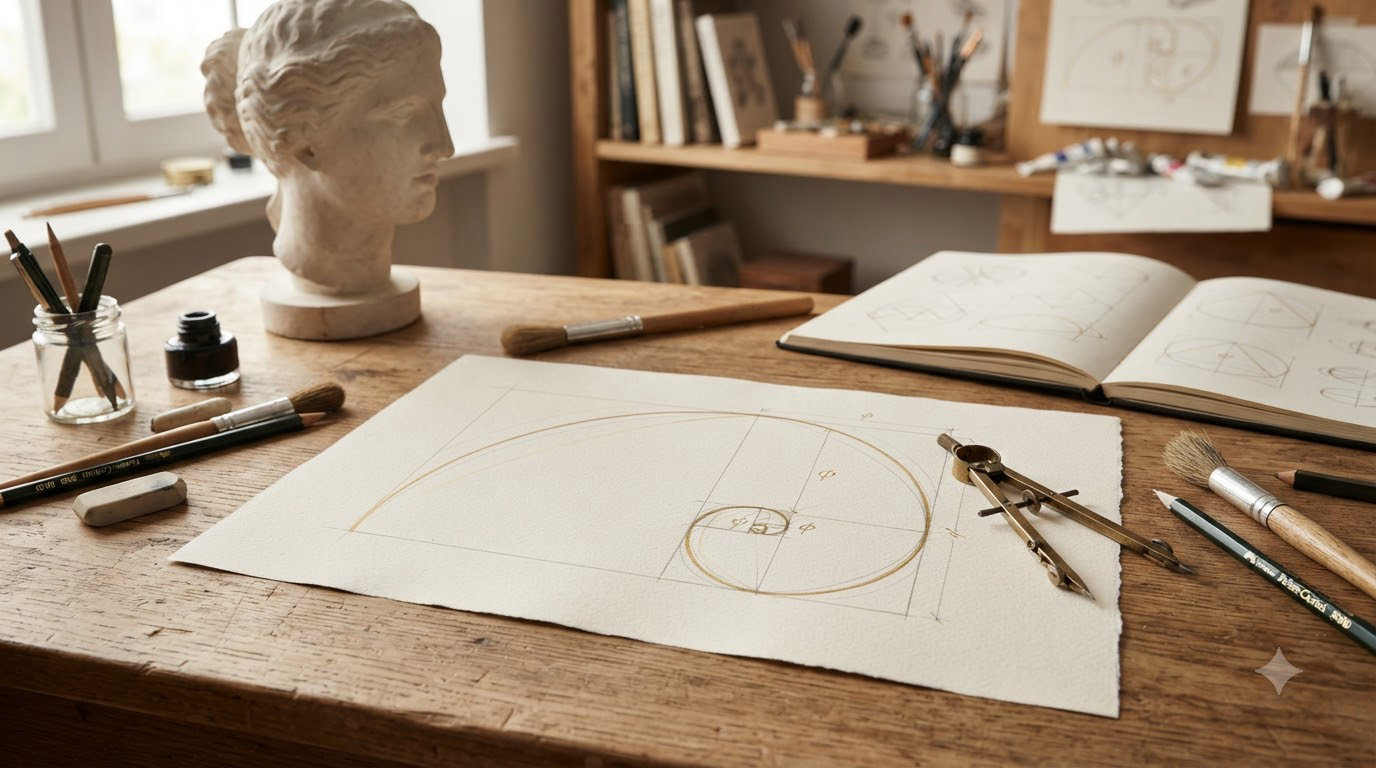
If you have ever wondered why some artworks feel instantly pleasing to the eye while others do not, the answer often lies in a mathematical concept that artists have used for centuries. The golden ratio in art is a compositional technique that can transform ordinary paintings into visually harmonious masterpieces. This guide breaks down this ancient mathematical principle into simple terms that anyone can understand and apply to their own creative work. Whether you are just starting your artistic journey or looking to understand the theory behind classical compositions, this article will give you practical knowledge you can use immediately.
Table of Contents
What is the Golden Ratio?
The golden ratio is a special number approximately equal to 1.618, represented by the Greek letter phi. Mathematically, it describes a proportion where the larger part divided by the smaller part equals the whole divided by the larger part. This creates what many describe as the most pleasing ratio found in nature and design. Unlike simple fractions like one-half or one-third, this irrational number continues infinitely without repeating, which contributes to its unique properties.
The Mathematical Foundation
To understand this in simple terms, imagine a line divided into two sections. When the longer section divided by the shorter section equals the entire line divided by the longer section, you have the golden ratio. This gives us the number 1.618, which appears throughout nature in spiral galaxies, seashells, flower petals, and human anatomy. Artists discovered that applying this same proportion to their compositions created work that felt naturally balanced and aesthetically satisfying. The mathematical formula is elegantly simple yet produces results that feel inherently right to human perception.
Why Artists Use It
Artists use the golden ratio because it provides a reliable framework for creating visual harmony. Rather than guessing what looks right, you can apply this mathematical guide to position elements in ways that naturally draw the viewer’s eye. Renaissance masters like Leonardo da Vinci and Michelangelo studied this proportion extensively, and modern designers continue to use it today. The ratio works because it mimics patterns our brains naturally recognize as beautiful, having evolved in an environment full of similar proportions. This makes it an incredibly powerful tool for artists seeking to create compelling, balanced compositions.
A Brief History
The golden ratio has fascinated mathematicians and artists for over two thousand years. Ancient Greek mathematician Euclid first described the geometric principles behind it around 300 BCE. The Greeks applied it extensively in architecture, with the Parthenon exhibiting golden ratio proportions in its facade design. During the Renaissance, artists rediscovered these principles and incorporated them into painting and sculpture, leading to some of the most celebrated artworks in history. Today, architects, designers, photographers, and digital artists continue to use this timeless proportion in their work.
The Golden Rectangle Explained
The golden rectangle is the most practical tool for applying the golden ratio in art. It is a rectangle whose sides follow the golden ratio, meaning the length is 1.618 times the width. This shape serves as the foundation for the golden spiral and countless compositional techniques. What makes the golden rectangle particularly useful is its self-similar property: if you remove a square from it, the remaining rectangle is also a golden rectangle. This process can continue infinitely, creating a series of nested rectangles that all share the same harmonious proportions.
How to Construct a Golden Rectangle
Building a golden rectangle requires just a few steps. Start with a square and draw a line from one corner to the opposite corner. From that same corner, draw a line downward at a 90-degree angle to the base. Use the diagonal of your square as a guide to mark the new corner point. Extend the remaining sides to complete your golden rectangle. This construction works because the diagonal you drew matches the proportion of the golden ratio. Once you have your golden rectangle, you can continue dividing it infinitely into smaller golden rectangles, each one containing the same harmonious proportions.
Using the Golden Rectangle in Your Art
Place your canvas or paper so that its proportions match a golden rectangle, or create an overlay guide that divides your composition into golden sections. Many artists print golden ratio grid templates that they can position over their work surface. The rectangle helps you identify where to place key elements for maximum visual impact. When positioning a horizon line, for example, placing it at a golden section rather than the center creates more dynamic tension. The same principle applies to vertical divisions, making golden rectangles invaluable for landscape paintings, portrait compositions, and abstract designs.
The Fibonacci Sequence Connection
The Fibonacci sequence and the golden ratio are deeply connected, though they are not the same thing. Understanding this relationship helps demystify the mathematical beauty behind the golden ratio in art. While the golden ratio is a specific number, the Fibonacci sequence is a series of numbers that generate this proportion through their relationships. This connection provides artists with both a mathematical framework and a practical counting method for applying golden ratio principles.
From Numbers to Visuals
The Fibonacci sequence starts with 0 and 1, then each subsequent number equals the sum of the two before it. So we get 0, 1, 1, 2, 3, 5, 8, 13, 21, 34, and so on. What makes this sequence special for artists is that the ratio between consecutive Fibonacci numbers approaches 1.618 as the numbers get larger. This means the further along the sequence you go, the closer each pair of numbers embodies the golden ratio. Artists can use these numbers directly when arranging elements, such as creating five flowers in one area and eight in another to achieve visual harmony.
The Spiral Emerges
When you draw squares using Fibonacci numbers as side lengths and connect them with quarter-circle arcs, the golden spiral emerges. This spiral starts small and grows infinitely while maintaining its characteristic shape. Artists can use this spiral as a compositional guide, positioning important elements along its curved path. The spiral does not have to start from a corner either; it can be flipped, rotated, and scaled to fit any composition. This flexibility makes it one of the most versatile tools in an artist’s compositional toolkit.
The Golden Spiral in Art
The golden spiral is perhaps the most recognizable application of the golden ratio in art. Its flowing curve appears in countless masterpieces, from Renaissance paintings to contemporary designs. Unlike straight lines that create rigid divisions, the spiral creates organic visual flow that guides the eye naturally through the composition. This dynamic quality is why so many artists and designers consider it essential for creating engaging artwork.
Understanding the Spiral
The golden spiral is formed by creating successive golden rectangles and drawing quarter-circle arcs within each square. The result is a spiral that grows outward while maintaining the same proportional relationships at every scale. Unlike a simple logarithmic spiral, the golden spiral has specific growth rates that match the golden ratio. Each quarter-circle arc connects perfectly to the next, creating a seamless curve that artists have used for centuries to direct viewer attention toward focal points.
Flipping and Rotating the Spiral
One of the most useful aspects of the golden spiral for artists is its flexibility. You can flip it horizontally or vertically, rotate it in 90-degree increments, and it still maintains its mathematical properties. This means you can choose whichever orientation best fits your composition. The spiral can guide your eye from any corner toward the focal point at its center. For a landscape with a setting sun, you might position the spiral so the sun sits at the focal point. For a portrait, the eyes or the subject’s face often aligns naturally with the spiral’s tightest curve.
How to Apply the Golden Ratio in Your Art
Now comes the practical part. Understanding the theory is important, but applying the golden ratio in art requires hands-on practice. Here are concrete techniques you can start using today. These methods range from simple approximations to more precise calculations, allowing you to choose the level of accuracy that suits your artistic style and workflow.
Canvas Division Techniques
Divide your canvas using golden ratio proportions rather than equal halves. For a rectangular canvas, make one section approximately 1.618 times larger than the adjacent section. Position your horizon line, background, or major structural elements along these divisions. This creates natural visual flow without rigid symmetry. You can also divide both horizontally and vertically to create a golden rectangle grid. This grid is less rigid than the rule of thirds but still provides clear guidance for element placement.
Subject Placement
Place your main subject where the golden spiral focal point meets your canvas. The eye naturally travels along the spiral path, so positioning key elements along this curve keeps viewers engaged. If your subject is a portrait, position the eyes at the golden intersection points. For landscapes, place your focal point along the spiral path, whether it is a tree, building, or area of dramatic light. This technique works particularly well when combined with leading lines that complement the spiral direction.
70/30 Rule Explained
The 70/30 rule offers a simplified approach to golden ratio composition. Instead of achieving the precise 1.618 proportion, you simply aim for a 70/30 split in your composition. This means approximately 70% of your visual weight goes to one area while 30% goes to another. This creates a similar dynamic tension while being easier to estimate on the fly. Many artists find this rule of thumb more practical for quick compositions or initial sketches before refining with more precise measurements.
Getting Started with Practice Exercises
Begin with simple exercises that build your intuition for golden ratio composition. Start by drawing a golden rectangle freehand, then subdivide it repeatedly. Next, practice placing simple shapes like circles or squares along the spiral path. Photograph your own compositions and overlay golden ratio guides to see how they align. These exercises train your eye to recognize and apply these proportions naturally over time, making them second nature in your artistic practice.
Famous Artworks and the Golden Ratio
Looking at how master artists applied the golden ratio helps us understand its power. While some claims about golden ratio usage are debated among historians, the geometric evidence in several famous works is remarkable. Studying these examples teaches us not just that the golden ratio works, but how master artists implemented it in their creative processes.
Mona Lisa by Leonardo da Vinci
The Mona Lisa demonstrates the golden ratio in multiple ways. Her face proportions follow golden ratio relationships, with the distance from her forehead to her chin relating to various facial features. The composition positions her figure at a golden section point, creating immediate visual interest. The background landscapes on either side appear to follow golden proportions as well, with the road and river aligning with golden rectangle divisions. Whether da Vinci consciously applied these ratios or naturally intuited them through his mathematical studies remains a fascinating question among art historians.
The Last Supper
In The Last Supper, da Vinci positioned the disciples and architectural elements with remarkable precision. The painting composition uses golden rectangles to organize the spatial arrangement. The table and windows create a framework that guides the viewer’s eye toward Christ at the center. Mathematical analysis reveals multiple golden ratio relationships throughout the composition, including the proportions of the windows behind Christ and the positioning of the disciples in groups of three. The opening in the background landscape also falls at a golden section point, drawing the eye deeper into the scene.
Other Notable Examples
Michelangelo Creation of Adam shows the divine figure extended along a golden curve, with the separation between God and Adam precisely positioned at a golden section. Hokusai The Great Wave incorporates the golden spiral in its crashing curl, with the famous wave curling in patterns that closely match golden spiral geometry. Mondrian geometric paintings explicitly explored golden ratio principles in his balanced compositions of primary colors and rectangles. These examples span centuries and cultures, suggesting the golden ratio resonates across different artistic traditions and continues to appear in contemporary design and architecture.
Golden Ratio vs Rule of Thirds
Many beginners confuse the golden ratio with the rule of thirds. While both are compositional tools, they differ in practice and effect. Understanding when to use each improves your artistic toolkit and helps you make informed choices about composition strategies. Both methods aim to create visual interest, but they achieve this through different mathematical relationships.
Key Differences
The rule of thirds divides your canvas into nine equal sections using two horizontal and two vertical lines. This creates intersection points that serve as suggested focal points. The golden ratio is less symmetrical, dividing space in the approximately 1.618 to 1 proportion. This creates more dynamic, off-center compositions that feel naturally balanced rather than mechanically divided. The difference is subtle but significant: rule of thirds creates equal divisions, while golden ratio creates weighted proportions.
When to Use Each
The rule of thirds works well for straightforward compositions, quick sketches, and scenes with clear focal points. It provides structure without requiring precise calculations, making it accessible for beginners and practical for time-sensitive work. The golden ratio suits more nuanced compositions where you want subtle visual flow rather than obvious guide points. Many photographers and filmmakers prefer the rule of thirds for its simplicity and effectiveness in capturing natural moments. Painters often favor the golden ratio for its more sophisticated balance and ability to create complex visual hierarchies.
The Golden Ratio in Nature
Understanding why the golden ratio feels so natural in art requires looking at nature. The same proportions that create beautiful artwork appear throughout the natural world, which explains why they resonate with human perception. This connection between mathematics and organic forms reveals why golden ratio compositions feel inherently right to viewers.
Patterns Found in Nature
The chambered nautilus shell grows in a golden spiral, adding new chambers while maintaining its characteristic shape throughout its life. Sunflower seeds arrange themselves in spiraling patterns that follow Fibonacci numbers, maximizing seed packing efficiency. The human body exhibits golden ratio relationships in facial proportions, finger ratios, and overall body structure. These patterns suggest the golden ratio represents fundamental principles of growth and form that apply across all living systems.
Why Nature Loves Phi
Scientists believe the golden spiral efficiency explains its prevalence in nature. This shape allows optimal packing of seeds in sunflowers, efficient fluid dynamics in shells, and maximum light exposure in leaves. Since human perception evolved in environments full of these patterns, our brains are literally wired to recognize and appreciate golden ratio proportions. This evolutionary explanation suggests that when we create artwork using golden ratios, we are tapping into deep-seated aesthetic preferences shaped by millions of years of natural selection.
Common Mistakes to Avoid
Beginners often struggle with the golden ratio because they overthink it. Here are the most common pitfalls and how to avoid them. Learning from these mistakes will help you use the golden ratio more effectively without frustration or diminishing your creative expression.
Overcomplicating the Process
You do not need to draw perfect golden rectangles or calculate precise measurements for every artwork. Think of the golden ratio as a guideline, not a rigid rule. Overly rigid application makes artwork feel mechanical rather than organic. Start by simply positioning elements near golden ratio points rather than obsessing over exact placement. Use visual judgment to refine your compositions after establishing initial golden ratio guides. The goal is enhanced visual appeal, not mathematical precision in your artwork.
Forcing Rather Than Feeling
The golden ratio should enhance your natural intuition, not replace it. If a composition feels right but does not align perfectly with golden proportions, trust your instincts. Many successful artists use the golden ratio subconsciously rather than mathematically. The goal is creating pleasing work, not passing a geometry test. Remember that famous artworks showing golden ratio patterns were often created before the concept was formally defined, suggesting artists naturally gravitate toward these proportions through artistic intuition alone.
Ignoring the Bigger Picture
Getting caught up in golden ratio details can cause you to lose sight of your artistic vision. The golden ratio is a tool for serving your creative goals, not the goal itself. If applying the golden ratio conflicts with the emotional impact or narrative of your piece, prioritize your artistic intent. Use the golden ratio as one of many compositional tools in your toolkit, balancing it with color theory, perspective, focal points, and other artistic considerations.
FAQs
How do I use the golden ratio in my art?
Start by dividing your canvas using golden ratio proportions (approximately 1:1.618). You can use a golden rectangle overlay, place your main subject at the spiral focal point, or divide your composition into sections following this ratio. Practice with simple compositions first before moving to complex scenes.
What is the golden ratio for dummies?
The golden ratio is a proportion (about 1:1.618) that divides a line or space so the larger part relates to the smaller part the same way the whole relates to the larger part. Artists use this ratio to create compositions that feel balanced and visually pleasing.
What is the 70/30 rule in art?
The 70/30 rule is a simplified version of the golden ratio. It means dividing your composition so that 70% of visual weight goes to one area and 30% to another. While related to the golden ratio, it is less precise but easier to apply quickly in your artwork.
Did Mona Lisa use the golden ratio?
Many analysts claim Mona Lisa proportions align with the golden ratio, particularly her facial features and the composition. However, there is debate about whether da Vinci consciously used it. Some believe he naturally applied harmonious proportions learned through his studies of mathematics and nature.
Conclusion
The golden ratio in art is a powerful compositional tool that bridges mathematics and creativity. By understanding the principles behind phi, the golden rectangle, and the golden spiral, you gain insights into why certain artworks captivate us so deeply. Start practicing with simple exercises, and you will gradually develop an intuitive sense for these proportions. The journey from understanding the theory to applying it naturally takes time, but every step builds your compositional skills.
Remember that the golden ratio serves your artistic vision, not the other way around. Use it as a guide for creating more harmonious compositions while staying true to your creative instincts. With practice, you will find yourself naturally incorporating these principles into your work, whether you consciously calculate them or simply feel their effects. Whether you are painting your first canvas or your hundredth, the golden ratio offers a timeless framework for creating artwork that resonates with viewers on a fundamental level.