
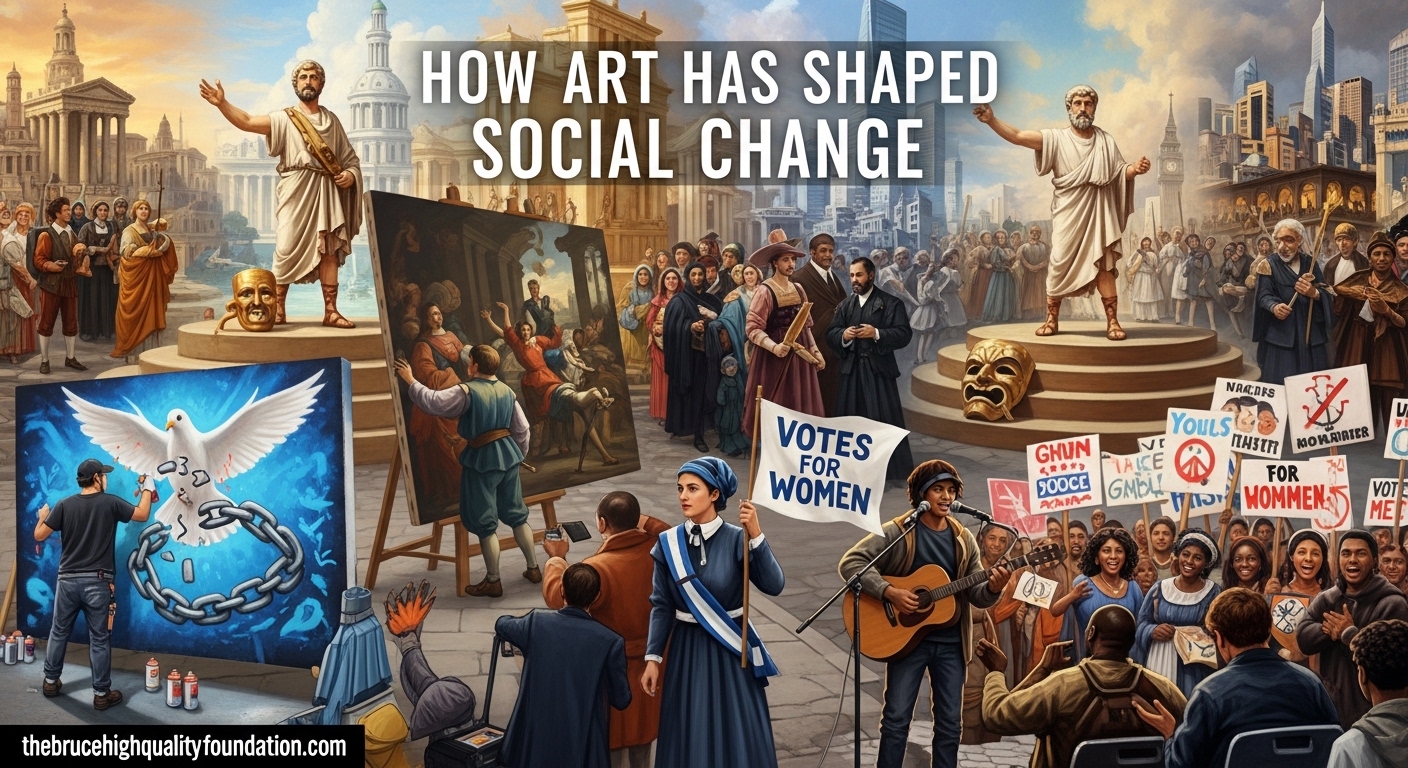
Art has always been more than decoration. Throughout history, it has served as a mirror reflecting society’s deepest wounds and boldest aspirations. When we examine how art has shaped social change, we discover a powerful force that transcends language barriers, challenges authority, and mobilizes communities toward collective action.
In this guide, our team explores the multifaceted ways creative expression drives social transformation. From protest posters to digital activism, from community murals to performance art interventions, we trace the remarkable journey of art as a catalyst for meaningful change. We address the skepticism some readers may feel about art’s real-world impact by presenting concrete historical examples and measurable outcomes.
If you are looking to understand the connection between artistic expression and social movements, or searching for ways to engage with art-driven activism yourself, this comprehensive exploration provides the insights you need. The relationship between art and social change is complex, but its power to shape our world is undeniable.
Table of Contents
Historical Examples of Art Driving Social Change
History offers countless examples of how art has shaped social change, often at the precise moments when societies needed their voices amplified most. These are not mere coincidences. They represent deliberate artistic choices that captured the spirit of their times and propelled movements forward.
The Mexican Revolution and Muralism
Following the Mexican Revolution (1910-1920), artists like Diego Rivera, Jose Clemente Orozco, and David Alfaro Siqueiros developed a new visual language. They created massive murals on public buildings that depicted the struggles of indigenous peoples, workers, and peasants. These works did not simply decorate city walls. They educated an largely illiterate population about their own history and rights. The muralist movement showed that art need not be confined to galleries, accessible only to the wealthy. Instead, it could belong to everyone.
Pablo Picasso’s Guernica (1937)
When Nazi Germany bombed the Basque town of Guernica during the Spanish Civil War, the world witnessed a brutal display of modern warfare. Pablo Picasso responded with a painting that has become the defining anti-war statement in Western art. The massive canvas does not show bombing victims bleeding on screen. Instead, it uses distorted figures, a screaming woman clutching a dead child, and a bull representing fascism to evoke the horror and suffering of that day. Guernica traveled to exhibitions worldwide, ensuring that audiences could not ignore the atrocities committed in Spain. The artwork became a universal symbol against the devastation of war.
The Civil Rights Movement’s Visual Legacy
The American Civil Rights movement of the 1950s and 1960s demonstrates how art shapes social change through repeated visual exposure. Norman Rockwell’s painting “The Problem We All Live With” (1963) depicted a young Black girl walking to school escorted by federal marshals. Published in Look magazine, it brought the reality of school desegregation into living rooms across America. Meanwhile, photographs by Gordon Parks and others documented the violence of segregation, creating an indelible record that still shapes how we remember that era.
These historical examples share a common thread. They met audiences where they were, whether on public walls, in magazines, or in museums. They transformed private grief into public conversation and private outrage into collective action.
How Art Creates Social Impact
Understanding how art influences social change requires examining the psychological and social mechanisms at work. Our research into forum discussions revealed that many people question whether art actually creates change or merely reflects it. The answer, our team found, is more nuanced than a simple either-or distinction.
Building Empathy Through Emotional Connection
Art possesses a unique ability to create emotional connections that statistics and speeches cannot achieve. When we see a powerful photograph of a refugee child, we feel something visceral. This emotional response motivates action in ways that abstract data about displacement never could. Harvard researchers studying Art/Science collaborations have documented how visual art activates regions of the brain associated with empathy and moral reasoning.
Community art projects extend this impact further by involving audiences as participants rather than passive viewers. When people contribute to a collaborative mural or performance piece, they develop ownership over the message. This participation transforms spectators into advocates.
Amplifying Marginalized Voices
One of art’s most powerful functions is giving voice to those who have been silenced. For centuries, dominant groups controlled the narrative through written documents, official histories, and sanctioned artistic expressions. Art created by and for marginalized communities subverts this control.
Street art and graffiti have historically provided platforms for communities without access to traditional art institutions. The work of street artists as protest and social commentary has repeatedly proven that artistic expression does not require institutional permission to be powerful or meaningful.
Challenging Norms and Provoking Dialogue
When artists challenge accepted norms, they create space for public dialogue about issues previously considered settled or taboo. This function of art as social provocation appears throughout art history, from Courbet’s realist paintings that depicted ordinary workers with dignity to contemporary installations that force viewers to confront uncomfortable truths about their societies.
Socially engaged art practices, sometimes called “new genre public art” by theorists, deliberately work outside traditional gallery contexts to address community-specific issues. Artists like Tania Bruguera have developed what she calls “arte util” – art that is useful rather than merely beautiful, designed to address specific social needs.
Artists as Catalysts for Change
Individual artists and collectives have repeatedly demonstrated that creative vision can precede and precipitate broader social transformation. Understanding the role artists play in social activism helps us appreciate how concentrated creative effort can ripple outward to affect millions.
Theaster Gates and Community Revitalization
Theaster Gates, a Chicago-born artist and conceptual artist, has developed innovative approaches to neighborhood revitalization through art. When he acquired abandoned buildings on Chicago’s South Side, he transformed them into community gathering spaces and archives of African American cultural history. His “Dorchester Projects” demonstrate how artists can drive tangible social change beyond symbolic gestures. Gates shows that art shapes social change not only through objects or images but through direct intervention in physical and social spaces.
Ai Weiwei and Global Human Rights
Chinese artist Ai Weiwei has consistently used his international profile to advocate for human rights and freedom of expression. Following the 2008 Sichuan earthquake, which killed thousands of schoolchildren, Ai investigated the collapsed schools and documented the victims when Chinese authorities attempted to suppress this information. His subsequent detention by Chinese authorities only amplified his message globally.
Ai’s practice demonstrates the risks artists sometimes face when confronting powerful institutions. It also shows how technology extends the reach of artistic activism beyond national boundaries.
Art Collectives and Collaborative Action
The emergence of influential art collectives that have shaped discourse represents a significant development in how art creates social impact. Collectives like the Guerilla Girls, established in 1985 to protest gender and racial inequality in the art world, combined humor with data-driven advocacy. Their iconic poster asking “Do women have to be naked to get into the Met. Museum?” sparked ongoing conversations about institutional bias that continue today.
The Role of Performance Art in Social Commentary
Performance art has proven particularly effective for social commentary because it requires immediate presence and often involves the artist’s own body as the medium. Looking at performance art pieces that challenged society reveals how artists like Marina Abramovic, Chris Burden, and Pussy Riot have used their physical presence to address issues from gender violence to political repression.
Pussy Riot’s 2012 “Punk Prayer” performance in a Moscow cathedral, which resulted in prison sentences for several members, transformed a local protest into an international symbol of resistance to authoritarianism. The calculated risk the artists took demonstrated that some forms of art activism carry genuine personal costs.
Modern Digital Activism and Art
The digital revolution has fundamentally transformed how art shapes social change. Social media platforms, meme culture, and digital art have created new channels for artistic activism that can spread globally within hours.
The Rise of Hashtag Activism
Movements like #BlackLivesMatter and #MeToo demonstrate how digital art and social media intersect to amplify social movements. While these movements primarily rely on written and photographic documentation, they have generated distinctive visual languages. The “Me Too” movement’s viral hashtag created a cascade of personal testimonies, but the accompanying artwork – posters, graphics, and symbols – provided visual anchors that helped maintain momentum beyond any single news cycle.
Street Art Goes Digital
Contemporary street artists like Banksy have leveraged social media to extend their messages globally. When Banksy’s works appear overnight in cities, they generate immediate photographic documentation that spreads across platforms before city authorities can remove them. This speed of dissemination means street art now reaches audiences far beyond the neighborhoods where it appears physically.
Digital Art and New Forms of Protest
The evolution of protest art from traditional forms to digital expression represents a significant shift in how art influences social change. Artists now create works specifically designed for screen viewing, understanding that their audience may encounter them through Instagram, Twitter, or TikTok rather than in person. This adaptation requires new technical skills but also opens unprecedented possibilities for rapid response to unfolding events.
Shepard Fairey, creator of the iconic Obama “Hope” poster, has documented how digital tools have transformed the economics and reach of political art. What once required expensive printing equipment and distribution networks can now be shared instantly across the globe for free. This democratization has lowered barriers to entry for artistic activism while also creating challenges around attribution and compensation.
The Impact of Digital Satire
Memes and digital satire have emerged as powerful tools for social commentary. When artists create satirical images that capture political absurdity, they provide frameworks for understanding complex events. This visual shorthand allows communities to process difficult situations collectively, building solidarity through shared humor even as they share serious critique.
Art and Science Collaboration
A relatively newer development in how art has shaped social change involves deliberate collaboration between artists and scientists. This intersection combines the emotional power of art with the credibility and data-driven approaches of scientific research.
Environmental Art and Advocacy
Projects like the “Entangled” and “Ingested” collaborations documented by Harvard’s Advanced Leadership Initiative demonstrate how art-science partnerships can address environmental issues. Artists working with marine biologists have created powerful visualizations of plastic pollution in oceans. These works do not simply document problems. They translate scientific data into emotional experiences that motivate behavioral change.
How Artists Use Data Visualization
Data visualization has emerged as a potent form of art-driven advocacy. When artists transform abstract statistics into vivid images, they make invisible problems visible. A chart showing temperature increases becomes a painting of a burning planet. Statistics about income inequality become a sculpture of a towering wall dividing figures of vastly different heights.
The Intersection of Technology and Activism
As AI and digital art’s role in contemporary expression continues to develop, we can expect new forms of artistic activism to emerge. Artists are already experimenting with machine learning to identify patterns in social media that could predict social movements, creating early warning systems that communities can use to prepare.
The intersection of art, technology, and social change raises important questions about authenticity and representation. When how artists use appropriation to challenge norms becomes a tool for social commentary, the boundaries between original creation and cultural borrowing blur in productive ways.
The Ongoing Transformative Power of Art
As we have explored throughout this guide, art shapes social change through multiple interconnected mechanisms. It builds empathy, amplifies marginalized voices, challenges norms, and mobilizes collective action. From the murals of the Mexican Revolution to today’s digital activism, creative expression has consistently proven itself as a catalyst for meaningful social transformation.
The evidence demonstrates clearly that art does not merely reflect society. It actively participates in shaping it. When communities face oppression, artists often provide the first visual language for resistance. When societies undergo transformation, artists document and interpret those changes in ways that shape collective memory.
For readers interested in engaging with art-driven social change, the opportunities are abundant. Supporting artists whose work addresses social issues, participating in community art projects, or simply sharing meaningful artwork on social media all contribute to the broader ecosystem of creative activism.
Our understanding of how art has shaped social change continues to evolve as new technologies and social movements emerge. What remains constant is art’s fundamental power to help us see ourselves and our societies more clearly, to imagine alternatives to present arrangements, and to inspire the collective action necessary for transformation.
FAQs
How does art influence social change?
Art influences social change by creating emotional connections that motivate action, amplifying marginalized voices that mainstream media ignores, challenging accepted norms to create space for dialogue, and building shared identities that enable collective action. Harvard researchers have documented how visual art activates brain regions associated with empathy and moral reasoning, providing scientific backing for what artists have long understood intuitively.
What are some famous examples of art driving social movements?
Famous examples include Pablo Picasso’s Guernica (1937), which became a universal anti-war symbol; Diego Rivera’s Mexican Revolution murals that educated and mobilized peasants; Norman Rockwell’s The Problem We All Live With (1963), which brought Civil Rights into American living rooms; and the #MeToo and #BlackLivesMatter visual movements that have maintained momentum through distinctive artwork and symbols. Banksy’s street art and Shepard Fairey’s Obama Hope poster represent more recent examples of art driving social conversations.
Can art really make a difference in political or social issues?
Yes, art can make measurable differences in political and social issues. Research from the Smithsonian and Harvard shows that emotional impact from art motivates people to give time and money to causes. Art has influenced elections, changed policies, and sustained movements over decades. The Civil Rights movement’s visual documentation and the global response to Guernica demonstrate that art shapes both public opinion and collective memory in ways that translate into real-world action.
How has protest art evolved throughout history?
Protest art has evolved from murals and paintings accessible primarily to elites, to street art and graffiti that belongs to communities, to digital art that spreads globally within hours. The Mexican muralist movement brought art to public spaces for working-class audiences. Performance art introduced the artist’s body as a medium for social commentary. Today, hashtag activism combines visual art with social media to create movements that cross national boundaries instantaneously. Each evolution has expanded both the reach and the accessibility of art-driven social change.
What role do artists play in social activism?
Artists serve multiple roles in social activism: as documentarians who create visual records of social conditions; as provocateurs who challenge norms and force uncomfortable conversations; as community organizers who create spaces for collective gathering and expression; and as translators who convert complex social issues into accessible emotional experiences. Artists like Theaster Gates demonstrate direct community intervention, while figures like Ai Weiwei show how international visibility can amplify domestic issues. The most effective artists often combine multiple roles within a single practice.