
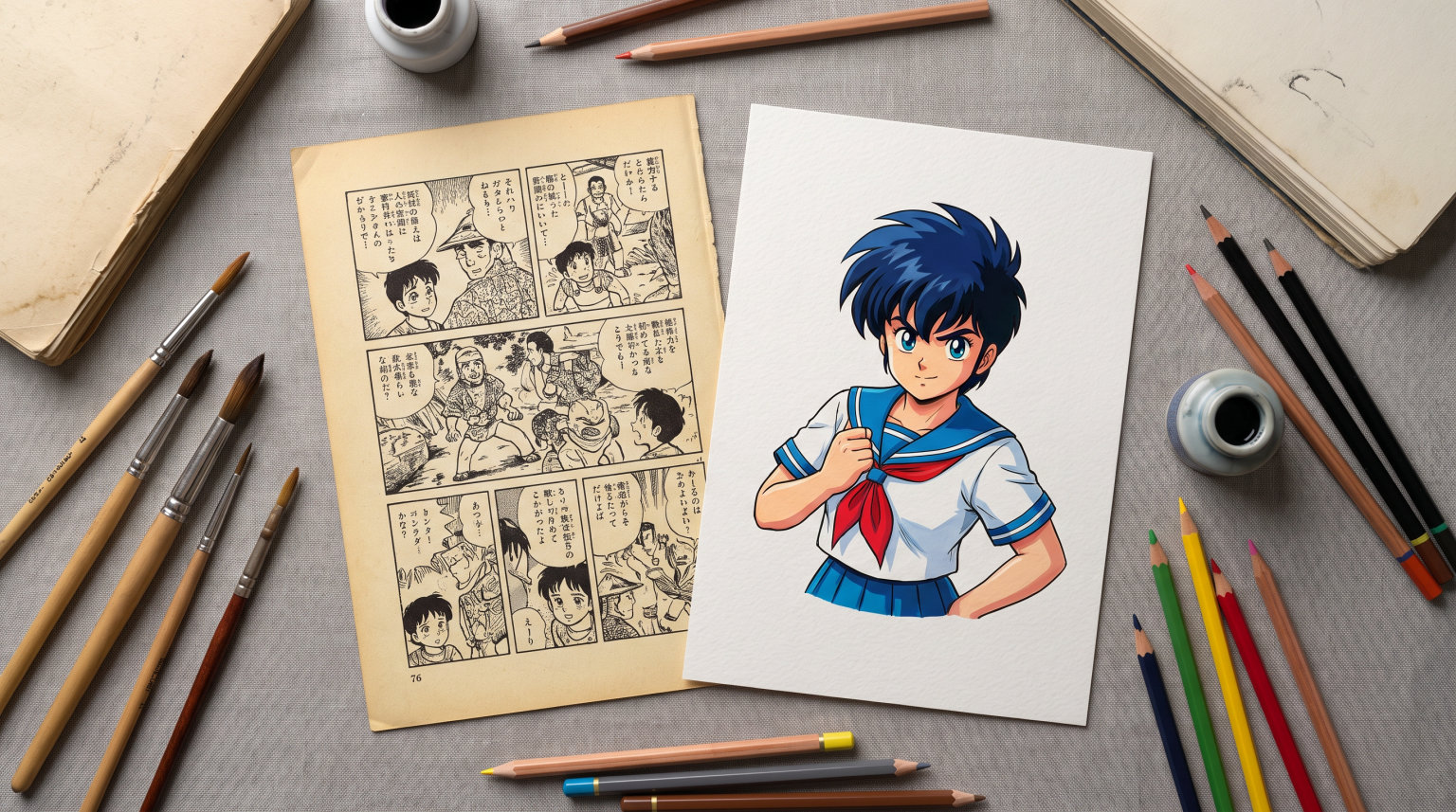
If you have ever picked up a manga volume and then watched the anime adaptation of the same series, you probably noticed something right away: the art does not look exactly the same. The manga vs anime style art differences run deeper than just “one is a comic and the other is a cartoon.” They stem from fundamentally different creative processes, production constraints, and storytelling tools.
Manga refers to Japanese comic books and graphic novels, typically drawn in black and white by a single creator called a mangaka. Anime refers to Japanese animated television shows and films produced by studios with large teams. Both share visual DNA, including large expressive eyes, stylized hair, and dramatic action poses. But the way those elements are rendered on paper versus on screen reveals striking contrasts.
In this guide, our team breaks down every major art style difference between manga and anime. We cover linework techniques, shading methods, eye and facial feature variations, the role of color, and the real reasons anime adaptations tend to simplify the original manga art. Whether you are an art student, a long-time fan, or just curious about Japanese visual storytelling, you will walk away understanding exactly why these two art forms look the way they do.
Table of Contents
What Is Manga Art Style?
Manga art is a form of sequential art told through panels on a page. A mangaka (the Japanese term for a manga creator) draws each page by hand or digitally, composing every panel to control pacing, emotion, and visual impact. The vast majority of manga is published in black and white, which is not a limitation but a deliberate stylistic choice that emphasizes linework and contrast.
One of the defining features of manga art is its incredible detail. Because a mangaka draws each page as a static image meant to be studied, they can invest time in intricate crosshatching, background architecture, fabric folds, and facial expressions that would be nearly impossible to replicate across thousands of animation frames. Series like Berserk by Kentaro Miura and Vagabond by Takehiko Inoue are legendary for their level of detail.
Manga is read right to left in its original Japanese format. This reading direction affects panel layout and how the artist guides your eye across the page. Pages are first serialized in weekly or monthly magazines like Weekly Shonen Jump, then collected into bound volumes called tankobon. The serialization schedule means a mangaka might produce 15 to 20 pages per week, which influences how detailed each chapter can be.
For shading and texture, manga artists use screen tones (also called screentone or halftone). These are adhesive sheets with dot patterns that artists cut and apply to specific areas to create gradients, shadows, and textures. Modern digital manga tools simulate this effect, but the visual result is the same: a distinctive pattern-based shading style that gives manga its characteristic look.
What Is Anime Art Style?
Anime art is the visual style of Japanese animated productions. Unlike manga, anime is a collaborative medium created by animation studios employing directors, character designers, key animators, in-between animators, color designers, background artists, and compositing teams. This team-based production shapes the art in ways that differ significantly from manga.
The most obvious difference is color. Anime is produced in full color, with dedicated color designers who choose palettes for characters, environments, lighting, and mood. This adds an entire dimension of visual information that manga simply does not have. A sunset scene in an anime can convey warmth and melancholy through color alone, whereas a manga artist must suggest the same mood through linework and tone density.
However, anime character designs are generally simplified compared to their manga counterparts. This is a practical necessity. An anime episode contains roughly 3,000 to 5,000 individual frames, and each character must look consistent across every frame drawn by different animators. Complex outfit details, elaborate hairstyles, and intricate facial features get streamlined into what the industry calls “animation-friendly” designs. Character model sheets serve as the reference standard that every animator follows.
Anime also introduces elements that manga cannot: voice acting, music, sound effects, and actual motion. Camera techniques like panning, zooming, and rack focus simulate cinematic storytelling. Some studios, like Ufotable (Demon Slayer) and Kyoto Animation (Violet Evergarden), push anime art to extraordinary levels of visual polish that rival or exceed the manga source material.
Manga vs Anime Style Art Differences: The Key Comparisons
Now let us get specific. When you place manga and anime side by side, several consistent art style differences emerge. These differences are not random; each one reflects the constraints and strengths of its medium.
Linework and Detail Level
Manga linework tends to be more intricate and varied. A mangaka can use fine crosshatching for shadows, bold strokes for impact lines, and delicate parallel lines for subtle gradients. Because the reader holds the page and can study each panel, the artist can pack in detail that rewards close inspection. Hair strands, fabric textures, and environmental elements like leaves or brickwork receive careful attention.
Anime linework is typically cleaner and more uniform. Characters are outlined with consistent line weights so that when the image moves from frame to frame, nothing visually jumps or flickers in a distracting way. Fine details like individual hair strands are often reduced to simplified shapes. A manga character might have individually drawn strands of hair across their face, while the anime version uses a few solid shapes to suggest the same hairstyle.
This simplification is especially noticeable in action scenes. A manga artist can dedicate an entire page to a single explosive moment with debris, speed lines, and shattered environments rendered in painstaking detail. The anime must animate that moment across multiple frames, which means each individual frame carries less detail but the sequence achieves something manga cannot: actual motion.
Color vs Black and White
Manga is overwhelmingly black and white. Color appears only on special pages, volume covers, and occasional full-color chapters. This limitation is partly economic (color printing is expensive for weekly serialization) and partly artistic. Working in black and white forces the artist to master contrast, composition, and value, which is why manga art often has such strong graphic impact.
Anime works in full color by default. Color designers establish palettes for each scene, considering time of day, emotional tone, and visual hierarchy. Warm amber tones might dominate a nostalgic flashback, while cold blues and purples set a threatening mood. This chromatic storytelling tool is one of anime’s biggest advantages over manga.
The trade-off is that color constrains other artistic choices. Every background must be fully painted rather than suggested through line density. Lighting must remain consistent across cuts within a scene. These requirements add production time and cost, which is one reason anime sometimes reduces background detail during complex action sequences.
Eyes and Facial Features
Large, expressive eyes are a hallmark of both manga and anime art. But the way those eyes are drawn differs noticeably between the two. Manga eyes often feature complex reflections, multiple layers of tone, and intricate iris patterns. A shonen manga might show a character’s determination through a heavily detailed eye close-up with crosshatched shadows and layered highlights.
Anime eyes are designed to be animatable. The iris and pupil are simplified into clean shapes that can be consistently reproduced across hundreds of frames. Reflections become standard white spots rather than complex light patterns. When a character’s expression changes, the eye shape distorts in ways that read clearly at 24 frames per second, sometimes using exaggerated techniques like eyes shrinking to dots for comedic effect or expanding to fill the face for dramatic emphasis.
Facial expressions also differ in their visual shorthand. Manga uses page layout to amplify expressions: a shocked character might get an entire panel, with speed lines radiating outward and screen tones heightening the contrast. Anime achieves similar effects through timing (a held frame, a sudden zoom), voice acting, and musical stings. The visual language overlaps, but the tools differ.
Technical Art Differences: Shading, Panels, and Motion
Beyond the visible surface differences, manga and anime use fundamentally different technical approaches to shading, composition, and conveying movement.
Shading and Screen Tones vs Digital Coloring
In manga, shading is primarily achieved through screen tones. These dot patterns create the illusion of gradients, shadows, and textures without using actual gray ink. Different tone densities convey different moods: heavy dot patterns for dark, tense moments and lighter patterns for softer scenes. Some manga artists layer multiple tones for complex shading effects that give their work a distinctive, almost photographic quality in certain panels.
Anime uses cel shading, a technique that applies flat blocks of color with sharp boundaries between light and shadow areas. This creates the characteristic anime look where a character’s hair has a distinct highlight zone and shadow zone with no smooth gradient between them. Cel shading was originally developed to make hand-drawn animation faster to produce, and it remains the standard even in digitally produced anime.
Modern anime sometimes blends cel shading with softer digital lighting effects, especially in high-budget productions. Studios like Ufotable combine traditional cel-shaded characters with CGI-enhanced environments and particle effects, creating a hybrid look that pushes beyond what either pure manga art or traditional cel animation could achieve alone.
Static Panels vs Animated Frames
The most fundamental difference between manga and anime art is the dimension of time. Manga is static. The mangaka controls pacing through panel size, page turns, and the arrangement of elements within each composition. A wide panel stretches a moment; a rapid sequence of small panels accelerates the pace. The reader controls the speed at which they consume the art, lingering on a detailed spread or racing through dialogue.
Anime adds motion and time as core artistic tools. A fight scene in anime uses frame rate, camera movement, and editing rhythm to create visceral impact. This is why animation inherently requires art simplification: every additional frame must be drawn, and complex details multiply the workload exponentially. A character design with 50 distinct visual elements in manga might need those 50 elements redrawn correctly across 2,000 frames of screentime.
This is also why anime often adds filler content or stretches short manga moments into extended scenes. A manga chapter that takes five minutes to read might become a 20-minute anime episode. The animation team must fill that time with visual content, which sometimes means expanding backgrounds, adding ambient movement, or creating entirely new sequences not present in the original manga.
Why Does Anime Art Look Different From the Manga?
This is the question that sparks countless forum debates on Reddit and anime communities. The answer comes down to three main factors: production constraints, consistency requirements, and creative interpretation.
First, consider the production pipeline. A single mangaka (with perhaps one to three assistants) draws a manga chapter of 15 to 20 pages per week. An anime episode requires dozens of artists working across multiple departments over several weeks to produce roughly 20 minutes of animation. The scale difference is enormous. Every simplification in anime art saves real production time and budget.
Second, consistency matters. When 10 different animators draw the same character across an episode, the character must look identical in every frame. Complex details are the enemy of consistency. This is why anime character designers create detailed model sheets with exact specifications for proportions, expressions, and color values. The model sheet is the law, and individual artistic flourishes are minimized in service of visual uniformity.
Third, creative interpretation plays a role. Some anime directors deliberately reimagine the manga’s visual style rather than copy it faithfully. The anime adaptation of JoJo’s Bizarre Adventure uses bold color shifts and stylized effects that differ from Hirohiko Araki’s original manga art. Mob Psycho 100 takes ONE’s simple webcomic style and transforms it into some of the most dynamic animation in recent memory. These creative divergences are not failures of adaptation but artistic choices that leverage anime’s unique strengths.
Fans often notice that body types become more uniform in anime adaptations. A manga might draw characters with distinct body proportions, unusual builds, or distinctive silhouettes. The anime version tends to standardize these differences because consistent animation of unusual body proportions across thousands of frames is exceptionally difficult. This is one of the most common complaints in fan communities, and it reflects a genuine technical limitation of the medium.
Popular Series: Manga vs Anime Art Compared
Looking at specific examples helps illustrate these differences in concrete terms.
One Piece: Eiichiro Oda’s manga is famous for its dense panel compositions, detailed character designs, and creative use of screen tones for dramatic effect. The anime adaptation by Toei Animation simplifies many character details for animation efficiency. Fans frequently debate whether the manga’s art captures Oda’s vision more faithfully, particularly in later arcs where the anime’s production schedule has led to noticeable quality dips.
Attack on Titan: Hajime Isayama’s early manga art was famously rough, with inconsistent proportions and sketchy linework. The anime adaptation by Wit Studio (and later MAPPA) refined the art significantly, giving characters cleaner designs and more polished visuals. Interestingly, this is a case where many fans prefer the anime’s art over the manga’s original, though Isayama’s style improved dramatically over the course of the series.
Demon Slayer: Koyoharu Gotouge’s manga has a distinctive, somewhat unusual art style with simple character designs but creative action compositions. The Ufotable anime adaptation is widely regarded as one of the most visually stunning anime ever produced, enhancing the source material with breathtaking color, lighting, and digital effects. This is an example where the anime elevates the art beyond what the manga achieved visually.
Berserk: Kentaro Miura’s manga represents perhaps the ultimate example of manga detail that cannot be faithfully adapted to animation. Each page features astronomical levels of crosshatching, architectural detail, and atmospheric shading. Multiple anime adaptations have attempted to bring Berserk to screen, but none have captured the density of Miura’s art. The 2016 adaptation’s use of CGI was particularly criticized for failing to honor the source material’s visual quality.
FAQs
What is the difference between manga and anime art style?
Manga art is drawn in black and white with detailed linework, screen tone shading, and intricate panel compositions created by a single mangaka. Anime art is produced in full color by studio teams with simplified character designs optimized for consistent animation across thousands of frames. The core difference is that manga prioritizes static visual detail while anime prioritizes animatable consistency and motion.
What is the most sold anime of all time?
By total franchise revenue including manga sales, merchandise, and media, Pokemon is the highest-grossing anime-related franchise globally. For manga specifically, One Piece holds the record with over 500 million copies in circulation worldwide, making it the best-selling manga (and comic series) in history.
Why are Gen Z obsessed with anime?
Gen Z’s connection to anime stems from growing up with internet access to streaming platforms like Crunchyroll and Netflix, which made anime far more accessible than previous generations had. Social media platforms amplify anime culture through memes, fan art, and community discussion. The diverse storytelling, emotional depth, and distinctive art styles resonate with a generation that values authentic creative expression and global cultural exchange.
Is Demon Slayer an anime or manga?
Demon Slayer (Kimetsu no Yaiba) is both. It originated as a manga series written and illustrated by Koyoharu Gotouge, serialized in Weekly Shonen Jump from 2016 to 2020. The anime adaptation by studio Ufotable began airing in 2019. The manga is the source material and the anime is the animated adaptation of that source.
Wrapping Up: Appreciating Both Art Forms
Understanding the manga vs anime style art differences is not about declaring one medium superior to the other. Both manga and anime are remarkable art forms with distinct strengths. Manga offers unmatched visual detail, intimate pacing controlled by the reader, and the singular artistic vision of a mangaka poured into every panel. Anime brings stories to life with color, motion, sound, and the collaborative creativity of entire studios.
The differences between them are a direct result of their different formats. Static pages allow for detail that moving frames cannot sustain. Full-color animation provides emotional and atmospheric tools that black-and-white ink cannot match. When you appreciate these trade-offs, both mediums become richer experiences.
If you are inspired to start creating your own manga or anime-style art, having the right tools makes a real difference. Check out our guide to the best art supplies for aspiring manga artists to get started with quality materials that support your creative journey.