
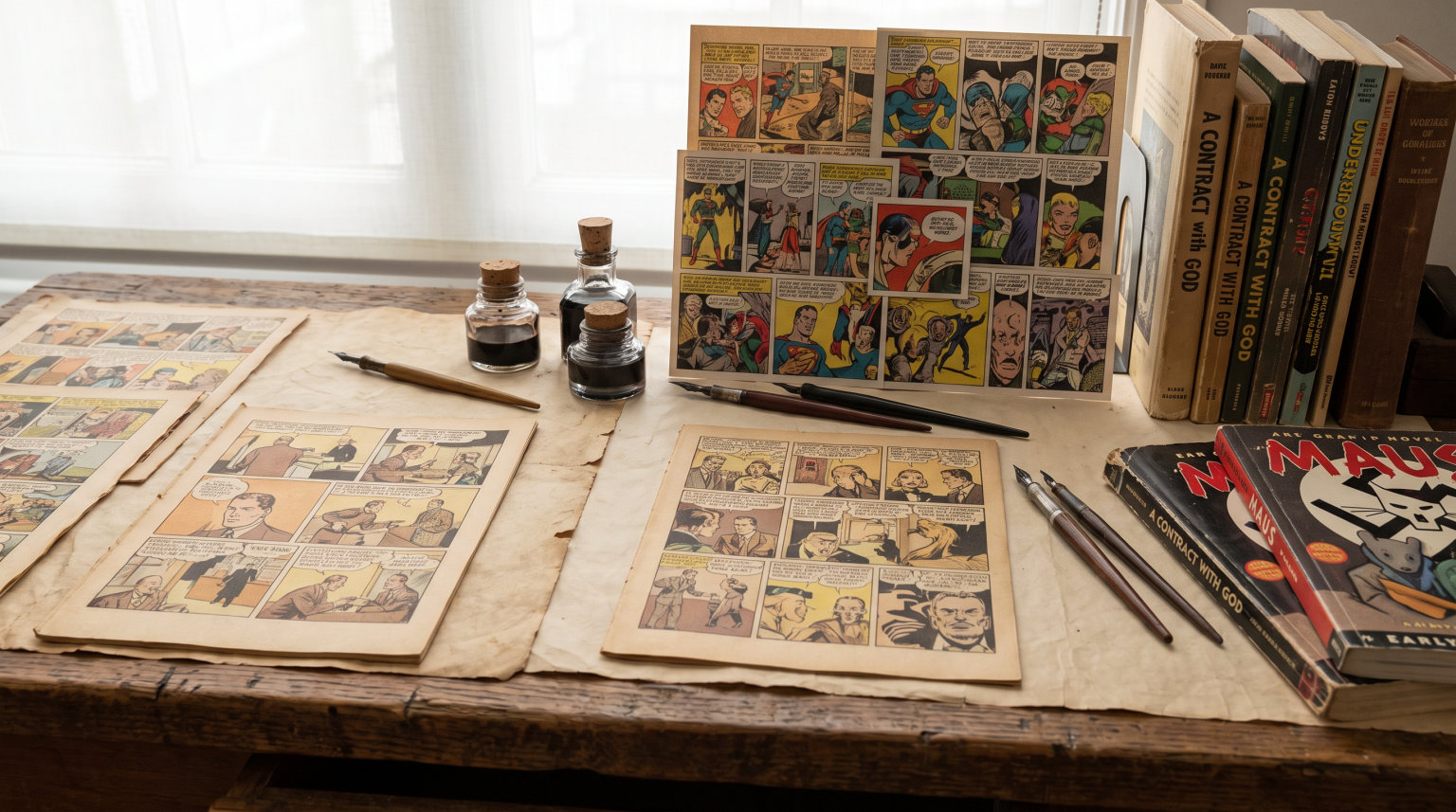
Comics is a medium of sequential visual storytelling that combines images and text to convey narratives, existing in forms ranging from newspaper strips to graphic novels. The history of comics as an art form stretches back thousands of years, evolving from ancient cave paintings to the sophisticated graphic novels we see today. Understanding this journey reveals how a medium once dismissed as lowbrow entertainment became recognized as a legitimate art form worthy of museum exhibitions and academic study.
When we explore the history of comics, we discover a rich tapestry of artistic innovation, cultural shifts, and storytelling evolution. This comprehensive guide walks through the major milestones, key figures, and transformative moments that shaped comics into what they are today. Whether you are an art enthusiast, a comics fan, or simply curious about visual narrative, this history offers fascinating insights into one of the most accessible yet complex art forms.
Table of Contents
Ancient Origins: Before Comics Existed
Long before the term “comics” existed, humans were telling stories through sequential images. The history of comics as an art form truly begins in prehistoric times when our ancestors painted on cave walls. Cave paintings in Lascaux, France, dating back approximately 17,000 years, show animals and hunters arranged in narrative sequences across walls. These early artists understood something fundamental about human perception: we read images in order, following a visual flow that creates meaning through progression.
Ancient civilizations continued this tradition of sequential visual storytelling. Trajan’s Column in Rome, erected around 113 CE, winds 190 meters around itself, depicting the emperor’s military campaigns in a continuous visual narrative. Viewers would walk around the column, reading the story as they moved, much like turning pages in a comic. The Bayeux Tapestry, created around 1070 CE, presents another remarkable example: a 70-meter embroidered cloth that tells the story of the Norman conquest of England through 58 sequential scenes with Latin captions. These works demonstrate that humans have always sought to combine images and narrative in organized sequences.
Medieval manuscripts often featured illuminated panels that arranged biblical stories in visual progressions. The term “bande dessinée,” which French speakers use for comics today, literally translates to “drawn strip,” reflecting the medium’s roots in sequential imagery. Scholars who study the history of comics recognize these ancient works as precursors that established the foundational principles comics would later formalize.
Rodolphe Töpffer and the Birth of the Comic Strip
The history of comics as an art form took a decisive turn in 19th century Europe with Rodolphe Töpffer, a Swiss schoolmaster who is now credited as the father of modern comics. Töpffer created his first comic strip, Voyages en zigzag, in 1832, but his masterpiece came in 1837 with Histoire de Monsieur Cryptogame. Unlike earlier sequential art, Töpffer’s work featured clearly defined panels, distinct characters with consistent appearances, and narrative continuity that readers could follow from frame to frame.
Töpffer understood something crucial about the comic form: the space between panels, which we now call the gutter, is where the reader’s imagination fills in the action. He described his process as creating “pictures in sequence,” a phrase that perfectly captures the essence of sequential art. His characters moved through storylines with visual logic that readers could track naturally, establishing conventions that comics still use today. The gutter became a powerful tool, not a limitation.
French artist Gustave Doré, known primarily for his book illustrations, further developed the relationship between image and text in works like Les Adventures du Baron de Br家门口. His intricate engravings combined with minimal text created visual narratives that influenced generations of comic artists. Meanwhile, in Paris, Charles Philipon and his student Cham developed satirical comic strips for magazines like Le Charivari. Cham’s characters, particularly the working-class figure Bobache, showed how comics could capture contemporary life with humor and social commentary.
These 19th century developments formalized what we now call the language of comics: panels that control pacing, speech balloons that carry dialogue, captions that provide narration, and gutters that let readers’ imaginations complete the action. The history of comics accelerated as this visual vocabulary became standardized across Europe and eventually the world.
The American Comic Book Eras
American comics evolved through distinct eras, each bringing artistic innovations and cultural shifts that expanded the medium’s possibilities. The history of comics in America is typically divided into four main ages: Golden, Silver, Bronze, and Modern. Each period reflects broader social changes while pushing artistic boundaries that transformed how we think about visual storytelling.
The Golden Age (1938-1950)
The Golden Age began with Action Comics #1 in 1938, featuring the debut of Superman. Created by Jerry Siegel and Joe Shuster, Superman represented a new kind of superhero: powerful yet principled, alien yet American. The character’s immediate success prompted a flood of imitators, spawning an entire genre of costumed heroes. Batman, Wonder Woman, Captain Marvel, and hundreds of other characters filled newsstands, each bringing their own visual style and narrative approach.
Artists during this era developed distinct styles that balanced drama with accessibility. Will Eisner’s work on The Spirit showcased innovative panel layouts and cinematic storytelling techniques. Meanwhile, Jack Kirby’s Dynamic Comics and later his work with Stan Lee at Marvel demonstrated how collaboration between writers and artists could create compelling serialized narratives. The Golden Age established the 64-page, full-color comic book format that dominated for decades.
This era also saw the emergence of comic strips as standalone art forms. Characters like Charlie Brown, Dennis the Menace, and Peanuts’ gentle humor demonstrated that comics could appeal beyond children. Artists like Charles Schulz and Hank Ketcham developed visual languages that communicated complex emotions through simple lines, raising the artistic standards of the entire medium.
The Silver Age (1950-1971)
The Silver Age revolutionized American comics with the introduction of more sophisticated storytelling and visual approaches. Marvel Comics, under the editorial leadership of Stan Lee and artists like Jack Kirby and Steve Ditko, transformed superhero comics with flawed, relatable characters who dealt with real-world problems. The Fantastic Four’s family conflicts, Spider-Man’s teenage anxieties, and the X-Men themes of prejudice resonated with readers in new ways.
Artistically, the Silver Age saw a shift toward more dynamic poses and exaggerated perspectives. Comic artists began using action lines, speed trails, and dramatic lighting to create visual excitement. The work of artists like Gil Kane and John Buscema brought classical drawing principles to superhero illustration, combining anatomy studies with theatrical staging. This emphasis on technical skill raised the professional standards of the industry.
Barry Windsor Smith’s Weapon X story and other landmark works demonstrated that comics could handle mature themes while maintaining their visual impact. The Silver Age proved that superhero comics could be both commercially successful and artistically ambitious, paving the way for the medium’s future evolution.
The Bronze Age (1971-1980)
The Bronze Age marked a turning point in the history of comics as social relevance became central to storytelling. Green Lantern #76, published in 1970, tackled drug addiction directly, appearing on newsstands at the request of the U.S. Department of Health, Education, and Welfare. This marked a shift toward addressing real-world issues in mainstream comics.
Artists like Neal Adams brought photo-realistic rendering and cinematic composition to mainstream comics. His work on Green Lantern/Green Arrow addressed racism, pollution, and class division. Meanwhile, independent publishers emerged, offering creators more freedom to explore mature themes and experimental approaches. The underground comix movement, featuring creators like Robert Crumb and Trina Robbins, pushed artistic boundaries with countercultural content and explicit artistic expression.
The Bronze Age also saw the rise of graphic novels that would redefine how people thought about comics. Will Eisner’s A Contract with God (1978) presented interconnected stories about Jewish immigrant life, using comics form to explore literary themes. This work demonstrated that comics could handle serious subject matter with emotional depth, challenging prevailing assumptions about the medium’s limitations.
The Modern Age (1980-Present)
The Modern Age transformed comics into the sophisticated medium we recognize today. Frank Miller’s The Dark Knight Returns (1986) and Alan Moore’s Watchmen (1986) demonstrated that comics could rival novels in complexity and literary merit. These works examined violence, mortality, and the costs of heroism with unprecedented depth, attracting adult readers and critical acclaim.
Art styles in the Modern Age reflect incredible diversity. Artists like Todd McFarlane, Jim Lee, and Rob Liefeld introduced exaggerated anatomy and dynamic poses that emphasized energy and emotion. Other artists pursued hyper-realistic styles, using comics to render complex scenes with painterly detail. This period also saw the rise of digital tools, with artists using computers to color and sometimes draw comics, opening new visual possibilities.
Independent publishers and creator-owned properties flourished. Image Comics, founded in 1992 by Todd McFarlane and other artists, established a model where creators retained ownership of their work. This shift empowered artists to pursue personal visions without corporate constraints, leading to diverse storytelling approaches and experimental formats that continue to push the medium forward.
Global Comics Traditions
The history of comics extends far beyond American and European developments. Understanding comics as a global art form requires exploring manga from Japan, manhwa from Korea, and other international traditions that developed distinct visual languages and storytelling approaches.
Manga’s history stretches back to 12th century Japan with illustrated narrative scrolls called chōjū-giga (Bird and Animal Scrolls). However, modern manga emerged in the late 19th century when artists like Rakuten Kitazawa began adapting Western cartooning techniques. The post-World War II period saw manga explode in popularity, with Osamu Tezuka’s work establishing conventions that still define the medium today. Tezuka’s character designs, panel layouts, and dramatic pacing influenced generations of artists worldwide.
Manga developed distinctive visual conventions that differ significantly from Western comics. Large eyes convey emotion, speed lines indicate movement, and省略 (省略) symbols suggest hesitation or interrupted thought. These techniques create a visual language that readers learn to interpret fluently. Manga also addresses audiences of all ages, with genres ranging from children’s adventure to mature psychological dramas.
Korean manhwa has ancient roots but modern industry developed primarily in the 20th century. Traditional painting styles influenced early sequential art, while Japanese colonial rule (1910-1945) introduced manga influences. Contemporary manhwa gained global recognition through webtoons, a vertical scrolling format optimized for smartphone reading that has revolutionized digital comics worldwide.
European comics, or bande dessinée, occupy a prestigious position in many European countries. French and Belgian comics particularly flourished after World War II, with artists like Hergé (Tintin), René Goscinny and Albert Uderzo (Asterix), and later Moebius creating works celebrated for artistic merit. European comics often feature larger formats, more realistic art styles, and literary ambitions that distinguish them from American genre comics.
The Franco-Belgian tradition influenced American artists like Art Spiegelman and Chris Ware, who combined European artistic sensibilities with American storytelling approaches. This cross-cultural exchange enriched comics globally, demonstrating how different traditions can learn from each other while maintaining distinct identities.
Comics as a Recognized Art Form
The journey of comics from disposable entertainment to respected art form represents one of the most significant cultural shifts in the history of visual arts. For decades, comics occupied a marginal position in cultural hierarchies, dismissed as children’s entertainment unworthy of serious attention. This perception began changing gradually, then dramatically accelerated in the late 20th century.
The turning point came with Art Spiegelman’s Maus, published in 1991-1992. This graphic novel about the Holocaust won the Pulitzer Prize, the first comics work to receive such recognition. Maus demonstrated that comics could tackle humanity’s darkest chapters with emotional power and moral seriousness. The Pulitzer committee’s decision legitimized comics in academic and literary circles, opening doors that had remained closed for generations.
Museum exhibitions further cemented comics’ artistic status. The Museum of Comic Art in New York, the Centre Pompidou’s comics exhibitions, and galleries worldwide began acquiring and displaying original comic art. Events like Angoulême International Comics Festival in France attract hundreds of thousands of visitors annually, celebrating comics as a cultural treasure. Major auction houses now sell original comic art alongside traditional fine art, with pages selling for hundreds of thousands of dollars.
Academic recognition followed institutional acceptance. Comics studies became a legitimate academic discipline, with university courses exploring comics history, theory, and practice. Scholars like Scott McCloud, Will Eisner, and Thierry Groensteen developed theoretical frameworks for understanding comics as a distinct art form with unique formal properties. McCloud’s Understanding Comics (1993) became a foundational text that explained comics grammar and terminology in accessible terms.
Today, comics appear in museum exhibitions, academic journals, and literary discussions alongside painting, sculpture, and traditional illustration. The medium’s ability to combine visual art, narrative, and sequential thinking creates possibilities that no other art form matches. This recognition validates the work of countless artists who pursued excellence in comics despite cultural dismissal.
The Digital Age and Beyond
The history of comics continues to evolve with digital technology reshaping how artists create and audiences consume sequential art. Webcomics emerged in the late 1990s and early 2000s, with artists publishing directly online without traditional publishing gatekeepers. Works like Penny Arcade, Questionable Content, and Homestuck attracted millions of readers and demonstrated that comics could thrive in digital spaces.
Webtoons, developed in South Korea and now available globally through platforms like Webtoon Canvas and Tapas, introduced vertical scrolling format optimized for smartphones. This innovation dramatically changed how comics are read, with readers simply scrolling down rather than turning pages. The format enabled new storytelling approaches and discovered creators who built massive audiences through serialized digital publication.
Digital art tools transformed the creative process itself. Artists like Alex Ross brought painterly digital techniques to mainstream comics, while others explored entirely digital aesthetics impossible in traditional media. Software like Procreate and Clip Studio Paint made professional-grade tools accessible to independent creators, lowering barriers to entry and expanding artistic diversity in the medium.
Artificial intelligence and machine learning present new frontiers that the history of comics has not yet seen. Artists are exploring how AI tools can assist创作 while debates continue about authenticity, copyright, and artistic agency. The medium’s future will likely involve technological innovations we cannot yet imagine, just as earlier generations could not foresee digital coloring or webcomics.
The core of comics, however, remains unchanged: sequential images combined with text to tell stories. Whether rendered in cave paintings, woodblock prints, offset lithography, or pixels, comics fulfill humanity’s fundamental need to communicate through visual narrative. The art form continues to grow, adapt, and inspire new generations of artists who carry forward traditions stretching back millennia.
FAQs
What is the history of comics?
Comics history spans from ancient cave paintings to modern digital comics, with formal comic strips emerging in 19th century Switzerland through Rodolphe Topffer’s work. The medium evolved through newspaper strips, comic books, and graphic novels, gaining artistic recognition over the past few decades.
Who was the first comic book artist?
Rodolphe Topffer, a Swiss schoolmaster, is credited as the father of modern comics for inventing the comic strip format in the 1830s. His work established the foundational conventions of sequential art that comics still use today.
How did comics evolve as an art form?
Comics evolved from newspaper strips to comic books, then graphic novels, gaining artistic legitimacy through works like Art Spiegelman’s Maus winning the Pulitzer Prize and museum exhibitions dedicated to comic art. Artists developed distinct styles across different eras, from the Golden Age superheroes to sophisticated modern graphic novels.
What are the key periods in comic book history?
American comics are typically divided into Golden Age (1938-1950), Silver Age (1950-1971), Bronze Age (1971-1985), and Modern Age (1985-present). Each era brought distinct artistic approaches and cultural themes that expanded what comics could accomplish.
Conclusion
The history of comics as an art form reveals a remarkable journey from ancient cave paintings to sophisticated digital works. This medium transformed from dismissed entertainment to Pulitzer Prize-winning literature, from newspaper strips to museum exhibitions. Artists like Rodolphe Topffer, Will Eisner, Osamu Tezuka, and countless others pushed boundaries that expanded what sequential art could accomplish.
Today, comics occupy a respected position in the artistic landscape, with diverse traditions from around the world contributing to its global richness. The medium continues to evolve through webcomics, webtoons, and experimental digital formats that push storytelling possibilities. Whether you read superhero comics, manga, graphic novels, or online serialized works, you participate in a tradition stretching back millennia.
Understanding the history of comics helps us appreciate how far this art form has come and anticipate where it might go next. From Lascaux to the digital age, humans have always told stories through sequential images. Comics carry forward that ancient impulse while continually reinventing what visual narrative can achieve. The medium’s future shines as bright as its past, promising new innovations and artistic achievements that will continue enriching our cultural world.