
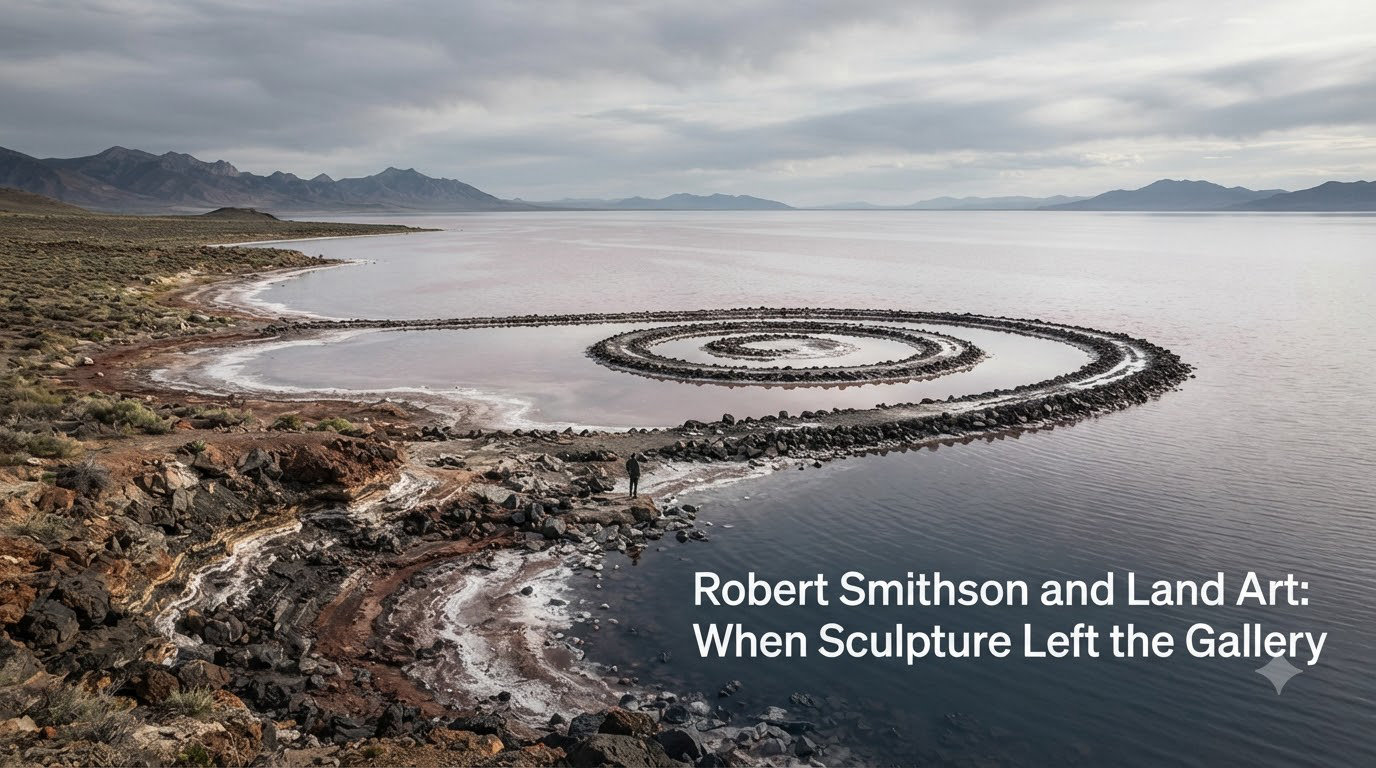
Robert Smithson and Land Art represents one of the most dramatic shifts in art history. In the late 1960s, sculpture broke free from gallery walls and began colonizing the landscape itself. This movement didn’t just change where art happened—it fundamentally questioned what art could be.
I first encountered Smithson’s work through photographs of Spiral Jetty in an undergraduate art history course. The image of that massive black coil stretching into pink-tinged water stopped me cold. How could something so ancient-looking be made in the modern era? That paradox defines everything compelling about land art.
The land art movement emerged when artists grew tired of what Smithson called “cultural confinement.” Traditional sculpture sat on pedestals in climate-controlled rooms. Collectors bought pieces, stored them, and occasionally displayed them. Smithson and his contemporaries asked a radical question: What if the earth itself became the medium, and the landscape became the gallery?
Table of Contents
Who Was Robert Smithson? The Artist Behind the Movement
Robert Smithson was born in 1938 in Passaic, New Jersey. His early life was marked by frequent moves between New Jersey and New York City, giving him a restless relationship with place that would define his later work. As a young artist, he started as a painter, producing work influenced by abstract expressionism and religious iconography.
By the mid-1960s, Smithson had moved away from canvas and into three-dimensional work. He began creating what he called “nonsites”—sculptural installations in galleries that referenced specific outdoor locations through materials like rocks, maps, and photographs. These works existed in a strange middle ground between the gallery and the landscape, foreshadowing his complete departure from indoor spaces.
Smithson married fellow artist Nancy Holt in 1963. Their partnership was both personal and professional, with Holt becoming an important land artist in her own right. Together they explored industrial wastelands, quarries, and abandoned sites across America. These journeys weren’t just research—they were foundational to Smithson’s developing philosophy about entropy, geology, and the relationship between human culture and natural processes.
Virginia Dwan played a crucial role in Smithson’s career. Her gallery in New York became the primary venue for showing earthwork proposals, drawings, and nonsite installations. Dwan had the vision to support artists working outside commercial norms. She understood that land art wasn’t just a style—it was a fundamental challenge to how art was bought, sold, and experienced.
The White Cube Problem: Why Galleries Felt Like Prisons
Smithson famously critiqued what he called the “white cube”—the pristine, neutral gallery space that modern art inhabited. These white-walled rooms were designed to isolate art from context, creating what he saw as an artificial and sterile environment. The white cube demanded that sculpture sit quietly, behaving itself, available for commodification and ownership.
The problem ran deeper than aesthetics. When art exists only in galleries and museums, it becomes subject to market forces. Collectors purchase works, speculators trade them, and institutions compete for prestigious pieces. Smithson saw this system as “cultural confinement”—art trapped in a cycle of buying and selling that had nothing to do with meaning or experience.
Site-specificity offered an escape. If a work of art could only exist in one specific location, it couldn’t be moved, sold, or collected in the traditional sense. The wealthy couldn’t own it. Museums couldn’t acquire it. The art world would have to come to the work rather than the work coming to the art world. This democratization of access—while creating new challenges about preservation and ownership—was central to land art’s revolutionary appeal.
Site and Non-Site: Smithson’s Revolutionary Framework
Smithson developed a theoretical framework that still influences contemporary art today. He distinguished between the “site”—the actual outdoor location where materials came from—and the “non-site”—the indoor gallery space where those materials were arranged and displayed. This dialectic created a conceptual bridge between landscape and institution.
A typical non-site installation might include rocks arranged in a geometric bin, accompanied by maps and photographs of the quarry where those rocks originated. The gallery visitor stood before both the material and its documentation, aware of the distance between the two. The work existed in the tension between here and there, now and then, raw material and cultural framing.
As Smithson’s practice developed, he grew less interested in the non-site and more focused on pure sites—works that existed only in their location, with any gallery documentation serving merely as secondary evidence. This progression led him toward his monumental earthworks, where the site became the entire work, and documentation served only to share the experience with those who couldn’t visit.
Understanding the Site/Non-Site Dialectic
The site/non-site concept can be confusing at first, but it’s essential to understanding Smithson’s contribution to conceptual art. Think of it this way: the site is the origin, the source, the raw reality of a place. The non-site is the displacement, the reference, the museum’s attempt to capture something that can’t truly be captured.
This framework wasn’t just theoretical gamesmanship. It raised serious questions about authenticity, documentation, and value. If you see a photograph of Spiral Jetty, have you experienced the artwork? Smithson would say no—but he also understood that most people would never visit the Great Salt Lake. His films and photographs weren’t substitutes; they were parallel works, non-sites that referred to the site while being distinct from it.
Spiral Jetty: The Masterwork That Defined Land Art
In April 1970, Robert Smithson created the work that would define both his career and the entire land art movement. Spiral Jetty is a 1,500-foot-long coil of basalt rocks, earth, and salt crystals extending from the shore of Rozel Point into the Great Salt Lake in Utah. When the water level is low, it appears as a massive black spiral against pinkish-red water. When levels rise, it disappears beneath the surface.
The location wasn’t arbitrary. Smithson chose Rozel Point specifically for its striking coloration—the water’s reddish hue comes from salt-tolerant bacteria and algae that thrive in the lake’s extreme salinity. The surrounding landscape featured abandoned oil rigs and industrial detritus, creating what Smithson called an “industrial wasteland” aesthetic that fascinated him. This wasn’t pristine nature. It was nature in dialogue with human intervention.
Construction took six days. Smithson hired a local construction company and paid $9,000 to move 6,650 tons of black basalt rock and earth into a perfect spiral form. The work was photographed and filmed by Smithson and his crew, creating a documentary record that has become as famous as the earthwork itself. The film “Spiral Jetty” shows the construction process while weaving in scientific imagery, creating a meditation on time, entropy, and human intervention in landscape.
The Meaning of the Spiral
Why a spiral? The form carries deep resonance across cultures and scientific disciplines. In geology, the spiral echoes crystal formations and the structure of salt deposits. In pre-Columbian American art, spirals appear in petroglyphs and earthworks across the continent. In astronomy, the spiral describes galaxies and the shape of the cosmos itself.
Smithson was drawn to spirals because they embody paradox. A spiral moves outward and inward simultaneously. It suggests both growth and entrapment, expansion and constriction. Standing at the center of Spiral Jetty, you feel this tension—the vast lake extending to the horizon while the spiral’s arms pull you inward toward a single point.
The work also engages with time in multiple registers. Human time is measured in the six days of construction. Geologic time is measured in the basalt’s ancient formation and the lake’s slow evaporation. Cosmic time appears in the spiral’s echo of galaxies. Smithson wanted viewers to feel small against these larger temporal scales—to sense their own impermanence against the vast backdrop of earth history.
Visibility and Change
Is Spiral Jetty still there? Yes, but its visibility changes dramatically based on water levels in the Great Salt Lake. In the years after its construction, drought conditions often left it high and dry, fully visible as a massive black coil. During wet periods, it can be completely submerged, existing only as memory and documentation.
This fluctuation isn’t a flaw—it’s the point. Smithson embraced entropy, the gradual decline into disorder that governs all physical systems. Rather than creating a permanent monument, he made a work that would change, decay, and perhaps eventually disappear. The spiral collects salt crystals, shifts with erosion, and interacts with algae blooms that sometimes turn the surrounding water shocking shades of red. It is never the same work twice.
The Dia Art Foundation now stewards the work, though stewardship of an earthwork presents unique challenges. You can’t conserve a spiral of rocks in a warehouse. You can only monitor it, document it, and accept that it will continue its slow transformation under forces beyond human control. This acceptance of change is perhaps the most radical aspect of Smithson’s legacy.
Beyond the Spiral: Other Major Works by Robert Smithson
Spiral Jetty dominates discussions of Smithson’s work, but his practice was remarkably diverse. He created earthworks, films, photographs, drawings, and writings that together form a complex intellectual project. Understanding his other major works helps clarify the breadth of his vision.
Broken Circle/Spiral Hill (1971) was created in Emmen, Holland, for the Sonsbeek sculpture exhibition. Unlike Spiral Jetty’s remote location, this work sat in a sand quarry near a populated area. It consisted of a massive broken circle of white sand surrounded by a canal, with a spiral hill rising nearby. The work engaged with Dutch land reclamation history while creating its own geological narrative.
Amarillo Ramp (1973) was Smithson’s final earthwork, completed posthumously by his wife Nancy Holt and friends Richard Serra and Tony Shafrazi. Located in a Texas panhandle playa lake, it consists of a 140-foot diameter ramp of red earth and rock extending into a shallow depression. The work recalls both ancient ziggurats and modern highways, collapsing time in typical Smithson fashion.
Partially Buried Woodshed (1970) was created on the campus of Kent State University in Ohio. Smithson simply piled earth onto an existing woodshed until the central beam cracked. The work engaged directly with entropy—documenting the structure’s slow collapse under the weight of the dirt. After the 1970 Kent State shootings, students painted “May 4 Kent 70” on the structure, adding an unintended but powerful layer of historical meaning.
Asphalt Rundown (1969) and Glue Pour (1969) were process works that documented industrial materials interacting with landscape. In Rome, Smithson poured asphalt down a quarry slope, filming its slow, viscous descent. These works explored the encounter between manufactured materials and natural settings, finding aesthetic value in industrial byproducts and waste.
Entropy and Geologic Time: The Philosophy Behind the Earthworks
Smithson’s writings are essential to understanding his artwork. He was as much a theorist as a practitioner, producing essays that connected his earthworks to geology, science fiction, and thermodynamics. His concept of entropy came from physics, where it describes the tendency of closed systems to move toward disorder and equilibrium.
In art historical terms, entropy offered an alternative to traditional notions of the monument. Western culture values permanence—we build statues and memorials meant to last forever. Smithson inverted this value system. He proposed that the most honest artworks would acknowledge their own impermanence, engaging with natural processes of decay and change rather than fighting against them.
Geologic time became his preferred temporal scale. Human history spans thousands of years. Geologic time spans billions. When Smithson placed his works in quarries, salt lakes, and volcanic landscapes, he was setting human creation against vastly older contexts. The spiral of basalt rocks at Rozel Point was made of material formed 200 million years ago during the Jurassic period. The work’s six-day construction was nothing against that timeline.
This perspective had political implications. Smithson wrote critically about the commodification of art and the economics of the gallery system. He saw land art as a way to escape market forces, creating works that couldn’t be bought or sold. While this escape was never complete—someone still had to pay for construction, and documentation could be collected—his critique opened space for later artists to think more radically about value and ownership.
Legacy and Influence: How Smithson Changed Art Forever
Robert Smithson didn’t work in isolation. He was part of a generation of artists exploring earthworks and site-specific installation. Michael Heizer created massive excavations in the Nevada desert. Walter De Maria made lightning fields and mile-long drawings in New Mexico. Nancy Holt built Sun Tunnels in the Utah desert. Together they formed what we now call the land art movement.
These artists shared certain concerns. They were all interested in scale—works so large they could only be comprehended from aerial views. They engaged with industrial aesthetics, finding beauty in quarries, mining operations, and abandoned infrastructure. They used industrial construction techniques, hiring crews with heavy equipment to realize their visions. And they all grappled with the relationship between their remote works and the gallery system that documented them.
Smithson’s influence extends far beyond his immediate contemporaries. Contemporary environmental art owes him a direct debt. Artists like Andy Goldsworthy, who creates ephemeral works from natural materials, work clearly in Smithson’s tradition of entropy and impermanence. The Holt/Smithson Foundation, established to preserve both artists’ legacies, continues to support new work that engages with landscape and time.
The environmental art movement of the 2026s also traces lineage back to Smithson. While some critics argue that land art was paradoxically destructive—bulldozers aren’t exactly eco-friendly—Smithson’s attention to geologic process and environmental change opened conceptual doors for later ecological art. His acceptance of natural cycles influenced artists who now work explicitly with climate change, erosion, and habitat restoration.
Perhaps his most enduring legacy is the permission he gave artists to think at different scales. Before Smithson, sculpture was something you walked around in a gallery. After Smithson, sculpture could be a landscape you hiked through, a lake you boated across, or a spiral you contemplated from a hilltop. The work of art became an experience rather than an object, a process rather than a product.
Frequently Asked Questions About Robert Smithson and Land Art
What is the meaning of earthwork in art?
In art, an earthwork is a large-scale installation created using natural materials like soil, rocks, and vegetation, typically made directly in a landscape rather than in a gallery. Robert Smithson and other land artists used earthworks to challenge traditional ideas about where art should be displayed and how it should function.
Why did Robert Smithson create earthworks?
Robert Smithson created earthworks to escape what he called cultural confinement—the limitations of galleries and museums that turned art into commodities. By building works in remote landscapes, he made art that couldn’t be bought, sold, or moved, forcing viewers to engage with place, time, and natural processes rather than just objects.
What is the meaning of land art?
Land art is an art movement that emerged in the late 1960s where artists use the landscape itself as their canvas, creating earthworks from natural materials in outdoor locations. Land art typically engages with concepts of site-specificity, entropy, geologic time, and the relationship between human culture and natural environments.
Is Spiral Jetty still there?
Yes, Spiral Jetty is still located at Rozel Point on the northeastern shore of the Great Salt Lake in Utah. However, its visibility varies dramatically depending on water levels. During drought periods it is fully visible, while during wet years it may be partially or completely submerged. This changing visibility is intentional—Smithson designed the work to interact with natural cycles of evaporation and precipitation.
Who are the artists like Robert Smithson?
Artists working in similar traditions include Michael Heizer, known for massive excavations like City in Nevada; Walter De Maria, creator of The Lightning Field in New Mexico; Nancy Holt, Smithson’s wife who built Sun Tunnels in Utah; and contemporary artists like Andy Goldsworthy, who creates ephemeral works using natural materials. These artists share interests in landscape, scale, and the relationship between human intervention and natural processes.
Conclusion
Robert Smithson and Land Art continues to challenge how we think about the relationship between culture and nature. His works ask us to consider different temporal scales, to accept impermanence as a value, and to experience art as a physical journey rather than a quick gallery visit. The questions his work raises remain urgent in an era of climate change and environmental crisis.
When sculpture left the gallery, it didn’t just find new venues—it found new meanings. Smithson’s earthworks remind us that art can be as vast as a landscape, as ancient as geology, and as changing as the weather. The white cube couldn’t contain such ambitions, and neither can traditional categories of art history. His legacy lives in every artist who has since taken work outside, engaged with place, and accepted that sometimes the most meaningful creations are those designed to change.
If you ever find yourself in northern Utah, drive the rough roads to Rozel Point. Stand at the edge of Spiral Jetty and watch the salt crystals catch the light. You’ll understand something no photograph can convey: the shock of encountering human intention on a geologic scale, the spiral pulling your eye inward while the horizon pulls your mind outward. That experience—immediate, physical, and unmediated—is exactly what Smithson wanted. It’s why sculpture had to leave the gallery.