
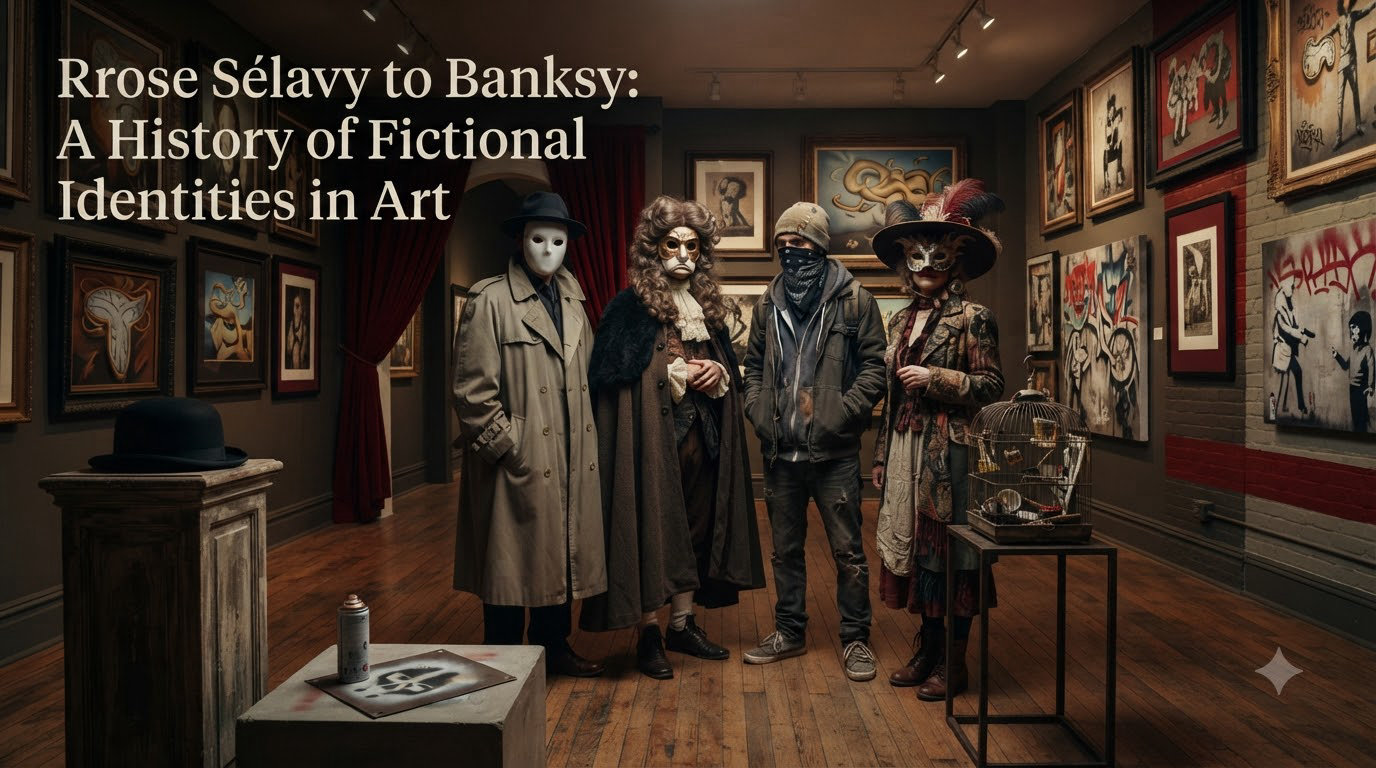
What do you get when you cross a French pronunciation pun with a radical act of artistic rebellion? You get Rrose Sélavy, perhaps the most elegant alter ego ever created in art history. Pronounced “Rose Selay-vee” with that theatrical rolling French R, the name sounds like “Eros, c’est la vie” (Eros, that’s life) or more pointedly, “arroser la vie” (to make a toast to life).
But listen closely and you hear the real punchline: it sounds exactly like “c’est la vie” spoken with a French accent, transforming the philosophical shrug into a celebration of erotic, creative life.
Fictional identities art history stretches back further than most people realize, weaving through the twentieth century like a secret thread connecting movements as disparate as Dada and digital NFT art. From Marcel Duchamp’s gender-bending Rrose Sélavy in the 1920s to Banksy’s anonymous street art empire in the 2026, artists have consistently turned to alter egos as tools for exploration, protection, and critique.
The phenomenon raises a fascinating question. Why would creative individuals who spend their lives seeking recognition deliberately hide behind masks, pseudonyms, and invented personas? The answer reveals something profound about artistic identity itself.
Table of Contents
A Century of Artistic Alter Egos: From Dada to Digital
The story begins in the chaotic aftermath of World War I, when traditional values seemed not just outdated but actively dangerous. The Dada movement emerged in Zurich in 1916, rejecting logic and reason in favor of nonsense, absurdity, and anti-art. It was within this anarchic context that Marcel Duchamp first began playing with identity itself.
By the 1920s, Duchamp had fully embraced Surrealism’s fascination with the unconscious, the irrational, and the transformation of self. Rrose Sélavy was born during this period, photographed by Man Ray in elegant drag, becoming both muse and mouthpiece for Duchamp’s most provocative ideas.
The 1970s brought feminist artists like Claude Cahun and the Guerrilla Girls, who used anonymity and alter egos to challenge the male-dominated art establishment. Performance artists of the 1970s and 1980s, including Joan Jonas with her persona Organic Honey, explored how technology and media could fragment and reconstruct identity.
Then came the 1990s street art explosion. What began as SAMO’s cryptic graffiti tags in 1970s New York evolved into Banksy’s global phenomenon by the late 1990s. The internet age brought new possibilities for anonymity and pseudonymous creation, while simultaneously making true anonymity increasingly difficult to maintain.
Today in 2026, we stand at another inflection point. AI-generated artists, crypto pseudonyms, and the recent speculation around Banksy’s identity have renewed interest in how artists navigate the tension between visibility and mystery.
Marcel Duchamp and Rrose Sélavy: The Original Artistic Alter Ego
Marcel Duchamp did not merely adopt a pseudonym. He created an entire personhood complete with handwriting, legal signatures, and a distinct personality. Rrose Sélavy first appeared in 1921, though Duchamp had been experimenting with gender presentation since 1919 when Francis Picabia painted him with long hair and feminine features.
The photographer Man Ray captured Rrose in a series of iconic images from 1920 to 1921, showing Duchamp in fur collared coats, wearing makeup, and gazing directly at the camera with an enigmatic expression. These were not jokes or Halloween costumes. They were serious investigations into how gender and identity function as constructions rather than biological destiny.
One of the most puzzling works associated with this persona is “Why Not Sneeze Rrose Sélavy?” from 1921. This readymade sculpture consists of a birdcage filled with marble cubes cut to resemble sugar lumps, a mercury thermometer, a cuttlebone, and a tiny porcelain dish. The title itself is absurd. Why sneeze? Why not?
The work embodies everything Rrose represented: wit, wordplay, erotic suggestion, and the transformation of ordinary objects into philosophical provocations through the power of naming and context.
Duchamp signed several works as Rrose Sélavy and even had business correspondence conducted under the name. The persona allowed him to explore ideas that his “male” artistic identity might have struggled to express, particularly around eroticism and the fluidity of self.
The Eros c’est la vie wordplay embedded in the name reveals Duchamp’s preoccupation with sexuality as a creative force. By transforming “c’est la vie” (that’s life) into a celebration of Eros, he suggested that life itself is fundamentally erotic, creative, and transformative.
SAMO: Jean-Michel Basquiat’s Street Art Prophet
Before Jean-Michel Basquiat became the most expensive Black artist in history, he was SAMO. The tag appeared all over Lower Manhattan in the late 1970s, cryptic aphorisms spray-painted on buildings, subway cars, and alley walls. “SAMO as an escape clause,” read one. “SAMO for those of us who merely tolerate civilization,” declared another.
SAMO was not just Basquiat. It was a collaboration between Basquiat and his friend Al Diaz, two teenagers from Brooklyn who met at City-as-School High School. The name itself came from a conversation about pot. “Same old shit,” one of them said, which got shortened to SAMO, then elevated into something resembling a corporate brand or religious movement.
The persona allowed Basquiat to exist in two worlds simultaneously. As SAMO, he was an underground figure, operating outside the gallery system, speaking directly to the street. As Jean-Michel Basquiat, he would eventually enter the white-walled world of SoHo galleries and international art stardom.
The death of SAMO came dramatically. In 1980, Basquiat and Diaz had a falling out. Basquiat began painting “SAMO IS DEAD” around the East Village, effectively killing off his own alter ego. It was a brilliant piece of performance art, declaring the end of one chapter so another could begin. Within months, Basquiat had his first gallery show.
Women Behind the Mask: Claude Cahun, Guerrilla Girls, and Lynn Hershman Leeson
The story of fictional identities art history cannot be complete without acknowledging the female artists who used alter egos to navigate a world that systematically excluded them. While male artists like Duchamp played with gender as philosophical experiment, women often needed masks for survival and access.
Claude Cahun, born Lucy Schwob in 1894, created one of the earliest and most profound artistic alter egos. Working primarily in photography, Cahun created hundreds of self-portraits in which she transformed herself into dozens of different characters: sailor, dandy, doll, Buddha, vampire, weightlifter. These were not simple costume changes. They were radical investigations into how identity itself is performed rather than innate.
Cahun’s work preceded Duchamp’s Rrose Sélavy by decades and offered a more sustained exploration of gender fluidity. She and her partner Marcel Moore (also an alias, born Suzanne Malherbe) created surrealist photomontages and collages that challenged every assumption about gender, sexuality, and selfhood.
Their work was largely forgotten until rediscovery in the 1990s, proving how alter egos can both protect artists during their lifetimes and obscure their legacies afterward.
The Guerrilla Girls emerged in 1985 as a collective rather than an individual, wearing gorilla masks in public to hide their identities while exposing sexism and racism in the art world. Their pseudonyms were names of dead female artists: Frida Kahlo, Käthe Kollwitz, Lee Krasner. By becoming collective anonymous figures, they could say things individual women artists feared to say.
“Do women have to be naked to get into the Met. Museum?” asked one of their most famous posters, pointing out that less than 5% of the artists in the modern art sections were women, while 85% of the nudes were female.
Lynn Hershman Leeson took the alter ego into the digital realm beginning in the 1970s with her creation of Roberta Breitmore. This was not merely a pseudonym but a fully documented person who had her own handwriting, psychiatrist, and driver’s license. Roberta existed from 1974 to 1978, a fictional character whose daily life was documented as performance art, anticipating our contemporary world of online avatars and constructed digital selves by decades.
Banksy and the Art of Anonymity in the Digital Age
No contemporary artist embodies the power of anonymity more completely than Banksy. Active since the 1990s, the British street artist has maintained his pseudonymous identity despite becoming one of the most famous and valuable artists alive. His works sell for millions at auction, yet no verified photograph of his face exists in the public domain.
In March 2026, speculation about Banksy’s identity reached another fever pitch when new evidence emerged supporting the long-standing theory that he is Robin Gunningham, a former student at Bristol Cathedral School. A 1998 photograph showing a man resembling Gunningham working on an early Banksy piece gained renewed attention, with forensic analysis suggesting strong facial feature matches.
But here’s what makes Banksy’s anonymity so powerful: it doesn’t actually matter if he is Robin Gunningham or someone else entirely. The speculation itself has become part of the artwork, a participatory element that engages millions in the mystery. By remaining unidentified, Banksy prevents his biography from overshadowing his message.
We cannot dismiss his political critiques by attacking his character, income, or background because we do not know them.
Banksy’s artistic lineage traces directly to Blek le Rat, the French stencil artist who pioneered the rat motif that Banksy later adopted. Blek le Rat (real name Xavier Prou) has stated publicly that he considers Banksy a copycat, yet acknowledges that Banksy’s anonymity has allowed him to achieve something Blek never could: the ability to place illegal art in public spaces without legal consequences. The mask provides protection.
In an era of total surveillance, social media documentation, and facial recognition technology, maintaining anonymity has become increasingly difficult. Banksy’s persistence suggests that the desire for mystery remains powerful even as technology works to eliminate it.
Why Do Artists Create Alter Egos? Four Core Motivations
Looking across the landscape of fictional identities art history, four primary motivations emerge for why artists create alter egos. Each explains a different dimension of this persistent phenomenon.
Protection from Consequences
Street artists face legal consequences for their work. Banksy’s anonymity keeps him out of jail while allowing him to create unsanctioned public art. The Guerrilla Girls’ gorilla masks protect them from professional retaliation when they criticize powerful museums and galleries. Anonymity provides a shield that enables risk-taking.
Freedom to Explore Identity
Duchamp’s Rrose Sélavy and Claude Cahun’s various personas allowed exploration of gender fluidity and sexual identity in eras when such explorations were dangerous or taboo. The alter ego becomes a laboratory for selfhood, a safe space to try on different identities without committing to them permanently.
Critique of Institutions
Duchamp used Rrose Sélavy to challenge the concept of artistic authorship itself. If a man can sign work with a woman’s name, what does signature mean? The Guerrilla Girls use anonymity to critique the very systems that value individual genius above collective action. The mask reveals the machinery behind the curtain.
Separation of Art from Personality
Perhaps the most philosophical motivation involves separating the artwork from the artist’s personal biography. Walter Benjamin theorized that authenticity in art comes from its presence in time and space, not from who made it. Alter egos push this further by suggesting that the creator’s identity is irrelevant to the work’s meaning. The art stands alone.
Alter Egos in the Digital Era: NFTs, AI Artists, and Virtual Personas
The internet promised anonymity but delivered surveillance. Social media platforms encourage real-name policies while tracking every interaction. Yet within this environment, new forms of artistic alter egos have emerged.
Crypto art and NFTs have revived the tradition of the pseudonymous artist. Digital creators like Pak and XCOPY sell work for millions while maintaining complete anonymity. The blockchain enables verification of authorship without requiring revelation of identity, a technological solution to the problem Duchamp explored a century ago.
AI-generated art has introduced entirely new categories of fictional artists. When an AI creates work in the style of a fictional persona, who is the artist? Projects like Lynn Hershman Leeson’s AI agents suggest that alter egos may eventually become autonomous, living their own digital lives independent of their creators.
The tension between visibility and anonymity has never been more acute. Artists today must navigate platforms that demand personal branding while seeking the creative freedom that masks provide. Those who successfully maintain mystery, like Banksy or the crypto artists, demonstrate that the hunger for alter egos remains undiminished even in an age of total exposure.
Frequently Asked Questions
What does Rrose Sélavy mean?
Rrose Sélavy is a phonetic pun on the French phrase ‘Eros, c’est la vie’ (Eros, that’s life) and sounds like ‘arroser la vie’ (to make a toast to life). Most directly, it sounds like ‘c’est la vie’ (that’s life) spoken with a rolling French R, transforming a philosophical shrug into a celebration of erotic, creative existence. Marcel Duchamp pronounced it like ‘Rose Selay-vee’ with that theatrical French R sound.
Who is Rrose Sélavy?
Rrose Sélavy was the female alter ego created by artist Marcel Duchamp in the 1920s. She appeared in photographs by Man Ray, signed artworks, and served as Duchamp’s mouthpiece for exploring gender fluidity, eroticism, and challenging traditional notions of artistic authorship. Rrose was both a performance and a philosophical statement about the constructed nature of identity.
Did Banksy reveal his identity in 2026?
In March 2026, new attention focused on the theory that Banksy is Robin Gunningham, a former Bristol student. A 1998 photograph showing a man resembling Gunningham working on an early Banksy piece gained renewed attention with forensic analysis suggesting facial feature matches. However, Banksy has neither confirmed nor denied this theory, and his anonymity remains officially intact.
What is an alter ego in art?
An alter ego in art is an alternate identity or persona created by an artist to separate their creative work from their personal identity. Artists use alter egos to explore different aspects of gender and identity, protect themselves from legal or professional consequences, critique art world institutions, and challenge traditional notions of authorship and authenticity.
What does SAMO mean in street art?
SAMO originated as an abbreviation of ‘Same Old’ shit, a phrase teenagers Jean-Michel Basquiat and Al Diaz used while discussing marijuana. They elevated it into a tag that appeared across Lower Manhattan in the late 1970s with cryptic philosophical messages like ‘SAMO as an escape clause’ and ‘SAMO for those of us who merely tolerate civilization.’ Basquiat officially killed the persona in 1980 by painting ‘SAMO IS DEAD’ around the East Village.
The Enduring Power of the Mask
From Duchamp’s elegant Rrose Sélavy to Banksy’s anonymous provocations, fictional identities art history reveals a persistent truth. Artists create alter egos not to hide, but to reveal. The mask allows them to say things that unmasked faces cannot, to explore territories that fixed identities forbid, and to challenge systems that demand we remain consistently, boringly ourselves.
In 2026, as surveillance technology erodes privacy and social media demands constant self-disclosure, the artistic alter ego feels more necessary than ever. The anonymous artists, the masked collectives, and the pseudonymous creators remind us that mystery has value. That not everything needs to be known.
That sometimes the most honest thing an artist can do is wear a disguise.
Rrose Sélavy was right. Eros, c’est la vie. Life is erotic, creative, transformative, and fluid. And the artists who understand this best are those who refuse to be just one person. They become many. They become everyone. They become anyone. And in that becoming, they set us all free.