
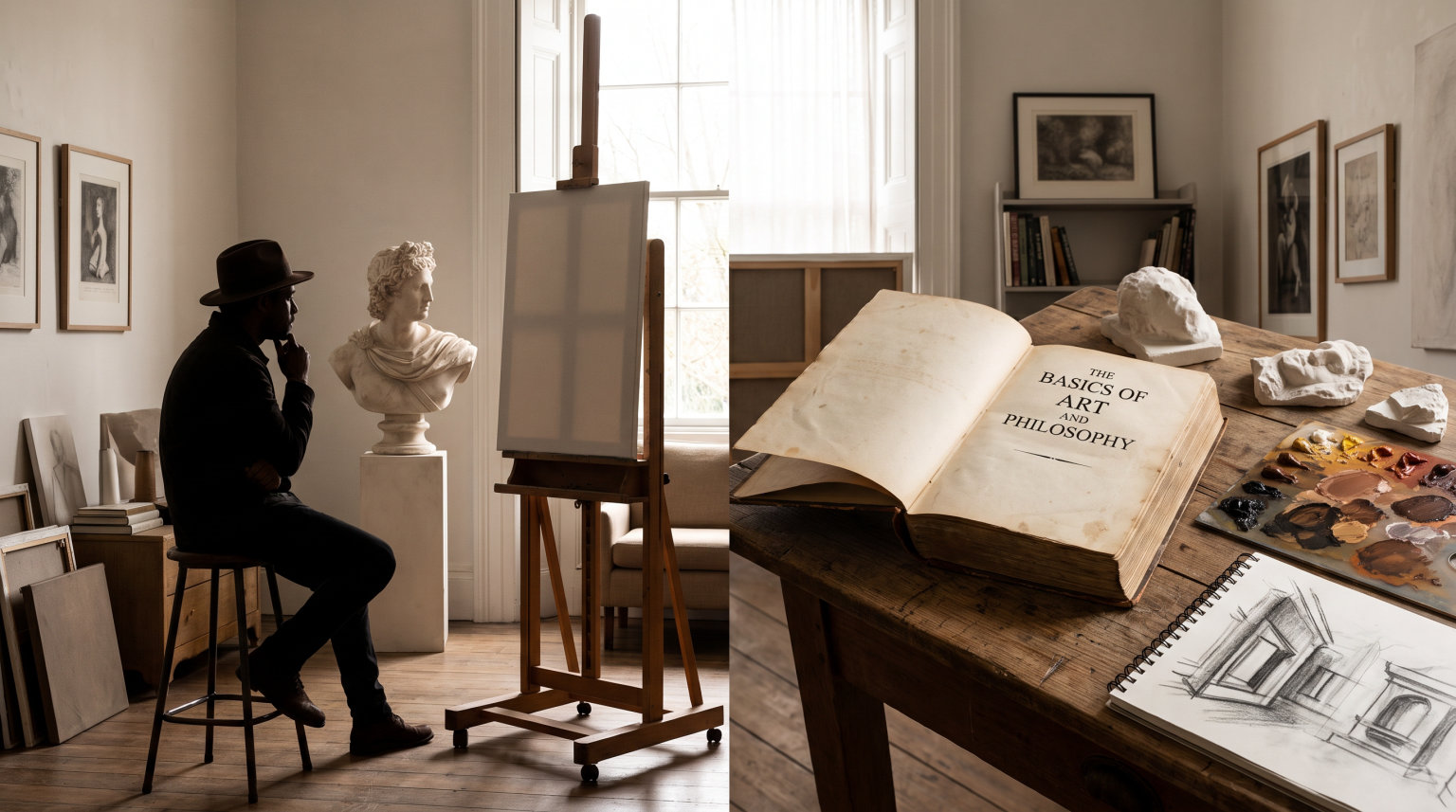
When I first encountered philosophy of art, I expected dry academic texts filled with impenetrable jargon. Instead, I discovered a field that asks some of the most compelling questions we can pose about human experience. What makes something art? Why do we find deep meaning in a painted canvas or a marble sculpture? How can a piece of music evoke tears or transcendence? These questions sit at the very heart of the basics of art and philosophy.
This guide walks you through the foundational concepts of philosophy of art, from major theoretical frameworks to practical ways of thinking about artistic creation and appreciation. Whether you are an artist seeking deeper understanding of your craft, an art enthusiast wanting to experience works on a richer level, or a student beginning your exploration of aesthetics, you will find clear, accessible explanations here without the typical academic gatekeeping that makes this field seem intimidating.
Table of Contents
What is Philosophy of Art?
Philosophy of art, sometimes called aesthetics, is the branch of philosophy that examines the fundamental nature of art itself. It systematically asks questions that most people encounter intuitively when standing before a compelling artwork: What is art really? How does art create meaning? Why do we value certain aesthetic experiences over others? What distinguishes great art from mere decoration?
The Stanford Encyclopedia of Philosophy describes this field as concerned with the nature of art, including concepts such as interpretation, representation, expression, and form. This scholarly definition captures the technical scope while still pointing toward the underlying human urgency that makes philosophy of art endlessly fascinating.
This discipline differs significantly from art criticism, which typically evaluates specific artworks, artists, or artistic movements. Art criticism tells you whether a particular painting succeeds or fails, whether an exhibition is worth visiting. Philosophy of art takes a broader view, seeking to understand what all art shares in common, what makes something art rather than not-art, and why aesthetic experience matters to human beings across cultures and throughout history.
The discipline draws heavily from aesthetics, the broader philosophical study of beauty and taste, but focuses specifically on how these concepts apply to artistic creation and appreciation. Some philosophers distinguish between “fine art” intended purely for aesthetic contemplation and “useful art” or craft that serves practical purposes alongside aesthetic qualities. When you understand the basics of art and philosophy, you gain a versatile framework for analyzing any artwork with greater depth and critical insight.
Key Theories of Art
Throughout intellectual history, philosophers have proposed different theoretical frameworks to explain what art fundamentally is and how it creates value. Understanding these major approaches gives you multiple analytical lenses for examining artistic creation, each with distinct strengths and limitations.
Representation: Art as Imitation
One of the oldest and most influential theories traces back to Plato, who argued that artistic creation essentially imitates the physical world, which itself imitates ideal Platonic forms. According to this view, a landscape painting represents something real rather than being merely pigment applied to canvas. The painting points beyond itself toward the actual landscape that the artist observed and translated into visual form.
Aristotle expanded on this mimetic (imitation-based) tradition in ways that proved enormously influential for subsequent Western art theory. He saw imitation as a natural human tendency that serves important educational and emotional purposes. Drama, he argued in his Poetics, allows audiences to experience and process emotions safely by observing fictional characters navigate challenging situations on stage. Through identification with dramatic figures, viewers gain insight into their own emotional lives.
While representation theory has significant limitations and has been challenged by later philosophers, it remains influential, particularly in understanding realistic artistic traditions. When you appreciate a photorealistic painting or a sculpture that captures human anatomy with stunning accuracy, you are engaging with art shaped by representational assumptions about what artistic excellence means.
Expression Theory
Expression theory fundamentally shifts philosophical attention from what art represents to what it communicates emotionally. This view, associated with thinkers like Leo Tolstoy and R.G. Collingwood, suggests that art is essentially about transmitting feelings from artist directly to audience through the artwork as vehicle.
According to expression theory, when Beethoven composed his late string quartets, he was not merely arranging sounds according to musical rules but communicating specific emotional states that sensitive listeners could experience directly. The artwork becomes a conduit for genuine emotional connection between creator and receiver, transcending the limitations of ordinary verbal language.
This theoretical framework particularly resonates with romantic and abstract expressionist traditions, where the inner emotional life of the artist takes clear precedence over technical realism or faithful representation of external appearance. When collectors pay premium prices for emotionally intense work by artists like Franz Kline or Willem de Kooning, they are implicitly accepting expression theory assumptions about artistic value.
Form and Formalism
Formalism emphasizes the formal elements of art: line, color, composition, texture, and other qualities that exist within the artwork itself rather than referring to anything beyond the work. Clive Bell and Roger Fry developed this theoretically sophisticated approach in early twentieth-century Britain, arguing that viewers should experience paintings primarily as visual arrangement before considering subject matter or emotional content.
Bell coined the term “significant form” to describe the combination of lines, colors, and shapes that somehow evokes a unique aesthetic emotion distinguishing genuine art from mere everyday objects. This formal configuration generates an artistic response independent of intellectual knowledge about the work or its creator.
This approach proved enormously influential in modernist art movements, where artists increasingly explored pure visual experience without narrative content or representation. Abstract painters from Piet Mondrian to Kazimir Malevich to Josef Albers embraced formalism as theoretical justification for art that prioritized visual relationships over depicting recognizable subjects.
Three Philosophical Positions
Beyond specific theories, philosophy of art has developed three broad philosophical positions that frame how we understand artistic value and meaning. These frameworks represent fundamentally different starting assumptions about what art is and how it achieves significance.
Formalism
Formalism claims that artistic value resides entirely in formal properties. An artwork’s worth derives from how effectively it achieves visual harmony, balance, rhythm, and composition rather than from external references, representational accuracy, or emotional expression. According to this position, form is the universal language of art, transcending cultural differences and historical periods.
This philosophical stance explains why major museums and galleries display pure abstractions alongside representational works. If formalism is correct, the most significant artworks share structural and formal similarities regardless of their apparent subject matter or historical context. The visual relationships themselves carry artistic meaning.
Critics of formalism note that this approach struggles to account for art with powerful emotional or political content that clearly matters to viewers. It also seems to exclude much of what cultures worldwide have traditionally valued as art, from religious iconography to commemorative portraiture to functional crafts designed for everyday use rather than pure contemplation.
Realism
Realism in philosophy of art holds that artworks derive their primary value from accurate representation of visible or experiential reality. This position, sometimes called mimesis, judges art by how effectively it captures the world as we actually perceive and experience it rather than inventing imagined alternatives or expressing internal emotional states.
Realist art need not be photographically exact. Artists like Gustave Courbet in the nineteenth century and Lucian Freud in the twentieth developed distinctive approaches to representation while maintaining clear commitment to visible truth. The key element is genuine engagement with empirical reality rather than pure invention or emotional expression.
This philosophical position dominated Western art education for centuries through academic traditions emphasizing draftsmanship, anatomical accuracy, and proper perspective. Though it has faced significant challenge from abstraction, expressionism, and various conceptual practices that question realism’s underlying assumptions, realist approaches continue to influence contemporary art education and popular appreciation.
Idealism
Idealism suggests that art’s highest purpose involves revealing truth, beauty, or spiritual reality that transcends ordinary empirical perception. This position, associated with Hegel and other idealist philosophers, sees authentic art as a vehicle for accessing higher realities that cannot be grasped through purely rational or scientific means.
For idealists, the physical artwork is less critically important than the spiritual or conceptual content it conveys and makes accessible to viewers. Michelangelo’s Sistine Chapel ceiling matters profoundly because it embodies divine ideals and makes spiritual truth visible, not merely because of its extraordinary formal achievement in depicting human anatomy and compositional mastery.
This philosophical framework proves particularly useful for understanding religious and spiritual art across diverse cultures, from Byzantine icons to Buddhist temple paintings to Renaissance altarpieces. In each case, artistic excellence serves transcendent purposes that give the works their ultimate significance and explain why they were created and valued.
Aesthetics and the Role of Beauty
Aesthetics, the philosophical study of beauty, taste, and sensory experience, sits at the very heart of art philosophy. When we appreciate a sunset, a symphony, or a sculpture, aesthetics provides conceptual tools for explaining what makes that experience valuable and why we seek it out despite its practical uselessness.
Traditional aesthetics emphasized beauty as the primary criterion for evaluating artistic excellence. Proportional forms, harmonious color relationships, pleasing arrangements, and graceful compositions characterized the great artworks across cultures. This classical tradition continues to influence how art is taught, displayed, and evaluated in many contexts today.
Modern aesthetics has considerably expanded beyond simple beauty to include concepts like the sublime, which describes experiences of awe, terror, and transcendence that exceed ordinary pleasurable response. Gothic architecture, romantic landscapes, and certain contemporary installations evoke sublime responses that challenge simple beauty-focused evaluative frameworks.
The relationship between aesthetics and art philosophy remains active intellectual terrain with ongoing debate. Philosophers continue discussing whether beauty is essential to art, whether aesthetic value is objective or entirely subjective, and how pleasure relates to artistic merit. These questions resist final resolution, which is partly what makes philosophy of art endlessly fascinating.
The Fundamentals of Art
Beyond theoretical and philosophical considerations, the basics of art and philosophy include understanding the practical building blocks that artists actually employ when creating. These fundamentals inform how philosophers analyze artistic achievement and how we can develop more sophisticated appreciation for artistic skill.
Color involves hue, saturation, and value relationships that artists manipulate to create visual effects and emotional responses. Understanding color theory helps both working artists and viewers appreciate how chromatic choices affect the overall impact of a work and guide emotional interpretation.
Composition refers to how visual elements are arranged within a work to create coherent, impactful images. Strong composition effectively guides viewer attention through deliberate visual pathways and creates the sense of visual momentum that makes images feel dynamic rather than static.
Value describes the range from light to dark in a work, often proving more important than color in creating immediately readable, impactful images. Value contrast establishes focal points and determines whether forms feel dimensional or flat.
Form encompasses three-dimensional shape and volume considerations. Artists working in sculpture and architecture must carefully consider how physical forms occupy space and relate to viewer movement and body positioning.
Anatomy knowledge proves essential for figurative artists seeking to represent the human body convincingly. Understanding how bodies move, expressing emotion through physical structure, and capturing distinctive proportions all require dedicated study of anatomical principles.
Perspective creates the illusion of three-dimensional space on flat surfaces through systematic projection. Renaissance developments in linear perspective fundamentally transformed how Western art represents spatial reality and continues teaching foundational spatial reasoning skills.
Brushwork or more broadly application technique adds visible texture and energy to works. Expressive brushwork became especially significant in impressionism and subsequent movements that valued visible artistic gesture as part of the artistic content itself.
How Philosophy and Art Connect
Philosophy and art share a fundamental concern with meaning-making that transcends simple entertainment or decoration. Both practices grapple seriously with questions about human existence, value, and understanding that resist simple answers or quick resolution.
Artists frequently work implicitly from philosophical assumptions they may never articulate consciously or systematically. The sculptor working in bronze implicitly assumes something about permanence, physical presence, and form that distinguishes sculptural practice from ephemeral performance. The conceptual artist exploring ephemerality and impermanence challenges assumptions about art objecthood that others take for granted. Understanding philosophy of art helps artists become more conscious of their own working frameworks and theoretical commitments.
For viewers and appreciators, philosophical understanding genuinely enriches artistic appreciation and opens new dimensions of experience. Knowing why a Dadaist readymade challenges our assumptions about artistic skill and creativity changes how we approach and interpret such works. Recognizing that conceptual art prioritizes ideas over visual form appropriately recalibrates viewer expectations and interpretive approaches.
The connection between art and philosophy extends well beyond analytical engagement. Many significant philosophers drew substantial inspiration from artistic practice and created works that changed philosophical understanding. Nietzsche found in Greek tragedy an experience of human contradiction and resolution that purely theoretical philosophical writing could not adequately convey. Heidegger wrote about van Gogh’s paintings of peasant shoes in ways that opened genuinely new dimensions of human existence and our relationship to the material world.
Understanding Art: Interpretation and Meaning
When we encounter art seriously, we inevitably seek meaning that goes beyond immediate visual or auditory sensation. This interpretive process involves multiple interacting factors that philosophy of art helps us understand more clearly and navigate more effectively.
The artist’s original intentions certainly matter for interpretation, but often prove impossible to access fully or with certainty. Surviving letters, documented statements, and contemporary accounts provide interpretive clues, but artworks inevitably take on lives that extend well beyond their creators’ conscious wishes and intended meanings. Viewers bring their own experiences, cultural frameworks, and personal concerns to every interpretive encounter, inevitably shaping what they perceive and understand.
Interpretation also happens within contexts that powerfully shape meaning. The same painting reads quite differently when experienced in a gallery devoted entirely to its work, in a church where it originally functioned devotionally, or in a corporate boardroom where it serves merely as decoration. Cultural context matters enormously for sophisticated interpretation. Japanese ukiyo-e prints meant something quite specific to Edo-period audiences that required deep cultural knowledge to access fully.
One useful interpretive framework distinguishes among the formal qualities of a work, its subject matter, and its content. Formal qualities involve what we directly perceive in the work itself. Subject matter involves what the work depicts or represents. Content involves the deeper meanings, values, and significance it embodies. Sophisticated interpretation moves thoughtfully among these distinct levels rather than collapsing them together or ignoring their differences.
For those interested in exploring how artistic meaning emerges through creative practice and how artists communicate their intentions, our guide on how to write an artist statement offers practical perspective on articulating artistic intent without reducing artistic practice to simple verbal explanation.
Contemporary Perspectives
Philosophy of art continues actively evolving as entirely new art forms emerge and cultural contexts shift across our increasingly interconnected world. Contemporary philosophical discussions engage seriously with digital art, immersive installation work, performance documentation, and hybrid practices that challenge traditional categorical boundaries.
Institutional theory, developed in the 1960s and 1970s, provocatively argued that art status derives fundamentally from acceptance within art world institutions rather than from any inherent properties of the objects themselves. This theoretical position explains effectively why theoretically anything can become art through curatorial and critical endorsement, but struggles to account for why certain works achieve lasting significance while countless institutional endorsements prove ephemeral.
Globalization has increased philosophical pressure to develop genuinely non-Western frameworks for understanding artistic creation and appreciation. Traditional Western categorical distinctions like “fine art” versus “craft” or “applied art” do not translate easily across all cultural contexts. Japanese, African, Indigenous Australian, and numerous other artistic traditions offer genuinely alternative philosophical approaches that promise to substantially enrich the field going forward.
Digital technology continues generating genuinely new philosophical questions that current theoretical frameworks struggle to resolve adequately. Can works genuinely created by AI systems constitute art? What happens to traditional concepts of authenticity when digital files can be copied and distributed infinitely without quality loss? How should we preserve, exhibit, and frame ephemeral digital works that exist only as data structures? These questions remain genuinely open as digital culture continues developing in unpredictable directions.
Conclusion
The basics of art and philosophy provide essential frameworks for understanding why art matters and how it creates meaning in human experience. From ancient theories of artistic representation to contemporary institutional analysis, philosophy of art offers intellectual tools for deeper appreciation and more thoughtful critical engagement with artistic practice.
Whether you approach art as creator, enthusiastic viewer, or curious student, these philosophical concepts genuinely enrich engagement with artistic practice. Importantly, you do not need to accept any single theoretical framework completely or permanently. The actual history of philosophy of art reveals an ongoing dialogue among competing perspectives rather than any final settled consensus or definitive answers.
Most importantly, philosophy of art genuinely invites continuous questioning rather than premature closure. The most powerful artworks provoke thought and systematically resist simple categorical assignment or purely verbal explanation. Philosophy of art provides both language and conceptual frameworks for engaging productively with that creative uncertainty rather than rushing toward false clarity or accepting inadequate premature conclusions.
FAQs
What is the definition of art philosophy?
Philosophy of art is the study of the nature of art, including concepts such as interpretation, representation, expression, and form. It asks fundamental questions about what art is, how it creates meaning, and why we value aesthetic experiences.
What are the 7 fundamentals of art?
The seven fundamentals of art are: Color (hue, saturation, value relationships), Composition (arrangement of elements), Value (range from light to dark), Form (three-dimensional shape and volume), Anatomy (understanding of body structure), Perspective (illusion of three-dimensional space), and Brushwork (application technique and texture).
What are the basic concepts of philosophy of art?
The basic concepts include: representation (art as imitation), expression (art as emotional communication), form (formal qualities), aesthetics (beauty and taste), interpretation (meaning-making), and the three philosophical positions of formalism, realism, and idealism.
How do philosophy and art relate to each other?
Philosophy and art both grapple with questions of meaning, value, and human experience. Artists often work from implicit philosophical assumptions, while philosophical understanding enriches how viewers appreciate art. Both practices seek to understand existence and communicate understanding in their respective languages.
What is the difference between aesthetics and philosophy of art?
Aesthetics is the broader philosophical study of beauty, taste, and sensory experience, applicable to nature and everyday objects. Philosophy of art focuses specifically on artistic creation and appreciation, examining what makes something art, how art creates meaning, and what constitutes artistic value.