
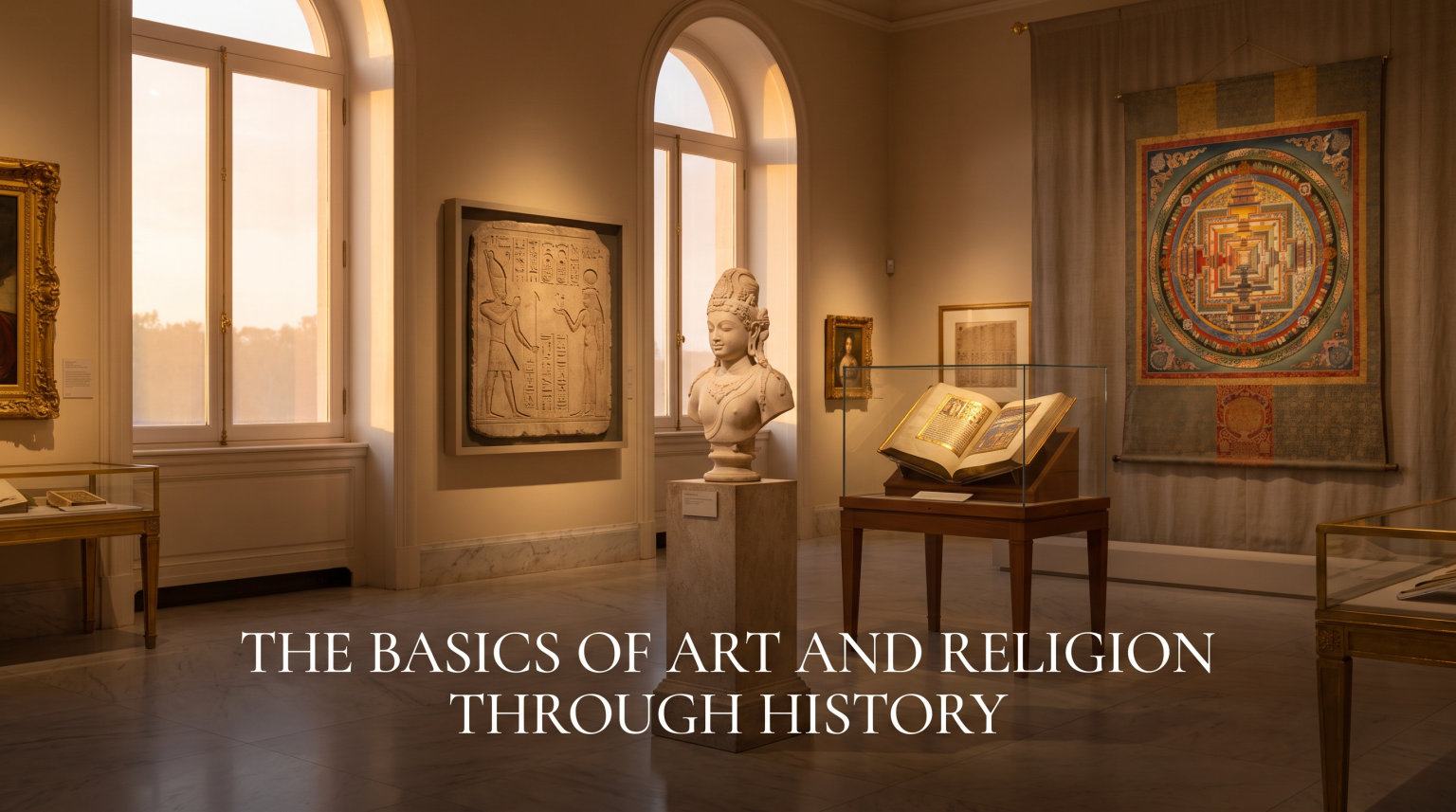
When I first started studying art history, something struck me immediately: for much of human civilization, separating art from religion would have seemed like an impossible task. The two have been woven together for thousands of years, with sacred spaces serving as galleries and divine narratives inspiring some of the most breathtaking objects ever created.
This guide covers the basics of art and religion through history, examining how different cultures have used visual expression to explore faith, communicate spiritual ideas, and create spaces of worship. Whether you are a student, an art enthusiast, or simply curious about this ancient relationship, you will find a comprehensive overview here.
Table of Contents
Ancient Religious Art: Where Faith First Took Visual Form
Long before museums existed, art served as the visual counterpart to religious stories. Ancient civilizations understood that images could communicate divine concepts in ways that words alone often could not.
Egyptian Art and the Afterlife
Ancient Egyptian art stands as one of the most recognizable religious art traditions in human history. The Egyptians believed deeply in the afterlife, and this belief shaped virtually every artistic creation they made.
Tomb paintings depicted scenes of daily life, offerings to gods, and journey through the underworld. These were not mere decorations but functional items intended to serve the deceased in their eternal existence. The famous Book of the Dead, a collection of spells and prayers, was illustrated with detailed vignettes showing the deceased before divine judges.
Hieroglyphics themselves functioned as sacred art, combining visual symbols with language to record religious texts. The pyramids, particularly those at Giza, served as massive architectural prayers, their alignment with celestial bodies reflecting Egyptian astronomical and religious knowledge.
Mesopotamian Temples and Divine Statues
In Mesopotamia, the relationship between art and religion manifested through monumental architecture and votive sculptures. Ziggurats, the distinctive stepped temples rising from the flat landscape, housed the images of city gods and served as earthly homes for divine beings.
Mesopotamian artists created votive statues representing devotees in poses of prayer and submission before the gods. These small sculptures, placed in temples, were believed to perpetually intercede on behalf of their owners. Narrative relief sculptures, such as those depicting the lion hunt of Ashurnasirpal II, combined historical commemoration with religious symbolism.
The Code of Hammurabi, inscribed on a towering stone stele, illustrates how legal and religious authority were intertwined in ancient Mesopotamia. Art served not just devotion but also the legitimization of social and divine order.
Greek and Roman Religious Imagery
Greek and Roman religious art built upon earlier traditions while developing distinctive approaches to depicting the divine. The Greeks created idealized human forms representing their gods, establishing a visual language that would influence Western art for millennia.
Greek temples, such as the Parthenon dedicated to Athena, featured sculptural programs depicting mythological narratives. The metopes, friezes, and pediments told stories of divine battles, heroic feats, and the relationship between mortals and gods. These works combined religious devotion with civic pride, as each city-state claimed particular deities as patrons.
Roman religious art borrowed heavily from Greek models while adding their own innovations. Roman imperial art connected political power with divine favor, depicting emperors as gods or as chosen by divine forces. This fusion of religious imagery and political propaganda would become a template used throughout European history.
Classical Antiquity: Gods, Emperors, and Divine Orders
Classical antiquity established the visual vocabulary that later Western religions would adopt and transform. Understanding this period helps us trace how religious imagery evolved from purely polytheistic contexts into the monotheistic traditions that followed.
Greek Temple Design and Sculptural Programs
Greek temple architecture embodied the Greek understanding of divine order and cosmic balance. The Greeks believed that gods lived among humans in their temples, and these sacred spaces required beauty worthy of divine habitation.
The sculptural decoration of Greek temples served multiple functions simultaneously. Religious narratives educated the illiterate public about mythology. Visual symbolism reinforced social values and civic identity. Beautiful objects honored the gods and encouraged their favor toward the community.
Gold leaf, painted surfaces, and carefully carved details combined to create overwhelming sensory experiences. Visitors entering a major temple would encounter ivory and gold statues of gods, colorful painted metopes, and intricately carved friezes depicting divine and heroic stories.
Roman Religious Art and Imperial Propaganda
Roman civilization expanded upon Greek religious art traditions while developing new purposes and audiences. The Romans understood art as a tool for social cohesion and political legitimacy, using religious imagery to support imperial authority.
Emperor worship represents one of the most significant developments in Roman religious art. After Augustus, Roman emperors were often depicted with divine attributes, and in some provinces, they received actual religious veneration. This fusion of political and religious authority created visual propaganda that reinforced imperial power.
Roman art also developed new religious forms, including private religious paintings in homes, elaborate tomb decorations, and public religious monuments. The frescoes preserved at Pompeii reveal domestic religious practices, showing how Roman households maintained sacred spaces with paintings of household gods, mythological scenes, and protective deities.
Medieval Christian Art: Devotion Through Darkness
The medieval period in Europe, roughly from the 5th to the 15th century, saw Christianity become the dominant force shaping art production. With the Church as the primary patron of artists, religious imagery proliferated in unprecedented quantity and variety.
Byzantine Icons and the Power of the Image
Byzantine art, centered in Constantinople (modern Istanbul), developed a distinctive approach to religious imagery that emphasized the divine rather than the human. Byzantine icons, painted images of Christ, Mary, and saints, were believed to possess spiritual power and served as channels for divine intercession.
The iconostasis, a screen decorated with icons separating the nave from the altar, became a defining feature of Orthodox church architecture. Through these images, worshippers engaged with the sacred directly, touching icons, lighting candles before them, and praying to the figures depicted.
Byzantine mosaics, using tiny tiles of glass and stone set in gold backgrounds, created shimmering environments suggesting heavenly realms. The Hagia Sophia, with its massive dome and golden mosaics, demonstrated how Byzantine architecture and art combined to create spaces feeling more like heaven than earth.
Romanesque and Gothic Cathedral Art
The great cathedrals of medieval Europe represented the culmination of Romanesque and Gothic artistic achievements. These buildings served as visual textbooks, their sculptures and windows teaching biblical stories to populations largely unable to read.
Romanesque cathedrals featured sturdy stone construction with rounded arches and heavy sculptural programs. Portals depicted Christ in majesty surrounded by the four evangelists, with Last Judgment scenes warning viewers of the consequences of sin. The severe, stylized figures communicated divine authority and otherworldly power.
Gothic cathedrals, with their pointed arches, flying buttresses, and emphasis on verticality, created spaces designed to lift the spirit toward heaven. Stained glass windows transformed light itself into religious imagery, with narratives from scripture depicted in glowing colors. The sculptural programs expanded, with entire facades devoted to biblical narratives, saints, and allegorical figures.
Altarpieces, paintings or sculptures placed behind church altars, provided focal points for liturgical worship. These works depicted crucified Christ, Virgin and Child, saints, and scenes from the lives of local patron saints. Pilgrims traveling to famous shrines often sought out specific altarpieces believed to possess miraculous powers.
Illuminated Manuscripts: Books as Sacred Objects
Medieval book illumination represents one of the most extraordinary artistic achievements of the period. Monks and nuns, working in monastery scriptoriums, created manuscripts where every page was treated as a potential work of sacred art.
Illuminated manuscripts included religious texts such as Bibles, psalters, gospel books, and devotional texts. The term illumination refers specifically to the gold and silver leaf used to create luminous effects, though these books also featured intricate borders, decorated initials, and miniature paintings.
The resources devoted to creating these manuscripts reflect the medieval understanding that beautiful objects honored God. A single manuscript might require years of labor from scribes and artists working in specialized roles. The resulting books were often encased in precious metal covers and guarded as treasures.
The Renaissance and Reformation: Humanism Meets Divinity
The Renaissance, beginning in Italy in the 14th century and spreading throughout Europe over the following centuries, transformed religious art while remaining fundamentally committed to Christian themes. The Reformation that followed would challenge assumptions about religious imagery that had prevailed for a millennium.
Perspective, Humanism, and Sacred Art
Renaissance artists developed revolutionary techniques that changed religious art forever. Linear perspective, allowing realistic representation of three-dimensional space on flat surfaces, emerged in Florence around 1420. This technical breakthrough enabled artists to create convincing environments for sacred narratives.
Humanism, a philosophical movement emphasizing human dignity and potential, influenced how artists approached religious subjects. Rather than the stylized, otherworldly figures of medieval art, Renaissance painters depicted religious scenes with human emotions, realistic body types, and identifiable settings.
Masaccio’s frescoes in the Brancacci Chapel demonstrate this transformation. His depiction of Adam and Eve expelled from Eden shows genuine psychological anguish, with expressions of shame and despair rendered with unprecedented realism. The religious narrative became emotionally accessible in ways medieval iconography had not achieved.
Masters Like Michelangelo and Leonardo
The High Renaissance produced religious artworks that remain among the most famous in the world. Michelangelo’s Sistine Chapel ceiling, painted between 1508 and 1512, depicts scenes from Genesis including the iconic Creation of Adam, where divine and human fingers nearly touch.
Michelangelo approached these religious subjects with the same mastery he applied to secular sculpture, creating figures of idealized beauty that embodied Renaissance ideals of human potential. Despite depicting biblical narratives, his work reflects the era’s confidence in human artistic achievement.
Leonardo da Vinci’s The Last Supper, painted in the refectory of a Milan convent between 1495 and 1498, demonstrates how Renaissance artists used composition and psychological insight to transform religious stories. Each apostle reacts differently to Christ’s announcement that one will betray him, creating a dynamic narrative frozen in a moment of revelation.
Whether Leonardo believed in Jesus as the divine Son of God remains a matter of historical debate. His religious beliefs appear to have been complex, influenced by humanist philosophy and scientific inquiry. What is certain is that he created religious artworks of profound spiritual power, regardless of his personal theological positions.
Reformation Art: Breaking the Image-Worship Tradition
The Protestant Reformation, beginning in 1517 with Martin Luther’s challenge to Church practices, fundamentally altered the relationship between art and religion in Northern Europe. Protestant reformers questioned the veneration of images and the vast resources the Catholic Church devoted to religious art.
Iconoclasm, the destruction of religious images, spread through parts of Europe during the Reformation period. In some regions, mobs attacked churches, smashing statues, whitewashing frescoes, and destroying paintings. The argument was that religious images promoted superstition and idolatry, violations of the biblical prohibition against carved images.
Protestant regions saw religious art production decline dramatically. The new Protestant aesthetic emphasized word over image, with churches featuring preaching rather than elaborate decorations. Religious art did not disappear entirely, but its character changed, with Dutch painters developing new forms of domestic religious imagery for private homes.
The Catholic Church responded to the Reformation with its own Counter-Reformation, reaffirming the value of religious imagery while encouraging clearer communication of doctrine. This led to the Baroque style, which used dramatic lighting, emotional intensity, and theatrical compositions to create art overwhelming the senses and inspiring devotion.
Non-Western Religious Art Traditions
While this guide has focused primarily on Western art, it is essential to recognize that the relationship between art and religion developed independently across the globe. Each tradition developed distinctive visual languages for expressing spiritual ideas.
Islamic Art: Geometry, Pattern, and Sacred Space
Islamic art developed sophisticated approaches to religious imagery that avoided figural representation while creating stunning visual environments. The prohibition against depicting the divine in Islamic tradition led artists toward geometric patterns, calligraphy, and architectural ornamentation.
Geometric patterns in Islamic art are not merely decorative but carry mathematical sophistication and spiritual symbolism. These patterns, derived from various symmetries, represent the infinite nature of God and the ordered structure of the universe. The repetition of patterns creates visual experiences suggesting endlessness and divine perfection.
Calligraphy, the art of beautiful writing, holds special importance in Islamic religious art because the Quran’s words were considered divine revelation. Mosques feature elaborate inscriptions quoting Quranic verses, executed in scripts ranging from monumental to intimate. These inscriptions transform sacred text into visual art.
Mosque architecture creates spaces designed for both practical worship and spiritual reflection. The great mosques of Isfahan, Cordoba, and Istanbul demonstrate how Islamic architects combined geometric patterns, calligraphy, and light to create environments supporting religious devotion.
Buddhist Art: From India to the World
Buddhist art spans thousands of years and extends across Asia and beyond, developing diverse visual traditions while maintaining consistent core symbols. From ancient Indian sculpture to Japanese Zen gardens, Buddhist art expresses teachings about suffering, enlightenment, and liberation.
Early Buddhist art in India used symbols rather than depicting the Buddha directly. The lotus throne, Bodhi tree, and footprint symbols represented key events in the Buddha’s life without showing his human form. This aniconic period eventually gave way to fully human representations that became standard throughout Buddhist Asia.
Throughout its geographical spread, Buddhist art adapted to local cultures while maintaining recognizable symbols. Tibetan thangka paintings, Japanese Buddhist sculptures, and Southeast Asian temple complexes all reflect distinct regional interpretations of Buddhist teachings.
Mandalas, intricate circular diagrams representing the cosmos and the path to enlightenment, appear across Buddhist traditions. These works function as meditation aids, with practitioners focusing on detailed imagery to progress toward spiritual understanding.
Hindu Temple Art: Devotion in Stone
Hindu art, developing primarily in India, created one of the world’s most extensive religious artistic traditions. Hindu temples serve as earthly homes for deities, with elaborate sculptural programs depicting divine narratives and cosmic principles.
Hindu temples feature extensive sculpture depicting the gods and goddesses of the Hindu pantheon. Shiva, Vishnu, Brahma, Lakshmi, and countless other deities appear in various forms and postures. Each representation follows iconographic conventions established in ancient texts, allowing devotees to recognize divine figures.
The Khajuraho temples, built between 950 and 1050 CE, demonstrate how Hindu art combined religious devotion with extraordinary artistic skill. While famous for their sensuous sculptures, these works primarily depict various aspects of human experience understood as connected to divine reality.
Narrative reliefs tell stories from the great Hindu epics, the Ramayana and Mahabharata. These visual narratives served educational purposes, communicating complex religious stories to communities where literacy was limited.
Modern and Contemporary Religious Art
The relationship between art and religion continued evolving in modern times. Secularization transformed how religious art is created, displayed, and understood, while contemporary artists continue exploring spiritual themes.
Secularization and the 70/30 Rule
The 70/30 rule in art, discussed among art historians and critics, refers to an observed pattern where religious themes came to comprise roughly 30 percent of significant art production by the 20th century, down from near 100 percent in medieval times. This shift reflects the broader secularization of Western societies.
As religious institutions lost their role as primary art patrons, museums assumed that function. The shift meant artworks were appreciated for aesthetic rather than devotional qualities. The Sistine Chapel ceiling, created to inspire religious awe, now draws visitors primarily interested in artistic achievement.
This transition had complex effects on religious art. On one hand, artists gained freedom to explore religious themes without ecclesiastical constraints. On the other hand, religious art lost its functional context, becoming something primarily to be viewed rather than prayed before.
Contemporary Artists Reclaiming Sacred Themes
Contemporary artists continue creating work engaging with religious and spiritual themes, though often in ways that critique, question, or reframe traditional approaches. The relationship between art and spirituality remains vital, even as its institutional forms have changed.
Some contemporary artists create work explicitly religious in intent, while others explore spirituality through more ambiguous frameworks. Issues of identity, belonging, and meaning-making appear throughout contemporary religious art, reflecting the diverse spiritual landscape of modern societies.
The boundaries between religious and secular art have become increasingly fluid in contemporary practice. Artists draw on religious imagery, architectural forms, and ritual objects, recontextualizing them within contemporary frameworks that may be critical, celebratory, or ambivalent about the religious traditions they reference.
Conclusion
The basics of art and religion through history reveal an inseparable relationship that has shaped human civilization. From Egyptian tombs to Renaissance masterpieces, from Islamic geometric patterns to Hindu temple sculptures, visual expression has served as a primary vehicle for exploring and communicating spiritual ideas.
Understanding this history helps us appreciate both the artworks themselves and the cultures that produced them. The conventions of religious iconography, developed over centuries, continue influencing contemporary visual culture in ways we often fail to recognize.
Today, as artists explore new relationships between visual culture and spirituality, the conversation begun thousands of years ago continues. The art and religion through history connection reminds us that human beings have always sought to express the ineffable through visible forms, transforming belief into beauty and devotion into creation.
FAQs
How has art been used in religion throughout history?
Art has served religion in numerous ways across cultures: as visual teaching tools for illiterate populations, as objects of veneration in devotional practices, as architectural expressions of sacred spaces, and as means of recording and celebrating religious narratives. From Egyptian tomb paintings to Renaissance altarpieces, religious institutions have commissioned and shaped artistic production to express faith, educate believers, and create environments conducive to worship.
What is the connection between art and religion?
Art and religion share an fundamental connection through their attempts to express meaning, transcend ordinary experience, and communicate with forces beyond the material world. Religion provides the content and context for much of human art production, while art provides religion with visual languages for expressing spiritual concepts. This relationship has been particularly strong in cultures where religious institutions served as primary patrons of artists.
What is the 70/30 rule in art?
The 70/30 rule in art refers to an observed historical pattern where religious themes declined from approximately 100 percent of significant art production during medieval periods to roughly 30 percent by the 20th century. This shift reflects broader secularization in Western societies, where religious institutions no longer serve as primary art patrons and artworks are more often displayed in museums than in churches or temples.
Did Leonardo da Vinci believe in Jesus?
Historical evidence suggests Leonardo da Vinci held complex religious beliefs that evolved throughout his life. While he was raised Catholic and received religious commissioning work, his notebooks reveal skepticism about certain Church doctrines and interest in scientific inquiry over doctrinal authority. He created profound religious artworks including The Last Supper and The Virgin of the Rocks, though whether these reflected personal faith or simply artistic commissions remains debated among historians.