
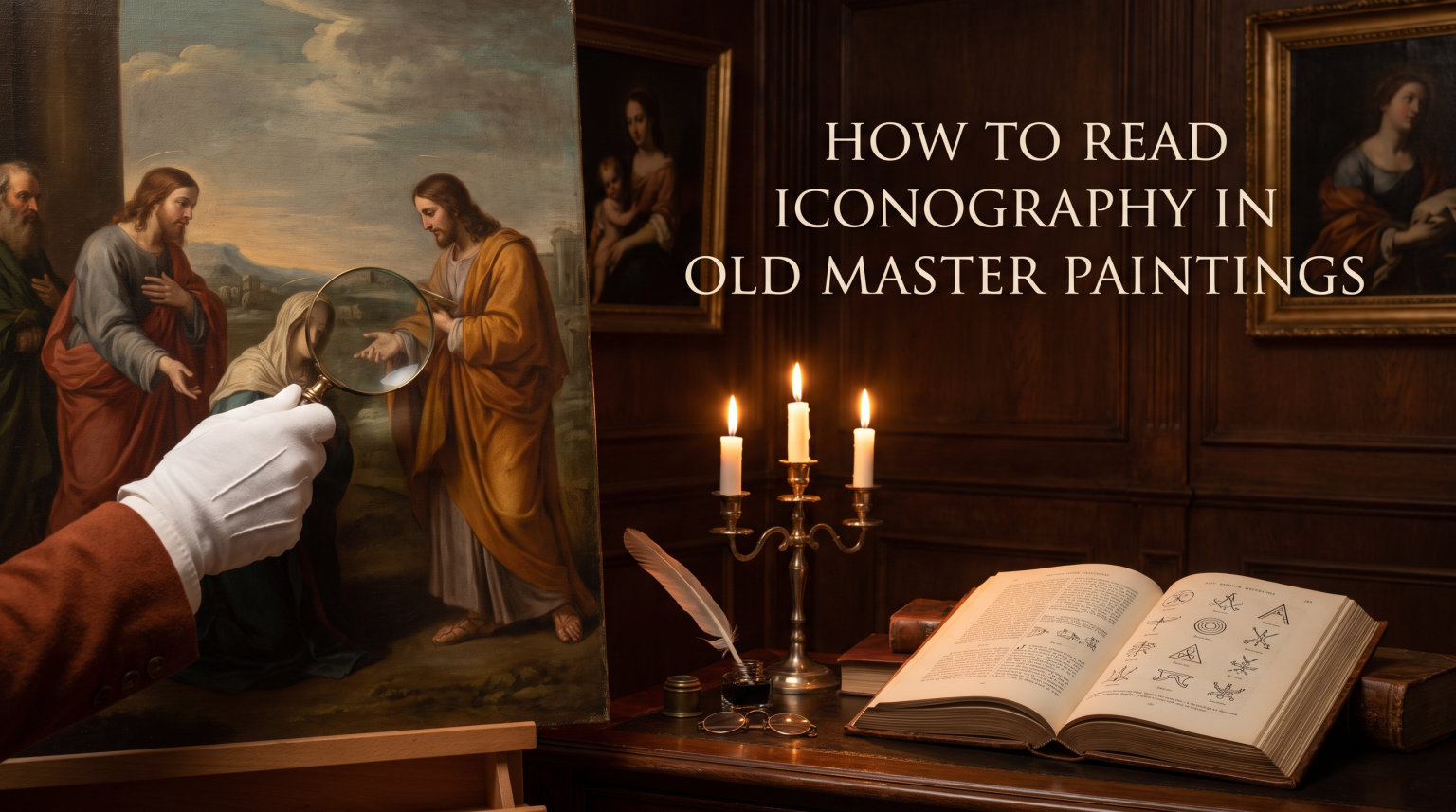
Standing before a 500-year-old painting in a museum, I used to feel exactly what Reddit users describe: complete bewilderment. I would stare at figures arranged in unfamiliar compositions, catching fragments of what might be a story, but never quite grasping the full picture. That changed when I learned to read iconography. Once you understand how old masters encoded meaning into their work, those same bewildering paintings suddenly reveal rich layers of narrative, religious devotion, and classical reference.
This guide will teach you how to decode symbolic imagery in old master paintings. You will learn what iconography means, why artists used visual symbols, and most importantly, a practical step-by-step method you can apply to any painting that leaves you puzzled. By the end, you will have the confidence to approach classical art with new eyes and discover hidden meanings in masterpieces you have admired for years.
Table of Contents
What Is Iconography and Why Should You Care?
Iconography refers to the identification and analysis of specific symbols, themes, and visual elements present in an artwork. The word comes from Greek roots: ikon (image) and graphia (writing or description). When art historians talk about iconography, they mean the systematic study of how artists used recurring visual elements to convey particular meanings that their original audiences would have understood immediately.
You might encounter the related term iconology and wonder about the difference between them. Iconography focuses on identifying individual symbols and their conventional meanings. Iconology goes deeper, examining how those symbols interact within cultural and historical contexts to reveal broader themes and messages. Think of iconography as the vocabulary and iconology as the grammar that gives those symbols meaning in context. Understanding both gives you a complete picture of how art communicates.
The Panofsky method, developed by art historian Erwin Panofsky in the early twentieth century, provides a three-level framework for analyzing art that remains influential today. First, you observe what you literally see in the painting, describing figures, objects, and scenes without interpretation. Then you identify the symbols and themes that connect to known artistic traditions. Finally, you interpret the deeper meaning within its cultural context, considering who commissioned the work and what messages it was meant to convey. This method gives you a structured approach rather than random guessing when confronted with unfamiliar imagery.
The Historical Context of Symbolic Imagery
Old masters did not invent symbolism arbitrarily. They drew from a rich tradition that stretched back to ancient Greece and Rome, continued through Byzantine art, and evolved throughout the Renaissance before reaching full maturity in the Baroque period. Understanding this lineage helps explain why certain symbols persist across centuries and cultures in European painting, and why you might recognize visual elements from Egyptian funerary art appearing in Renaissance religious paintings.
Religious patronage drove much of the development of iconography. Churches and wealthy donors commissioned paintings to communicate faith to audiences who often could not read written texts. A painting of Saint Peter holding keys instantly signaled his role as the gatekeeper of heaven. A lamb resting on a book might reference Christ as the “Lamb of God” sacrifice. This visual shorthand made complex theological concepts accessible to the faithful and allowed churches to teach doctrine through imagery that transcended language barriers.
The classical tradition added another layer of complexity and beauty. Renaissance artists revived themes from Ovid’s Metamorphoses and Virgil’s Aeneid, creating visual poetry that educated viewers in Greek and Roman mythology while simultaneously referencing Christian themes. When you see a woman with a mirror and a comb, she may represent Venus, the Roman goddess of love, whose mythological stories warned against the dangers of vanity and inappropriate desire. These classical references demonstrated the artist’s learning and appealed to humanist sensibilities among wealthy patrons who prided themselves on their education in the classics.
Medieval workshops maintained strict iconographic traditions, with apprentices learning specific formulas for depicting saints, martyrs, and biblical scenes. These conventions ensured that a figure painted with a specific appearance would be instantly recognizable across different artworks, much like how we recognize corporate logos today. This standardization means that once you learn what a halo signifies or why a figure holds a specific object, you can apply that knowledge broadly across centuries of European art.
Common Symbols and Their Meanings
Religious iconography forms the largest body of conventional symbols in old master paintings. Learning these gives you immediate access to countless biblical scenes that dominate medieval and Renaissance art, allowing you to follow narratives that were once visible literacy for populations who encountered these images weekly in church settings.
Christian and Biblical Symbols
Certain animals carry specific Christian meanings that appear repeatedly across centuries of European art. A lamb represents gentleness and references Christ as the “Lamb of God” who would take away the sins of the world. Lions often symbolize courage or the resurrection, drawing on the medieval legend that lion cubs were born dead and revived by their father’s roar. Owls traditionally represent wisdom and sometimes melancholy, appearing in paintings of scholars and contemplatives.
Objects frequently appear as visual shorthand for specific meanings or figures. Crowns suggest royalty, martyrdom, or the celestial crown promised to the faithful. Keys, especially crossed, indicate Saint Peter and his authority as the rock upon which Christ built his church. A skull at the base of a cross points to Christ’s crucifixion and meditations on mortality that dominated medieval spirituality. Books may represent scripture, learning, or the writings of specific saints whose teachings shaped orthodoxy.
Gestures carry meaning too, and learning to read them opens a new dimension of painting interpretation. Open arms suggest welcome or surrender. Pointing fingers direct attention toward heaven or highlight specific figures in composition. Hands pressed in prayer indicate piety and direct communication with the divine. Crossed hands on the chest often signal devotion or a vow taken seriously by the figure depicted.
Plants and flowers carry symbolic weight in traditional iconography. Lilies represent purity and the Annunciation, when the angel Gabriel told Mary she would bear God’s son. Roses symbolize divine love, mystery, or the Virgin Mary herself. Thistles and burrs suggest Christ’s suffering and the thorny crown he wore. When you notice specific plants in a painting, consider what they might symbolize beyond their natural beauty.
Mythological and Allegorical Symbols
Classical mythology provided artists with an entire vocabulary of symbols that Renaissance patrons expected educated viewers to recognize. Jupiter’s eagle represents divine authority, borrowed from the Roman king of gods who transformed into this bird to pursue mortal lovers. A serpent eating its tail (ouroboros) suggests eternity or the cyclical nature of time, a symbol that predates Christianity but was absorbed into its visual language. Peacocks display pride and the promise of resurrection through their supposedly incorruptible flesh, which medieval Christians believed never decayed.
Allegorical figures personify abstract concepts that had no literal form before photography and film. A woman holding a sphere often represents Geometry or the Cosmos, demonstrating the Renaissance fascination with mathematical order underlying creation. A figure with scales weighs justice or the elements, appearing in paintings about law, balance, and cosmic order. Time is typically an old man with a hourglass or clock, sometimes accompanied by Father Time’s scythe that harvests all mortal endeavors.
Classical gods have consistent attributes that allow you to identify them across different paintings. Jupiter (Zeus) carries a thunderbolt and eagle. Neptune (Poseidon) holds a trident and appears near water. Mercury wears winged sandals and a winged hat, carrying his caduceus staff. Venus has a mirror and often appears with doves, swans, or myrtle plants. Learning these attributes lets you navigate mythological narratives that surface constantly in Renaissance and Baroque art.
Color Symbolism
Colors carried symbolic weight in traditional iconography that artists deployed consciously to reinforce meaning. Blue suggests divinity, heavenly love, or sometimes melancholy, making it a common choice for the cloaks of Virgin Mary figures. Red indicates passion, martyrdom, or the divine fire of the Holy Spirit, frequently appearing in images of saints who suffered for their faith. White represents purity, innocence, or resurrection, visible in angel wings and Easter imagery celebrating Christ’s victory over death.
Green signifies hope, nature, or sometimes jealousy, appearing in gardens and settings associated with spring and romantic love. Gold suggests the divine light that surrounds celestial beings in Byzantine and Gothic art. Black inverts these positive associations, typically representing death, mourning, or the darkness of evil in dramatic compositions where heroes and villains contrast visually.
Skin tones revealed character and health in conventional ways that modern viewers sometimes find uncomfortable. Pale skin suggested aristocratic refinement or illness, depending on context. Rosy cheeks indicated vitality and good health. Darker skin tones sometimes indicated figures from warmer climates or, in some contexts, negative character associations that sophisticated Renaissance audiences would have recognized. Artists used these conventions consistently within their own cultural contexts, even when representing ideal beauty that their patrons expected.
A Step-by-Step Method for Reading Iconography
Here is a practical framework our team developed after analyzing how experienced art historians approach unfamiliar paintings during museum visits and research. We call it the 3 C’s method: Collect, Connect, Conclude. This systematic approach transforms subjective reactions into structured analysis that you can replicate and refine over time.
Step 1: Collect Observations
Begin by looking at the painting purely for what you can see, without interpretation or jumping to conclusions. Note the figures present, their positions and gestures, the objects they hold, the setting and background, the colors and lighting, and the overall composition. Write down everything that catches your attention, even if you do not understand its significance or see how it connects to anything else.
This step matters because it grounds your analysis in observable facts rather than jumping to conclusions based on first impressions. I learned this the hard way by assuming I knew what a painting depicted before actually examining it carefully during a visit to the National Gallery in London. The symbols that seemed obvious at first glance often proved misleading upon closer inspection, and rushing to interpretation made me miss details that changed everything.
Pay attention to scale and proportion as you collect observations. Figures larger than their surroundings indicate importance in the painting’s hierarchy. Positioning in the center or higher in the composition suggests prominence. What touches the picture edge and what exists in the center creates visual tension that artists exploited deliberately for emotional effect.
Step 2: Connect to Traditions
Once you have catalogued your observations, start connecting them to conventional meanings that you can research or look up. Consult reference materials, museum placards, or smartphone apps that identify symbols. Ask yourself which figures or scenes this painting most resembles. Consider the historical period and geographical origin of the work, as iconographic traditions varied significantly between Italian, Flemish, German, and Spanish painting traditions.
At this stage, you might recognize the scene as a biblical narrative from the Old or New Testament, a classical myth from Greek or Roman sources, or an allegorical composition representing abstract qualities like virtue, vice, or the elements. The connections you draw should account for most of your initial observations. If something remains unexplained after careful research, that might indicate a more complex meaning or a specific local tradition that requires additional investigation.
Consider how the painting relates to other works from the same period, workshop, or patron. Artists working for the same client often developed visual vocabularies that repeated across different commissions, allowing you to recognize patterns once you have seen several examples from the same hand or workshop.
Step 3: Conclude with Context
The final step brings together your observations and traditional interpretations within their historical context. Ask who commissioned this painting and why. Consider what was happening in the artist’s time that might influence the work’s meaning. Think about what messages would resonate with the original audience who first saw this artwork in its intended location.
Consider why the artist made specific choices about composition, color, and arrangement. These choices often reveal the purpose of the work, whether devotional, commemorative, political, or purely aesthetic. Your conclusion should synthesize visual evidence with historical knowledge to produce a coherent interpretation that accounts for all significant elements you observed.
Common Mistakes to Avoid
Beginners often over-interpret, seeing symbols everywhere and finding hidden meanings that were never intended by the artist. Not every object carries hidden meaning. A chair might simply be a chair. A window might simply provide light. Start conservatively by identifying only the most conventional symbols before expanding your analysis to more obscure or context-specific meanings.
Another common error involves ignoring context. A skull in a seventeenth-century Dutch vanitas painting carries different meaning than a skull in a Mexican colonial retablo or a medieval European altarpiece. Always consider when and where the painting was made, as iconographic conventions evolved significantly over centuries and varied across regional traditions.
Finally, avoid assuming symbols have fixed meanings across all periods and places. Symbols evolved, combined, and sometimes reversed their significance over centuries of use. What meant resurrection in one era might mean mortality in another, and meanings that held in Italy might differ from those in Flanders or Spain. Context always matters more than formulaic interpretation.
Iconography in Action: Famous Paintings Analyzed
Theory becomes clearer through practice, and examining specific works demonstrates how the 3 C’s method works in real situations. Let us examine how iconographic analysis applies to three well-known works from different periods, each presenting unique interpretive challenges.
van Eyck’s Arnolfini Portrait (1434)
In this famous painting, a merchant and his wife stand in a bedchamber with remarkable attention to detail. The symbols accumulate carefully throughout the composition: the single candle burning in the chandelier suggests the all-seeing eye of God monitoring the marital vow being declared. The small dog represents fidelity, a quality expected in both marriage partners. The fruit on the windowsill hints at temptation and the garden of Eden, suggesting the couple’s awareness of sin even as they commit to each other. The mirror reflecting the scene includes two figures who may be witnesses to the marriage, legitimizing the union before divine observation.
Our team spent forty-five minutes cataloguing every object before our interpretation solidified. The cumulative effect creates a meditation on marriage, faith, and the spiritual significance of earthly bonds. The Arnolfini Portrait rewards patient observation more than any single quick reading could provide, making it an ideal practice piece for developing your iconographic skills.
Botticelli’s Primavera (c. 1478)
This enigmatic painting displays mythological figures in a garden setting that has inspired countless interpretations since its creation. Central is Venus, goddess of love, flanked by the Three Graces (Charites) and Cupid with his bow. To the left, Mercury reaches toward the sky, perhaps dispelling clouds or communicating with divine realms. The right side shows Marsilia receiving flowers from Flora, the goddess of spring, in a scene suggesting the transition from winter to the renewal of spring.
Iconographic analysis reveals multiple layers of meaning that scholars continue debating. The painting may celebrate love, springtime, fertility, beauty, or Neoplatonic philosophy that integrated classical gods into Christian frameworks. Art historians disagree about whether the painting honors a specific Medici patron, celebrates humanist values, or simply displays mythological beauty for its own sake. What everyone agrees upon is that the visual vocabulary draws from classical mythology consistently, requiring viewers to recognize figures and their attributes to understand the composition.
Rembrandt’s The Return of the Prodigal Son (c. 1668)
In this profound image held by the Hermitage Museum in Saint Petersburg, a kneeling son embraces his father while two figures observe from the shadows in the background. The father’s outstretched hands and the son’s bare feet communicate vulnerability and the humility required for genuine reconciliation. The older brother’s stance in the doorway suggests disapproval, creating dramatic tension about forgiveness and grace that resonates beyond its biblical source.
The iconography draws from Luke’s gospel account while transcending literal illustration of the story. Rembrandt uses composition and light to create an image of unconditional forgiveness that continues moving viewers regardless of their religious background. The warm lighting focuses attention on the embrace at the painting’s center, making the emotional climax visually inescapable for anyone who stands before this masterpiece.
Your Iconography Questions Answered
What is the 70/30 rule in art?
The 70/30 rule in art composition suggests that approximately 70 percent of a painting’s space should consist of empty or less detailed areas, while 30 percent contains the main subject matter and detail. This principle helps create visual balance and prevents compositions from feeling cluttered.
What are the 3 C’s of art?
The 3 C’s of art appreciation are Collect, Connect, and Conclude. Collect means gathering visual observations without interpretation. Connect involves linking those observations to known symbols and traditions. Conclude means synthesizing findings within historical and cultural context to form an interpretation.
What is the iconographic controversy?
The iconographic controversy refers to scholarly debates about how to interpret symbols in art, particularly regarding whether symbols have fixed meanings or whether interpretation should account for context, intention, and viewer reception. Different art historical schools favor different approaches.
Is there an app to identify painters’ signatures?
Several apps and websites can help identify artists and their work. Google Lens, Smartify, and museums like the Art Institute of Chicago offer image recognition tools that can match artworks to their creators and provide contextual information.
Start Your Iconography Journey Today
You now have a practical framework for reading iconography in old master paintings that you can apply immediately during your next museum visit. The 3 C’s method gives you a repeatable process: collect what you see, connect to known symbols, and conclude with contextual interpretation. This approach transforms intimidating masterpieces into accessible, meaningful encounters that reward patient attention rather than demanding prior expertise.
Practice this skill at your local museum or gallery. Bring a small notebook and apply the 3 C’s to one painting each visit. Within weeks, you will notice patterns and symbols appearing repeatedly across different works and periods, building your personal vocabulary of visual recognition that compounds over time. Your confidence will grow naturally through direct observation, and soon you will find yourself recognizing figures and symbols that seemed completely foreign when you first encountered them.
Art history offers infinite depth for curious minds who want to continue learning beyond this introduction. Each symbol you learn opens new connections to history, literature, theology, and philosophy that enrich your understanding of human creativity across centuries. The investment in learning iconography pays dividends every time you encounter classical art, whether in a world-famous museum like the Louvre or the Metropolitan Museum of Art, or a small regional gallery you might otherwise walk past without interest.