
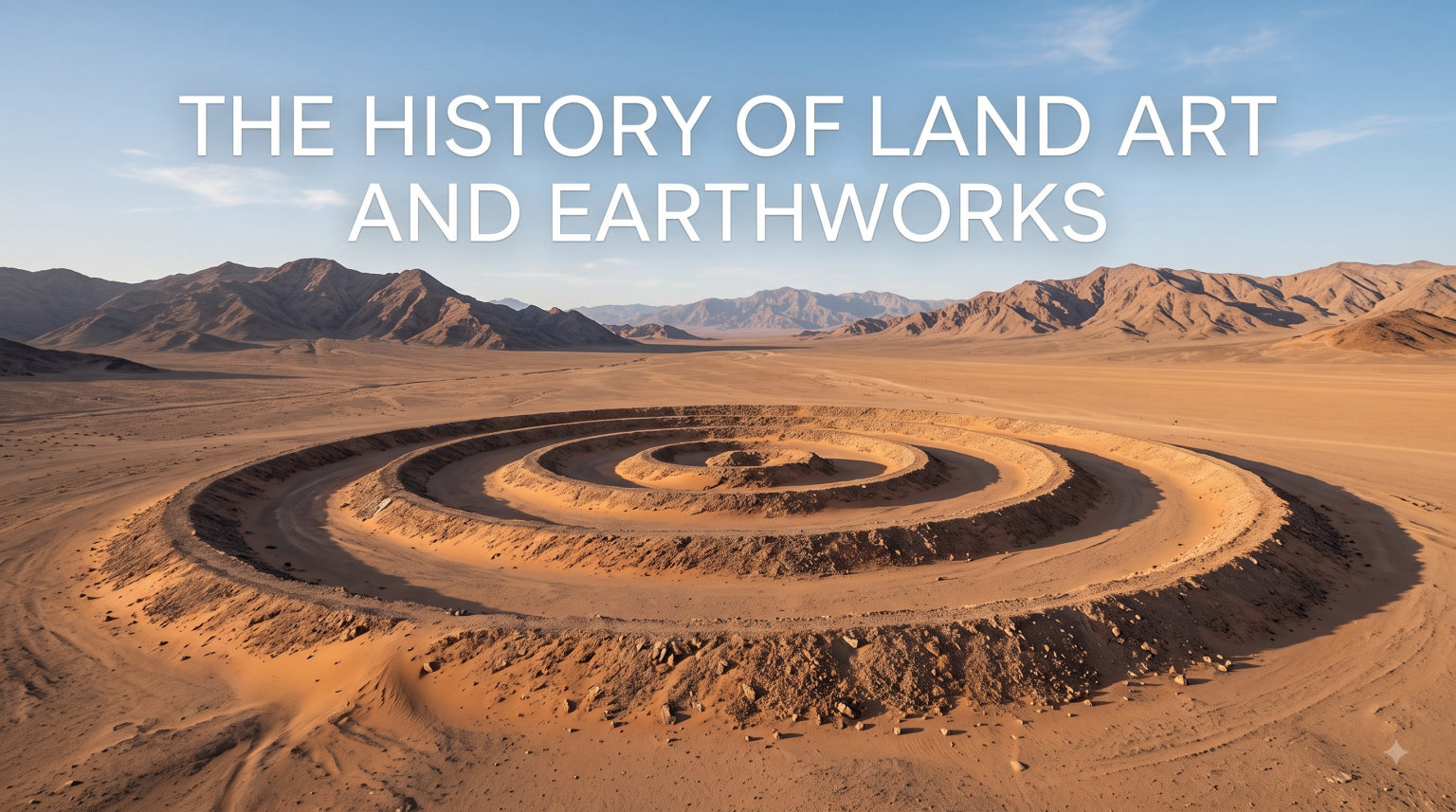
Land art is an art movement in which artists create works directly in and from the natural landscape, sculpting earth, stacking rocks, or simply walking across terrain to make their mark. The history of land art and earthworks stretches back to the late 1960s, when a group of mostly American and British artists decided the gallery system was broken and struck out for deserts, lakeshores, and open fields to prove it. These artists used bulldozers, basalt, salt crystals, and plain footsteps to build works that no collector could hang on a wall and no dealer could flip for profit.
What makes land art so compelling is the tension between ambition and impermanence. Robert Smithson hauled over 6,000 tons of rock into the Great Salt Lake to build Spiral Jetty, knowing full well that rising water levels might swallow it within a few years. Nancy Holt poured concrete into the Utah desert to frame the sun and stars, then watched as weather slowly claimed the surfaces. These works were statements about entropy, about nature’s refusal to stay still, and about art’s refusal to stay confined.
In this guide, I will walk you through the origins of the land art movement, the artists who defined it, the famous earthworks you can still visit, and the challenges of preserving art that was designed to decay. Whether you are an art history student cramming for an exam or someone who just stumbled across a photo of Spiral Jetty and wanted to know more, this article covers everything you need to understand why land art matters.
Table of Contents
What Is Land Art? A Clear Definition
Land art, also called earth art or earthworks, is an art movement in which the artwork is made directly in the landscape by shaping the land itself or by arranging natural materials found on-site. Rocks, soil, salt, water, branches, and even the passage of the artist’s body through space serve as the medium. The work often exists outdoors, exposed to weather and time, and is typically documented through photography or film so that it can be shared beyond its remote location.
The term “earthworks” was popularized by Robert Smithson and is sometimes used interchangeably with land art, though earthworks tends to describe the large-scale, sculptural interventions that reshape the ground. “Environmental art” is a related but broader category that includes any work addressing ecological themes, even if it sits inside a gallery. Land art is specifically about making work in and of the land.
Key characteristics set land art apart from other movements. First, the works are site-specific, meaning they cannot be moved without destroying them. Second, they are often monumental in scale, measured in acres rather than inches. Third, they are ephemeral by nature, subject to erosion, flooding, plant growth, and the slow grind of geologic time. Fourth, they resist commercialization, because you cannot exactly ship a 1,500-foot spiral coil of mud and basalt to a SoHo loft.
Materials vary widely. Smithson used black basalt, earth, and salt crystals. Richard Long used nothing but his own footsteps on grass. Michael Heizer used poured concrete and carved sandstone. Walter de Maria used stainless steel poles planted in the New Mexico desert. The common thread is that the material comes from the earth and returns to the earth.
The History of Land Art and Earthworks: Origins in the Late 1960s
Land art emerged in the United States and United Kingdom during the late 1960s and early 1970s, a period of intense social upheaval, anti-war protests, and a growing environmental consciousness. Artists were disillusioned with what they saw as the commodification of art, where paintings and sculptures were treated as luxury investments rather than vehicles for ideas. The gallery scene in New York felt stifling, and the wider conceptual art movement had already begun prioritizing ideas over objects.
The immediate catalyst was a convergence of several forces. The Minimalist movement had stripped sculpture down to basic geometric forms and industrial materials, which opened the door to thinking about form at a landscape scale. The conceptual art movement had declared that the idea behind a work mattered more than the physical object, which freed artists to create pieces that could not easily be owned or displayed. And the environmental movement, catalyzed by Rachel Carson’s Silent Spring in 1962 and the first Earth Day in 1970, gave artists a new vocabulary for talking about humanity’s relationship to the natural world.
In 1968, the Dwan Gallery in New York mounted an exhibition called “Earth Works,” which is widely regarded as the movement’s formal debut. The show featured proposals, photographs, and models of outdoor works by artists including Robert Smithson, Michael Heizer, Walter de Maria, Dennis Oppenheim, and Stephen Kaltenbach. Because many of the actual works were too large or too remote to display in a gallery, visitors experienced them through documentation, a radical concept at the time.
Geographically, the American Southwest became ground zero for large-scale earthworks. The vast, open landscapes of Utah, Nevada, and New Mexico offered cheap land, dramatic terrain, and an almost alien emptiness that appealed to artists who wanted to work far from the commercial art world. The Mojave Desert, the Great Salt Lake, and the mesas of New Mexico became studios, and the artists who worked there became known for a rugged, almost mythic approach to art-making.
In the United Kingdom, a parallel but distinctly different tradition developed. British land artists tended to work at a smaller scale, using walking, gathering, and subtle interventions rather than heavy machinery. Richard Long, Hamish Fulton, and Andy Goldsworthy created works that were gentler, more poetic, and less about dominating the landscape than about passing through it. This British tradition drew on a deep cultural connection to the countryside, the rambling movement, and ideas about psychogeography that were circulating in European art and literary circles.
The connection between land art and conceptual art is essential. Land artists were not simply making big sculptures outdoors. They were asking fundamental questions about what art is, where it belongs, who gets to see it, and how long it should last. The physical earthwork was one part of the equation; the photographs, maps, essays, and films that documented it were equally important. In many cases, the only way to experience the work was through these secondary materials, which made the documentation itself a form of art.
Key Land Art Artists You Should Know
Robert Smithson (1938-1973)
Robert Smithson is the figure most associated with land art, and for good reason. He coined the term “earthworks,” wrote extensively about entropy and the decay of systems, and created the movement’s most iconic work: Spiral Jetty. Smithson was born in Passaic, New Jersey, and began his career as a painter before shifting to sculpture and then to large-scale outdoor works. His writing, particularly the essay “The Sedimentation of the Mind: Earth Projects” published in 1968, laid out the philosophical framework for the entire movement.
Smithson was obsessed with entropy, the idea that all systems tend toward disorder. He saw the crumbling edges of urban development, the abandoned industrial sites of his native New Jersey, and the eroding landscapes of the American West not as blights but as subjects for art. His early “nonsites” brought materials from specific outdoor locations into gallery spaces, creating a tension between the real place and its representation. Spiral Jetty, built in 1970, was the culmination of this thinking: a work that could only exist in one place, that would change with the seasons, and that would eventually disappear.
Smithson died in a plane crash in Texas on July 20, 1973, at the age of 35, while surveying a site for a new work called Amarillo Ramp. His death cut short one of the most influential careers in postwar American art, but his ideas about site, entropy, and the limits of the gallery continue to shape contemporary art practice.
Richard Long (born 1945)
Richard Long represents the quieter, more meditative side of land art. While Smithson was hiring bulldozers, Long was walking. His breakthrough work, A Line Made by Walking (1967), is exactly what the title describes: a straight line of flattened grass created by walking back and forth across a field in the English countryside. He photographed the result, and that photograph became the artwork.
Long has spent decades walking through landscapes around the world, from the Scottish Highlands to the Sahara Desert, leaving traces that range from stone circles to mud drawings on gallery walls. His work is about duration, measurement, and the relationship between the human body and the natural world. He never uses heavy equipment. His tools are his feet, his hands, and the stones he finds along the way.
The British tradition that Long represents is less about spectacle and more about contemplation. His works ask you to think about time, distance, and the fleeting marks we leave on the earth. They are gentle where the American earthworks are aggressive, and personal where the American works are mythological. Long won the Turner Prize in 1989 and remains one of the most respected figures in British art.
Nancy Holt (1938-2014)
Nancy Holt was a pioneer of land art whose contributions were long overshadowed by those of her husband, Robert Smithson. In recent years, scholars and curators have given her work the attention it deserves. Holt’s Sun Tunnels, completed in 1976 in the Great Basin Desert of Utah, is one of the most celebrated earthworks in the United States.
Sun Tunnels consists of four massive concrete tubes arranged in an open X configuration. Each tunnel is perforated with holes that correspond to the constellations Draco, Perseus, Columba, and Capricorn. At sunrise and sunset during the summer and winter solstices, the sun aligns perfectly with the tunnels, casting patterns of light and shadow on the interior surfaces. Holt spent years planning and building the work, pouring the concrete on-site in a remote corner of the desert.
Holt’s work connects land art to astronomy, timekeeping, and the ancient tradition of building structures that align with celestial events. Her legacy includes not only her own art but also her role in preserving and promoting the work of Smithson after his death, and her advocacy for women artists in a movement that was overwhelmingly male.
Michael Heizer (born 1944)
Michael Heizer is the most reclusive and perhaps the most ambitious of the major land artists. His Double Negative, completed in 1969, consists of two massive trenches cut into the facing edges of a mesa in the Moapa Valley, Nevada. Together, they displaced 240,000 tons of rhyolite and sandstone. The “negative” in the title refers to the space created by removing material rather than adding it.
Heizer has spent over 50 years working on City, a vast complex of earthen and concrete structures in the remote desert of central Nevada. Begun in 1972, City is often described as one of the largest contemporary artworks in the world, measuring over a mile and a quarter in length. It was finally opened to the public in 2022, five decades after construction began. Heizer, the son of an archaeologist, has drawn comparisons between his work and the monumental structures of ancient civilizations, and he has spoken about wanting to create art that could last for thousands of years.
Heizer lives and works in relative isolation in Nevada, rarely giving interviews and fiercely protecting the remote locations of his works. His commitment to making art at an almost impossible scale, and his willingness to spend decades on a single project, make him a unique figure in the history of land art.
Walter de Maria (1935-2013)
Walter de Maria brought a minimalist’s precision and a composer’s sense of timing to land art. His Lightning Field, installed in 1977 near Quemado, New Mexico, consists of 400 polished stainless steel poles arranged in a rectangular grid measuring one mile by one kilometer. The poles are sharpened to a point at the top and are designed to attract lightning strikes during the summer monsoon season.
Viewing Lightning Field requires advance reservation and an overnight stay in a cabin on the property. The Dia Art Foundation, which maintains the work, limits visitors to small groups. The experience is deliberately slow and immersive. You spend hours watching the poles catch and reflect the changing light, and if you are fortunate, you witness a lightning strike illuminating the grid. De Maria insisted that the work could only be experienced in person, through prolonged exposure, not through photographs.
Before Lightning Field, de Maria created Mile Long Drawing (1968), two parallel chalk lines drawn across the Mojave Desert floor, and The New York Earth Room (1977), a gallery space in SoHo filled with 280,000 pounds of dirt. The Earth Room still exists today, maintained by the Dia Art Foundation, and offers a strange, almost comedic contrast between the raw earth filling the space and the expensive Manhattan real estate surrounding it.
Famous Earthworks and Land Art Works
Spiral Jetty (1970) by Robert Smithson
Spiral Jetty is the single most famous work of land art ever created. Built in April 1970 on the northeastern shore of the Great Salt Lake in Utah, the work is a 1,500-foot-long coil of mud, salt crystals, and black basalt rocks that spirals counterclockwise into the reddish water. Smithson used dump trucks and a tractor to move over 6,000 tons of material into the lake, shaping the spiral by hand and machine over the course of about two weeks.
The jetty has had a dramatic life since its creation. Within a few years, rising water levels in the Great Salt Lake submerged it entirely, and it remained underwater for decades. In the early 2000s, drought lowered the lake levels and the jetty re-emerged, its basalt rocks encrusted with white salt crystals that gave it a stark, almost otherworldly appearance. Water levels have fluctuated since, sometimes covering the jetty and sometimes exposing it, making each visit a unique experience.
Visiting Spiral Jetty today requires commitment. The site is about two hours from the nearest town of any size, down unpaved roads that can become impassable after rain. There is no signage, no visitor center, and no cell service. The Dia Art Foundation holds the lease on the lake bed and manages the site, but there is little infrastructure. The experience of standing on the jetty, surrounded by the pinkish water, the salt-encrusted shore, and the absolute silence of the Utah desert, is unlike anything you will find in a conventional museum.
Sun Tunnels (1976) by Nancy Holt
Sun Tunnels sits in the Great Basin Desert of western Utah, about four hours by car from Salt Lake City. The work consists of four concrete tunnels, each 18 feet long and over 9 feet in diameter, arranged in an open X pattern on the desert floor. The tunnels frame the sunrise and sunset during the summer and winter solstices, and each tunnel is drilled with holes that map the stars of a specific constellation.
Holt chose the site after years of searching for a location that was flat, remote, and offered unobstructed views of the horizon in every direction. She spent months calculating the exact angles and positions required for the solar alignments. The result is a work that functions as an astronomical instrument, a sculpture, and a shelter from the desert wind. Walking through the tunnels at sunset, watching the perforated light patterns shift across the concrete, is a deeply meditative experience.
Unlike some earthworks, Sun Tunnels has aged relatively well. The concrete has weathered but remains structurally sound, and the site is maintained by the Dia Art Foundation. Holt’s work has attracted growing attention in recent years, and Sun Tunnels has become a destination for art pilgrims, astronomers, and anyone seeking a quiet encounter with the landscape.
A Line Made by Walking (1967) by Richard Long
A Line Made by Walking is one of the simplest and most influential works of land art. In 1967, Richard Long, then a 22-year-old student at Saint Martin’s School of Art in London, walked back and forth across a field in the English countryside until his footsteps had flattened the grass into a visible straight line. He photographed the line, and the photograph became the artwork.
The work is radical in its simplicity. No heavy machinery, no expensive materials, no remote desert location. Just a person, a field, and the act of walking. The line itself would have disappeared within days as the grass recovered, but the photograph preserved the gesture. Long has said that the work was about making “a sculpture in the landscape, made by walking in the landscape,” collapsing the distinction between the artist’s action and the resulting form.
A Line Made by Walking established the model for Long’s entire career, which has consisted of walking through landscapes around the world and documenting the traces left behind. It also established a distinctly British approach to land art that privileges subtlety, temporality, and the artist’s body over the monumental interventions of the American earthworkers.
Double Negative (1969) by Michael Heizer
Double Negative is exactly what it sounds like: two enormous cuts in the earth that together form a single sculptural gesture. The work is located in the Moapa Valley on Mormon Mesa, Nevada, and consists of two trenches, each 50 feet deep, 30 feet wide, and 1,500 feet long, cut directly into the top edges of a mesa. The two cuts face each other across a natural gap in the mesa, and together they displace 240,000 tons of rock.
Heizer conceived of the work as a “negative” sculpture, meaning the art exists in the space where material has been removed rather than added. The title plays on this idea: two negatives that together make a positive. Standing between the two cuts, looking across the open desert, you experience the vast emptiness of the space as the artwork itself. The work is owned by the Museum of Contemporary Art, Los Angeles (MOCA), but it sits on public land and can be visited without special permission.
Over the decades, Double Negative has experienced significant erosion. The edges of the cuts have softened, and debris has accumulated on the floor of the trenches. Some conservationists argue that this decay is part of the work’s meaning, an illustration of entropy that Smithson wrote about. Others believe the work should be maintained in its original condition. The debate reflects a fundamental tension in land art: should art that was made to change be frozen in place?
The Lightning Field (1977) by Walter de Maria
The Lightning Field is perhaps the most theatrical of the major earthworks, though the drama is largely provided by nature rather than the artist. Walter de Maria installed 400 stainless steel poles in a precisely measured grid across a high desert plain in western New Mexico. The poles average about 20 feet in height and are spaced 220 feet apart, creating a rectangular array that covers roughly one square mile.
The poles are polished to a mirror finish, and during the day they catch and reflect the shifting light of the desert, creating an effect like a field of candles flickering on the horizon. During the summer months, when thunderstorms roll across the high desert, the poles are designed to attract lightning strikes. The sight of 400 steel poles buzzing with electrical energy under a roiling sky is one of the most extraordinary spectacles in all of art.
De Maria imposed strict rules on how the work should be experienced. Visitors must make reservations through the Dia Art Foundation, stay overnight in a cabin on the property, and commit to spending at least several hours in the field. Photography is discouraged. The point is to experience the work in real time, with your full attention, over an extended period. It is a demanding proposition, but those who make the trip consistently describe it as transformative.
British Land Art: Walking, Traces, and the Landscape
While the American earthworkers were blasting through mesas and dumping thousands of tons of basalt, British land artists were doing something altogether different. The British tradition, led by Richard Long, Hamish Fulton, and later Andy Goldsworthy, focused on walking, gathering, and making subtle interventions in the landscape. Where Smithson and Heizer imposed their will on the land, Long and Fulton passed through it like guests.
Hamish Fulton, a contemporary and friend of Richard Long, has described himself as a “walking artist.” Since the late 1960s, Fulton has undertaken hundreds of walks in locations around the world, from the Scottish Highlands to Mount Everest. He does not alter the landscape during his walks. Instead, he photographs what he sees and presents the photographs alongside text describing the duration, location, and conditions of the walk. The walk itself is the artwork; the photographs and texts are merely evidence that it happened.
Andy Goldsworthy, who emerged in the 1980s, creates ephemeral sculptures from natural materials found on-site: leaves, ice, stones, twigs, and flower petals. His works are stunningly beautiful and almost impossible to preserve. A frozen arch of ice melts in the morning sun. A column of balanced stones collapses in the wind. Goldsworthy photographs each work at the moment of completion, knowing it will soon disappear. His approach is less about the conceptual rigor of Long and Fulton and more about a direct, almost spiritual engagement with natural materials.
The British tradition has been criticized by some for being too polite, too picturesque, and insufficiently critical of the social and political forces that shape the landscape. But its proponents argue that the gentleness is the point. In a world where humans have scarred and exploited the natural environment at every turn, these artists offer a model of engagement that is respectful, observant, and temporary.
Ancient Earthworks and the Prehistoric Connection
One of the most fascinating aspects of land art is its connection to ancient earthworks that predate the movement by centuries or even millennia. When Robert Smithson was building Spiral Jetty, he was keenly aware that he was working in a tradition that included the Nazca Lines of Peru, the chalk figures of southern England, and the earthen mounds of the Mississippi Valley.
The Nazca Lines, enormous geoglyphs etched into the desert floor of southern Peru between 500 BCE and 500 CE, are perhaps the closest historical parallel to the American earthworks. Like Spiral Jetty and Double Negative, the Nazca Lines can only be fully appreciated from the air, which raises questions about who they were made for and how they were meant to be seen. Some scholars believe they served religious or astronomical purposes; others think they were related to water rituals in an arid landscape.
Serpent Mound, a 1,348-foot-long earthen effigy mound in southern Ohio, was built by indigenous peoples of the Fort Ancient culture around 1070 CE. It depicts an uncoiling serpent and aligns with the summer solstice sunset. Like the best land art, Serpent Mound cannot be separated from its site; it is the site, shaped into meaning. Stonehenge, the Great Pyramid of Giza, and the earthen circles of Avebury in England all share this quality of being landscape-scale structures that encode astronomical and cultural knowledge.
Land artists of the 1960s and 1970s were not ignorant of these precedents. Michael Heizer, the son of a prominent archaeologist, grew up visiting prehistoric sites in Peru and Mexico. Robert Smithson wrote about the relationship between ancient monuments and modern earthworks. Nancy Holt’s Sun Tunnels explicitly references the solar alignments of ancient structures. The difference is that the modern land artists created their works as conscious artistic statements rather than as religious or civic monuments, and they did so within the framework of a contemporary art world that valued self-awareness and critical reflection.
Preservation Challenges for Land Art
Land art poses a unique problem for conservators: how do you preserve art that was designed to change? Spiral Jetty has been submerged, re-exposed, and re-submerged. Double Negative has eroded significantly since 1969. Sun Tunnels has weathered but remains largely intact. The Lightning Field’s steel poles require regular maintenance to maintain their polish. Every one of these works faces threats from erosion, vandalism, development, and climate change.
The Dia Art Foundation, which manages Spiral Jetty, Sun Tunnels, and The Lightning Field, has adopted a policy of minimal intervention. Rather than trying to freeze the works in their original state, Dia focuses on documentation, access, and structural stabilization. When the jetty re-emerged from the lake in 2002, Dia documented its condition but did not attempt to restore it to its 1970 appearance. The salt-encrusted rocks and the reshaped spiral are now part of the work’s history.
Climate change adds a new layer of urgency. The Great Salt Lake has been shrinking due to drought and water diversion, which has exposed Spiral Jetty for longer periods but also raised concerns about the long-term health of the lake ecosystem. Rising temperatures in the desert Southwest are changing weather patterns, which could affect the frequency of lightning strikes at The Lightning Field and the erosion rate at Double Negative.
There is also the question of access. Many earthworks are located on remote, fragile sites that cannot accommodate large numbers of visitors without sustaining damage. The Dia Art Foundation limits visits to Sun Tunnels and Spiral Jetty by keeping access information sparse and discouraging organized tours. The Lightning Field requires advance reservations and caps the number of overnight guests. These restrictions protect the works but also mean that relatively few people will ever experience them in person.
Contemporary Land Art in 2026
The land art movement did not end in the 1970s. A new generation of artists has taken up the tradition, adapting it to contemporary concerns about climate change, social justice, and indigenous land rights. These artists work in a landscape that has changed dramatically since Smithson and Heizer first drove into the desert, and their work reflects those changes.
Olafur Eliasson, the Icelandic-Danish artist known for large-scale installations, created Ice Watch in 2014, hauling 12 blocks of glacial ice from Greenland to public squares in Copenhagen, Paris, and London, where they were left to melt. The work was a direct response to climate change and a reminder that land art can address environmental crisis without deploying heavy machinery. Maya Lin, best known for the Vietnam Veterans Memorial in Washington, D.C., has spent years creating works that address deforestation, species extinction, and water pollution, using data-driven approaches that Smithson could not have imagined.
Chris Drury, a British artist, creates works that combine the walking tradition of Richard Long with scientific research into ecology and geology. His Cloud Chamber (built in 2003 in North Carolina) is a camera obscura made of local stone that projects an image of the sky onto its interior floor. Strijdom van der Merwe, a South African artist, creates land works in the Karoo desert that reference colonial history and land dispossession, connecting the land art tradition to postcolonial critique.
Digital technology has also changed how land art is documented and experienced. Satellite imagery, drones, and GPS mapping allow artists to conceive of works at scales that would have been impractical in the 1970s. Social media has made remote earthworks visible to millions of people who will never visit them in person, raising questions about whether the photograph has become more important than the work itself, exactly the tension that the original land artists wrestled with.
FAQs
When did land art originate?
Land art originated in the late 1960s, with the movement formally debuting at the Dwan Gallery’s Earth Works exhibition in New York in 1968. Artists including Robert Smithson, Michael Heizer, and Walter de Maria began creating large-scale outdoor works around this time, with Smithson’s Spiral Jetty completed in 1970 and Heizer’s Double Negative in 1969.
Where did land art originate?
Land art originated primarily in the United States and the United Kingdom. In the U.S., artists gravitated toward the vast, remote landscapes of the American Southwest, particularly Utah, Nevada, and New Mexico. In the U.K., artists like Richard Long and Hamish Fulton developed a distinct tradition based on walking and subtle landscape interventions, centered on the British countryside.
What is the most famous land art?
The most famous land art work is Robert Smithson’s Spiral Jetty (1970), a 1,500-foot-long coil of basalt, mud, and salt crystals built into the Great Salt Lake in Utah. Other widely known earthworks include Nancy Holt’s Sun Tunnels (1976) in Utah, Michael Heizer’s Double Negative (1969) in Nevada, Walter de Maria’s The Lightning Field (1977) in New Mexico, and Richard Long’s A Line Made by Walking (1967) in England.
Why did artists create earthworks?
Artists created earthworks as a reaction against the commercialization and commodification of the art world in the 1960s. They wanted to make art that could not be bought, sold, or displayed in galleries. Land art also grew out of the conceptual art movement’s emphasis on ideas over objects, the Minimalist interest in geometric form, and rising environmental awareness. By working directly in the landscape, these artists challenged traditional boundaries between art and nature.
Conclusion: Why the History of Land Art and Earthworks Still Matters
The history of land art and earthworks is a story about artists who refused to play by the rules. They walked out of galleries, drove into deserts, and reshaped the earth itself to make art that could not be owned, commodified, or easily contained. From Robert Smithson’s Spiral Jetty to Richard Long’s meditative walks, from Nancy Holt’s astronomical tunnels to Michael Heizer’s megalithic City, these works challenge us to think differently about where art belongs and what it can be.
What I find most compelling about land art is its honesty. These works do not pretend to be permanent. They change with the weather, the seasons, and the decades. They erode, flood, and sometimes disappear entirely, leaving behind only photographs and written accounts. In an era of climate crisis and ecological anxiety, that willingness to accept impermanence feels more relevant than ever.
If you want to go deeper, I recommend visiting one of the accessible earthworks. Spiral Jetty and Sun Tunnels are both within driving distance of Salt Lake City, and the experience of standing in the desert with nothing but art and sky around you is something no photograph can fully capture. The Dia Art Foundation’s website has current information on access and conditions. For those who prefer to explore from home, Robert Smithson’s collected writings and the documentary films of Nancy Holt’s Sun Tunnels are excellent starting points.