
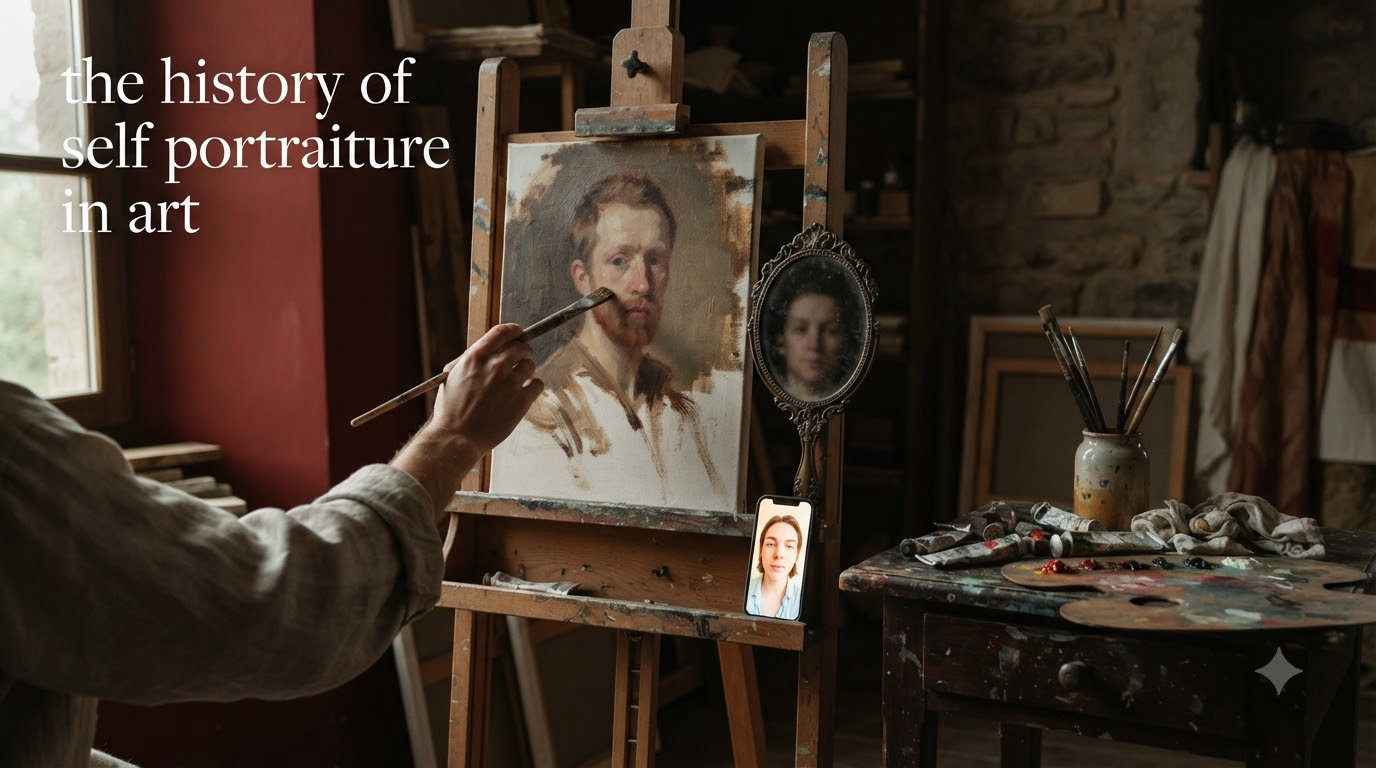
Long before smartphones and front-facing cameras, humans felt the urge to capture their own likeness. The history of self portraiture in art stretches back more than 40,000 years, beginning with hand stencils pressed against cave walls and evolving through centuries of paint, silver, light, and pixels. Every era brought a new way for artists to ask the same question: who am I, and how do I want the world to see me?
Self-portraiture is not just an artistic exercise. It is a record of human consciousness, a timeline of how people have understood identity, status, mortality, and self-expression across cultures and centuries. From the mirrored canvases of the Renaissance to the daguerreotype experiments of the 1830s, artists have used their own faces as both subject and laboratory.
In this guide, our team traces the history of self portraiture in art from its earliest known examples to the digital present. We look at the famous names, like Rembrandt and Frida Kahlo, but also the lesser-known figures, like Hippolyte Bayard and Sofonisba Anguissola, whose stories deserve wider recognition. Whether you are an art student, a working artist, or simply curious about why humans keep making pictures of themselves, this article covers the full arc.
Table of Contents
What Is Self-Portraiture?
Self-portraiture is the practice of an artist creating a visual representation of themselves. That sounds simple enough, but the category is broader than most people realize. A self-portrait can be a painted canvas, a photograph, a drawing, a sculpture, or even a print where the artist appears within a larger scene.
Art historians generally recognize three types of self-portraits. The first is the standalone self-portrait, where the artist is the sole subject. The second is self-insertion, where the artist places their own face within a larger composition, often a religious or historical painting. The third is the hidden self-portrait, a face tucked into a crowd or reflected in a mirror within the painting, waiting to be discovered by attentive viewers.
What separates a self-portrait from a portrait made by another artist is authorship. When Rembrandt painted himself, he controlled every brushstroke, deciding how to present his image to the world. That control is what gives self-portraiture its unique power: the artist becomes both creator and subject, observer and observed.
The Earliest Self-Portraits: Prehistoric Origins
The oldest known self-representations are not paintings or sculptures at all. They are hand stencils. In caves across the world, from Sulawesi in Indonesia to Lascaux in France to Patagonia in Argentina, early humans placed their hands against rock walls and blew pigment around them. The result is a negative image, a silhouette of a specific hand left behind tens of thousands of years ago.
The Sulawesi cave hand stencils, discovered in 2014 and dated to roughly 39,900 years old, are among the oldest known examples. Some researchers argue these are not true self-portraits in the modern sense, since they do not depict a face or full figure. But they are undeniably self-representations: a direct physical record of an individual’s body, made by that individual’s own hand.
Archaeologists and art historians debate whether these early stencils served a spiritual purpose, a communal one, or something closer to what we would call artistic expression. The answer is probably all three. What matters for understanding the history of self portraiture in art is the impulse itself: the drive to leave a trace of oneself, to say “I was here.”
In ancient Egypt, sculptors created carved self-portraits, though few survive. The Greek sculptor Phidias reportedly included his own likeness on the shield of the Athena Parthenos statue. These fragments show that even in antiquity, artists found ways to insert themselves into their work, sometimes openly and sometimes in hiding.
Renaissance and the Birth of Self-Portraiture in Art
The Renaissance is where self-portraiture as we know it truly begins. Several factors converged in 15th-century Europe to make the self-portrait a recognized artistic genre. Improved mirror technology, particularly the development of silvered glass mirrors in Venice, gave artists a clearer reflection than polished metal had ever provided. The rising social status of the artist, from anonymous craftsman to celebrated intellectual, created a desire to document one’s own image. And the spread of oil painting techniques allowed for the level of detail that a convincing self-portrait demanded.
Jan van Eyck and the First Painted Self-Portrait
The Flemish master Jan van Eyck is widely credited with creating one of the first true painted self-portraits. His Portrait of a Man (1433), now in the National Gallery in London, depicts a man in a red chaperon hat gazing directly at the viewer with an intense, slightly narrowed expression. The painting’s Latin inscription reads “Als Ich Can” (As I Can), a pun on the artist’s name that many scholars read as van Eyck’s personal signature on the work.
Not everyone agrees the painting is a self-portrait. Some art historians argue it depicts a patron. But the direct gaze, the inscribed motto, and the lack of a patron’s identifying attributes make the self-portrait attribution the most widely accepted interpretation. If correct, it stands as a founding moment in the history of self portraiture in art.
Albrecht Durer and the Artist as Hero
No Renaissance artist embraced self-portraiture more boldly than Albrecht Durer. The German painter and printmaker created at least twelve self-portraits across his career, each one making a statement about who he was and what he aspired to be. His most famous, the Self-Portrait at 28 (1500), presents Durer in a pose traditionally reserved for Christ, with his hand raised in a gesture of blessing. It is a striking, almost audacious image: a mortal artist depicting himself with divine authority.
Durer’s self-portraits were not vanity projects. They were strategic. By presenting himself as a gentleman, a scholar, and even a Christ-like figure, Durer elevated the status of the artist from craftsman to intellectual. His self-portraits functioned as a kind of personal branding, a concept that would not be named for another 500 years but that Durer understood intuitively.
Sofonisba Anguissola and Female Self-Portraiture
While male artists dominated the Renaissance self-portrait tradition, women also found ways to participate. Sofonisba Anguissola, an Italian painter from Cremona, produced numerous self-portraits in the mid-16th century that stand among the most accomplished of the period. Her Self-Portrait at the Easel (1556) shows the artist holding a brush and mahlstick, gazing confidently at the viewer while depicting the Virgin and Child on the canvas behind her.
Anguissola used self-portraiture to assert her professional identity in a world that rarely recognized women as serious artists. Her self-portraits served as calling cards, sent to potential patrons and fellow artists to demonstrate her skill. They also served as quiet acts of defiance against a system that expected women to remain invisible.
Hidden Selves: Self-Insertion in Renaissance Art
Not all Renaissance self-portraits were standalone paintings. Many artists inserted their own faces into larger compositions, often religious scenes. Sandro Botticelli included himself in his Adoration of the Magi (1475), gazing out from the right edge of the canvas. Raphael painted himself into The School of Athens (1509-1511), standing among the greatest philosophers of antiquity as if to claim his own place in that lineage.
These self-insertions served multiple purposes. They were signatures, proving the artist’s hand. They were acts of devotion, placing oneself in the presence of the sacred. And they were claims to immortality, ensuring the artist’s face would survive alongside the masterpiece itself.
Baroque Through Impressionism: The Evolving Self-Portrait
Rembrandt: The Master of Self-Examination
No artist in the history of self portraiture in art devoted more energy to the self-portrait than Rembrandt van Rijn. Over four decades, the Dutch master produced roughly 80 self-portraits in oil, along with numerous etchings and drawings. Together, they form one of the most remarkable autobiographical records in all of art history.
Rembrandt’s self-portraits range from youthful bravado to unflinching depictions of aging and decline. He painted himself in costumes, as a beggar, as a soldier, and as a nobleman. He captured himself laughing, frowning, and staring with a rawness that still feels startling today. What makes Rembrandt’s self-portraits extraordinary is not just their quantity but their honesty. He did not idealize himself. He showed his double chin, his wrinkles, his sagging skin, and somehow made those features the source of the paintings’ power.
Scholars have debated Rembrandt’s motives. Some argue the self-portraits were primarily practical: a free and always-available model for studying expression and lighting. Others see them as deep psychological investigations, Rembrandt using his own face to explore the full range of human emotion. The truth probably lies somewhere in between, and that combination of practical study and existential curiosity is what makes these works enduring.
Artemisia Gentileschi: Self-Portraiture as Resistance
Artemisia Gentileschi, one of the most accomplished painters of the Italian Baroque, used self-portraiture to assert her identity in a male-dominated profession. Her Self-Portrait as the Allegory of Painting (1638-1639) depicts the artist mid-stroke, hair disheveled, completely absorbed in her work. It is a powerful image that claims both artistic authority and physical presence.
Gentileschi’s self-portraits carry added weight when considered alongside her biography. After surviving a sexual assault and a grueling public trial against her attacker, she built a career that took her from Rome to Florence to Naples and eventually to the English court. Her self-portraits do not just show what she looked like. They declare who she chose to become.
Van Gogh: Self-Portraiture as Survival
Vincent van Gogh produced more than 35 self-portraits in a remarkably short period, most of them during his two years in Paris and his time at the asylum in Saint-Remy-de-Provence. For Van Gogh, self-portraiture was partly economic: he could not afford models, and he was always available. But the resulting paintings are far more than practice exercises.
Van Gogh’s self-portraits vibrate with color and emotion. His gaunt features, red hair, and intense gaze appear under swirling skies, against blue backgrounds, and beneath yellow straw hats. Each painting captures a different emotional state, from restless energy to deep melancholy. They are among the most recognizable self-portraits ever created, and they transformed the genre from documentation into something closer to confession.
Self-Portraiture in Photography: A New Medium
The invention of photography in 1839 did not kill self-portraiture. It reinvented it. Suddenly, artists did not need years of training in oil painting to capture their own likeness. They needed only a camera, a light-sensitive plate, and a few minutes of patience.
Robert Cornelius and the First Photographic Self-Portrait
In October 1839, just months after Louis Daguerre announced his daguerreotype process to the world, an amateur chemist and lamp manufacturer named Robert Cornelius stepped outside his family’s Philadelphia storefront and took a photograph of himself. The image, a silver-plated copper sheet showing a young man with tousled hair and crossed arms, is widely recognized as the first photographic self-portrait.
Cornelius’s daguerreotype was no casual snapshot. The exposure took several minutes, requiring him to stand perfectly still in the sunlight. The result is a strikingly modern-looking image: direct gaze, slightly disheveled appearance, an air of casual confidence that feels utterly contemporary. Cornelius apparently recognized the significance of what he had done. On the back of the plate, he wrote: “The first light picture ever taken. 1839.”
Hippolyte Bayard: The First Staged Self-Portrait Photograph
If Robert Cornelius made the first photographic self-portrait, the French photographer Hippolyte Bayard made the first conceptual one. In 1840, Bayard created Self-Portrait as a Drowned Man, a photograph showing the artist posed as a corpse, shirtless and slumped against a backdrop. On the reverse, Bayard wrote a note explaining that he had chosen to “drown” himself out of frustration at being overlooked in favor of Daguerre and others who received credit and funding for inventing photography.
This image is remarkable for several reasons. It is the first known instance of a photographer using the self-portrait to make a statement rather than simply record a likeness. It is a protest, a work of performance art, and a dark joke all at once. Bayard’s drowned man anticipates by more than a century the kind of staged, conceptually driven self-portraiture that artists like Cindy Sherman would make famous.
Photography Democratizes Self-Portraiture
As photographic technology improved and costs dropped, self-portraiture became accessible to people who had never picked up a paintbrush. The carte de visite craze of the 1860s, the introduction of the Kodak Brownie camera in 1900, and the rise of instant photography with Polaroid in the 1940s each made it easier for ordinary people to photograph themselves.
This democratization is one of the most important shifts in the history of self portraiture in art. For centuries, creating a self-portrait required training, materials, and time. Photography reduced all three to minutes and cents. The result was an explosion of self-representation that continues to accelerate today.
Modern and Contemporary Self-Portraiture
The 20th and 21st centuries saw self-portraiture explode in both quantity and conceptual ambition. Artists stopped treating the self-portrait as a straightforward record of appearance and began using it to explore identity, performance, gender, race, and the nature of image-making itself.
Frida Kahlo: Identity as Territory
Frida Kahlo produced approximately 55 self-portraits, many of them unflinching explorations of physical pain, emotional suffering, and cultural identity. Her Self-Portrait with Thorn Necklace and Hummingbird (1940) shows the artist wearing a necklace of thorns that draws blood, a dead hummingbird hanging from the chain. It is an image that resists easy interpretation but communicates anguish with visceral force.
Kahlo’s self-portraits draw on Mexican folk art traditions, Catholic iconography, and personal mythology. They do not ask the viewer to admire her beauty. They demand that the viewer witness her experience. In doing so, Kahlo transformed the self-portrait from a record of what an artist looks like into a map of what an artist feels.
Andy Warhol: The Commodification of Self
Andy Warhol took self-portraiture in the opposite direction. His silkscreen self-portraits from the 1960s and beyond present his own face as a mass-produced image, identical to his portraits of Marilyn Monroe and Campbell’s Soup cans. Warhol’s self-portraits are not about self-examination. They are about the erasure of the individual self into brand and image.
In works like his 1986 Fright Wig self-portraits, Warhol stares out from a black background, hair wild, face ghostly pale. The image has become one of the most recognizable self-portraits of the late 20th century, precisely because it treats the artist’s own face as a product, an endlessly reproducible icon.
Cindy Sherman: Performed Identity
Cindy Sherman has spent her entire career making self-portraits in which she is never actually herself. In her Untitled Film Stills series (1977-1980), Sherman photographed herself in the guise of fictional movie characters, each image a constructed persona drawn from the visual language of Hollywood. In later series, she adopted the roles of Renaissance madonnas, centerfold models, and clown figures.
Sherman’s work raises fundamental questions about the nature of self-portraiture. If the artist is disguised, costumed, and performing a role, is it still a self-portrait? Sherman’s answer seems to be that identity itself is a performance, and that the self-portrait, far from revealing a true self, reveals only the masks we choose to wear.
Digital Age: AI, Filters, and Avatars
The latest chapter in the history of self portraiture in art is being written in code. AI-generated self-portraits, social media filters, and virtual avatars have created new ways to represent the self that would have been unimaginable even a generation ago. Artists like Mario Klingemann and Refik Anadol use machine learning algorithms to generate portraits that blend human features with digital abstraction.
These tools raise questions that earlier self-portraitists never faced. Who owns an AI-generated image: the artist, the algorithm, or the training data? Is a filtered selfie a self-portrait, a distortion, or something else entirely? The technology is new, but the underlying impulse, to see and represent oneself, is as old as those hand stencils on cave walls.
Non-Western Self-Portraiture Traditions
Most discussions of self-portraiture focus on the European tradition. That focus reflects the biases of art history as a discipline, not the actual global history of self-representation. Artists across Asia, Africa, the Middle East, and the Americas have long found ways to depict themselves, often within very different cultural and religious frameworks.
Chinese Literati Self-Portraiture
In China, the literati painting tradition produced a rich vein of self-portraiture that dates back to at least the Song Dynasty (960-1279). Shen Zhou, one of the founders of the Wu School, painted himself into landscape settings, often as a small figure contemplating vast natural scenery. These images were not about individual likeness in the Western sense. They expressed the artist’s relationship to nature, philosophy, and the cultivated life.
Later Chinese artists, including Shitao and Bada Shanren, used self-portraiture to express political disenchantment and personal eccentricity. Their works often feature exaggerated, almost cartoonish self-depictions that communicate inner states more than physical accuracy.
Japanese Self-Portraiture
Japanese art also has a strong self-portrait tradition, particularly within the literati and ukiyo-e movements. The poet-painter Yosa Buson created self-portraits that blend Chinese literati conventions with distinctly Japanese sensibility. In the 20th century, photographers like Masahisa Fukase turned the self-portrait into an exploration of obsession and psychological unraveling, as in his haunting series Karasu (Ravens).
Islamic, African, and Latin American Traditions
In Islamic art, where figural representation has often been restricted, self-portraiture took subtler forms. Artists sometimes included their own faces in miniature paintings as self-insertions within manuscript illustrations. Ottoman court painters occasionally created self-portrait drawings, though these were typically private works not intended for public display.
African self-portraiture traditions are less documented in Western art history but no less rich. Yoruba sculptors, Ethiopian icon painters, and contemporary African artists like Samuel Fosso have all produced powerful self-representations. Fosso’s photographic self-portraits, in which he adopts the costumes and poses of historical and political figures, rank among the most inventive self-portraits in any tradition.
In Latin America, self-portraiture has deep roots that extend far beyond Frida Kahlo. Colonial-era painters, muralists, and contemporary photographers have all used the self-portrait to explore identity, colonialism, and cultural hybridity. The tradition continues to thrive in the work of artists across the region.
Why Do Artists Create Self-Portraits?
Ask a dozen artists why they make self-portraits, and you will get a dozen different answers. But several themes come up again and again across the centuries.
The most practical reason is availability. The artist is the one model who is always present, never late, and free of charge. Rembrandt, Van Gogh, and countless others turned to self-portraiture when they could not afford or find sitters. But convenience alone does not explain why these works are so compelling.
Self-portraiture is also a form of self-study. By rendering their own features repeatedly, artists sharpen their observational skills and develop a deeper understanding of light, proportion, and expression. The self-portrait becomes both a technical exercise and a record of progress.
For many artists, the self-portrait serves as a calling card or personal brand. Durer used his self-portraits to announce his skill and social ambition. Anguissola sent hers to potential patrons. Warhol turned his into merchandise. In each case, the self-portrait is not just a picture of the artist; it is an argument about who the artist is and why they matter.
Perhaps the deepest motivation is psychological. The self-portrait allows artists to examine their own emotional states, confront aging and mortality, and work through personal trauma. Kahlo painted her pain. Rembrandt painted his decline. Bayard photographed his despair. In each case, the act of self-representation became a form of self-knowledge.
Finally, self-portraiture can serve as political or social commentary. Gentileschi asserted a woman’s right to be seen as a professional artist. Sherman exposed the constructed nature of gender. Fosso challenged colonial narratives by placing himself at the center of historical tableaux. The self-portrait, it turns out, is never just about the self.
Self-Portrait vs. Selfie: What Is the Difference?
It is tempting to dismiss the selfie as a degraded form of self-portraiture, a shallow imitation of a noble tradition. But the relationship between the two is more interesting than that simple dismissal allows.
The most obvious difference is intention and time. A self-portrait by Rembrandt or Kahlo took days, weeks, or months to complete. Every brushstroke was a decision. A selfie is taken in seconds, often with little thought beyond “this angle looks good.” The self-portrait is deliberative; the selfie is spontaneous.
But that distinction is not as clean as it sounds. Many selfies are carefully composed, filtered, and curated before being shared. The average Instagram user spends significant time choosing which image to post and how to present it. In that sense, the gap between selfie and self-portrait narrows to a difference of degree rather than kind.
What connects the two is the underlying impulse: the desire to see oneself, to control one’s image, and to communicate something about who you are. The cave painter who left a hand stencil on a wall in Sulawesi 40,000 years ago was doing something not so different from what a teenager does when posting a photo to social media today. The tools have changed. The human need has not.
FAQs
What is the history of self-portraiture?
Self-portraiture dates back over 40,000 years, beginning with prehistoric hand stencils in caves across Indonesia, France, and Argentina. The practice evolved through ancient Egyptian and Greek art, matured during the Renaissance with artists like Jan van Eyck and Albrecht Durer, and expanded through the Baroque period with Rembrandt’s extensive self-portrait series. The invention of photography in 1839 democratized self-portraiture, and the tradition continues today through digital media, AI-generated images, and social media selfies.
Who invented the self-portrait?
No single person invented the self-portrait. The earliest known self-representations are prehistoric hand stencils dating back roughly 40,000 years. In the history of painted self-portraiture, Jan van Eyck is widely credited with creating one of the first true painted self-portraits with his Portrait of a Man (1433). In photography, Robert Cornelius created the first photographic self-portrait in 1839 using the daguerreotype process.
Who did the first self-portrait painting?
Jan van Eyck’s Portrait of a Man (1433) is widely considered the first true painted self-portrait in Western art history. The painting features a man in a red chaperon hat with the inscription ‘Als Ich Can’ (As I Can), a pun on the artist’s name. While some scholars debate whether it is truly a self-portrait, the majority view holds that it depicts van Eyck himself. Albrecht Durer later became the most prolific early self-portraitist, producing at least twelve self-portraits that elevated the genre.
What is self-portraiture?
Self-portraiture is the practice of an artist creating a visual representation of themselves. This can take many forms, including standalone self-portraits where the artist is the sole subject, self-insertion where the artist appears within a larger composition, and hidden self-portraits where the artist’s face is tucked into a crowd or reflected in a mirror. Self-portraiture spans painting, drawing, sculpture, printmaking, and photography, and serves purposes ranging from technical practice to psychological self-examination to personal branding.
Why did Rembrandt paint so many self-portraits?
Rembrandt produced approximately 80 self-portraits in oil plus numerous etchings and drawings over his four-decade career. Scholars believe he had multiple motivations: the practical benefit of having a free and always-available model for studying expression and lighting, a desire to build his artistic reputation and brand, and a genuine interest in psychological self-examination. His self-portraits range from youthful confidence to unflinching depictions of aging, making them one of the most complete autobiographical records in art history.
What is the difference between a selfie and a self-portrait?
The main differences lie in intention, time, and deliberation. A traditional self-portrait is created over hours, days, or weeks with conscious artistic decisions about every element. A selfie is typically taken in seconds with a smartphone. However, the line between them has blurred as people increasingly curate, filter, and compose their selfies carefully. Both share the same fundamental impulse: the desire to see and control one’s own image and communicate identity to others.
Conclusion
The history of self portraiture in art is, at its core, a story about what it means to be human. From those first hand stencils pressed against cave walls to the AI-generated portraits being created right now, the impulse to represent oneself has never faded. It has only found new tools and new audiences.
What makes this history worth knowing is not just the art itself, though that would be reason enough. It is the continuity across time and culture. A Renaissance painter looking in a Venetian mirror, a French photographer pretending to drown, a Mexican artist painting her pain, a Chinese scholar placing himself in a vast landscape, and a teenager posting a photo online are all participants in the same long conversation about identity, visibility, and self-expression.
If there is one lesson to take from the history of self portraiture in art, it is this: the desire to see and show ourselves is not a modern vanity. It is one of the oldest human impulses we know, and it shows no sign of going away.