
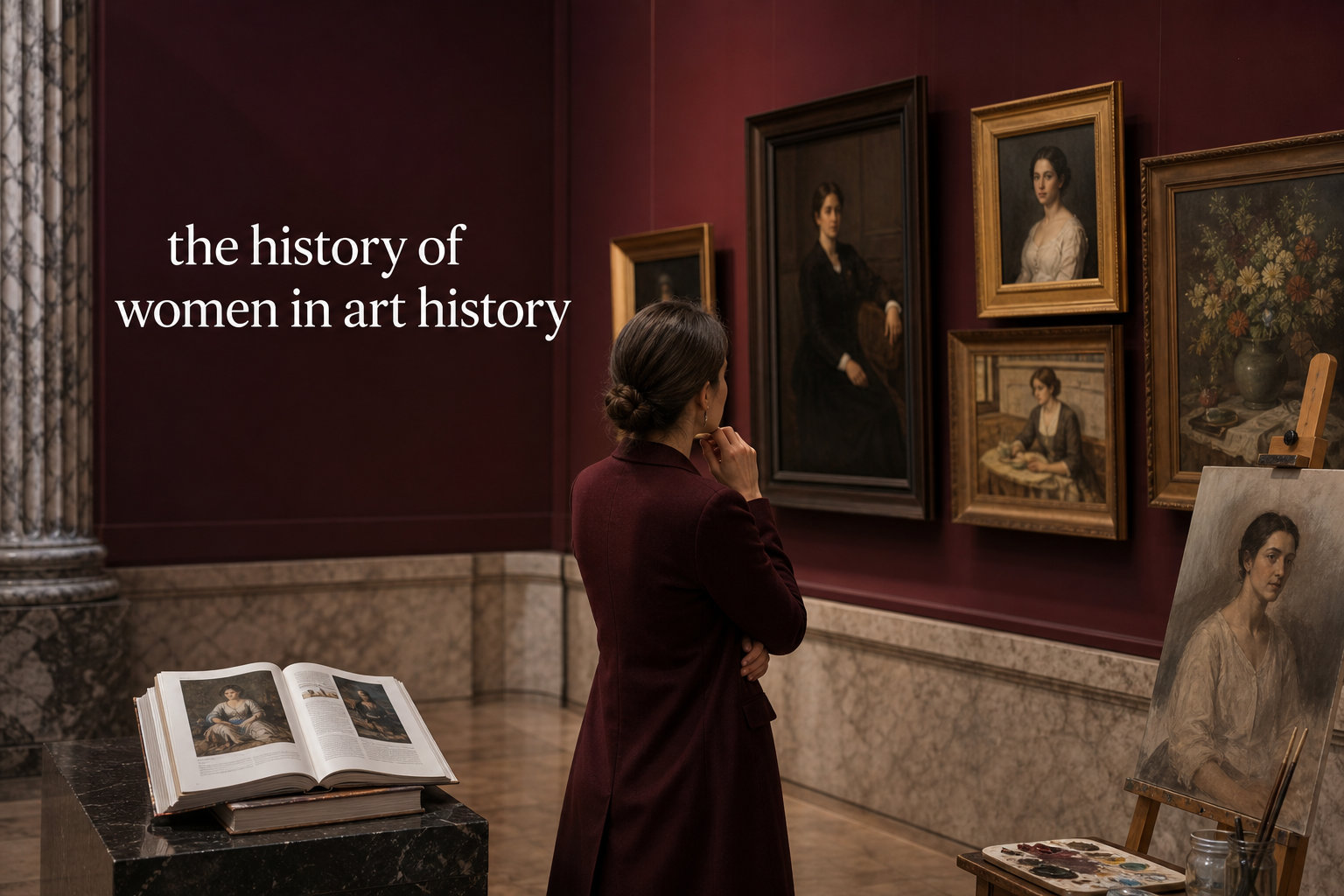
For decades, the story of art history was told as if women barely participated. Textbooks lined up Male Artist after Male Artist, gallery walls displayed work by men almost exclusively, and museum collections reflected centuries of selective memory. But women have always been making art. They painted in ancient workshops, illuminated manuscripts in medieval convents, built careers during the Renaissance despite every possible obstacle, and led some of the most important art movements of the last century. The history of women in art history is not a story of absence. It is a story of erasure, and one that scholars, museums, and readers like you are finally correcting.
Our team spent weeks researching this topic, digging through exhibition catalogues, academic papers, and museum archives to put together a comprehensive guide. What we found was staggering: women artists were not only present in every era, they were often innovators who shaped the very direction of art itself. The problem was never a lack of talent. The problem was a system designed to keep their work invisible.
In this article, we walk through the full arc of the history of women in art history, from the earliest known women painters in ancient civilizations to the contemporary artists commanding museum walls today. We cover the challenges they faced, the movements they helped create, and the feminist scholarship that brought so many of them back into view. Whether you are an art student, a museumgoer, or simply curious about the full picture, this guide gives you the depth that most textbooks skip.
Table of Contents
Women Artists in the Ancient and Medieval Worlds
Long before the Renaissance, women were already creating visual art at the highest levels. The challenge for historians is that most of their work was never signed, was credited to male relatives, or simply did not survive the centuries. But the records that do exist paint a clear picture: women were active, skilled, and in some cases famous in their own lifetimes.
The Earliest Known Women Artists
The ancient Greek writer Pliny the Elder, writing in the first century CE, mentioned several women painters by name in his Natural History. He wrote about Timarete, who painted a portrait of the goddess Artemis at Ephesus. He described Iaia of Cyzicus, a Greek painter working in Rome who specialized in portraits of women and was said to work faster and achieve higher prices than her male competitors. He also named Aristarete, daughter and student of the painter Nearchos. These mentions are brief, but they prove that women were recognized as professional artists in the ancient Mediterranean world.
In ancient Egypt, evidence suggests that women participated in tomb painting and decorative arts. The wall paintings found in elite burial sites show a level of workshop organization where women likely contributed alongside men, though individual attribution was not the practice in Egyptian artistic tradition.
Women in Medieval Convents and Scriptoria
During the medieval period, the convent became one of the most important spaces for women’s artistic production. Nuns in monasteries across Europe created illuminated manuscripts, embroidered textiles, and devotional objects. These works were often unsigned, as was common for medieval art, but convent records and stylistic analysis have identified women’s hands in some of the most beautiful manuscripts of the period.
The most extraordinary example is Hildegard of Bingen (1098-1179), the German abbess, composer, writer, and visionary who created a series of illuminated manuscripts documenting her mystical visions. Her Scivias manuscript contains 35 miniature paintings of incredible complexity and symbolic depth. Hildegard was not formally trained as a painter, yet she directed the creation of these images and may have painted some herself. Her work stands as one of the earliest signed creative outputs by a named woman in European visual art.
In the Islamic world, women contributed to decorative arts, calligraphy, and textile design throughout the medieval period. Persian court records reference women artists working in royal workshops, though specific names are rarely preserved. In China, women calligraphers and painters worked within court traditions, and a few like Guan Daosheng (1262-1319) achieved significant recognition for their bamboo ink paintings.
In Japan, the Heian period (794-1185) saw women producing some of the most celebrated visual works in Japanese cultural history, including illustrated handscrolls. The Tale of Genji scroll paintings, attributed to workshops that included women artists, remain masterworks of Japanese visual art.
Why Ancient and Medieval Women Artists Remain Obscure
The documentation problem is enormous. Most ancient and medieval art was created in workshops where individual attribution was not recorded. When a woman painted within a family workshop or a convent, the work was typically credited to the head of the workshop, the male patron, or the religious institution. Without signatures, names vanish. This does not mean the women did not exist or create. It means the historical record was designed not to remember them.
Renaissance and Baroque: Women Who Defied Convention
The Renaissance is often celebrated as the rebirth of art and learning, but for women, it remained an era of severe restrictions. Art academies did not admit women. Life drawing classes, which were essential for mastering the human figure, were closed to female students because they involved nude models. Guild systems in most Italian and Northern European cities barred women from independent professional practice. And yet, some women found ways through.
Our team found that the most common pathway for women artists during this period was through family workshops. Daughters of painters, sisters of sculptors, and wives of artisans gained access to materials, training, and sometimes clients through their male relatives. A smaller number managed to build independent careers through sheer talent and persistence, often with the support of a progressive patron or ruler.
Sofonisba Anguissola: The First International Star
Sofonisba Anguissola (c. 1532-1625) was born in Cremona, Italy, to a family that believed in educating daughters. Her father actively promoted her work, sending her self-portraits to potential patrons across Europe. She studied with two local painters, which was unusual for a woman at the time, and developed a style of portraiture that captured psychological depth with remarkable subtlety.
Her talent attracted the attention of King Philip II of Spain, who invited her to Madrid to serve as court painter and lady-in-waiting to Queen Elisabeth of Valois. She spent roughly 14 years at the Spanish court, painting portraits of the royal family and teaching the queen to paint. At a time when most women could not even enter a professional workshop, Anguissola was painting monarchs and collecting a royal salary. Her self-portraits, scattered across museums today, are among the most psychologically revealing images of the Renaissance.
Artemisia Gentileschi: Baroque Drama and Defiance
Artemisia Gentileschi (1593-c.1656) is now one of the most recognized women artists in history, but for centuries her work was misattributed to her father Orazio or to other male Baroque painters. She was born in Rome, trained in her father’s workshop, and absorbed the dramatic chiaroscuro style of Caravaggio with extraordinary skill.
Her biography is impossible to separate from her art. At 17, she was raped by her painting instructor Agostino Tassi. The subsequent trial lasted seven months and subjected Gentileschi to physical torture to test her testimony. She survived the trial, won a partial verdict, and went on to build one of the most powerful bodies of work in Baroque painting.
Her painting Judith Slaying Holofernes (c. 1612-1613) is a visceral, unflinching depiction of two women beheading a general. The physical effort, the blood, and the women’s determined faces make it one of the most intense paintings in all of Baroque art. For centuries, art historians dismissed it as a curiosity. Today, it hangs in Naples and is recognized as a masterpiece by any standard. She painted multiple versions of the Judith story, along with scenes of Susanna, Lucretia, and other women from classical and biblical narratives. Her works are now in the Uffizi, the National Gallery in London, and major collections worldwide.
Lavinia Fontana and Properzia de’ Rossi
Lavinia Fontana (1552-1614) was another Bologna-born painter who achieved something no woman before her had: she received major public commissions for large-scale altarpieces. Bologna was unusually progressive for the era, and Fontana benefited from a father who trained her and a husband who supported her career. She painted over 100 documented works, including portraits, mythological scenes, and religious paintings for churches. She was also one of the first women to paint female nudes, though she likely worked from statuary rather than live models.
Properzia de’ Rossi (c. 1490-1530) carved her own path in an even harder medium: sculpture. She trained as a sculptor in Bologna and gained recognition for her intricate carvings on peach pits and eventually marble. Vasari, the Renaissance art historian, included her in his Lives of the Artists, though he spent more time discussing her appearance than her technique. Her marble panel of Joseph and Potiphar’s Wife for the facade of San Petronio in Bologna remains her best-known work.
Judith Leyster: The Misattributed Master
In the Dutch Golden Age, Judith Leyster (1609-1660) built a successful career painting genre scenes, portraits, and still lifes. She was admitted to the Haarlem Guild of St. Luke, making her one of very few women to achieve this professional status. She ran her own workshop, took on students, and produced work of exceptional quality.
But here is the part that reveals how women’s contributions were erased: after her death, virtually all of her known paintings were attributed to Frans Hals or to her husband Jan Miense Molenaer. It was not until 1892 that a curator noticed her distinctive monogram on a painting that had been sold as a Frans Hals original. Her Self-Portrait (c. 1630), now in the National Gallery of Art in Washington, shows her in fine clothes with a relaxed, confident expression, painting a violin player on her easel. It is a statement piece: she is an artist, she is professional, and she is good at her job.
The 18th and 19th Centuries: Salon Painters and Impressionists
By the 18th century, women artists were gaining more visible public profiles, though the barriers remained significant. The French Royal Academy restricted the number of women members. The Salon system, which was the primary venue for exhibiting and selling art in France, was theoretically open to women but biased in practice. And the fundamental restriction on life drawing persisted well into the 19th century, limiting women’s ability to master the figure-based subjects that commanded the highest prices and prestige.
Elisabeth Louise Vigee Le Brun and Angelica Kauffman
Elisabeth Louise Vigee Le Brun (1755-1842) was one of the most successful portrait painters of the 18th century, male or female. She produced over 660 portraits and produced work for the courts of France, Austria, Italy, and Russia. Her most famous subject was Marie Antoinette, whom she painted in dozens of portraits that ranged from formal state images to intimate maternal scenes. When the French Revolution forced her into exile, she simply moved to Rome, then Vienna, then St. Petersburg, painting royalty and aristocracy everywhere she went.
Angelica Kauffman (1741-1807), born in Switzerland, was a child prodigy who spoke multiple languages, painted with technical brilliance, and became one of the founding members of the Royal Academy of Arts in London in 1768. She was one of only two women among the 36 founding members. Her history paintings and neoclassical compositions earned her an international reputation. Yet even as a founding Academician, she was excluded from certain Academy activities because of her gender.
Rosa Bonheur: The Animal Painter Who Broke Every Rule
Rosa Bonheur (1822-1899) became the most celebrated animal painter of the 19th century and the first woman to receive the French Legion of Honour. Her massive painting The Horse Fair (1852-1855), now in the Metropolitan Museum of Art, is over 8 feet tall and nearly 17 feet wide. She achieved a level of technical ambition and commercial success that very few artists of either gender reached.
To study animals accurately, Bonheur visited slaughterhouses and horse fairs, which required her to dress in men’s clothing to move freely and avoid harassment. She obtained an official cross-dressing permit from the French police to do so. She also lived openly with women partners throughout her life, making her an important figure in LGBTQ+ art history as well.
Women Impressionists: Morisot, Cassatt, and Gonzales
The Impressionist movement offered women artists new opportunities, partly because it rejected the academic establishment that had excluded them. Berthe Morisot (1841-1895) exhibited in the first Impressionist exhibition in 1874 and participated in all but one of the eight Impressionist group shows. She was a founding member of the movement, not a follower. Her paintings, characterized by loose brushwork and an intimate focus on domestic life, are now recognized as central to Impressionist aesthetics. During her lifetime, many critics dismissed her work as “feminine” rather than assessing it on its artistic merits.
Mary Cassatt (1844-1926), an American who moved to Paris, was invited by Edgar Degas to join the Impressionist group. She exhibited with them from 1879 onward and became one of the movement’s most distinctive voices. Her paintings and pastels of mothers and children are among the most reproduced images in all of art history. She was also a key advisor to American collectors, helping shape major museum collections in the United States.
Eva Gonzales (1849-1883), a student of Manet, developed her own approach to light and color that was distinct from both her teacher and the broader Impressionist circle. Her career was cut short by her death at 34, shortly after giving birth, but her surviving works show a painter of remarkable ability and originality.
Early Modernism and the Avant-Garde (1900-1950)
The first half of the 20th century saw women artists step into nearly every major movement: abstraction, Dada, Surrealism, Expressionism, and more. Some achieved recognition in their lifetimes. Others watched male colleagues receive credit for ideas they pioneered.
Hilma af Klint: Who Really Invented Abstract Art?
Hilma af Klint (1862-1944) was a Swedish painter who began creating large-scale abstract paintings in 1906, years before Wassily Kandinsky, Piet Mondrian, or Kazimir Malevich produced the works typically credited as the origins of abstract art. Her Paintings for the Temple series consists of 193 works of staggering scale and visual complexity, filled with spirals, orbs, and geometric forms in vivid colors.
She kept these paintings secret during her lifetime, instructing that they not be shown until 20 years after her death. When they were finally exhibited publicly in the 1980s and then in a blockbuster 2018 retrospective at the Guggenheim Museum, the art world was forced to reconsider the entire origin story of abstract painting. Her work draws on spiritualism, science, and mathematics, and it looks startlingly contemporary even today.
Georgia O’Keeffe and the American Modern
Georgia O’Keeffe (1887-1986) is one of the most famous American artists of any gender. Her large-scale flower paintings, New York skyscraper scenes, and New Mexico landscapes are instantly recognizable. What is less discussed is how male critics consistently sexualized her work, reading her flower paintings as anatomical imagery despite her explicit denials. Alfred Stieglitz, her husband and gallerist, actively promoted this sexualized reading as a marketing strategy.
O’Keeffe herself resisted these interpretations fiercely. She painted what she saw and felt, and she wanted the work to stand on its own terms. Her move to New Mexico in 1949 was partly an escape from the New York art world’s reductive framing of her art. She painted prolifically there until near the end of her life, producing landscapes and sky paintings that rank among her best work.
Frida Kahlo: Pain, Identity, and Mexican Culture
Frida Kahlo (1906-1954) has become one of the most recognized artists in the world, but for much of her life she was known primarily as “Diego Rivera’s wife.” She began painting while recovering from a devastating bus accident at 18 that left her with lifelong pain and medical complications. Her self-portraits, which depict her physical and emotional suffering alongside symbols of Mexican folk culture, have become iconic images of resilience and identity.
André Breton described her work as surrealist, but Kahlo rejected the label. She said she painted her own reality, not dreams. Her The Two Fridas (1939), Self-Portrait with Thorn Necklace and Hummingbird (1940), and dozens of other works are now in major museum collections worldwide and have made her a global symbol of feminist art.
Abstract Expressionism: Lee Krasner and Helen Frankenthaler
The Abstract Expressionist movement that dominated the mid-20th century New York art scene included several women of enormous talent, but they were often overshadowed by their more famous male partners and colleagues.
Lee Krasner (1908-1984) was a formidable painter who worked across multiple styles over her career, from cubist-inspired abstractions to large-scale gestural paintings. She was a critical figure in the Abstract Expressionist circle, but during the lifetime of her husband Jackson Pollock, critics consistently framed her as “Pollock’s wife” rather than as an artist in her own right. After Pollock’s death, she preserved his legacy while continuing to produce some of her own strongest work. Her paintings now command millions at auction, though still a fraction of Pollock’s prices.
Helen Frankenthaler (1928-2011) invented the soak-stain technique that defined Color Field painting. She poured thinned paint directly onto unprimed canvas, allowing it to soak into the fabric and create luminous, floating fields of color. Her Mountains and Sea (1952) directly influenced Morris Louis and Kenneth Noland, who are often credited as pioneers of Color Field painting. Frankenthaler’s innovation came first, and it transformed how an entire generation of painters approached the medium.
Other Avant-Garde Voices
Hannah Hoch (1889-1978) was a pioneer of photomontage and a key member of Berlin Dada. Her Cut with the Kitchen Knife (1919) is a massive photomontage that critiques Weimar-era politics and gender roles with razor-sharp wit. She produced hundreds of works over five decades, yet she remains far less known than male Dadaists like Raoul Hausmann or George Grosz.
Sonia Delaunay (1885-1979) co-developed Simultanism, a theory of simultaneous color contrasts that produced vibrant abstract compositions. Her work spanned painting, textile design, fashion, and book arts. She was the first living woman to have a retrospective at the Louvre in 1964, yet her husband Robert Delaunay is often credited as the primary innovator of their shared movement.
Contemporary Women Artists Who Changed the Game (1950-Present)
Since the mid-20th century, women artists have increasingly gained museum recognition, gallery representation, and art market presence. But the gap remains significant. Women still represent a small fraction of artists in permanent museum collections and a fraction of the top auction prices. The artists below represent a range of practices, geographies, and approaches that have reshaped contemporary art.
Judy Chicago and Feminist Installation Art
Judy Chicago (born 1939) created The Dinner Party (1974-1979), a massive triangular installation with place settings for 39 mythical and historical women. Each place setting features an individually designed plate with butterfly and floral imagery rendered in a style that celebrates women’s bodies and experiences. The work was controversial when it premiered, dismissed by some critics as “craft” rather than “art,” but it has since become one of the most iconic works of feminist art ever created. It is now permanently installed at the Brooklyn Museum.
Yayoi Kusama: Infinity and Obsession
Yayoi Kusama (born 1929) has become one of the most popular and commercially successful living artists in the world. Born in Japan, she moved to New York in 1958 and quickly established herself as a force in the avant-garde scene. Her Infinity Mirror Rooms, immersive environments filled with repeating lights, polka dots, and soft sculptures, draw massive crowds at museums globally.
Kusama has lived voluntarily in a psychiatric hospital in Tokyo since 1977, commuting daily to her nearby studio to paint. Her prolific output includes painting, sculpture, installation, performance, and literature. She is currently the highest-selling living woman artist, though the gap between her auction prices and those of male contemporaries like Jeff Koons or Gerhard Richter remains large.
Kara Walker, Jenny Saville, and Shirin Neshat
Kara Walker (born 1969) uses the genteel medium of the Victorian silhouette to create tableaux of violence, sexuality, and racial terror in American history. Her room-sized installations place viewers inside scenes that are simultaneously beautiful and horrifying. Her A Subtlety (2014), a massive sugar-coated sphinx installed in a former Brooklyn sugar refinery, attracted over 130,000 visitors and sparked intense public conversation about race, labor, and memory.
Jenny Saville (born 1970) paints monumental figures that challenge conventional beauty standards and the male gaze. Her fleshy, heavily worked canvases depict bodies that are large, vulnerable, and unapologetically present. In 2018, her painting Propped sold for 12.4 million dollars, setting a record for a living woman artist at auction.
Shirin Neshat (born 1957), an Iranian artist working in photography and video, creates powerful meditations on women’s identity in Islamic culture. Her Women of Allah series overlays photographs of women’s faces with Farsi calligraphy. Her video installations, including Turbulent and Rapture, have been exhibited at the Venice Biennale and major museums worldwide.
Alma Thomas and Global Voices
Alma Thomas (1891-1978) was the first African American woman to have a solo exhibition at the Whitney Museum of American Art, in 1972, at the age of 80. Her vibrant, mosaic-like paintings of color blocks were inspired by nature, space exploration, and her own garden. She taught art in Washington, D.C. public schools for 35 years before devoting herself full-time to painting, proving that it is never too late to make your mark.
Beyond the Western canon, women artists from around the world have produced extraordinary work. Emily Kame Kngwarreye (c. 1910-1996), an Aboriginal Australian artist, began painting late in life and produced over 3,000 works in an eight-year period. Her large-scale abstract paintings of her ancestral land are considered among the most important works of contemporary Australian art. Bharti Kher (born 1969), an Indian artist, uses bindis, the forehead decorations worn by Hindu women, to create massive sculptural and installation works that explore identity, mythology, and the female body.
The Challenges Women Artists Faced Throughout History
Understanding the history of women in art history means understanding the systems that kept women out. These barriers were not accidental. They were built into the institutions, economics, and cultural norms of every era.
Exclusion from Training and Education
The most fundamental barrier was access to training. From the Renaissance through the 19th century, women were excluded from formal art academies. In Europe, this meant they could not attend life drawing classes with nude models, which were essential for mastering figure painting, the most prestigious genre. Without figure painting skills, women were steered toward “lesser” genres like still life, portraiture, and flower painting. These genres were considered less important by the academic hierarchy, which in turn justified the claim that women were less capable artists. It was a closed loop of exclusion.
The Ecole des Beaux-Arts in Paris, the most influential art academy in Europe, did not admit women until 1897. Even then, they were given limited access to studios and models. The Royal Academy in London admitted two women as founding members in 1768 but did not admit another woman until 1922.
Guild Systems and Legal Restrictions
In medieval and Renaissance Europe, guilds controlled professional artistic practice. Most guilds barred women from membership, which meant they could not sign contracts, take on apprentices independently, or sell work through official channels. Women who painted or sculpted professionally often had to work under a male relative’s guild membership. In many countries, women could not own property or enter into contracts in their own name until the 19th or even 20th century, making a professional artistic career legally impossible without male intermediaries.
Misattribution and Erasure
One of the most damaging forms of erasure was misattribution. Works by women were routinely attributed to their fathers, husbands, or male teachers. Judith Leyster’s entire body of work was reassigned to Frans Hals. Artemisia Gentileschi’s paintings were attributed to her father. Many works by women in museum collections may still carry incorrect attributions. When a painting is unsigned, the default assumption has historically been that it was made by a man.
This problem extends beyond individual paintings. Entire artistic traditions, like textile arts, manuscript illumination, and ceramics, were dominated by women for centuries but classified as “craft” rather than “fine art,” excluding them from art historical study altogether.
Museum and Market Disparities
The numbers tell a stark story. According to data from the National Museum of Women in the Arts, work by women makes up only 11 to 13 percent of acquisitions by major American museums. A 2019 study of major U.S. museums found that 87 percent of artists in their collections are men. At auction, the highest price ever paid for a work by a woman artist is a fraction of the record for a male artist. Jenny Saville’s record-setting 12.4 million dollars is remarkable, but it is less than one-tenth of the 450 million dollars paid for Leonardo da Vinci’s Salvator Mundi.
Women earn 70 percent of Bachelor of Fine Arts degrees and 65 to 75 percent of Master of Fine Arts degrees in the United States, according to the National Museum of Women in the Arts. Yet they represent only about 46 percent of working artists. The pipeline is not the problem. The problem is what happens after the degree.
How Feminist Art History Changed Everything
The field of feminist art history emerged in the 1970s and fundamentally transformed how we study, teach, and display art. What started as a challenge to the male-dominated canon became a complete rethinking of what art history is and who it serves.
Linda Nochlin and the Question That Started It All
In 1971, the art historian Linda Nochlin published an essay titled “Why Have There Been No Great Women Artists?” Her answer was not that women lacked talent. Her answer was that the entire system of artistic training, patronage, and recognition was structured to prevent women from achieving greatness. She showed that the question itself was wrong. The real question was: what institutional forces kept women from being recognized?
Nochlin’s essay is now considered one of the most important texts in modern art history. It opened the floodgates for a generation of feminist scholars who began excavating the work of women artists who had been hidden for centuries.
Scholarship, Rediscovery, and Reattribution
Griselda Pollock, another foundational figure in feminist art history, developed methodologies for analyzing how gender, class, and race shape both the production and reception of art. Her work moved beyond simply “adding women” to the existing canon and instead questioned the structures of the canon itself.
Museums began reexamining their collections with fresh eyes. Works that had been attributed to “unknown” or “workshop of” male artists were reassessed. Some were recognized as the work of known women painters. Exhibition programs shifted, with major museums staging solo shows for women artists who had never received them. The 2018 Hilma af Klint retrospective at the Guggenheim attracted over 600,000 visitors, making it one of the most attended exhibitions in the museum’s history.
More recently, Katy Hessel’s book The Story of Art Without Men (2022) offers a popular, accessible retelling of art history that centers women’s contributions. The book became a bestseller and introduced a new generation of readers to artists they had never encountered in traditional survey courses.
Feminist art history has not only recovered individual artists. It has changed how we understand the very conditions of artistic production, the politics of museum display, and the economics of the art market. The work is ongoing, and there is still a long way to go.
FAQs
How have women been portrayed in art throughout history?
Women have been portrayed in art both as subjects and as creators throughout history. As subjects, women appeared in religious paintings, portraits, and mythological scenes, though these depictions were overwhelmingly created by male artists and often reflected male perspectives and ideals. As creators, women produced work across every medium and genre, from manuscript illumination and portraiture to abstraction and installation art, though their contributions were systematically excluded from the art historical canon until feminist scholarship began recovering them in the 1970s.
Why are there so few famous women artists in art history?
There are not fewer women artists. There are fewer famous ones. The difference comes from centuries of exclusion from art academies, guild restrictions, denial of life drawing access, legal barriers to professional practice, and a pattern of misattributing women’s work to male artists. Feminist art historians since the 1970s have recovered hundreds of women artists from erasure, proving that women were creating art at every period in history.
Who was the first known woman artist?
The earliest named woman artist in Western records is Timarete (also spelled Thamyris), a Greek painter mentioned by Pliny the Elder in the first century CE. He wrote that she painted a portrait of Artemis at Ephesus. Other early named women artists include Iaia of Cyzicus, a Greek painter who worked in Rome and was known for her portrait work. In medieval Europe, Hildegard of Bingen (1098-1179) is one of the earliest named women whose visual art survives in documented form.
What is feminist art history?
Feminist art history is a scholarly approach that examines how gender has shaped the creation, reception, and historical documentation of art. It began with Linda Nochlin’s landmark 1971 essay ‘Why Have There Been No Great Women Artists?’ and has since expanded to include the recovery of overlooked women artists, analysis of how gender bias operates in museums and the art market, and critical examination of the traditional art historical canon itself.
What challenges did women artists face in the Renaissance?
Women artists in the Renaissance faced exclusion from art academies and formal training programs, denial of access to life drawing classes with nude models, guild restrictions that barred them from independent professional practice, and legal limitations on signing contracts or owning property. Most women who succeeded did so through family workshops, where they trained under fathers or male relatives. Even highly successful artists like Sofonisba Anguissola and Artemisia Gentileschi navigated restrictions that their male peers did not face.
How many women artists are represented in major museums?
According to data from the National Museum of Women in the Arts, women’s work represents only 11 to 13 percent of acquisitions by major American museums. A 2019 study of major U.S. museums found that approximately 87 percent of artists in their permanent collections are men. This disparity persists even though women earn the majority of art degrees, including 70 percent of Bachelor of Fine Arts degrees and up to 75 percent of Master of Fine Arts degrees.
What is Katy Hessel’s book about?
Katy Hessel’s ‘The Story of Art Without Men’ (2022) retells art history by centering the contributions of women artists from the Renaissance to the present day. The book profiles hundreds of women painters, sculptors, photographers, and installation artists across every major movement and era. It became a bestseller and is widely credited with introducing general audiences to women artists who had been excluded from traditional art history textbooks.
Who are the most influential women artists working today?
Some of the most influential living women artists include Yayoi Kusama (known for Infinity Mirror Rooms and polka dot installations), Jenny Saville (monumental figurative paintings), Kara Walker (silhouette installations exploring race and American history), Shirin Neshat (photography and video exploring Iranian women’s identity), Julie Mehretu (large-scale abstract paintings mapping social and political systems), and Paula Rego (figurative paintings revising traditional narratives). These artists are exhibited in major museums worldwide and are reshaping contemporary art practice.
Conclusion: Why the History of Women in Art History Matters
When we look at the full scope of the history of women in art history, one fact becomes undeniable: women have been creating extraordinary art in every era, in every culture, and in every medium. The gap is not in talent or ambition. The gap is in who got to sign their work, who got to attend the academy, who got reviewed by critics, and who got preserved in museum collections. For centuries, those doors were closed to women by law, by custom, and by institutional design.
What feminist art historians have achieved since the 1970s is nothing short of revolutionary. They have recovered artists who were misattributed, forgotten, or deliberately excluded. They have forced museums to reckon with biased acquisition histories. They have rewritten textbooks that once presented art history as an unbroken chain of male genius. And they have made space for contemporary women artists to enter the conversation on their own terms.
But the work is not finished. Women still represent a small fraction of permanent museum collections. Auction prices for women artists remain a fraction of what male artists command. And art history courses still too often present a token handful of women rather than integrating them fully into the narrative. The history of women in art history is still being written, and every exhibition, every book, and every article that centers women’s contributions pushes the story closer to completeness.
If you take one thing from this guide, let it be this: the next time you walk through a museum, pay attention to whose work is on the walls and whose is not. Seek out the women artists in the collection. Look up the names that were not in your textbook. The art is there, and it always has been. It just needs someone to look.