
You stop on a side street in Lisbon and look up. A four-story stencil of a child holding a balloon stares back at you. No ticket, no velvet rope, no curator’s wall text. Two days later, in a hushed gallery in Mayfair, you stare at a similar image — framed, lit, priced at six figures. Same artist. Same idea. Two completely different worlds. That gap is what the street art vs. gallery art debate is really about.
Table of Contents
Street Art vs. Gallery Art: The Quick Answer
Street art is unsanctioned, public, often anonymous, and made for anyone who happens to walk by. Gallery art is curated, private, archival, and made for an audience that chooses to walk in. Street art’s value lives in context, risk, and message. Gallery art’s value lives in scarcity, pedigree, and the market. Both can be brilliant. Neither is automatically “real” art. The interesting story is how they keep stealing from each other.
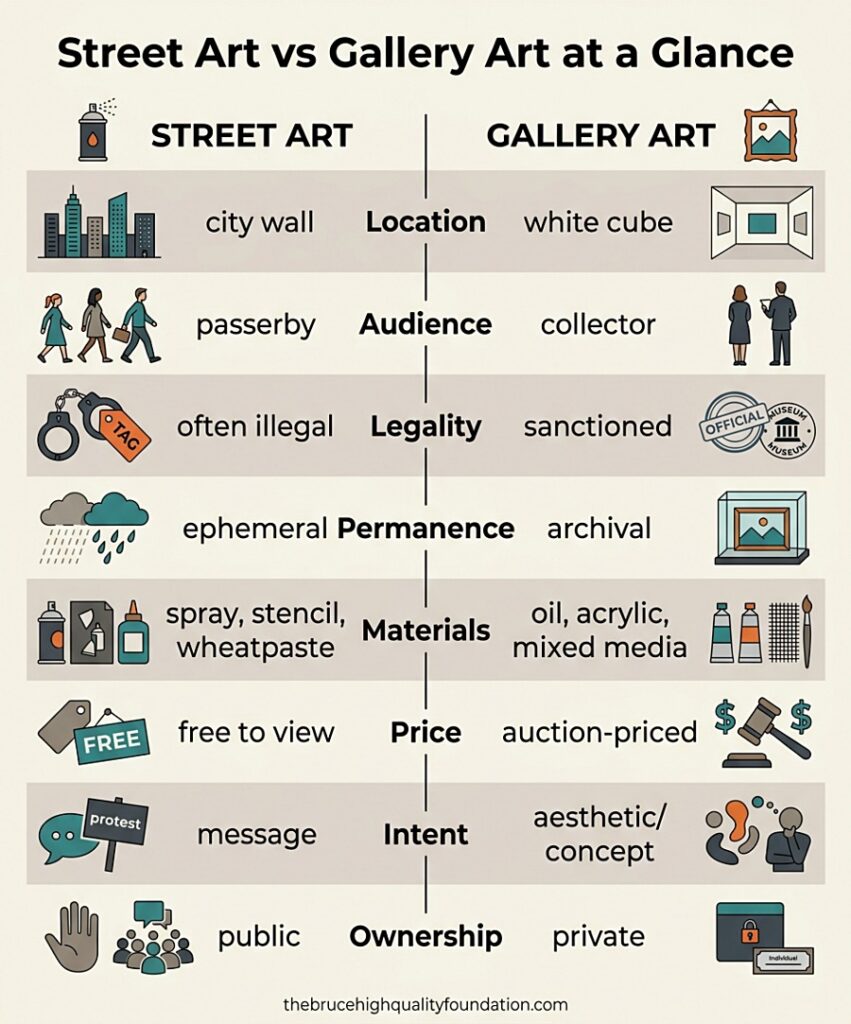
Quick-Glance Comparison
| Feature | Street Art | Gallery Art |
|---|---|---|
| Location | City walls, trains, alleys, rooftops | White-cube galleries, museums, art fairs |
| Audience | Random passersby | Self-selecting collectors and viewers |
| Legality | Often illegal or quasi-legal | Sanctioned and contracted |
| Lifespan | Ephemeral — buffed, weathered, painted over | Archival, climate-controlled, conserved |
| Materials | Spray paint, stencils, wheatpaste, rollers, markers | Oil, acrylic, watercolor, mixed media, sculpture |
| Price to view | Free | Free–expensive (museums, fairs, private viewings) |
| Price to own | Tricky — often unsellable in original form | Defined by market, dealers, auctions |
| Primary intent | Message, protest, presence | Aesthetic, conceptual, collectible |
| Authorship | Often anonymous or pseudonymous | Signed, documented, provenance-tracked |
I’ll unpack every row of that table below — but if you only read this far, you already know more than most.
What Street Art Actually Is (And Isn’t)
Street art is a broad umbrella. According to the Tate’s glossary definition of street art, it’s “related to graffiti writing in that it is created in public locations and is usually unsanctioned, but it covers a wider range of media and is more connected with graphic design.” That last part matters — street art borrowed from punk, conceptual art, advertising, and graphic design, while pure graffiti grew out of hip-hop and tagging culture.
Modern graffiti is usually traced to late-1960s and early-1970s New York City, when young people from marginalized neighborhoods began tagging their pseudonyms on walls and subway cars. Taki 183, a Greek-American messenger whose tag spread across Manhattan, is one of the earliest names anyone remembers.
By the 1980s, street art had branched into stencils, paste-ups, stickers, murals, and installations. Today, it includes everything from a knee-high sticker on a lamp post to a six-story commissioned mural on a hotel facade. The defining trait isn’t the medium — it’s the site. The street is the canvas, and the audience is whoever happens to look up.
The Core Traits of Street Art
- Public access — anyone can see it without permission, payment, or appointment.
- Spontaneity — environmental conditions, time pressure, and risk are part of the work.
- Ephemerality — it’s expected to fade, get buffed, or be painted over. Some artists embrace this.
- Message-first — political, social, communal, or personal commentary tends to outweigh pure aesthetics.
- Anonymity or pseudonymity — many artists keep their legal identities hidden, partly for legal reasons, partly as a stance.
What Gallery Art Actually Is
Gallery art is the umbrella for everything that lives, gets shown, and gets traded inside the institutional art system — commercial galleries, museums, art fairs, auction houses, biennales, and private collections. It includes painting, drawing, sculpture, photography, installation, video, and (increasingly) prints and works on canvas made by street artists themselves.
Gallery art operates on a different set of rules:
- Curation — someone decides what gets shown and how.
- Context control — lighting, wall text, climate, sightlines, and adjacency are all engineered.
- Provenance — every serious work has a paper trail of ownership, exhibition history, and authentication.
- Market structure — primary sales (gallery), secondary sales (auction), and a network of dealers, advisors, and collectors set price.
- Conservation — the work is meant to outlive the artist.
Walking into a gallery is a deliberate act. You went there to look. The artist knows that, and they make work assuming a viewer who is paying attention.
The Real Differences (Beyond the Obvious)
1. Audience Selection
The biggest functional difference between street art and gallery art is who decides to be there. On the street, the audience is random — a kid on a scooter, a commuter on autopilot, a tourist with their camera out. The artist has zero control over context. In a gallery, the audience is self-selecting. People who walk in already opted into the conversation.
This changes the work itself. Street artists tend to make pieces that hit hard and fast — a single image, a punchline, an immediate emotional read — because they have about three seconds before the viewer keeps walking. Gallery artists can ask for ten minutes, twenty, an hour. The pacing of the experience is completely different.
2. Legality and Risk
Most pure street art is, at minimum, unsanctioned. In many jurisdictions it’s straight-up illegal — trespassing, vandalism, or property damage. That risk isn’t a side effect; for a lot of artists, it’s part of the work’s meaning. Doing something at 3 a.m. on a freight train carries a charge that doing the same thing in a studio cannot replicate.
Gallery art is sanctioned by definition. The artist has permission. The piece is insured. Nobody is going to jail. That security is exactly what makes some street purists distrust the gallery — they argue the adrenaline and stakes are part of what makes street art street art.
3. Permanence
A mural on the side of a building has an unknown expiration date. Weather, sun, vandalism, redevelopment, or a city cleanup crew can erase it tomorrow. Many street artists make peace with this and treat ephemerality as part of the medium. Photographs and Instagram archives become the only permanent record.
Gallery art is built to last. Acid-free paper, archival varnishes, climate-controlled storage, conservators on call. A painting at a major institution like the Museum of Modern Art in New York is meant to be viewable in 200 years. That permanence is partly what justifies the price tag.
4. Materials and Tools
| Street Art | Gallery Art | |
|---|---|---|
| Primary tools | Aerosol cans, stencils, wheatpaste & brush, rollers, markers, stickers | Oils, acrylics, watercolors, charcoal, pastel, digital, sculpture media |
| Surface | Brick, concrete, metal, wood, glass | Canvas, panel, paper, board, gallery walls, plinths |
| Speed | Often fast — minutes to hours | Often slow — days to months |
| Reproducibility | Stencils and wheatpaste enable repetition | Each piece is usually unique or in a small edition |
A working street artist’s kit might include Montana or Molotow spray cans, custom caps for line width, pre-cut acetate stencils, a wallpaper paste bucket, and a wide brush. A working gallery painter might be using Winsor & Newton oils, sable brushes, linen canvas, and a maulstick. Same impulse, completely different toolkits.
5. Money and Market
Here’s where it gets uncomfortable. Street art is technically free to view — but original street art is almost impossible to own without literally cutting a piece of building off the wall. So when collectors want street art, they buy canvases, prints, sculptures, and editions that street artists produce for the gallery system. Which means the same artist often has two parallel practices: the unsellable street stuff and the sellable studio stuff.
The numbers got serious fast. In 2020, Banksy’s Game Changer, a tribute to NHS workers, sold at Christie’s for over £16 million, with proceeds going to NHS charities. Jean-Michel Basquiat — who started as the graffiti artist SAMO© on Lower Manhattan walls — has had paintings sell for over $100 million at auction. The street-to-auction pipeline is now a fully formed industry.
6. Intent
Street art tends to push outward — communicating, provoking, protesting, marking territory, or just making a gray wall feel alive. Gallery art tends to push inward — exploring an idea, a feeling, a formal problem, or a personal vision in depth.
That’s a generalization, obviously. Plenty of gallery work is fiercely political, and plenty of street murals are pure decoration. But as a center of gravity, the difference holds: street art is usually about something out loud, while gallery art is often about something more quietly.
A Brief History of How These Two Worlds Collided
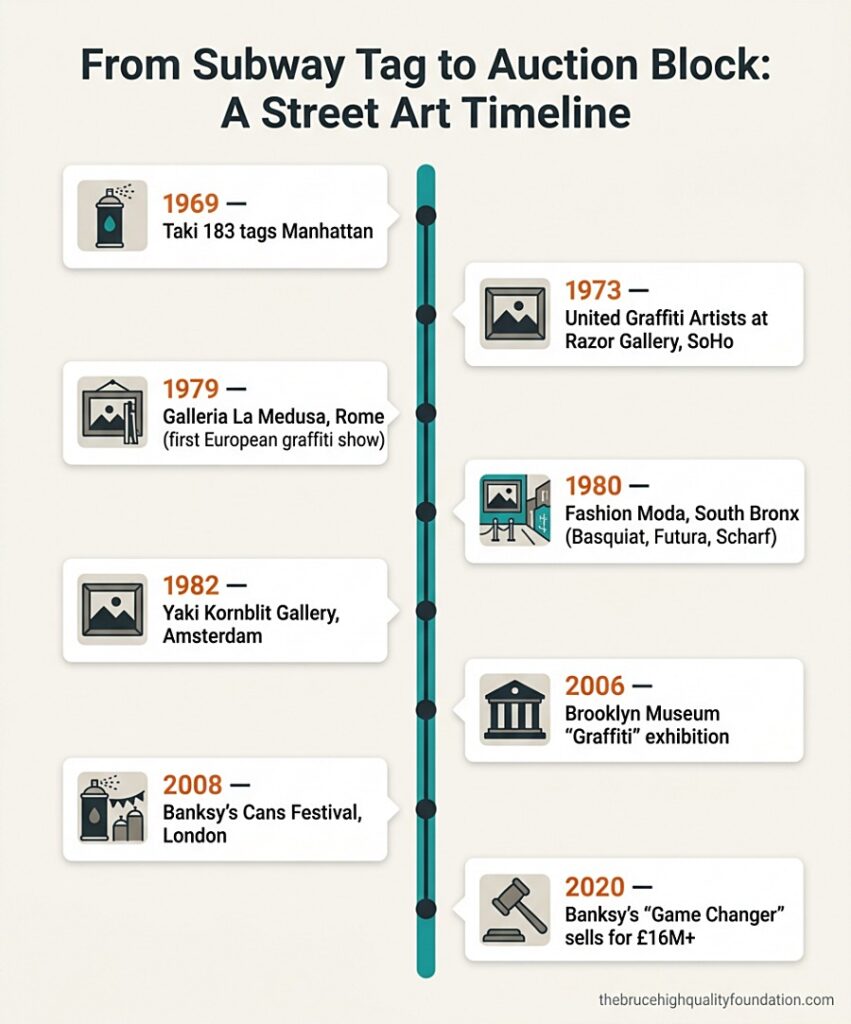
The tension between street and gallery isn’t new. It started almost as soon as the first writers realized people were paying attention.
- September 1973 — The first gallery exhibition of graffiti opens at the Razor Gallery in SoHo, New York, featuring the collective United Graffiti Artists (Hugo Martinez, PHASE 2, Mike 171, SJK 171).
- 1979 — Italian dealer Claudio Bruni shows graffiti at Galleria La Medusa in Rome after buying work “by the square foot” from Lee Quiñones and Fab 5 Freddy. Same year, Hugo Kaagman and Diana Ozon open ANUS Gallery in Amsterdam, the first punk graffiti gallery in the Dutch capital.
- October 1980 — Fashion Moda in the South Bronx hosts one of the most influential early shows mixing graffiti and street art, with Basquiat, Futura 2000, and Kenny Scharf.
- Late 1982 — Yaki Kornblit Gallery in Amsterdam shows Seen, Blade, Futura 2000, and Dondi — the first major American graffiti show in the Netherlands.
- 2006 — The Brooklyn Museum mounts “Graffiti,” a major historical survey of early NYC writers.
- 2008 — Banksy curates the Cans Festival in a London tunnel, briefly turning a public space into an open-air gallery.
- 2020 — Banksy’s Game Changer hammers down at over £16 million at Christie’s.
By the late 2010s, dedicated street-art museums (like STRAAT in Amsterdam) and major institutional shows had become normal. The “is street art real art?” question had quietly answered itself. The harder question — what happens to street art when it stops being on the street? — is the one we’re still arguing about.
Does Street Art Die When It Goes Indoors?
This is the most interesting fight in the whole debate, and there’s no clean answer.
The purist position: Street art is defined by its site, its risk, its illegality, and its impermanence. Strip those away and you’re left with… a painting of street art. The aesthetic is intact but the meaning is gutted. A tag on a subway car is illegal and electric. The same tag on a canvas behind glass is decoration.
The pragmatist position: Artists need to eat. Gallery sales fund the studio that funds the next street piece. Institutional recognition brings the form respect, opens doors for younger writers, and preserves a movement that would otherwise vanish under municipal paint. Galleries don’t kill street art — they document and sustain it.
The honest middle ground: Most working street artists live in both worlds and don’t pretend otherwise. They make spontaneous pieces outside for the love and the message, and they make studio work inside for the rent. The two practices feed each other. The problem isn’t that gallery work exists. The problem is when collectors literally cut Banksy murals off buildings — as happened in England in 2014, when a specialist scaffolding firm removed a Banksy-marked wall section to be sold at a London gallery — because at that point the public has been robbed of a public work.
Street Art vs. Public Art vs. Graffiti: Don’t Mix Them Up
These three terms get thrown around interchangeably and they shouldn’t be. Quick clarifier:
- Graffiti is primarily text-based — tags, throw-ups, pieces, wildstyle — rooted in hip-hop culture and personal name recognition. Almost always unsanctioned.
- Street art is image-led, graphic-design-inflected, and broader in technique. Usually unsanctioned, but more likely to cross over into commissioned work.
- Public art is sanctioned, commissioned, and paid for by cities, developers, or institutions. Sculptures in plazas, light installations on bridges, official murals — that’s public art.
A Banksy stencil on a wall in Bristol is street art. A “TAKI 183” scrawl on a subway car is graffiti. A Konstantin Dimopoulos Blue Trees installation, commissioned by a city, is public art. They overlap, but they’re not synonyms.
The Ethical Knots Nobody Likes Talking About
A few uncomfortable realities:
- Gentrification. Street art gets a neighborhood “discovered.” Cafés open. Rents rise. The communities who made the area interesting get pushed out. Artists who came up in those neighborhoods often end up complicit in the displacement.
- Commodification by brands. Nike, Louis Vuitton, Red Bull and dozens of other corporate brands have hired street artists for campaigns, borrowing the aesthetic of rebellion without any of the risk or message.
- The mural-extraction problem. When a mural becomes valuable, building owners sometimes literally remove the wall and sell it. The original public audience loses access. The work loses context. The collector wins.
- Selective recognition. The art world tends to canonize a handful of street artists (mostly white, mostly male) while overlooking the writers and crews who built the visual language they borrow from.
These aren’t reasons to dismiss street art’s gallery presence — they’re reasons to be honest about what’s happening when a wall gets a price tag.
So Which Is “Better”? My Honest Take
I’ve spent a lot of time in both worlds, and I’ve stopped taking sides. Here’s how I actually think about it:
- If you want immediacy, accessibility, and a pulse, street art is unbeatable. There’s something about turning a corner and finding a piece that wasn’t there yesterday that no curated experience can replicate.
- If you want depth, slowness, and the chance to sit with one idea for an hour, gallery art does something street art can’t. The white cube isn’t sterile — it’s quiet, and quiet is a feature.
- If you want a working artist who survives long enough to keep making things, you probably want both ecosystems to coexist. The street keeps the form honest. The gallery keeps it solvent.
The dichotomy is mostly a marketing convenience. Most serious artists don’t see a wall and a canvas as enemies — they see them as different rooms in the same studio.
Where to See Both (For Real)
If you want to actually look at this debate instead of read about it, here are concrete places to start:
- Tate Modern, London — strong street-art history and contemporary holdings; their art term entry on street art is a good starting point and their archive includes documentation of major shows.
- STRAAT Museum, Amsterdam — purpose-built for street art and graffiti, with a permanent collection of large-scale works by international writers.
- MoMA & MoMA PS1, New York — for the Basquiat-era pipeline from street to canvas.
- Wynwood Walls, Miami — open-air, sanctioned street art at scale.
- Berlin’s East Side Gallery — the longest open-air gallery in the world, on a remaining stretch of the Berlin Wall.
- Lisbon, Bogotá, Buenos Aires, São Paulo, Melbourne — entire cities where street art is woven into the fabric of daily life, no admission required.
Pro Tips From Working Artists
A few things I’ve heard repeatedly from people who actually do this work:
- Don’t romanticize illegality. Getting arrested doesn’t make you a better artist. It makes you a worse-resourced one. Plenty of legendary street artists started with permission walls.
- Document everything. If your medium is ephemeral, your archive is your portfolio. Photograph your work in good light, multiple angles, with and without context.
- Build two practices. Studio work pays for street work. Street work feeds studio work. They’re not opposites; they’re a feedback loop.
- Don’t sneer at the gallery. The white cube isn’t selling out. Selling out is making work you don’t believe in for money. You can sell work you do believe in and stay clean.
- Don’t sneer at the wall. Some of the most original visual thinking of the last 50 years happened on walls before it ever happened on canvas. Gallery snobs who write off street art are missing half the story.
Common Misconceptions
- “Street art is just vandalism.” Vandalism is intent-based and context-based. A racist scrawl is vandalism. A thoughtfully composed mural on a derelict wall, even if technically unsanctioned, is something else. The legal category and the aesthetic category are not the same.
- “Gallery art is for rich people.” Most galleries are free to walk into. You don’t need to buy anything to look. Museums often have free days. The barrier is mostly psychological.
- “Banksy is the only real street artist.” Banksy is famous. He is not the form. Look up Lady Pink, Futura 2000, JR, Swoon, Os Gêmeos, Vhils, Faith47, Shepard Fairey, Lee Quiñones, Dondi, Blade, and a hundred others.
- “You can’t sell street art.” You can sell prints, canvases, books, originals on portable surfaces, and commissioned walls. You generally can’t sell the actual wall — and trying to is where the ethics get ugly.
Frequently Asked Questions
Is street art considered fine art?
Increasingly, yes — though the term “fine art” is itself slippery. Major museums collect street artists, university art departments teach the form, and auction houses sell it for serious money. A purist will say street art stops being street art the moment it enters a gallery, but the broader art world has long since accepted it as legitimate.
What is the main difference between street art and gallery art?
The main difference is context and access. Street art is unsanctioned, public, ephemeral, and aimed at anyone walking by. Gallery art is curated, private, archival, and aimed at viewers who chose to come in. Everything else — materials, price, intent, lifespan — flows from that core difference.
Is graffiti the same as street art?
No. Graffiti is text-based, name-driven, and rooted in hip-hop culture. Street art is image-led, graphic-design-influenced, and broader in technique. They overlap and often share artists, but they aren’t synonyms.
Why is Banksy so valuable?
Scarcity, mystery, and message. Banksy makes relatively few studio works, his identity remains hidden, his pieces consistently land politically resonant punches, and his auction record keeps reinforcing demand. Whether the work justifies the price is a separate question — that’s how markets work for every blue-chip artist.
Can street art belong in a museum?
Yes, but with caveats. Museums can document, contextualize, and preserve street art’s history beautifully. What they can’t do is recreate the original site, risk, or surprise of encountering a piece on a wall at midnight. A museum show is a recordof the form, not a substitute for it.
Is cutting a mural off a wall and selling it ethical?
Most of the art world considers it deeply problematic. The work was made for a specific public site and a specific community. Removing it strips the context, the audience, and often the artist’s consent. Some courts have agreed; in several cases, artists have successfully argued against the sale of their removed works.
Do street artists make money?
Many do, primarily through studio work, commissioned murals, prints, books, brand collaborations, and gallery sales. The pure-street-only artist who makes a living is rare. Most working street artists run a hybrid practice.
Is street art legal anywhere?
Yes — sanctioned walls, permission walls, commissioned murals, and dedicated street art zones exist in cities worldwide. Wynwood (Miami), Shoreditch (London), Kreuzberg (Berlin), and many others have legal walls where artists can paint without risk.
What materials do street artists use?
Most commonly: aerosol spray paint (Montana, Molotow, Ironlak), interchangeable spray caps for line width, pre-cut stencils, wheatpaste with brushes for paste-ups, rollers and house paint for large fills, oil-based markers, and stickers. Studio work expands into canvas, screenprint, sculpture, and digital.
Will street art keep getting more valuable?
The market has been on a long upward curve, but art markets are cyclical. The artists likely to hold value are the ones with strong bodies of studio work, good documentation of their street practice, museum recognition, and a clear conceptual identity. Pure hype-driven names are riskier bets.
The Bottom Line
Street art and gallery art aren’t opposites. They’re two halves of how images move through the world right now — one through public space, one through institutions. Picking a side is mostly a way of avoiding the more interesting question, which is: what does this specific work do, where, and for whom?
The wall and the white cube need each other. The wall keeps the white cube honest. The white cube keeps the wall remembered. Bookmark this guide the next time someone tells you street art “doesn’t count” — or that gallery art is just for snobs. Both takes are lazy. The truth is messier, older, and a lot more fun.
Keep Exploring
- Visit a local street art tour in your city before your next gallery trip — the contrast will sharpen how you see both.
- Follow STRAAT Museum, the Tate, MoMA, and Brooklyn Museum on their official channels for documentation of street art history shows.
- Read Roger Gastman and Caleb Neelon’s The History of American Graffiti if you want the deep timeline.