
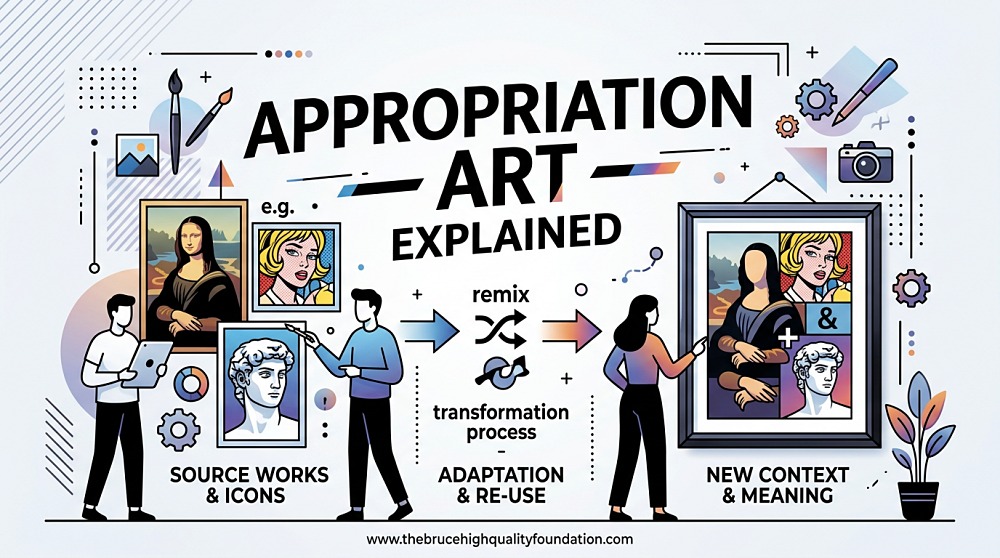
In art, appropriation is the use of pre-existing objects or images with little or no transformation applied to them. The term “appropriation art” refers to works that deliberately borrow, copy, or reuse existing imagery, objects, or ideas to create something new through recontextualization rather than physical alteration. This artistic practice has sparked debates about originality, authorship, and the very definition of art for over a century.
From Marcel Duchamp’s infamous urinal submitted to an art exhibition in 1917 to the current controversies surrounding AI-generated imagery in 2026, appropriation art continues to challenge our assumptions about creativity and ownership. Understanding this movement means exploring not just famous artworks, but the legal battles, philosophical questions, and ethical debates that have shaped modern and contemporary art.
This guide traces appropriation art from its Dadaist origins through Pop Art, the Pictures Generation, and into today’s digital age. Whether you are an artist navigating copyright concerns or an art lover seeking to understand what you see in museums, this exploration will clarify one of art history’s most provocative practices.
Table of Contents
What Is Appropriation Art?
Appropriation art is the practice of incorporating pre-existing objects, images, or concepts into new artworks with minimal modification. The artistic value lies not in creating something from raw materials, but in selecting, positioning, and recontextualizing existing elements to generate new meaning. This approach fundamentally shifted art’s focus from technical craft to conceptual framework.
The movement challenges traditional notions of originality and authorship that dominated Western art for centuries. Where artists once sought to create something entirely new, appropriation artists ask whether selection and context can be as creative as fabrication. This question became central to Conceptual Art and Postmodernism, influencing generations of artists from the 1960s to the present.
Readymades and Found Objects
The term “readymade” was coined by Marcel Duchamp to describe manufactured objects designated as art through the artist’s choice. A urinal, a bottle rack, or a snow shovel could become art simply by being selected, signed, and presented in a gallery context. This concept remains foundational to understanding how everyday objects transform into museum pieces through the power of artistic intention.
“Found object art” (or objet trouve) represents a related practice where artists incorporate natural or manufactured items into their work. While readymades are typically presented as-is, found objects might be combined with other materials or modified slightly. Both practices share the core principle that the artist’s selection and contextualization constitute the creative act, not the physical crafting of the object itself.
Appropriation vs. Plagiarism
The distinction between appropriation art and plagiarism lies in transparency and intent. Appropriation artists openly acknowledge their sources and use them to comment on art, society, or the nature of images themselves. Plagiarism involves presenting someone else’s work as your own original creation, typically hiding the source material and claiming full authorship.
Legal frameworks further differentiate these practices through the concept of “transformative use.” Courts consider whether the new work adds new meaning, expression, or message to the original. Appropriation art often passes this test by commenting on the original work or the broader culture that produced it. Plagiarism fails this test because it merely copies without adding meaningful transformation or commentary.
The Birth of Appropriation: Duchamp and the Readymades
Marcel Duchamp’s submission of Fountain to the Society of Independent Artists exhibition in 1917 marks the pivotal moment when appropriation entered the art world consciousness. The work consisted of a standard porcelain urinal signed “R. Mutt, 1917” and submitted upside-down. Despite the exhibition’s policy of accepting all submissions, the committee rejected this piece, sparking a controversy that continues to resonate in 2026.
Duchamp’s act was not about the object itself but about testing the boundaries of what could be considered art. He argued that the artist’s choice in selecting an ordinary object was sufficient to elevate it to art status. This radical proposition removed the requirement of technical skill or handcrafted uniqueness, replacing it with intellectual and conceptual value.
The Mystery of R. Mutt
The signature “R. Mutt” has generated decades of speculation about its meaning. Duchamp offered various explanations, suggesting it referenced a plumbing equipment manufacturer named Mott or played on the words “mutt” (a common dog) and “mud” (money in French). The pseudonym allowed Duchamp to submit the work anonymously while maintaining plausible deniability about his authorship.
Art historians have proposed additional interpretations of the name. Some suggest “R. Mutt” stands for “Richard Mutt,” while others see it as an anagram or coded reference to Duchamp’s friends and fellow artists. The deliberate ambiguity serves the work’s conceptual nature, inviting interpretation and discussion rather than providing definitive answers.
Elsa von Freytag-Loringhoven: The Authorship Debate
Recent scholarship has challenged the traditional attribution of Fountain solely to Duchamp. Art historian William Camfield and others have presented evidence suggesting the work may have been created by Elsa von Freytag-Loringhoven, an avant-garde artist and Duchamp’s friend. This theory gained traction after the discovery of a 1917 letter from Duchamp to his sister mentioning that “one of my female friends” had submitted a porcelain urinal as a sculpture.
Von Freytag-Loringhoven was known for provocative works using found objects and bodily themes, making the urinal consistent with her artistic practice. She had previously created sculptures from found items and was actively challenging gender norms through her art. If she created Fountain, the work gains additional layers of meaning about gender, authorship, and the art world’s tendency to attribute significant works to famous male artists while overlooking female contributors.
The authorship debate surrounding Fountain illustrates a central theme in appropriation art: who gets credit for selecting and contextualizing an object? Whether created by Duchamp, von Freytag-Loringhoven, or collaboratively, the work’s impact on art history remains undeniable. It opened doors for countless artists to question the relationship between objects, authorship, and artistic value.
The Original’s Disappearance and Legacy
The original Fountain was lost shortly after the 1917 exhibition, likely discarded as trash by someone who failed to recognize its significance. Duchamp later authorized several replicas, which are now displayed in major museums including the San Francisco Museum of Modern Art and the Tate Modern. These authorized copies raise their own questions about authenticity in appropriation art.
Artists have created numerous interventions and homages to Fountain over the decades. Mike Bidlo’s Not Duchamp’s Urinal (2003) presents a fractured version that acknowledges the work’s broken status in art history. Sherrie Levine created bronze replicas that comment on the preciousness assigned to art objects. These meta-appropriations demonstrate how Duchamp’s original gesture continues to generate new artistic responses nearly a century later.
Pop Art and the Commercial Image
Andy Warhol brought appropriation into mainstream consciousness through his embrace of commercial imagery and mass production. His Campbell’s Soup Cans (1962) reproduced product labels with minimal variation, treating advertising graphics as ready-made subjects for fine art. This series questioned the distinction between commercial design and artistic creation that had seemed absolute to previous generations.
Warhol’s Marilyn Diptych (1962) appropriated a publicity photograph of Marilyn Monroe, reproducing it repeatedly across a canvas while varying colors and registration. The work simultaneously celebrates and critiques celebrity culture, mass media saturation, and the commodification of human identity. By using an existing photograph rather than painting from life, Warhol positioned himself as a selector and arranger rather than a traditional portrait artist.
The Factory and Mechanical Reproduction
Warhol’s studio, known as The Factory, employed silkscreen printing to produce images based on photographs of celebrities, disasters, and consumer products. This mechanical reproduction process was itself a form of appropriation, taking the logic of industrial manufacturing and applying it to art production. The Factory’s output deliberately blurred lines between original and copy, unique and multiple.
The artist’s famous declaration that he wanted to be a machine expressed his rejection of the romantic ideal of the solitary genius creating from inner inspiration. Instead, Warhol positioned himself as a conduit for existing images, selecting what already saturated American visual culture and presenting it in new contexts. This approach influenced generations of artists who see the contemporary world as already filled with images waiting to be recontextualized.
Copyright Questions in Warhol’s Work
Warhol’s appropriation practices have generated significant legal controversy that continues to shape copyright law. The recent Supreme Court case Warhol Foundation v. Goldsmith (2026) addressed whether Warhol’s Orange Prince, based on photographer Lynn Goldsmith’s portrait of Prince, constituted fair use. The Court’s decision narrowed the scope of transformative use, ruling that Goldsmith’s copyright was infringed.
This case demonstrates how appropriation art remains legally precarious despite decades of acceptance in art institutions. The ruling suggests that simply changing an image’s aesthetic or presenting it in a new medium may not be sufficiently transformative if the new work serves a similar commercial purpose to the original. Artists working with appropriation in 2026 must navigate these evolving legal standards carefully.
The Pictures Generation: Rephotography and Recontextualization
The Pictures Generation, a group of artists emerging in the late 1970s and 1980s, made appropriation central to their critique of image culture. Sherrie Levine, Richard Prince, Cindy Sherman, and Barbara Kruger examined how photographs construct meaning through existing visual codes rather than capturing transparent reality. Their work responded to a media-saturated environment where most images were already processed and circulating.
These artists questioned whether any photograph could be truly original when cameras capture what already exists. Their answer was to deliberately work with existing images, turning photography’s appropriative nature into a conscious strategy. This generation’s theoretical sophistication made appropriation not just a technique but a method for investigating representation itself.
Sherrie Levine and the After Series
Sherrie Levine’s After Walker Evans (1981) represents perhaps the purest statement of photographic appropriation. Levine rephotographed Walker Evans’s famous Depression-era documentary photographs and presented them as her own work, titled “After Walker Evans” with the original dates. The series asks fundamental questions about authorship, originality, and the gendered nature of art history canon formation.
By rephotographing a canonical male photographer’s work, Levine highlighted how women artists have been historically excluded from museum collections and art historical narratives. The series also questions whether photography can ever produce unique art objects when the medium is inherently reproductive. Levine’s act of copying a copy emphasizes the endless chain of reproduction that characterizes contemporary image culture.
Richard Prince’s Cowboys and Instagram
Richard Prince built his reputation on rephotographing existing advertising images, most famously the Marlboro Man campaign. His Untitled (Cowboy) series (1980s) cropped and rephotographed Marlboro advertisements, removing text and presenting the romantic Western imagery as fine art photography. Prince’s work highlighted how advertising appropriates and mythologizes American culture, then reappropriated those images into art world contexts.
Prince continued this practice into the social media era with his New Portraits series (2014), where he enlarged and printed Instagram screenshots without permission from the original users. This controversial move sparked lawsuits and debates about whether sharing on social media constitutes publication that can be further appropriated. The series tests the boundaries between public and private, sharing and ownership, in digital culture.
Barbara Kruger’s Textual Appropriation
Barbara Kruger developed a distinctive approach combining found photographic imagery with bold text overlays. Works like Your Body Is a Battleground (1989) appropriate mass media photographs and recontextualize them with provocative slogans challenging consumerism, gender stereotypes, and power structures. Kruger’s graphic design background informs her visual language, which appropriates both images and advertising aesthetics.
Unlike Levine and Prince, who often leave appropriated images relatively unchanged, Kruger transforms her source materials through aggressive graphic intervention. The text overlays function as commentary on the images while also mimicking advertising’s persuasive techniques. This approach shows how appropriation can combine existing imagery with new elements to create works that speak back to the sources they borrow from.
Jeff Koons: Appropriation Meets Copyright Law
Jeff Koons has pushed appropriation into three-dimensional sculpture while generating some of the most significant copyright cases in art history. His String of Puppies (1988) reproduced a photograph by Art Rogers showing a couple with eight puppies on a bench. Koons transformed the photograph into a painted bronze sculpture, arguing that his version constituted fair use as a parody of sentimentality in bourgeois taste.
The court disagreed, ruling that Koons had infringed Rogers’s copyright and ordering Koons to pay damages. The decision established that appropriation art does not automatically qualify as fair use simply because it comments on popular culture. For fair use protection, the new work must specifically critique or comment on the original work being appropriated, not just general cultural trends.
Pattern of Litigation
Koons has faced multiple copyright lawsuits throughout his career. His work Niagara (2000) reproduced a photograph by Andrea Blanch without permission, leading to another infringement case. However, in this instance, the Second Circuit Court of Appeals found Koons’s use transformative because it commented on the original image’s themes of female sexuality and gaze.
These cases demonstrate the inconsistent application of fair use doctrine to appropriation art. Similar acts of appropriation have produced opposite legal outcomes depending on how courts interpret the specific relationship between original and new work. For artists, this unpredictability makes working with appropriation a legal gamble that can result in substantial financial penalties.
Pink Panther and Comic Strip Characters
Koons’s sculptures of cartoon characters like the Pink Panther, Popeye, and Gumby raise additional intellectual property questions. These works appropriate trademarked characters owned by media corporations with substantial legal resources. Koons has generally licensed these characters or settled disputes, suggesting that appropriating corporate icons carries higher legal risk than appropriating individual photographers’ work.
The distinction highlights how copyright and trademark law treat appropriation differently. While fair use provides some protection for artistic transformation of copyrighted works, trademark law prioritizes preventing consumer confusion about product source. This legal complexity means that appropriation artists must navigate multiple overlapping intellectual property regimes when selecting source materials.
Copyright, Fair Use, and the Legal Landscape
The legal framework governing appropriation art centers on the fair use doctrine, which permits limited use of copyrighted material without permission under certain circumstances. United States copyright law identifies four factors for determining fair use: the purpose and character of the use, the nature of the copyrighted work, the amount used, and the effect on the market for the original.
Courts have increasingly focused on whether the new work is “transformative,” meaning it adds new meaning, expression, or message rather than merely superseding the original. This concept, derived from a 1994 Supreme Court decision about a 2 Live Crew song parodying Roy Orbison’s “Oh, Pretty Woman,” has become central to appropriation art litigation. However, as the 2026 Warhol Foundation decision demonstrates, transformation is not guaranteed protection.
Warhol Foundation v. Goldsmith: A Turning Point
The Supreme Court’s decision in Warhol Foundation v. Goldsmith (2026) significantly impacted how courts evaluate appropriation art. The case concerned Warhol’s Orange Prince, based on a 1981 photograph by Lynn Goldsmith of the musician Prince. The Warhol Foundation had licensed the image to Condé Nast for a magazine cover, prompting Goldsmith to sue for copyright infringement.
Writing for the majority, Justice Sonia Sotomayor emphasized that fair use must be evaluated in light of the specific commercial context. Since both Goldsmith’s photograph and Warhol’s print could be licensed to magazines for portraits of Prince, they served substantially the same commercial purpose. This reasoning narrowed the transformative use doctrine, suggesting that aesthetic changes alone may not suffice when the works compete commercially.
The decision creates uncertainty for appropriation artists who previously believed that substantial aesthetic transformation would protect their work. It suggests that courts will examine whether the new work substitutes for the original in the marketplace, not just whether it looks different or carries artistic significance. This commercial analysis marks a shift from previous approaches that emphasized artistic meaning over market effects.
Practical Guidelines for Artists
Artists working with appropriation in 2026 should understand that fair use remains a defense rather than a right, meaning it can only be invoked after being sued. The safest approach involves using public domain materials, which are no longer protected by copyright, or obtaining licenses for copyrighted works. Materials published before 1929 are generally in the public domain in the United States, though this date extends periodically.
For works still under copyright, artists should consider whether their use genuinely comments on or transforms the original work specifically, not just related themes. The more the new work critiques the original directly, the stronger the fair use argument. Additionally, avoiding commercial exploitation of appropriated works strengthens legal protection, though this may be impractical for artists who need to sell their work to sustain their practice.
International Perspectives
Fair use is primarily a United States doctrine; other countries employ different frameworks for balancing copyright protection with creative freedom. The United Kingdom recognizes “fair dealing” with more specific permitted purposes than the open-ended American approach. Many European countries protect quotation rights and parody, though these exceptions are often interpreted more narrowly than American fair use.
The European Union’s Directive on Copyright in the Digital Single Market, implemented in 2021, includes provisions for quotation, criticism, and pastiche that could protect some appropriation art. However, the directive’s implementation varies by member state, and litigation remains relatively untested. Artists working internationally should be aware that fair use protection in the United States does not extend to other jurisdictions.
Cultural Appropriation vs. Art Appropriation: Understanding the Difference
The term “appropriation” appears in two distinct contexts that are often confused: appropriation art and cultural appropriation. While both involve taking something from elsewhere, they differ fundamentally in what is being taken and the power dynamics involved. Understanding this distinction is essential for both artists and audiences navigating 2026‘s complex cultural landscape.
Appropriation art involves borrowing visual forms, images, or objects from existing art or commercial culture. The practice operates primarily within art world discourse, engaging questions of originality, authorship, and the nature of images. Cultural appropriation, by contrast, involves members of dominant cultures adopting elements of marginalized cultures without understanding, respect, or compensation, often perpetuating historical patterns of exploitation.
Power and Context
The key difference lies in power dynamics. Appropriation art typically involves artists of relatively equal standing within the art world borrowing from each other or from mass media. While legal and ethical questions arise, the parties generally operate within similar institutional frameworks. Cultural appropriation often involves historically privileged groups extracting value from historically oppressed communities, continuing colonial patterns of resource extraction.
Examples of cultural appropriation in art include non-Native artists painting “in the style of” Indigenous art for commercial sale, or fashion designers using sacred Indigenous patterns without permission or understanding. These acts strip cultural elements from their original contexts and meanings, reducing them to decorative commodities. The harm extends beyond individual artists to entire communities whose cultural heritage is devalued and misrepresented.
When Appropriation Art Crosses the Line
Some works of appropriation art have been criticized for verging into cultural appropriation. Artists who appropriate imagery from cultures not their own without research or engagement with source communities may reproduce harmful stereotypes or spiritual practices. The art world’s emphasis on artistic freedom has sometimes shielded artists from accountability for such harmful borrowing.
Responsible appropriation art requires acknowledging sources, understanding contexts, and avoiding harm to communities whose cultural materials are being referenced. Some contemporary artists have developed collaborative practices that involve source communities in decision-making and share benefits from commercial success. These approaches recognize that creativity does not exist in a vacuum but within networks of relationship and responsibility.
The 70/30 Rule Myth
A persistent myth suggests that changing 70% of an original work makes the new work legal or ethical, often called the “70/30 rule.” No such rule exists in copyright law. Courts evaluate fair use through the four-factor test, not through percentage calculations. Changing 70% of a work while keeping the most distinctive or valuable 30% could still constitute infringement if that 30% represents the work’s core creative expression.
Similarly, no universal ethical standard dictates how much change makes appropriation acceptable. The ethical evaluation depends on context, relationship to source communities, commercial impact, and the nature of what is being borrowed. Artists should focus on understanding their sources deeply and transforming them meaningfully rather than attempting to meet arbitrary percentage thresholds.
AI Art: The New Frontier of Appropriation
The emergence of generative AI tools like Midjourney, Stable Diffusion, and DALL-E has created a new chapter in appropriation art history. These systems learn to generate images by training on vast datasets containing billions of copyrighted images scraped from the internet without permission. The resulting AI-generated images often replicate stylistic elements from specific artists, raising unprecedented questions about appropriation, authorship, and copyright.
In 2026, lawsuits against AI companies are reshaping how we think about appropriation. Artists allege that training AI on their copyrighted works without consent constitutes copyright infringement. The legal question centers on whether using copyrighted images as training data is fair use or whether it requires licenses, a question that existing law does not clearly answer. These cases may establish precedents that govern creative technology for decades.
Training Data and the Scale of Appropriation
What distinguishes AI appropriation from traditional artistic borrowing is scale. While an artist might reference dozens or hundreds of works over a career, AI systems ingest millions of images in training. This massive aggregation raises concerns about collective harm to working artists whose styles may be replicated without compensation. The practice resembles industrial resource extraction more than individual artistic dialogue.
Artists have documented cases where AI-generated images reproduce recognizable elements from copyrighted works, including distinct poses, compositions, and stylistic signatures. Some generated images even contain faint traces of the original artists’ watermarks, suggesting direct copying rather than stylistic learning. These findings suggest that current AI systems appropriate more extensively than their developers acknowledge.
The Artist as Prompt Engineer
Users of generative AI tools become a new kind of appropriation artist, crafting text prompts that guide the algorithm’s output. Prompts might specify “in the style of” particular artists, directly requesting stylistic appropriation. The resulting images remix elements from countless training sources into novel combinations, raising questions about who, if anyone, deserves authorship credit for the output.
Some artists have embraced AI tools as extensions of appropriation practices, using them to explore how meaning emerges from recontextualized imagery. Others reject these tools as fundamentally exploitative, arguing that no aesthetic experimentation justifies the uncompensated use of working artists’ livelihoods. The art world in 2026 remains divided on whether AI-generated work represents the next evolution of appropriation art or its industrial perversion.
Regulatory Responses and Future Directions
Governments and institutions are beginning to respond to AI appropriation concerns. The European Union’s AI Act includes transparency requirements for training data, while some platforms have implemented policies requiring disclosure of AI-generated content. Museums and galleries debate whether to exhibit AI art and under what conditions, considering both artistic merit and ethical implications.
Technological solutions may emerge, including opt-out mechanisms that allow artists to prevent their work from being used in training datasets. Some companies have begun offering compensation frameworks for artists whose work contributes to commercially successful AI outputs. Whether these developments will satisfy critics or merely legitimize existing appropriation practices remains to be seen as the technology and its regulation continue evolving.
Frequently Asked Questions
What does appropriation art mean?
Appropriation art is the practice of using pre-existing objects, images, or ideas in new artworks with minimal transformation. The artistic value comes from selection, recontextualization, and the new meaning generated by placing existing elements in different contexts. Examples include Duchamp’s Fountain, Warhol’s Campbell’s Soup Cans, and Sherrie Levine’s After Walker Evans series.
Does Andy Warhol use appropriation?
Yes, Andy Warhol extensively used appropriation throughout his career. His famous works including the Campbell’s Soup Cans, Marilyn Monroe portraits, and Elvis paintings all appropriate existing commercial photographs and product imagery. Warhol’s Factory used silkscreen printing to reproduce existing images, making mechanical reproduction itself part of his artistic practice.
What is the difference between cultural appropriation and appropriation art?
Appropriation art involves artists borrowing images, objects, or styles from existing art or commercial culture, operating primarily within art world discourse about originality and authorship. Cultural appropriation involves members of dominant cultures taking elements from marginalized cultures without respect or compensation, often perpetuating historical exploitation. The key difference lies in power dynamics and the nature of what is being borrowed.
Who was R. Mutt?
R. Mutt was the pseudonym Marcel Duchamp signed on Fountain, the 1917 urinal he submitted to an art exhibition. Duchamp offered various explanations for the name, suggesting it referenced a plumbing manufacturer or played on words like ‘mutt’ and ‘money’ in French. Some scholars believe the work may actually have been created by Duchamp’s friend Elsa von Freytag-Loringhoven, making R. Mutt potentially her pseudonym.
Is AI art appropriation?
AI art functions as a new form of mass appropriation. Generative AI systems like Midjourney and Stable Diffusion train on billions of copyrighted images without permission, learning to replicate artists’ styles. When users generate images ‘in the style of’ specific artists, they are effectively appropriating those artists’ creative labor. Lawsuits in 2026 are determining whether this training process constitutes copyright infringement or fair use.
Is appropriation art legal?
Appropriation art exists in a legal gray area. Some appropriation qualifies as fair use under copyright law, particularly when it is transformative and comments on the original work. However, many appropriation artists have lost copyright lawsuits, including Jeff Koons in the String of Puppies case. The Supreme Court’s 2026 decision in Warhol Foundation v. Goldsmith narrowed fair use protection, making the legal landscape more uncertain for appropriation artists.
The Enduring Legacy of Appropriation Art
From Duchamp’s porcelain provocation in 1917 to the algorithmic outputs of 2026, appropriation art has consistently challenged what art can be and who gets to create it. The movement shifted focus from technical execution to conceptual framework, from creating new objects to selecting and recontextualizing existing ones. This philosophical repositioning opened doors for Conceptual Art, Pop Art, and countless contemporary practices that question the boundaries between art and everyday life.
The legal battles surrounding appropriation have clarified some boundaries while leaving many questions unresolved. The Supreme Court’s recent narrowing of transformative use in the Warhol case suggests that appropriation artists will face increasing scrutiny in coming years. Meanwhile, AI technology has introduced appropriation at an industrial scale that existing legal frameworks struggle to address. These developments ensure that questions of originality, authorship, and fair use will remain central to art discourse.
You can experience appropriation art firsthand at major museums worldwide. The Museum of Modern Art in New York holds significant works by Duchamp, Warhol, and the Pictures Generation. The Tate Modern in London and San Francisco Museum of Modern Art both display authorized replicas of Fountain. Contemporary galleries regularly show artists working with appropriation strategies, from rephotography to digital collage. As you encounter these works, consider what has been borrowed, what has been transformed, and whether the new context generates meaning worth the appropriation.
Understanding appropriation art means engaging with fundamental questions about creativity in a world already saturated with images. In an era of digital reproduction, social media remix culture, and generative AI, everyone with a smartphone practices some form of appropriation daily. The artists who pioneered this approach decades ago anticipated our current condition, where the challenge is not making something from nothing but finding meaning within the endless flow of existing imagery that surrounds us.