
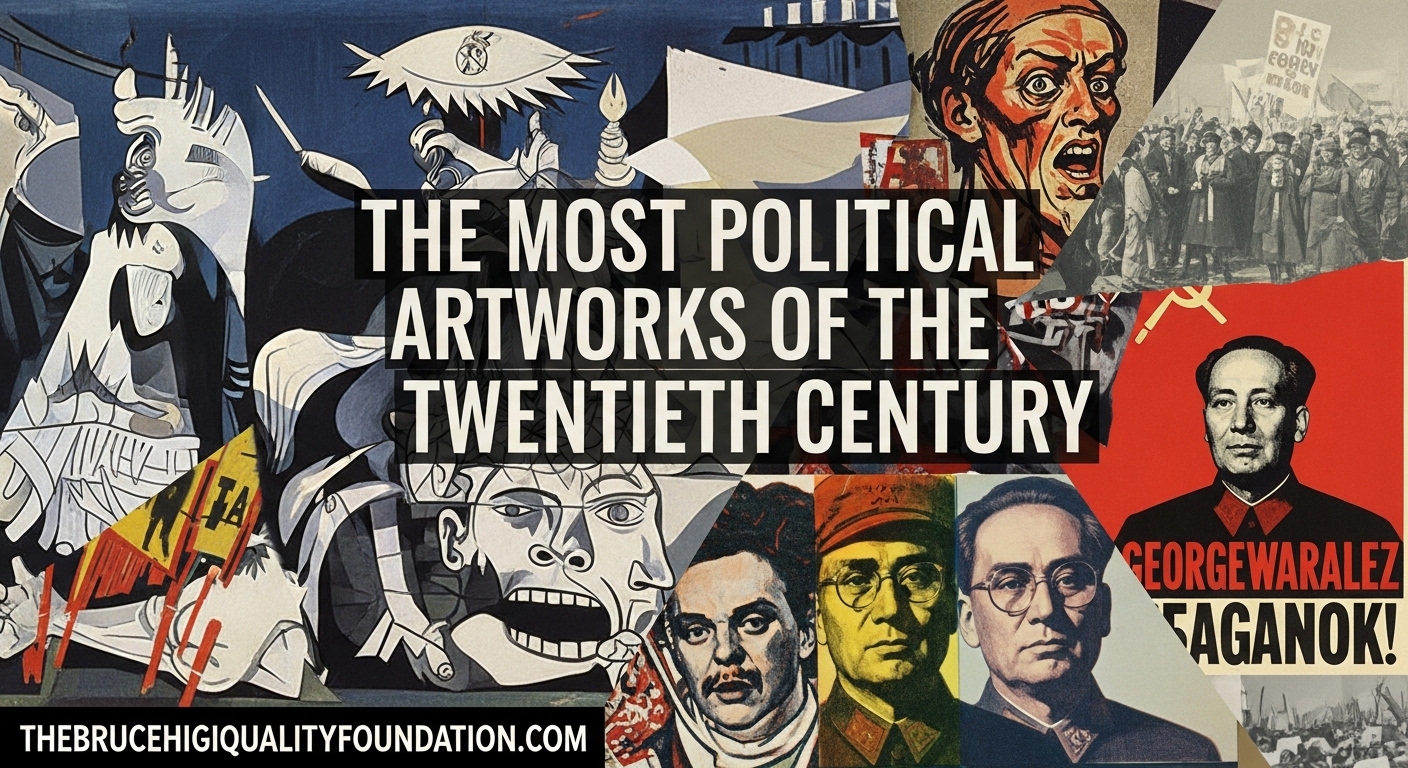
When we entered a museum gallery containing Picasso’s Guernica for the first time, the scale alone hit us like a physical force. This massive canvas, stretching nearly 12 feet tall, does not merely depict the bombing of a Basque town in 1937. It screams. The distorted figures, the wounded horse, the flame-riven woman carrying a dead child through rubble. We spent forty minutes in that room, watching visitors enter silent and leave shaken. That visceral response is precisely what makes political art so powerful. And the twentieth century gave us more than enough material to fuel such art.
The century witnessed two world wars, the Spanish Civil War, the Korean War, the Cold War’s endless standoff, the fall of empires, the rise of fascism, and the persistent fight for civil rights and gender equality. Artists responded to these upheavals not with passive observation but with paint, print, and provocations. The most political artworks of the twentieth century did not simply document history. They challenged it, condemned it, and ultimately helped shape how we remember it.
In this guide, we examine the artworks that transformed political expression into enduring visual testimony. From Picasso’s anti-fascist masterpiece to Barbara Kruger’s feminist manifesto, these pieces demonstrate how art becomes a weapon of dissent, memorial, and warning.
Table of Contents
Historical Context: Wars, Revolutions, and Social Change
The twentieth century opened with artists already engaged in political discourse. Goya’s 1814 painting The Third of May 1808 had established the template: artwork that memorializes violence, names the perpetrators, and honors the victims. By the time Picasso completed Guernica in 1937, the tradition of politically charged art had deep roots.
What changed in the twentieth century was the scale of destruction and the speed of communication. Wars became industrial. Propaganda became sophisticated. Photography allowed unprecedented documentation. And artists, witnessing atrocities through new media, felt increasingly compelled to respond with their own visual testimony.
Art movements emerged directly connected to political ideology. Dadaism rejected the rationality that had led to World War I. Social Realism championed workers and opposed capitalism. Pop Art commentated on consumer culture and Cold War anxieties. Each movement brought tools and techniques that artists deployed for political purposes.
Guernica by Pablo Picasso (1937)
On April 26, 1937, Nazi Germany bombed the Basque town of Guernica at the request of Francisco Franco’s nationalist forces. The attack lasted three hours. Basque civilians died by the hundreds. The town burned. Picasso, who had not yet visited Spain when he accepted the commission to create a large mural for the Paris World’s Fair’s Spanish Pavilion, learned of the destruction and began working immediately.
The resulting canvas measures 11.5 feet tall and 25.3 feet wide. Its monochrome palette creates a stark, almost newsprint quality that makes the imagery feel like documentation even as it transcends into symbol. The central elements are a bull, a horse in agony, a fallen soldier, a woman screaming, and flames consuming everything.
Art historians have debated the specific meaning of each element for decades. The bull may represent fascism or brutality or simply the Spanish spirit. The horse has been interpreted as the innocent people of Spain, innocent and suffering. The soldier’s severed hand holds a broken sword, symbolizing defeat and resistance simultaneously. What is certain is that Picasso built a visual language for horror that transcends the specific event.
Guernica traveled to museums across Europe and the Americas, becoming a touchstone for anti-fascist sentiment. When Franco died in 1975, the painting did not return to Spain until 1981, held hostage by the dictatorship even in death. Today it hangs in Madrid’s Reina Sofia museum, protected behind glass, its meaning still contested but its power uncontested.
The Third of May 1808 by Francisco Goya (1814)
Though created in 1814, Goya’s masterpiece influenced every subsequent political artwork on this list. The painting depicts the execution of Spanish civilians by French soldiers following the Dos de Mayo Uprising in Madrid. Goya witnessed the event from his window and created this response less than two years later.
The composition divides cleanly into two zones. On the left, the French soldiers form a faceless firing squad, their uniforms merging into a single block of mechanical authority. On the right, a man in bright yellow lifts his arms in a gesture of Christ-like surrender. His white shirt tears open. Behind him, other victims await their fate, their faces expressing terror and resignation.
Goya’s genius lies in his inversion of traditional religious painting. The victim becomes the martyr. The executioners become the faceless instruments of imperial power. The bright colors of the victim contrast against the dark masses of the soldiers. This contrast establishes a moral hierarchy that makes interpretation immediate and visceral.
The painting established a template that Picasso, Bacon, and countless others would follow: locate the political violence in a specific moment, honor the victims, condemn the perpetrators, and create an image that communicates across languages and generations.
Massacre in Korea by Francis Bacon (1955)
Francis Bacon never traveled to Korea. He created this painting from secondhand sources: photographs, news reports, and his own nightmares. The resulting canvas measures roughly 4 by 7 feet, showing a cluster of figures pressed against a horizontal format that emphasizes their vulnerability.
The image depicts a group of civilians, including women and children, cornered against a wall by uniformed soldiers. The figures scream. Their bodies distort in ways that suggest both physical and psychological terror. The palette is limited: pale flesh tones against grays and browns, punctuated by the red of blood.
Bacon’s technique involves what he called “accident.” He allowed paint to drip, splash, and pool, creating effects that feel like violence itself made visible. The faces blur into screams that seem to emanate from the canvas itself. Critics have noted the almost cubist fragmentation of the figures, linking Bacon to Picasso while establishing his own unique visual language of horror.
The Korean War (1950-1953) claimed millions of civilian lives. Bacon’s painting does not document specific events so much as it embodies the experience of war’s randomness and brutality. We found that viewers who know nothing about Korea still feel the painting’s impact. The human cry transcends the specific conflict.
Man at the Crossroads by Diego Rivera (1933)
Diego Rivera received a commission in 1932 to paint a mural in the lobby of the RCA Building at Rockefeller Center in New York City. The subject he proposed was Man at the Crossroads, depicting the intersection of science, labor, and political ideology. The Rockefeller family approved the initial sketches.
When Rivera added a portrait of Lenin to the composition, the Rockefellers objected. The artist refused to remove it. The mural was destroyed. Rivera lost the commission. He later recreated the work in Mexico as Man at the Crossroads, but the original was literally scraped from the wall.
The controversy revealed something essential about political art in the twentieth century: money and power have no patience for messages they cannot control. Rivera, who had embraced communism as his political philosophy, saw art as inseparable from economic justice. He painted workers, scientists, and revolutionaries. The Rockefellers saw only propaganda.
The irony persists. Today, photographs and sketches of the destroyed mural are more widely known than any physical work. The controversy itself became the artwork’s legacy, demonstrating that political power will destroy inconvenient messages while inadvertently ensuring those messages persist in alternative forms.
The Survivors by Kathe Kollwitz (1923)
Kathe Kollwitz created The Survivors (also known as The Survivors or Outbreak) in 1923, working primarily in woodcut printmaking. The work depicts a mother figure with two children pressed against her body, her face expressing an emotion beyond simple fear or grief.
Kollwitz lived through the aftermath of her son’s death in World War I. She witnessed the German defeat, the economic collapse, and the political instability that preceded the rise of the Nazi party. Her art increasingly focused on the experiences of working-class families, mothers, and children. She believed that political art must engage with the most vulnerable.
The Survivors seems to ask: what remains after catastrophe? The mother does not look at the viewer. She looks through us toward something beyond the frame. Her body protects her children while her expression suggests a confrontation with an unbearable knowledge. The print technique, with its bold lines and high contrast, gives the image a timeless quality that feels more immediate than many oil paintings from the same period.
We find that Kollwitz’s work is less known than it deserves, perhaps because she worked primarily in printmaking rather than the large-scale oil paintings that dominate museum collections. Her influence on political art in Germany and beyond was profound, yet her name rarely appears alongside Picasso or Rivera in popular discussions of twentieth-century political art.
Your Body is a Battleground by Barbara Kruger (1989)
Barbara Kruger’s 1989 text-and-image work consists of white text on a red background: “Your Body is a Battleground.” The words appear in a typeface typically associated with protest signs and manifestos. The image behind the text shows a woman’s face split down the middle: one side lit normally, the other inverted and darkened.
The work emerged during the AIDS crisis, when women were increasingly recognized as vulnerable to HIV transmission. It also addressed ongoing battles over reproductive rights that continue today. Kruger’s text is confrontational and direct, refusing the subtlety that might allow comfortable viewers to look away.
Kruger understood that political art in the late twentieth century required different strategies than earlier eras. Photography, typography, and mass reproduction allowed messages to spread across surfaces from billboards to bus stops. She worked with commercial printing techniques that would have seemed beneath earlier generations of political artists, embracing the aesthetics of advertising to subvert them.
The phrase “your body is a battleground” has outlasted its specific historical moment. It speaks to ongoing conflicts over bodily autonomy, medical consent, and gender politics. We observe that Kruger’s work remains relevant precisely because it names a persistent condition rather than a temporary crisis.
My God, Help Me Survive This Deadly Love by Dmitri Vrubel (1990)
The Berlin Wall stood for 28 years, dividing families, executing those who attempted escape, and embodying the Cold War’s ideological standoff. When the wall fell in November 1989, artists rushed to document both the wall itself and the overwhelming emotion of its collapse.
Dmitri Vrubel painted My God, Help Me Survive This Deadly Love on the East Side Gallery section of the wall in 1990. The work shows Soviet leader Leonid Brezhnev and East German leader Erich Honecker locked in a kiss. The style is deliberately reminiscent of Soviet propaganda art, with bold colors and simplified forms. The subject matter transforms that style into satire.
We find this artwork notable for its use of irony in political art. Earlier twentieth-century political artworks tended toward direct confrontation. Vrubel and other artists who worked on the Berlin Wall could afford humor because the threat had been defeated. The kiss is simultaneously homoerotic, absurd, and deadly serious. It suggests that the relationship between Soviet and East German leadership was both oppressive and intimate.
The wall has since been demolished, but fragments covered in artwork remain throughout Berlin. Vrubel’s painting has been restored multiple times after damage and decay. Its survival demonstrates that political art often outlives the political conditions that inspired it, requiring new interpretations as history continues.
What Makes Art Politically Powerful
After examining these major works, patterns emerge. The most politically powerful artworks share certain characteristics that transcend their specific subjects and historical moments.
First, they address specific events within universal frameworks. Guernica depicts the bombing of Guernica but speaks to all bombings. The Third of May 1808 shows French soldiers executing Spanish civilians but warns against all occupiers. The specificity grounds the work in historical fact while the universal framing ensures broader resonance.
Second, they honor victims while naming perpetrators. Political art that avoids judgment fails as political action. These works identify who suffers and who causes suffering. They take moral positions rather than presenting false equivalencies.
Third, they use formal innovation to match emotional intensity. Picasso’s cubist fragmentation of forms reflects the fragmentation of Spanish society. Bacon’s dripping technique embodies psychological collapse. Goya’s composition inverts religious painting’s hierarchy to make the powerful the faceless and the victims the heroic.
Fourth, they often face censorship or controversy. Rivera lost his commission. Guernica was withheld from Spain during Franco’s dictatorship. Kruger’s work continues to provoke conservative backlash. The resistance to political art often confirms its effectiveness.
Art Movements and Political Ideology
The twentieth century saw art movements emerge that were explicitly political in their founding principles. Understanding these movements helps contextualize individual artworks within broader movements.
Dadaism arose in Zurich during World War I, rejecting the rationality that artists saw as responsible for industrial-scale slaughter. Dadaist works were deliberately absurdist, using collage, photomontage, and found objects to challenge established aesthetic and political orders. The movement spread to Berlin, where it took on explicitly anti-nationalist characteristics.
Social Realism developed across multiple countries as artists sought to document workers’ lives and promote labor movements. In Mexico, Rivera, Orozco, and Siqueiros created murals that remain among the most significant political artworks in existence. In the United States, artists like Thomas Hart Benton and Grant Wood initially embraced social realism before some turned toward regionalism and abstraction.
Pop Art, emerging in the 1950s and 1960s, commentated on consumer culture, Cold War anxieties, and the increasingly mediated nature of political events. Artists like Roy Lichtenstein and Andy Warhol repurposed commercial imagery to question the relationship between capitalism and political life.
These movements influenced later artists working in graffiti, installation, and performance art. Contemporary political artists like art collectives and collaborative movements continue traditions established by these earlier movements.
FAQ: Political Art in the Twentieth Century
What is considered the greatest piece of political art ever?
Who is the most influential artist of the 20th century?
What are famous examples of protest art?
What are the most important paintings of the 20th century?
How does political art influence public opinion?
The Enduring Power of Political Art
The most political artworks of the twentieth century continue to speak to us because the conditions that created them persist. Wars continue. Authoritarianism rises and falls. Workers organize. Bodies remain contested terrain. The visual strategies these artists developed remain relevant precisely because political conflicts remain with us.
We find that viewing these works in sequence reveals both continuities and evolutions. Goya’s inversion of religious composition echoes in Picasso’s arrangement of victims and perpetrators. Rivera’s mural tradition continues in contemporary community murals. Kruger’s confrontational text appears in today’s protest signs. These artworks do not exist in isolation. They form a conversation across time.
Political art also reminds us that aesthetic choices are political choices. The decision to depict suffering, to honor victims, to name perpetrators, to challenge power structures through visual form is itself a political position. These artists chose to engage rather than observe, to create testimony rather than decoration, to use their skills in service of causes beyond themselves.
For those interested in exploring how art intersects with political power, these works offer starting points. Each leads to networks of related artists, movements, and historical contexts. The study of political art is itself an education in twentieth-century history, offering perspectives that documents and statistics alone cannot provide.
Performance art pieces with political themes offer another avenue for exploring how artists have challenged political authority through creative practice. The boundaries between painting, sculpture, performance, and protest remain productively unclear. You can find examples in our performance art pieces with political themes guide.
The artists discussed here represent only a fraction of the political art produced during the twentieth century. They share commitments to using art as a tool for political engagement, to challenging power structures, and to creating works that remain relevant long after their creation. Their legacy ensures that future generations will continue to find in these artworks not merely historical documents but ongoing confrontations with persistent political realities.
For further exploration of how artists have addressed political themes, consider studying the influential contemporary artists who continue traditions established by these twentieth-century figures, as well as the political art at the Venice Biennale that has showcased national and political statement works throughout the twentieth and twenty-first centuries.