
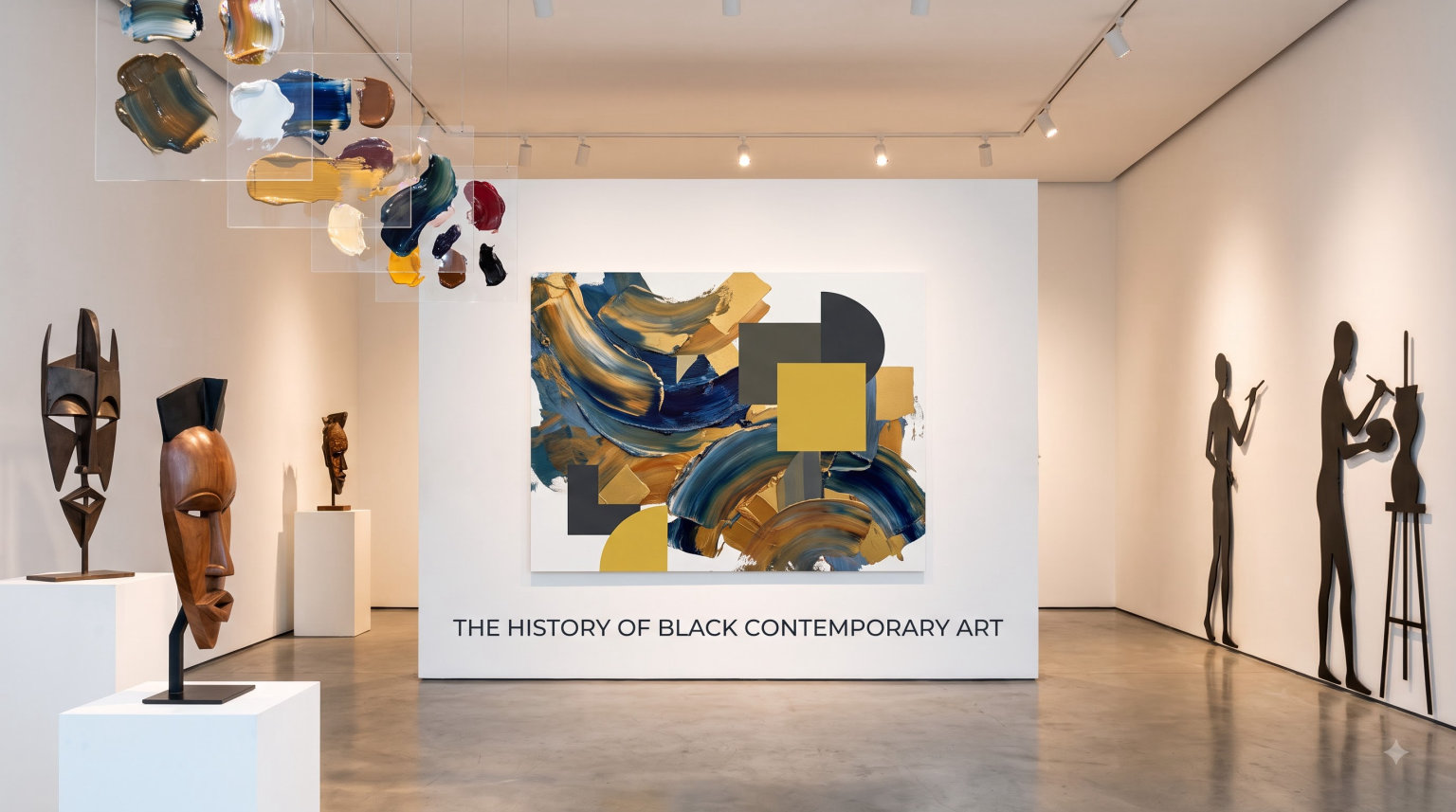
Black contemporary art represents one of the most dynamic and culturally significant movements in modern visual culture. From its roots in the civil rights era to today’s global recognition, this artistic tradition continues to challenge, inspire, and redefine how we understand Black identity and experience through art. If you want to understand how Black contemporary art developed and why it matters, this guide covers everything you need to know.
The story begins not in isolation, but as part of a longer continuum of African American creative expression that stretches back centuries. Our team has spent months researching the major milestones, key artists, and cultural movements that shaped this history. By the end of this article, you will have a comprehensive understanding of how Black artists transformed the contemporary art world and claimed their rightful place in art historical discourse.
Table of Contents
Defining Black Contemporary Art
Black contemporary art encompasses visual artwork created by Black artists from the 1970s to the present day. It is characterized by exploration of Black identity, experience, heritage, and the ongoing fight for representation in the mainstream art world. Unlike general contemporary art, which spans all artists working today, Black contemporary art specifically centers the Black perspective and narrative.
The term covers a wide range of mediums including painting, sculpture, photography, mixed media, installation art, and digital art. What unites these diverse practices is a shared commitment to examining what it means to be Black in the modern world. Many scholars describe this as art that “reclaims visual sovereignty” over images and narratives that have historically been controlled by others.
Understanding contemporary art definitions helps frame why Black contemporary art carved out its own distinct space. While mainstream contemporary art often operates within formally experimental boundaries, Black contemporary artists have balanced innovation with representation, creating work that is both visually compelling and culturally urgent.
Origins: Before the Black Arts Movement
The Harlem Renaissance Foundation (1920s-1930s)
Long before the Black Arts Movement emerged, African American artists were laying groundwork that would prove essential. The Harlem Renaissance of the 1920s and 1930s brought Black artists, writers, and musicians together in New York, creating a flourishing cultural hub. Artists like Aaron Douglas, Augusta Savage, and Jacob Lawrence established that Black artists could command attention and respect in the American art scene.
This period proved that there was both an audience and a market for art celebrating Black life and culture. It also established important institutions that would support future generations. The Schomburg Center for Research in Black Culture became a vital repository for Black historical and artistic achievement.
Post-World War II Context
After World War II, the civil rights movement began gaining momentum, creating new political awareness among Black Americans. Artists like Charles Alston, who worked during this period, used their talents to support the struggle for equality. Murals in Harlem community centers depicted themes of resistance and hope.
However, even as civil rights victories mounted, Black artists remained largely excluded from major galleries and museums. The few who achieved recognition often had their work categorized as “Negro art” rather than simply American art. This marginalization would become a driving force behind the Black Arts Movement that emerged in the mid-1960s.
The Black Arts Movement (1965-1975)
The Black Arts Movement began in 1965, coinciding with the assassination of Malcolm X that year. Unlike the Harlem Renaissance, which had close ties to white patronage and institutions, this movement explicitly rejected outside validation. Artists sought to create work that served Black communities directly, producing what poet Amiri Baraka called “art that is as Black as Black people.”
The movement spanned visual arts, literature, theater, and music, but its visual art wing proved particularly influential. Artists like Noah Purifoy, who co-founded the Watts Artists Workshop, began creating assemblage art from found objects in the wake of the Watts riots. This approach of turning discarded materials into powerful statements about Black experience became a hallmark of the movement.
Key figures during this period included painters like Al Holden and Jae Jarrell, as well as collectives such as the Black art collectives that emerged to provide mutual support and exhibition opportunities. The movement lasted roughly from 1965 to 1975, but its influence continues to shape Black contemporary art practice today.
Key Characteristics of the Movement
The Black Arts Movement was defined by several distinctive approaches. Artists favored bold, figurative imagery over abstraction, often depicting Black bodies as symbols of pride and power rather than objects of gaze. Color palettes drew from African art traditions, using rich earth tones and vivid hues.
Political messaging played a central role, with many works directly addressing issues like segregation, police brutality, and economic inequality. Yet the movement was not monolithic. Some artists created protest art while others focused on celebrating Black family life, spirituality, or historical achievements. This diversity of approach reflected the complexity of Black American experience itself.
Key Artists and Signature Works
Kara Walker and Silhouette Narratives
Few artists have shaped contemporary understanding of Black history quite like Kara Walker. Born in 1969, Walker gained international recognition in the 1990s for her silhouettes depicting antebellum plantation life. Her instantly recognizable style uses stark black cutouts against white walls, creating jarring images that force viewers to confront the violence and complexity of American slavery.
Walker’s work does not offer easy answers. Instead, her silhouettes present scenarios filled with tension, desire, and cruelty, inviting viewers to grapple with uncomfortable truths about American history. Pieces like “A Subtlety” (2014), a massive sphinx made of sugar, brought her work to wider audiences and sparked important conversations about labor, race, and consumption.
Kehinde Wiley and Portraiture Reimagined
Kehinde Wiley burst into mainstream consciousness in 2017 when his portrait of Barack Obama replaced Gilbert Stuart’s famous rendering in the National Portrait Gallery. Wiley is known for his practice of painting contemporary Black individuals in the styles of Old Master paintings, effectively inserting Black presence into art historical lineages that had excluded it.
His series “The World Stage” documents Black individuals from around the world, dressed in contemporary clothing but posed against ornate, patterned backgrounds inspired by various cultural traditions. Wiley’s work challenges viewers to consider whose faces have historically been considered worthy of artistic celebration.
Kerry James Marshall and Everyday Black Life
Kerry James Marshall has spent his career documenting the richness of everyday Black life in America. His paintings feature meticulously rendered scenes of Black families in domestic settings, backyard parties, and church gatherings. Born in Birmingham, Alabama, and raised in Los Angeles, Marshall brings specific geographic and cultural context to his universally resonant scenes.
Marshall is also notable for his frank discussion of the art world’s lack of diversity. He has spoken openly about how difficult it remains for Black artists to achieve museum recognition. His retrospective at the Museum of Contemporary Art Chicago and his acquisition by major institutions represent important steps, but the struggle for representation continues.
Other Influential Voices
The landscape of influential Black contemporary artists extends far beyond these three figures. Faith Ringgold has spent decades creating narrative quilts that chronicle Black American life. Her work addresses themes from the civil rights movement to fairy tale adventures, all rendered in her distinctive story quilt format.
The late David Hammons created powerful works from unconventional materials, from basketball hoops to bottlecaps. His body print works, created by pressing his body into greasy surfaces, explore themes of presence and absence in American society.
You can explore more of these influential contemporary artists and their contributions in our comprehensive guide to the most important voices shaping art today.
Major Themes in Black Contemporary Art
Identity and Representation
Perhaps the central concern running through Black contemporary art is the question of identity. Who gets to be seen? Who creates those images? And who controls the narratives surrounding Blackness? Artists have consistently used their work to assert presence in spaces where Black individuals have been rendered invisible or hyper-visible in negative ways.
This focus on identity extends beyond simple representation. Many artists examine how identity is constructed through intersections of race, gender, class, and sexuality. The work of artists like Lorna Simpson investigates how Black identity is performed, documented, and socially constructed through everyday interactions and institutional frameworks.
Social Justice and Civil Rights Legacy
Black contemporary art maintains deep connections to the civil rights movement that preceded it. Many artists see their work as continuation of the struggle for equality, even as the specific forms of oppression have evolved. The killings of Trayvon Martin, Michael Brown, and other Black individuals prompted urgent artistic responses.
Artists like Theaster Gates have not only created art but have actively worked on urban development projects in Chicago’s South Side. This blurring of artistic practice with community organizing reflects the movement’s origins in grassroots activism. The tradition of using art as a tool for social change remains vibrant today.
African Diaspora and Cultural Heritage
The concept of the African diaspora looms large in Black contemporary art. Many artists explore connections between African and African American experiences, tracing cultural threads that stretch across continents and centuries. This exploration often involves reclaiming and recontextualizing African visual traditions.
Artists like El Anatsui, originally from Ghana but working in Nigeria, create shimmering sculptural works from discarded bottle caps and other found materials. His pieces, which can span tens of feet, evoke both the wealth of African history and the ongoing challenges facing the continent. This ability to work across geographic and cultural boundaries reflects the increasingly global nature of Black contemporary art.
Post-Colonial Perspectives
Post-colonial theory has profoundly influenced how Black contemporary artists approach their work. Rather than accepting Western art historical frameworks as universal, many artists question these frameworks and offer alternative perspectives rooted in their own experiences and cultural traditions.
The Négritude movement of the 1930s and 1940s, though earlier, laid important groundwork for these explorations. Writers like Léopold Sédar Senghor and Aimé Césaire articulated pride in Black heritage and African identity that continues to resonate. Contemporary artists extend these ideas into visual art, exploring what it means to create meaningful work from post-colonial positionalities.
The Evolution to Present Day
Gallery and Museum Recognition
The past two decades have brought significant changes in how major institutions approach Black contemporary art. Museums that once largely ignored Black artists now actively seek out their work for acquisitions and exhibitions. The Museum of Modern Art, the Whitney, and the Guggenheim have all mounted major shows dedicated to Black artists.
However, statistics reveal persistent disparities. A 2019 study by art historian Dr. Chiang-Shan Liu found that major American museums remain overwhelmingly white in their representation. While progress has been made, Black artists still face systemic barriers to entry that their white counterparts do not encounter.
Market Growth and Auction Results
The market for Black contemporary art has experienced remarkable growth. In 2021, a single painting by Kehinde Wiley sold for $450,000 at auction. Works by Kerry James Marshall, Kara Walker, and other artists command ever-increasing prices as collectors recognize the cultural and historical significance of these pieces.
This market growth cuts both ways. On one hand, it validates Black contemporary art as a serious investment category. On the other, some worry that the art market’s commodification could dilute the cultural and political significance that many artists intend. The tension between artistic integrity and market forces remains an ongoing conversation.
Digital Art and New Mediums
Black artists have eagerly embraced digital technologies, creating new possibilities for expression and distribution. From digital painting to video art to interactive installations, Black contemporary artists push against the boundaries of what art can be. Online platforms have also democratized access, allowing artists to reach audiences without traditional gatekeeping by galleries and museums.
Artists like Sydney G. James have used digital platforms to document experiences during the pandemic and protests of recent years. This immediacy and accessibility represents a significant shift from traditional art world hierarchies. The ability to share work directly with audiences through social media has empowered a new generation of Black artists.
Global Perspectives and International Artists
While much discussion of Black contemporary art focuses on the United States, artists of African descent have made vital contributions around the globe. Artists from the Caribbean, Africa, and Europe bring diverse perspectives that enrich the broader field. This international dimension reflects the truly global nature of the African diaspora.
The work of British artists like Lubna Hussain and Canadian artists like Stan Douglas demonstrates that Black contemporary art is not limited to any single national context. Nigerian artist Njideka Akunyili Crosby, now based in Los Angeles, creates large-scale works exploring the experiences of Nigerians living between multiple cultures. Her 2017 work “The Crocodylia” sold for $1 million, signaling growing recognition for international Black artists.
The Ongoing Importance of Black Contemporary Art
Understanding the history of Black contemporary art matters now more than ever. In a time when debates over representation, identity, and systemic racism dominate public discourse, the insights offered by Black artists remain vital. Their work documents struggles, celebrates achievements, and invites all of us to consider perspectives beyond our own.
The art world continues to evolve, with Black artists increasingly visible in major exhibitions and collections. Yet disparities persist, and the work of representation is far from complete. Museums, collectors, and art institutions face ongoing pressure to ensure that Black artists receive the recognition and support they deserve.
For art enthusiasts, students, and anyone curious about American culture, engaging with Black contemporary art offers rewards that extend far beyond aesthetic appreciation. It provides a lens for understanding historical processes, contemporary social dynamics, and the ongoing project of building a more just society. The history documented through these artists’ work is essential reading for anyone seeking to understand the world we share.
FAQs
What is the Black Arts Movement and why was it important?
The Black Arts Movement was a cultural movement spanning roughly 1965-1975 that emphasized artmaking rooted in Black history and identity. Unlike earlier Black arts movements, it explicitly rejected white patronage and sought to create work serving Black communities directly. It established important precedents for Black contemporary art and established that Black artists could build independent artistic traditions outside mainstream institutions.
Who are the most famous Black contemporary artists?
Among the most recognized Black contemporary artists are Kara Walker, known for her silhouette works confronting slavery’s legacy; Kehinde Wiley, famous for his portrait of Barack Obama and paintings inserting Black individuals into art historical traditions; Kerry James Marshall, who documents everyday Black life in America; Faith Ringgold, known for her narrative quilts; and Theaster Gates, who combines artistic practice with community development. Many other important artists like David Hammons, Lorna Simpson, and Njideka Akunyili Crosby also command significant recognition.
How did contemporary African American art begin?
Contemporary African American art emerged from several lineages, most significantly the civil rights movement and the Black Arts Movement of the 1960s and 1970s. Artists like those involved in the Watts Artists Workshop began creating politically engaged work using found objects and bold figurative imagery. The movement built on earlier foundations like the Harlem Renaissance but explicitly sought independence from white-dominated art institutions, establishing its own institutions and support networks.
What defines Black contemporary art?
Black contemporary art is defined by artwork created by Black artists from the 1970s to the present that explores Black identity, experience, and culture. It encompasses various mediums including painting, sculpture, photography, mixed media, and digital art. Key characteristics include examination of Black representation, engagement with social justice themes, exploration of African diaspora experiences, and reclamation of narratives about Black life.
How has Black art influenced modern art?
Black art has profoundly influenced modern art by challenging mainstream perspectives, introducing new subjects and narratives, and pushing against formal boundaries. It has expanded what subjects are considered worthy of artistic attention, from everyday Black life to historical trauma. Artists like Kara Walker and Kehinde Wiley have achieved mainstream recognition that reshapes how art institutions operate. The movement has also inspired broader conversations about diversity, representation, and decolonizing art historical narratives.