
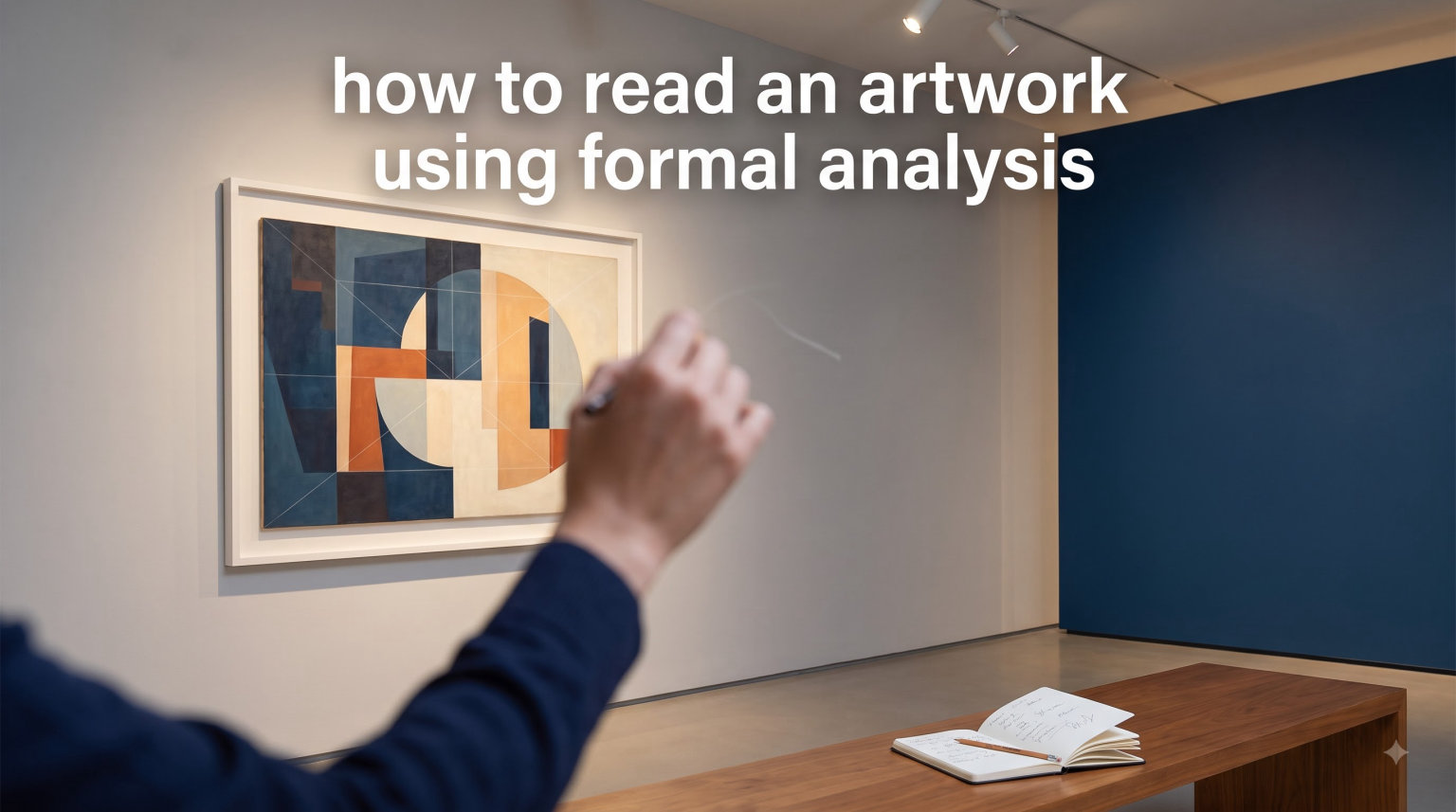
You have probably stood in front of a painting at some point and thought, “I know I like this, but I have no idea why.” That feeling is more common than most people admit. The good news is that reading an artwork is a skill you can learn, and formal analysis is the tool that makes it possible. In this guide, I will walk you through exactly how to read an artwork using formal analysis, even if you have zero background in art history.
Formal analysis is a structured way of looking at art. Instead of jumping straight to “what does this mean?” or “do I like it?”, you start with what is right in front of your eyes. You examine the visual building blocks an artist used, and then figure out how those building blocks work together to create an effect. Think of it like learning the grammar of visual language. Once you know the rules, you can read any artwork fluently.
By the end of this article, you will understand the seven elements of art, the five principles of design, and a clear four-step process for analyzing any piece of art you encounter. Whether you are an art student facing your first essay, a museum-goer who wants deeper engagement, or an artist working on your craft, this framework will change the way you see art.
Table of Contents
What Is Formal Analysis of Art?
Formal analysis is a method of examining an artwork by looking only at its visual qualities, such as line, color, shape, texture, space, and composition, without relying on historical context, the artist’s biography, or outside references. It answers a simple question: what do you see, and how is it organized?
The word “formal” here does not mean stiff or academic. It comes from “form,” meaning the physical and visual properties of the work. When you perform a formal analysis, you treat the artwork as a self-contained object. Every conclusion you draw comes from evidence within the piece itself.
This approach matters because it trains your eyes. Most people glance at art for a few seconds and move on. Formal analysis forces you to slow down and really look. Artists spend hundreds of hours making decisions about every square inch of their work. When you learn to analyze those decisions, you develop a deeper appreciation for art that goes far beyond “I like it” or “I do not get it.”
Formal analysis is different from contextual analysis, which considers the time period, cultural background, political climate, and artist’s personal history. Both approaches are valuable, and they complement each other well. Formal analysis comes first because it grounds everything in what you can actually observe. Contextual analysis adds layers of meaning later.
The 7 Elements of Art You Need to Know
Every artwork, whether it is a Renaissance oil painting, a modern sculpture, or a digital illustration, is built from the same seven visual elements. These elements are the vocabulary of art. When you know how to identify them, you can describe any artwork precisely and clearly.
1. Line
A line is a mark made by a moving point. It is the most basic element of art and often the first thing an artist puts down. Lines can be thick or thin, straight or curved, continuous or broken. They can outline shapes, create texture, suggest movement, or direct your eye across the composition.
When analyzing line in an artwork, look at the types of lines present. Horizontal lines tend to feel calm and stable. Vertical lines suggest strength and formality. Diagonal lines create energy and tension. Curved lines feel organic and flowing. The quality of line, whether it is rough, smooth, bold, or delicate, tells you a lot about the artist’s intent and emotional tone.
Ask yourself: where do the lines start and end? Do they create boundaries, or do they merge with other elements? Are the lines consistent throughout the work, or do they change in different areas? These observations form the foundation of your analysis.
2. Shape
A shape is a two-dimensional area defined by lines, color, or value changes. Shapes fall into two main categories: geometric (circles, squares, triangles) and organic (irregular, free-form shapes found in nature). Every object in a representational painting can be broken down into a collection of shapes.
Pay attention to how shapes interact. Do they overlap? Are they clustered together or spread apart? Large shapes tend to dominate the composition, while smaller shapes can create rhythm and detail. The relationship between shapes often reveals the underlying structure of the work.
3. Form
While shape is flat and two-dimensional, form has three-dimensional depth. A circle is a shape; a sphere is a form. In drawing and painting, artists create the illusion of form through shading, perspective, and highlights. In sculpture and architecture, form is literal and physical.
When you look at a painting, notice how the artist suggests three-dimensionality. Does the form feel solid and weighty, or light and airy? Are the forms clearly defined, or do they dissolve into the background? The treatment of form affects how realistic or abstract the work feels.
4. Space
Space refers to the area within, around, and between objects in an artwork. There are two types to consider. Positive space is occupied by the main subjects or forms. Negative space is the empty area around and between them. Both are equally important in formal analysis.
Artists manipulate space to create depth, focus attention, and establish mood. A composition crammed with elements feels very different from one with generous empty space. In two-dimensional art, techniques like overlapping, size variation, and atmospheric perspective create the illusion of depth on a flat surface.
Many beginners overlook negative space, but experienced viewers know it is just as active as the positive space. The shapes formed by empty areas can create tension, balance, or harmony. Training yourself to see negative space is one of the fastest ways to improve your analysis skills.
5. Color
Color is often the first thing people notice about an artwork, but formal analysis pushes you to go beyond “it is blue” or “the colors are pretty.” Color has three properties: hue (the name of the color), value (how light or dark it is), and intensity (how bright or dull it is).
Consider the color scheme the artist chose. Is it warm (reds, oranges, yellows) or cool (blues, greens, purples)? Is the palette limited to a few colors, or is it wide and varied? Are the colors harmonious or intentionally clashing? The emotional impact of a painting often depends heavily on its color choices.
Also look at how color creates contrast, emphasis, and unity within the composition. A single bright color against a muted background draws the eye immediately. Gradual color transitions can guide the viewer through the work in a specific sequence.
6. Texture
Texture refers to the surface quality of an object, both actual and implied. In sculpture and mixed media, you can often see or feel the actual texture of the materials. In painting and drawing, artists create the illusion of texture through techniques like impasto (thick paint application), stippling, or cross-hatching.
When analyzing texture, consider whether it is smooth, rough, glossy, matte, soft, or hard. Does the texture match what you would expect from the subject, or has the artist deliberately chosen a contrasting texture? Texture adds sensory richness to a work and can make it feel more tactile and real.
7. Value
Value is the lightness or darkness of a color or tone. Even in a full-color painting, value structure is what makes the composition readable. Without value contrast, shapes blur together and forms lose definition. With strong value contrast, elements pop forward and the composition gains drama.
Squint at any artwork and you will see its value structure more clearly. This trick strips away color and forces you to see the arrangement of lights and darks. High-contrast value schemes tend to feel dramatic and bold. Low-contrast schemes feel subtle and quiet. The distribution of values across the composition is one of the strongest tools an artist has for directing attention.
The 5 Principles of Design That Organize Art
Elements are the raw materials of art. Principles are how artists arrange those materials. Think of elements as ingredients and principles as the recipe. Understanding the principles of design lets you see not just what is in an artwork, but why it is arranged the way it is.
1. Balance
Balance refers to how visual weight is distributed across a composition. There are three main types. Symmetrical balance means both sides mirror each other, creating a sense of stability and order. Asymmetrical balance uses different elements on each side that still feel visually equal, creating more dynamic tension. Radial balance arranges elements around a central point, like the spokes of a wheel.
When you analyze balance, ask yourself: does the composition feel stable or precarious? Is the visual weight concentrated in one area, or spread evenly? Does the artist use size, color, value, or position to create balance?
2. Contrast
Contrast is the juxtaposition of opposing elements: light against dark, rough against smooth, large against small, warm color against cool color. Without contrast, a composition would be flat and monotonous. Contrast creates visual interest and helps important elements stand out.
Look for areas of strong contrast in the artwork. These are usually where the artist wants your eye to go. The degree of contrast also sets the mood. Sharp, extreme contrast creates drama. Gentle, subtle contrast creates calm.
3. Emphasis and Focal Point
Emphasis is the principle of making one element stand out above the rest. The focal point is the specific area where emphasis is strongest. Most artworks have a clear focal point, and the artist uses various tools to draw your attention there: contrast in value, color, size, shape, or placement.
When analyzing emphasis, identify the focal point first. What did the artist do to make it stand out? Then trace how other elements lead your eye toward it. Lines, edges, color gradients, and even the direction of figures’ gazes can all point toward the focal point.
Some works deliberately avoid a single focal point, spreading emphasis across the entire surface. This is a choice too, and it creates a different kind of viewing experience. Jackson Pollock’s drip paintings are a classic example of evenly distributed emphasis.
4. Rhythm and Movement
Rhythm in art works much like rhythm in music. It is the repetition of elements, such as colors, shapes, or lines, that creates a visual tempo. Regular rhythm repeats elements at consistent intervals, creating predictability and calm. Alternating rhythm switches between different elements, adding variety. Progressive rhythm changes gradually, like shapes getting larger as they move across the canvas.
Movement is how the artist guides your eye through the composition. Diagonal lines, curved forms, and gradual value changes all create a sense of motion. When you analyze rhythm and movement, try tracing the path your eye follows when you first look at the work. That path is no accident.
5. Unity and Variety
Unity is the sense that all parts of an artwork belong together, that nothing feels random or out of place. Artists create unity through consistent color palettes, repeated shapes, similar textures, or a dominant value scheme. Unity makes a composition feel cohesive and complete.
Variety is the counterpoint to unity. Too much unity becomes boring. Too much variety becomes chaotic. The best artworks find a balance between the two, creating interest without losing coherence. Some artists follow what is called the 70/30 rule: roughly 70 percent unity and 30 percent variety. This ratio keeps a work unified while still surprising the viewer.
How to Read an Artwork Using Formal Analysis: A Step-by-Step Guide
Now that you know the vocabulary, it is time to put it into practice. The following four-step framework will help you move from a blank stare to a thoughtful, structured analysis. This is the same approach used in art history classrooms and museum education programs around the world.
Step 1: Describe What You See
Start with pure observation. No interpretation, no judgment, no background knowledge. Just describe what is physically present in the artwork as if you are explaining it to someone who cannot see it.
List the subject matter: figures, objects, landscapes, abstract shapes. Note the medium (oil on canvas, charcoal on paper, bronze sculpture) and the dimensions if available. Identify the dominant colors, the types of lines, the textures, and the overall arrangement.
This step is about building a factual foundation. Many people skip it because it feels too basic, but it is actually the most important step. Without accurate description, your analysis will be built on shaky ground. Take your time here. Spend at least five minutes just looking before you write anything.
Step 2: Analyze How Elements Work Together
Once you have described the elements, examine the relationships between them. This is where the principles of design come in. Ask yourself how the artist used balance, contrast, emphasis, rhythm, and unity to organize the composition.
Look for patterns and deliberate choices. Why did the artist place the focal point where it is? How does the use of space affect your experience of the work? What role does color play in creating mood or directing attention? How does the value structure create depth?
This step is the core of formal analysis. You are connecting the “what” from Step 1 to the “how.” Every claim you make should be supported by specific visual evidence. If you say the composition feels tense, point to the diagonal lines or clashing colors that create that tension.
Understanding how artists borrow and recombine visual strategies across movements and eras adds another layer to this step. Many formal strategies repeat throughout art history, and recognizing them sharpens your eye.
Step 3: Interpret the Meaning
Now you can bring in interpretation. Based on your observations and analysis, what ideas, emotions, or messages does the artwork communicate? This is where you move from describing and analyzing to making a case for what the work means.
Keep your interpretation grounded in the visual evidence you gathered in Steps 1 and 2. Avoid wild speculation or bringing in outside knowledge that is not visible in the work itself. A strong formal interpretation sounds like this: “The harsh contrast between the bright foreground figure and the dark, undefined background creates a sense of isolation and vulnerability,” not “I think the artist was sad when they made this.”
Step 4: Evaluate the Work
Evaluation is the final step, and it asks you to make a judgment about the artwork’s effectiveness. Does the piece succeed on its own terms? Does the composition achieve what it seems to set out to do?
This is not about whether you personally like or dislike the work. It is about whether the formal choices are coherent, effective, and meaningful. A painting can be technically impressive but emotionally flat. An abstract work can be visually simple but formally brilliant. Evaluation requires you to articulate why a work succeeds or falls short based on the evidence you have gathered.
Be specific. Instead of saying “the composition works well,” say “the asymmetrical balance between the large dark mass on the left and the smaller bright elements on the right creates a dynamic tension that keeps the viewer engaged.”
Formal Analysis vs. Contextual Analysis: What’s the Difference?
This distinction confuses a lot of beginners, so let me make it crystal clear.
Formal analysis looks only at what is inside the frame. It examines visual elements and design principles. Your evidence comes entirely from the artwork itself. If you can see it, you can analyze it formally.
Contextual analysis looks outside the frame. It considers when and where the work was made, who made it, what was happening in the world at the time, what artistic movement it belongs to, and how audiences have responded to it over time. Your evidence comes from historical records, artist statements, critical reviews, and cultural research.
Neither approach is better than the other. They answer different questions. Formal analysis tells you what the artwork does visually. Contextual analysis tells you what it means within a larger cultural framework. Most art historians use both, but formal analysis almost always comes first because it establishes a baseline of observable facts before you start layering on context.
If you are writing an art history paper, a good rule of thumb is to spend roughly the first half on formal analysis and the second half on contextual analysis. This structure shows your professor that you can see the work clearly before you start interpreting it through a historical lens.
5 Common Mistakes Beginners Make When Analyzing Art
After years of looking at art and teaching others to do the same, I see the same patterns come up over and over. Here are the five most common mistakes and how to fix them.
Mistake 1: Skipping Description and Jumping to Interpretation
This is the number one error. People want to talk about meaning before they have fully described what is in front of them. The result is vague, unsupported claims. Spend more time on Step 1 than you think you need. Build a thorough factual description first, and every subsequent step will be stronger.
Mistake 2: Confusing Personal Opinion with Formal Observation
“I like this painting” is not analysis. Neither is “this painting is beautiful.” Formal analysis requires you to make claims supported by visual evidence. Instead of “the colors are nice,” try “the limited palette of cool blues and grays creates a somber, restrained mood.” The second statement is arguable, specific, and grounded in what you can see.
Mistake 3: Using Technical Vocabulary Incorrectly
It is tempting to throw around terms like “chiaroscuro” and “sfumato” to sound knowledgeable. But using these terms incorrectly is worse than not using them at all. Master the basics first: line, shape, form, space, color, texture, value. Once you can use these seven terms accurately and consistently, you can gradually add more specialized vocabulary.
Mistake 4: Ignoring Negative Space
Most beginners focus exclusively on the main subject and treat the background as unimportant. But negative space is a crucial compositional tool. The shape and size of empty areas affect the mood, balance, and visual tension of the entire work. Train yourself to look at what is not there, not just what is.
Mistake 5: Rushing Through the Looking Process
Formal analysis takes time. A thorough analysis of a single artwork should take at least 15 to 30 minutes of concentrated looking before you write a single word. Many mistakes come from simply not spending enough time with the work. Slow down. Let the artwork reveal itself gradually. The best insights come after sustained, patient observation.
Practical Tips for Building Your Art Analysis Skills
Like any skill, formal analysis improves with practice. Here are some strategies that I have found effective for building observation skills over time.
Start a daily looking practice. Set aside 15 to 30 minutes each day to study a single artwork. You can use online museum collections, art books, or works you encounter in person. The consistent practice matters more than the duration. After a few weeks, you will notice that you see details faster and describe them more precisely.
Keep an analysis journal. Write down your observations in a notebook dedicated to art viewing. Date each entry and note the artwork’s title, artist, and medium. Over time, this journal becomes a record of your developing eye and a valuable reference you can revisit.
Use a quick-reference checklist. When you are starting out, having a physical checklist of the seven elements and five principles helps you stay systematic. Run through the list every time you encounter a new work. Eventually the process becomes second nature and you will not need the list anymore.
Study alongside others. Art analysis benefits enormously from conversation. Join a gallery walk, take a class, or find an online community where people discuss art. Seeing how others observe the same work reveals blind spots in your own looking and introduces you to perspectives you might never have considered. The collective energy of art communities has always been a catalyst for deeper understanding.
Read art criticism. Engaging with published criticism shows you how experienced writers translate visual observation into prose. Look for writers who ground their interpretations in specific formal details rather than sweeping generalizations. Over time, you will absorb their habits and develop your own analytical voice.
FAQs
What are the 4 aspects of formal analysis?
The four aspects of formal analysis are description, analysis, interpretation, and evaluation. Description identifies what is visibly present in the artwork. Analysis examines how the visual elements and principles of design work together. Interpretation explores what the artwork communicates based on the formal evidence. Evaluation judges the overall effectiveness and coherence of the work.
How do you write a formal analysis of art?
To write a formal analysis, start by thoroughly describing the artwork’s visual elements (line, shape, form, space, color, texture, value). Then analyze how the principles of design (balance, contrast, emphasis, rhythm, unity) organize those elements. Next, interpret what the work communicates based on your visual evidence. Finally, evaluate the overall success of the piece. Support every claim with specific observations from the artwork itself.
What is the 70/30 rule in art?
The 70/30 rule in art suggests that a strong composition contains roughly 70 percent unity and 30 percent variety. This means most of the work should feel cohesive and connected through consistent elements like color, texture, or style, while about 30 percent introduces contrast, surprise, or visual tension to keep the viewer engaged.
What is the difference between formal analysis and contextual analysis?
Formal analysis examines only the visual elements and design principles within the artwork itself, relying on what you can directly observe. Contextual analysis considers outside factors such as the artist’s biography, the historical period, cultural influences, political events, and critical reception. Formal analysis focuses on what you see; contextual analysis focuses on the circumstances surrounding the work’s creation and reception.
How do beginners start analyzing art?
Beginners should start by learning the seven elements of art (line, shape, form, space, color, texture, value) and the five principles of design (balance, contrast, emphasis, rhythm, unity). Practice describing what you see in an artwork before trying to interpret it. Use a checklist of elements and principles to guide your observation. Spend at least 15 minutes looking at a single work before writing anything down. Consistent daily practice builds the skill over time.
Start Reading Art with Fresh Eyes
Learning how to read an artwork using formal analysis changes your relationship with art. You stop being a passive viewer and become an active participant in the experience. Every painting, sculpture, and photograph becomes a puzzle waiting to be understood, a conversation between the artist’s choices and your observations.
The framework is straightforward: describe what you see, analyze how the elements and principles work together, interpret the meaning based on visual evidence, and evaluate the work’s effectiveness. The skill comes with practice, and the practice is genuinely rewarding. If you want to continue developing your art writing skills, check out our guide to art criticism techniques as a natural next step. For those interested in the broader context of art education institutions and how they shape the way we learn about art, we have that covered too.
Pick an artwork today, any artwork, and spend 15 minutes with it using the steps in this guide. You will be surprised by how much you see that you never noticed before.