
No, the art world is not a single, organized scam — but it does contain more legal scams, near-scams, and outright fraud than almost any other multi-billion-dollar market on earth. The global art market moved roughly $65 billion in 2026, yet it operates with fewer regulations than used cars. Forgery, price manipulation, money laundering, phishing, and gallery games are all real and documented. Calling the whole thing a scam is wrong. Calling it clean is also wrong. The truth lives in the middle, and this guide walks you through every part of it.
| Question | Honest Answer |
|---|---|
| Is contemporary art priced fairly? | Rarely. Prices are set by a tiny circle of dealers, advisors, and auction specialists. |
| Are there real forgeries on the market? | Yes — one major book estimates 20–40% of art on the market is forged. |
| Is money laundering happening? | Yes, documented by U.S. Senate reports and FBI cases. |
| Are most artists being ripped off? | Often, yes — galleries take 50% and can drop you at any time. |
| Should you ever buy art? | Yes, if you buy what you love, not what you’re told is “an investment.” |
Table of Contents
Why People Keep Asking If the Art World Is a Scam
I’ve been around art markets long enough to know this question comes from a real place. You see a banana taped to a wall sell for $6.2 million. You see a Basquiat scribble fetch $110 million. You read about Damien Hirst backdating his own shark sculptures. You watch a YouTube essay calling the whole thing a money-laundering racket. And then you walk into a local gallery, see a beautifully painted landscape priced at $400, and wonder why the universe makes no sense.
It’s not just you. Comedian Adam Conover’s “Adam Ruins Everything” segment calling the fine art market a scam crossed a million views in a day. Wendover Productions made a similar video. Even Artnet News — an industry publication — admitted Conover got several things right, and several things wrong.
So let me break down what’s actually true, what’s exaggerated, and what’s worse than people realize.
What’s Actually Real: The Five Genuine Scams Inside the Art World
1. Forgery — And It’s More Common Than You Think
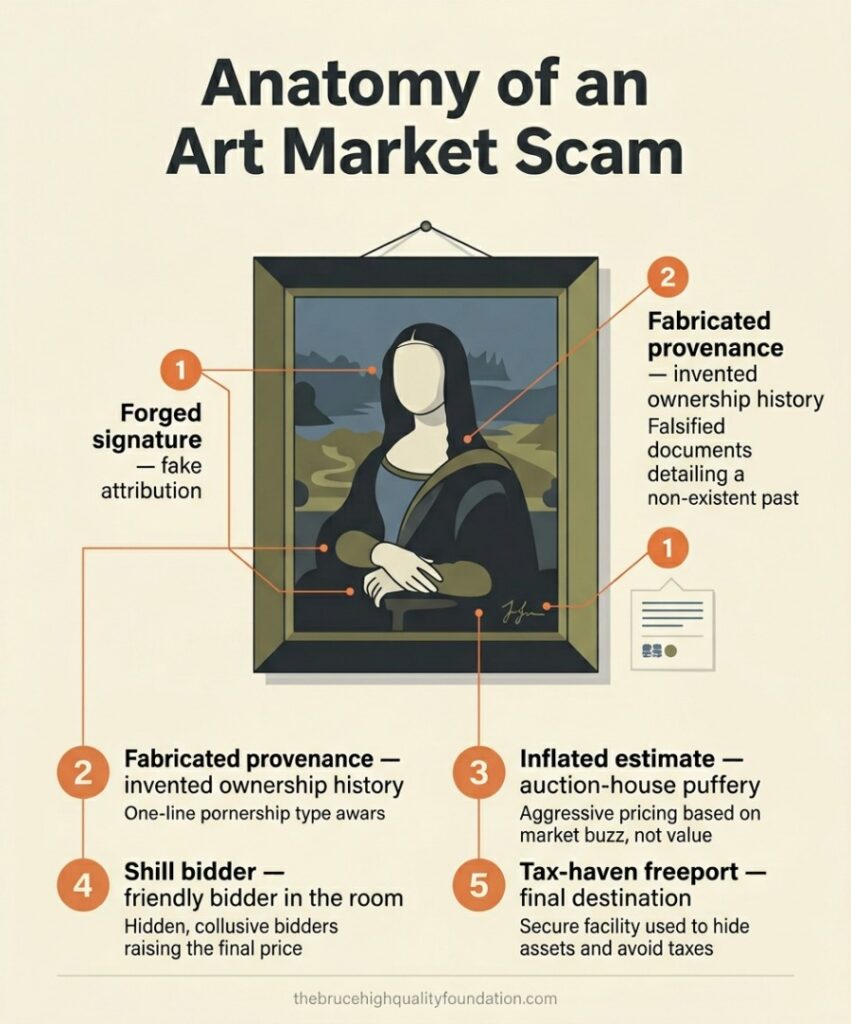
The most famous case in modern history is the Knoedler Gallery scandal. Knoedler was the oldest gallery in America, founded in 1846. It supplied Old Masters to the Vanderbilts, the Mellons, and the Frick Collection. It collapsed overnight in 2011 after it was revealed that between 1994 and 2009, the gallery sold roughly 40 forged Abstract Expressionist paintings — fake Pollocks, fake Rothkos, fake Motherwells — for around $80 million.
The forgeries weren’t painted in some European master’s studio. They were painted by Pei-Shen Qian, a Chinese immigrant working out of a garage in Queens, New York. He aged them with tea bags and dirt from a vacuum cleaner. He was paid less than $9,000 per painting. The dealer who supplied them, Glafira Rosales, sold them to Knoedler for millions. Today she works as a server in a Brooklyn diner.
What makes the case haunting is what the Winterthur Museum’s “Treasures on Trial” exhibition pointed out: experts wanted to believe. New York Times journalist Michael H. Miller put it best — everyone “wanted so badly to believe these things were real, because it was better for everybody if they were real.” Galleries made commissions, experts got new “discoveries,” collectors got bragging rights.
How widespread is forgery? The book Provenance: How a Con Man and a Forger Rewrote the History of Modern Artestimates 20% to 40% of all art on the market is forged. A former director of the Metropolitan Museum of Art is reported to have said roughly 40% of pieces at the Met itself are fake or misattributed. Take those numbers with caution — nobody can prove them — but even half of either figure is shocking.
2. Money Laundering and the “Freeport” System
The art market has one feature criminals love: high-value, easily moveable, hard-to-value objects with no required public registry of ownership. A $20 million painting can change hands in a Geneva freeport — a tax-free warehouse — without anyone knowing.
A 2020 U.S. Senate investigation into the Russian oligarchs Arkady and Boris Rotenberg concluded that the men used shell companies and intermediaries to move more than $18 million through the art market after being sanctioned. The investigation found that the art industry was “the largest legal, unregulated industry in the United States.” That’s not a conspiracy theorist — that’s a Senate report. The 2020 Anti-Money Laundering Act extended Bank Secrecy Act requirements to antiquities dealers, and the EU has applied similar rules since 2020. Enforcement is still patchy.
3. Price Fixing, Bidding Rings, and “Chandelier Bidding”
Auction houses are supposed to be transparent — and at the public level, they are. Hammer prices are published. But the games happen around the auction.
- Chandelier bidding: auctioneers calling out fake bids “off the chandelier” to push the price up to the reserve. Sotheby’s and Christie’s both admit this happens; it’s legal in most jurisdictions as long as it stops at the reserve.
- Guarantees and irrevocable bids: a third party agrees in advance to buy a work at a set price. The work technically “sells,” the auction record looks great, and the artist’s market gets a manufactured boost.
- Bidding rings: small groups of dealers agreeing not to bid against each other, then re-auctioning the work privately afterward and splitting the difference. Illegal, and quietly common.
Damien Hirst’s 2008 “Beautiful Inside My Head Forever” sale at Sotheby’s — held the same week Lehman Brothers collapsed — is the textbook case of an artist bypassing his own galleries to sell directly through auction. It made $200 million. Within five years, several of those works were reselling at a fraction of their original prices.
4. The Inigo Philbrick-Style Modern Hustle
In 2022, the dealer Inigo Philbrick was sentenced to seven years in U.S. federal prison for an $86 million fraud. His method was simple: he sold the same fractional shares of a single artwork to multiple investors, none of whom knew about the others. He also forged signatures on consignment agreements and used works he didn’t fully own as collateral for loans. Philbrick wasn’t some shadowy figure — he was a celebrated young dealer with backing from major art-finance firms.
His case showed something important: the most modern art-world scams aren’t about fake paintings. They’re about fake paperwork.
5. Phishing, Wire Fraud, and the Email Scam Every Artist Eventually Gets
If you’re an artist with a website, you’ve already received this email. It goes something like:
“Hello, my name is John. I’m relocating from Texas to London with my wife and saw your work online. We’d like to purchase the piece titled (detail). Please send us your bank details. We will overpay and arrange shipping ourselves.”
It’s a check-overpayment scam. The check bounces a week after you’ve wired the “shipping” money to the scammer’s “shipper.” Artwork Archive, ArtBusinessInfo, and Vasari21 have all documented hundreds of versions. There’s also a more dangerous version aimed at collectors: hackers clone a real gallery’s domain (changing one letter), monitor real email threads, then send a fake invoice during a real negotiation. Art Basel’s VIP list was hacked this way. So was at least one major Italian gallery.
What Looks Like a Scam But Isn’t (Quite)
This is where the conversation gets interesting. A lot of what people call a scam is actually just an unregulated, opaque, and unfair market behaving exactly the way an unregulated, opaque, and unfair market would behave.
Wild Prices Aren’t Proof of Fraud
A Basquiat selling for $110 million isn’t a scam — it’s a small group of ultra-wealthy buyers competing for an extremely scarce object that has cultural cachet. As one ARTnews writer put it: if dealers were really skilled at “manufacturing” million-dollar artists out of thin air, they’d do it constantly. Most don’t, because they can’t. True breakout careers are rare, and most try-and-fails never get talked about.
The Salvator Mundi sale is the classic example everyone misuses. The painting — attributed (and disputed) to Leonardo da Vinci — sold for $450.3 million at Christie’s in 2017, the highest price ever paid for a painting. Critics call it a scam because the attribution is contested. But it’s not fraud — it’s a high-stakes bet on disputed scholarship, the kind of bet that’s existed since the Renaissance.
Gallery Splits Feel Predatory — But There’s a Reason
Galleries take 50% of a sale. New artists scream that this is theft. It’s not. Galleries also pay rent in expensive neighborhoods, employ staff, ship works, insure them, build collector relationships across decades, photograph inventory, run openings, fly to art fairs, and eat the cost of every artist who doesn’t sell. The 50% isn’t a scam — it’s the price of distribution. The actual problem isn’t the split; it’s that galleries can drop an artist tomorrow, taking the entire collector base with them, with no severance and no warning.
“Conceptual Art” Isn’t the Scam Either
Maurizio Cattelan’s Comedian — the duct-taped banana — sold three editions for $120,000–$150,000 each in 2019, and then again in 2024 for $6.2 million at Sotheby’s. Calling this a scam misunderstands what was sold. The buyer didn’t buy a banana. They bought a certificate of authenticity, exhibition rights, and a piece of art-world history. It’s still bizarre. It’s still a market built on hype. But it’s not technically fraud.
Who Actually Gets Hurt — And Who Doesn’t
Most art-market commentary worries about the wrong victims. Here’s how the harm actually flows:
| Hurt the Most | Hurt Some | Hurt the Least |
|---|---|---|
| Mid-career artists dropped by galleries | Wealthy collectors who buy fakes | Billionaire flippers — they’re playing the game |
| Estates of dead artists with weak provenance | First-time buyers from secondary markets | Auction houses (they get a cut either way) |
| Beginning artists scammed by phishing emails | Small museums tricked by donations of forged works | Mega-dealers (Gagosian, Zwirner, Hauser & Wirth) |
| Real human craft that competes with hype | Art critics losing reputation by misattributing | Tax-shelter freeports |
The popular narrative is that wealthy collectors are the victims. They’re not. The real victims are working artists who get used as inventory and dropped, and beginner collectors who buy into a system that has no warranty.
How to Protect Yourself (Whether You Buy or Make Art)
If You’re Buying Art
- Buy what you love, not what you’re told is an investment. Documentary filmmaker Barry Avrich, who covered the Knoedler scandal, said the same thing: buy a piece because you want to look at it every day. The market is the worst reason.
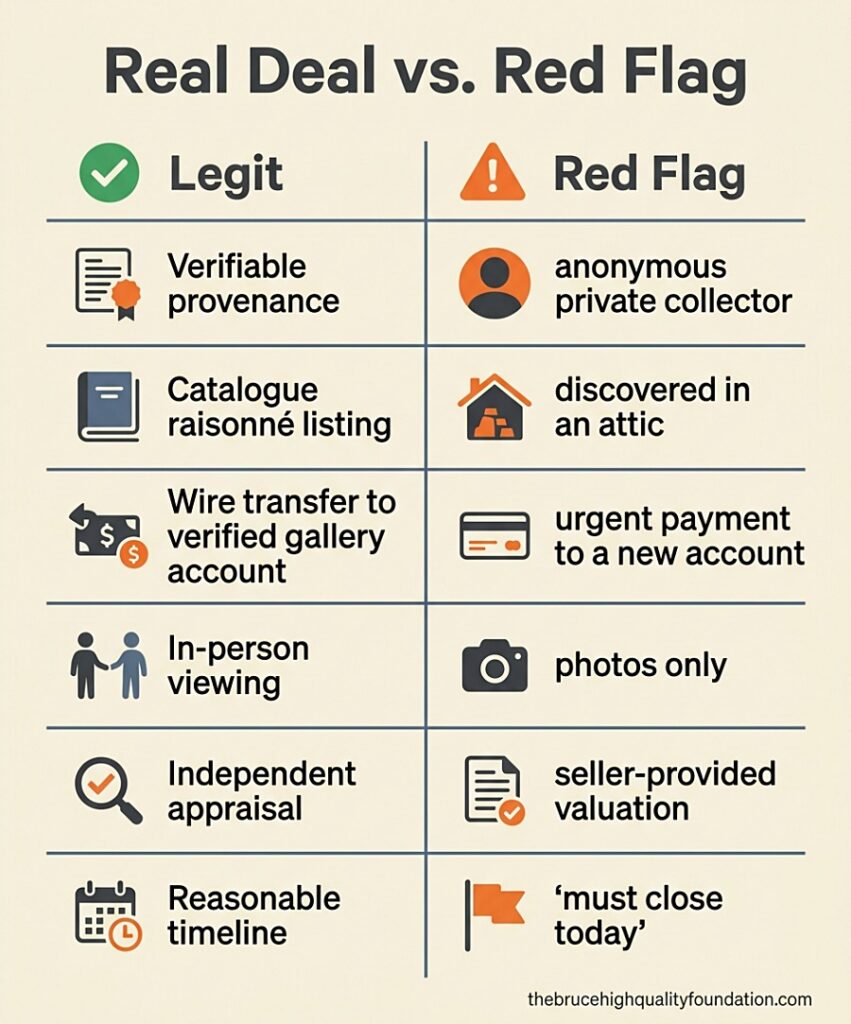
- Demand provenance in writing. Auction catalogues, exhibition history, gallery records, prior sale records. “From a private European collection” is a red flag, not a credential.
- Cross-check with the catalogue raisonné. Every major artist has one — a published, scholarly inventory of their authenticated works. If a work isn’t in it and the artist is dead, walk away.
- Use independent appraisers, not the seller’s. This sounds obvious. Most buyers don’t.
- Verify wire details by phone, never by email. The phishing scam I described above has cost collectors millions because they trusted an email that looked identical to one in an existing thread.
- Don’t skip due diligence on small purchases. The fake-print market is bigger than the fake-painting market and lives entirely on eBay, Etsy, and unverified online stores.
If You’re an Artist
- Build your own mailing list. Don’t depend entirely on a gallery. Galleries close. Galleries drop you. Your collectors should be able to find you.
- Treat every “moving to London and want to buy your art” email as a scam by default. If they’re real, they’ll happily call you.
- Never accept overpayment by check with a request to refund the difference. Ever. That’s the entire scam.
- Read every contract, especially the consignment terms. Know what happens if the gallery closes, who owns the work in storage, who insures it, and how disputes are resolved.
- Document everything. Photograph every piece. Keep editioned prints in a registry. If you suspect a gallery is reprinting your editions without permission, you’ll need the records to fight it.
Pro Tips From People Who’ve Worked Inside the Market
- “If someone offers you something too good to be true, it probably is too good to be true.” — Bridget Moore, DC Moore Gallery, quoted in Artsy.
- “In approaching people to participate, I often found the same resistance, secrecy, and desire to distance themselves, the same lack of transparency in the art market that allowed the hoax to flourish for almost 15 years.” — Daria Price, director of Driven to Abstraction, on the Knoedler case as reported by The Art Newspaper.
- The single most useful sentence in all of art-market commentary: “The art market is not one market. It’s a constellation of mini-markets.” A $300 watercolor at a county fair has nothing in common with a $30 million Rothko at Sotheby’s. Don’t apply the rules of one to the other.
So — Is the Art World a Scam? My Honest Take
After looking at the documented cases, the academic studies, the FBI reports, and the conversations I’ve had with working artists and dealers, here’s where I land:
The art world is not a scam. It is a legal, opaque, lightly regulated market that contains scams, attracts scammers, and rewards a small group of insiders. That’s a different statement, and the difference matters. Calling the whole thing a scam lets the actual scammers blend into the noise. It also dismisses every honest artist, every honest gallerist, every conservator, every museum educator, every collector who buys a small painting from a local artist because they love it. They’re real. They outnumber the crooks by a wide margin.
But pretending the system is fine is worse. The forgery rate is real. The price manipulation is real. The money laundering is real. The artist exploitation is real. The phishing is real. Knoedler ran for 165 years and ended in disgrace. Inigo Philbrick was the future of the market until he was a federal inmate.
The honest position is: be skeptical, do the homework, buy what you love, and never trust anyone who tells you art is a “guaranteed investment.” If you do that, the art world isn’t a scam for you. It’s just a strange, beautiful, ugly, unregulated room you’re walking into with your eyes open.
FAQ
Is buying art a good investment?
For most people, no. Art is illiquid, expensive to insure and store, often impossible to authenticate without expert help, and historically underperforms broad equity indexes once you factor in commissions and fees. Studies of art-as-an-asset by academic finance researchers consistently find that average returns underperform the S&P 500 over long periods. A small slice of blue-chip art outperforms — but you have to already be wealthy to access it.
Why do conceptual artworks sell for so much?
Because the buyers aren’t paying for the object. They’re paying for the idea, the artist’s market position, the provenance, and the cultural status that comes with owning it. Whether that’s foolish is a separate question. It’s not technically a scam.
How much of the art on the market is forged?
The most-cited estimate, from the book Provenance, is 20% to 40%. A former director of the Metropolitan Museum of Art is reported to have said roughly 40% of pieces at the Met may be fakes or misattributions. Both numbers are unverifiable, but even conservative estimates put forgery rates much higher than the public believes.
Is the art market really used for money laundering?
Yes, and it’s documented. A 2020 U.S. Senate Permanent Subcommittee on Investigations report described the art industry as the largest legal, unregulated market in the U.S. and detailed how sanctioned Russian oligarchs used it to move funds. Anti-money-laundering rules now exist in the EU and partially in the U.S., but enforcement is uneven.
What’s the biggest art scandal in recent memory?
The Knoedler Gallery forgery case is the textbook example. From 1994 to 2009, the 165-year-old New York gallery sold around 40 forged Abstract Expressionist paintings for roughly $80 million. The gallery closed in 2011, ten lawsuits followed, and the actual forger fled to China. The story is told in the Netflix documentary Made You Look: A True Story About Fake Art.
Are local galleries also part of the scam?
Almost never in any organized way. Most local and regional galleries operate on tight margins, work hard to support working artists, and would love nothing more than the kind of cash flow people imagine they have. The scams concentrate at the very top of the market and at the very bottom (online phishing). The middle is mostly just hustle.
How do I tell if a painting I want to buy is real?
Ask for provenance documentation. Cross-check with the artist’s catalogue raisonné. Get an independent appraisal — not one provided by the seller. For higher-value works, get scientific testing (pigment analysis, infrared imaging, dendrochronology for panel paintings). And if anything about the seller’s story sounds too convenient, walk away. Real provenance is boring. Scam provenance is dramatic.
Should I still buy art if I’m a beginner?
Yes — just buy small, buy local, and buy what you actually want to live with. Visit open studios. Visit MFA thesis shows. Buy directly from artists you like. You’ll skip the entire gallery markup, support a real human, and take home something with real meaning. That’s the part of the art world that has never been a scam, and never will be.
Save This Guide
The art-world conversation cycles back every couple of years — usually after a forgery trial, a viral video, or another auction record that defies gravity. Bookmark this page for the next time someone in your life asks the question. The answer hasn’t changed in fifty years and probably won’t in the next fifty: it’s not a scam, but you should still act like it might be.
Next steps: if you want to go deeper, read Provenance by Laney Salisbury and Aly Sujo, watch Made You Look on Netflix, and follow auction reporting at The Art Newspaper and ARTnews. Skip anything that promises to teach you how to “invest in art for guaranteed returns.” That part actually is a scam.