
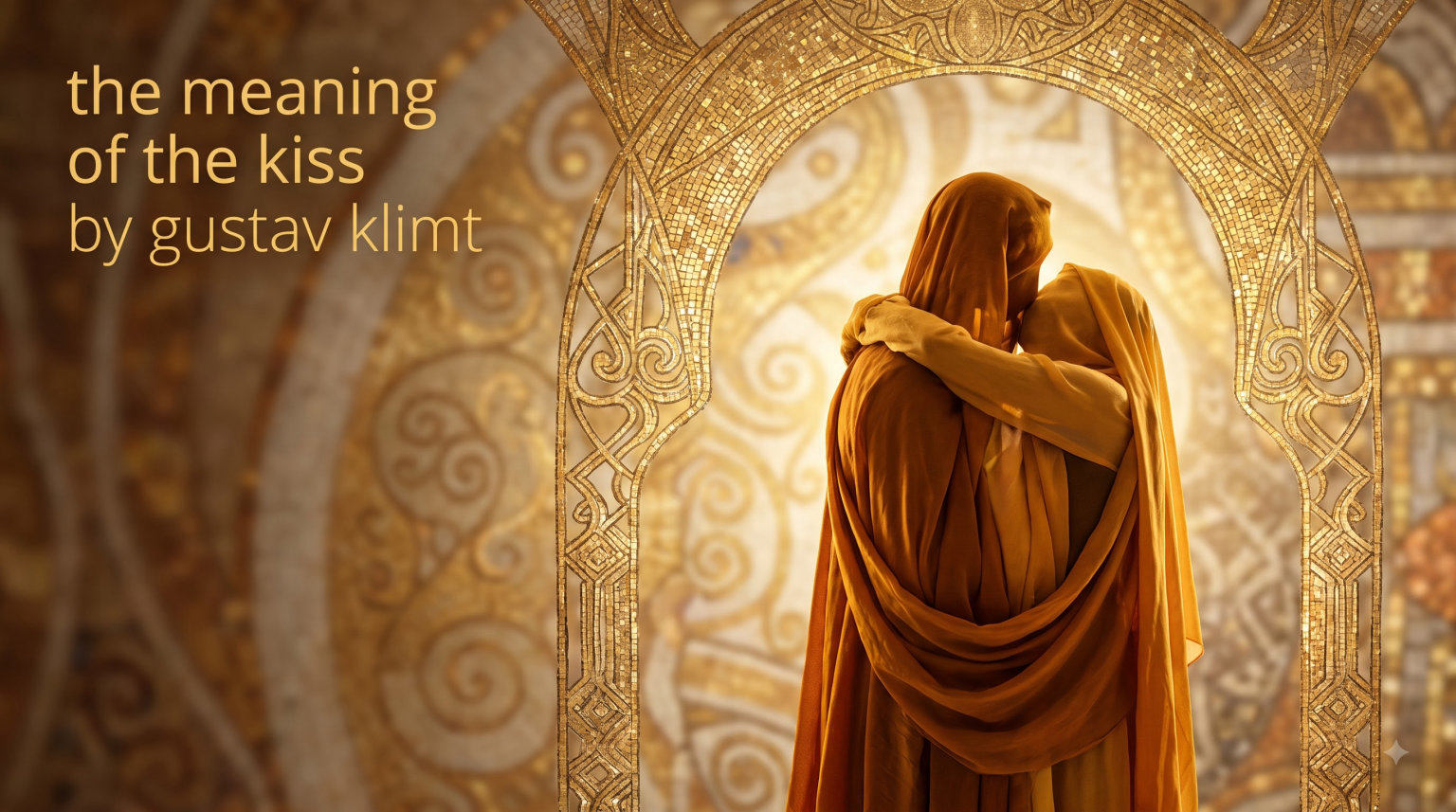
Few paintings in history stop people in their tracks quite like Gustav Klimt’s The Kiss. Standing before it at the Belvedere Museum in Vienna, you see two figures wrapped in golden light, locked in an embrace so intimate it almost feels intrusive to watch. The gold shimmers. The patterns dance. The couple seems to exist outside of time entirely.
I have spent years studying art history, and The Kiss remains one of those rare works that reveals something new every time you look at it. The meaning of the kiss by Gustav Klimt is not a single, tidy answer. It is a layered conversation about love, spirituality, desire, and the boundaries between two people dissolving into one.
In this guide, we will break down what The Kiss actually means, explore the symbolism hidden in its golden patterns, and look at why this painting still captivates millions of people in 2026. Whether you are an art student preparing for an exam, a traveler planning a trip to Vienna, or simply someone who fell in love with this image on a postcard, you will find the answers here.
Table of Contents
What Is The Kiss by Gustav Klimt?
The Kiss is an oil and gold leaf painting on canvas completed by Austrian artist Gustav Klimt between 1907 and 1908. It measures 180 by 180 centimeters, a perfectly square format that gives the composition a sense of balance and stability. The painting has hung in the Osterreichische Galerie Belvedere in Vienna since 1908, when the Austrian government purchased it directly from the artist for the then-significant sum of 25,000 crowns.
The work depicts a man and a woman locked in an embrace on the edge of a flower-covered cliff. Their bodies are draped in elaborately patterned golden robes that flow together, making it nearly impossible to tell where one figure ends and the other begins. Only their faces, hands, and the woman’s bare feet are visible beneath the golden garments.
It is the defining masterpiece of Klimt’s celebrated Golden Phase, a period during which he incorporated actual gold leaf and silver into his paintings. This technique gives The Kiss its otherworldly luminosity and ties it directly to the sacred art traditions of Byzantine mosaics. The painting is widely considered one of the most recognized works of art in the world, sometimes called the “Mona Lisa of Vienna” for the crowds it draws year after year.
The Historical Context Behind The Kiss
To understand the meaning of the kiss by Gustav Klimt, you need to understand the world he was painting in. Vienna at the turn of the 20th century was a city in creative upheaval. The Habsburg Empire was declining, but the art scene was exploding with new ideas about what art could be and do.
Klimt was at the center of this revolution. In 1897, he had co-founded the Vienna Secession, a movement of artists who broke away from the conservative, state-sanctioned art establishment. Their motto was inscribed above their exhibition hall: “To every age its art, to every art its freedom.” This was not just a slogan. It was a declaration that art should evolve with the times rather than cling to academic tradition.
In 1903, Klimt traveled to Ravenna, Italy, where he encountered the Byzantine mosaics of the Basilica of San Vitale. The experience transformed him. The flat, gilded surfaces and spiritual intensity of those ancient mosaics directly informed the aesthetic of The Kiss. Klimt had grown up around gold, too. His father was a gold engraver, and that familiarity with the material shaped his experimental approach to applying metal leaf to canvas.
The years leading up to The Kiss were also marked by personal turmoil. In 1904, Klimt’s three ceiling paintings for the University of Vienna were rejected as obscene and controversial. The scandal wounded him deeply, and he retreated from public commissions. Many art historians see The Kiss as Klimt’s response to that rejection, a painting that moved away from the controversial toward the transcendent.
There is also the question of the woman in the painting. Many scholars believe she was modeled after Emilie Flöge, Klimt’s longtime companion and possibly his great love. Klimt and Flöge never married, but their relationship lasted decades. Whether The Kiss is a portrait of their specific bond or a universal allegory of love remains one of the painting’s most enduring mysteries.
The Meaning of The Kiss by Gustav Klimt: Core Symbolism
The meaning of the kiss by Gustav Klimt operates on multiple levels simultaneously. It is romantic, spiritual, and erotic all at once. Here are the core themes that art historians and critics have identified over more than a century of analysis:
- Spiritual and Erotic Union: The painting merges the sacred and the sensual. The gold leaf suggests devotion and holiness, while the intimate embrace conveys physical passion. Klimt refuses to separate these two aspects of love.
- Transcendence Beyond the Physical World: The cliff edge beneath the couple dissolves into abstract patterns. The gold background erases any clear sense of time or place. The lovers exist in a space that is not quite earthly, not quite divine.
- The Golden Cloak as Protection: The shimmering robe that wraps around both figures acts as a shield. It separates the couple from the viewer and from the world below. Inside that golden cocoon, love exists undisturbed.
- Loss of Individual Identity: The patterns on their garments flow together. The boundary between male and female dissolves. In this moment of connection, the two become something unified and indivisible.
- Pagan and Ritualistic Overtones: Some scholars have connected The Kiss to ancient fertility rituals and the myth of Dionysus. The flower-covered cliff suggests a Garden of Eden or a sacred grove. The embrace reads not just as romantic but as ceremonial.
- Ambiguity of the Embrace: Not everyone reads the painting as purely joyful. Some observers point to the woman’s turned head and wonder whether she is pulling away rather than leaning in. This ambiguity is intentional. Klimt leaves space for multiple readings.
One Reddit commenter I came across described the painting beautifully: it looks like “a man kissing a woman from behind, who is, even without him, whole and living in her own happy world.” That reading captures something essential. The woman in The Kiss is not a passive recipient. She exists fully on her own terms, and the painting is richer for that independence.
Decoding the Male and Female Figures
One of the most revealing aspects of The Kiss is how Klimt uses pattern to differentiate the male and female figures. The man’s robe is covered in bold, rectangular geometric shapes, primarily in black, white, and gray tones. These rigid forms suggest structure, logic, and traditionally masculine energy.
The woman’s garment, by contrast, is alive with circular floral motifs in soft colors. Flowers, circles, and curves dominate her portion of the composition. These patterns evoke fertility, growth, warmth, and the natural world. The contrast is not accidental. Klimt is using the visual language of geometry versus organic form to represent masculine and feminine principles.
The man’s face is partially hidden as he leans down to kiss the woman’s cheek. His hands cradle her face with care, one on her cheek and the other supporting her head. The positioning suggests tenderness and protectiveness rather than dominance.
The woman’s expression has generated the most debate among viewers and scholars alike. Her eyes are closed. Her head tilts back. Some viewers see pure ecstasy and surrender to the moment. Others read discomfort or even resistance in her posture, as though she is turning away from the kiss rather than meeting it.
I think both readings can be true at once. Klimt was deeply influenced by the psychoanalytic ideas circulating in Vienna at the time. Sigmund Freud’s writings on the unconscious mind and the complexity of human desire were in the air. The Kiss captures the idea that love and desire are never simple, never one-dimensional.
The placement of their bodies on the edge of a cliff adds another layer of meaning. They kneel on a patch of flowers that drops away into a golden abyss. There is danger here, or at least the suggestion of it. Love, Klimt seems to say, is an act of faith. You stand at the edge and you leap.
The Golden Phase and Byzantine Influence
Klimt’s Golden Phase spanned roughly from 1899 to 1910, and it produced some of the most celebrated works in modern art history. During this period, Klimt moved beyond traditional oil painting and began incorporating gold leaf, silver, and platinum directly into his canvases. The results were unlike anything the European art world had seen.
The technique was not purely decorative. Gold leaf in art has a long association with religious devotion and sacred spaces. Byzantine icons and mosaics used gold backgrounds to represent divine light, the radiance of heaven made visible on earth. When Klimt applied the same material to a painting of two lovers, he elevated romantic love to the level of spiritual experience.
His 1903 visit to Ravenna was the catalyst. The mosaics of San Vitale and Sant’Apollinare Nuovo use flat, stylized figures against shimmering gold surfaces. Perspective is suppressed. Space becomes symbolic rather than realistic. Klimt absorbed all of this and translated it into his own visual language.
In The Kiss, the gold does something specific and deliberate. It flattens the pictorial space. There is no horizon line, no sky, no depth. The couple floats in a field of gold that could be a wall, a void, or the surface of a Byzantine church. This flattening removes the lovers from the everyday world and places them in a timeless, sacred realm.
Klimt’s family background gave him a practical advantage here. His father, Ernst Klimt the Elder, was a gold engraver from Bohemia. Growing up around precious metals and the techniques of working with them gave Gustav an intuitive understanding of how gold catches and holds light. That childhood familiarity became one of his greatest artistic assets.
Why The Kiss by Gustav Klimt Became So Famous
There are thousands of paintings about love in museums around the world. Why does this one command such devotion? Here are the reasons The Kiss stands apart from every other romantic painting in art history:
- Universal Theme, Executed Brilliantly: Everyone understands the experience of intimate connection. Klimt distilled that universal feeling into a single, visually overwhelming image. The emotional accessibility combined with technical mastery is a rare combination.
- Gold That Demands Attention: The sheer amount of gold leaf creates an immediate visual impact. In a museum gallery, the painting glows. It pulls your eye from across the room. The material presence of the gold makes it feel precious and alive in a way that reproductions cannot fully convey.
- A Perfect Blend of Styles: The painting sits at the intersection of Art Nouveau, Symbolism, and Byzantine tradition. It does not belong to a single movement, which gives it a timeless quality. It looks modern and ancient at the same time.
- Ambiguity That Invites Interpretation: The best artworks are the ones you can never fully resolve. The Kiss resists a single reading. Is it joyful or melancholy? Is the woman surrendering or resisting? Every viewer sees something slightly different, and that keeps people talking.
- Cultural Ubiquity: The image has been reproduced on posters, postcards, tote bags, phone cases, and wedding invitations for over a century. Its fame feeds itself. You probably saw it before you ever knew Klimt’s name.
- Official Recognition: In 2003, Austria featured The Kiss on a 100-euro gold commemorative coin. The painting has become not just an artwork but a national symbol of Austria and a global icon of romantic love.
The Controversy and Early Reception
It might be hard to imagine today, when The Kiss appears on coffee mugs and greeting cards, but Klimt’s work was genuinely controversial in its time. Vienna in the early 1900s was a city torn between tradition and modernity. The art establishment was conservative, and public morality was enforced with real consequences for artists who crossed the line.
The controversy that matters most for understanding The Kiss is the scandal of Klimt’s University of Vienna ceiling paintings. Commissioned in 1894, the three works, titled Philosophy, Medicine, and Jurisprudence, were denounced as pornographic and twisted when they were exhibited. Critics called them obscene. University faculty demanded their removal. The paintings were never installed.
This rejection devastated Klimt. He withdrew from public commissions entirely and focused on private portraiture and personal projects. The Kiss emerged from this period of retreat and reflection. Some art historians see it as a kind of redemption, a painting that could express sensuality without provoking outright outrage.
But even The Kiss was not entirely free of controversy. Its erotic undertones were clear to contemporary viewers. The bodies beneath the golden robes are naked. The intimacy of the moment is unmistakable. In a culture shaped by Freud’s recent writings on sexuality and repression, the painting carried an electric charge that a simple landscape or portrait could not match.
The connection to Freud is worth pausing on. Klimt and Freud moved in overlapping circles in Vienna during this period. Both were interested in what lay beneath the surface of human consciousness. Freud’s Interpretation of Dreams had been published in 1899, and his ideas about unconscious desire and repression were reshaping how educated Viennese society thought about love, sex, and the mind. Klimt’s paintings, including The Kiss, operate in a similar register. They show not just what love looks like but what it feels like beneath the surface.
When The Kiss was first exhibited at the 1908 Kunstschau in Vienna, the public response was overwhelmingly positive. The Austrian government purchased it immediately for the Belvedere collection. Compared to the university scandal, the reception was a triumph. The controversy had softened into admiration, and the painting began its journey toward becoming one of the most beloved works of art ever created.
The Kiss in Klimt’s Broader Body of Work
The Kiss did not emerge in isolation. It sits within a larger body of work that explored similar themes of love, desire, and the female form. Understanding these connections adds depth to the meaning of the kiss by Gustav Klimt.
The painting is often linked to Klimt’s earlier Beethoven Frieze from 1902, a monumental wall painting created for the 14th Vienna Secession exhibition. The frieze includes an embracing couple that clearly foreshadows the composition of The Kiss. The longing for happiness, the power of love to overcome suffering, and the visual motif of two figures merging into one all appear in both works.
Klimt’s portrait of Adele Bloch-Bauer I from 1907, painted during the same period as The Kiss, uses a similar gold-leaf technique and decorative pattern language. That portrait became famous in its own right when it was restituted to the Bloch-Bauer family and sold for $135 million in 2006, making it one of the most expensive paintings ever sold at the time.
These connections matter because they show that The Kiss was not a one-time inspiration. It was the culmination of years of artistic exploration. Klimt had been working toward this synthesis of gold, pattern, and emotional intensity for nearly a decade before he painted it.
Frequently Asked Questions About The Kiss by Gustav Klimt
What is the meaning behind The Kiss Klimt?
The Kiss by Gustav Klimt symbolizes the union of spiritual and erotic love. The painting depicts two figures embraced on a flower-covered cliff, wrapped in golden robes that blend together. It represents love as both a sacred and sensual experience, with the gold leaf evoking religious devotion while the intimate pose conveys physical passion. Multiple interpretations exist, including themes of transcendence, loss of individual identity in love, and pagan ritual symbolism.
What does The Kiss symbolize?
The Kiss symbolizes the merging of two souls into one unified being. The golden cloak that wraps both figures acts as a protective barrier between their love and the outside world. The contrast between the man’s geometric patterns and the woman’s floral motifs represents masculine and feminine principles coming together. The cliff edge beneath them suggests that love requires faith and risk.
What does The Kiss mean in painting?
In the context of art history, The Kiss represents the peak of Klimt’s Golden Phase and the Vienna Secession movement. It combines oil painting with gold leaf application, blending Byzantine mosaic traditions with Art Nouveau aesthetics. The painting uses flattened perspective and decorative patterning to create a symbolic rather than realistic scene, moving away from academic painting traditions toward a more personal, emotional form of expression.
What makes The Kiss so iconic?
The Kiss is iconic because it combines a universally relatable theme with extraordinary technical skill. The gold leaf creates an immediate visual impact that few paintings can match. It blends Art Nouveau, Symbolism, and Byzantine art into a single timeless image. The ambiguity of the woman’s expression invites endless interpretation. Its widespread reproduction on merchandise has made it one of the most recognized paintings in the world, and it has become a national symbol of Austria.
Why was The Kiss by Klimt controversial?
The Kiss carried erotic undertones that challenged early 20th-century Viennese sensibilities. The figures are nude beneath their golden robes, and the intimacy of their embrace was bold for its time. Klimt had already faced scandal with his University of Vienna ceiling paintings, which were rejected as obscene. The Kiss emerged during the same era as Freud’s writings on sexuality, adding to its charged reception. While it was better received than Klimt’s earlier controversial works, its sensuality still pushed boundaries for contemporary audiences.
Final Thoughts on The Meaning of The Kiss by Gustav Klimt
The meaning of the kiss by Gustav Klimt is not a single answer but a constellation of ideas. It is about spiritual love and physical desire. It is about two people dissolving into one another while somehow remaining themselves. It is about gold that shines like heaven and bodies that are undeniably human.
What makes The Kiss endure, more than a century after Klimt painted it, is that it holds all of these contradictions without resolving them. The woman’s closed eyes and tilted head contain both ecstasy and uncertainty. The golden cloak is both a wedding garment and a burial shroud. The cliff edge is both a garden and a precipice.
If you ever have the chance to stand in front of this painting at the Belvedere Museum in Vienna, take it. Reproductions on screens and postcards capture the image. They do not capture the way the gold leaf catches the gallery light, or the way the painting’s square format creates a sense of perfect, contained intimacy. Some artworks need to be experienced in person. The Kiss is one of them.