
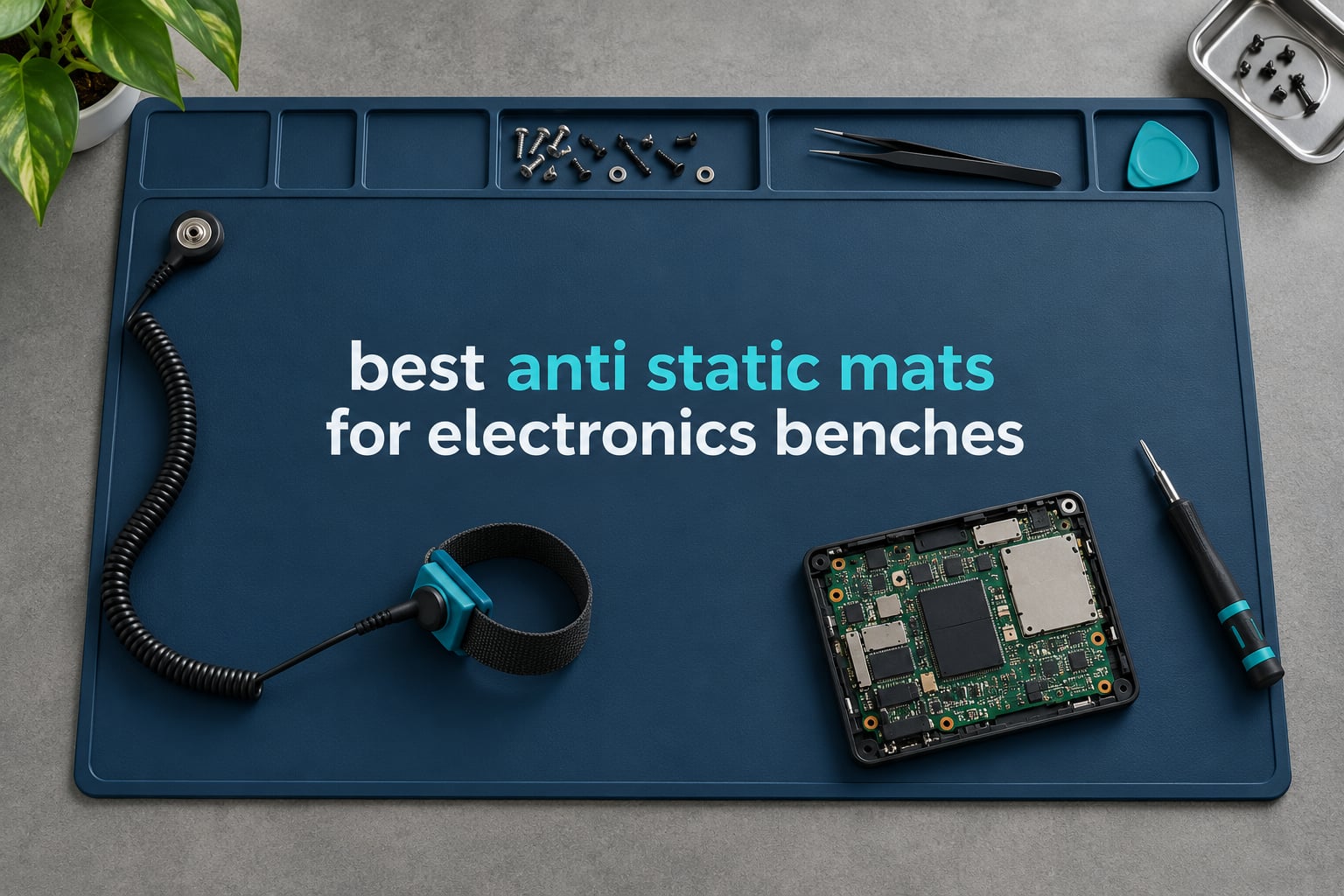
An anti-static mat for an electronics bench is a static-dissipative work surface that slows charge transfer, stops static from building as you move parts around, and carries whatever charge is already on a board safely to ground. The right one is not about price or brand prestige. It is about whether the mat’s measured resistance sits in the 10^6 to 10^9 ohm range, whether the layer you work on can survive a soldering iron, and whether the grounding kit in the box actually reaches your ground point.
Static damage to electronics is rarely dramatic. You do not see a spark and a dead board. A microscopic discharge punches a pinhole through a MOSFET gate oxide, the part passes a quick bench test, and the failure shows up three weeks later in a customer’s hand. That is why picking the best anti static mats for electronics benches matters even though almost every mat on the market looks identical in a photo. This roundup judges 12 of them against resistance range, layer construction, heat tolerance, mat thickness, included grounding hardware and the size of the working area they actually give you.
If you are still building out your bench, the grounding mat is only one piece. Our guides to the best soldering stations for electronics and the best multimeters for electronics hobbyists cover the rest of the ESD chain, and you will want a meter on the bench regardless.
Table of Contents
Top 3 Best Anti Static Mats For Electronics Benches (October 2026)

iFixit Portable Anti-Static Mat
- 10^7 to 10^9 ohm surface resistivity
- Complete kit with wrist strap and ground cord
- Folds for transport between benches

HPFIX Silicone Soldering Mat
- Heat resistant to 932 F
- 10^6 to 10^8 ohm resistivity
- Built-in ruler and parts compartments

StarTech Large ESD Bench Mat
- 23.6 x 47.2 inch coverage
- ANSI/ESD S4.1 tested surface resistance
- Two-layer PVC with textured underside
Those three cover the three most common bench situations. The iFixit mat is the safest buy for a hobbyist or a technician who moves between stations. The HPFIX silicone mat is the one to buy if a hot air rework station sits directly on the surface. The StarTech mat is the one to buy if you want the whole bench covered and a documented compliance standard behind it.
All 12 Anti-Static Mats Compared Side by Side in 2026
| Product | Specifications | Action |
|---|---|---|
| iFixit Portable Anti-Static Mat |
|
Check Latest Price |
| HPFIX Silicone Soldering Mat 15.9 x 12 inch |
|
Check Latest Price |
| StarTech Large ESD Bench Mat 23.6 x 47.2 inch |
|
Check Latest Price |
 Bertech ESD Mat Kit 2 x 4 ft Blue Bertech ESD Mat Kit 2 x 4 ft Blue |
|
Check Latest Price |
 KooMall 36 x 24 inch Rubber ESD Mat Kit KooMall 36 x 24 inch Rubber ESD Mat Kit |
|
Check Latest Price |
 LUTICO Anti Static ESD Mat 24 x 48 inch LUTICO Anti Static ESD Mat 24 x 48 inch |
|
Check Latest Price |
 Kaisi Anti Static Mat 21.6 x 16.9 inch Kaisi Anti Static Mat 21.6 x 16.9 inch |
|
Check Latest Price |
 MWRF Source ESD Mat Kit 20 x 24 inch MWRF Source ESD Mat Kit 20 x 24 inch |
|
Check Latest Price |
 Static Care RubberStat Dual Layer Mat 24 x 24 inch Static Care RubberStat Dual Layer Mat 24 x 24 inch |
|
Check Latest Price |
 Hooandxk Extra Large Silicone Mat 27.6 x 15.7 inch Hooandxk Extra Large Silicone Mat 27.6 x 15.7 inch |
|
Check Latest Price |
 Esoldnic Silicone Repair Mat 23.7 x 13.8 inch Esoldnic Silicone Repair Mat 23.7 x 13.8 inch |
|
Check Latest Price |
 MYOYAY Rubber ESD Mat Roll 118 x 23.6 inch MYOYAY Rubber ESD Mat Roll 118 x 23.6 inch |
|
Check Latest Price |
The table above is sorted for scanning, not for ranking. The five columns that actually decide a purchase are working area, heat tolerance, resistance range, grounding hardware and thickness. Everything else is preference.
1. iFixit Portable Anti-Static Mat: The Complete Kit That Travels
iFixit Portable Anti-Static Mat – ESD Pad, Wrist Strap, Grounding Cord
- Mat cord and wrist strap all in one box
- Adjustable XL wrist strap with 1.8 m lead
- Folds for transport between stations
- 60 x 60 cm area is compact for large builds
- Nylon and polymer build is not a soldering surface
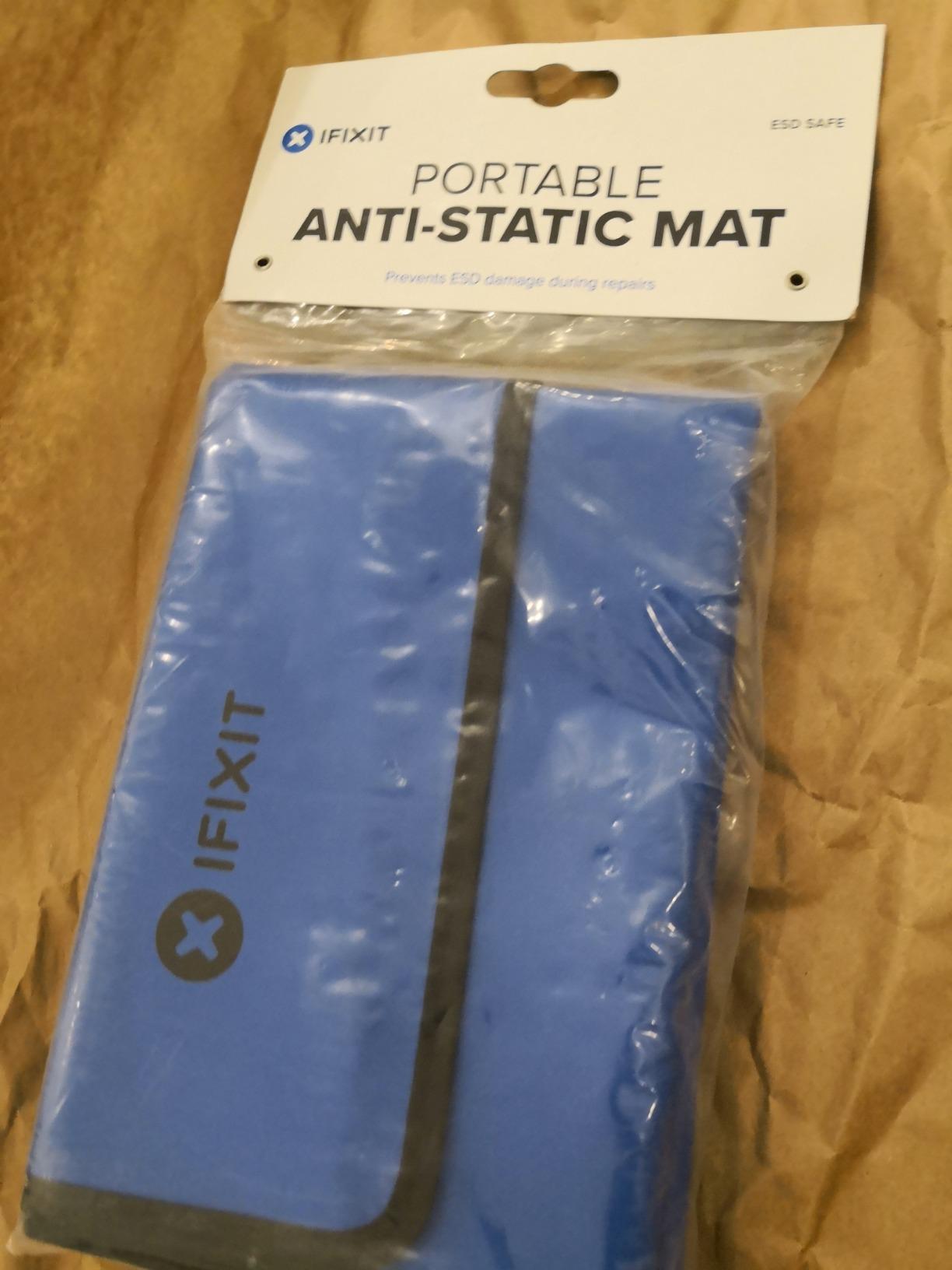
The iFixit mat is the one I keep in a drawer and pull out when I am working away from my main bench. At 60 x 60 cm it folds down to almost nothing, and the whole package is mat, wrist strap and grounding cord, so there is nothing else to hunt for when you set up at a kitchen table.
The numbers are in the right place. Surface resistivity is quoted at 10^7 to 10^9 ohm, which sits comfortably inside the static-dissipative window rather than the conductive range. Grounding is a 10 mm snap on the mat edge feeding a 1.8 m cord rated at 10^5 ohm, and the included wrist strap is 1.8 m of 50 ohm with an adjustable band that fits up to size XL.
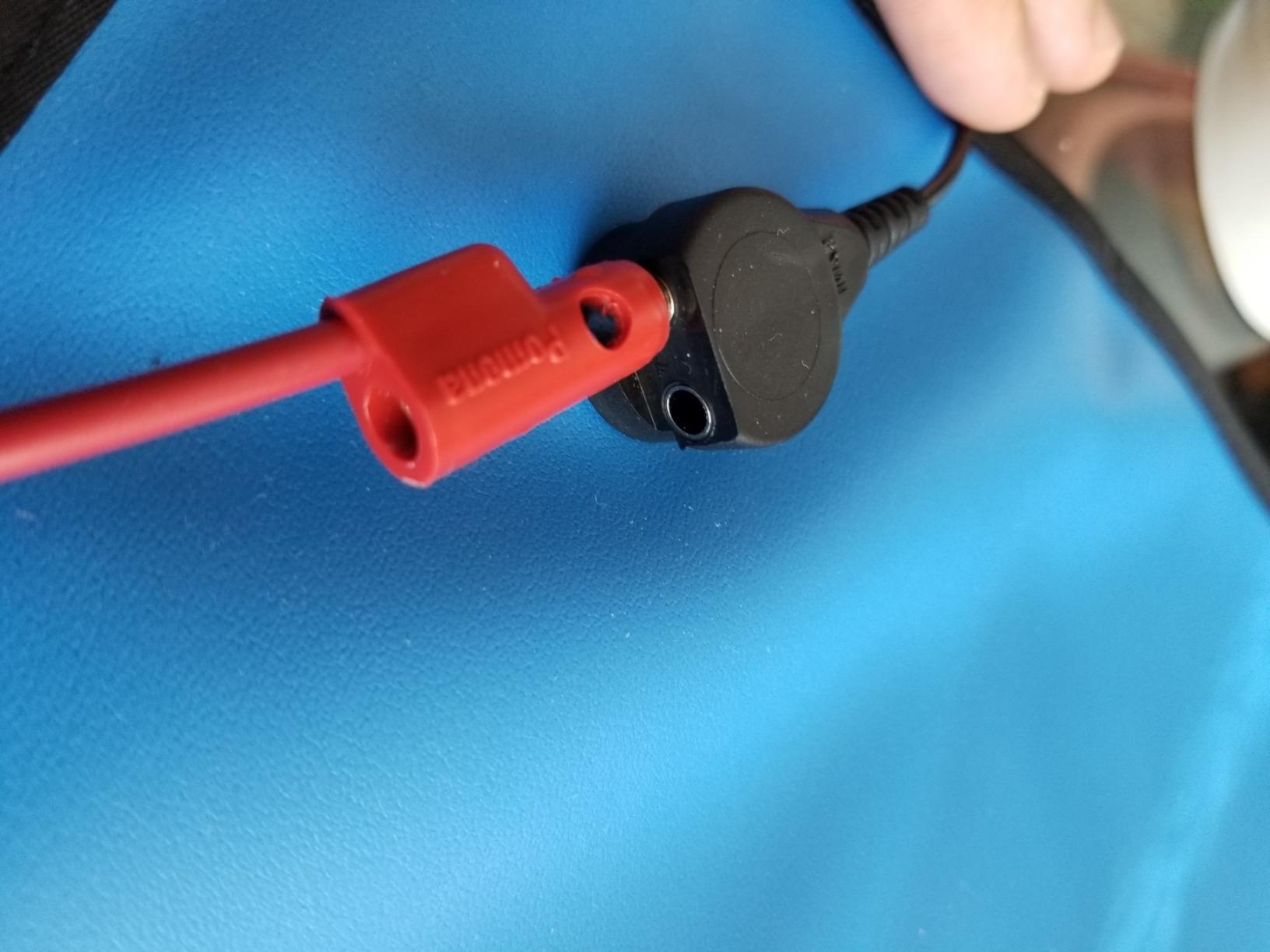
What I like most is that the wrist strap is a real strap rather than a token. A lot of kits ship a thin elastic band with a wire that disconnects the moment you reach across the bench. This one has a proper adjustable closure and a lead long enough to work a large spread of parts without tugging.
The limitation is honest and worth stating plainly: this is not a soldering surface. Nylon and polymer construction has no meaningful heat rating, so resting a hot iron on it is a bad idea. Treat it as an assembly, disassembly and inspection mat. If your bench is primarily a solder bench, look at the HPFIX silicone option below instead.
A 60 x 60 cm footprint also runs small for full tower PC builds. For phone and tablet work, laptop servicing and board-level repair it is genuinely roomy.
Check the wrist strap and cord length before buying for a large bench
Because the mat grounds through a snap and a cord, the cord has to physically reach your ground point. The 1.8 m length works for a single bench with a nearby outlet or ground block. For a wide bench where you will be reaching to both corners, check the reach before you commit.
The 10 mm snap is the most common fitting in the hobby and light-industrial world. It will mate with the snap leads sold by the major ESD suppliers, so you are not locked into this kit if you later want a longer cord.
Know when this mat is the wrong tool
Skip it if your work involves hot air rework, direct iron contact or molten solder on the surface. Those jobs need a silicone mat rated to 932 F or a rubber mat rated well above 200 degrees C.
Skip it if you plan to service full-size desktop towers where the case alone spans most of the mat. The width is fine for laptops, phones, tablets and single boards.
2. HPFIX Silicone Soldering Mat: Built for a Hot Work Surface
- Rated 932 F for direct iron contact
- Numbered compartments and built-in ruler
- Compact size suits a small bench
- Lies flat after unrolling
- Small area for large circuit boards
- Short included grounding cord
- Compartments are not magnetised
This is the mat I use at the soldering station, and the reason is simple: a 932 F rating means a hot air rework gun or a resting iron can sit on the surface without bubbling the top layer. That failure mode, delamination right where the iron rests, is the single most common complaint about cheap rubber and vinyl mats.
Resistivity is quoted at 10^6 to 10^8 ohm, squarely in the dissipative range. The build is silicone at 0.15 inch thick, grey, weighing 0.47 kg. In the box you get the mat, an ESD wristband, a grounding cord and a grounding plug, so it functions as a complete kit out of the packaging.
The organising features are what separate it from a plain silicone mat. There is a printed ruler along one edge and a grid of compartments and trays for screws, phone parts and small components. During a teardown that grid is the difference between a tidy bench and a lost M2 screw.
Two practical notes. First, 15.9 by 12 inch is a genuinely small working area once the compartments are accounted for, so large motherboards or laptop bottom cases will overhang. Second, the compartments are not magnetic, so parts shift when you bump the bench. For phone and camera repair the surface area is more than sufficient.
The included cord is on the short side. If your ground point is more than a bench width away, budget for a longer grounding cord or reposition the outlet.
Check whether your solder work happens on the mat surface
If you routinely set an iron down, drag a solder reel across the surface or park a hot air gun while you change a tip, heat rating decides everything. This mat is rated to 932 F, so it survives that. Most vinyl mats in this category are not rated at all and will mark permanently.
Also check the thickness. At 0.15 inch it adds a small but real height between your bench and the work, which matters if you are used to a bare surface for very fine pitch work.
Know when the small footprint becomes a problem
Tablet and ultrabook bottom cases, larger server boards and full desktop cases will hang off the edges. That is not dangerous but it puts supported work on a non-dissipative surface, which defeats the purpose.
If your bench area is limited, this is a very efficient choice. If you have room, the extra-large silicone mat later in this list gives you far more working surface at a similar construction.
3. StarTech Large ESD Bench Mat: Full Bench Coverage With a Tested Standard
StarTech Large Anti-Static ESD Mat, TAA, ANSI/ESD S4.1 compliant, Table
- Covers nearly a full bench width
- Tested to a named resistance standard
- Textured underside grips the desk
- Rolls up for storage
- PVC is not for direct iron contact
- No wrist strap in the kit
Most mats in this roundup cover a laptop-sized patch of bench. This one covers 23.6 by 47.2 inch, which is close to a full two-foot bench, and that changes how you work. You stop sliding a board off the safe area to reach the far corner of the bench.
What makes it credible for institutional buyers is the compliance line. It is tested to the ANSI/ESD S4.1 surface resistance standard and carries TAA language, which matters if you are buying for a government or education facility rather than a garage. Construction is two layers of PVC at 0.04 inch each, with a textured black bottom layer for desk adhesion.
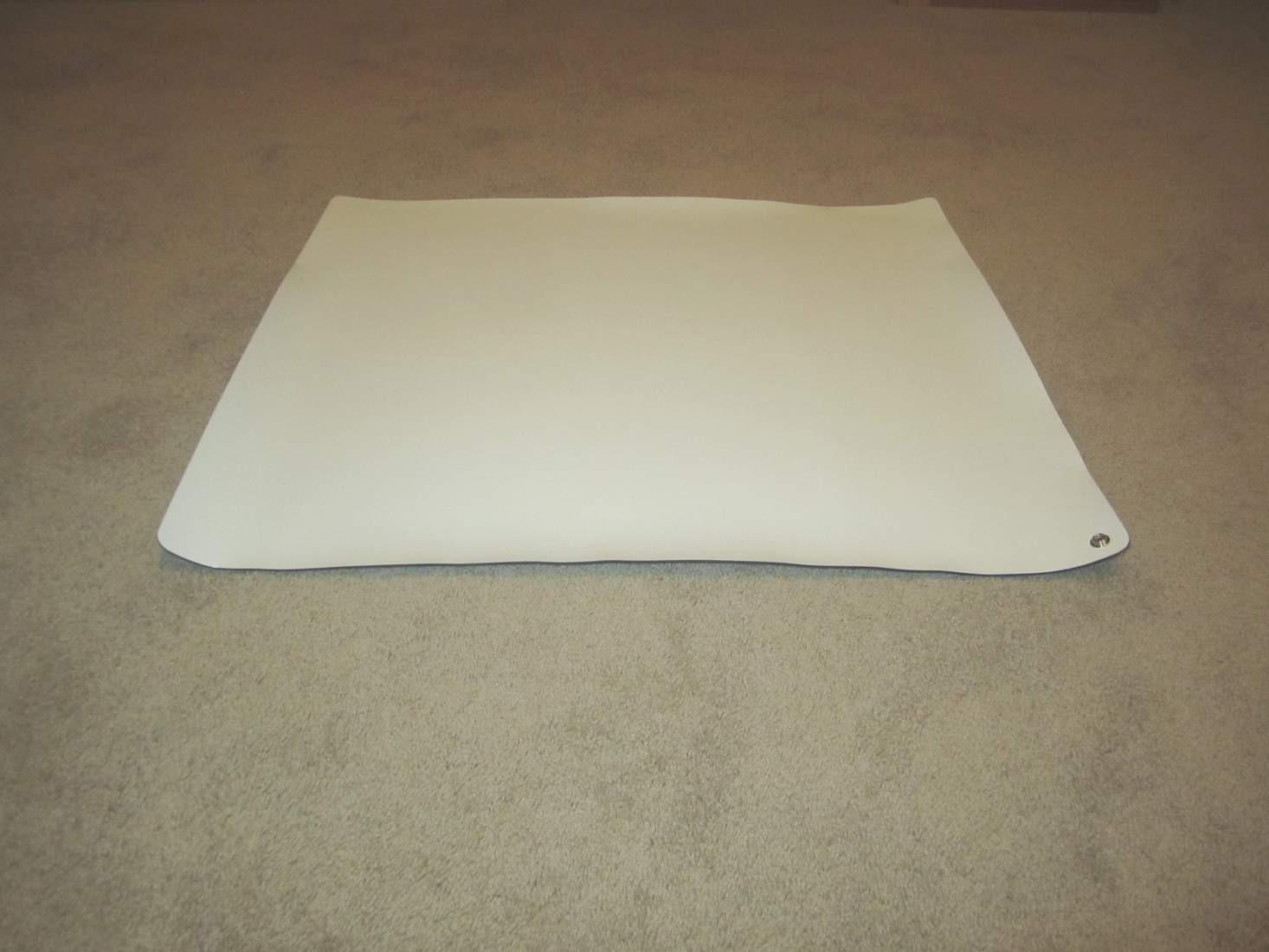
The beige top surface is a deliberate choice for inspection work. Beige gives strong contrast against dark green and black PCBs, so a small black component on a beige mat is far easier to spot than on a dark mat. It also hides solder flux staining better than a light surface would.
The grounding wire is 6.6 ft with a snap-on clip, which is generous reach for a bench of this size. The mat is 1.6 pounds and rolls into a tube for storage. A two-year warranty comes with it.
Two things to know. PVC is not a soldering surface, so this is an assembly, service and inspection mat rather than an iron rest. And no wrist strap is included, so if your operators handle bare boards you will want to add one.
Check the standard and the warranty if you are buying for an institution
Documented standards are the difference between a mat that works and a mat you can prove works. S4.1 covers surface resistance, which is the figure that tells you whether the top layer is dissipating. If your facility has an ESD program, that documentation is the purchase justification.
The two-layer PVC build is thinner than most rubber mats in this roundup, which keeps it flat and light. Check that thinness suits your bench, because a 2 mm mat gives less mechanical protection for delicate ribbon cables than a 6 mm rubber mat.
Know when beige is or is not your answer
Beige is ideal when you are inspecting bare boards and need visual contrast against dark components and green solder mask. If you prefer the blue or green that most people associate with ESD equipment for recognition reasons, this is not that mat.
It is also the wrong pick if your bench doubles as a solder bench. Nothing in the PVC construction tolerates a resting iron.
4. Bertech ESD Mat Kit: American-Made Vinyl for Real Assembly Work
Bertech ESD General Purpose Mat Kit, 2ft. X 4ft., Blue (1059-2x4BKT)
- Heavy tough vinyl that resists flux and solvent
- Verified surface resistivity
- Easy to trim to a smaller bench
- Ground connections at both ends
- Strong off-gassing smell on unpacking
- Vinyl is not heat resistant
- Higher cost than most in this category
The Bertech kit is the one I would put in a lab where the bench takes abuse rather than a desk where comfort matters. It is 2 ft by 4 ft, 0.093 inch thick and weighs just under 6 pounds. That weight is the first thing you notice, and it is a good thing: it does not walk across the bench when you lean on it.
Surface resistivity is specified at 10^9 to 10^10 ohm, which sits at the dissipative end of the range rather than the conductive end. That is the correct behaviour for a bench mat. It is RoHS compliant and made in the USA, and it is sold for aerospace assembly, contract manufacturing and semiconductor work.
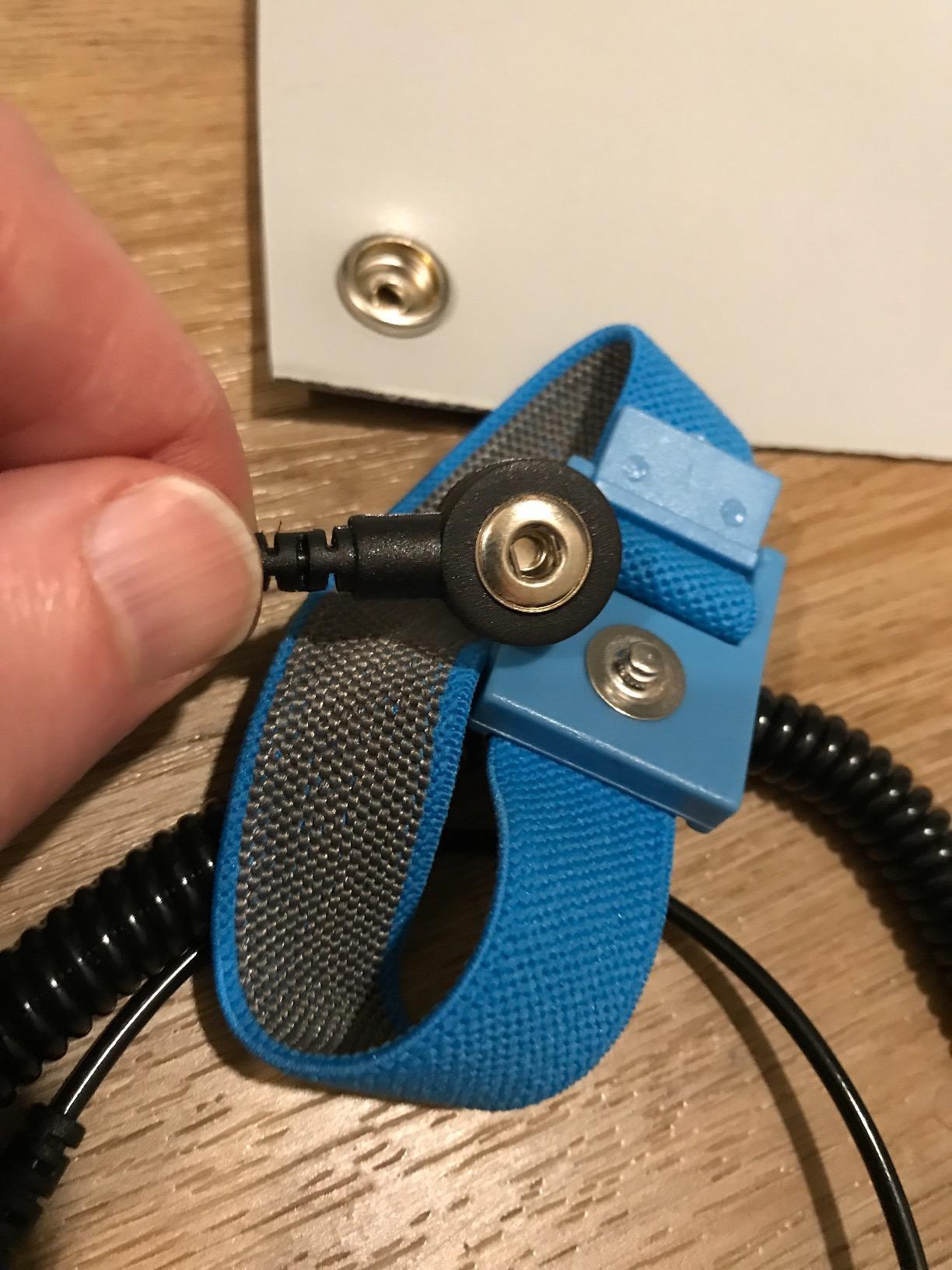
Owners report measuring it with a meter and getting close to the advertised figure, which is more than can be said for several mats in this roundup. They also report it surviving years of flux, alcohol wipes and stray molten solder, and rolling flat again after storage.
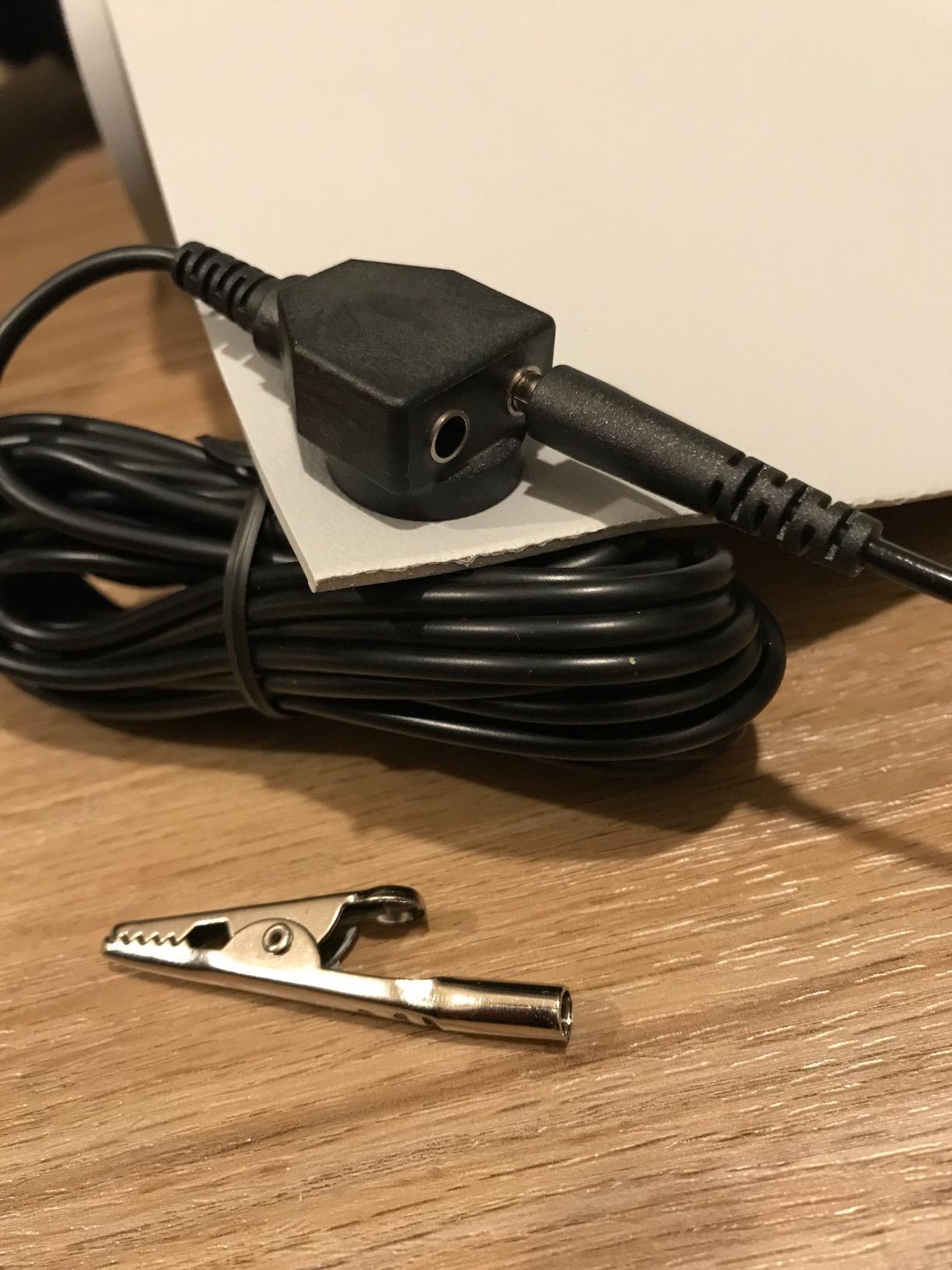
The kit includes the mat, a wrist strap and a grounding cord, with grounding connections at both ends so either hand reaches a lead. That detail matters more than it sounds on a four-foot mat. A wrist strap that uses an alligator clip rather than a matching snap is less elegant, but it is a reliable connection.
The trade-offs are real. New vinyl has a strong off-gassing smell that owners say takes days to dissipate, so ventilate the room when it arrives. And vinyl melts under a soldering iron, so this is a build and teardown surface, not a solder surface.
Check the off-gassing if you work in an enclosed room
This is a homogeneous polymer mix rather than a coated foam, and the odour on unpacking is the most repeated complaint in the reviews. In a well-ventilated workshop it clears in a few days. In a small closed room it lingers and it is genuinely unpleasant.
If you have respiratory sensitivity or a sealed bench area, choose a silicone or nitrile rubber mat instead. Both of those are odour-free from the start.
Know when a heavier mat beats a thinner one
At 0.093 inch and nearly 6 pounds this mat absorbs shocks and protects delicate ribbon cables and connectors far better than a 2 mm sheet. It stays flat under a case chassis, a battery pack or a heavy transformer.
It is easy to trim with a single blade pass, so a two-foot-wide mat can become a two-foot-deep one for a narrower bench without buying a different product.
5. KooMall 36 x 24 Inch Rubber Mat: Conductive Drainage and Two Ground Studs
- Conductive on both faces for fast drainage
- Two 10 mm male stud ground points
- Large area suits tower builds
- Dotted anti-slip texture
- Rubber has less heat resistance than silicone
- Premium pricing for the size
- Printed ESD text wears with use
This is the mat I use for full tower PC builds, and the reason is the resistance figure. Surface resistance is quoted at 10^3 to 10^5 ohm, which is conductive rather than dissipative. That is a deliberate departure from the usual 10^6 to 10^9 window, and it means charge drains quickly off both faces.
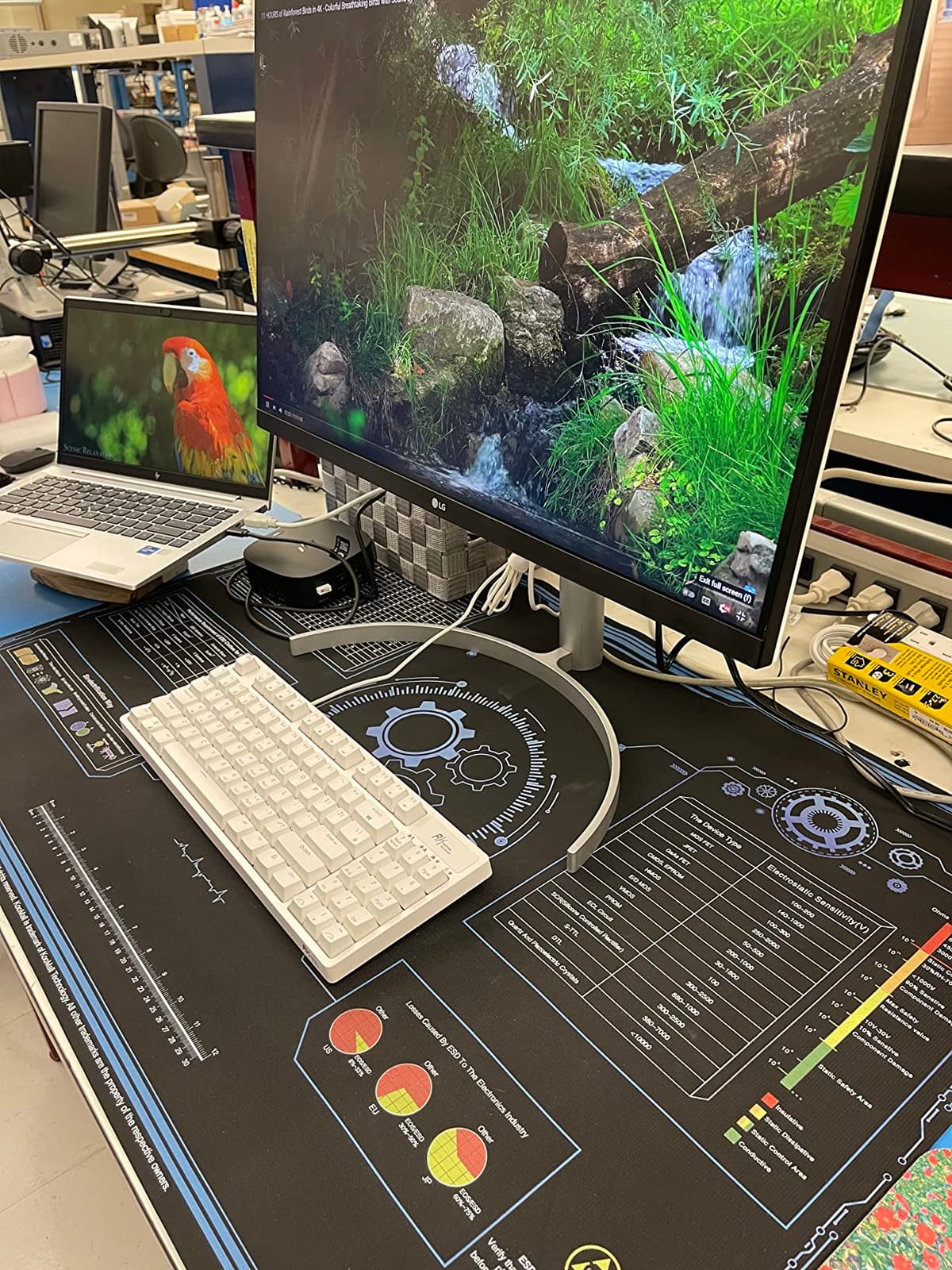
Conductive behaviour is correct here because the mat is thick rubber at 36 by 24 inch and rated to 250 degrees C. It is not a thin sheet sitting between you and a powered rail, so the fast drain does not create the shock hazard people worry about with floor mats. Reserve genuinely low-resistance mats for floor use.
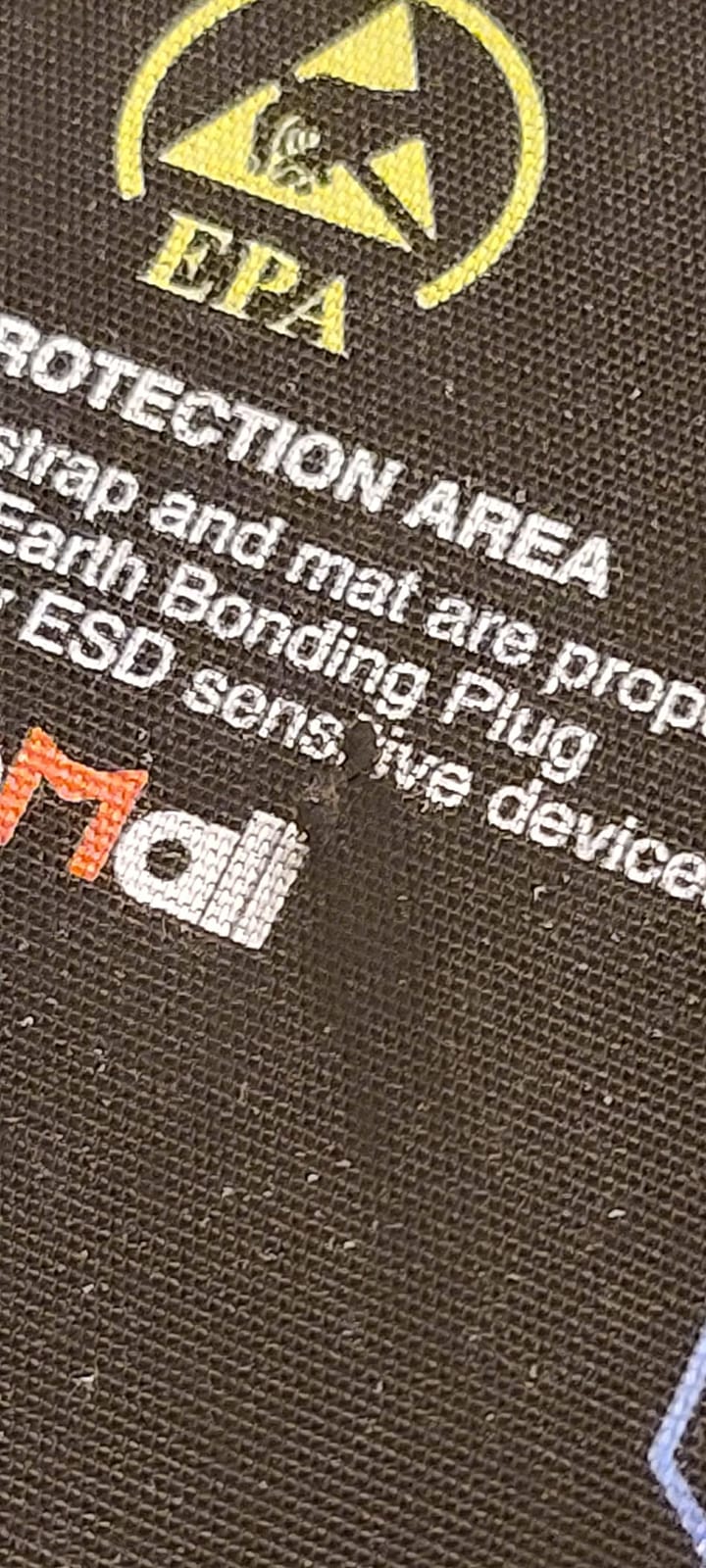
Grounding is unusually well thought out. Instead of a single snap there are two 10 mm male studs mounted on the mat, which give you a positive connection that will not accidentally unclip while you are moving a graphics card around. The kit includes a US grounding plug, a grounding cord with two holes and an ESD wrist strap.
The working side has an anti-slip dotted texture, and the rubber is described as non-toxic and cleanable with water. Printed ESD awareness text is printed on the surface, which is a nice touch for training, although it does wear with heavy use.
At 1 kg it is heavier than the vinyl and PVC options but well under the 5 kg rubber roll. The upper temperature rating of 250 degrees C handles solder and a hot air station without damage, though it is well below the 932 F of a silicone mat.
Check whether conductive behaviour suits your safety policy
A mat below 10^6 ohm is outside the dissipative range that ANSI/ESD S20.20 expects for a bench surface. Many programs require a dissipative surface at a specified point-to-ground resistance, and a conductive mat will fail that paperwork even though it works perfectly well in practice.
If your facility has a written ESD control plan, pick a dissipative mat. If you are a technician or hobbyist without one, the fast drain is a genuine practical advantage for large builds.
Know when size beats everything else
At 36 by 24 inch this fits a mid-tower case laid on its side with room to spare, which is the single most practical thing a mat can do for PC builders. A full tower with a power supply and radiator out is tight but workable.
Also check the stud positions against your grounding setup. Two hard-mounted studs are a different fitting from the 10 mm snap most people already own.
6. LUTICO 24 x 48 Inch Multi-Layer Mat: Large Area With a Relocatable Ground Lug
Anti Static ESD Mat for Electronics Repair, 24″X48″, Grounding Kit
- Large 24 x 48 inch permanent bench coverage
- Full grounding kit with coil cord
- Ground lug can be moved to any corner
- Multiple sizes and colours available
- Only rated to 180 F
- Outlet ground adapter not included
- Strong vinyl odour on arrival
At 24 by 48 inch this is one of the larger surfaces in the roundup, and the construction is the textbook version: a blue static-dissipative top layer over a black conductive bottom layer. The blue layer spreads charge across the table, the black layer carries it away to ground.
Specified performance is surface resistivity of 10^6 to 10^8 ohm and volume resistivity of 10^5 to 10^8 ohm. Volume resistance is the number most listings omit, so having it published is a point in its favour. At least one technician reports measuring the mat with a multimeter and finding the construction matched the advertised range.
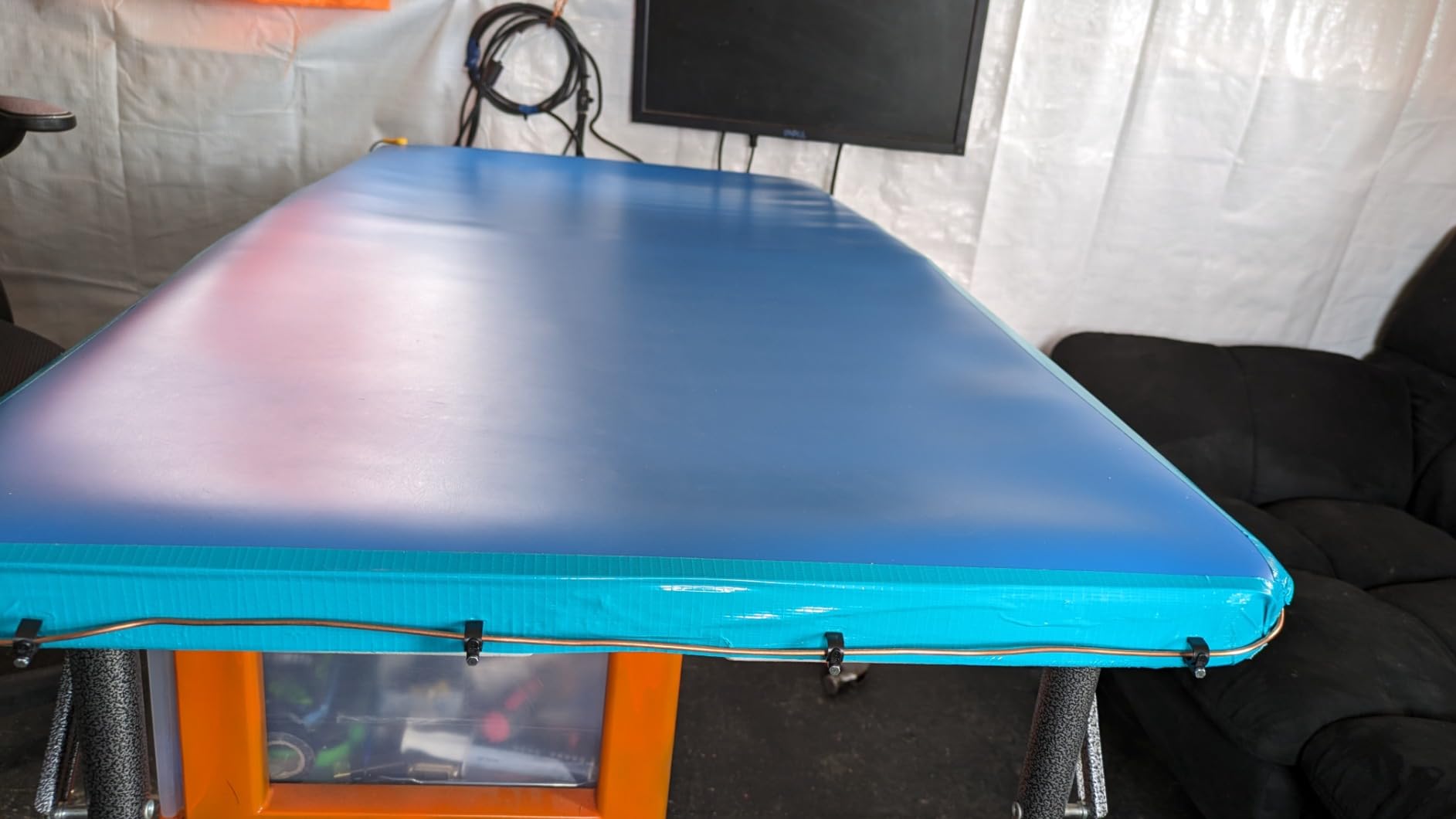
The grounding kit is thorough. You get an ESD mat, a wrist strap, a coil cord and a common-point ground cord with a ring terminal. The outlet ground adapter is not included, which is a small gap you will notice the first time you try to plug in. The coil cord is a genuine plus because it keeps the wrist lead off the work surface.
One practical feature deserves attention: the ground lug can be unsnapped and relocated to any corner with a screwdriver and a leather punch. That matters on a mat this wide, because a fixed corner lead leaves most of the surface with a long cord run.
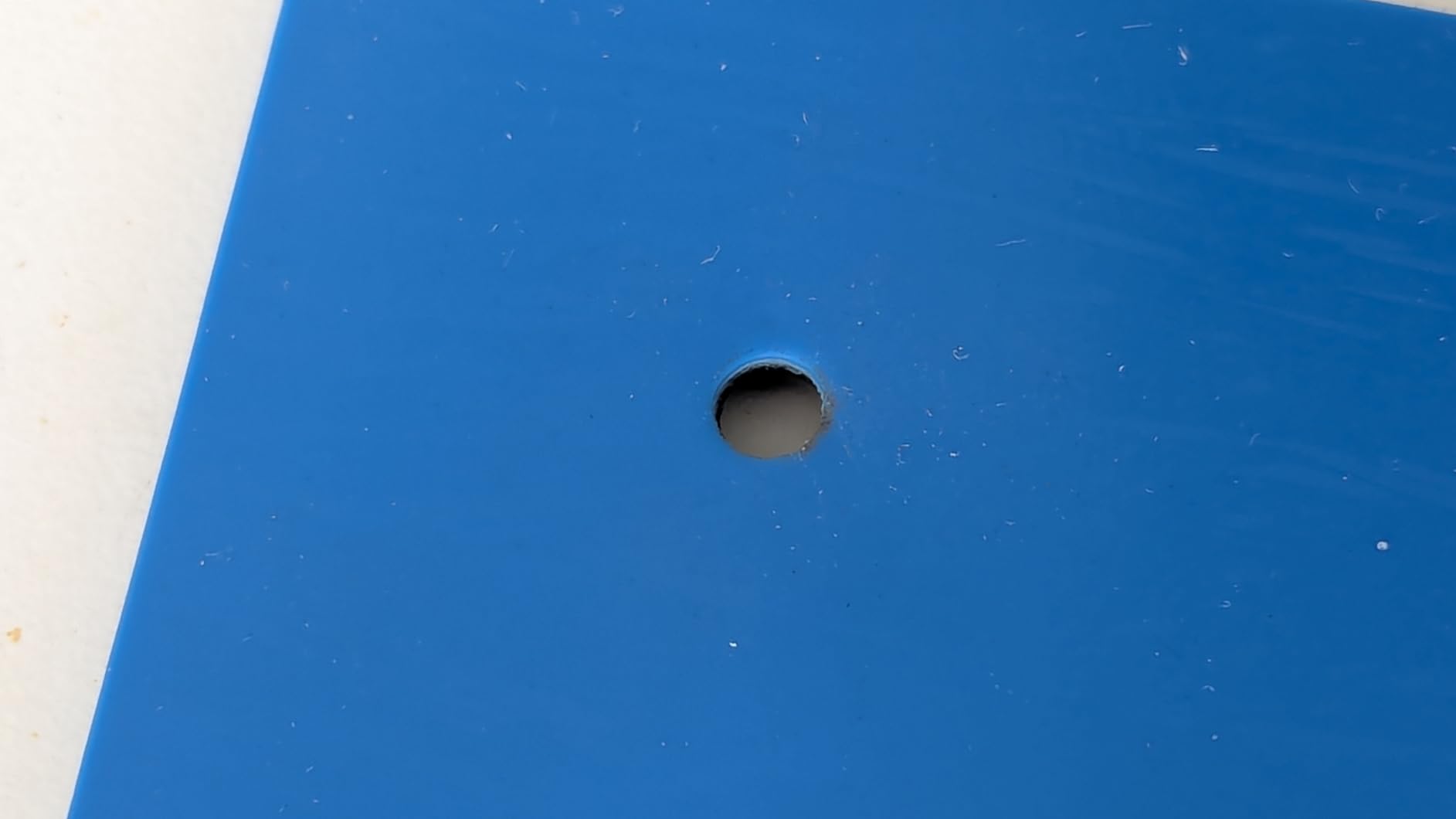
Now the honest part. One laboratory test measured the blue layer as effectively insulating, which raised real doubt about dissipation, and that is why the rating sits at 4.2 with a visible one-star share. The upper temperature rating is only 180 F, which means no direct iron contact and no hot air station on the surface. Vinyl odour on arrival fades, and the mat needs time in sunlight or under weight to flatten after shipping coiled.
Check the temperature rating before you commit
At 180 F this is the lowest heat rating among the large mats here, and it is the first specification to verify. If your bench is purely assembly, disassembly and inspection, 180 F is fine. If a soldering iron or hot air gun will touch the surface, this is the wrong mat.
Second, confirm you already have an outlet ground adapter or a proper ground point. The ring terminal cord needs a destination, and the included kit does not supply the wall plug piece.
Know when 24 x 48 inches is worth the compromises
This size is for a fixed, dedicated electronics bench where you want the maximum safe area permanently committed. If your bench doubles as a desk, a 24 x 24 or 20 x 24 footprint leaves working space around it.
Check your verification expectations too. If you intend to test resistance periodically with a megohmmeter, confirm the material is documented well enough to interpret the result.
7. Kaisi 21.6 x 16.9 Inch Silicone Mat: 48 Compartments for Teardowns
Kaisi Large Anti Static Mat with Grounding Accessories,Soldering Mat
- 48 numbered compartments for screws and parts
- 932 F rating suits irons and hot air
- Large area for a silicone mat
- Grounding plug cord and strap included
- 0.25 inch thickness is bulky to store
- Accessories hidden in the tube packaging
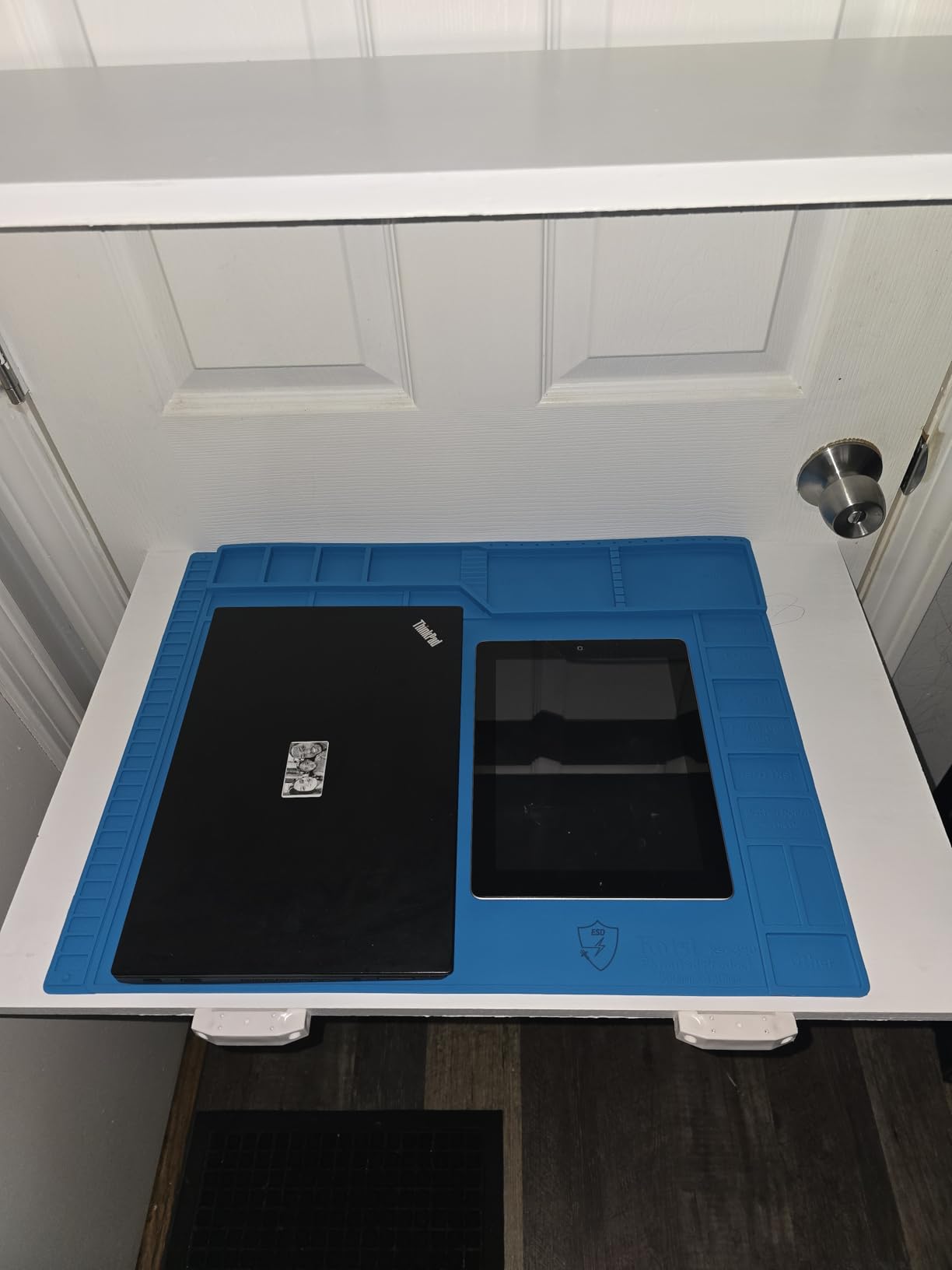
The Kaisi mat is built around a specific job: taking something apart without losing anything. Forty-eight built-in screw and parts positions are moulded into the surface, which is more than double what most silicone repair mats offer and is genuinely useful for laptop and phone teardowns.
Construction is silicone rated to 932 F, so irons and hot air stations can rest directly on it. Resistivity is quoted at 10^6 ohm, which places it in the dissipative band rather than conductive. Dimensions are 21.6 by 16.9 inch at 0.25 inch thick, and it weighs 2.4 pounds.
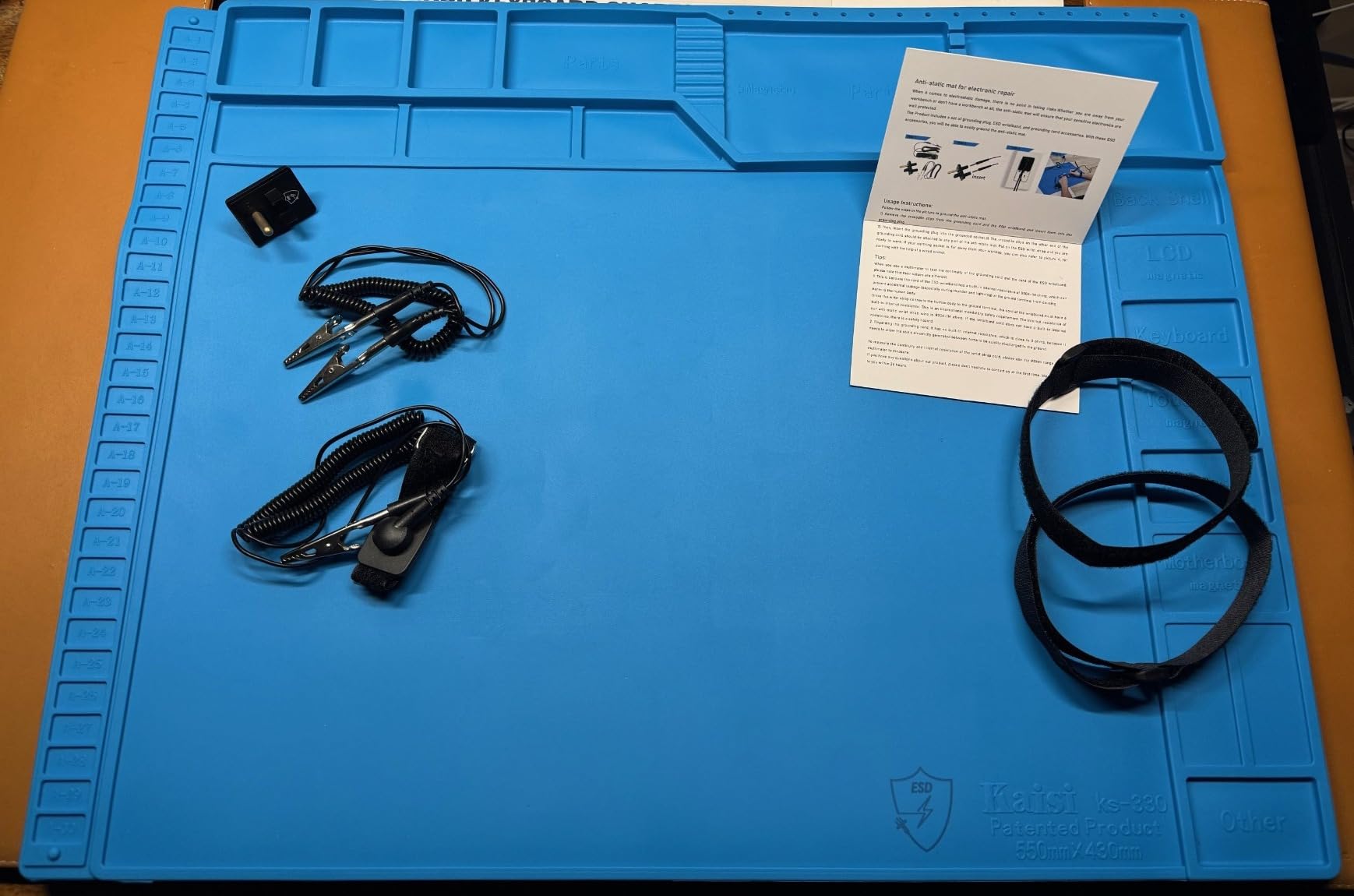
The in-box kit includes a grounding line, a grounding plug, a wrist strap and an instruction sheet. One packaging quirk worth knowing: the grounding accessories sit in the middle of the paper tube, so open the tube fully before you assume the kit is incomplete.
That 0.25 inch thickness cuts both ways. It makes the mat durable and stable under a device chassis, and it makes the mat awkward to store in a shallow drawer. If you work at one dedicated bench and leave the mat laid out, the bulk is irrelevant.
Owners rate the combination of size, heat rating and storage grid highly for the money. The 4.4 average reflects a product that does a specific job well rather than one trying to be everything.
Count your teardown screws before choosing
Forty-eight positions sounds like plenty until you open a laptop with 27 different screw lengths, which is when the grid proves its value. If your work involves multi-device teardowns where screws from four boards would otherwise share a tray, this is the mat to look at.
If you mostly solder rather than disassemble, a plain silicone mat with more open surface may suit you better, since compartments eat usable area.
Know when 0.25 inch is too thick
Thick silicone mats sit high off the bench, which changes wrist angle and can make very fine tweezer work harder. It also means the mat will not roll into a small tube for field work.
Check that your bench has depth to spare and that you are not stacking other tools on top of the storage grid where they will no longer be on a dissipative surface.
8. MWRF Source 20 x 24 Inch Nitrile Rubber Kit: Thick, Heavy and Bench-Ready
MWRF Source ESD Mat Kit with Wrist Strap and Grounding Cord (20 Inches x 24 Inches x 0.12 Inch, Blue)
- Thick nitrile rubber resists soldering contact
- 10 ft cord gives generous bench reach
- Protects the bench surface from scratches
- Many sizes and colours available
- Strong rubber odour on arrival
- Strap lead can unclip across a wide reach
The MWRF Source kit is a straightforward blue nitrile rubber mat at 20 by 24 inch and 0.12 inch thick, supplied with an adjustable wrist strap and a 10 ft grounding cord. The cord length is the standout detail here: ten feet means you can ground from a bench corner without a long extension across the floor.
Surface resistivity is quoted at 10^9 to 10^10 ohm, which is at the top of the dissipative range. Nitrile rubber is the material of choice in professional ESD work because it tolerates repeated solvent contact, abrasion and stray solder without degrading, and 0.12 inch of it gives real mechanical protection for the bench underneath.
Owners consistently describe it as thick, heavy-duty and effective for PC assembly, and they report it doubles as bench scratch protection during builds. Sizes run from 18 by 30 up to 2 by 4 foot and 18 by 47 inch, in blue and grey.
The two recurring complaints are both first-week issues. The rubber smell on arrival takes days to air out, so let it sit somewhere ventilated before you start work. And the wrist strap lead can disconnect from the mat if you stretch across a wide area, which is a habit worth unlearning.
Check the cord length against your bench layout
A 10 ft ground cord removes the most common installation problem, which is a mat that cannot reach a ground point. Before buying any kit, measure from the mat’s intended corner to your nearest verified ground or ground block and compare.
Also check the fitting. This kit uses a two-hole grounding cord arrangement rather than a 10 mm stud, so plan your ground hardware accordingly.
Know when the resistance figure sits at the edge of the window
At 10^9 to 10^10 ohm you are at the upper limit of static-dissipative behaviour. That is still a bench-appropriate range, but if your facility specifies a 10^6 to 10^9 window you should verify with a meter before it goes into service.
At 0.12 inch this mat is thick enough to solder on in moderation, which makes it a reasonable single-mat solution for benches that both assemble and solder.
9. Static Care RubberStat 24 x 24 Inch Dual Layer Mat: The Compliance-Proof Build
RubberStat Dual Layer ESD Compliant Workstation Rubber Table Mat Kit, Soldering, Cell Phone Repair, with Wrist Strap Set and Ground Cord – 24″x24″ Green
- Dual-layer construction matches the S20.20 spec
- Resists hot solder irons and solvents
- 15 ft ground cord reaches a wide bench
- Green surface gives component contrast
- 24 x 24 is smaller than full bench mats
- Arrives rolled and settles slowly
- Limited colour options at this size
This is the mat I would specify if someone had to justify the purchase in an audit. It meets the point-to-point and point-to-groundable point resistance requirements of ANSI/ESD S20.20, which is the standard most corporate ESD programs are written around.
The construction is what makes that claim credible: a static-dissipative rubber top layer bonded over a black conductive rubber base, 24 by 24 inch at 0.080 inch thick. It weighs 2.94 pounds, which is substantial enough to stay put, and the green top surface gives good visual contrast against dark PCBs and black chips.
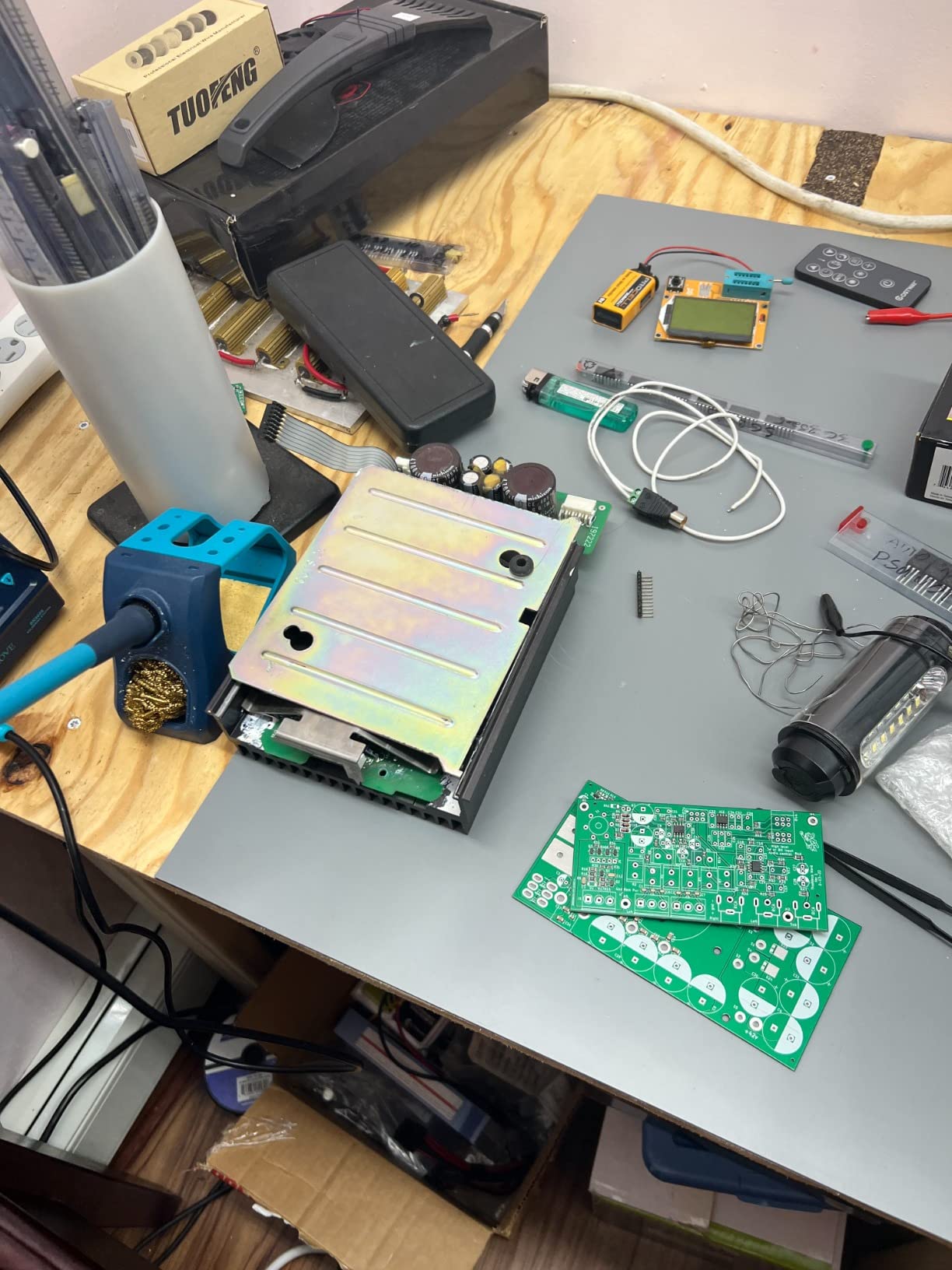
Durability is the headline. Owners and the manufacturer both point to resistance to hot solder, soldering irons, most solvents and everyday wear, plus scratch and gouge protection for the table underneath. That combination is what makes dual-layer rubber different from a coated vinyl mat, where any deep contact reaches the substrate.
The kit includes the mat, an adjustable wrist strap and a 15 ft ground cord, which is the longest run in this roundup and covers a wide bench from a single outlet. Over 100 size and colour combinations exist across the range, including royal blue, light blue, grey and green.
The 24 by 24 footprint is square rather than long, so it suits phone, tablet and board repair better than a full tower build. Expect it to arrive rolled and to take a while to settle flat, which is normal for rubber.
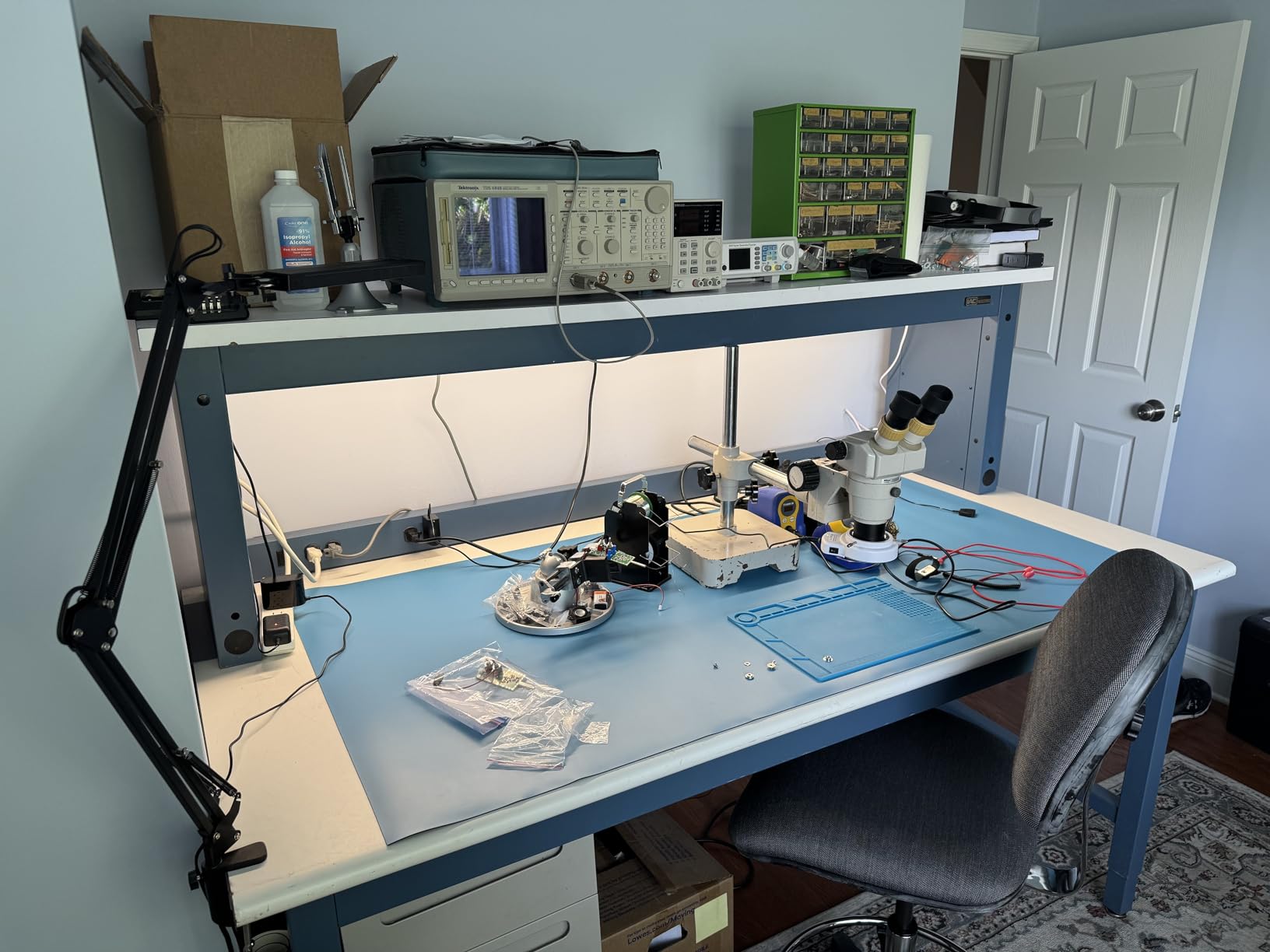
Check the standard if your workplace has an ESD control plan
S20.20 is the reference standard for an ESD control program covering both personnel and area grounding. A mat that explicitly meets its resistance requirements saves you from having to validate a surface yourself, which in a regulated environment is worth more than any material advantage.
Ask for the test report if you are buying in volume. A claimed compliance line and a dated report are not the same thing, and suppliers for institutional buyers will normally provide one.
Know when a square footprint limits tower builds
Twenty-four by twenty-four inches is ample for laptops, phones, tablets and single boards. A mid-tower case laid flat will overhang on two sides, and any work beyond the edge is no longer on a dissipative surface.
Rubber also arrives with a strong odour that fades over several days. Plan for that before you set up in a closed room.
10. Hooandxk 27.6 x 15.7 Inch Silicone Mat: The Widest Heat-Resistant Surface Here
Anti Static Soldering Mat, Extra Large 27.6″ x 15.7″ Heat Resistant 932°F Large Silicone ESD Safe Work Mat with Grounding Accessories and Anti Static Wrist Strap (Black)
- Extra wide silicone surface for the category
- Handles irons and hot air directly
- Coiled cord and wrist strap included
- Folds flat for storage
- Black surface shows flux residue
- Smaller review base than the established kits
This mat solves a specific sizing problem. Most silicone soldering mats measure around 16 by 12 inch, which suits phones and cameras. This one is 27.6 by 15.7 inch, or 70 by 40 cm, which is a laptop-sized work area while still tolerating a resting iron.
Surface resistivity is quoted at 10^6 to 10^9 ohm, the widest and most textbook dissipative range in this roundup. Material is silicone rated to 932 F, so hot air stations and irons can go straight onto the surface. In the box you get the mat, a coiled cord, an ESD wrist strap and a ground cord.
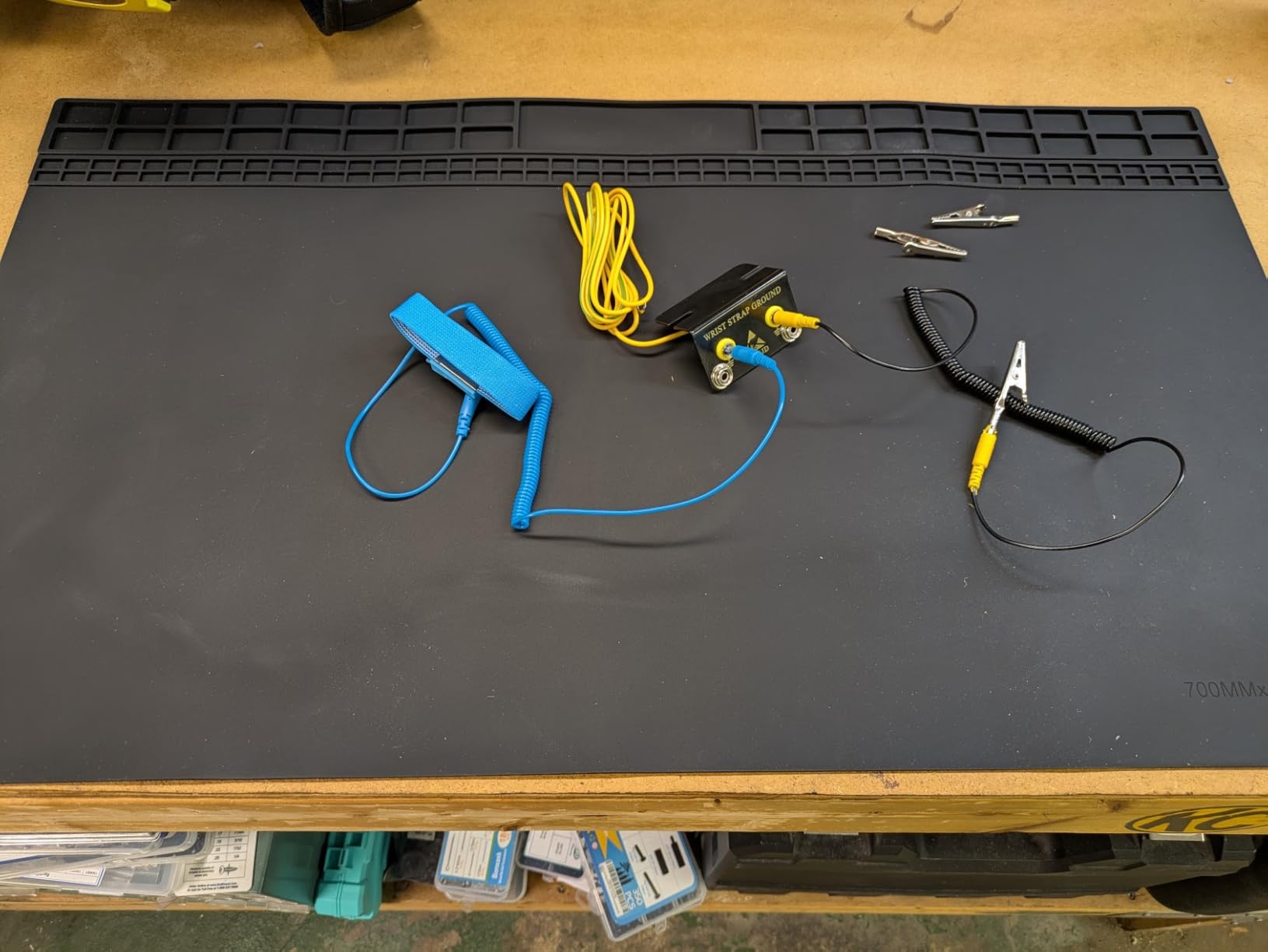
Having both a coiled cord and a straight ground cord is useful. The coil keeps the wrist lead off the bench and out of the way of a hot iron, while the straight cord grounds the mat itself. On a bench of this size that separation matters.
It folds flat for storage and the manufacturer rates it for phones, laptops, computers, watches and cameras, which matches the width well. The black colour is a deliberate choice, and a deliberate trade-off: black shows flux and solder residue more readily than beige or grey, so it will need more regular wiping to look clean.
The honest caveat is the review base. With 51 ratings this is the least-proven option in the roundup, and the absence of one-star ratings in that sample is not the same evidence as a long history. The specifications are good; the field history is short.
Check surface colour against your inspection habits
Black gives less contrast against dark components and green solder mask than a beige or green mat. If your work involves finding small black chips or inspecting bare boards, colour matters more than most buyers expect.
If your work is soldering-driven rather than inspection-driven, black hides general shop staining better and the heat rating is what matters.
Know when a shorter track record matters
Institutional buyers who need documented compliance evidence will find none published here. Private benches and hobbyists have less to worry about, since the heat rating and resistance range are both stated clearly.
The coiled cord is worth checking against your reach. Coiled leads extend the usable distance but add length that has to be managed at the edge of the bench.
11. Esoldnic 23.7 x 13.8 Inch Silicone Mat: Budget Heat Protection With One Big Caveat
- Generous area for the money
- 932 F rating for iron contact
- Folds flat without taking creases
- Washable with soap water or alcohol
- The mat itself is not anti-static
- Protection depends on wearing the wrist strap
- No built-in screw compartments
The first thing to say about this mat is in the manufacturer’s own listing: the mat itself is not inherently anti-static. It is a heat-resistant silicone work mat. The ESD protection comes from the included 1M ohm wrist strap, which passes a static decay test and drains body charge in roughly a tenth of a second.
That is a meaningfully different product from the other eleven here, and it is not automatically a bad thing. A wrist strap is the more effective control for the operator, which is where most static originates. What the mat gives you is a heat-tolerant, non-insulative surface that will not itself build charge.
The build is premium silicone rated to 932 F, 23.7 by 13.8 inch at 0.15 inch thick, grey, 1.37 pounds. It folds without creasing and cleans with soap, water or alcohol. The kit includes an ESD wrist strap, a ground cord and a coiled cord.
Buyers like the size and heat rating. The 4.2 average with a 10 percent one-star share is the weakest profile in the roundup, and the reason is almost always this same point: people buy it expecting a dissipative mat and get a silicone tray with a strap beside it. If you buy it understanding that, it does what it says.
Check whether you will actually wear the wrist strap
A mat plus strap combination only works if the strap is worn continuously while sensitive parts are handled. If you will forget it or work with gloves, the ESD benefit mostly disappears and you are left with a heat-resistant surface, which you can get elsewhere.
For a workbench where a single person sits for hours and does repetitive board work, a strapped wrist is realistic. For a shared bench with multiple people passing through, a dissipative mat is safer because it protects everyone without individual compliance.
Know when the missing compartments matter
There are no built-in screw positions here, unlike the Kaisi and HPFIX silicone mats. For teardown-heavy phone work that means a separate parts tray, and any tray you add needs to be dissipative too or it becomes a charge source.
Cleaning is straightforward with soap and water or alcohol, which matters because contaminated surfaces defeat the grounding you are paying for.
12. MYOYAY 118 Inch Rubber Roll: Cut It to Whatever Bench You Have
- Long roll cut to any bench length
- Strong traction on both sides
- Survives dropped hot solder
- Resists oil grease acid alkali and flux
- Very strong rubber odour that lingers
- Edges curl and stay curled
- Heavy at 5.35 kg
This one arrives as a 118 by 23.6 inch roll of 2 mm double-layer rubber, weighing 5.35 kg, and you cut it to fit. For a workshop with several benches, a long shared table or an irregular bench shape, that is genuinely more useful than any of the fixed-size mats here.
The resistance figures are the most complete published here. Top layer is 2 x 10^6 to 10^8 ohms, bottom layer is 8 x 10^3 to 10^5 ohms, giving you a dissipative working layer over a conductive base. The listed wear rate is under 0.02 g per square centimetre and discharge time under 0.1 seconds.
Material performance is the reason to consider it. The double-layer construction is described as resistant to acid, alkali, chemical flux and abrasion, plus oil, grease and most solvents, and the upper temperature rating is 450 degrees C. Owners confirm it survives hot solder dropped straight onto the surface and grips well on both wood and metal benches.
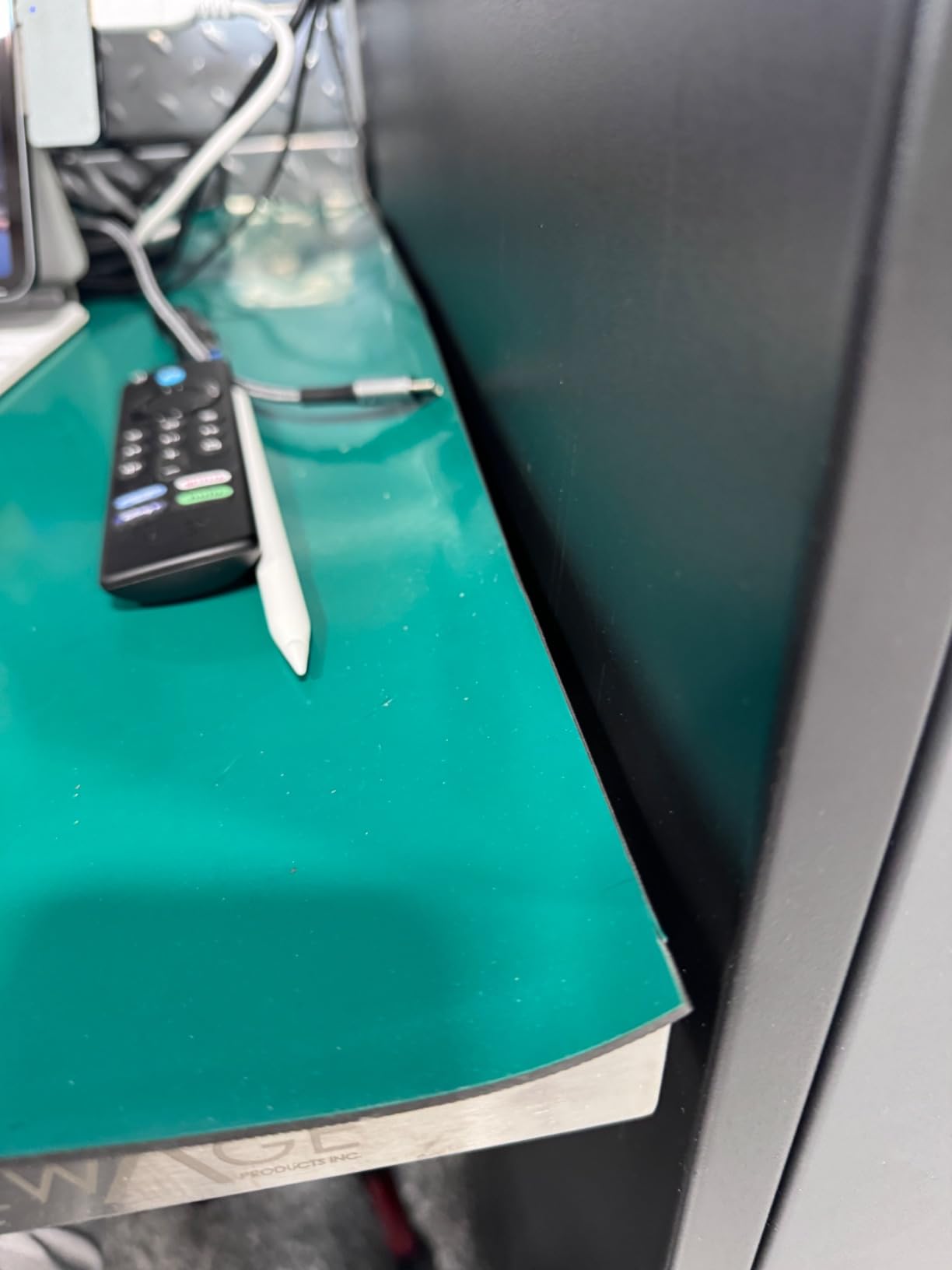
Three practical issues come up repeatedly. The rubber odour is strong and can linger for weeks, so air it outdoors before bringing it in. Edges curl and can stay curled even after heat treatment, which means tape or weights at the corners. And at 5.35 kg it is awkward to reposition, so measure and cut once, in place.
Grounding hardware is not included in the box, so plan for a 10 mm snap and cord separately. For a permanent multi-bench installation that is the correct approach anyway.
Check that you can fix the edges before you commit
Edge curl is the issue that decides whether this works for you. If your bench is a fixed surface where you can tape or clamp the perimeter once and leave it, curl is a minor annoyance solved in an afternoon.
If you need the mat to be moved and stored regularly, a curled roll is a snag hazard for small components and an ongoing irritation. In that case a finished mat with factory-bound edges suits you better.
Know when cutting to size beats buying a finished mat
A roll wins when you have more than one bench, an unusual shape or a long shared workbench. Buy length once rather than three separate mats, and the seams between them are minimal if you cut cleanly.
A roll loses when you work at a single small desk. You will be storing several feet of rubber you are not using, and the 450 C rating and chemical resistance are capabilities you may never use. Also note that no grounding snap is fitted, so hardware is on you.
Anti-Static vs ESD vs Grounding Mats: What the Terms Actually Mean?
The difference between a grounding mat and an ESD mat is one of purpose and electrical behaviour. A grounding mat is hard-connected to earth with very low resistance, which drains charge fast but poses a shock risk if you are working on a live circuit. An ESD mat is static-dissipative, typically 10^6 to 10^9 ohms, which bleeds charge away slowly enough that it cannot shock you and fast enough that no damaging spark forms.
The word anti-static is the one that causes the most confusion, and the confusion is the buyer’s problem. In loose usage it describes anything sold to reduce static. Properly, it refers to a material treatment that reduces charge generation, such as a topical antistat, rather than providing a discharge path. A mat can be anti-static and still not be ESD-compliant.
For a bench, you want static-dissipative with a documented resistance range and a ground connection. Three things to avoid entirely: a floor mat used on a bench, a mat with no resistance figure published at all, and a mat whose charge path depends only on the floor.
Triboelectric charging is the mechanism behind all of this. Every movement of a non-conductive object against another surface separates charge, and a nylon sleeve dragged across a bench generates far more static than a slow hand movement. The mat works by giving that charge somewhere controlled to go.
Resistance Ranges Explained: Why 10^6 to 10^9 Ohms Matters?
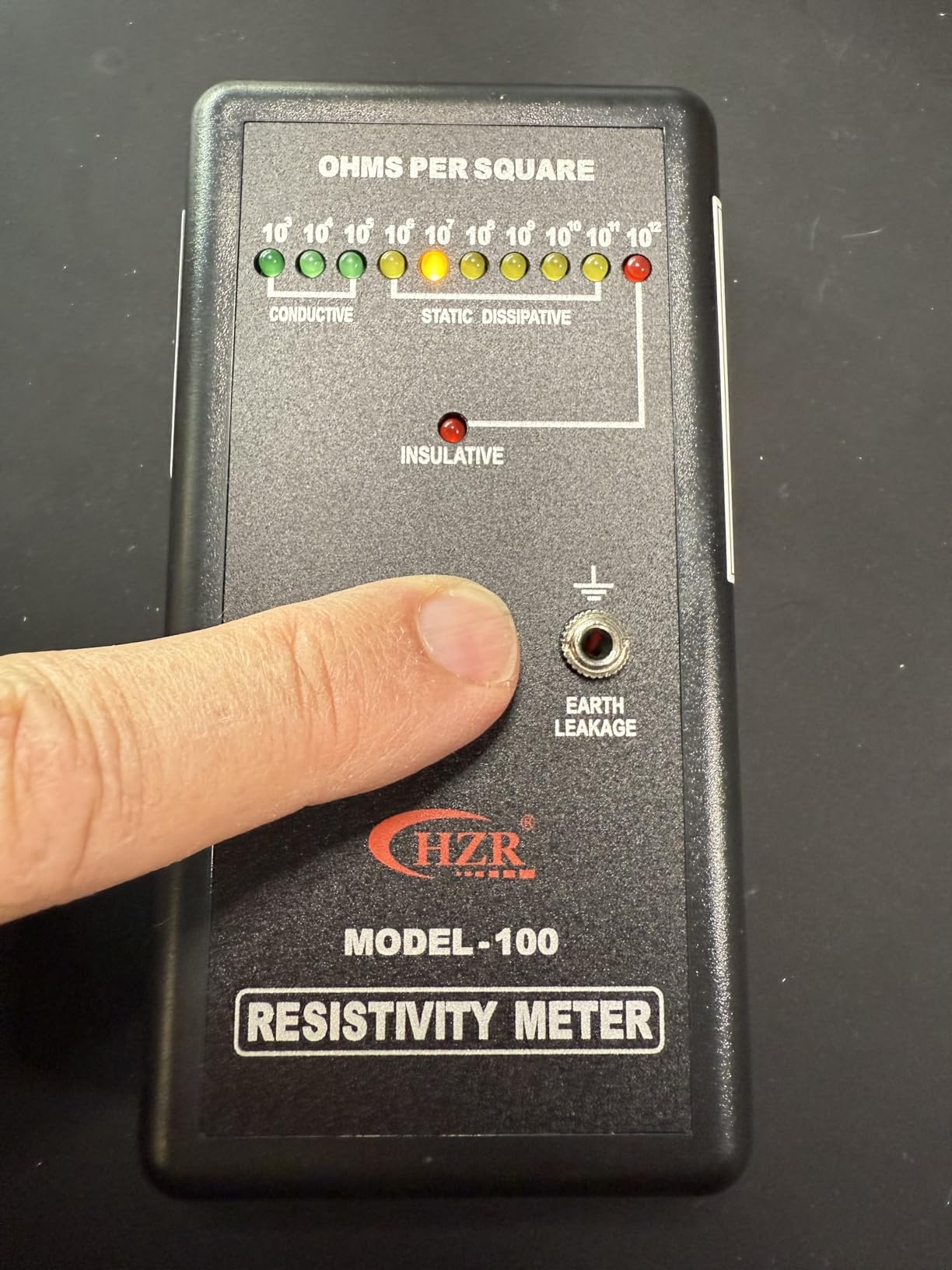
The static-dissipative range of 10^6 to 10^9 ohms is the number that separates a proper bench mat from a piece of rubber with a conductive additive. Below 10^6 you are into conductive territory, which drains fast and raises shock questions on a bench. Above 10^9, or into the insulative range above 10^12, the surface charges and holds it.
Two figures matter. Surface resistance is measured across the top face, which is the surface your parts touch. Volume resistance is measured through the material itself and tells you whether charge can move from the top down to the conductive base and out to ground. A mat can have a good surface figure and a poor volume figure, which is why listing both is a sign of a serious manufacturer.
Two standards appear repeatedly. ANSI/ESD S20.20 covers point-to-point and point-to-groundable point resistance for a full control program. ANSI/ESD S4.1 covers work surface material surface resistance specifically. IPC-A-610 is the workmanship standard for soldered assemblies rather than the mat, but it governs what you are protecting.
How to test an ESD mat with a megohmmeter?
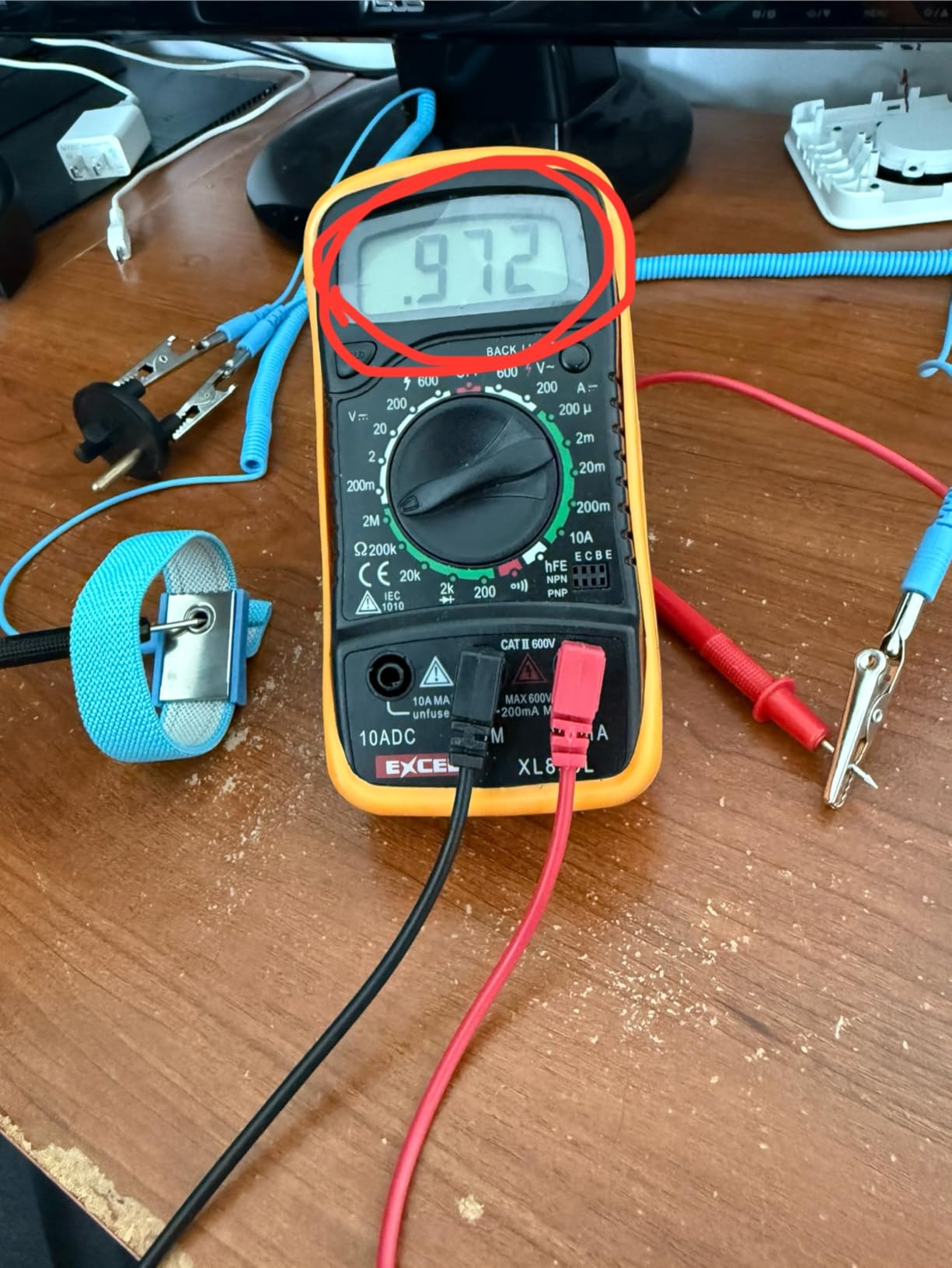
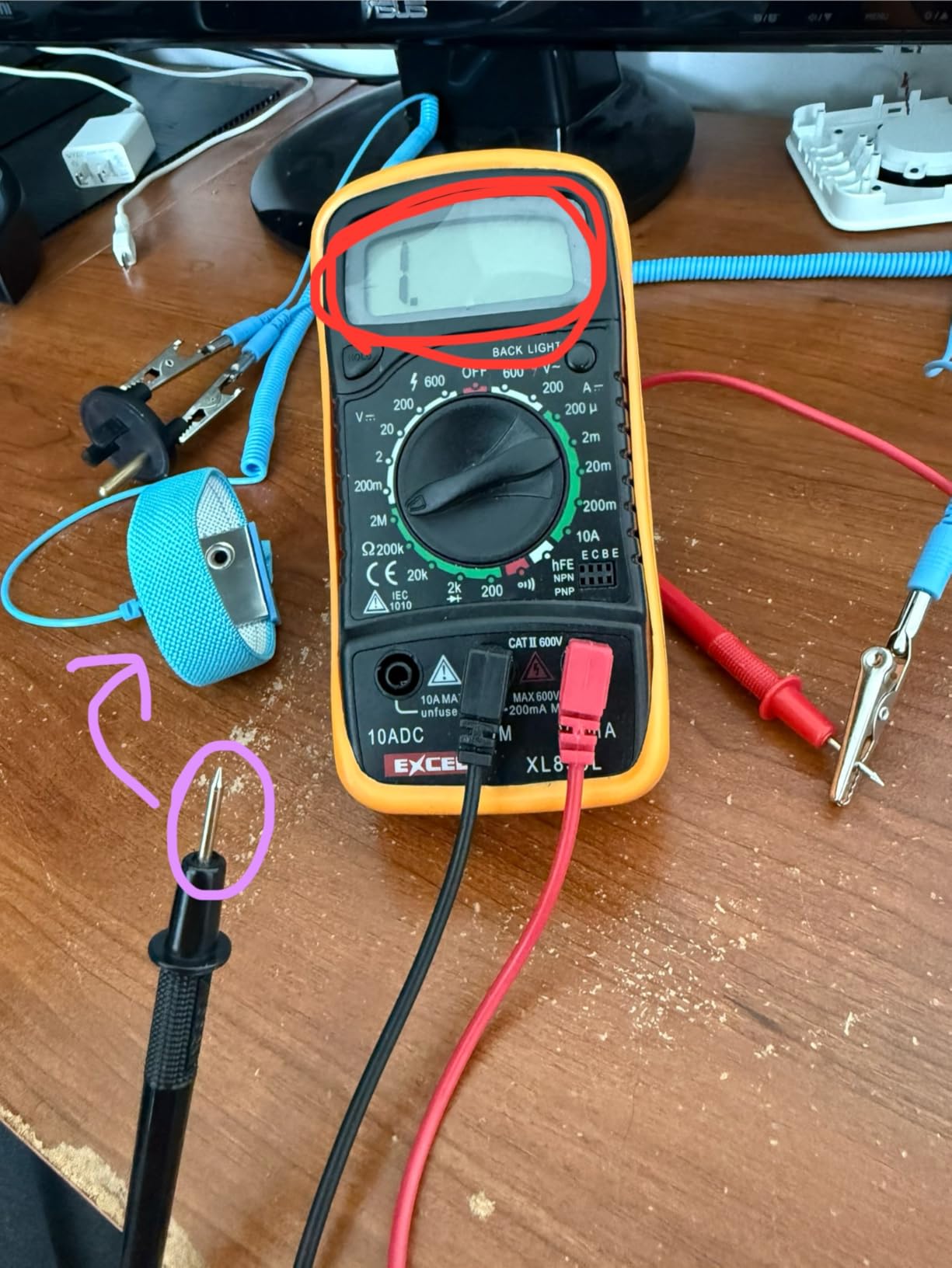
Pros test monthly; hobbyists almost never test, which is why a lot of cheap mats quietly stop working after a year of the wrong cleaner. The procedure is short and needs a specific instrument rather than a multimeter.
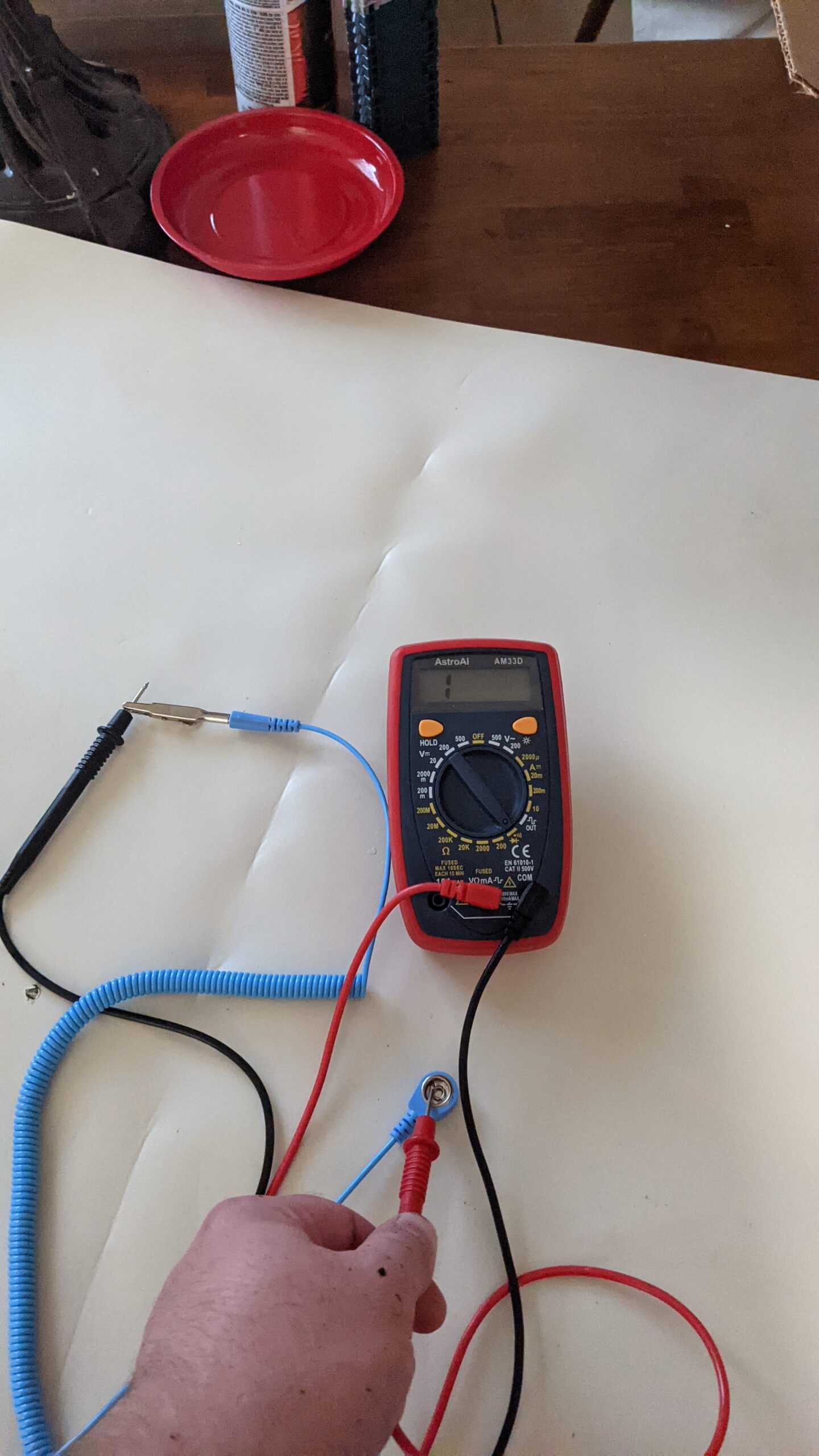
You need a megohmmeter or insulation resistance tester with a surface resistance electrode set, typically 5-pound cylindrical electrodes of conductive rubber. A standard multimeter cannot produce the test voltage required and its readings will be meaningless.
Clean and dry the mat first, then measure with the mat connected to ground through its cord. Test at a low voltage, typically a 10-volt test charge for mats in the dissipative range, and re-test at 100 volts for lower-resistance materials. Record the reading at multiple points across the surface and at the grounding point.
A reading in the 10^6 to 10^9 window is correct. A reading above 10^9 means the surface has become insulative, usually from a silicone-based cleaner leaving a residue. A reading near zero means you have conductive material rather than a dissipative mat.
How to Ground an Anti-Static Workbench Mat Correctly?
Grounding a bench mat takes four parts: the mat, a snap or stud connector, a grounding cord with a 1-megohm safety resistor, and a verified ground point. Skip any one of them and the mat is decorative.
Install it in this order. First, confirm your ground point. The second step is to attach the snap to the mat edge or use the studs if it has them. Third, run the cord to your ground point, which is usually an ESD ground block fed from an earthed power outlet, and never to a neutral conductor or a random screw.
The fourth step is fitting the 1-megohm safety resistor in the cord. That resistor limits current so the mat cannot put more than a microampere into a circuit under fault conditions. It is the single component most often missing from budget kits.
Connect your wrist strap to the same common point ground rather than to a separate outlet. That is what the common point ground designation means, and it prevents charge from moving between you and the bench.
One warning to take seriously. Do not daisy-chain mats together in a string, and do not rely on a floor mat to ground your bench mat. Series resistance adds up and drifts out of specification, and floor-rated mats often sit far below 10^6 ohm, which is a shock hazard on a bench.
Cleaning matters just as much as installation. Use 70 percent isopropyl alcohol or a manufacturer-approved cleaner and a lint-free cloth. Avoid silicone sprays and silicone-based cleaners: they leave an insulative film that will quietly raise your surface resistance out of the dissipative range while the mat still looks clean.
Buying Checklist: 7 Criteria Before You Order
Work through these seven in order and the right mat usually becomes obvious. Skipping straight to appearance is how people end up with a mat that looks identical to a good one and measures out of specification.
1. Published resistance range. A surface resistance figure of 10^6 to 10^9 ohms, and volume resistance if the manufacturer offers it. No figure means no verification, which means no evidence the mat dissipates anything.
2. Working area versus real bench space. Measure the bench, then measure the largest device you actually work on. A 24 by 24 inch mat is generous for a phone and short for a mid-tower case.
3. Heat rating matched to your work. No rating means no iron contact. Silicone mats go to 932 F, quality rubber commonly reaches 250 to 450 degrees C, and vinyl should be treated as assembly-only.
4. Layer construction. A dissipative top layer over a conductive base is the standard that makes fast, even discharge possible. Single-layer mats are harder to reason about.
5. Grounding hardware in the box. Look for the mat connector, a cord with a 1-megohm safety resistor, and a wrist strap. Kits missing the resistor are common.
6. Surface colour and texture. Blue, green and beige give contrast against dark boards and black chips. A dotted or embossed texture stops tools and parts sliding. Avoid heavy embossing if you work with delicate flat flex cables.
7. Compliance documentation. If you are buying for a lab, facility or government work, look for ANSI/ESD S20.20 or S4.1 language and TAA compliance, plus RoHS where relevant. If you are buying for yourself, this matters much less.
Two further notes for government and institutional buyers. TAA compliance language appears on some mats for exactly this reason, and authorised distributors such as DigiKey, Newark and Mouser provide authenticity that marketplace listings do not. For the rest of your bench, our guides to the best breadboard kits for electronics and the best anti fatigue mats cover the supporting equipment.
Frequently Asked Questions
What is the proper use of an anti-static mat?
Lay the mat flat on a grounded, even work surface, connect the grounding cord to a verified earth ground point through a 1-megohm safety resistor, and wear the wrist strap whenever you handle exposed boards or semiconductors. Keep all work inside the mat boundary, clean it only with approved alcohol-based cleaners, and never rest a hot iron on a mat that has no heat rating.
What is the best workbench mat for electronics?
The best workbench mat for electronics is one with a published surface resistance of 10^6 to 10^9 ohms, a dissipative top layer over a conductive base, and a grounding cord with a 1-megohm safety resistor. Add a heat rating of at least 250 degrees C if you solder on the surface, or 932 F if you use a hot air rework station.
What is the difference between a grounding mat and an ESD mat?
A grounding mat is hard-connected to earth at very low resistance, which drains charge quickly but can create a shock hazard on a powered bench. An ESD mat is static-dissipative at 10^6 to 10^9 ohms, which bleeds charge away slowly enough to be safe and fast enough to prevent a damaging spark. Bench work calls for the dissipative type.
How do you test an ESD mat with a megohmmeter?
Use a megohmmeter or insulation resistance tester fitted with conductive rubber surface electrodes, typically 5-pound cylinders. Clean and dry the mat, connect it to ground through its cord, apply a 10-volt test charge for dissipative materials, and measure at several points. Readings should fall between 10^6 and 10^9 ohms.
Can you use an anti-static floor mat on a workbench?
No. Floor mats are often designed to be highly conductive so people can safely walk on them, and that puts their resistance well below the 10^6 ohm lower limit for a bench surface. Using one on a bench risks shock when working on live equipment, and the surface resistance will fail most ESD control plans.
Do you need a wrist strap if you have an ESD mat?
A mat protects the work surface and the parts sitting on it, but static is generated by your body and clothing as you move. A wrist strap connects you to the same common point ground so charge drains off you continuously. For bench work that handles bare boards, using both is the standard practice.
Conclusion: The Best Anti-Static Mats for Electronics Benches in 2026
The iFixit Portable Anti-Static Mat takes the top spot for 2026 because it is the only mat in this roundup that works as a complete system straight out of the box, sits squarely in the 10^7 to 10^9 dissipative range, and folds down small enough to move between workstations. At 4.7 stars across 2505 reviews, it has the strongest combination of rating and review volume here.
If your bench is primarily a solder bench, take the HPFIX silicone mat instead, because a 932 F rating is the only thing that stops the top layer bubbling under a resting iron. If you want full bench coverage with documented compliance, the StarTech mat covers 23.6 by 47.2 inch and is tested to a named standard.
Whatever you choose, ground it properly, test it periodically, and keep silicone cleaners away from the surface. A mat that is not connected to a real ground point and never measured is just a slightly rubbery table.