
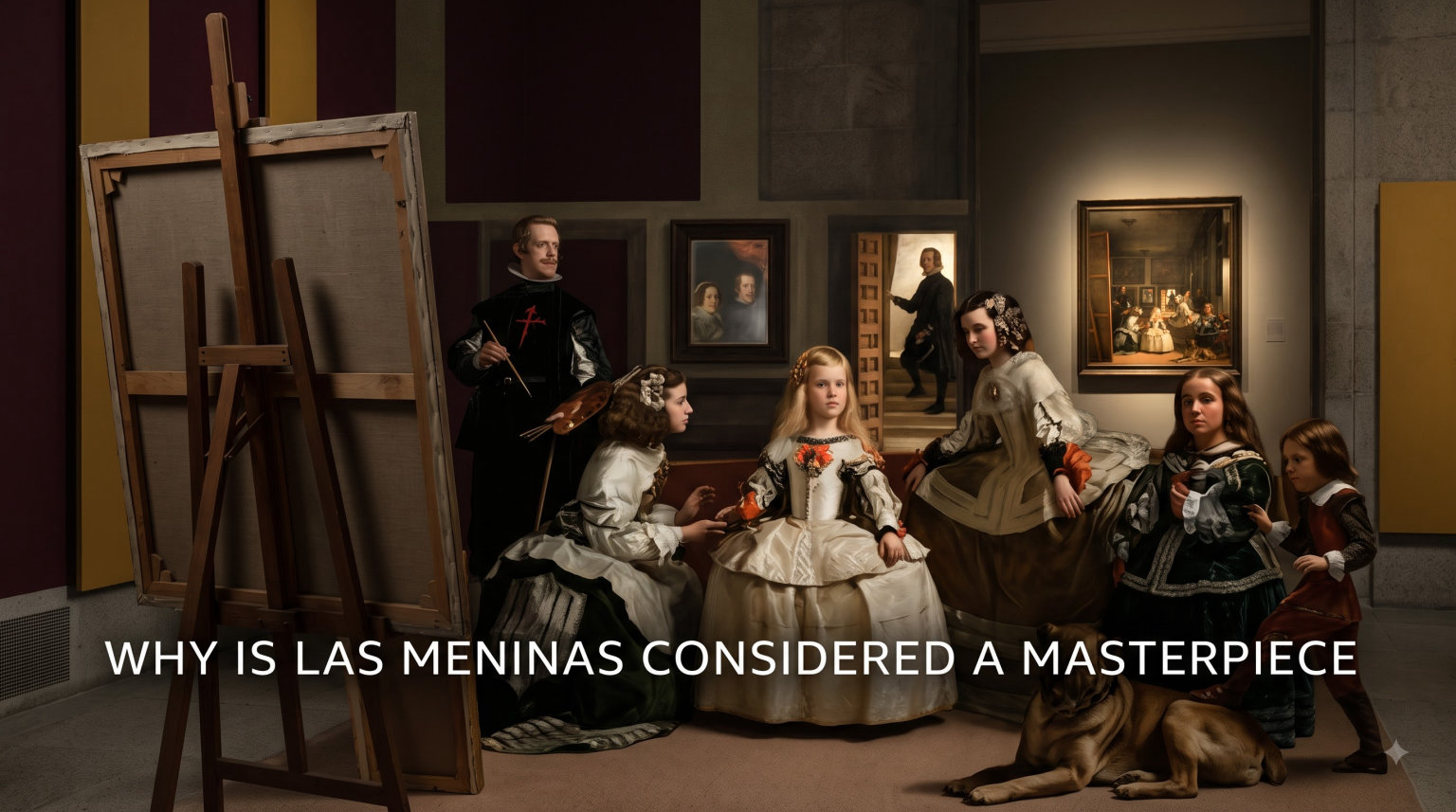
Las Meninas is considered a masterpiece because it shattered every convention of 17th-century portraiture and raised questions about reality, illusion, and the nature of art itself that scholars still debate today. Painted in 1656 by Diego Velazquez, this single canvas accomplishes something no painter had attempted before: it pulls you, the viewer, directly into the scene as an active participant. You are not looking at a painting. You are standing in the royal studio, and the people in the room are looking back at you.
If you have ever wondered why is Las Meninas considered a masterpiece when so many other royal portraits from the same era have faded into obscurity, the answer lies in its radical composition. Velazquez combined masterful perspective, an unprecedented mirror device, and a self-portrait that elevates the artist’s own profession. The result is a painting about the act of painting itself, and that intellectual ambition is what sets it apart from every other Baroque work.
In this guide, I will walk you through the historical context, break down every figure in the scene, explain the technical innovations in plain language, and explore the controversies that keep this painting at the center of art history conversations nearly 400 years later.
Table of Contents
The Story Behind Las Meninas: Velazquez and the Spanish Court
Diego Velazquez (1599-1660) served as the official court painter to King Philip IV of Spain for more than three decades. He was not just a decorator of royal walls. He lived in the Alcazar palace in Madrid, ate at the royal table, and had direct access to the most powerful family in Europe. That proximity shaped every canvas he produced, including Las Meninas.
The Spanish Golden Age was a period of immense cultural output. Writers like Cervantes and painters like Velazquez pushed creative boundaries while the Habsburg empire expanded across continents. Baroque art, with its emphasis on dramatic light, deep shadows, and emotional intensity, was the dominant style. Velazquez absorbed those trends and then went further, developing a loose, almost impressionistic brushwork technique that was centuries ahead of its time.
Velazquez had one lingering ambition: he wanted to be recognized as a nobleman, not merely a craftsman. In 17th-century Spain, painting was classified as a mechanical trade. Velazquez spent years campaigning for admission to the Order of Santiago, one of the most prestigious military orders in the country. Las Meninas, painted in 1656, is partly a statement of that ambition. By placing himself prominently at the easel alongside members of the royal family, Velazquez makes a visual argument that painting belongs among the liberal arts, alongside poetry and philosophy.
The painting originally hung in Philip IV’s private study in the Alcazar palace. It was not intended for public display. This was a personal, intimate work for the king’s eyes only, which makes its compositional ambition even more striking. Velazquez was not trying to impress a mass audience. He was creating a private meditation on his craft, his position, and his relationship with the royal family.
What Do We See in Las Meninas? A Room-by-Room Breakdown
Before diving into analysis, it helps to know exactly who and what is in the painting. Las Meninas depicts a large room in the Alcazar palace, and nearly every element has been identified by art historians. Here are the key figures, numbered from foreground to background:
1. The Infanta Margaret Theresa – The five-year-old princess stands at the center of the composition. She is the focal point of the entire painting, bathed in the brightest light. Her blonde hair, pale dress, and calm expression immediately draw the eye.
2. Isabel de Velasco and Maria Agustina Sarmiento – These are the two meninas, or ladies-in-waiting, who flank the Infanta. Isabel curtsies on the left while Maria kneels on the right, offering a clay drinking vessel on a silver tray. Their attentive poses reinforce the Infanta’s importance.
3. Diego Velazquez himself – The artist stands to the left, palette and brushes in hand, working at a large canvas whose back faces us. We never see what he is painting. His gaze meets ours directly, creating an unsettling sense of connection across centuries.
4. Mari-Barbola and Nicolas Pertusato – Two court dwarfs stand to the right of the meninas. Nicolas has his foot resting on a large, sleepy mastiff. Their inclusion reflects the Habsburg court practice of keeping dwarfs as members of the royal household.
5. Marcela de Ulloa and the guardadamas – Behind the dwarfs, a woman in mourning dress (the chatelaine Marcela de Ulloa) stands in quiet conversation with an unidentified man, possibly a guard or escort.
6. Don Jose Nieto Velazquez – In the doorway at the back of the room, a figure stands on the stairs, caught in the act of either entering or leaving. He holds a curtain, and light spills in around him. This figure creates the deepest point of spatial recession in the painting.
7. The mirror on the back wall – A small mirror reflects the blurred images of King Philip IV and Queen Mariana. They appear to be standing where the viewer stands, which is one of the painting’s most discussed elements.
Why Is Las Meninas Considered a Masterpiece? The 6 Key Reasons
This is the central question, and art historians have spent centuries refining their answers. After reviewing the scholarship and looking at the painting with fresh eyes, here are the six reasons that come up again and again:
1. The revolutionary double perspective. Most portraits from this period have a single, clear subject who looks out at the viewer. Las Meninas does something entirely different. The painting has two vanishing points working at once: one draws your eye to the doorway figure at the back, and the other pulls your attention to the mirror where the king and queen are reflected. This creates a spatial puzzle. Are you looking at the Infanta and her entourage, or are you the subject being painted by Velazquez? The double perspective puts you in the position of the royal couple, making you an active participant rather than a passive observer.
2. The mirror as a philosophical device. The small mirror on the back wall is arguably the most important element in the entire composition. It shows Philip IV and Queen Mariana, reflected as if they are standing in front of the canvas. But the mirror also reflects something Velazquez might be painting on his large canvas. This tiny detail turns the entire painting into a meditation on representation. Is the painting showing us reality, or is it showing us a reflection of reality? That question, posed visually rather than verbally, was centuries ahead of its time.
3. Unprecedented realism and brushwork. Up close, Velazquez’s brushstrokes look loose and almost sloppy. Step back a few feet, and the forms snap into sharp focus. This technique, sometimes described as “painting from a distance,” anticipates Impressionism by more than two hundred years. Velazquez captured textures, skin tones, fabric, and light with an accuracy that his contemporaries found astonishing. One Reddit user described the effect as giving the painting a “3D quality” that makes the space feel “believable” and the figures “ideal yet still realistic.”
4. Breaking every portrait convention. As one astute commenter on r/ArtHistory noted, Las Meninas “is not a stiff, posed family portrait.” That observation gets right to the heart of why it stands out. Royal portraiture in the 1600s followed strict formulas: the sitter centered, regalia on display, the viewer kept at a respectful distance. Velazquez threw that formula out. His subjects look like they have been caught mid-action, like a photograph snapped in a bustling room. The informality was shocking for its time, and it remains visually gripping today.
5. The self-portrait as artistic statement. Velazquez included himself in the painting for a reason, and that reason was ambition. By standing at the easel alongside members of the royal family, he visually equates his artistic practice with the nobility of his subjects. The red cross of the Order of Santiago on his chest (reportedly added after he finally received the honor in 1659, just a year before his death) is the punctuation mark on that argument. Velazquez used Las Meninas to declare that painting deserves the same respect as poetry, philosophy, or military service.
6. The painting questions reality versus illusion at every level. This is the philosophical dimension that has earned the painting labels like “theology of painting” from critics. The mirror shows a reflection. The canvas shows its back. The figures look in different directions. The viewer stands where the king and queen should be. Nothing is quite what it seems. Every time you think you have figured out the spatial logic, another layer reveals itself. That endless depth of interpretation is the hallmark of a true masterpiece.
How Las Meninas Manipulates Perspective and Light
One of the biggest complaints people have about existing explanations of Las Meninas is that they are too academic and filled with jargon. So let me explain the technical achievements in plain terms.
Think of the room in Las Meninas as a stage. Velazquez built this stage using a technique called linear perspective, where lines converge toward a vanishing point to create the illusion of three-dimensional depth on a flat surface. The main vanishing point is the open doorway at the back of the room, where Don Jose Nieto stands. Your eye is naturally pulled toward that bright rectangle of light, which makes the room feel like it extends deep into the wall behind it.
But Velazquez did not stop at one vanishing point. The mirror creates a second focal point that competes for your attention. Your eye bounces between the Infanta in the foreground, the mirror on the back wall, and the doorway beyond. This constant movement keeps you engaged and makes the painting feel alive, almost like watching a scene unfold in real time rather than looking at a frozen image.
Light enters the scene from two sources: a large window on the right side, which illuminates the Infanta and her attendants, and the open doorway in the background, which spills a softer glow onto Don Jose Nieto. Velazquez was a master of tenebrism, the technique of contrasting bright highlights with deep shadows to create dramatic volume. In Las Meninas, the tenebrism is subtle. The shadows are not harsh or theatrical. They feel natural, the way light actually falls in a large room with tall windows.
The effect on the viewer is powerful. People often describe the painting as having a “3D effect,” and that is not an accident. Velazquez carefully controlled the scale of each figure to match their position in space. The Infanta is largest, the figures behind her are slightly smaller, and Don Jose Nieto in the doorway is smallest of all. Your brain reads these size differences as depth, pulling you into the illusion of the room.
Symbolism and Controversy: The Hidden Meanings in Las Meninas
No painting in Western art has generated more interpretive debate, and some of the most compelling readings go far beyond the surface composition.
The bucaro pot and material vanity. One of the most fascinating interpretations, highlighted by the BBC, centers on the small clay vessel that the kneeling menina offers to the Infanta. This vessel is a bucaro, a type of scented clay pot imported from the Americas. In 17th-century Spain, bucaros were luxury objects associated with female vanity, colonial wealth, and even self-harm: some women ate the fragrant clay, which was believed to whiten the skin but was genuinely toxic. By placing this object at the center of the scene, Velazquez may be commenting on the ephemeral nature of beauty, the human cost of empire, or the fragility of the material world itself. It is a small detail that opens an enormous philosophical can of worms.
Is this meta-art before meta-art existed? Many scholars argue that Las Meninas is not primarily a portrait of the Infanta. It is a painting about painting. Velazquez shows himself at work on a canvas we cannot see. The mirror reflects subjects we can barely make out. The entire composition circles around the act of representation without ever settling on what is being represented. This makes it one of the earliest examples of what we would now call meta-art: art that is consciously about its own creation.
The red cross controversy. Art historians have long debated whether the red cross of the Order of Santiago on Velazquez’s chest was painted by Velazquez himself or added later after he received the honor in 1659. Some experts believe Philip IV himself painted the cross onto the canvas. Whether or not that romantic story is true, the cross underscores the painting’s role as a personal statement about the artist’s social standing.
Who is the real subject? This question has driven scholars to distraction for decades. Is the painting about the Infanta? The king and queen reflected in the mirror? Velazquez himself? The act of painting? The viewer? The ambiguity is the point. Las Meninas refuses to settle on a single subject, and that refusal is exactly what makes it feel so modern and so endlessly discussable.
The scholarly community has even coined a term for the exhaustion that comes from analyzing this painting: “Las Meninas Fatigue Syndrome.” After decades of papers, books, and conferences, some art historians openly groan at the prospect of yet another interpretation. But the fact that a single painting can generate that level of intellectual exhaustion is itself a testament to its complexity and power.
How Las Meninas Changed Art Forever
The influence of Las Meninas on later artists is enormous and ongoing. Francisco de Goya, another Spanish court painter, directly referenced the work in his 1800 painting Charles IV of Spain and His Family, which adopts a similar informal, multi-figure composition with the artist present. Edouard Manet and John Singer Sargent both studied Velazquez’s brushwork and adopted his loose, visible-stroke technique.
In 1957, Pablo Picasso created an entire series of 58 reinterpretations of Las Meninas, deconstructing and reassembling Velazquez’s composition in his own cubist style. Picasso’s series is both a tribute and a proof of the original’s enduring power: if the greatest painter of the 20th century found enough material in Las Meninas to fuel 58 separate works, the original clearly has layers worth exploring.
Contemporary artists continue to reference Las Meninas in photography, video art, and installation. The painting’s central trick, placing the viewer inside the artwork as an active participant, anticipates interactive and immersive art by centuries. In that sense, Velazquez was not just a Baroque master. He was an idea that the rest of the art world spent the next 370 years catching up to.
FAQs
Why is Las Meninas a masterpiece?
Las Meninas is a masterpiece because it introduced a revolutionary double perspective that makes the viewer an active participant, used a mirror to question the nature of representation, displayed unprecedented brushwork realism, broke every convention of stiff royal portraiture, included the artist as a statement about the nobility of painting, and posed philosophical questions about reality versus illusion that scholars still debate today.
What is considered the greatest painting of all time?
There is no single consensus, but Las Meninas by Diego Velazquez is frequently cited alongside the Mona Lisa by Leonardo da Vinci and The Night Watch by Rembrandt as one of the greatest paintings in Western art history.
What is so controversial about the Meninas?
The main controversy centers on who the real subject of the painting is. Some scholars argue it is about the Infanta Margaret Theresa, others say it depicts the king and queen reflected in the mirror, and still others believe it is a self-referential work about the act of painting itself. The debate has never been fully resolved.
What is the symbolism of Las Meninas?
Las Meninas contains several layers of symbolism: the mirror represents the tension between reality and illusion, the bucaro pot may reference colonial exploitation and the vanity of material beauty, Velazquez’s self-portrait argues for the nobility of artistic practice, and the red cross of Santiago on his chest symbolizes his long-sought social elevation.
Who are the figures in Las Meninas?
The painting features nine identified figures: the Infanta Margaret Theresa at center, two ladies-in-waiting (meninas) named Isabel de Velasco and Maria Agustina Sarmiento, the artist Diego Velazquez at his easel, two court dwarfs (Mari-Barbola and Nicolas Pertusato), the chatelaine Marcela de Ulloa with an unidentified escort, and Don Jose Nieto Velazquez in the doorway. The mirror also reflects King Philip IV and Queen Mariana.
The Painting That Still Has Us Guessing
Nearly 400 years after Velazquez picked up his brush, Las Meninas remains one of the most analyzed, debated, and revered works in all of Western art. The reasons why is Las Meninas considered a masterpiece are not just technical, though the perspective, brushwork, and light handling are extraordinary. The deeper answer is that the painting does something no other work from its era attempted: it makes you question what you are looking at and what it means to look at all.
Scholars have called it the “theology of painting” and “the philosophy of art made visual.” Picasso spent months deconstructing it. Museum visitors at the Prado still stand in front of it and feel the strange sensation of being watched by the figures on the canvas. That power to provoke wonder, debate, and even scholarly exhaustion after all these years is the mark of a true masterpiece.
If you ever find yourself in Madrid, go see it in person at the Museo del Prado. No photograph or screen can reproduce the spatial illusion that Velazquez built into that canvas. You have to stand where he intended you to stand and feel the room open up around you. That experience is worth the trip.