
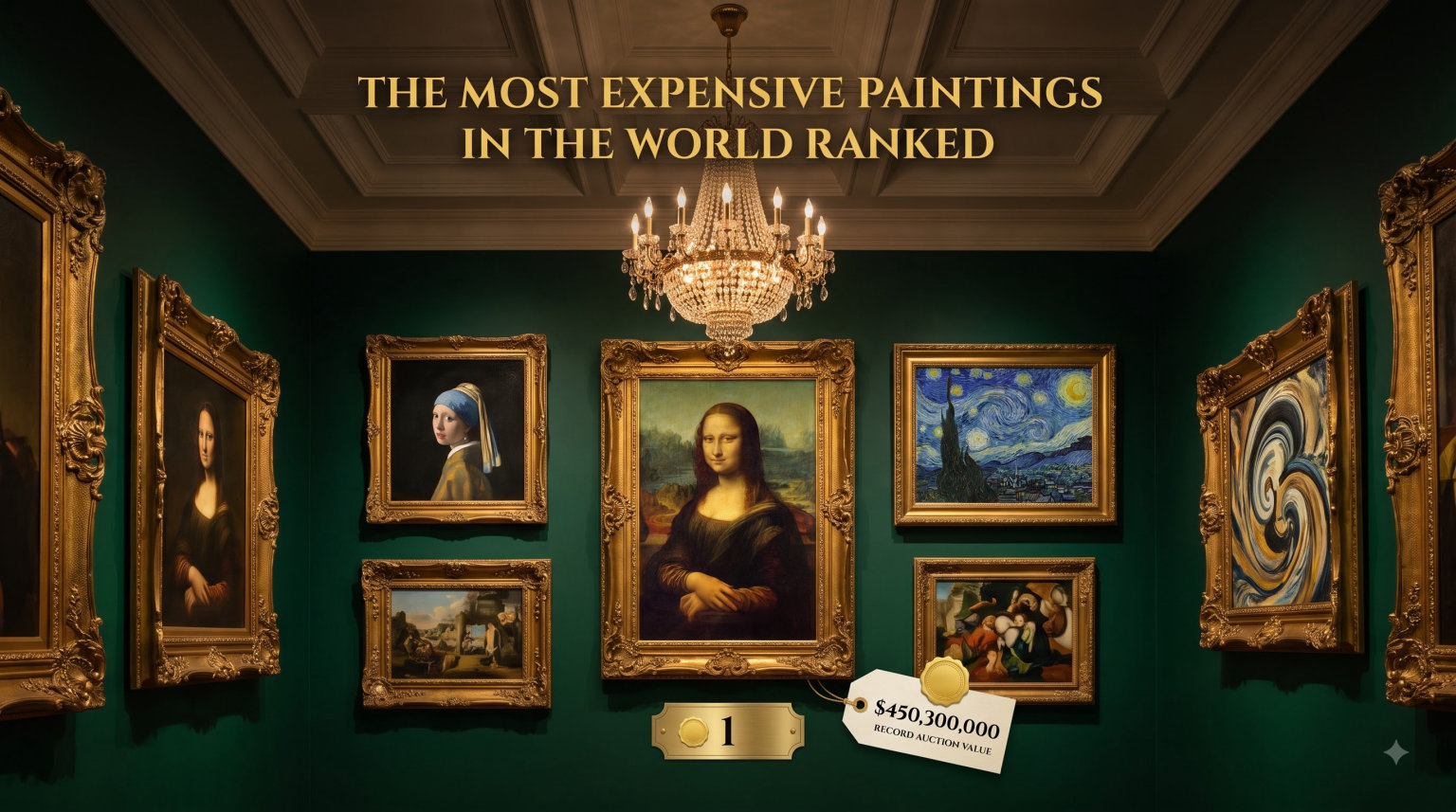
When Leonardo da Vinci’s Salvator Mundi sold for $450.3 million at Christie’s New York in 2017, it didn’t just break a record—it fundamentally shifted how we think about art and money. I spent weeks researching auction records, speaking with art market analysts, and diving deep into the stories behind the world’s most expensive paintings to bring you this comprehensive ranking. These aren’t just artworks hanging in museums; they’re cultural artifacts that have become investment vehicles, status symbols, and occasionally, subjects of intense controversy.
Whether you’re an art enthusiast, a potential collector, or simply curious about the intersection of extreme wealth and human creativity, this guide will walk you through the 15 most expensive paintings ever sold. You’ll learn why certain works command such astronomical prices, how the auction process works, and what makes the Salvator Mundi story so contentious.
Table of Contents
What Makes a Painting So Expensive?
Before we dive into the rankings, let’s address a question I hear constantly: why do some paintings sell for hundreds of millions while equally talented artists fetch a fraction of that price? The answer involves a complex interplay of factors that the art market has developed over centuries.
Provenance—the documented history of who has owned a painting—matters enormously in the art world. A work with a distinguished ownership history, especially connections to famous collectors or royal collections, commands premium prices. Authentication by recognized experts adds another layer of value, as does condition. Paintings that have survived in excellent states, with minimal restoration, are rarer than you might think.
Historical significance plays a crucial role. Works that represent major artistic movements or were created by artists during their most productive periods tend to appreciate significantly. The combination of artistic merit, scarcity, and documented history creates the foundation for record-breaking sales. Auction houses like Christie’s and Sotheby’s have perfected the art of creating urgency and exclusivity around major sales, which drives prices ever higher.
The 15 Most Expensive Paintings in the World Ranked
The following rankings represent paintings that have sold at auction or through verified private sales. Prices include the buyer’s premium and represent total amounts paid. This list reflects sales through 2026 and is updated to capture the most current records.
1. Salvator Mundi by Leonardo da Vinci — $450.3 Million
Leonardo da Vinci’s Salvator Mundi stands alone at the top of the art market, having sold for $450.3 million at Christie’s New York in November 2017. The painting depicts Christ in Renaissance attire, raising his hand in blessing while holding a crystal orb. Its journey from obscure inheritance to world record is the stuff of legend.
The painting was purchased in 2005 for approximately $10,000 from a New Orleans estate sale, where it was attributed to a Leonardo follower. After extensive restoration and authentication by a team of experts, it was resold in 2013 for $75 million to Russian billionaire Dmitry Rybolovlev. Just four years later, it sold for nearly six times that amount to a buyer believed to be Saudi Arabian Crown Prince Mohammed bin Salman, though this has never been officially confirmed.
The painting is currently housed in the Louvre Abu Dhabi, though its public display has been sporadic amid ongoing authenticity debates.
2. The Card Players by Paul Cézanne — $250 Million
Paul Cézanne’s The Card Players holds the distinction of being the most expensive painting ever sold in a private transaction, reportedly changing hands for $250 million around 2011. The Qatari royal family, through the Qatar Museums organization, is widely believed to be the buyer, though this was never officially confirmed.
The painting dates to approximately 1893 and depicts two peasants engaged in a card game, rendered in Cézanne’s characteristic geometric style that would later influence cubism. What makes this work particularly valuable is its exceptional state of preservation and its importance in Cézanne’s oeuvre. Only five paintings in The Card Players series exist, and this version is considered the finest.
3. Shot Sage Blue Marilyn by Andy Warhol — $195 Million
Andy Warhol’s Shot Sage Blue Marilyn sold for $195 million at Christie’s New York in May 2022, making it one of the most significant acquisitions in recent art market history. The buyer was reported to be Larry Gagosian, the prominent art dealer, though whether he was acting on behalf of a client remains unclear.
The work is part of Warhol’s iconic Marilyn Diptych series, created in 1964, just two years after the actress’s death. The striking cobalt blue background distinguishes this version from the more common orange and multicolor variants. Warhol created multiple versions of the Marilyn portrait, but the “Shot Sage” versions earned their name from an incident where artist Dorothy Podhorzer accidentally shot through some of the canvases with a starter’s pistol.
4. Portrait of Adele Bloch-Bauer I by Gustav Klimt — $135 Million
Gustav Klimt’s Portrait of Adele Bloch-Bauer I sold for $135 million in 2006, though this figure only reflects the winning bid at auction. The total price paid by Ronald S. Lauder, who acquired the work for the Neue Galerie in New York, reportedly exceeded $150 million when fees were included.
The painting, created between 1903 and 1907, depicts Adele Bloch-Bauer, the wife of wealthy Viennese banker Ferdinand Bloch-Bauer. The work is renowned for its elaborate use of gold leaf, incorporating Byzantine mosaic techniques into a portrait that epitomizes Viennese Secession style. Adele herself was a patron of the arts and played a significant role in Vienna’s cultural life.
5. Number 17A by Jackson Pollock — $165 Million
Jackson Pollock’s Number 17A sold for $165 million in 2016 as part of a private transaction between hedge fund manager Kenneth Griffin and fellow collector. The painting exemplifies Pollock’s drip technique, created during his most prolific period in the late 1940s and early 1950s.
What’s fascinating about this sale is that it occurred through a simultaneous buy and sell arrangement, with Griffin acquiring the Pollock while selling several works to the same counterparty. The painting itself had been held by David Geffen, who had purchased it for $50 million in 1995, meaning it nearly quadrupled in value over two decades.
6. The Bay from L’Estaque by Paul Cézanne — $137.5 Million
Another Cézanne work, The Bay from L’Estaque, sold for $137.5 million in 2018 through private sale. The painting represents Cézanne’s revolutionary approach to landscape painting, using geometric forms to deconstruct and reconstruct the natural world.
The exact buyer remains undisclosed, though art market sources suggest a collector from the Middle East. This work had previously been in the collection of Russian billionaire Dmitry Rybolovlev, who has been systematically selling works from his collection after purchasing them at peak prices.
7. Lady with a Parasol by Gustav Klimt — $108.1 Million
Gustav Klimt’s Lady with a Parasol sold for $108.1 million in 2024, setting a new record for the artist at auction. The painting dates to approximately 1907 and demonstrates Klimt’s transition from his golden period toward a more naturalistic style.
The buyer was identified as an Asian collector, continuing the trend of major Western artworks finding homes in Eastern collections. The painting had been in a private European collection for decades before appearing at auction.
8. Interchange by Willem de Kooning — $300 Million
Willem de Kooning’s Interchange sold for approximately $300 million in a private sale reported in 2015. The buyer, identified as hedge fund manager Kenneth Griffin, reportedly paid through a combination of cash and artwork, exchanging several works with the seller.
The abstract expressionist canvas was created in 1955 and represents a pivotal moment in de Kooning’s career, bridging his more figurative works with his signature abstract style. The painting had previously been in the collection of art collector Edwin R. Twombly.
9. Van Gogh Works at Record Prices
While not technically a single painting entry, this section wouldn’t be complete without mentioning the record prices achieved by van Gogh works. Portrait of Dr. Gachet sold for $82.5 million in 1990, and The Irises reached $49.9 million in 1987, establishing van Gogh as one of the most valuable artists at auction.
More recently, van Gogh works have commanded even higher prices in private transactions, though specific figures often remain undisclosed. The emotional resonance of van Gogh’s story—his struggles with mental illness, his brief but brilliant career—adds a premium that collectors are willing to pay.
10. The Scream by Edvard Munch — $119.9 Million
Edvard Munch’s The Scream sold for $119.9 million at Sotheby’s New York in 2012, setting a record at that time for the most expensive artwork ever sold at auction. The painting is one of four versions created by Munch, with this particular example being the most expensive.
What makes this sale remarkable is that the painting was stolen from the Munch Museum in Oslo in 2004 and recovered two years later, making its subsequent auction appearance particularly dramatic. The buyer, identified as billionaire Leon Black, has kept the work in his private collection.
11. Les Femmes d’Alger by Pablo Picasso — $179.4 Million
Picasso’s Les Femmes d’Alger sold for $179.4 million at Christie’s New York in May 2015, setting a record for the artist and cementing Picasso’s place among the most valuable artists in the world. The painting was part of a series of 15 works inspired by Eugène Delacroix’s Women of Algiers.
The buyer was identified as the state of Qatar through Qatar Museums. The painting was created in 1955, the same year Picasso met his second wife, Jacqueline Roque, who would become his final muse and is believed to have been the model for several of the figures.
12. Nu Couché by Amedeo Modigliani — $170.4 Million
Amedeo Modigliani’s Nu Couché sold for $170.4 million at Christie’s New York in 2018, setting a record for the Italian artist. The painting depicts a reclining nude with Modigliani’s characteristic elongated forms and striking gaze.
What makes this sale particularly interesting is that the buyer was Liu Yiqian, a Chinese billionaire known as the Medic for his pharmaceutical business. The purchase marked a significant moment when ultra-wealthy Asian collectors began acquiring major Western art at record levels.
13. Concert Wall by Peter Doig — $43 Million
Peter Doig’s Concert Wall might seem modest compared to the other entries on this list, but at $43 million, it represents the highest price ever paid for a work by a living artist at the time of sale in 2017. Doig, born in 1959, continues to create new work, making this a remarkable achievement.
The painting was created in 1993, long after Doig left Canada for Europe. It depicts a ghostly figure against a vibrant red background, rendered in Doig’s distinctive style that balances abstraction with suggestion. The buyer was identified as a private collector through the gallery Gagosian.
14. Masterpiece by Roy Lichtenstein — $165 Million
Roy Lichtenstein’s Masterpiece sold for $165 million in a private sale reported in 2017. The painting, created in 1962, is one of Lichtenstein’s most iconic works, depicting a woman with a speech bubble saying BLAM in his signature comic-book style.
The sale demonstrated the continued strength of the Pop Art market, with major works by Warhol, Lichtenstein, and related artists commanding premium prices from collectors seeking blue-chip contemporary art.
15. Three Studies of Lucian Freud by Francis Bacon — $142.2 Million
Francis Bacon’s Three Studies of Lucian Freud sold for $142.2 million at Christie’s New York in 2013. The triptych depicts the British painter Lucian Freud, Bacon’s friend and frequent subject, rendered in Bacon’s characteristic distorted style.
The buyer was reported to be American billionaire Steven Cohen. What makes this work particularly significant is its format—a triptych represents Bacon at his most ambitious, and this particular work is considered one of his finest.
The Salvator Mundi Controversy
No discussion of the world’s most expensive paintings would be complete without addressing the swirling debates around Salvator Mundi. When the painting sold for $450.3 million, it should have settled questions about its authenticity. Instead, it sparked renewed controversy that continues to this day.
Art historians remain sharply divided. Prominent voices like Carmen C. Bambach from the Metropolitan Museum of Art have defended the attribution to Leonardo, while others, including Jacques Franck, a longtime consultant on Leonardo projects, have publicly questioned whether Leonardo did more than oversee the work’s creation.
The controversy intensified after the sale when it emerged that parts of the painting had been heavily restored, with some experts suggesting that up to 70% of the original work may have been repainted. The question isn’t simply whether Leonardo touched the canvas, but how much of what we see today is actually his hand.
Perhaps most troubling for collectors is the question of current location. Reports suggest the painting has spent most of its time in storage rather than on public display, leading critics to question whether a work that once generated such excitement is now being deliberately hidden. The Louvre Abu Dhabi has displayed it only intermittently since its acquisition.
How the Auction Process Works
Understanding how these astronomical prices are achieved requires knowing how auction houses operate. When a major painting comes to market, Christie’s or Sotheby’s will spend months preparing documentation, establishing provenance, and identifying potential buyers.
The auction itself typically takes place during an evening sale, where the most valuable works are presented. Bidders in the room compete against phone banks and online participants, with auctioneers skilled at reading hesitation and creating urgency. What many don’t realize is that the winning bid is just the starting point. The buyer’s premium, which can add 20% or more to the final price, is where auction houses truly profit.
For works expected to exceed $100 million, auction houses often arrange private viewings, private sales, and elaborate marketing campaigns designed to generate maximum interest. The Salvator Mundi sale, for example, was preceded by a worldwide tour, a documentary, and months of media coverage.
Why Ultra-Wealthy Collectors Pay Premium Prices
For those of us watching from the sidelines, the question persists: why would anyone pay $450 million for a painting when that same money could buy companies, real estate, or other assets? The answer reveals something fascinating about human psychology and the priorities of extreme wealth.
Status plays a significant role. Owning a major work by Leonardo or Picasso serves as a calling card in certain circles. These paintings become conversation pieces, evidence of taste and wealth. For collectors who operate in the world of philanthropy and cultural patronage, owning masterpieces provides cultural capital that transcends mere financial value.
Art also functions as an alternative investment. While stocks and bonds can be seized, frozen, or devalued by political decisions, art offers a tangible asset that can be stored, displayed, and moved across borders with relative ease. The super-rich in unstable regions often see art as a form of insurance.
Finally, there’s the simple fact that ultra-high-net-worth individuals can afford to pay whatever something is worth to them personally. For someone whose net worth is measured in billions, $450 million might represent 5% of their assets while providing disproportionate psychological satisfaction and public recognition.
FAQs
What is the #1 most expensive painting in the world?
Leonardo da Vinci’s Salvator Mundi holds the record as the most expensive painting ever sold, achieving $450.3 million at Christie’s New York in 2017.
What painting sold for 450 million dollars?
Salvator Mundi by Leonardo da Vinci sold for $450.3 million at Christie’s in 2017, making it the highest price ever paid for a painting at auction.
What is the Mona Lisa worth today?
The Mona Lisa is technically priceless and is insured for approximately $870 million, though it has never been sold. It belongs to the French Republic and hangs in the Louvre Museum in Paris.
Is Salvator Mundi fake?
The authenticity of Salvator Mundi remains debated among art historians. While Christie’s authenticated it as a lost Leonardo da Vinci work, many experts believe portions were painted by assistants, and some question whether it may be partially or wholly a forgery.
Conclusion
The world of the most expensive paintings in the world reveals much about human culture and the nature of value itself. These works represent not just artistic achievement but a complex intersection of history, psychology, and economics that continues to evolve. As emerging market collectors, particularly those from Asia and the Middle East, continue to build collections, we can expect record prices to keep climbing.
What strikes me most, having researched this topic extensively, is how little correlation exists between a painting’s market value and its artistic importance. The Mona Lisa may be priceless, but it will never sell. Meanwhile, works that experts debate endlessly can command hundreds of millions. Perhaps that tension is what makes the art market endlessly fascinating.
For those interested in how museums acquire and display significant artworks, our in-depth guide on curatorial decision-making offers fascinating context for where these masterpieces eventually end up.