
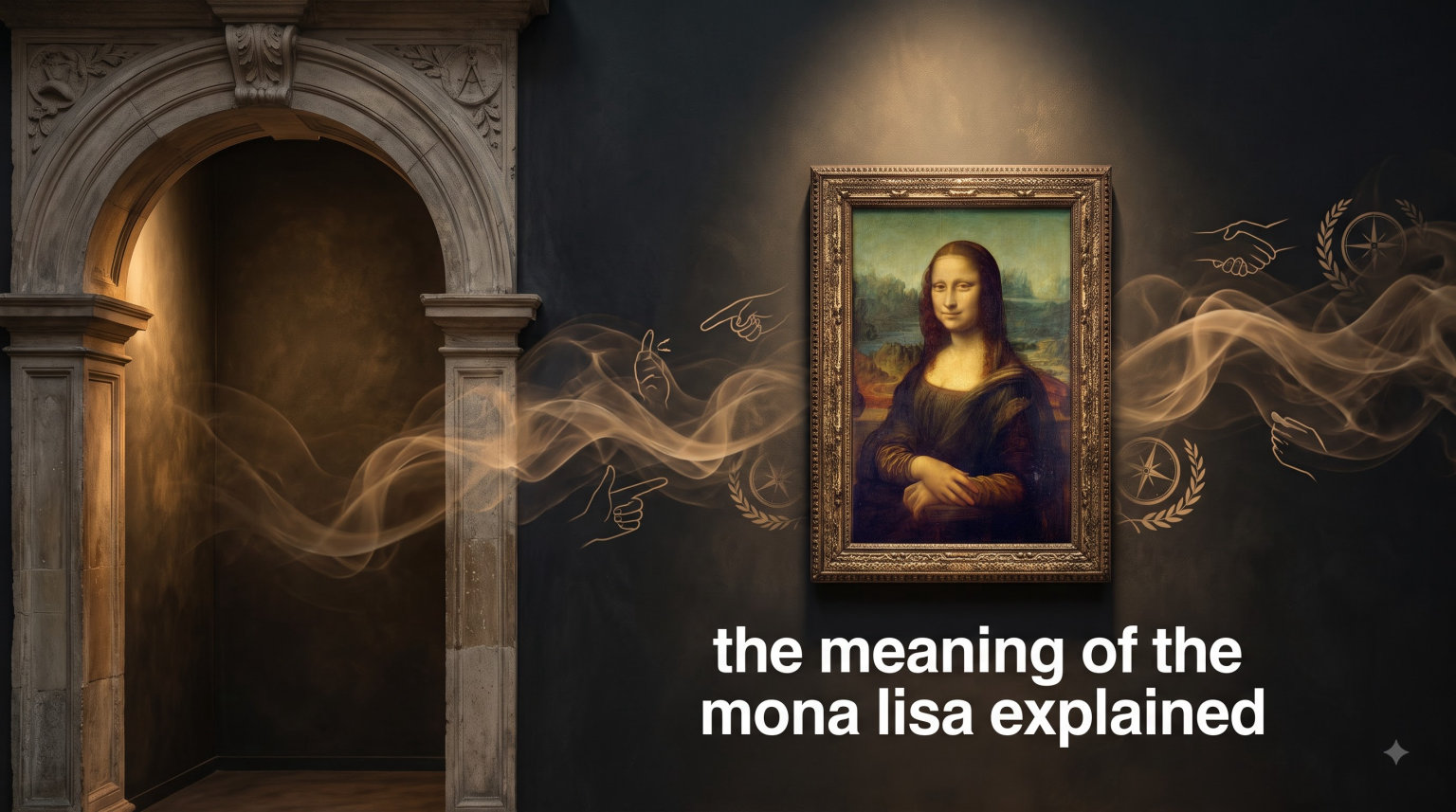
The meaning of the Mona Lisa goes far beyond a simple portrait. Painted by Leonardo da Vinci between 1503 and 1519, this small oil painting on a poplar wood panel has become the most recognized, most discussed, and most visited artwork in human history. It depicts a woman with an expression that seems to shift depending on where you look, set against a dreamlike landscape that dissolves into blue-green mountain peaks.
The painting’s significance lies in a combination of factors: Leonardo’s extraordinary technique, the subject’s mysterious smile, a dramatic theft that made global headlines in 1911, and centuries of cultural fascination that have turned it into something larger than art itself. Whether you see it as a technical masterwork, a philosophical statement, or simply a woman from Renaissance Florence, the Mona Lisa carries layers of meaning that continue to reward closer study.
In this guide, I will walk through every dimension of the meaning of the Mona Lisa. We will explore who she really was, how Leonardo created his most talked-about effect, why the smile appears to change before your eyes, and how a painting that Leonardo never finished to his own satisfaction became the most famous image on Earth.
Table of Contents
Who Was the Mona Lisa? The Subject Behind the Portrait
The most widely accepted answer is that the Mona Lisa depicts Lisa Gherardini, the wife of a wealthy Florentine silk merchant named Francesco del Giocondo. Giorgio Vasari, the 16th-century art historian who wrote about Leonardo during his lifetime, identified Lisa as the subject. Vasari described the painting as an unfinished work that Leonardo kept with him for years, unable to part with it.
The name “Mona” is a polite Italian contraction for “madonna,” meaning “my lady” or “madam” in the courtly sense. So “Mona Lisa” simply means “Madam Lisa.” The painting’s Italian title, “La Gioconda,” is a play on her married name (Giocondo) and the Italian word for “joyful” or “happy.” That double meaning may have been intentional on Leonardo’s part, linking the sitter’s identity to the elusive expression he gave her face.
Francesco del Giocondo likely commissioned the portrait around 1503 to celebrate the birth of the couple’s second son or their purchase of a new home. However, Leonardo never delivered the finished painting to the Giocondo family. Instead, he kept working on it, refining it, and carrying it with him when he left Italy for France in 1516. He continued adding tiny adjustments until his death in 1519.
Alternative Theories About the Subject
Not everyone agrees that Lisa Gherardini is the woman in the painting. Over the centuries, researchers and enthusiasts have proposed dozens of alternatives. Some have argued that the Mona Lisa is actually a self-portrait of Leonardo in drag, noting that the subject’s facial features align with the artist’s own. Others have suggested it depicts his young assistant Salaì, known for his androgynous appearance.
Another theory proposes that the painting represents an idealized woman rather than a specific person. Leonardo wrote in his notebooks about combining the most beautiful features from multiple faces to create a perfect composite. Some scholars believe the Mona Lisa is exactly this kind of constructed ideal, which would explain why she does not look quite like any particular woman.
In 2005, a researcher discovered a marginal note in a 1503 book owned by an acquaintance of Leonardo that explicitly mentions the artist working on a portrait of Lisa del Giocondo. This discovery swung scholarly consensus firmly back toward Lisa Gherardini as the subject, though the alternative theories persist in popular culture because they add to the painting’s mystique.
For our purposes, the meaning of the Mona Lisa does not depend entirely on identifying the subject. Whether Lisa Gherardini, an ideal, or someone else entirely, the painting gains its significance from what Leonardo did with the commission, not from who sat for it.
Leonardo da Vinci’s Sfumato Technique Explained
If there is one technical reason the Mona Lisa captivates viewers, it is sfumato. This is Leonardo’s signature painting method, and understanding it is key to understanding the meaning of the Mona Lisa. The word “sfumato” comes from the Italian “sfumare,” which means “to evaporate like smoke.” In practice, sfumato is the art of creating impossibly smooth transitions between tones, with no visible lines or harsh edges anywhere on the painted surface.
Leonardo achieved this by applying dozens of microscopic layers of translucent oil paint, each one thinner than a human hair. Instead of drawing outlines and filling them in, as most painters of his era did, he built up forms through gradually shifting areas of light and shadow. The result is that the contours of the Mona Lisa’s face seem to emerge from and dissolve into the surrounding tone, the way a face appears in soft candlelight.
The technique is most visible around the corners of the mouth and the eyes. Leonardo applied his thinnest, most delicate glazes in these areas, creating an effect where the expression appears to change depending on where the viewer focuses. Look directly at the mouth, and the smile seems subtle or even absent. Look at the eyes or the background, and the smile seems more pronounced. This is not an optical illusion in the cheap sense. It is a deliberate artistic strategy that took Leonardo years to perfect.
How Sfumato Differs From Other Renaissance Techniques
Most Renaissance painters used chiaroscuro, the contrast between strong light and dark, to model three-dimensional forms on a flat surface. Leonardo used chiaroscuro too, but he pushed it further by softening every boundary between light and shadow until it disappeared. Where another painter would draw a clear line around the lips, Leonardo made the edge between lip and skin almost impossible to locate.
Modern scientific analysis of the painting using X-ray fluorescence spectroscopy has revealed that Leonardo applied individual glaze layers as thin as 1 to 2 micrometers. For comparison, a red blood cell is about 7 micrometers wide. This means the Mona Lisa is not so much painted as it is grown, layer by invisible layer, like a pearl forming inside an oyster shell.
The effect on viewers is profound, even if they cannot articulate why. The face feels alive, soft, and three-dimensional in a way that sharper, more linear paintings from the same period simply do not. This quality of aliveness, of a painted face that seems to breathe and shift, is central to the meaning of the Mona Lisa. It is not a record of what a woman looked like. It is a record of how light moves across a human face, and how that movement creates the impression of consciousness.
The Meaning Behind the Mona Lisa Smile
The smile is what everyone talks about, and for good reason. Leonardo devoted more time and attention to the area around the mouth than to any other part of the painting. The smile is the visual center of the Mona Lisa, the feature that draws the eye and holds it, and the element that has generated more interpretation than perhaps any other detail in any painting ever made.
The meaning of the Mona Lisa smile depends on who you ask. Some art historians see it as a straightforward expression of contentment, appropriate for a portrait commissioned to celebrate a happy family milestone. Others read it as mysterious, ambiguous, or even seductive. Sigmund Freud famously interpreted it as a recovered memory of Leonardo’s mother, projecting the artist’s own psychological history onto the canvas.
What makes the smile so difficult to pin down is the sfumato technique itself. Because Leonardo blurred the corners of the mouth with those microscopically thin glazes, there is no definitive point where the smile begins or ends. The expression exists in a state of permanent ambiguity. It is simultaneously a smile and not quite a smile, a look of amusement and a look of detachment, warmth and distance coexisting in the same quarter-inch of paint.
Why the Smile Appears to Change
In 2000, a neuroscientist at Harvard named Margaret Livingstone published a study that explained why the Mona Lisa smile seems to shift when you look at it from different angles. Her research showed that the smile is more visible in your peripheral vision than in your central vision. The human eye has two types of photoreceptors: cones, which handle detailed central vision and are concentrated in the fovea at the center of the retina, and rods, which handle peripheral vision and are better at detecting shadows and soft gradients.
When you look directly at the Mona Lisa’s mouth, your cones process the fine detail, and the smile appears faint. When you look at her eyes, the mouth falls into your peripheral vision, where your rods pick up the soft shadow gradients that define the smile. The smile appears stronger because your peripheral vision is more sensitive to the very shadows Leonardo painted there.
This discovery added a new dimension to the meaning of the Mona Lisa. It is possible that Leonardo understood this effect intuitively, through years of careful observation rather than scientific knowledge. He was famous for his studies of optics and human perception, filling notebooks with diagrams of how light enters the eye. Whether he consciously engineered the shifting smile or stumbled into it through obsessive refinement, the result is a painting that interacts with human neurology in a way no other artwork from that era does.
The smile has also been analyzed using emotional recognition software. In 2005, researchers at the University of Amsterdam used emotion recognition algorithms to analyze the expression and found it registered as 83 percent happy, 9 percent disgusted, 6 percent fearful, and 2 percent angry. This mixed emotional reading matches what most viewers feel: an expression that seems to contain multiple emotions at once, never settling on just one.
Symbolism and Hidden Details in the Mona Lisa
Beyond the technique and the smile, the painting contains layers of symbolism that contribute to its overall meaning. Leonardo was a thinker who saw connections between art, science, nature, and philosophy. Every element in the Mona Lisa reflects this integrated worldview.
The distant landscape behind the subject is one of the most symbolic features. On the left side, a winding road leads through rocky terrain toward a distant bridge, possibly a reference to the real Ponte Buriano near Arezzo. On the right side, the landscape dissolves into icy mountain peaks and a body of water that could be a river, a lake, or a sea. The two sides do not quite match in scale or geography, creating an unsettling sense that the world behind the sitter exists outside normal physical laws.
Many scholars interpret this asymmetrical landscape as a representation of the passage of time or the relationship between humanity and nature. The road and bridge suggest civilization and the built environment. The jagged peaks and empty waters suggest the primordial world before human existence. Lisa sits between these two realms, embodying the Renaissance ideal of humanity as the bridge between earthly life and something larger.
The Revolutionary Three-Quarter Pose
The pose itself was a radical departure from convention. Before Leonardo, most portrait painters positioned their subjects in strict profile view, facing sideways, or full frontal view, staring straight ahead. Leonardo placed Lisa in a three-quarter turn, with her body angled slightly to one side and her face turned toward the viewer. This created a sense of psychological engagement that profile portraits could never achieve.
Her hands rest gently on the arm of a chair, relaxed and folded in a way that suggests ease and composure. The delicacy of the hands, with their soft contours and subtle shading, is often overlooked in favor of the smile, but they demonstrate the same sfumato mastery. They look like real hands resting on a real surface, which was extraordinarily rare for a portrait painted in the early 1500s.
Hidden Details Revealed by Modern Technology
In recent decades, researchers have used multispectral imaging and other non-invasive technologies to look beneath the surface of the painting. These studies have revealed that Leonardo made significant changes during the painting process. Early versions show the subject with a wider face, different eyebrow placement, and a more elaborate hairstyle. He also originally painted her holding or standing near a column, which he later removed.
In 2007, French researcher Pascal Cotte used a high-resolution multispectral camera to study the painting and found evidence that the Mona Lisa was originally painted with eyebrows and eyelashes that have since faded. This finding challenged the long-held belief that Leonardo intentionally painted her without them, suggesting instead that centuries of cleaning and aging removed these delicate features.
Some researchers have claimed to find tiny letters and numbers hidden in the painting, including the letters “LV” in the right eye and the letters “CE” or possibly “B” or “S” in the left eye. These claims remain controversial and are not universally accepted by art historians. Whether these marks are intentional symbols, random brushstrokes, or artifacts of aging, they have added yet another layer to the mythology surrounding the painting’s meaning.
The History of the Mona Lisa: From 1503 to the Louvre
Leonardo began painting the Mona Lisa in Florence around 1503, when he was in his early fifties and already recognized as one of the greatest artists of his generation. He worked on it intermittently for roughly 16 years, carrying it with him from Florence to Milan, then to Rome, and finally to France. This long, drawn-out process was typical of Leonardo, who was notorious for starting projects and never finishing them to his own satisfaction.
In 1516, Leonardo accepted an invitation from King Francis I of France to serve as the royal painter, architect, and engineer. He crossed the Alps on foot with a mule carrying his belongings, and the Mona Lisa was among the paintings he brought with him. Francis I housed Leonardo at the Chateau de Cloux (now called Clos Luce) near Amboise, where the artist lived out his final years.
When Leonardo died in May 1519, the Mona Lisa became the property of the French crown. Francis I displayed it at his palace at Fontainebleau, where it remained for over a century. It was later moved to the Palace of Versailles during the reign of Louis XIV. After the French Revolution, the new republican government transferred the painting to the Louvre Museum in Paris, where it has been on display for the public since 1797.
The journey from a private commission in Florence to the walls of the world’s most visited museum took nearly three centuries. During most of that time, the Mona Lisa was admired by art connoisseurs and royalty but was not widely known among the general public. That changed dramatically in the 20th century, thanks to one of the most audacious art thefts in history.
The 1911 Theft That Made the Mona Lisa a Superstar
On August 21, 1911, a man named Vincenzo Peruggia walked into the Louvre, removed the Mona Lisa from its frame, hid it under his coat, and walked out the door. Peruggia was an Italian immigrant who had worked as a glazier at the Louvre and knew the museum’s layout and routines. He believed, incorrectly, that the painting had been stolen from Italy by Napoleon and that returning it to Florence was a patriotic act.
The theft was not discovered until the next day, when a painter arrived to sketch the Mona Lisa and found only four iron hooks on the wall. The disappearance triggered an international sensation. Newspapers around the world ran front-page stories about the stolen painting. Suspects were interrogated, including the poet Guillaume Apollinaire and the young Pablo Picasso, both of whom were eventually cleared.
For over two years, the Mona Lisa was missing. Peruggia kept the painting in a trunk in his Paris apartment, then smuggled it to Florence in December 1913. He contacted an art dealer, Alfredo Geri, and offered to sell the painting back to Italy as a patriot. Geri contacted the police, and Peruggia was arrested when he brought the painting to the Uffizi Gallery for authentication.
The theft and recovery transformed the Mona Lisa from a respected painting into a global celebrity. Millions of people who had never heard of it now knew its name and face. When the painting was returned to the Louvre in January 1914, it was displayed to enormous crowds. The meaning of the Mona Lisa had shifted. It was no longer just a portrait. It was now a symbol of cultural value so high that people would steal it, hide it, and fight to get it back.
Why the Mona Lisa Became the Most Famous Painting in the World
The theft explains the beginning of the Mona Lisa’s global fame, but it does not explain why that fame endured and grew for over a century after the painting was recovered. Several factors combined to make the Mona Lisa the singular cultural phenomenon it remains in 2026.
First, the technical mastery is real. Even among Renaissance paintings, the Mona Lisa stands out for the sophistication of its execution. The sfumato technique, the three-quarter pose, the naturalistic rendering of hands and fabric, and the atmospheric landscape were all ahead of their time. When art historians and critics rank the greatest paintings ever made, the Mona Lisa appears near the top of virtually every list. That professional consensus provides a foundation that no amount of hype could create on its own.
Second, the painting has been amplified by pop culture for over a century. Marcel Duchamp drew a mustache on a postcard of the Mona Lisa in 1919 and called it “L.H.O.O.Q.,” a provocative gesture that linked the painting to the modern art movement. Andy Warhol screen-printed the Mona Lisa in the 1960s, turning her into a repeating icon like his Campbell’s Soup cans. Songs, movies, advertisements, and cartoons have used her image so often that she has become a visual shorthand for “great art” itself.
Third, the 1963 tour of the United States cemented the painting’s status as a diplomatic and cultural icon. The Mona Lisa was displayed at the National Gallery in Washington, D.C., and the Metropolitan Museum of Art in New York. Over 1.6 million people viewed the painting during the tour, including President John F. Kennedy and First Lady Jacqueline Kennedy. The tour generated the kind of media coverage usually reserved for heads of state.
Modern Incidents and Continuing Relevance
The Mona Lisa has also remained in the public eye through a series of dramatic incidents. In 1956, a vandal threw acid at the lower portion of the painting, damaging the area near the elbow. Later that same year, someone threw a rock at it, chipping a speck of paint near the left elbow. These attacks led to the installation of bulletproof glass, which now separates the painting from visitors by several feet.
More recently, the Mona Lisa has been targeted by climate activists. In 2026, visitors regularly encounter the painting behind climate-controlled, bulletproof glass in a specially designed room at the Louvre. These modern incidents keep the painting in the news cycle, adding new chapters to its already long story of drama and intrigue.
The combination of genuine artistic achievement, theft, pop culture saturation, and ongoing drama has created a feedback loop. The Mona Lisa is famous because it is famous. Each generation rediscovers it, debates its merits, and adds its own interpretations. That cycle of engagement is, in itself, part of the meaning of the Mona Lisa in 2026.
Where Is the Mona Lisa Today? Visiting in 2026
The Mona Lisa hangs in the Salle des Etats (Room 711) at the Louvre Museum in Paris, France. It has lived there permanently since 1797, except for its two-year absence during the 1911 theft and brief periods during World War II when it was moved to safety in the French countryside. In 2026, it is displayed in a freestanding, climate-controlled enclosure with bulletproof glass, set into a partition wall that separates it from the main viewing area.
Visitors often report being surprised by the painting’s size. The Mona Lisa measures 77 centimeters tall by 53 centimeters wide, roughly 30 by 21 inches. It is smaller than most people imagine, especially given its enormous reputation. The bulletproof glass and the crowd-control barriers create additional distance between the viewer and the artwork, which some visitors find disappointing.
Despite these barriers, the Mona Lisa draws roughly 10 million visitors per year to the Louvre. Many people make the painting their primary reason for visiting the museum, treating it as a cultural pilgrimage. Guides and art historians consistently note that visitors who learn about Leonardo’s techniques and the painting’s history before their visit report a much richer experience than those who simply walk up, take a photo, and move on.
Conservation efforts are ongoing. The Louvre monitors the painting’s condition with specialized equipment and controls the temperature, humidity, and light exposure in the display case with extreme precision. The painting’s surface shows signs of craquelure, the network of tiny cracks that develop in old oil paintings over centuries, and the varnish has yellowed over time, giving the work a warm golden tone that was not part of Leonardo’s original palette. There are no current plans to restore or clean the painting, as any intervention carries significant risk.
The Mona Lisa Compared to Other Leonardo Works
Leonardo da Vinci completed surprisingly few paintings during his lifetime. Scholars attribute only 15 to 20 surviving works to him with reasonable certainty. Understanding how the Mona Lisa fits among these works reveals another layer of its meaning.
The Last Supper, Leonardo’s massive mural in Milan, demonstrates his mastery of composition and perspective. Where the Mona Lisa is intimate and psychological, The Last Supper is grand and theatrical. Both works share Leonardo’s obsession with capturing human expression, but they serve entirely different purposes. The Last Supper tells a story. The Mona Lisa presents a moment.
The Virgin of the Rocks, painted in two versions, shows Leonardo exploring the same sfumato technique on a larger scale. The rocky, cave-like settings in both versions share visual DNA with the landscape behind the Mona Lisa. These works reveal that Leonardo was thinking about the relationship between human figures and wild, geological landscapes throughout his career.
Lady with an Ermine, painted around 1490, is perhaps the closest relative to the Mona Lisa in Leonardo’s body of work. It features a three-quarter pose, a living subject (Cecilia Gallerani), and the same psychological intensity. Comparing the two portraits side by side reveals how Leonardo’s technique evolved between the 1490s and the 1500s. The Lady with an Ermine is beautiful and accomplished, but the sfumato in the Mona Lisa is softer, more refined, and more elusive. The difference is like comparing a brilliant rough draft to a finished masterwork.
FAQs
What is the message behind the Mona Lisa?
The Mona Lisa does not carry a single, clear message. Instead, it conveys multiple layers of meaning through technique, symbolism, and expression. Leonardo’s sfumato method creates a face that seems alive and shifting, suggesting that human emotion is complex and impossible to pin down with a single label. The distant landscape behind the sitter may represent the relationship between humanity and the natural world. The ambiguous smile invites each viewer to project their own interpretation, which is arguably the painting’s most powerful message: that great art holds space for multiple, even contradictory, meanings at the same time.
Who was da Vinci’s lover?
Leonardo da Vinci never married and left no definitive record of a romantic relationship with anyone. His most intimate documented relationships were with his young assistants and pupils, particularly Gian Giacomo Caprotti da Oreno, known as Salaì, who lived with Leonardo for decades and served as a model for several of his works. Some historians have speculated about the nature of their relationship, but there is no conclusive evidence. Leonardo was intensely private about his personal life, and his notebooks focus almost exclusively on his scientific observations, artistic studies, and engineering projects rather than romantic matters.
What does the Mona Lisa symbolize?
The Mona Lisa has come to symbolize many things over the centuries: the heights of Renaissance artistic achievement, the mystery and ambiguity of human expression, the power of artistic technique to create the illusion of life, and the idea that great art transcends its original context to become a universal cultural touchstone. In a broader sense, it symbolizes the enduring human fascination with beauty, mystery, and the desire to find meaning in images. Its fame has also made it a symbol of celebrity culture and the way media attention can transform an artwork into something far larger than the canvas it was painted on.
What is the real story behind the Mona Lisa?
The real story begins around 1503 in Florence, when Leonardo da Vinci was likely commissioned by Francesco del Giocondo to paint a portrait of his wife, Lisa Gherardini. Leonardo never delivered the painting to the Giocondo family. Instead, he worked on it for roughly 16 years, refining it obsessively and carrying it with him when he moved to France in 1516 to work for King Francis I. After Leonardo’s death in 1519, the painting entered the French royal collection. It eventually became property of the French state and was placed in the Louvre Museum. In 1911, it was stolen by Vincenzo Peruggia, an Italian who wanted to return it to Italy. The theft made global headlines and turned the painting into an international celebrity. It was recovered in 1913 and returned to the Louvre, where it has remained ever since.
Why does the Mona Lisa smile seem to change?
The smile appears to change because of how Leonardo applied his sfumato technique around the mouth. He painted the corners of the lips with extremely thin, translucent glazes that create soft shadow gradients. When you look directly at the mouth, your central vision picks up the fine detail and the smile appears faint. When you look at her eyes or elsewhere on the painting, your peripheral vision detects the soft shadows at the corners of the mouth, making the smile appear stronger. This interaction between the painting and human visual processing creates the illusion that the expression is shifting.
How much is the Mona Lisa worth?
The Mona Lisa is technically considered priceless because it belongs to the French state and cannot be bought or sold under French cultural heritage law. However, in 1962, it was assessed at $100 million for insurance purposes, which was the highest insurance value for any painting at that time. Adjusted for inflation, that valuation exceeds $900 million in 2026. Some experts believe that if it were ever sold on the open market, it could fetch several billion dollars due to its unique cultural status, though this is purely hypothetical since it will never be sold.
How long did it take Leonardo to paint the Mona Lisa?
Leonardo worked on the Mona Lisa for approximately 16 years, from around 1503 until his death in 1519. He did not work on it continuously during that entire period. He started the painting in Florence, set it aside for other projects, picked it up again, and continued making small refinements even after moving to France in 1516. This prolonged, iterative process was typical of Leonardo, who was known for his perfectionism and tendency to leave works unfinished. He carried the painting with him across Italy and into France, treating it as a personal experiment in technique rather than a standard commission with a deadline.
Conclusion: Understanding the Meaning of the Mona Lisa
The meaning of the Mona Lisa is not a single fact to be memorized. It is an accumulation of technique, history, symbolism, and cultural momentum that has been building for over 500 years. Leonardo da Vinci poured his deepest knowledge of light, shadow, anatomy, optics, and human psychology into a small poplar panel that he refused to let go of. The result is a painting that does something rare in any art form: it rewards attention. Every time you look at it, you can find something new.
I think the most important thing to understand about the Mona Lisa is that its fame is not a fluke or a marketing accident. The technical achievement is extraordinary, even by the standards of the Renaissance. The sfumato technique creates effects that were not fully explained by science until nearly 500 years after Leonardo painted them. The psychological complexity of the expression anticipates modern understandings of how perception shapes emotion. The composition broke with convention in ways that influenced every portrait painter who followed.
At the same time, the meaning of the Mona Lisa has been shaped by events Leonardo could never have predicted. The theft in 1911, the pop culture appropriations, the millions of photographs taken every year in front of bulletproof glass. These layers of history have become inseparable from the painting itself. When you look at the Mona Lisa in 2026, you are seeing not just a Renaissance portrait but the entire cultural journey that brought it to this moment.
Whether you plan to visit the Louvre or simply want to understand what makes this painting so significant, knowing the story behind it changes everything. The smile makes more sense when you understand the sfumato that creates it. The fame makes more sense when you know about the theft that triggered it. And the painting itself becomes more than a tiny image behind thick glass. It becomes a 500-year conversation between an artist, his subject, and every person who has ever stood in front of it and wondered what she was thinking.