
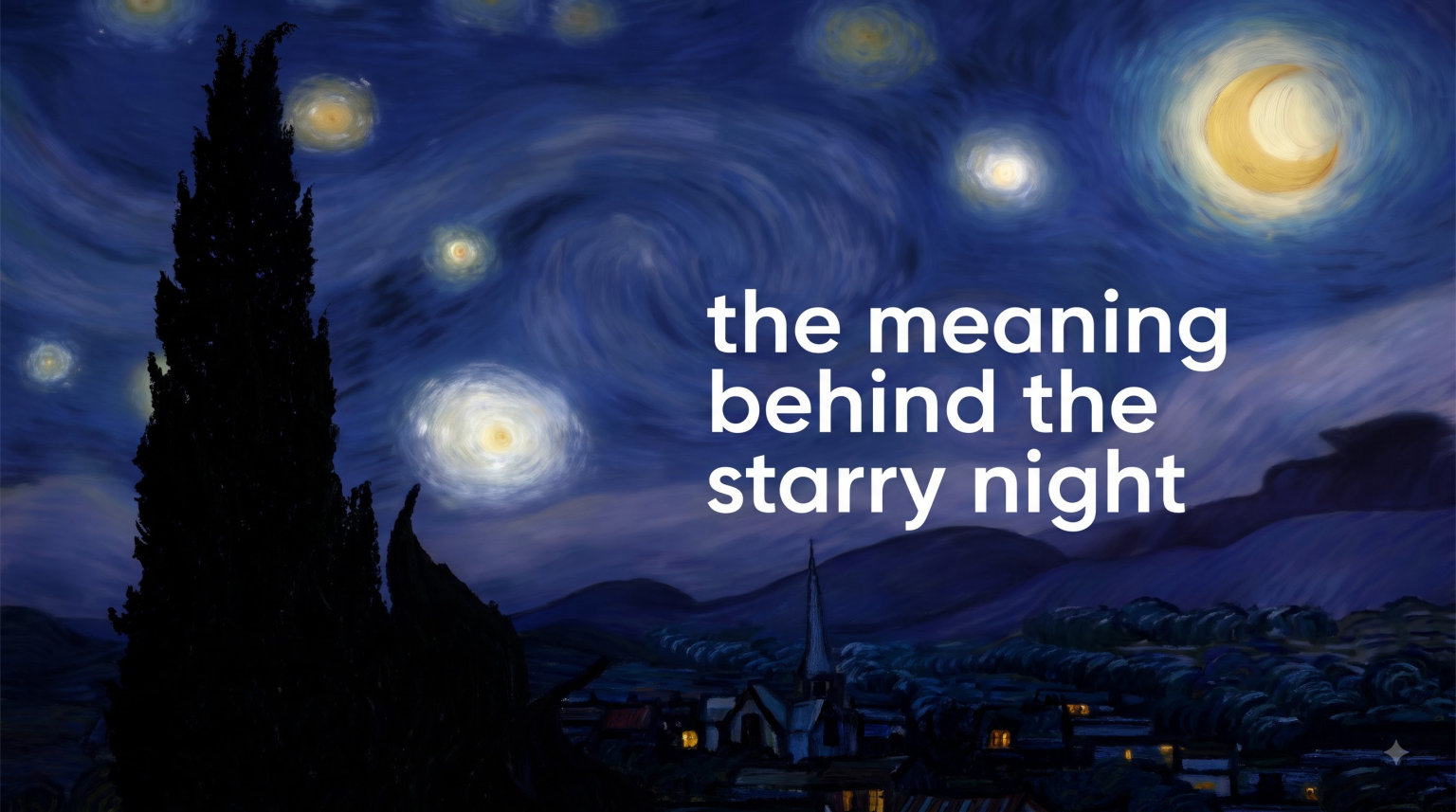
When Vincent van Gogh painted The Starry Night in June 1889, he could not have imagined it would become one of the most recognized artworks in the world. The painting depicts a swirling night sky over a quiet village, viewed from the window of his asylum room at Saint-Paul-de-Mausole. Today, the piece hangs in the Museum of Modern Art in New York City, drawing visitors who stand before it seeking to understand what van Gogh meant to convey.
The meaning behind The Starry Night goes far beyond its vivid blues and yellows. It is a window into the mind of an artist wrestling with hope, darkness, and the cosmos itself. This guide explores every element of the painting to reveal why it continues to captivate audiences more than a century after its creation.
Table of Contents
The Asylum That Birthed a Masterpiece
Van Gogh checked into the Saint-Paul-de-Mausole asylum in Saint-Rémy-de-Provence, France, in May 1889, following a severe mental breakdown. His brother Theo had arranged for his care during one of the most difficult periods of the artist’s life. The asylum occupied a former monastery in the countryside, offering the promise of tranquility and structure that van Gogh desperately needed.
From his barred window, van Gogh could see the Alpilles mountains and, at night, the stars above. He found inspiration in the night sky even during his darkest periods. The Starry Night captures this view, though the village below was partly imagined. The artist composites memory and observation into something more personal and emotionally true than a simple depiction could achieve.
He wrote extensively to his brother Theo about the stars and night sky, describing them as sources of comfort and inspiration. “I need something great—something infinite, divine—to paint,” he noted in a letter from this period. This need drove him to transform a simple view from his asylum window into an emotionally charged vision of nature that transcends mere representation.
The painting was not exhibited during van Gogh’s lifetime. It remained in his possession until his death in July 1890, when Theo inherited the work. Theo died just months later, and the painting passed through several hands before finding its way to the MoMA collection in 1941. Its journey from asylum sketch to international icon mirrors the universal themes embedded within its brushstrokes.
The Swirling Sky: Emotional Turbulence Made Visible
The most striking feature of The Starry Night is its dynamic sky, filled with concentric spirals that seem to move across the canvas. Van Gogh painted these swirls with bold, confident strokes using his characteristic impasto technique. Thick layers of paint applied with palette knives and brushes create a textured surface that catches the light and adds dimensional energy to the composition.
The sky dominates roughly two-thirds of the painting, demanding attention and conveying a sense of barely contained energy. Each swirl follows its own logic while contributing to an overall sense of cosmic movement. The stars themselves pulse with light, surrounded by halos that create an almost luminous effect against the deep blue background.
Art scholars interpret the swirling patterns as visual representations of emotional turbulence. Van Gogh himself wrote that he found inspiration in the phrase “the sight of the stars always makes me dream.” The spirals may reflect his inner turmoil, but they also suggest movement, vitality, and a kind of cosmic dance that connects earth to the heavens.
The contrast between the chaotic sky and the peaceful village below creates tension that drives the entire composition. Where the sky swirls with barely contained energy, the village sleeps in quiet stillness. This deliberate juxtaposition amplifies both elements, making the sky’s turbulence feel more intense and the village’s peace more profound.
The swirling sky demonstrates van Gogh’s post-impressionist approach to capturing subjective experience. Rather than painting the sky as it objectively appeared, he painted it as he felt it. This technique of assigning emotional language to nature became a hallmark of modern art. The sky in The Starry Night is not a weather report; it is a mood, a state of mind rendered in oil paint.
The Cypress Tree: Bridge Between Earth and Heaven
A dark, flame-like cypress tree rises on the left side of The Starry Night, anchoring the viewer’s eye and connecting the earth to the sky above. Cypress trees were common in the Provence region where van Gogh stayed, but this one takes on symbolic weight far beyond its natural surroundings. Its dramatic vertical form cuts into the composition like a dark flame frozen mid-leap.
In art history, cypress trees often represent immortality, eternity, and mourning. These meanings feel appropriate given van Gogh’s circumstances at the asylum. The evergreen nature of the cypress made it a symbol of life persisting through winter, a message that would have resonated deeply with an artist searching for hope during his darkest period.
The cypress in The Starry Night serves as a vertical counterpoint to the swirling sky. Where the heavens move in spirals, the tree stands firm and grounded. Yet van Gogh painted the cypress with the same attention to dynamic movement as the sky. Its foliage ripples like fire, suggesting life and energy even in its stillness.
The tree’s shape echoes the church spire in the village below, creating visual harmony between different elements of the painting. This parallel suggests a connection between the earthly and divine, the human-made and the natural. Both reach upward, one toward heaven, one toward the cosmic sky.
Van Gogh described the cypress as resembling a dark flame reaching upward, finding beauty in its dark silhouette against the night sky. The cypress bridges the gap between the turbulent sky and the peaceful village, making it one of the most symbolically loaded elements in the composition. It stands as a symbol of persistence, of life pushing upward even in the darkest circumstances.
The Village and Church: Human Life Beneath the Cosmos
Below the swirling sky sits a small village, rendered in peaceful contrast to the heavens above. A church with a tall spire rises above the rooftops, its lines reaching toward the sky as if in prayer. The village appears asleep, untouched by the cosmic drama overhead. Its windows glow with warm yellow light, suggesting cozy interiors where people live unaware of the turbulence in the sky.
Most scholars believe the village van Gogh painted was not visible from his asylum window. He likely combined elements from memory and imagination, creating an idealized European village that fits his emotional vision. The church spire particularly may be a composite or pure invention, a symbol of spiritual aspiration rather than a specific architectural record.
This departure from strict realism underscores the painting’s emotional rather than documentary purpose. Van Gogh was not creating a photograph of what he saw. He was constructing a visual poem about the relationship between human life and cosmic forces, between the small scale of individual existence and the vast scale of the universe.
The church spire carries religious symbolism relevant to van Gogh’s spiritual struggles. The artist grappled with questions of faith throughout his life. He was the son of a Dutch minister and often found himself torn between doubt and desperate faith. The church represents traditional spirituality, community, and connection to the divine.
The church’s placement beneath the stars suggests humanity’s place in the cosmic order. The spire reaches upward but cannot touch the heavens. This visual hierarchy places the cosmic above the human, suggesting both our connection to something greater and our fundamental separation from it.
The Moon and Stars: Biblical and Astronomical Meaning
A bright moon hangs in the upper right portion of The Starry Night, surrounded by eleven stars of varying sizes. One star glows with particular intensity, its light radiating outward in concentric circles that echo the swirling sky. The moon seems almost to pulse with energy, its surface suggested through delicate brushwork rather than detailed rendering.
Astronomical observations confirm that Venus was visible near the horizon in June 1889, and some scholars believe van Gogh incorporated this sighting into his painting. The brilliant star near the crescent moon may represent Venus, though van Gogh likely intensified the astronomical reality for emotional effect.
The eleven stars have generated extensive interpretation among art historians and biblical scholars. Some connect them to a passage in Genesis 37:9, where Joseph dreams of eleven stars representing his eleven brothers. This reading suggests van Gogh included subtle religious symbolism, perhaps referencing his own family dynamics or spiritual longing.
Others caution against over-interpreting the star count. Van Gogh may simply have arranged them for visual balance and compositional effect. The stars glow brightly against the dark swirling sky, creating a sense of hope and illumination regardless of their specific symbolic meaning.
What seems clear is van Gogh’s intention to use celestial bodies as symbols of hope and illumination. The stars glow against the dark sky, refusing to be extinguished by the surrounding darkness. This imagery appears throughout the artist’s letters, where he describes looking at the stars as a form of comfort and inspiration. The Starry Night translates this personal connection into a visual language that continues to move viewers more than a century later.
Brushwork and Technique: The Post-Impressionist Approach
Van Gogh’s technique in The Starry Night represents the height of post-impressionist painting. His bold brushstrokes create movement and energy that extend beyond simple representation. Each stroke follows a distinct direction, contributing to the swirling effect that defines the painting’s sky.
The impasto technique adds texture and dimension to the painting. Thick layers of paint stand slightly proud of the canvas, catching light differently as viewers move past the work. This creates an almost animated quality, as if the sky itself might come alive before your eyes.
Van Gogh’s color palette in The Starry Night demonstrates his mastery of complementary colors. The deep blues of the night sky create contrast with the warm yellows of the stars and village windows. This interplay between cool and warm tones adds visual interest while reinforcing the painting’s emotional themes of darkness and light.
The artist also employed visible brushwork as an expressive element. Rather than smoothing his strokes for a polished finish, he allowed the texture of his application to remain visible. This approach gives the painting an immediate, almost raw quality that connects viewers directly to the artist’s hand and intention.
Why The Starry Night Resonates Today
The Starry Night speaks to contemporary audiences partly because of what we now know about van Gogh’s mental health. Learning that the artist painted this work while institutionalized adds layers of meaning to every brushstroke. The swirling sky may represent inner turmoil, but it also represents the human capacity to transform pain into beauty.
Modern viewers appreciate the painting’s universal themes. Hope, darkness, beauty, and the cosmos connect us to fundamental human experiences that transcend time and culture. The Starry Night does not require specialized art knowledge to appreciate. Its emotional directness cuts across cultural and educational boundaries.
Anyone who has ever looked up at the night sky and felt both small and connected to something infinite can understand what van Gogh was trying to communicate. The painting captures that universal human experience of cosmic wonder mixed with personal vulnerability.
You can see van Gogh’s masterwork at the Museum of Modern Art in New York City, where it remains one of the most visited works in the collection. Countless prints, adaptations, and references in popular culture—from the animated film “Up” to the video game “Kentucky Route Zero”—testify to its enduring influence.
The painting has become a touchstone for discussions about mental health and artistic expression. It reminds us that creativity can emerge from suffering, and that beauty can be found even in dark circumstances. Van Gogh’s transformation of his asylum window view into this cosmic vision offers hope to anyone facing their own difficult times.
The Legacy of The Starry Night
Since its creation, The Starry Night has influenced countless artists and inspired numerous adaptations across media. Its distinctive visual language has become synonymous with the romantic notion of the tortured artist finding beauty through creative expression. The painting appears on everything from coffee mugs to smartphone cases, testament to its status as a cultural icon.
Museums around the world recognize the painting’s significance. Beyond MoMA in New York, the Van Gogh Museum in Amsterdam holds the largest collection of van Gogh works, allowing visitors to understand the artist’s development leading up to The Starry Night. The painting’s journey from personal work to global icon reflects its universal appeal.
Art historians continue to discover new layers of meaning in the work. Recent scholarship has explored van Gogh’s astronomical observations, his letter correspondence, and his spiritual struggles. Each new context enriches our understanding without diminishing the painting’s immediate emotional impact.
Whether you encounter The Starry Night in person at MoMA or through reproduction, the painting invites contemplation. It offers a space for reflection on our own place in the cosmos, our own struggles and hopes, our own capacity to find beauty in darkness.
Conclusion
Understanding the meaning behind The Starry Night requires looking beyond its visual beauty to the circumstances of its creation. Van Gogh painted this masterpiece during one of the darkest periods of his life, yet he found in the night sky something worth capturing and sharing.
The painting reminds us that even in our most difficult moments, we can look up and find stars that still shine. If you want to learn more about interpreting and writing about art, check out our guide on how to write about art.
For those planning a visit to see van Gogh’s work in person, our guide to Van Gogh artworks in NYC galleries can help you find the best venues in the city.