
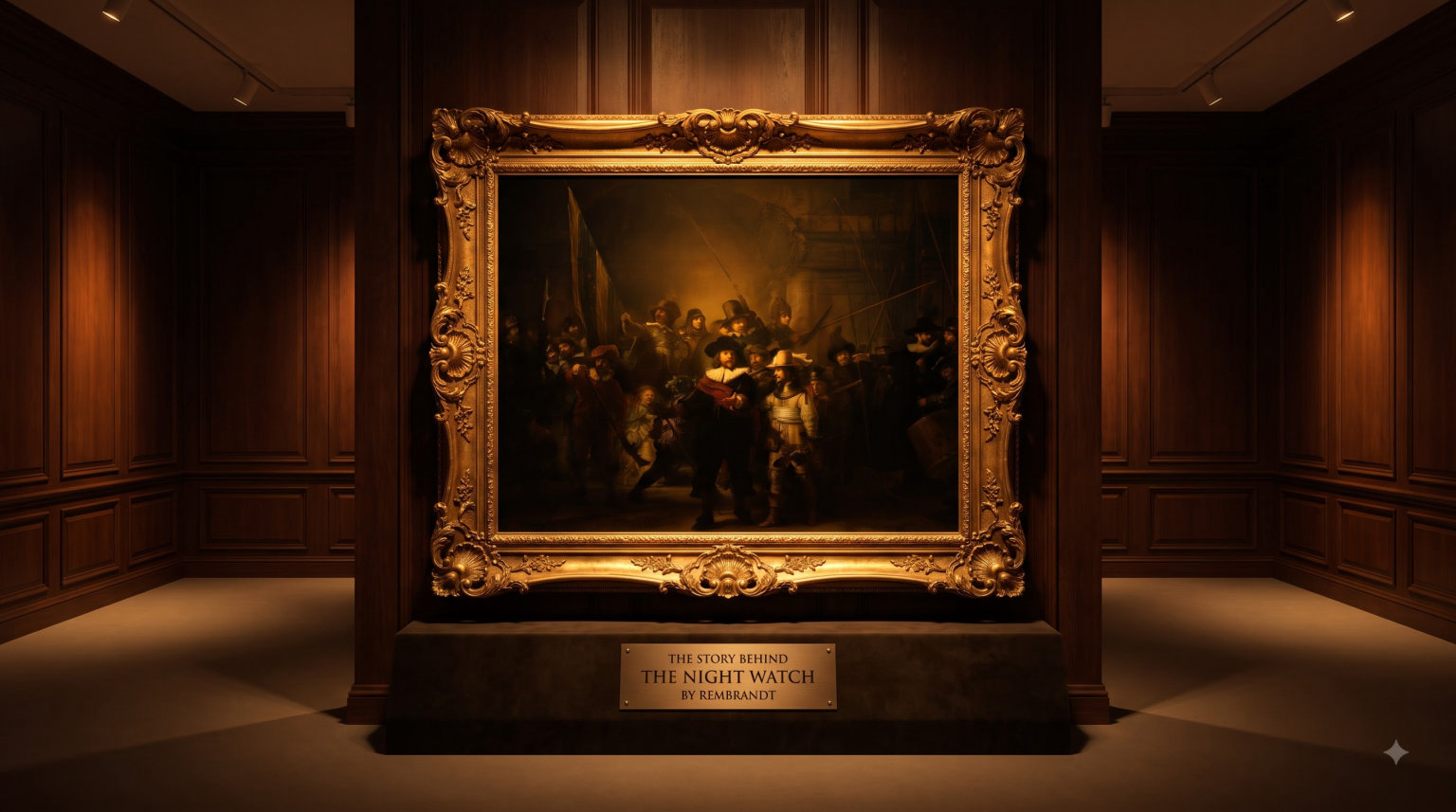
Standing before Rembrandt’s The Night Watch at the Rijksmuseum in Amsterdam, I felt the same thing millions of visitors have felt over the centuries: a sense that the painting is not just hanging on the wall but is actually happening right in front of you. The figures seem to breathe. Weapons glint in sudden light. A small dog barks at the edge of the frame. The sheer scale of the canvas, measuring over 12 feet tall and more than 14 feet wide, makes you feel as though you have stepped directly into 17th-century Amsterdam.
The Night Watch, completed in 1642, is a Dutch Golden Age masterpiece by Rembrandt van Rijn that depicts a civic militia company led by Captain Frans Banninck Cocq preparing to march. The story behind The Night Watch by Rembrandt is one of artistic ambition, historical circumstance, and a series of events that nearly destroyed the painting several times over. It is also a story of a nickname that got the whole thing wrong.
Let me walk you through what we know about this painting, from its original commission to the cutting-edge AI restoration that revealed what was lost, and the startling 2025 discovery about one of its most curious details.
Table of Contents
The Dutch Golden Age and Civic Militias
The story behind The Night Watch by Rembrandt begins with the world that produced it. In the early 17th century, the Dutch Republic was experiencing an extraordinary period of economic growth, global trade expansion, and cultural flowering that we now call the Dutch Golden Age. Amsterdam had become one of the wealthiest cities in Europe, and its citizens were eager to celebrate their prosperity and civic pride through art.
Central to Amsterdam’s social and political life were the civic militia companies. These were volunteer guard units made up of wealthy citizens who were responsible for maintaining order in their districts, defending the city walls, and participating in ceremonial processions. Think of them as part neighborhood watch, part social club, and part honorary society. Membership was a mark of social standing. These were not professional soldiers; they were merchants, politicians, and tradesmen who took pride in their role as defenders of the republic.
Each militia company had its own meeting hall, called a doelen. The company Rembrandt painted was the Kloveniers, named after the arquebus (called a kloven in Dutch), a type of early musket they carried. Their headquarters, the Kloveniersdoelen, was a grand building along the Amstel River where members gathered for banquets, meetings, and celebrations. The walls of these halls were decorated with group portraits of the companies, a tradition that became an important genre of Dutch painting known as the schuttersstuk.
These schuttersstuk paintings were commissioned collectively. Each member who wanted to appear in the portrait contributed toward the artist’s fee. The more members painted, the more the artist earned. This created a specific set of challenges for painters: every paying customer expected to be shown clearly and favorably. Most artists solved this by arranging figures in neat rows, giving each sitter equal prominence. Rembrandt had a very different idea.
The Commission: Who Paid for The Night Watch
In 1640, the Kloveniers decided to commission a new group portrait for their great hall. They turned to Rembrandt Harmenszoon van Rijn, who was 36 years old and at the absolute height of his powers. He was already Amsterdam’s most celebrated painter, known for his portraits, history paintings, and an uncanny ability to capture the inner life of his subjects. The commission called for a painting featuring the company of District II under the command of Captain Frans Banninck Cocq.
Eighteen members of the militia company each paid approximately 100 guilders to be included in the portrait, bringing the total commission to roughly 1,600 guilders. That was a considerable sum at the time, equivalent to several years’ wages for a skilled craftsman. For Rembrandt, it was one of the most lucrative commissions of his career, but it also carried significant risk. Each paying guardsman expected to see himself depicted with clarity and dignity.
What Rembrandt delivered was not what anyone expected. Instead of a static, orderly arrangement of faces looking out at the viewer, he painted a scene bursting with movement and drama. Musket smoke drifts across the composition. A boy runs off to the right carrying a powder horn. A dog barks near the bottom. The guardsmen are loading, firing, and shouldering their weapons in a cacophony of coordinated action. It was a storytelling masterstroke, but it was also a gamble that not every paying sitter appreciated equally.
Exactly how long Rembrandt spent on the painting remains unknown. Art historians have suggested anywhere from several months to over a year, but no documentary evidence survives to confirm the timeline. What we do know is that the finished work was installed in the Kloveniersdoelen, where it hung in the great hall alongside other militia portraits.
The Misnomer: Why It Is Not Actually a Night Scene
One of the most surprising facts about The Night Watch is that its famous name is completely wrong. The painting does not depict a nighttime scene at all. The original title, as recorded in Captain Cocq’s own family album, was “The Militia Company of District II under the Command of Captain Frans Banninck Cocq.” It showed a daytime muster, with bright sunlight streaming across the scene.
So where did the name “Night Watch” come from? Over the decades and centuries, multiple layers of dark varnish were applied to the painting to protect it and to give it an aged, warm tone. By the late 18th century, those layers of varnish had yellowed and darkened so much that the entire scene appeared to take place at dusk or at night. People began calling it “De Nachtwacht” (The Night Watch), and the nickname stuck so firmly that it became the painting’s permanent identity, even after the truth was revealed.
In 1947, a major restoration stripped away centuries of darkened varnish and revealed the original bright colors Rembrandt had intended. Sunlight on armor, the golden gleam of Lieutenant van Ruytenburch’s uniform, and the warm daylight filling the scene became visible once again. The painting we see today, while still carrying some centuries-old damage, is far closer to what Rembrandt originally painted than the murky version that earned it the wrong name.
The misnomer persists because the name has become inseparable from the painting’s identity. Even the Rijksmuseum, which knows better than anyone that the scene is set in daylight, continues to display and market it under the title The Night Watch. At this point, correcting it would be like renaming the Mona Lisa.
Who Are the People in The Night Watch
The Night Watch contains 34 identifiable figures, plus several additional faces and characters whose identities have been lost to time. The two most prominent figures, positioned at the center of the composition and bathed in Rembrandt’s characteristic light, are Captain Frans Banninck Cocq and Lieutenant Willem van Ruytenburch.
Captain Cocq is the figure dressed in formal black with a striking red sash across his chest. He strides forward with confidence, his left hand extended as if giving an order, his mouth open as though calling out a command. He was a powerful figure in Amsterdam: a burgomaster (mayor), a member of the city council, and a man of considerable wealth and political influence. Commissioning this painting was partly an act of personal legacy, and Cocq kept a personal copy of the image in his family album, which is how we know the painting’s original title.
Lieutenant Willem van Ruytenburch stands just behind and to the captain’s right, dressed in a brilliant cream-colored uniform with gold trim. His light clothing creates a striking visual contrast with Cocq’s dark attire, and this interplay of dark and light is one of the painting’s most celebrated compositional decisions. Van Ruytenburch was also a man of means, from a prominent Amsterdam family, and his prominent placement in the portrait reflects his status as the company’s second-in-command.
Behind the two commanders, other guardsmen perform their roles. The ensign, Jan Visscher Cornelissen, holds the company’s bright orange banner aloft. A drummer beats his instrument at the left edge. Various musketeers demonstrate the three stages of handling a musket: loading powder, firing, and blowing the pan clean. One guardsman near the center fires his weapon directly into the light, sending a plume of smoke across the composition.
Then there are the figures who were not militia members at all. A small girl, dressed in a golden gown, appears in the middle foreground. A drummer boy scurries along the edge. And somewhere in the crowd, Rembrandt painted himself, a single green eye peeking out from behind a helmeted guardsman in the back row. It is a sly, almost mischievous self-portrait that you might walk past a dozen times before noticing.
Chiaroscuro and Rembrandt’s Revolutionary Technique
What made The Night Watch so radical was not just its subject but how Rembrandt chose to depict it. To understand his achievement, it helps to know what the competition looked like. Other painters of schuttersstuk paintings arranged their sitters in neat rows or tiers, giving each person equal lighting, equal size, and equal visual weight. The result was a group of individuals sharing a canvas but sharing nothing else: no interaction, no story, no sense that these people were in the same room at the same time doing the same thing.
Rembrandt’s Night Watch shattered that convention. Instead of a lineup of faces, he created a narrative. The militia is in motion, responding to a call to action. Some figures are brightly lit, others recede into shadow. Some stride forward with purpose, others fumble with their weapons or stare off in different directions. This created something unprecedented in group portraiture: the feeling of a real moment, captured as it happened.
The key to this effect was Rembrandt’s mastery of chiaroscuro, the technique of using strong contrasts between light and dark to create volume, depth, and drama. The word comes from Italian: “chiaro” meaning light and “oscuro” meaning dark. Rembrandt pushed this technique into the realm of tenebrism, where large areas of the canvas are swallowed by shadow while specific elements emerge into pools of sharp, directed light.
In The Night Watch, the brightest light falls directly on the two central figures, Cocq and van Ruytenburch. The captain’s outstretched hand, the lieutenant’s gleaming uniform, and the golden dress of the small girl all draw the viewer’s eye like spotlights on a stage. Meanwhile, the outer edges of the composition dissolve into shadow, suggesting depth and the presence of more figures and activity than we can fully see. It is a technique that makes the painting feel enormous even beyond its actual dimensions, as though the scene continues into the darkness on all sides.
The lighting also serves a narrative function. Rembrandt painted the musket-firing sequence so that the flash of the weapon being discharged sends light across the surrounding figures, linking the action to the illumination. Light and action are inseparable in this painting, and that integration of technique and storytelling is what separates it from every other militia portrait of the era.
Hidden Symbols and the Mystery of the Dog
The Night Watch is loaded with symbolism that 17th-century viewers would have recognized instantly but that can easily escape a modern eye. Understanding these symbols reveals just how carefully Rembrandt constructed this seemingly spontaneous scene.
The most debated symbolic figure is the small girl in the golden dress standing near the left side of the composition, illuminated by a pool of bright light. She wears a ornate dress, carries a dead chicken by its claws, and has what appears to be a pistol hanging from her waist. Most art historians interpret her as a mascot of the Kloveniers company. The chicken’s claws (called “klauwen” in Dutch) were a visual pun on the name “Kloveniers,” derived from the arquebus musket. The pistol references the company’s military function. She is not a real child in the scene but a symbolic representation of the militia’s identity.
Another subtle detail is the shadow of Captain Cocq’s outstretched hand falling on the golden uniform of Lieutenant van Ruytenburch. This shadow creates an uncanny visual illusion: the hand appears to be reaching forward in three-dimensional space. It is a small touch that adds to the painting’s sense of depth and movement, drawing the viewer into the scene as though the captain’s hand is reaching toward us.
Rembrandt’s self-portrait is another hidden treasure. His face appears just behind a tall guardsman in a helmet near the back of the crowd. Only one green eye and part of his nose and beret are visible. It is a quiet, almost ghostly presence, as if the artist slipped into his own painting to stand witness to the scene he created. This self-portrait is easy to miss, and I have spoken with museum visitors who have looked at the painting dozens of times without ever noticing it.
Then there is the dog. Near the bottom of the composition, a small dog appears to be barking or jumping, startled by the commotion of the militia mobilizing. For years, this dog was treated as a charming but minor detail, a bit of naturalistic atmosphere. But in 2025, researchers made a discovery that reframed the animal entirely. Using advanced imaging techniques, art historians found evidence that Rembrandt may have painted over another artist’s work in this section, and that the dog’s posture and style bear striking similarities to dogs painted by one of Rembrandt’s contemporaries in the same workshop. The finding suggests the possibility of artistic collaboration or adaptation that was previously unknown, adding yet another layer of intrigue to the painting’s already complex story.
The musketeers in the painting are also arranged to demonstrate a complete firing manual in visual form. One figure pours powder into his musket (loading), another fires the weapon (discharging), and a third blows air across the firing pan to clean it. This sequence was drawn from a standard military manual of the era, and Rembrandt embedded it into his composition as a kind of painted instruction guide. It is one more example of how densely layered The Night Watch is with both artistic and practical information.
Trimmed, Moved, and Nearly Lost: The Painting’s Journey
One of the most painful chapters in the story behind The Night Watch by Rembrandt is what happened to the painting in 1715. When the Kloveniersdoelen was demolished, the painting was moved to Amsterdam’s Town Hall on the Dam. The wall space available was smaller than the canvas, so the painting was trimmed on all four sides to make it fit. The left side lost the most: roughly 60 centimeters (about 2 feet) was cut away, along with portions from the top, bottom, and right edge.
The trimming removed two entire figures from the left side of the composition and altered the spatial balance that Rembrandt had carefully constructed. The captain’s extended left hand, which originally pointed into open space, now appears to gesture toward a figure that no longer exists. The overall effect was to compress the scene, making it feel more cramped than Rembrandt intended. We know what the original composition looked like because of a 17th-century copy painted by Gerrit Lundens, which preserved the full layout before the cuts were made.
In 2021, the Rijksmuseum used artificial intelligence to reconstruct the trimmed portions of The Night Watch based on the Lundens copy. Researchers trained an AI model on Rembrandt’s brushwork and the Lundens painting, then generated a digital recreation of the missing strips. The museum displayed the reconstruction alongside the original for a period, using printed panels attached to the frame to show viewers what the painting looked like before the 1715 cuts. It was a remarkable fusion of art history and technology, giving us the closest approximation yet of Rembrandt’s original vision.
The painting’s journey did not end with the trimming. After the Town Hall, it was moved to the Trippenhuis in Amsterdam before finally arriving at the Rijksmuseum in 1885, where it has been the crown jewel of the collection ever since. During World War II, the painting was rolled up and hidden in limestone caves near Maastricht, along with much of the Netherlands’ most treasured art, to protect it from Nazi looting. It was recovered safely after the war and returned to the Rijksmuseum, where it now hangs in a specially designed gallery enclosed in a climate-controlled glass chamber.
Vandalism and Operation Night Watch
Remarkably for a painting of such immense cultural value, The Night Watch has been the target of three separate acts of vandalism. In January 1911, an unemployed ship’s cook slashed the painting with a knife in what was apparently a protest against his inability to find work. The damage was repaired, but the incident revealed how vulnerable the painting was in its publicly accessible display.
A far more devastating attack occurred on September 14, 1975, when a disturbed schoolteacher slashed the canvas 12 times with a bread knife. The cuts sliced through the left side of the painting, damaging the area around the two main figures. The restoration took eight months and involved painstaking work to reweave the canvas threads and retouch the damaged paint. Although the restoration was considered successful, some subtle differences in paint texture remain visible to trained conservators today.
In April 1990, a man approached the painting and sprayed it with sulfuric acid. Quick-thinking museum staff immediately sprayed the surface with distilled water to neutralize the acid, preventing catastrophic damage. The varnish layer absorbed most of the chemical, and the underlying paint was largely spared. The attack reinforced the need for better protective measures around the painting.
From 2019 to 2021, the Rijksmuseum undertook its most ambitious conservation project ever: Operation Night Watch. For the first time, the painting was restored inside a specially constructed glass chamber in full public view, with every step of the process live-streamed online. Millions of people around the world watched as conservators used advanced imaging technology, including X-ray fluorescence scanning and digital microscopy, to map the painting’s condition at a level of detail never before possible. The team also created a gigapixel photograph of the painting, allowing viewers to zoom in on individual brushstrokes from their computers at home.
The project revealed new details about Rembrandt’s working methods, including evidence that he made significant changes to the composition during the painting process. Underdrawings showed that he repositioned limbs, adjusted the placement of figures, and even painted over entire elements as he refined the scene. These discoveries reinforced what many art historians had long believed: The Night Watch was not a pre-planned, carefully mapped-out composition but a living, evolving work that Rembrandt adjusted instinctively as he painted.
Why The Night Watch Still Captivates Us
More than 380 years after it was painted, The Night Watch remains the most visited and most celebrated painting in the Netherlands. The story behind The Night Watch by Rembrandt is ultimately the story of a painter who refused to do the expected thing. Where others painted records, Rembrandt painted a drama. Where others arranged faces, he created a world. His gamble with the schuttersstuk tradition paid off in ways he could never have imagined, producing a work that continues to surprise scholars, delight museum visitors, and generate new discoveries even in 2026.
The painting’s endurance comes down to something simple: it feels alive. Every time I look at it, I notice something new: a hidden face, a glint of light on metal, the texture of fabric, the way shadow suggests far more than it reveals. That quality of inexhaustible discovery, combined with a history of near-destruction and repeated resurrection, is what makes The Night Watch not just a masterpiece of the Dutch Golden Age but one of the great achievements in the entire history of Western art.
FAQs
What is the story behind Rembrandt’s Night Watch?
The Night Watch was commissioned in 1640 by Captain Frans Banninck Cocq and his civic militia company, who each paid about 100 guilders to be included. Rembrandt, then 36 and Amsterdam’s leading painter, delivered an unprecedented group portrait full of action and drama rather than a static lineup of faces. The painting hung in the Kloveniersdoelen militia hall, was trimmed to fit a smaller wall in 1715, survived three acts of vandalism, was hidden in caves during World War II, and now resides as the centerpiece of the Rijksmuseum collection.
Why is The Night Watch controversial?
The Night Watch was controversial in its time because Rembrandt broke with the established tradition of Dutch group portraiture. Rather than giving each paying militia member equal visibility in a neat, posed arrangement, he composed a dramatic action scene where some figures are brightly lit and prominent while others fade into shadow. Some of the paying guardsmen may have felt shortchanged by their placement. In modern times, the painting’s near-destruction through trimming, vandalism, and chemical attacks has also been a source of controversy and concern.
What is the symbolism in The Night Watch?
The Night Watch contains several layers of symbolism. The small girl in the golden dress carrying a dead chicken represents the mascot of the Kloveniers militia, with the chicken’s claws (klauwen) serving as a visual pun on the company name. The musketeers demonstrate the complete firing sequence from a military manual, turning the painting into practical instruction. Rembrandt hid a self-portrait behind a guardsman in the back row. Captain Cocq’s hand shadow on the lieutenant’s uniform creates a three-dimensional illusion, and the overall composition uses light and dark to symbolize leadership, order emerging from chaos, and civic duty.
What makes Rembrandt’s Night Watch unique compared to other group portraits?
The Night Watch broke with the Dutch tradition of static group portraiture by depicting its subjects in motion, responding to a call to action. Instead of arranging figures in neat rows with equal lighting, Rembrandt used chiaroscuro to create a dramatic narrative scene with a clear focal point (the two commanders), secondary action (musketeers loading and firing), and atmospheric details (smoke, a barking dog, a running boy). This storytelling approach, combined with his masterful use of light and shadow to create depth and movement, made The Night Watch revolutionary and distinguished it from every other militia portrait of the era.
What is the significance of The Night Watch by Rembrandt?
The Night Watch is significant as the most famous painting of the Dutch Golden Age and one of the most recognized artworks in the world. It demonstrates Rembrandt’s innovative approach to group portraiture, his mastery of chiaroscuro, and his ability to infuse a commissioned work with narrative drama and psychological depth. It is the crown jewel of the Rijksmuseum collection in Amsterdam, draws millions of visitors annually, and has been the subject of ongoing conservation efforts including the groundbreaking Operation Night Watch (2019-2021). Its cultural influence extends to film, music, and literature worldwide.