
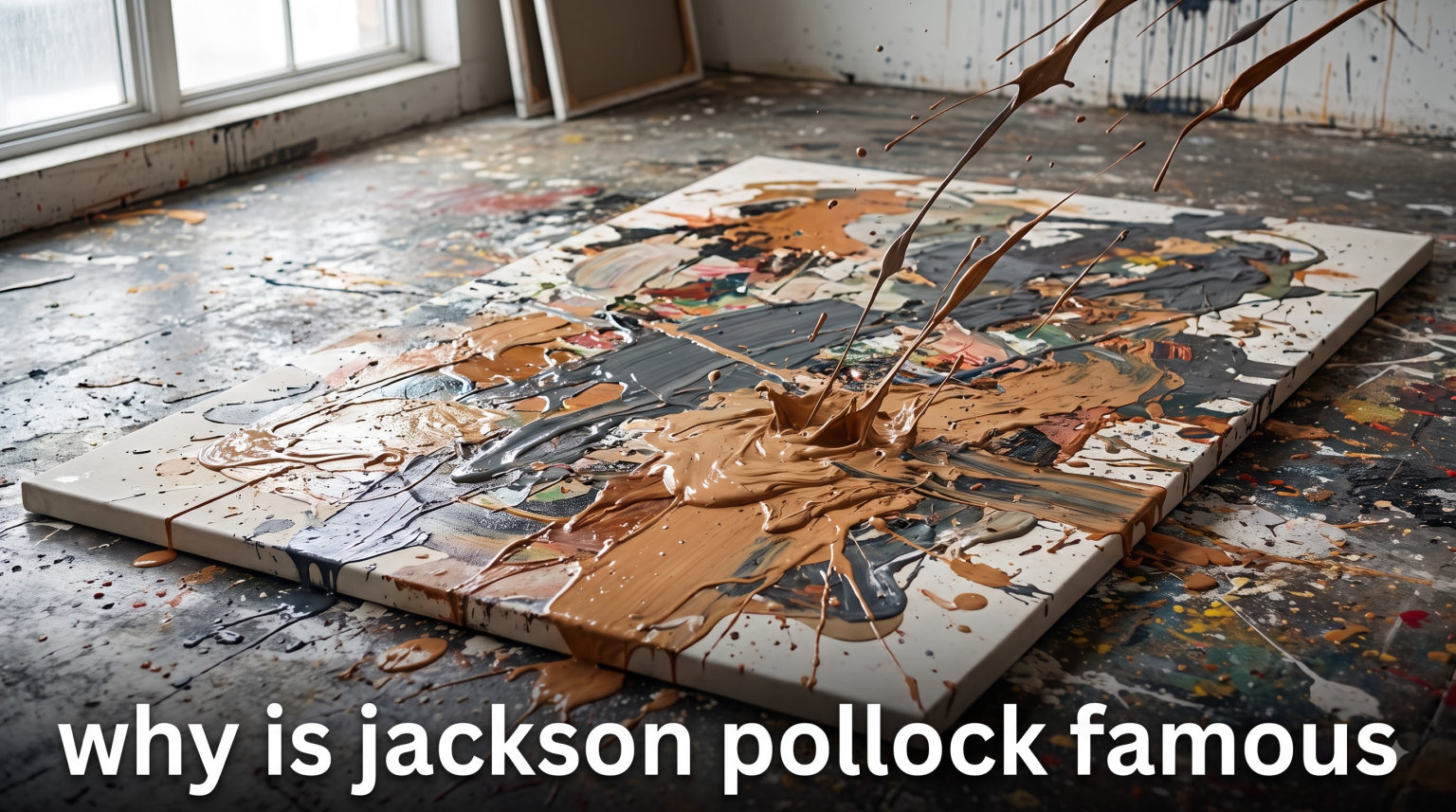
When someone first sees a Jackson Pollock painting, the reaction is often the same: confusion followed by curiosity. You might stare at what looks like tangled threads of paint splattered across canvas and wonder how this could possibly be one of the most famous artworks in history. I had that same question years ago when I stood in front of Number 1A, 1948 at MoMA. That visit changed how I think about art entirely.
Jackson Pollock is famous for pioneering the drip painting technique in the late 1940s, revolutionizing modern art through his physically performative approach to painting, and becoming the most recognized figure of the Abstract Expressionist movement. His work shifted the center of the art world from Paris to New York and created an entirely new way for artists to express emotion through their creations. Beyond the technique itself, Pollock became a cultural symbol representing the messy, spontaneous creativity that defined post-war American art.
Table of Contents
Early Life and Artistic Influences
Paul Jackson Pollock was born on January 28, 1912, in Cody, Wyoming. His family moved around the American West during his childhood, eventually settling in San Diego, California, where his artistic journey began. In his late teens, Pollock traveled to New York City and studied under Thomas Hart Benton at the Art Students League, absorbing lessons about composition and mural techniques that would later inform his own work.
Our team has found that his early artistic development was marked by struggle and intense self-examination. He worked for the WPA Federal Art Project during the Great Depression, creating murals that showed his growing interest in accessing raw emotional states through art. This period coincided with his first encounters with Jungian psychology, which led him to explore myth and archetypes in his sketching.
Pollock battled alcoholism and emotional instability throughout his twenties and thirties. He met Lee Krasner, a talented painter herself, in 1941, and they married in 1945. Krasner became his closest confidante and fiercest advocate, helping manage his professional career while he wrestled with personal demons. Their relationship was complicated but deeply important to Pollock’s growth as an artist.
The Drip Technique Revolution
In 1947, Pollock arrived at the technique that would define his career and change art history. He placed his canvases on the floor rather than an easel and began dripping, pouring, and splashing household enamel paints onto the surface using sticks, trowels, and brushes. He did not stand back to paint but moved around and even over the canvas, applying paint with physical, whole-body gestures that turned painting into performance.
The results were webs of tangled color that covered every inch of the canvas. There was no central focal point, no traditional composition, no brush handling that viewers could trace back to conventional painting methods. Pollock called this approach “action painting” because it captured the physical energy of creation itself. Every movement of his body left traces in the final work.
Critics who dismissed Pollock’s work as “just splashing paint” missed the crucial point. While anyone can drip paint, Pollock was the first to do it with intention and artistic vision that created coherent, powerful compositions. He developed his method through years of experimentation, and the seemingly chaotic results actually contained remarkable balance and complexity.
Brown University researchers later studied the physics behind Pollock’s technique. They found that his pour rates, viscosities, and application methods created predictable fractal patterns that matched the appearance of natural structures like trees and clouds. Science confirmed what art critics had sensed: there was deep structure beneath the apparent chaos.
Famous Works That Defined His Career
Number 1A, 1948 is perhaps Pollock’s most famous painting and the one that made him a household name in the art world. MoMA acquired the piece, and visitors line up to see how colored skeins of paint create what appears to be both organized chaos and dense emotional weight. The black, white, and tan palette seems to pulse with energy despite the absence of any recognizable subject.
Full Fathom Five, also from 1948, demonstrates Pollock’s mastery of metallic paints and complex surface texture. Paint layers build up to create a three-dimensional relief effect that catches light differently depending on viewing angle. The title comes from a Shakespeare phrase suggesting profound depth beneath a surface.
One: Number 31, 1950 is a massive canvas that showcases the full expression of Pollock’s drip technique. The work sprawls across nearly 9 by 17 feet, engulfing viewers in its intricate web of loops, drips, and splatters. Many critics consider this piece the ultimate expression of his artistic philosophy.
The She-Wolf, created in 1943, shows an interesting transitional moment before his drip technique fully developed. The mythological creature emerges from dark backgrounds with aggressive, primal energy. This early work already demonstrates his interest in accessing emotional depths rather than creating pretty surfaces.
Lavender Mist, Number 1, 1950 provides an interesting contrast to his more aggressive works. Soft colors drift and settle into patterns that feel almost peaceful. Collectors and museums now value Pollock’s works at extraordinary prices, with some pieces selling for over $140 million at auction.
Abstract Expressionism and Lasting Legacy
Pollock became the leading figure of the Abstract Expressionist movement, a group of New York painters who rejected traditional representational art in favor of spontaneous, emotionally charged abstract works. These artists shared a belief that art should express the artist’s inner psychological state rather than copy external reality.
The movement arrived at a pivotal moment in history. After World War II, the United States sought to establish cultural dominance against Soviet communism. Our team discovered that the CIA actually promoted Abstract Expressionism as proof of American freedom and creativity, funding exhibitions abroad as part of cultural diplomacy. Pollock became an unlikely cold war warrior in the battle for hearts and minds.
The shift from Paris to New York as the center of the art world happened largely through Pollock and his contemporaries like Willem de Kooning and Mark Rothko. Art critics and collectors who had looked to France for innovation suddenly found themselves watching American artists create something entirely new.
You can learn more about Pollock’s revolutionary drip painting technique in our guide to understanding modern art movements, where we explore how Abstract Expressionism fits into the broader story of art history.
Contemporary artists continue to draw inspiration from Pollock’s methods. His emphasis on process over product, his physical engagement with materials, and his willingness to embrace chance and accident have influenced generations of creators working in all media.
Personal Struggles and Tragic Death at 44
Pollock’s life was marked by intense struggle that fueled his art but also tore him apart. He drank heavily throughout his adult years, using alcohol to manage what doctors would likely diagnose today as bipolar disorder. His emotional volatility made relationships difficult, and his career pressures created constant stress.
The fame that arrived in the early 1950s only complicated his problems. Suddenly wealthy and celebrated, Pollock found the attention overwhelming. He continued drinking despite warnings from doctors and friends. Lee Krasner tried to help him manage the pressure, but the demons were too powerful.
On August 11, 1956, Pollock died in a car crash near Southampton, New York. He was driving under the influence when his car struck a tree, killing him instantly. He was 44 years old, the same age as another famous artist who died too young, Pablo Picasso. He left behind his wife and two young daughters.
Many critics believe his best work came before his death, with his later pieces showing signs of struggle and diminishing innovation. The tragic end matched the intensity of his life’s work. His legacy lives on not just in museums but in every artist who picks up a brush or pour and decides to let go of control.
FAQs
How did Jackson Pollock become famous?
Pollock became famous by developing his signature drip painting technique in 1947, placing canvases on the floor and using sticks, trowels, and brushes to splash and pour house enamel paints. This physically performative approach to creating abstract art was revolutionary and attracted immediate attention from critics, collectors, and other artists. By 1950, he had achieved international recognition and became the most celebrated figure of the Abstract Expressionist movement.
What is Jackson Pollock’s drip technique?
The drip technique involved placing unstretched canvas on the floor and dripping, pouring, or splashing household enamel paints onto the surface using various tools like sticks, trowels, and brushes. Pollock moved his entire body around and over the canvas, creating tangled webs of color with no central focal point. This ‘action painting’ captured the physical energy of creation itself and abandoned traditional brush-and-easel methods entirely.
Why is Jackson Pollock important in art history?
Pollock is important because he revolutionized what painting could be. He abandoned traditional techniques in favor of a physically performative approach that turned the act of painting into a form of expression itself. His work helped shift the center of the art world from Paris to New York after World War II and established Abstract Expressionism as a major movement. His influence continues to affect how contemporary artists think about materials, process, and spontaneity.
What made Pollock’s paintings unique?
Pollock’s paintings were unique because they had no central focal point, covered the entire canvas surface, and showed visible traces of his physical body movements during creation. The ‘all-over composition’ approach meant every area of the canvas carried equal importance. His works seemed to capture energy and emotion in visual form, making viewers feel something without necessarily knowing why. Scientific analysis has shown his drips create fractal patterns similar to natural structures.
How did Jackson Pollock die?
Jackson Pollock died on August 11, 1956, in a car crash near Southampton, New York. He was driving under the influence of alcohol at age 44 when his car left the road and struck a tree. His death was accidental but related to his long-standing struggle with alcoholism. He was married to artist Lee Krasner at the time and left behind two daughters.
Conclusion
When you ask why Jackson Pollock is famous, the answer extends far beyond simple technique. He changed what art could be by introducing physical performance, emotional spontaneity, and radical abstraction into the conversation about what matters in creative work. His drip paintings captured something that no camera could replicate: the energy of creation itself frozen in time.
The fact that his paintings now sell for nine figures demonstrates how completely the art world accepted his revolution. But the real measure of his importance is not auction prices. It is the simple fact that every artist working today who experiments with abstraction, chance, and physical process walks in footsteps Pollock carved out first.
Pollock remains controversial enough that visitors still debate whether his work constitutes genius or accident. That controversy is itself part of his lasting power. His art demands that viewers engage rather than passively receive, making each encounter with his paintings a personal journey into questions that have no final answers.