
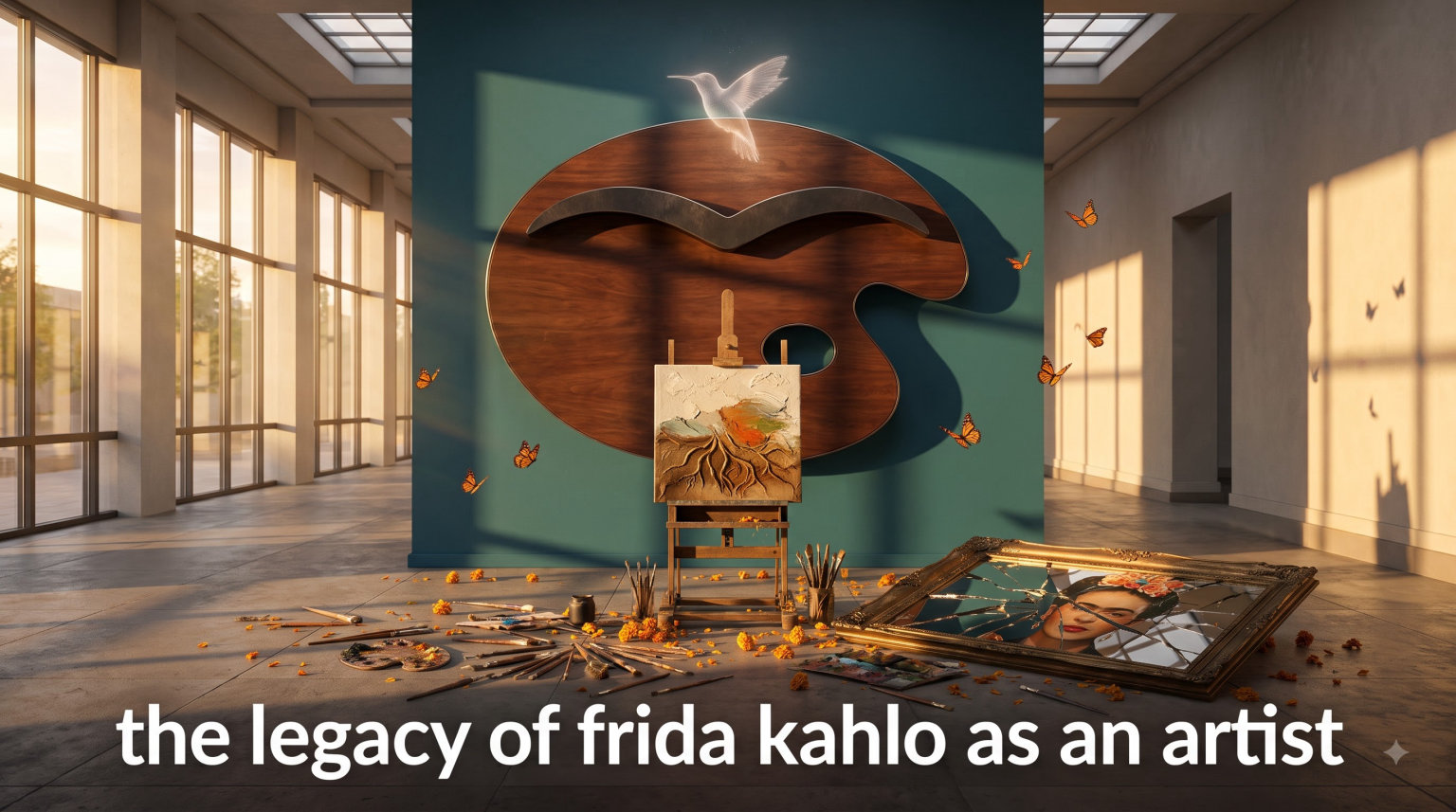
Frida Kahlo’s legacy as an artist is one of the most recognizable and deeply felt in all of modern art history. She transformed personal suffering into visual language, painting 143 works — 55 of them self-portraits — that explored identity, physical pain, Mexican heritage, and the female experience with a raw honesty that was almost unheard of in her era. Her paintings hang in major museums worldwide, her face appears on everything from museum gift shop tote bags to high-fashion runway collections, and her influence on contemporary artists, feminist movements, and LGBTQ+ visibility continues to grow more than seven decades after her death in 1954.
In this article, our team traces the arc of Kahlo’s artistic legacy — from the devastating bus accident that launched her career, to the self-portraiture technique that redefined autobiographical art, to the cultural movements she continues to inspire in 2026. Whether you are an art student, a casual admirer, or someone who just spotted her image on a tote bag and wondered about the story behind it, this guide covers what makes Kahlo’s artistic contribution so enduring.
Table of Contents
Early Life and the Accident That Changed Everything
Frida Kahlo was born Magdalena Carmen Frida Kahlo y Calderon on July 6, 1907, in Coyoacan, Mexico, in the house that would later become the Frida Kahlo Museum, known as Casa Azul. Her father, Guillermo Kahlo, was a German immigrant and photographer, and her mother, Matilde Calderon y Gonzalez, was of mixed Spanish and indigenous Mexican descent. This mixed heritage became a recurring theme in Kahlo’s artistic identity throughout her career.
Kahlo’s relationship with physical struggle began early. She contracted polio at age six, which left her right leg shorter and thinner than her left. The children in her neighborhood taunted her, calling her “Frida la coja” — Frida the lame one. Despite this, she was an active, restless child who eventually became one of only 35 female students at the prestigious National Preparatory School in Mexico City, where she first encountered the muralist Diego Rivera, who was painting a mural there.
Then came September 17, 1925 — the day that reshaped her entire existence. Kahlo, then 18 years old, was riding a bus that collided with a streetcar. The accident was catastrophic. An iron handrail pierced her abdomen and pelvis. She suffered fractures to her spine, collarbone, ribs, and right leg. Her right foot was crushed, and her shoulder was dislocated. The damage to her reproductive organs would haunt her for the rest of her life, contributing to a series of devastating miscarriages.
During the months of immobilization that followed, Kahlo abandoned her plans to attend medical school. She borrowed her father’s paints, set up a specially designed lap easel, and placed a mirror above her bed. That mirror became her most frequent subject. “I paint myself because I am so often alone,” she later wrote, “and because I am the subject I know best.” Painting went from a distraction to a calling — one that would produce some of the most autobiographical artwork ever created.
The Legacy of Frida Kahlo as an Artist: Self-Portraits and Style
Kahlo’s artistic style defies easy classification, and that is part of what makes her legacy so significant. She is often grouped with the Surrealists — Andre Breton famously described her work as “a ribbon around a bomb” — but Kahlo herself pushed back against the label. “They thought I was a Surrealist, but I wasn’t,” she said. “I never painted dreams. I painted my own reality.” Her work sits at the intersection of naive folk art, pre-Columbian symbolism, and autobiographical narrative, producing something entirely her own.
Her technique was deliberate and intimate. She typically worked in oil on small formats — Masonite panels and tin sheets — drawing from Mexican retablo traditions, those small devotional paintings that give thanks for miracles. Each painting reads like a visual diary entry, laden with symbols, animals, botanicals, and direct references to the events of her life. The vivid colors she favored — deep reds, electric blues, warm earth tones — echo the palette of Mexican folk art and the markets of her native Coyoacan.
Self-portraiture was her central mode of expression, and the consistency of that focus is remarkable. In painting after painting, Kahlo stares directly at the viewer with an expression that is equal parts confrontational and vulnerable. Her unibrow and faint moustache, which she refused to alter or hide, became iconic features rendered without apology. The famous works from this mode include “The Two Fridas” (1939), a double self-portrait showing two versions of herself sitting hand in hand with exposed hearts — one in European dress, one in Tehuana dress — painted during her divorce from Rivera. “The Broken Column” (1944) shows her torso split open to reveal a crumbling Ionic column in place of her spine, her skin studded with nails, tears streaming down her face. “Henry Ford Hospital” (1932) depicts the aftermath of a miscarriage, with Kahlo lying naked on a hospital bed connected by red ribbons to floating objects including a fetus, a pelvis, and a snail.
These paintings matter not just for their technical skill but for what they chose to depict. Kahlo painted the things women were not supposed to talk about: miscarriage, surgical trauma, infertility, bodily violation, emotional devastation. In doing so, she carved out space in the art world for raw, unfiltered female experience — a contribution that feminist art historians would later recognize as foundational.
Pre-Columbian Symbolism and Indigenous Motifs
One area where Kahlo’s work departs from European art traditions is her deep engagement with pre-Columbian symbolism. Monkeys appear in several of her self-portraits, referencing Aztec mythology where monkeys symbolize lust and fertility. Hummingbirds — worn as a necklace of sorts in “Self-Portrait with Thorn Necklace and Hummingbird” (1940) — carry meaning in Mexican folk belief as love charms. Skeletons and skulls, drawn from the Mexican Day of the Dead tradition, appear as reminders of mortality that feel celebratory rather than morbid.
The plants and animals in her paintings are never merely decorative. They function as a symbolic vocabulary rooted in Mexican soil, connecting her personal narrative to the broader story of her country’s indigenous past. This blending of the deeply personal with the culturally specific is one of the most distinctive aspects of her technique and a major reason her work resonates across cultures.
Mexican Identity, Heritage, and Mexicanidad
Kahlo’s commitment to Mexican identity was not incidental to her art — it was the foundation. The Mexicanidad movement, which emerged in the aftermath of the Mexican Revolution, sought to define a national identity rooted in indigenous culture rather than European colonial inheritance. Kahlo and Diego Rivera were both central figures in this cultural project, though they approached it from different angles.
Rivera expressed his Mexicanidad through massive public murals depicting the history and struggles of the Mexican people. Kahlo’s approach was personal and intimate. She wore traditional Tehuana dress daily — the long embroidered skirts, the flowery huipil blouses, the elaborate braided updos woven with ribbons and flowers. This was not costume. It was a political statement about the value of indigenous Mexican culture at a time when Western fashion and European cultural standards dominated the art world.
Her home at Casa Azul became a living embodiment of this philosophy. She filled it with pre-Columbian artifacts, traditional Mexican folk art, retablos, and papier-mache Judas figures. The vivid cobalt blue walls of the house, the cactus fences, the courtyard garden — all of it was an extension of her artistic identity. When visitors entered Casa Azul, they entered Frida’s aesthetic universe, one where Mexican folk traditions were elevated to the level of fine art.
Her paintings reinforced this identity at every turn. “My Dress Hangs There” (1933), painted during a difficult period living in the United States with Rivera, shows an empty Tehuana dress hanging against a chaotic collage of American consumerism and capitalism. The message is unmistakable: her identity, like her dress, belongs to Mexico, not to the United States. “Self-Portrait on the Border Line Between Mexico and the United States” (1932) makes the same point even more directly, with Kahlo standing between a machine-driven American landscape and a sun-warmed Mexican terrain rich with ancient ruins and flowering plants.
This political dimension of her art — the insistence that indigenous Mexican culture deserved equal footing with European traditions — positions her as a key figure in post-colonial art history. Her work challenged the hierarchy that placed Western art above all other traditions, and her influence on artists from formerly colonized nations continues to this day.
Feminist Icon and LGBTQ+ Representation
Frida Kahlo did not live to see the feminist art movement of the 1970s, but that movement claimed her as one of its patron saints — and for good reason. Her paintings centered the female body and the female experience without mediation through a male gaze. She painted her own face, her own pain, her own miscarriages, her own desires. She refused to soften her features for viewers, maintaining her unibrow and moustache as acts of defiance against conventional beauty standards. At a time when women artists were expected to paint still lifes and landscapes, Kahlo painted the interior landscape of a woman’s life.
The feminist art historians of the 1970s and 1980s — particularly those associated with the National Museum of Women in the Arts and similar institutions — rediscovered Kahlo’s work and brought it to a much wider audience. What they found was an artist who had anticipated many of their concerns by decades: bodily autonomy, the politics of domestic space, the intersection of gender with race and class, and the validation of personal experience as legitimate artistic subject matter.
Disability Pride Before the Movement Existed
Kahlo’s relationship with disability is inseparable from her art. She lived with chronic pain for nearly three decades, underwent at least 32 surgeries, and spent long periods confined to bed or restricted to a wheelchair. Rather than hiding this reality, she made it the subject of her most powerful paintings. “The Broken Column” does not ask for pity — it demands acknowledgment. Her body cast, which she painted directly with images and symbols, became both a medical device and an art object.
In 2026, disability rights advocates and scholars continue to claim Kahlo as a precursor to disability pride. She represented the disabled body not as something broken or lesser, but as a site of knowledge, creativity, and power. Her art insists that bodies in pain have stories worth telling and that physical limitation does not diminish artistic or human value.
LGBTQ+ Visibility and Relationships
Kahlo’s bisexuality is well-documented, and her relationships with women were an open part of her life, even in a cultural context that rarely acknowledged same-sex desire. Her romantic connections included the American artist Georgia O’Keeffe, the French dancer and singer Josephine Baker, and the Mexican singer Chavela Vargas, among others. Her androgynous self-presentation — she occasionally wore men’s suits and was photographed in masculine attire — further challenged the gender norms of her era.
For the LGBTQ+ community, Kahlo’s significance goes beyond her personal relationships. She modeled a way of being that refused categorization. She was neither strictly feminine nor masculine, neither exclusively heterosexual nor homosexual, neither entirely Mexican nor European. She existed in the spaces between categories, and her art celebrates that liminality rather than apologizing for it. This refusal to be boxed in makes her an enduring icon for queer and gender-nonconforming people around the world.
Cultural and Fashion Influence
Frida Kahlo’s visual identity — the braided updos, the bold jewelry, the Tehuana dresses — has become one of the most recognizable personal styles in modern cultural history. Her image has transcended the art world entirely, appearing on clothing, handbags, phone cases, cosmetics, and home decor. But the journey from artist to icon to commodity is a complicated one.
During her lifetime, Kahlo’s style already attracted attention. She appeared on the cover of Vogue in 1937, though the magazine featured her more as an exotic curiosity than as a serious artist. In the decades following her death, high-fashion designers including Valentino, Jean Paul Gaultier, and Dolce and Gabbana have cited her as an influence, incorporating elements of the Tehuana dress — the bold florals, the structured silhouettes, the statement jewelry — into their runway collections.
The commercialization of Kahlo’s image raises genuine questions that forum discussions and art critics continue to debate. When her face appears on a mass-produced tote bag, does it honor her legacy or reduce it to a consumable aesthetic? Does the merchandising of her image serve her political commitments to indigenous culture and anti-capitalism, or does it undermine them? These are not easy questions, and reasonable people disagree about the answers.
What is clear is that the interest in Kahlo extends well beyond merchandise. Casa Azul, her former home in Coyoacan, now operates as the Frida Kahlo Museum and receives hundreds of thousands of visitors annually. Many of those visitors describe the experience as something closer to a pilgrimage than a typical museum visit. They come to see the bed where she painted, the studio with its pigments and brushes still arranged as she left them, and the urn containing her ashes. The intimacy of the space — the feeling of being inside her world rather than observing it from a distance — speaks to the personal connection people feel with her story.
Influence on Contemporary Artists and the Art Market
Kahlo’s impact on contemporary art operates on two levels: her influence on individual artists who followed her, and her impact on the art market’s recognition of Latin American and female artists more broadly.
Art critics have identified Kahlo’s autobiographical self-portraiture as a direct precursor to the work of contemporary artists like Cindy Sherman, who uses self-portrait to explore identity and performance, and Kehinde Wiley, who reclaims portraiture for marginalized bodies. The tradition of artists painting their own bodies as sites of political meaning — whether around race, gender, disability, or sexuality — traces a line directly back to Kahlo’s practice.
On the art market side, Kahlo’s posthumous recognition has been transformative. In 2006, her painting “Roots” (1943) sold at Sotheby’s for $5.6 million, setting a record for a Latin American artist at auction. She became the first Mexican artist to be included in Sotheby’s top 100 most expensive artworks. Her paintings now appear in the permanent collections of the Museum of Modern Art in New York, the San Francisco Museum of Modern Art, the Centre Pompidou in Paris, and dozens of other major institutions. Major retrospectives — including the 2018 exhibition at the Victoria and Albert Museum in London, which became the museum’s most-visited exhibition ever — continue to draw record-breaking crowds.
This market and institutional recognition matters because it signals a shift in the art world’s center of gravity. For decades, the canon was defined almost entirely by white male European and American artists. Kahlo’s ascent to the highest levels of institutional recognition represents a broadening of that canon — one that her work, with its insistence on the value of Mexican culture, female experience, and indigenous identity, helped make possible.
FAQs
What was Frida Kahlo’s legacy and impact?
Frida Kahlo’s legacy includes pioneering autobiographical self-portraiture that explored identity, pain, and Mexican heritage. She became a feminist icon, a symbol of disability pride, and an LGBTQ+ role model. Her paintings influenced contemporary artists worldwide, and her image became a global symbol of female creativity and resilience. Her work helped expand the Western art canon to include Latin American, female, and indigenous voices.
Why is Frida Kahlo an important artist?
Frida Kahlo is important because she created a completely personal artistic language that combined Mexican folk art traditions with autobiographical storytelling. She painted subjects women were not supposed to discuss u002du002d miscarriage, chronic pain, bodily autonomy u002du002d and did so with technical skill and emotional power. Her 55 self-portraits redefined what portraiture could accomplish, turning it from a record of appearance into a record of inner experience.
What is the saddest painting ever painted?
Many art historians and viewers consider Frida Kahlo’s ‘The Broken Column’ (1944) among the saddest paintings ever created. It depicts Kahlo’s torso split open to reveal a crumbling stone column where her spine should be, her skin pierced with nails, tears running down her face. Painted after one of her many spinal surgeries, it communicates physical and emotional anguish with devastating directness.
Why is Frida Kahlo considered LGBTQ+?
Frida Kahlo is recognized as an LGBTQ+ icon because she was openly bisexual, having romantic relationships with both men and women u002du002d including the dancer Josephine Baker and the singer Chavela Vargas. She also challenged gender norms through her appearance, sometimes wearing men’s suits and refusing to alter her natural features like her unibrow and moustache. Her refusal to fit into fixed categories of gender or sexuality resonates deeply with LGBTQ+ communities today.
The Enduring Legacy of Frida Kahlo
The legacy of Frida Kahlo as an artist is impossible to reduce to a single dimension. She was a Mexican painter who transformed her country’s folk art traditions into a language that the whole world could understand. She was a disabled woman who made the body in pain a subject worthy of serious artistic attention. She was a bisexual feminist who refused to let anyone else define her identity. And she was a technical painter whose small, meticulous works on Masonite and tin achieved an emotional power that murals ten times their size often fail to reach.
What makes her legacy endure, I believe, is that she was honest. She did not prettify her suffering or dress up her joy. She painted what she knew — her own body, her own country, her own heartbreak — and she painted it with the conviction that these specific, local, deeply personal things mattered. Seven decades after her death, the world clearly agrees.
Her Casa Azul stands open in Coyoacan. Her paintings fill museum walls from Mexico City to London to Tokyo. Her image — that unflinching stare beneath the braided crown of flowers — remains one of the most recognized faces in global culture. The legacy of Frida Kahlo as an artist is not just about the paintings she made. It is about the permission she gave to every artist who came after her to be exactly who they are.