
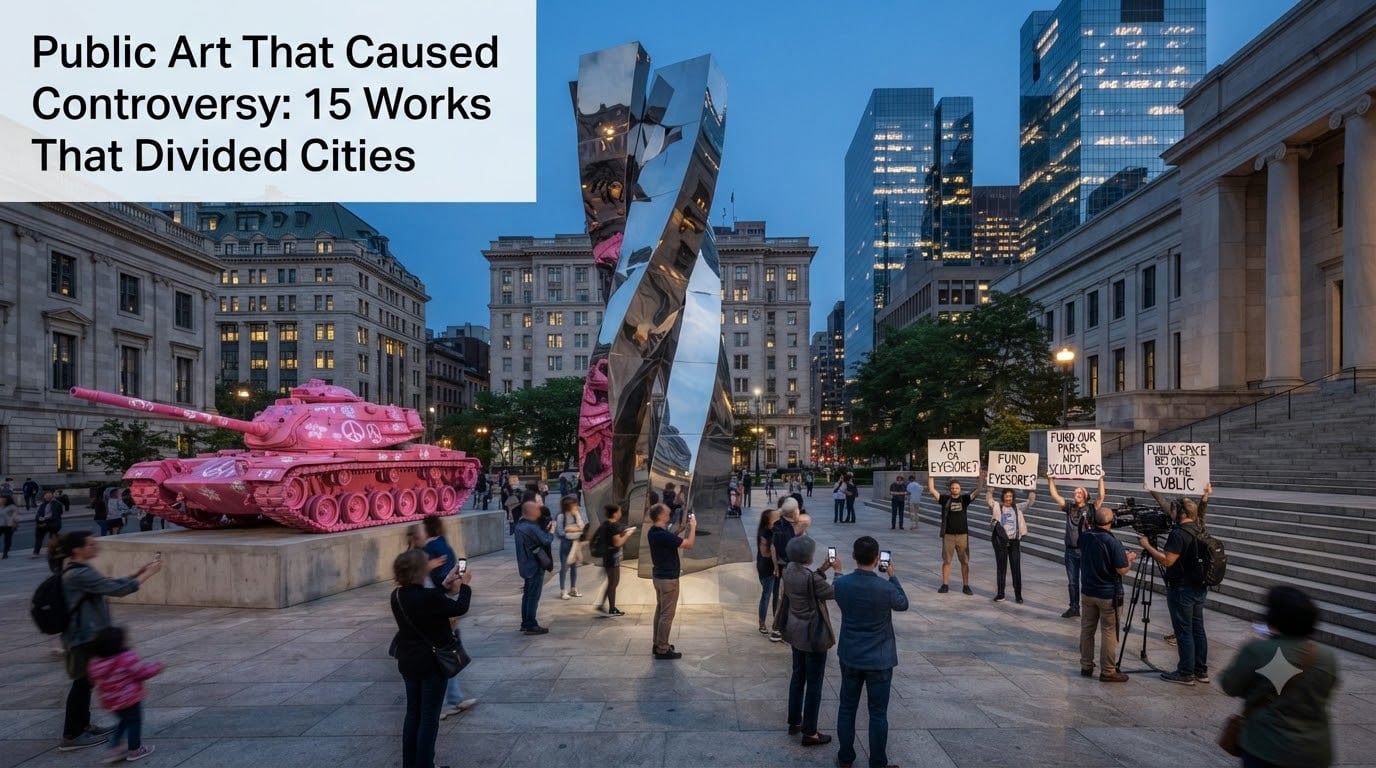
When a artist installs a sculpture in a public square, they are not just placing an object in space. They are entering a arena where diverse communities must negotiate meaning, value, and belonging. Public Art That Caused Controversy explores how these moments of artistic ambition have repeatedly ignited fierce debates about democracy, taxpayer funds, and the boundaries of creative expression. Our team has tracked these controversies for years, and what becomes clear is that the most contested works often leave the deepest marks on our collective cultural memory.
The question of who gets to decide what belongs in shared spaces has no easy answer. When art is funded by public money, disagreement becomes political by default. We found that controversies typically erupt when three conditions align: significant public funding, artwork that challenges existing norms, and communities who feel their voices were excluded from the decision. This pattern repeats from 1980s New York to present-day Charlottesville, showing that our struggles with public art are really struggles with what kind of society we want to be.
What follows is our analysis of 15 Public Art That Caused Controversy works, examining not just the art itself but the human stories behind both its creation and its reception. We hope this exploration helps readers understand why these controversies matter and what they reveal about the communities they divide.
Table of Contents
The Most Controversial Public Artworks in History
Public art controversy takes many forms. Some controversies erupt over money, others over meaning, and some simply because a sculpture looked strange to people who had never encountered contemporary art before. The artworks below represent the full spectrum of disputes that have shaped how cities think about commissioning, funding, and maintaining art in public spaces.
Richard Serra’s Tilted Arc (1981)
Richard Serra’s Tilted Arc was a 120-foot-long, 12-foot-high steel wall that curved gently through the federal plaza in lower Manhattan. When it was installed, federal plaza workers immediately protested. They said the sculpture transformed their daily commute into an obstacle course and created an atmosphere that felt hostile and alienating. Serra insisted the work was meant to reshape how people moved through and experienced the plaza.
The controversy became a landmark case in public art history. Workers filed complaints, architects joined the opposition, and eventually a federal court ruled that the sculpture should be removed. Serra fought the decision, arguing that removing his work would constitute censorship. The court disagreed, and Tilted Arc was dismantled in 1989.
Today, art historians view the Tilted Arc controversy as a turning point. It raised fundamental questions about whether public art should serve everyone or challenge everyone, and whether a work commissioned through proper procedures could still be removed if it genuinely harmed its community. The case influenced how cities approach site-specific art commissions today.
Jeff Koons’ Bouquet of Tulips (2016)
Jeff Koons created Bouquet of Tulips as a gift from France to the United States following the 2015 Paris terrorist attacks. The sculpture, standing 33 feet tall in vibrant colored stainless steel, was meant to symbolize joy and hope. However, its placement in the Tuileries Garden near the Place de la Concorde immediately drew criticism.
Critics questioned both the sculpture’s $3.1 million cost and its timing. Some felt that Kolns’s gift felt disconnected from the trauma of the attacks, while others argued that the bright, cheerful forms were inappropriate for a memorial context. A petition circulated demanding the work be rejected.
The city of Paris ultimately accepted the sculpture, and Koons donated his fees to victims of the attacks. The work remains installed today, though it continues to divide visitors who stumble upon it in the gardens.
Anish Kapoor’s Cloud Gate (2006)
Anish Kapoor’s Cloud Gate now draws millions of visitors to Chicago’s Millennium Park each year. The sculpture’s seamless reflective surface transforms the city skyline into rippling abstractions, creating an experience that changes with every angle and every cloud that passes overhead. When Chicago announced the commission in 2003, however, the reaction was far from enthusiastic.
The $6 million price tag troubled taxpayers who questioned whether public funds should go toward contemporary sculpture. Others dismissed the work as a mere novelty, nicknaming it “The Bean” in ways that seemed to diminish Kapoor’s artistic intent. Some worried the highly polished surface would become a beacon for terrorists.
Today, Cloud Gate has become Chicago’s most photographed landmark and a point of civic pride. Kapoor’s transformation of public skepticism into widespread adoration represents one of public art’s great redemption stories. The controversy seems almost quaint now that the sculpture has become inseparable from the city’s identity.
Christo and Jeanne-Claude’s The Gates (2005)
Christo and Jeanne-Claude spent 26 years planning The Gates, a temporary installation of 7,503 vinyl gates with saffron-colored fabric panels along 23 miles of pathways in Central Park. The project cost $21 million, entirely funded through the artists’ own efforts. Yet when installation began in early 2005, opposition was fierce and immediate.
Critics attacked the cost during a time of war and economic uncertainty. Environmental groups worried about the fabric’s impact on park wildlife. Some dog owners opposed the gates, claiming they would interfere with off-leash walking. A lawsuit attempted to stop the project entirely.
Once the gates opened to the public on February 12, 2005, the tone shifted dramatically. Over 5 million visitors walked the park during the 26-day exhibition, many describing the experience as magical. The gates caught the winter light beautifully, and the limited duration made them feel precious. When the installation ended, crews removed everything within days, leaving the park exactly as it had been.
The Gates showed that temporary controversial art could generate enthusiasm even from those initially opposed. It also demonstrated that Christo and Jeanne-Claude understood public space differently than most artists, viewing the park itself as the true artwork, gates and all. You can read more about how The Gates divided New York City in our detailed case study.
Kara Walker’s A Subtlety (2014)
Kara Walker’s A Subtlety was a massive sphinx sculpted from white sugar, standing 75 feet long and 35 feet high, commissioned by Creative Time for the abandoned Domino Sugar Factory in Brooklyn. The sculpture’s surface was inscribed with scenes depicting stereotypic and confrontational imagery from America’s history of slavery and oppression.
The choice of sugar as a medium was deliberate and devastating. Sugar production in the Americas was built on enslaved labor, and Walker’s enormous sugar sphinx forced visitors to confront this uncomfortable history. Groups arrived with vastly different expectations, and some found the imagery difficult or painful.
The project drew 130,000 visitors over its 11-week run, far exceeding Creative Time’s expectations. Many visitors stayed for hours, processing the complex visual narrative. The temporary nature of the artwork meant it would inevitably melt away, which seemed poetically appropriate for a monument addressing histories that many wish would simply disappear.
A Subtlety proved that contemporary art could still provoke genuine shock and debate in the smartphone age. Its success encouraged Creative Time and other organizations to pursue increasingly ambitious public projects. The echoes of this project can be seen in Creative Time’s pioneering public art projects that followed.
David Cerny’s Pink Tank (1991)
When Czech artist David Cerny unveiled his Pink Tank at Petrin Hill in Prague, the city was still processing the end of Soviet domination. The original Soviet tank that had occupied the same spot during the 1968 invasion had been a painful but familiar presence for over two decades. Cerny’s solution was to paint that successor tank bright pink.
Prague residents were initially bewildered and offended. The pink color seemed to mock both the Soviet occupation and the Czech struggle for independence. Many felt the city was making light of serious historical trauma. Local authorities attempted to have the sculpture removed.
Over time, however, the Pink Tank became one of Prague’s most photographed attractions. The shock of the color gradually transformed from offense to affection, and Cerny himself became a national hero for his irreverent approach to public art. The tank is now considered one of the defining symbols of post-communist Czech cultural identity.
The Enola Gay Memorial Controversy (1995)
The Smithsonian’s planned 1995 exhibition commemorating the 50th anniversary of the end of World War II became one of the most heated museum controversies in American history. The exhibition was to include the Enola Gay, the B-29 bomber that dropped the atomic bomb on Hiroshima. Veterans groups and politicians protested what they saw as a morally ambiguous presentation that seemed to question the decision to use atomic weapons.
Critics argued the exhibition’s text implied that the bombing of Hiroshima was unjustified and that the United States had committed something approaching a war crime. The anger was swift and intense. Congressional hearings followed, and the exhibition was significantly restructured before opening.
The controversy revealed the difficulty of presenting contested historical narratives in public institutions. It also set precedents for how museums handle military history that intersects with ongoing political debates. The episode continues to inform discussions about academic freedom, institutional independence, and the role of museums in shaping public memory.
Paul McCarthy’s Tree (2014)
Paul McCarthy’s Tree was installed in the Place du Trocadéro across from the Eiffel Tower, and within hours of its unveiling, it had become the center of intense protests. The work, a massive green sculpture that from certain angles resembled an oversized sex toy, triggered immediate backlash from visitors and officials alike.
The Paris mayor’s office condemned the work as obscene and potentially harmful to children. Petitions circulated demanding its removal. Within days, the sculpture was vandalized and then removed entirely, only to be reinstalled in modified form at another location.
The Tree controversy illustrated how different cultural contexts shape reactions to public art. What McCarthy considered a commentary on commercialization and nature was interpreted by Parisian officials and visitors as something far more simple and offensive. The incident revealed ongoing tensions between artistic ambition and community standards in major world cities.
Banksy’s Street Art Debates (2000s-Present)
Banksy’s anonymous street art has generated controversy from Bristol to New York to Palestine. His works appear overnight on walls and buildings, often without permission, transforming neglected urban spaces into sites of artistic contemplation. But the illegality of his placements has made him simultaneously celebrated by art world insiders and pursued by authorities.
Perhaps no Banksy work better illustrates his controversial approach than his 2018 departure from his own Dismaland bemusement park. The project, which sold entry tickets and featured twisted versions of Disney attractions, was simultaneously a tourist attraction and a commentary on capitalism. It closed as planned after five weeks, demolished entirely as though it had never existed.
More recently, the fate of Banksy works has become intensely commercialized. A Valentine’s Day sculpture in a UK coastal town was reportedly sold for nearly $1 million despite ongoing debates about whether street art can or should be commodified at all. The controversy continues to evolve alongside the art form itself.
Terry Gilliam’s Haniel (2013)
Terry Gilliam, better known as a filmmaker than a sculptor, created Haniel, a 10-meter-tall bronze figure for a German business park in Duisburg. Locals were baffled by the towering, somewhat menacing figure that seemed to have no connection to its surroundings or to any recognizable artistic tradition.
Residents near the sculpture formed protest groups and attempted to have it relocated. Some found the figure’s appearance genuinely frightening. Others questioned why a business park needed such an imposing artwork when community services faced budget cuts.
Gradually, Haniel developed an unexpected following. The sculpture’s very strangeness made it photographically compelling, and visitors began traveling specifically to see it. What began as a source of community shame became an unlikely tourist attraction, demonstrating again that the lifecycle of controversial art rarely follows initial expectations.
Tony Smith’s Moondog (1962)
Tony Smith’s Moondog stands in the lobby of a Seagram Building, but its placement there was far from smooth. When the sculpture was first installed, architects at Skidmore, Owings & Merrill objected strongly, arguing that the geometric form blocked their carefully designed lobby space and disrupted the building’s modernist aesthetic.
This early controversy established patterns that would repeat for decades. The question of whether a building’s architect should have veto power over sculptures placed in their spaces remains unsettled. Smith, who was primarily an architect himself, eventually won the right to keep his work, but the dispute influenced how building commissions handle art integration.
Mona Hatoum’s Kissing the Future (2002)
Mona Hatoum’s Kissing the Future was commissioned for public spaces in London in 2002, but the post-9/11 political climate made its installation timing extraordinarily awkward. The work featured projections and installations that touched on themes of surveillance, displacement, and global tension, topics that seemed suddenly more relevant and more sensitive than they had just a year earlier.
Several venues that had agreed to host the work withdrew their participation, citing concerns about public reaction. Others rescheduled to avoid potential controversy. The delays transformed what was meant to be a widespread public artwork into something far more fragmented and hard to experience.
Hatoum’s experience illustrates how external political events can transform uncontroversial art into something that feels dangerous or inappropriate. The controversy was not about the work itself so much as about the climate in which it would be received.
The Everyday Anonymity Installations (2010)
Artist Gillespy’s Everyday Anonymity series placed mysterious installations in public spaces across UK cities beginning around 2010. Some appeared to be abandoned objects, others seemed to be performing strange rituals of their own. At least one installation triggered a bomb squad response when frightened commuters reported what appeared to be a suspicious package.
The anonymity of the artist and the unexplained nature of the works generated intense speculation and media coverage. Some praised the installations for forcing urban dwellers to pay attention to their surroundings. Others criticized what they saw as a dangerous game with public safety in an age of heightened terrorism awareness.
Eventually, the artist revealed his identity, and the installations were understood as conceptual art about urban alienation and the tendency of city dwellers to ignore everything around them. The controversy had been, in some sense, the point all along.
Confederate Monuments Debates (Various)
Perhaps no recent controversy has more dramatically illustrated the power of public art to divide communities than the ongoing debates over Confederate monuments across the American South. These monuments, many erected decades after the Civil War during periods of Jim Crow segregation, have long been understood by historians as celebrations of white supremacy rather than genuine historical commemoration.
The 2015 murder of nine Black church members in Charleston, South Carolina, and the 2020 murder of George Floyd in Minneapolis sparked renewed calls for monument removal. Supporters argued these works honor heritage, while opponents insisted they celebrate slavery and terrorism. The debates became flashpoints for broader conflicts over American history, racial justice, and public space.
Cities across the country began removing monuments, sometimes quietly and sometimes after prolonged legal battles. Counter-protesters defended monuments with force, leading to tragic outcomes in Charlottesville, Virginia in 2017. The controversy shows no signs of resolution, as communities continue to negotiate what history deserves public commemoration and what should be preserved in museums rather than celebrated in public squares.
Sculpture_Fundamentalism and the Case of Robert Rauschenberg (2002)
Robert Rauschenberg’s Speak was commissioned for New York City’s subway system, part of an effort to beautify transit spaces with contemporary art. When the MTA reviewed the final text embedded in the sculpture, officials objected to certain words they considered inappropriate for a public space accessible to children.
The MTA demanded alterations before installation could proceed. Rauschenberg, an artist known for his confrontational approach, initially refused. After extended negotiations, some text was modified. The final work was smaller and less ambitious than originally conceived.
The episode raised questions about how public institutions should balance artistic integrity with community standards. The MTA’s position that public subway space required different standards than gallery space seemed reasonable to many, but the alterations nonetheless diminished what the artist had intended to communicate.
Who Decides? Democracy, Funding, and Public Art
The controversies above share common threads that go beyond individual artistic disputes. At the heart of every debate about Public Art That Caused Controversy lies a fundamental question: who has the right to decide what art belongs in shared spaces?
Taxpayer funding creates immediate political stakes. When public money supports art, citizens reasonably expect some voice in what that money purchases. Artists and administrators counter that artistic quality cannot be determined by committee and that public art should challenge and surprise rather than simply reflect existing preferences. This tension has no satisfying resolution because both positions contain genuine wisdom.
Community consultation processes have become standard in many cities, yet they rarely prevent controversy. Communities consulted in planning phases often feel betrayed when final installations differ from presentations. Artists consulted in good faith sometimes find their intentions misrepresented or oversimplified. The process can create as many problems as it solves.
Some cities have experimented with different models. Percent-for-art programs that set aside a fixed budget percentage for public art have produced both beloved landmarks and contested eyesores. Independent nonprofit commissioning has allowed more adventurous projects but removed accountability. Temporary installations allow experimentation without permanent commitment but can feel like an inadequate compromise.
What seems clear is that controversy itself is not a sign of failure. Many of the artworks discussed here that initially sparked outrage are now considered civic treasures. The discomfort that controversial art creates is sometimes precisely what makes it valuable, forcing communities to confront aspects of their identity they would prefer to ignore.
The debate over influential contemporary artists who created controversial public works reflects broader questions about whether art should serve as a mirror reflecting community values or as a window revealing possibilities the community has not yet imagined. Both functions matter, and the most productive public art often serves both simultaneously.
Frequently Asked Questions
What makes public art controversial?
Public art becomes controversial when it occupies shared spaces with taxpayers who did not choose to fund it. Common triggers include perceived waste of public funds, artwork that challenges community values, commemorates disputed historical figures, or installations that physically obstruct public spaces.
Which controversial public artwork was removed?
Richard Serra’s Tilted Arc (1981) is the most famous removed controversial artwork. After years of protests from federal plaza workers who said it made their workplace hostile, a federal court ordered its removal in 1989. The decision remains controversial in the art world, with many arguing it set back public art in America.
Does public opinion influence controversial art’s legacy?
Often, artworks that initially sparked outrage become beloved landmarks over time. Chicago’s Cloud Gate exemplifies this trajectory, transforming from a $6 million gamble that many questioned to the city’s most photographed landmark. Similarly, David Cerny’s pink tank in Prague now draws visitors who once protested its installation.
What role does social media play in art controversies?
Social media has accelerated and amplified public art controversies, enabling rapid mobilization against installations before completion. Recent debates about Confederate monuments and controversial sculptures in 2020 showed how digital platforms can quickly escalate local disputes into national conversations, sometimes leading to swift removal.
The Enduring Power of Contested Art
Looking across these 15 cases of Public Art That Caused Controversy, a pattern emerges. The works that generate the most intense opposition are often the ones that communities eventually embrace most fully. Cloud Gate, the Pink Tank, The Gates: all were greeted with protests and petitions, yet all now serve as beloved civic symbols.
This does not mean all controversy is healthy or that communities are wrong to resist artworks they find genuinely offensive. Some controversies reveal genuine moral conflicts that deserve serious engagement rather than dismissal. The Confederate monument debates, for instance, engage fundamental questions about American history and justice that will not be resolved by artistic taste alone.
What we can say is that public art exists precisely because art matters enough to argue about. If everyone agreed immediately on every artwork, we would not need public processes for commissioning or removing sculptures. The controversy proves that art retains power to shape how we understand ourselves and our communities.
Our team will continue tracking these debates as they evolve. The next Public Art That Caused Controversy is probably being fabricated or installed right now, in some city whose residents do not yet know what awaits them. That uncertainty is, in the end, part of what makes public art vital.