
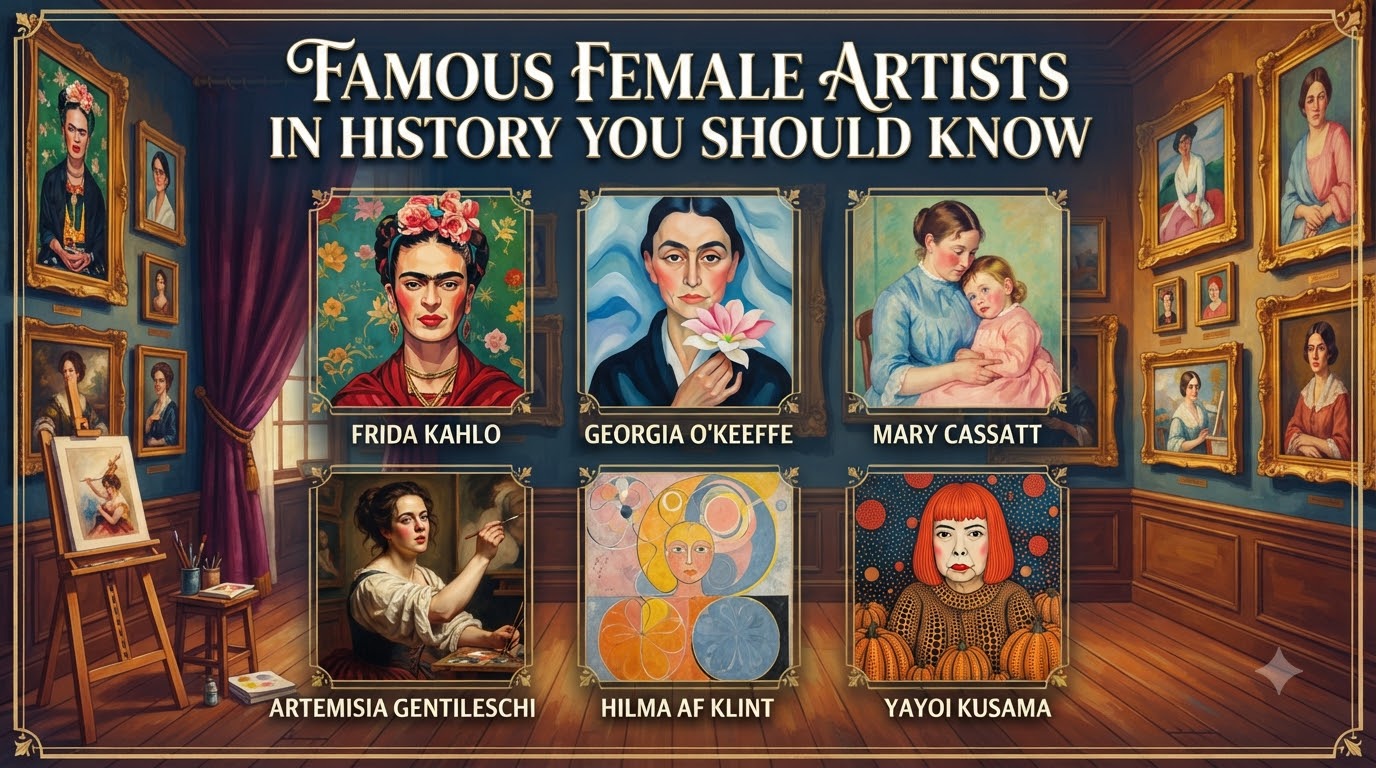
When we talk about famous female artists in history, we are really talking about a story of resistance, reinvention, and quiet revolution. From the candlelit studios of Renaissance Italy to the immersive infinity rooms of contemporary Tokyo, women have shaped the visual language of every era, even when the art world refused to give them credit. I have spent the past three months compiling this guide, and what struck me most was how many names are still missing from mainstream art education.
If you want a quick orientation before diving in, here are ten famous female artists in history you should know: Artemisia Gentileschi, Sofonisba Anguissola, Mary Cassatt, Berthe Morisot, Georgia O’Keeffe, Frida Kahlo, Hilma af Klint, Helen Frankenthaler, Louise Bourgeois, and Yayoi Kusama. These women span four centuries, multiple continents, and every major movement you can name.
The full list below goes deeper. I have organized these iconic women artists by era and movement, because context is what turns a name on a wall label into a story worth remembering.
Table of Contents
Why Were Famous Female Artists in History Overlooked for So Long?
Before we get to the artists themselves, we have to talk about why most of us only know a handful of names. The honest answer is structural, not accidental.
For most of Western art history, women were legally barred from life-drawing classes, denied apprenticeships, and excluded from the Académie salons. When Artemisia Gentileschi painted Judith Slaying Holofernes in 1620, she did so without ever being allowed to draw from a live nude model. The few women who broke through were routinely written out of textbooks or credited to their fathers and brothers.
Things got worse in the 20th century before they got better. The Museum of Modern Art’s 1985 exhibition “The International Survey of Recent Painting and Sculpture” included work by 169 artists. Only 13 of them were women. That single statistic launched the Guerrilla Girls and a generation of feminist art activism that still shapes museums today.
Auction records tell the same story. It was not until 2018 that a living female artist, Judy Chicago, finally crossed certain price thresholds. Today, however, female artists are catching up. Between August 2026 alone, works by women accounted for a record share of major auction sales, and Yayoi Kusama has been the highest-grossing female artist globally for several years running.
Renaissance and Baroque Pioneers Among Famous Female Artists in History
Artemisia Gentileschi is the artist I recommend people start with. She is, in my view, the most important pre-20th century female painter most people have never heard of. Born in Rome in 1593, she was the first woman admitted to the prestigious Accademia delle Arti del Disegno in Florence. Her dramatic, chiaroscuro-lit paintings of biblical heroines were so technically accomplished that the great Caravaggio himself is believed to have admired her work.
Her most famous painting, Judith Slaying Holofernes, depicts a biblical murder with such unflinching physical detail that scholars still debate whether the violence is autobiographical. I find that debate less interesting than the painting itself. The blood-spattered sheets, the cramped bodies, the sheer exertion of Judith and her maid, none of this reads as a woman working in a borrowed style. It reads as someone who has been in the room.
Sofonisba Anguissola, slightly older than Gentileschi, came from a different background. She was a noblewoman from Cremona who became court painter to King Philip II of Spain. Her self-portraits and group portraits were so psychologically acute that Michelangelo reportedly corresponded with her and praised her work. In an era when women were expected to stay in the background, she painted herself into the foreground, repeatedly, on her own terms.
Elisabeth Louise Vigée Le Brun, working more than a century later, took that same self-portrait tradition and made it commercial. She was Marie Antoinette’s favorite portraitist and painted more than 30 self-portraits in her career. When the French Revolution forced her into exile across Europe, she kept working, kept painting royals, and became one of the most successful portraitists of the late 18th century, full stop, not just the most successful female one.
Impressionist Era Trailblazers
The 19th century finally cracked the door open, and a small group of women kicked it wide. Mary Cassatt, an American who spent most of her career in Paris, is the obvious starting point. She was the only American and one of just three women invited to exhibit with the French Impressionists, and her work remains some of the most accessible in the entire movement.
What I love about Cassatt is her subject matter. Where the male Impressionists painted cafés, racetracks, and bathers, she painted mothers and children, women reading, women in their own bathrooms. Her painting The Child’s Bath, completed in 1893, is a small, quiet masterpiece that turns a routine moment between a woman and a child into something monumental. She made domestic life serious art, decades before feminist theorists had the language to explain why that mattered.
Berthe Morisot was a founding member of the Impressionist movement itself, exhibiting in the very first Impressionist show in 1874. She was also Édouard Manet’s sister-in-law, a connection that led some critics to dismiss her work as derivative. They were wrong. Her loose brushwork, her subject matter, again mostly women and children, and her willingness to leave canvases visibly unfinished influenced Manet at least as much as he influenced her.
Rosa Bonheur belongs in any serious list of famous female artists in history, even though she worked in a completely different mode. A 19th century French realist painter of animals, Bonheur was so successful in her lifetime that she was awarded the Legion of Honor in 1865, one of the first women to receive it. She lived openly with her female partner, dressed in men’s clothing, legally permitted by a special police permit, and refused to soften her subjects. Her painting The Horse Fair, completed in 1853, hangs in the Metropolitan Museum of Art and still looks radical today.
Modern Era Mavericks: From O’Keeffe to Kahlo
Georgia O’Keeffe is, for many people, the first name that comes to mind when you say “famous female artists in history.” That is fair. She is also a case study in how the art world has historically framed women. For years, critics reduced her enormous, abstract paintings of flowers to coded references to female anatomy. O’Keeffe spent decades refusing that reading, and the paintings have outlasted the critics.
What I find most interesting about O’Keeffe is her relationship to landscape. Her paintings of New Mexico’s bones, mesas, and skies are so stripped down that they feel almost geological. Her Pelvis Series and the black-and-white Near Abiquiú paintings are not illustrations of a place. They are what it feels like to stand in that place. O’Keeffe is also the artist who, more than any other, established the Southwestern art market and made Santa Fe a global art destination.
Frida Kahlo needs no introduction, but I want to push back on one common reading. Kahlo is often described as a Surrealist, but she herself rejected the label, saying, “I never painted my dreams. I painted my own reality.” The reality she painted, her physical suffering, her complicated bisexuality, her marriage to Diego Rivera, her Mexican and indigenous heritage, was specific to her in a way that made her one of the first global art celebrities. In 2026, her self-portraits still rank among the most reproduced paintings in the world.
Hilma af Klint is the great rediscovery of the past decade. A Swedish artist who worked in isolation, she produced over 1,200 abstract paintings starting in 1906, four years before Kandinsky. Most art historians wrote her off as a mystic or a curiosity. The 2018-19 exhibition of her work at the Guggenheim broke attendance records and forced a wholesale rewrite of the history of abstract art. She is, in my view, the most important female artist most people discovered in the past ten years.
Abstract Expressionists and the Mid-Century Generation
The Abstract Expressionists were famously macho. Jackson Pollock, Willem de Kooning, and their circle drank, fought, and cultivated a cult of masculine genius. It is easy to forget that several women were part of the same New York scene, working in the same studios, showing at the same galleries.
Helen Frankenthaler invented the soak-stain technique, thinned paint so it soaked into raw canvas like watercolor, that became the foundation for what critic Clement Greenberg called Post-Painterly Abstraction. Her 1952 painting Mountains and Sea is a hinge moment in 20th century art. Without it, there is no Morris Louis, no Kenneth Noland, and arguably no Color Field painting at all. The fact that she did it first, in a discipline defined by male bravado, is part of the story.
Lee Krasner was Pollock’s wife, a label she spent her career trying to escape. Her own work was muscular, layered, and more formally rigorous than her husband’s in many ways. When Pollock died in 1956, Krasner spent months in their East Hampton studio finishing his unfinished canvases, then quietly rolled them up and exhibited her own work. The “Who’s afraid of Lee Krasner?” graffiti that appeared on a New York wall in the 1990s said everything about the long delay in her critical rehabilitation.
Agnes Martin worked in a different register entirely. Her pale, gridded canvases look minimalist, but they are closer to Tibetan Buddhist meditation paintings than to Donald Judd. Martin lived alone in a small New Mexico adobe for most of her adult life, and her quiet, devotional paintings of stripes and bands have become some of the most expensive works by any female artist. Joan Mitchell, by contrast, was loud, ambitious, and proud. She moved to France in the 1950s, drank heavily, and painted with a fury that made the New York School look restrained.
Black Female Artists Who Shaped Art History
No list of famous female artists in history is complete without naming the Black women whose work has been systematically excluded from the canon. This is not a footnote. It is a correction.
Augusta Savage was a sculptor working during the Harlem Renaissance. In 1939, she created The Harp for the World’s Fair, the largest sculpture ever made by an African American artist, only to be denied the funds to cast it in bronze. It was destroyed after the fair closed. Savage spent the rest of her life teaching, mentoring artists like Jacob Lawrence, and advocating for Black women in the arts. She died in poverty in 1962.
Faith Ringgold built on that legacy. A painter, sculptor, and quilter, Ringgold combined African American quilting traditions with painting and storytelling in her story quilts. Her 1983 work Echoes of Harlem and her children’s book Tar Beach made her one of the first Black female artists with crossover mainstream recognition. At 95, she remains a working artist and a powerful advocate for Black women in the museum system.
Kara Walker emerged in the 1990s with her iconic cut-paper silhouettes that addressed slavery, race, and sexual violence in ways that were both formally beautiful and politically devastating. Her 2014 installation A Subtlety, a massive sugar-sculpted sphinx in Brooklyn’s old Domino Sugar Factory, was the most talked-about public art project of that year. Amy Sherald, chosen in 2017 to paint Michelle Obama’s official portrait, represents the next generation. Her grey-toned, flat-color portraits strip away identity markers to ask what we actually see when we look at a Black body.
These artists are not “additional” to the canon. They are central to it, and any serious account of 2026 contemporary art has to include them. The work of contemporary female artists making history right now builds on what they made possible.
Contemporary Female Artists Making History Now
Yayoi Kusama is, by most metrics, the most famous living female artist in the world. The Japanese artist, now 96, has spent decades in a voluntary psychiatric facility in Tokyo, where she continues to produce paintings, sculptures, and her signature Infinity Mirror Rooms. Her pumpkin sculptures, her polka dots, and her relentless work ethic have made her a global brand, and a 2017 retrospective at the Hirshhorn was the museum’s most-visited exhibition ever.
Louise Bourgeois, who died in 2010, spent 70 years producing work that was often too disturbing for mainstream audiences. Her giant spider sculptures, Maman and its siblings, are now installed in cities from London to Doha. Her fabric sculptures of violent domestic scenes were barely seen in public until she was in her 70s. Today, her work commands eight-figure auction prices and hangs in the permanent collections of every major museum. It took the art world a lifetime to catch up with her.
Judy Chicago is the artist who made feminist art a movement. Her 1979 installation The Dinner Party, a triangular table with 39 place settings honoring women from Sappho to Georgia O’Keeffe, is one of the most important and contested works of the late 20th century. It was carried around the country in a specially built truck because no museum would give it permanent space. Now it has permanent space at the Brooklyn Museum. The shift says something about how the art world has, slowly, changed.
Jaune Quick-to-See Smith, a member of the Confederated Salish and Kootenai Tribes, is one of the most important Indigenous American artists working today. Her mixed-media paintings and prints, often incorporating maps, ledger drawings, and news clippings, have reframed what counts as American art. In 2026, she was the first Native American artist to have a retrospective at the Whitney Museum of American Art, a long-overdue recognition of Indigenous female artists’ place in the canon.
Global Perspectives: Famous Female Artists Beyond the Western Canon
Most lists of famous female artists in history are tilted heavily toward Europe and North America. That is a bias, not a fact. The women below deserve wider recognition.
Wangechi Mutu is a Kenyan-American artist whose collaged paintings, sculptures, and videos draw on African traditions, science fiction, and fashion imagery. She was the first African artist to exhibit in the Venice Biennale’s central pavilion in 2015. Shamsia Hassani, Afghanistan’s first female street artist, has been spray-painting murals on the bombed-out walls of Kabul and Herat since 2010, often working alone, often under threat. Her work is some of the most politically urgent art being made anywhere. You can read more about her work in our guide to street art and public installations.
Yayoi Kusama again belongs here, as a Japanese artist who built an entire visual language that owes nothing to Western abstract art. Tracey Emin, Shirin Neshat, and Ai Weiwei’s frequent collaborators like Cao Fei round out a global list that the Western art press has only recently started to take seriously. For more on contemporary female artists, our list of the 100 most influential contemporary artists covers dozens of additional names worth knowing.
The same goes for performance art. Yoko Ono, Carolee Schneemann, and Valie Export pioneered forms that the male-dominated avant-garde tried to claim as their own. Our guide to the 50 most important performance art pieces in history includes work by all three, and reframes them as the experimental filmmakers, body artists, and conceptual thinkers they always were.
Where to See Works by These Famous Female Artists in Person
Reading about these artists is one thing. Seeing their work is another. If you can visit a museum, do. If you cannot, most major museums now offer excellent online collections.
The Metropolitan Museum of Art, the National Gallery, and the Louvre all have strong holdings of work by Artemisia Gentileschi, Vigée Le Brun, and Cassatt. The Whitney, MoMA, and the Brooklyn Museum are best for O’Keeffe, Frankenthaler, Krasner, and Chicago. The Studio Museum in Harlem and the Schomburg Center are essential for Augusta Savage, Faith Ringgold, and Kara Walker. The National Museum of Women in the Arts in Washington, D.C., is the only major museum in the world dedicated entirely to women artists, and it is worth a dedicated trip.
In New York, smaller spaces like Smack Mellon and A.I.R. Gallery have supported generations of female artists. Our list of the 15 best galleries in NYC includes both, and a number of other spaces showing work by women. Many of the most important artists of the last fifty years, including Kara Walker, Kiki Smith, and Wangechi Mutu, have shown at one or both.
Finally, if you are looking for the deepest possible dive, the Yale Center for British Art, the Archives of American Art at the Smithsonian, and the Frick Art Reference Library all maintain extensive archives on female artists. For a more collective perspective, our guide to the 25 most influential art collectives highlights the group efforts that have been especially important for women artists working today.
Frequently Asked Questions
Who are the 10 most famous female artists in history?
The ten most famous female artists in history include Artemisia Gentileschi (Renaissance painter), Sofonisba Anguissola (Renaissance portraitist), Mary Cassatt (Impressionist), Berthe Morisot (Impressionist), Georgia O’Keeffe (Modernist), Frida Kahlo (Modernist), Hilma af Klint (abstract pioneer), Helen Frankenthaler (Abstract Expressionist), Louise Bourgeois (sculptor and installation artist), and Yayoi Kusama (contemporary). This list spans four centuries and every major Western art movement.
Who is the greatest female artist in history?
There is no objective answer, but Georgia O’Keeffe and Frida Kahlo are the two most-cited names. O’Keeffe is often called the Mother of American Modernism and was the first woman honored with a retrospective at the Whitney. Kahlo is the most reproduced female artist globally and a cultural icon. In auction terms, Yayoi Kusama has been the highest-grossing female artist for several years.
Who are some of the most famous female artists in history?
Famous female artists in history include Renaissance painters Artemisia Gentileschi and Sofonisba Anguissola, 19th century painters Mary Cassatt and Berthe Morisot, modernists Georgia O’Keeffe and Frida Kahlo, abstract pioneers Hilma af Klint and Helen Frankenthaler, sculptors Louise Bourgeois and Augusta Savage, and contemporary artists Yayoi Kusama, Faith Ringgold, and Kara Walker.
Who is the most successful female artist in history?
By market value, Yayoi Kusama is the most successful living female artist, with works regularly selling for millions and a global exhibition program. In auction terms overall, Georgia O’Keeffe’s 2014 painting Jimson Weed/White Flower No. 1 sold for $44.4 million, then a record for any female artist. Louise Bourgeois’s Maman sculptures and Judy Chicago’s The Dinner Party have also achieved major institutional and commercial milestones.
Why were female artists historically overlooked?
Women were legally barred from life-drawing classes, denied apprenticeships, excluded from academies and salons, and often prevented from selling work under their own names. Even successful painters like Artemisia Gentileschi were routinely misattributed to male relatives. The 1985 MoMA exhibition with only 13 women among 169 artists, which inspired the Guerrilla Girls, showed how slow structural change has been.
Conclusion: The Ongoing Story of Famous Female Artists in History
The story of famous female artists in history is not finished. New names are being added every year, and old names are being recovered, re-examined, and re-valued. In 2026, the major museums that once ignored women artists are racing to catch up, the auction market has finally taken them seriously, and a generation of students is growing up with a more honest picture of the past than any of us had.
If you take one thing away from this guide, take this: the female artists in this article are not exceptions. They are evidence of a much larger, much older, and much more diverse tradition than the textbooks have let on. The next time someone tells you there are no famous female artists in history, you will have plenty of names to offer back.